


Community hub
Recent from talks
Contribute something to knowledge base
Content stats: 0 posts, 0 articles, 1 media, 0 notes
Members stats: 0 subscribers, 0 contributors, 0 moderators, 0 supporters
Subscribers
Supporters
Contributors
Moderators
Hub AI
Last Glacial Maximum AI simulator
(@Last Glacial Maximum_simulator)
Hub AI
Last Glacial Maximum AI simulator
(@Last Glacial Maximum_simulator)
Last Glacial Maximum
The Last Glacial Maximum (LGM), also referred to as the Last Glacial Coldest Period, was the most recent time during the Last Glacial Period where ice sheets were at their greatest extent between 26,000 and 20,000 years ago. Ice sheets covered much of Northern North America, Northern Europe, and Asia and profoundly affected Earth's climate by causing a major expansion of deserts, along with a large drop in sea levels.
Based on changes in position of ice sheet margins dated via terrestrial cosmogenic nuclides and radiocarbon dating, growth of ice sheets in the southern hemisphere commenced 33,000 years ago and maximum coverage has been estimated to have occurred sometime between 26,500 years ago and 20,000 years ago. After this, deglaciation caused an abrupt rise in sea level. Decline of the West Antarctica ice sheet occurred between 14,000 and 15,000 years ago, consistent with evidence for another abrupt rise in the sea level about 14,500 years ago. Glacier fluctuations around the Strait of Magellan suggest the peak in glacial surface area was constrained to between 25,200 and 23,100 years ago.
There are no agreed dates for the beginning and end of the LGM, and researchers select dates depending on their criteria and the data set consulted. Jennifer French, an archeologist specialising in the European Palaeolithic, dates its onset at 27,500 years ago, with ice sheets at their maximum by around 26,000 years ago and deglaciation commencing between 20,000 and 19,000 years ago. The LGM is referred to in Britain as the Dimlington Stadial, dated to between 31,000 and 16,000 years ago.
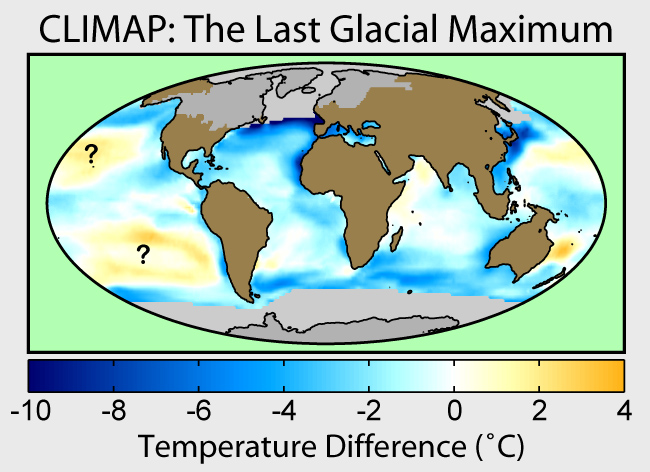
The average global temperature about 21,000 years ago was about 6 °C (11 °F) colder than today. According to the United States Geological Survey (USGS), permanent summer ice covered about 8% of Earth's surface and 25% of the land area during the last glacial maximum. The USGS also states that sea level was about 125 meters (410 ft) lower than in present times (2012). When comparing to the present, the average global temperature was 15 °C (59 °F) for the 2013–2017 period. As of 2012 about 3.1% of Earth's surface and 10.7% of the land area is covered in year-round ice.
Carbon sequestration in the highly stratified and productive Southern Ocean was essential in producing the LGM. The formation of an ice sheet or ice cap requires both prolonged cold and precipitation (snow). Hence, despite having temperatures similar to those of glaciated areas in North America and Europe, East Asia remained unglaciated except at higher elevations. This difference was because the ice sheets in Europe produced extensive anticyclones above them. These anticyclones generated air masses that were so dry on reaching Siberia and Manchuria that precipitation sufficient for the formation of glaciers could never occur (except in Kamchatka where these westerly winds lifted moisture from the Sea of Japan). The relative warmth of the Pacific Ocean due to the shutting down of the Oyashio Current and the presence of large east–west mountain ranges were secondary factors that prevented the development of continental glaciation in Asia.
All over the world, climates at the Last Glacial Maximum were cooler and almost everywhere drier. In extreme cases, such as Southern Australia and the Sahel, rainfall could have been diminished by up to 90% compared to the present, with flora diminished to almost the same degree as in glaciated areas of Europe and North America. Even in less affected regions, rainforest cover was greatly diminished, especially in West Africa where a few refugia were surrounded by tropical grasslands. The Amazon rainforest was split into two large blocks by extensive savanna, and the tropical rainforests of Southeast Asia probably were similarly affected, with deciduous forests expanding in their place except on the east and west extremities of the Sundaland shelf. Only in Central America and the Chocó region of Colombia did tropical rainforests remain substantially intact – probably due to the extraordinarily heavy rainfall of these regions. Most of the world's deserts expanded. Exceptions were in what is the present-day Western United States, where changes in the jet stream brought heavy rain to areas that are now desert and large pluvial lakes formed, the best known being Lake Bonneville in Utah. This also occurred in Afghanistan and Iran, where a major lake formed in the Dasht-e Kavir.
In Australia, shifting sand dunes covered half the continent, while the Chaco and Pampas in South America became similarly dry. Present-day subtropical regions also lost most of their forest cover, notably in eastern Australia, the Atlantic Forest of Brazil, and southern China, where open woodland became dominant due to much drier conditions. In northern China – unglaciated despite its cold climate – a mixture of grassland and tundra prevailed, and even here, the northern limit of tree growth was at least 20° farther south than today. In the period before the LGM, many areas that became completely barren desert were wetter than they are today, notably in southern Australia, where Aboriginal occupation is believed to coincide with a wet period between 40,000 and 60,000 years Before Present (BP). In New Zealand and neighbouring regions of the Pacific, temperatures may have been further depressed during part of the LGM by the world's most recent supervolcanic eruption, the Oruanui eruption, approximately 25,500 years BP.
However, it is estimated that during the LGM, low-to-mid latitude land surfaces at low elevation cooled on average by 5.8 °C relative to their present-day temperatures, based on an analysis of noble gases dissolved in groundwater rather than examinations of species abundances that have been used in the past.
Last Glacial Maximum
The Last Glacial Maximum (LGM), also referred to as the Last Glacial Coldest Period, was the most recent time during the Last Glacial Period where ice sheets were at their greatest extent between 26,000 and 20,000 years ago. Ice sheets covered much of Northern North America, Northern Europe, and Asia and profoundly affected Earth's climate by causing a major expansion of deserts, along with a large drop in sea levels.
Based on changes in position of ice sheet margins dated via terrestrial cosmogenic nuclides and radiocarbon dating, growth of ice sheets in the southern hemisphere commenced 33,000 years ago and maximum coverage has been estimated to have occurred sometime between 26,500 years ago and 20,000 years ago. After this, deglaciation caused an abrupt rise in sea level. Decline of the West Antarctica ice sheet occurred between 14,000 and 15,000 years ago, consistent with evidence for another abrupt rise in the sea level about 14,500 years ago. Glacier fluctuations around the Strait of Magellan suggest the peak in glacial surface area was constrained to between 25,200 and 23,100 years ago.
There are no agreed dates for the beginning and end of the LGM, and researchers select dates depending on their criteria and the data set consulted. Jennifer French, an archeologist specialising in the European Palaeolithic, dates its onset at 27,500 years ago, with ice sheets at their maximum by around 26,000 years ago and deglaciation commencing between 20,000 and 19,000 years ago. The LGM is referred to in Britain as the Dimlington Stadial, dated to between 31,000 and 16,000 years ago.
The average global temperature about 21,000 years ago was about 6 °C (11 °F) colder than today. According to the United States Geological Survey (USGS), permanent summer ice covered about 8% of Earth's surface and 25% of the land area during the last glacial maximum. The USGS also states that sea level was about 125 meters (410 ft) lower than in present times (2012). When comparing to the present, the average global temperature was 15 °C (59 °F) for the 2013–2017 period. As of 2012 about 3.1% of Earth's surface and 10.7% of the land area is covered in year-round ice.
Carbon sequestration in the highly stratified and productive Southern Ocean was essential in producing the LGM. The formation of an ice sheet or ice cap requires both prolonged cold and precipitation (snow). Hence, despite having temperatures similar to those of glaciated areas in North America and Europe, East Asia remained unglaciated except at higher elevations. This difference was because the ice sheets in Europe produced extensive anticyclones above them. These anticyclones generated air masses that were so dry on reaching Siberia and Manchuria that precipitation sufficient for the formation of glaciers could never occur (except in Kamchatka where these westerly winds lifted moisture from the Sea of Japan). The relative warmth of the Pacific Ocean due to the shutting down of the Oyashio Current and the presence of large east–west mountain ranges were secondary factors that prevented the development of continental glaciation in Asia.
All over the world, climates at the Last Glacial Maximum were cooler and almost everywhere drier. In extreme cases, such as Southern Australia and the Sahel, rainfall could have been diminished by up to 90% compared to the present, with flora diminished to almost the same degree as in glaciated areas of Europe and North America. Even in less affected regions, rainforest cover was greatly diminished, especially in West Africa where a few refugia were surrounded by tropical grasslands. The Amazon rainforest was split into two large blocks by extensive savanna, and the tropical rainforests of Southeast Asia probably were similarly affected, with deciduous forests expanding in their place except on the east and west extremities of the Sundaland shelf. Only in Central America and the Chocó region of Colombia did tropical rainforests remain substantially intact – probably due to the extraordinarily heavy rainfall of these regions. Most of the world's deserts expanded. Exceptions were in what is the present-day Western United States, where changes in the jet stream brought heavy rain to areas that are now desert and large pluvial lakes formed, the best known being Lake Bonneville in Utah. This also occurred in Afghanistan and Iran, where a major lake formed in the Dasht-e Kavir.
In Australia, shifting sand dunes covered half the continent, while the Chaco and Pampas in South America became similarly dry. Present-day subtropical regions also lost most of their forest cover, notably in eastern Australia, the Atlantic Forest of Brazil, and southern China, where open woodland became dominant due to much drier conditions. In northern China – unglaciated despite its cold climate – a mixture of grassland and tundra prevailed, and even here, the northern limit of tree growth was at least 20° farther south than today. In the period before the LGM, many areas that became completely barren desert were wetter than they are today, notably in southern Australia, where Aboriginal occupation is believed to coincide with a wet period between 40,000 and 60,000 years Before Present (BP). In New Zealand and neighbouring regions of the Pacific, temperatures may have been further depressed during part of the LGM by the world's most recent supervolcanic eruption, the Oruanui eruption, approximately 25,500 years BP.
However, it is estimated that during the LGM, low-to-mid latitude land surfaces at low elevation cooled on average by 5.8 °C relative to their present-day temperatures, based on an analysis of noble gases dissolved in groundwater rather than examinations of species abundances that have been used in the past.
Recent media
Recent media