Hubbry Logo
ColletColletMain
Open search
Collet
Community hub
Collet
logo
8 pages, 0 posts
0 subscribers
Be the first to start a discussion here.
Contribute something
Collet
Collet
from Wikipedia
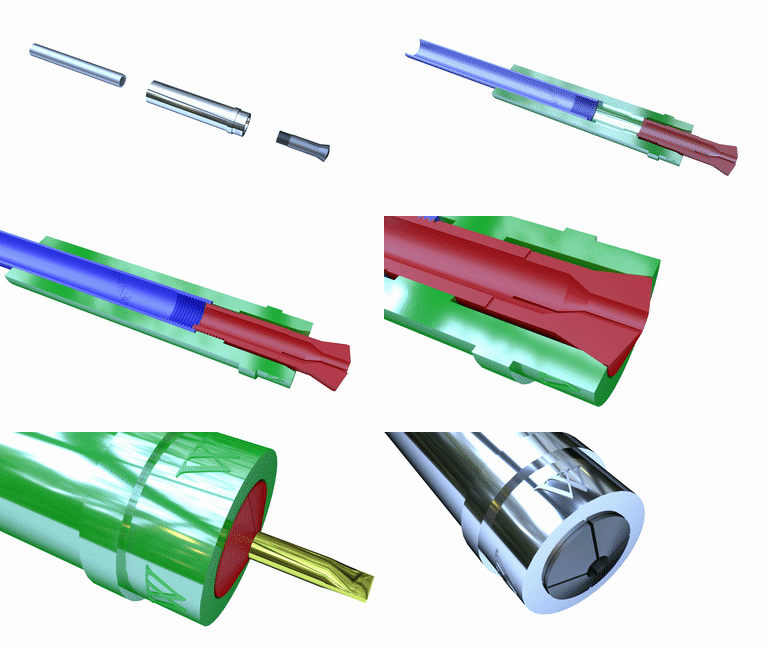
A W-type external-thread collet (red) being pulled into its spindle seat (green) with a drawbar (blue), clamping, rotating and then releasing a shaft.

A collet /ˈkɒlɪt/ is a segmented sleeve, band or collar.[1][2] One of the two radial surfaces of a collet is usually tapered (i.e a truncated cone) and the other is cylindrical. The term collet commonly refers to a type of chuck that uses collets to hold either a workpiece or a tool (such as a drill), but collets have other mechanical applications.

An external collet is a sleeve with a cylindrical inner surface and a conical outer surface. The collet can be squeezed against a matching taper such that its inner surface contracts to a slightly smaller diameter, squeezing the tool or workpiece to hold it securely. Most often the collet is made of spring steel, with one or more kerf cuts along its length to allow it to expand and contract. This type of collet holds the external surface of the tool or workpiece being clamped. This is the most usual type of collet chuck. An external collet clamps against the internal surface or bore of a hollow cylinder. The collet's taper is internal and the collet expands when a corresponding taper is drawn or forced into the collet's internal taper.

As a clamping device, collets are capable of producing a high clamping force and accurate alignment. While the clamping surface of a collet is normally cylindrical, it can be made to accept any defined shape.

Collet chucks for machine tools

[edit]
Several machine collets (top and centre) and a dismantled pin chuck (below).

Generally, a collet chuck,[3] considered as a unit, consists of a tapered receiving sleeve (sometimes integral with the machine spindle), the collet proper (usually made of spring steel) which is inserted into the receiving sleeve, and (often) a cap that screws over the collet, clamping it via another taper.

For machining operations, such as turning, chucks are commonly used to hold the workpiece. The table below gives a functional comparison of the three most common types of chuck used for holding workpieces.

Comparison with different types of chucks
- Collet Scroll chuck Independent-jaw chuck
1. Fast chucking (unclamp one part, switch to a new part, reclamp) Reliably Reliably Generally not
2. Self centering Reliably Reliably Never
3. Strong clamping Reliably[4] Usually Reliably
4. Resistance against being jarred loose (untightened) Reliably[4] To varying extents Usually
5. Precise centering (run-out less than 0.005 in (0.13 mm) TIR and usually less than 0.001 in (0.025 mm)) Reliably[4] Not reliably Reliably (but requires time and skill)

Collets have a narrow clamping range and a large number of collets are required to hold a given range of tools (such as drills) or stock material. This gives the disadvantage of higher capital cost and makes them unsuitable for general usage in electric drills, etc. However, the collet's advantage over other types of chuck is that it combines all of the following traits into one chuck; making it highly useful for repetitive work.

Metalworking

[edit]

There are many types of collet used in the metalworking industry. Common industry-standard designs are R8[5] (internally threaded for mills) and 5C[6] (usually externally threaded for lathes). There are also proprietary designs which only fit one manufacturer's equipment. Collets can range in holding capacity from zero to several inches in diameter. The most common type of collet grips a round bar or tool, but there are collets for square, hexagonal, and other shapes. In addition to the outside-holding collets, there are collets used for holding a part on its inside surface so that it can be machined on the outside surface (similar to an expanding mandrel). Furthermore, it is not uncommon for machinists to make a custom collet to hold any unusual size or shape of part. These are often called emergency collets (e-collets) or soft collets (from the fact that they are bought in a soft (unhardened) state and machined as needed). Yet another type of collet is a step collet which steps up to a larger diameter from the spindle and allows holding of larger workpieces.

In use, the part to be held is inserted into the collet and then the collet is pressed (using a threaded nose cap) or drawn (using a threaded drawbar) into the body which has a conjugate taper form. The taper geometry serves to translate a portion of the axial drawing force into a radial clamping force. When properly tightened, enough force is applied to securely clamp the workpiece or tool. The cap or drawbar threads act as a screw lever, and this leverage is compounded by the taper, such that a modest torque on the screw produces an enormous clamping force.

The precise, symmetric form and rigid material of the collet provide precise, repeatable radial centering and axial concentricity. The basic mechanism fixes four of the six degrees of kinematic freedom, two locations and two angles. Collets may also be fitted to precisely align parts in the axial direction (a fifth degree of freedom) with an adjustable internal stop or by a shoulder stop machined into the internal form. The remaining sixth degree of freedom, namely the rotation of the part in the collet, may be fixed by using square, hexagonal, or other non-circular part geometry.

ER collets

[edit]
ER Collet

The "ER" collet system, developed and patented by Swiss manufacturer Rego-Fix in 1972, and standardized as DIN 6499, is the most widely used tool clamping system in the world and today available from many producers worldwide.[7][8] The standard series are: ER-8, ER-11, ER-16, ER-20, ER-25, ER-32, ER-40, and ER-50. The "ER" name came from an existing "E" collet (which were a letter series of names) which Rego-Fix modified and appended "R" for "Rego-Fix". The series number is the opening diameter of the tapered receptacle, in millimetres. ER collets collapse to hold parts up to 1 mm smaller than the nominal collet internal size in most of the series (up to 2 mm smaller in ER-50, and 0.5 mm in smaller sizes) and are available in 1 mm or 0.5 mm steps. Thus a given collet holds any diameter ranging from its nominal size to its 1-mm-smaller collapsed size, and a full set of ER collets in nominal 1 mm steps fits any possible cylindrical diameter within the capacity of the series. With an ER fixture chuck, ER collets may also serve as workholding fixtures for small parts, in addition to their usual application as toolholders with spindle chucks.[9] Although a metric standard, ER collets with internal inch sizes are widely available for convenient use of imperial sized tooling. The spring geometry of the ER collet is well-suited only to cylindrical parts, and not typically applied to square or hexagonal forms like 5C collets.

Autolock collets

[edit]

"Autolock" collet chucks (Osbourn "Pozi-Lock" is a similar system) were designed to provide secure clamping of milling cutters with only hand tightening. They were developed in the 1940s by a now defunct UK company, Clarkson (Engineers) Limited, and are commonly known as Clarkson chucks. Autolock collets require cutters with threaded shank ends to screw into the collet itself. Any rotation of the cutter forces the collet against the collet cap taper which tightly clamps the cutter, the screw fitting also prevents any tendency of the cutter to pull out. Collets are only available in fixed sizes, imperial or metric, and the cutter shank must be an exact match.[10]

The tightening sequence of Autolock collets is widely misunderstood. The chuck cap itself does not tighten the collet at all, with the cap tight and no tool inserted the collet is loose in the chuck. Only when a cutter is inserted will the collet be pressed against the cap taper. The back of the cutter engages with a centering pin and further turning drives the collet against the chuck cap, tightening around the cutter shank, hence "Autolock".

The correct installation sequence as per the original specification is:

  1. Insert the collet and hand tighten the chuck cap (collet free to float)
  2. Insert the tool and hand tighten (tool engaged with rear pin and collet engaging cap taper)

As the tool is used further rotation tightens the collet and the centering pin ensures that tool extension and alignment remain unchanged. A spanner is only required to release the locked collet.[11]

While threaded shank "Autolock" tools may be gripped by plain collets, such as ER, plain shank tools should never be used in an "Autolock" collet as they will not be properly clamped or aligned.

R8 collets

[edit]
R8 Collets

R8 collets were developed by Bridgeport Machines, Inc. for use in milling machines. Unusually, R8 collets fit into the machine taper itself (i.e. there is no separate chuck) and tools with integral R8 taper can also be directly fitted. R8 was developed to allow rapid tool changes and requires an exact match between collet and tool shank diameter.

R8 collets have a keyway to prevent rotation when fitting or removing, but it is the compressed taper and not the keyway that provides the driving force. Collets are compressed by a drawbar from behind, they are self releasing and tool changes can be automated.

5C collets

[edit]

Unlike most other machine collet systems, 5C collets were developed primarily for work holding. Superficially similar to R8 collets, 5C collets have an external thread at the rear for drawing the collet closed, and so work pieces may pass right through the collet and chuck (5C collets often also have an internal thread for workpiece locating). Collets are also available to hold square and hex stock. 5C collets have a limited closing range, and so shank and collet diameters must be a close match. A number of other C-series collets (1C, 3C, 4C, 5C, 16C, 20C & 25C) with different holding ranges also exist.

A collet system with capabilities similar to the 5C (originally a proprietary system of Hardinge) is the 2J (originally a proprietary system of Sjogren,[12] a competitor of Hardinge, and which Hardinge later assimilated).

From left to right 5C, 2J and 3J collets. All 1" workholding size.

355E Collets

[edit]

The SO Deckel tool grinders use these. Sometimes called U2 collets.

Watchmaker collets

[edit]

Watchmaking at Waltham, Massachusetts led to the invention of collets. Watchmakers' lathes all take collets which are sized by their external thread. The most popular size is 8 mm which came in several variations but all 8 mm collets are interchangeable. Lorch, a German Lathe maker, started with 6 mm collets and the first Boleys used a 6.5 mm collet. 6 mm collets will fit into a 6.5 mm lathe but it is a poor practice. Another popular size is the 10 mm collet used by Clement and Levin. For work holding, collets are sized in 0.1 mm increments with the number on the face being the diameter in tenths of a millimetre. Thus a 5 is a 0.5 mm collet.

Watchmaker collets come in additional configurations. There are step collets which step inward to hold gear wheels by the outer perimeter. These typically were made in sets of five to accommodate a range of different size gear wheels. These, like straight rod-holding collets, close on the outer taper. Ring collets also come in sets of five and hold work from inside a hole. They open as they are tightened by an outside taper against the outer taper of the lathe headstock.

Watch collets also include taper adapters and wax or cement chucks. These collets take an insert, usually brass, to which small parts are cemented, usually with shellac.

The book The Modern Watchmaker's Lathe and How to Use it[13] contains tables of makers and sizes; note that it refers to basic collets as split wire chucks.

DIN 6343 dead length collets

[edit]

These collets are common especially on production machines, particularly European lathes with lever or automated closers. Unlike draw-in collets, they do not pull back to close, but are generally pushed forward, with the face remaining in place.

Multi-size collets

[edit]

Collets allowing a wider range of workholding by means of springs or elastic spacers between jaws; such collets were developed by Jacobs (Rubberflex), Crawford (Multibore), and Pratt Burnerd, and are in some cases compatible with certain spring collet chucks.

Morse taper collets

[edit]

The Morse taper is a common machine taper frequently used in drills, lathes and small milling machines. Chucks for drilling usually use a Morse taper and can be removed to accommodate Morse taper drill bits. Morse taper collet sets usually employ ER collets in an adaptor to suit the Morse taper. The adaptor is threaded to be held in place with a drawbar. They can be used to hold strait-shanked tooling (drills and milling cutters) more securely and with better accuracy (less run-out) than a chuck.

Other applications

[edit]

Woodwork

[edit]

On a wood router (a hand-held or table-mounted power tool used in woodworking), the collet is what holds the bit in place. In the U.S. it is generally for 0.25 or 0.5 inches (6.4 or 12.7 mm) bits, while in Europe bits are most commonly 6, 8 or 12 mm (0.24, 0.31 or 0.47 in). The collet nut is hexagonal on the outside so it can be tightened or loosened with a standard wrench, and has threads on the inside so it can be screwed onto the motor arbor.

Craft hobbies

[edit]

Many users (hobbyists, graphic artists, architects, students, and others) may be familiar with collets as the part of an X-Acto or equivalent knife that holds the blade. Another common example is the collet that holds the bits of a Dremel or equivalent rotary tool.

Semiconductor work

[edit]

In semiconductor industry, a die collet is used for picking a die up from a wafer after die cutting process has finished, and bonding it into a package. Some of them are made with rubber, and use vacuum for picking.

Internal combustion engines

[edit]
Valve, spring, retainer and split collet

Most internal combustion engines use a split collet to hold both the inlet and exhaust valves under constant valve spring pressure which returns the valves to their closed position when the camshaft lobes are not in contact with the top of the valves. The two collet halves have an internal raised rib which locate into a circular groove near the top of each valve stem, the outer side of the collet halves are a taper fit into the spring retainer (also known as a collar), this taper locks the retainer in place and the raised rib that sits in the circular groove on the valve stem also locks the collet halves in place to the valve stem. To remove the valves from a cylinder head a 'valve spring compressor' is used to compress the valve springs by exerting force on the spring retainer which allows the collets to be removed, when the compressor is removed, the retainer, spring and valve can then be removed from the cylinder head. It may be realized that the retainer does not budge when the valve spring compressor is used, this is due to a buildup of carbon which over time has locked the retainer and collets slightly. A slight sharp tap on the backside of the valve spring compressor above the valve stem should free the retainer allowing the springs to be compressed whilst retrieving the split collet. On reassembly it is difficult to keep the split collets in place whilst the compressor is released, by applying a small amount of grease to the internal side of the split collets will keep them in place on the valve stem whilst releasing the compressor, then as the spring retainer rises it locks the tapered split collets in place.

Firearms

[edit]
Schematic of a (straight-pull) collet locked firearm operation

The Blaser R93 (and related models) use a unique bolt locking system that employs an expanding collet. The collet has claw-like L-shaped segments that face outward from the axis of the barrel.[14] The multiple claws give a large contact area to distribute load. As the breech is closed, the collet expands, extending the claws to engaging with an annular groove in the barrel just behind the chamber; locking the bolt closed.[15][16] The Thompson .30-06 prototype used a collet locking operation.[17][18]

See also

[edit]

References

[edit]
[edit]
Revisions and contributorsEdit on WikipediaRead on Wikipedia
from Grokipedia
A collet is a specialized holding device used in machining and manufacturing, consisting of a segmented, tapered sleeve or collar that securely grips a tool, workpiece, or other cylindrical object by applying radial compression force. Typically integrated into a collet chuck on machine tools such as lathes, mills, and grinders, it ensures precise, concentric clamping to minimize runout and vibration during operations like milling, drilling, and reaming. Collets originated in 19th-century watchmaking, with early designs invented around 1865 for holding small wire stock. Collets are distinguished from other chucks by their design, which often features a conical taper on one end that mates with a matching taper in the chuck body, allowing for quick changes and high repeatability in tool or workpiece positioning. Common materials include high-grade spring steel for elasticity and durability under repeated clamping cycles. The most prevalent type is the ER collet, a versatile system standardized under DIN 6499 that accommodates a range of diameters—typically from 1 mm to 27 mm—via interchangeable collets, making it suitable for general-purpose with tools like end mills and drills. Other variants include precision collets like the FPC, which offer ≤ 0.003 mm for high-accuracy applications, and hydraulic or shrink-fit collets that provide uniform pressure distribution for heavy-duty tasks. In addition to metalworking, collets find applications in woodworking, welding (e.g., TIG torches), and even jewelry setting, where they serve as a rim to enclose gems, though the engineering context dominates their usage. Advantages of collets over traditional three-jaw chucks include faster setup times, better balance at high speeds, and reduced tool deflection, though they may require more frequent to prevent on the taper interface. Modern innovations, such as coolant-through designs (e.g., Perfect Seal collets), enhance by directing fluids directly to the cutting zone, improving chip evacuation and tool life.

Introduction

Definition and Function

A collet is a specialized workholding device consisting of a cylindrical, cone-shaped with longitudinal slits along its length and a tapered outer surface, designed to encircle and grip a cylindrical tool shank or workpiece radially when inserted into a matching tapered receptacle within a or spindle. This design allows the collet to function as a subtype of , providing secure, concentric clamping for precision machining operations such as drilling, milling, and reaming. The primary function of a collet is to hold tools or workpieces, such as drill bits or , with high precision and minimal by translating axial force into radial clamping pressure. The clamping action occurs through an axial draw mechanism: a nut or drawbar pulls the collet into the chuck's tapered bore (with taper angles such as 8° for ER collets or 10° for 5C collets), causing the slits to close and the inner diameter to contract uniformly around the object, ensuring even pressure distribution without distortion. This process enables quick insertion and release, facilitating efficient tool changes compared to traditional chucks. Key advantages of collets include exceptional accuracy with often below 0.005 mm, which supports superior concentricity and in machined parts; rapid changeover times that enhance in high-volume setups; and suitability for high-speed operations due to their rigidity and balanced holding force, outperforming jaw chucks in scenarios requiring minimal . General components include the collet body itself, an actuating nut threaded onto the drawbar for manual or automated tightening, and the matching taper in the chuck body to guide the compression. Examples of collet types include ER and 5C, which vary in size range and application but share this core mechanism.

Historical Development

The origins of the collet trace back to the mid-19th century in the watchmaking industry of , where Charles Moseley, foreman of the machine department at the American Watch Company, developed the hollow-spindle with draw-in collets around 1857–1858. These early devices, known as "wire chucks," were designed to precisely hold small wires and components during intricate watch assembly, enabling the high-precision work required for in . Moseley's innovation laid the foundation for collet systems by allowing axial draw-in mechanisms to clamp workpieces without distorting them, a principle that revolutionized precision machining in horology. In the early , collet technology advanced significantly for broader applications, with Hardinge Brothers introducing the 5C collet around 1901 for use in lathes and grinders. This design established new standards for accuracy and versatility, accommodating round, hexagonal, and square stock up to 1-1/16 inches while maintaining repeatability within 0.0005 inches, making it ideal for production environments. The 5C collet's threaded body and tapered sleeve allowed for quick changes and reliable gripping, influencing subsequent collet standards in . Mid-20th-century innovations focused on , exemplified by the 1944 for a quick-engage collet by E.B. Phillips, assigned to Allison Chuck Products, Inc. (US 2,345,069). This lever-action design enabled collets to engage or disengage without stopping the spindle, reducing downtime in continuous operations and supporting wartime production demands. By the late , the ER collet emerged as a pivotal advancement, invented in 1972 by Fritz Weber at REGO-FIX in to address limitations in older E-series collets, such as limited clamping range and rigidity. The ER system's symmetrical slots and 8-degree taper provided superior (under 0.005 mm) and grip force across a wider range, quickly gaining adoption; its standardization as DIN 6499 in 1993 solidified it as the global norm for toolholding. The evolution of collets from the onward reflected the rise of computer numerical control (CNC) machining, with a shift from manual to power-actuated systems integrating hydraulic or pneumatic mechanisms for automated clamping cycles as short as 10 seconds. This transition, driven by CNC adoption in the , enhanced productivity in high-volume by minimizing setup times and enabling unmanned operations. Post-2000 developments emphasized high-speed cutting (HSC) collets, such as HAIMER's Power Collet Chucks, optimized for spindle speeds exceeding 20,000 rpm with and balance grades up to G2.5, supporting precision in and automotive sectors. These advancements prioritize extended tool life and surface finishes under dynamic loads, aligning with modern machining's demands for speed and accuracy.

Operating Principles

Mechanical Design

The mechanical design of a collet relies on a tapered cylindrical body with longitudinal slits to enable controlled radial compression for workpiece gripping. The taper typically features a half-angle of approximately 8° in ER collets, conforming to DIN 6499 standards, while other designs like 5C collets use a 10° half-angle for similar wedge-based contraction. Bore sizing is precisely matched to the nominal workpiece diameter, often with a slight undersize to allow for elastic expansion or contraction within a 0.5–1 mm range depending on the collet type. Collets typically feature multiple longitudinal slits—often 6 to 16 depending on the type and size—from the open end and sometimes the base, providing the necessary flexibility for the collet segments to deform uniformly and produce a full 360° circumferential grip without localized stress concentrations. Actuation occurs through an axial force FF applied via a drawbar, collet nut, or hydraulic mechanism, which engages the tapered collet body against a matching tapered sleeve or nut. This creates a wedge action where the axial force converts to radial clamping FrF_r according to FrF/tan(θ)F_r \approx F / \tan(\theta), with θ\theta as the taper half-angle; the derivation stems from equilibrium on the inclined taper surface, where the normal component perpendicular to the taper yields a radial inward amplified by the inverse tangent of the angle, assuming negligible for simplicity. The effective clamping PP along the contact interface is then P=Fr/(πdl)P = F_r / (\pi d l), where dd is the workpiece and ll is the axial contact ; this arises from distributing the total radial over the cylindrical contact area, providing uniform distribution essential for grip stability. Precision in collet design emphasizes minimization, achieved through symmetrical and balanced slit placement to ensure concentric alignment within 0.005–0.010 total indicator reading (TIR) at the gripping point. Vibration damping is facilitated by the inherent material elasticity, which absorbs dynamic loads and reduces transmitted oscillations during high-speed operations. Collet variations include spring collets, which self-center the workpiece through slight axial pull-back during clamping for improved concentricity, versus dead-length collets that fix the workpiece position axially without movement, enhancing length repeatability to within 0.025 mm for repetitive setups.

Materials and Construction

Collets are primarily constructed from spring steel, such as AISI 1065 or equivalents like 65Mn, valued for its high elasticity and ability to repeatedly grip and release workpieces without permanent deformation. For high-speed machining, collets are employed due to their superior hardness and resistance to abrasion, ensuring prolonged precision under intense operational stresses. In environments susceptible to , such as those involving fluids or humid conditions, collets are preferred for their enhanced resistance to rust and chemical degradation while maintaining necessary flexibility. The manufacturing process begins with precision machining from to form the basic collet shape, followed by to achieve a of 45-50 HRC, which balances , elasticity, and resistance to . Slits that enable radial contraction are typically created using wire (EDM) for hardened materials to minimize distortion, or conventional milling for softer stock. Final grinding ensures taper accuracy and concentricity, with the clamping interface often polished to a of Ra <0.4 μm to minimize friction and promote consistent tool retention. Collets must adhere to quality standards such as ISO 1940-1 for rotational balance, which specifies permissible unbalance levels to prevent vibration during high-speed operations. For maintenance, operators should monitor for wear indicators like increased or bore expansion, which signal reduced gripping force; collets typically last 400-600 hours of use depending on and application intensity, after which replacement is recommended to maintain precision.

Collet Types in Metalworking

ER Collets

ER collets form a widely used spring collet system in precision toolholding, standardized under DIN 6499, which specifies their dimensions and performance criteria for consistent interchangeability across manufacturers. The design incorporates an 8° taper per side (16° included angle) on the collet body, enabling radial compression through a clamping nut that draws the collet into a matching tapered within the toolholder, providing a self-centering grip on cylindrical tool shanks. This elastic deformation allows for a clamping range of 0.5 to 1.5 mm per collet size, depending on the model; for instance, the ER16 system includes collets for tool diameters from 0.5 mm to 10 mm, with each collet covering a clamping range of approximately 1 mm around its nominal size, while larger sizes like ER50 extend to 2 mm of elastic space for broader capacity. Clamping is achieved by applying nut torque values typically ranging from 20 to 50 Nm for smaller sizes such as ER11 (25 Nm) and ER16 (50 Nm), ensuring secure hold without excessive deformation that could compromise accuracy. In modern CNC machining centers, ER collets are primarily employed to hold milling cutters, drills, and taps, leveraging their radial flexibility to minimize runout to less than 3 μm total indicator reading (TIR) in high-precision setups, which enhances tool life and surface finish during operations like high-speed milling and drilling. Available in sizes from ER8 (for tools up to 5 mm) to ER50 (up to 34 mm), the ER32 variant is the most commonly used due to its balance of capacity for tools up to 20 mm and compatibility with standard CNC spindles. Variants include sealed ER collets equipped with rubber O-rings or sealing disks integrated into the nut or collet body, which prevent coolant leakage and direct through-tool coolant flow up to 2,000 PSI, making them suitable for wet machining environments. Despite their versatility, ER collets have limitations in demanding applications; they are not ideal for heavy roughing operations, where higher clamping forces and rigidity are required to withstand substantial radial loads, potentially leading to slippage or accelerated wear under such conditions. Additionally, while capable of high speeds, the system's maximum operational RPM is generally limited to 50,000, beyond which dynamic balancing and specialized nuts become necessary to avoid vibration and imbalance.

5C Collets

The 5C collet system, invented by Hardinge Brothers in 1901, represents a foundational advancement in precision workholding for machinery. Originally developed for lathes, it quickly became a standard for holding small to medium workpieces in mills and grinders due to its robust design and high accuracy. The designation "5C" derives from the Machine Company, which Hardinge acquired early in its history, reflecting the innovative draw-back collet mechanism that enables quick and secure clamping. In terms of mechanical design, 5C collets feature a tapered shank with a 10° angle per side (20° included angle) that mates with a corresponding spindle taper, actuated via a rigid draw-tube for positive closure. This configuration allows for bores in round, square, or hexagonal shapes, with standard capacities ranging from 0.015 inches to 1.0625 inches in diameter for round smooth workpieces, and reduced ranges for hex (up to 7/8 inch) and square (up to 3/4 inch) profiles. Precision-ground construction ensures repeatability within 0.0005 inches total indicator reading (TIR) when used in compatible spindles, making it suitable for demanding operations on small components such as pins, bushings, and fasteners. Primarily applied in and grinder workholding, 5C collets excel in securing cylindrical or prismatic parts for turning, facing, and grinding tasks requiring sub-thousandth precision, often in production environments for and automotive components. Their rigid actuation minimizes deflection under load, supporting spindle speeds up to several thousand RPM while maintaining concentricity for finish-quality surfaces. Variants expand the system's versatility: standard 5C collets cover incremental sizes in 0.001-inch steps, while step collets (marked 5C-SC) accommodate larger diameters up to 2 inches via a stepped bore, ideal for irregular or oversized stock. collets, supplied as blanks, allow users to custom-bore the collet face to exact dimensions, shapes, or depths for one-off or prototype parts without dedicated tooling. Key advantages include exceptional repeatability for , as the tapered interface and internal threads for stops ensure consistent positioning; straightforward loading via draw-tube pull-back reduces setup time compared to jaw chucks; and overall rigidity that supports high-precision operations with minimal . These attributes have sustained the 5C system's popularity in manual and semi-automated for over a century.

R8 Collets

The R8 collet is a precision tool-holding device integral to the spindle of milling machines, featuring a standardized that includes a 7/16-20 UNF drawbar thread for secure retention via the machine's drawbar mechanism. The collet measures 3.500 inches in length, with an internal R8 taper that precisely matches the spindle taper at a rate of 3.5 inches per foot (approximately 16.26 degrees included ), ensuring a self-holding and repeatable fit without slippage under load. Available in sizes from 1/16 inch to 3/4 inch (in increments of 1/16 inch or finer), these collets accommodate a range of tool shank diameters while maintaining tolerances as low as 0.0005 inches for accurate . In applications, R8 collets excel in Bridgeport-style vertical milling machines for clamping end mills, face mills, drills, and reamers, enabling rapid tool changes that reduce downtime compared to traditional chucks. The drawbar pulls the collet into the tapered spindle, compressing the slotted body to grip the tool shank uniformly, which supports high-precision operations in such as contouring, slotting, and with minimal vibration. Variants include the standard R8 collet for typical tool lengths and extended versions, which provide additional reach (up to 25 mm protrusion) for accessing deep features or using longer tools without interference. R8 collet blocks, often used in fixturing setups, adapt the collet for holding workpieces or tools externally to the spindle, enhancing versatility in manual and semi-automated milling tasks. Key limitations of R8 collets include a recommended maximum spindle speed of 3,000 to 5,000 RPM, beyond which centrifugal forces can cause imbalance, tool deflection, or premature wear due to the design's emphasis on low-speed precision. As a result, R8 systems are increasingly phased out in new CNC milling machines in favor of ISO standards (e.g., ISO 30 or ISO 40), which offer higher speed capabilities, better balance, and broader international compatibility for automated production.

Dead-Length and Specialized Collets

Dead-length collets represent a specialized variant in , designed to secure workpieces with a fixed protrusion that eliminates axial movement during clamping, thereby ensuring highly repeatable positioning in turning operations. This feature is particularly valuable in CNC lathes, capstan lathes, and automatic screw machines, where consistent workpiece length is essential to maintain precision across multiple cycles without the need for spacers or adjustments. According to the DIN 6343 standard, these collets incorporate a rigid end-stop mechanism that limits protrusion variation to a maximum of 0.1 mm of the nominal diameter, allowing for smooth bores up to 8 mm while supporting high-speed applications on dividing heads and automatic lathes. Autolock collets, such as those in the Clarkson system, feature a self-locking mechanism that tightens the tool under cutting forces, making them ideal for high-vibration environments like milling operations where traditional collets might loosen. This design enables quick release and insertion of cutters, enhancing efficiency in tool changes while providing reliable grip during dynamic loads. The self-tightening action compensates for operational vibrations, ensuring stable performance in manual and semi-automated setups. For ultra-precision applications, 355E collets adhere to DIN 6341 specifications and are employed in tool grinders and sharpeners for micro-machining tasks, offering hardened and ground construction with tolerances as low as 0.02 mm. These collets, featuring S20 x 2 mm threads, clamp small-diameter workpieces effectively in machines like Deckel or KNUTH SM series, supporting exacting tolerances in grinding and honing. Similarly, watchmaker collets, optimized for Swiss-type lathes, handle bores smaller than 1 mm—down to approximately 0.15 mm—with ground precision to achieve total indicated (TIR) rivaling industry standards of 5 microns or better, facilitating intricate operations in micro-turning and fine wire processing. Multi-size collets, often referred to as adjustable or emergency types, utilize segmented designs that can be custom-bored to accommodate variable diameters within a broad range, such as from 1/16 inch (1.6 mm) to 1 inch (25.4 mm), reducing the need for multiple dedicated collets in versatile setups. These are particularly useful in lathes and mills for prototyping or low-volume production, where flexibility in gripping irregular or non-standard stock is required, though they may have shorter service life compared to precision-ground alternatives. Morse taper collets integrate with Morse taper (MT) shanks, commonly used in drill presses and smaller machine tools, with standard sizes ranging from #0 to #5 to match spindle configurations. These collets provide a self-holding taper for secure tool retention, supporting capacities from fine drills to larger bits while maintaining alignment in vertical machining. Collectively, dead-length and specialized collets offer enhanced repeatability, often achieving 0.001 mm TIR in high-precision setups, which is crucial for automation in turning centers and supports seamless integration with robotic loading systems to minimize setup errors and improve throughput.

Other Applications

Woodworking

In woodworking, collets are primarily adapted for securing router bits, shaper cutters, and small wood stock in machinery such as routers, shapers, drill presses, and lathes, providing precise, concentric clamping to support clean machining operations. These collets feature larger bores compared to many variants, typically ranging from 1/4 inch to 1/2 inch for tool shanks in routers and up to 3/4 inch for holding spindle stock in lathes, allowing compatibility with common woodworking bit diameters and irregular wood pieces. To prevent marring delicate wood surfaces when gripping stock, collet chucks often incorporate soft jaws made from non-marring materials like , which offer flexibility and grip without damaging the workpiece. The 1/4-inch bore remains a standard for most handheld and fixed-base routers due to the prevalence of 1/4-inch shank bits in lighter-duty applications. Key applications include holding router bits in handheld, plunge, or table-mounted routers for tasks like edge profiling, dado cutting, and , where the collet's tight grip minimizes vibration for smoother passes. In spindle shapers, collets secure profile cutters for shaping moldings and intricate edges on boards, often using dedicated 1/4-inch or 1/2-inch collet assemblies that fit larger 1-1/4-inch spindles. For holding small wood stock, collet chucks on lathes provide quick setup for turning pens, spindles, or tool handles, with the collet's radial compression ensuring even pressure distribution around cylindrical or slightly tapered pieces. Quick-change collets, such as cam-lock designs for CNC routers, enable rapid bit swaps—often in seconds with a hex wrench—facilitating efficient production in automated setups like fabrication. When clamping wood stock, is typically limited to 10-20 Nm to avoid excessive that could cause splintering or deformation, particularly with softer woods like or . The primary advantages of collets in lie in their ability to deliver concentric, runout-free holding, which promotes clean cuts with reduced tear-out along , especially in end-grain or figured like or cherry. This precision is particularly valuable in and furniture making, where consistent alignment prevents defects in joints, profiles, and decorative elements, ultimately improving fit and finish quality over less accurate systems.

Craft and Hobby Uses

In craft and hobby applications, collets are integral to portable rotary tools like and Foredom models, where 1/8-inch (3.2 mm) collets securely hold engraving bits, sanding drums, and other small accessories for detailed work. These tools, often used by enthusiasts for their compact size and versatility, enable precise operations such as grinding and polishing without the need for stationary equipment. Collets in these hobby contexts feature miniature bores ranging from 1 mm to 3 mm to accommodate fine-shank bits, constructed from lightweight aluminum for reduced tool weight and improved handling during extended sessions. Quick-twist collet nuts allow for tool-free accessory changes, making them accessible for non-professional users who may switch bits frequently. Designed to withstand high rotational speeds exceeding 20,000 RPM, these collets maintain a firm grip on accessories during , , or tasks. Common applications include jewelry making, where collets secure polishing wheels and carving burs for intricate designs; model aircraft construction, holding cutters for shaping balsa wood or plastics; and PCB drilling, gripping micro-drill bits for creating circuit board holes. In these uses, collets ensure abrasives or cutters remain stable at speeds up to 35,000 RPM, facilitating clean, controlled results in small-scale projects. Variants such as universal collet sets accommodate mixed shank sizes (e.g., 1/32-inch to 1/8-inch), providing flexibility for hobbyists working with diverse accessories without multiple tool purchases. Safety features emphasize secure clamping to prevent bit slippage or ejection, with the collet's spring-loaded design distributing even pressure for reliable performance at high speeds. This stems from early adaptations in precision crafts like watchmaking, where collets evolved to handle delicate, high-RPM tasks safely.

Semiconductor and Precision Electronics

In semiconductor and precision assembly, collets are adapted with advanced materials such as , ceramics, , and to ensure contamination-free holding of delicate components, minimizing particle generation and wear in environments. Vacuum-assisted collets, often functioning as suction nozzles, are employed for secure handling of wafers and dies, providing gentle yet firm grip without physical contact that could cause damage or . These designs incorporate ESD-safe polymers like PEEK for added protection against static buildup during operations. Key applications include die attachment and processes, where micro-collets precisely pick and place dies onto substrates, as well as probing, , and grinding to facilitate electrical testing and chip separation. In (PCB) fabrication, ER-style collets secure drill bits for high-precision hole formation, enabling intricate circuit patterns essential for and microprocessors. These collets integrate seamlessly with robotic handlers and pick-and-place systems, a development prominent since the early , enhancing in high-volume production. Achieving sub-micron precision, these collets maintain below 0.5 μm to support nanoscale alignment in settings, with some variants offering less than 1 μm accuracy for features as small as 0.05 mm. They operate at high speeds up to 100,000 RPM in spindles, ensuring efficient processing without compromising stability, and micro-collets are tailored for handling leads as fine as 0.1 mm in applications.

Internal Combustion Engines

In internal combustion engines, collets primarily serve as valve keepers or locks within the valve train system, securing the spring retainer to the top of the to maintain proper operation under high-speed and high-stress conditions. These components are typically split into two or more tapered sections that fit into circumferential grooves machined on the , with the taper providing a wedging action that locks the retainer in place when the valve spring is released. The design ensures reliable retention during rapid valve cycling, preventing detachment that could lead to catastrophic . High-strength steel is the standard material for valve collets in most automotive applications due to its durability, cost-effectiveness, and ability to withstand mechanical loads, while are preferred in high-performance and engines for their lighter weight and reduced inertia, though they may require surface treatments to mitigate . Bronze or variants are also used in some designs for enhanced resistance in demanding environments. These materials enable collets to operate effectively in temperatures exceeding combustion chamber influences on the , supporting efficiencies in both road and racing contexts. Applications of collets extend to valve train assembly in automotive engines, where they facilitate precise installation and removal during overhauls, and in aerospace-derived high-performance powerplants requiring ultra-reliable valvetrain integrity. In maintenance procedures, specialized tools using magnetic or mechanical collet pickups aid in handling and positioning keepers during spring compression and decompression, minimizing damage to delicate components. Additionally, collet chucks hold cutting tools in CNC machines for engine reconditioning tasks, such as honing cylinder bores to achieve optimal surface finish for piston ring seating or precision turning of crankshaft journals to ensure balanced rotation. Key variants include keeper collets, which feature a tapered split configuration for engagement into the groove upon spring release, allowing quick assembly without additional fasteners. Precision collets are employed in the fabrication of accessories like timing belt pulleys, where they provide concentric holding during to maintain tight tolerances for synchronous drive alignment. The of these split collet designs traces to the 1940s, with early innovations like the 1948 three-section collet unit improving overhaul efficiency in commercial s by automating retention during spring compression. In modern practice, collets support CNC-based customization of components such as pistons, enabling tailored geometries for enhanced combustion efficiency in performance builds.

Firearms and Gunsmithing

In firearms manufacturing and gunsmithing, collets provide precise workholding for barrels, receivers, and actions, enabling accurate operations such as chambering, tenoning, and threading. These tools are essential for maintaining alignment and concentricity during custom builds and repairs, where even minor deviations can affect accuracy and . Design adaptations for collets in this field include heavy-duty constructions to withstand the forces involved in barrel tenoning, where the collet grips the barrel blank firmly to cut the tenon shoulder and threads. Adjustable collets are also employed to fine-tune alignment, allowing gunsmiths to correct bore orientation before cutting grooves. Key applications encompass using collet chucks on lathes for chambering cartridges and threading muzzle devices like suppressors or brakes, ensuring the chamber aligns perfectly with the bore. In milling operations, collet chucks secure receivers for or , minimizing vibration for clean cuts. Specific types include 5C-style collets, which are popular for due to their compatibility with standard spindles and ability to hold round precisely. Custom multi-size collets accommodate varying calibers, from .22 to .50, by offering interchangeable segments for different barrel diameters without rechucking. These collets achieve high precision, ensuring bore concentricity below 0.001 inch, which is critical for consistent flight in —a practice common in precision gunsmithing since the . Dead-length collets may be referenced for repeatable tenon positioning in production runs.

References

Add your contribution
Related Hubs
Contribute something
User Avatar
No comments yet.