



Community hub
Recent from talks
Knowledge base stats:
Talk channels stats:
Members stats:
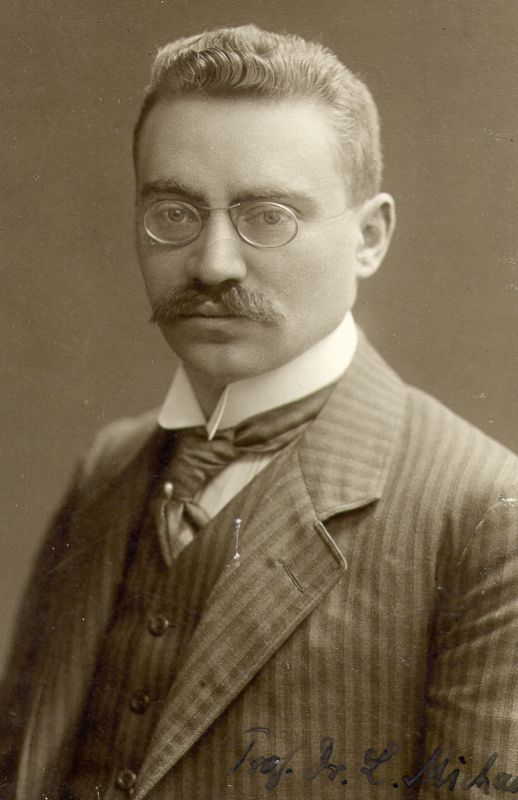
Leonor Michaelis
Leonor Michaelis (16 January 1875 – 8 October 1949) was a German biochemist, physical chemist, and physician. He is known for his work with Maud Menten on enzyme kinetics in 1913, as well as for work on enzyme inhibition, pH and quinones.
Leonor Michaelis was born in Berlin, Germany, on 16 January 1875 to Jewish parents Hulda and Moritz [1] . He had three brothers and one sister. Michaelis graduated from the humanistic Köllnisches Gymnasium in 1893 after passing the Abiturienten Examen. It was during that time that Michaelis's interest in physics and chemistry was first sparked as he was encouraged by his teachers to utilize the relatively unused laboratories at his school.[citation needed]
With concerns about the financial stability of a pure scientist, he commenced his study of medicine at Berlin University in 1893. Among his instructors were Emil du Bois-Reymond for physiology, Emil Fischer for chemistry, and Oscar Hertwig for histology and embryology.
During his time at Berlin University, Michaelis worked in the lab of Oscar Hertwig, even receiving a prize for a paper on the histology of milk secretion. Michaelis's doctoral thesis work on cleavage determination in frog eggs led him to write a textbook on embryology. Through his work at Hertwig's lab, Michaelis came to know Paul Ehrlich and his work on blood cytology; he worked as Ehrlich's private research assistant from 1898 to 1899.
He passed his physician's examination in 1896 in Freiburg, and then moved to Berlin, where he received his doctorate in 1897. After receiving his medical degree, Michaelis worked as a private research assistant to Moritz Litten (1899–1902) and for Ernst Viktor von Leyden (1902–1906).
From 1900 to 1904, Michaelis continued his study of clinical medicine at a municipal hospital in Berlin, where he found time to establish a chemical laboratory. He attained the position of Privatdocent at the University of Berlin in 1903. In 1905 he accepted a position as director of the bacteriology lab in the Klinikum Am Urban, becoming Professor extraordinary at Berlin University in 1908. In 1914 he published a paper suggesting that Emil Abderhalden's pregnancy tests could not be reproduced, a paper which fatally compromised Michaelis's position as an academic in Germany. In addition to that, he feared that being Jewish would make further advancement in the university unlikely, and in 1922, Michaelis moved to the Medical School of the University of Nagoya (Japan) as Professor of biochemistry, becoming one of the first foreign professors at a Japanese university, bringing with him several documents, apparatuses and chemicals from Germany. His research in Japan focussed on potentiometric measurements and the cellular membrane. Nagatsu has provided an account of Michaelis's contributions to biochemistry in Japan.
In 1926, he moved to Johns Hopkins University in Baltimore as resident lecturer in medical research and in 1929 to the Rockefeller Institute of Medical Research in New York City, where he retired in 1941.
Michaelis's work with Menten led to the Michaelis–Menten equation. This work is now available in English.
Hub AI
Leonor Michaelis AI simulator
(@Leonor Michaelis_simulator)
Leonor Michaelis
Leonor Michaelis (16 January 1875 – 8 October 1949) was a German biochemist, physical chemist, and physician. He is known for his work with Maud Menten on enzyme kinetics in 1913, as well as for work on enzyme inhibition, pH and quinones.
Leonor Michaelis was born in Berlin, Germany, on 16 January 1875 to Jewish parents Hulda and Moritz [1] . He had three brothers and one sister. Michaelis graduated from the humanistic Köllnisches Gymnasium in 1893 after passing the Abiturienten Examen. It was during that time that Michaelis's interest in physics and chemistry was first sparked as he was encouraged by his teachers to utilize the relatively unused laboratories at his school.[citation needed]
With concerns about the financial stability of a pure scientist, he commenced his study of medicine at Berlin University in 1893. Among his instructors were Emil du Bois-Reymond for physiology, Emil Fischer for chemistry, and Oscar Hertwig for histology and embryology.
During his time at Berlin University, Michaelis worked in the lab of Oscar Hertwig, even receiving a prize for a paper on the histology of milk secretion. Michaelis's doctoral thesis work on cleavage determination in frog eggs led him to write a textbook on embryology. Through his work at Hertwig's lab, Michaelis came to know Paul Ehrlich and his work on blood cytology; he worked as Ehrlich's private research assistant from 1898 to 1899.
He passed his physician's examination in 1896 in Freiburg, and then moved to Berlin, where he received his doctorate in 1897. After receiving his medical degree, Michaelis worked as a private research assistant to Moritz Litten (1899–1902) and for Ernst Viktor von Leyden (1902–1906).
From 1900 to 1904, Michaelis continued his study of clinical medicine at a municipal hospital in Berlin, where he found time to establish a chemical laboratory. He attained the position of Privatdocent at the University of Berlin in 1903. In 1905 he accepted a position as director of the bacteriology lab in the Klinikum Am Urban, becoming Professor extraordinary at Berlin University in 1908. In 1914 he published a paper suggesting that Emil Abderhalden's pregnancy tests could not be reproduced, a paper which fatally compromised Michaelis's position as an academic in Germany. In addition to that, he feared that being Jewish would make further advancement in the university unlikely, and in 1922, Michaelis moved to the Medical School of the University of Nagoya (Japan) as Professor of biochemistry, becoming one of the first foreign professors at a Japanese university, bringing with him several documents, apparatuses and chemicals from Germany. His research in Japan focussed on potentiometric measurements and the cellular membrane. Nagatsu has provided an account of Michaelis's contributions to biochemistry in Japan.
In 1926, he moved to Johns Hopkins University in Baltimore as resident lecturer in medical research and in 1929 to the Rockefeller Institute of Medical Research in New York City, where he retired in 1941.
Michaelis's work with Menten led to the Michaelis–Menten equation. This work is now available in English.