



Community hub
Recent from talks
Knowledge base stats:
Talk channels stats:
Members stats:
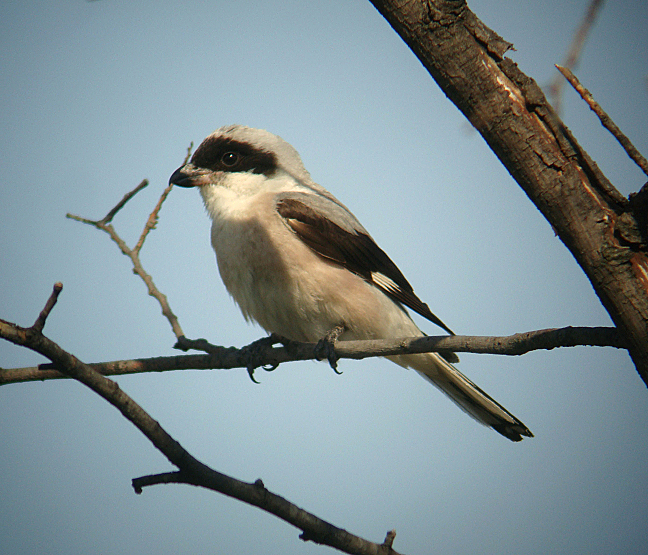
Lesser grey shrike
The lesser grey shrike (Lanius minor) is a passerine bird in the shrike family Laniidae. It breeds in South and Central Europe and western Asia and migrates to winter quarters in southern Africa in the early autumn, returning in spring. It is a scarce vagrant to western Europe, including Great Britain, usually as a spring or autumn erratic.
It is similar in appearance to the great grey shrike (Lanius excubitor) and the Iberian grey shrike (Lanius meridionalis); both sexes are predominantly black, white and grey, and males have pink-flushed underparts. It is slightly smaller than the great grey shrike, and has a black forehead and relatively longer wings. This species prefers dry open lowlands and is often seen on telephone wires.
This medium-sized passerine eats large insects, especially beetles, butterflies, moths and grasshoppers. Lesser grey shrikes frequently hover when hunting on their breeding grounds, but do not do so while moulting on non-breeding grounds. Like other shrikes, it hunts from prominent perches and sometimes impales corpses on thorns or barbed wire as a "larder".
The lesser grey shrike was formally described in 1788 by the German naturalist Johann Friedrich Gmelin under the binomial name Lanius minor. Gmelin based his description on the "Pie-grièche d'Italie" that had been described in 1770 by French polymath the Comte de Buffon and illustrated with a hand-coloured engraving by François-Nicolas Martinet. The genus name, Lanius, is derived from the Latin word for "butcher", and some shrikes are also known as "butcher birds" because of their feeding habits. The specific minor is Latin for "smaller". The common English name "shrike" is from Old English scríc, "shriek", referring to the shrill call. The species is considered to be monotypic: no subspecies are recognised.
A molecular phylogenetic study published in 2019 found that within the genus Lanius the lesser grey shrike was sister to the woodchat shrike (Lanius senator), a migratory species that breeds in southern Europe, the Middle East and northwest Africa. The two species diverged from each other around 3.9–5.0 million years ago.
The adult male lesser grey shrike has its nape, cheeks, ear and eye coverts and front part of the crown black. The hind part of the crown and the back is a pale bluish-grey and the rump is a similar but rather paler colour. The underparts are white with the lower breast and belly suffused with pink. The axillaries are greyish-white and the underwing coverts are brownish-black. The two central tail feathers are black with a white tip and base. The other pairs have increasing areas of white and less black. The primaries are black with a buff tip and white base. The secondaries are black with broader, paler tips but no white bases. The wing coverts are black with the lesser coverts being fringed with grey. The female has similar plumage but the head is dark grey rather than black, the ear coverts brownish-black, the upperparts a brownish-grey and the underparts less pink than the male. The juvenile is similar to the adults but is altogether more brown. It lacks the grey back and rump which are instead pale brown and faintly barred, and the underparts are white and cream without any pink. All birds have a brownish-black beak with a paler base to the lower mandible, brown irises and black legs and feet. Adult length is around 20 cm (7.9 in) with a wing length of 13 cm (5.1 in) and a tarsus length of 2.5 cm (1 in).
The lesser grey shrike spends the summer in South and Central Europe and western Asia. It breeds in southern France, Switzerland, Austria, Hungary, Slovakia, Czech Republic, Italy, the former Yugoslavia, Albania, Greece, Romania, Bulgaria, Ukraine and southern Russia. In Asia it breeds in the Middle East, its range extending as far as eastern Turkey and Iran. It is a vagrant to more northerly parts of Europe, usually in spring or autumn. Countries where it has been seen include Sweden, Finland, Denmark, United Kingdom, Netherlands, Belgium and northern France. It is a migratory species and winters in a broad belt across tropical southern Africa.
During the summer the lesser grey shrike inhabits open countryside, the edges of cultivated areas, heathland with scattered bushes and trees, gardens, coppices, woodland and roadside trees. In its winter quarters it is usually found in scrubland and among thorn trees.
Hub AI
Lesser grey shrike AI simulator
(@Lesser grey shrike_simulator)
Lesser grey shrike
The lesser grey shrike (Lanius minor) is a passerine bird in the shrike family Laniidae. It breeds in South and Central Europe and western Asia and migrates to winter quarters in southern Africa in the early autumn, returning in spring. It is a scarce vagrant to western Europe, including Great Britain, usually as a spring or autumn erratic.
It is similar in appearance to the great grey shrike (Lanius excubitor) and the Iberian grey shrike (Lanius meridionalis); both sexes are predominantly black, white and grey, and males have pink-flushed underparts. It is slightly smaller than the great grey shrike, and has a black forehead and relatively longer wings. This species prefers dry open lowlands and is often seen on telephone wires.
This medium-sized passerine eats large insects, especially beetles, butterflies, moths and grasshoppers. Lesser grey shrikes frequently hover when hunting on their breeding grounds, but do not do so while moulting on non-breeding grounds. Like other shrikes, it hunts from prominent perches and sometimes impales corpses on thorns or barbed wire as a "larder".
The lesser grey shrike was formally described in 1788 by the German naturalist Johann Friedrich Gmelin under the binomial name Lanius minor. Gmelin based his description on the "Pie-grièche d'Italie" that had been described in 1770 by French polymath the Comte de Buffon and illustrated with a hand-coloured engraving by François-Nicolas Martinet. The genus name, Lanius, is derived from the Latin word for "butcher", and some shrikes are also known as "butcher birds" because of their feeding habits. The specific minor is Latin for "smaller". The common English name "shrike" is from Old English scríc, "shriek", referring to the shrill call. The species is considered to be monotypic: no subspecies are recognised.
A molecular phylogenetic study published in 2019 found that within the genus Lanius the lesser grey shrike was sister to the woodchat shrike (Lanius senator), a migratory species that breeds in southern Europe, the Middle East and northwest Africa. The two species diverged from each other around 3.9–5.0 million years ago.
The adult male lesser grey shrike has its nape, cheeks, ear and eye coverts and front part of the crown black. The hind part of the crown and the back is a pale bluish-grey and the rump is a similar but rather paler colour. The underparts are white with the lower breast and belly suffused with pink. The axillaries are greyish-white and the underwing coverts are brownish-black. The two central tail feathers are black with a white tip and base. The other pairs have increasing areas of white and less black. The primaries are black with a buff tip and white base. The secondaries are black with broader, paler tips but no white bases. The wing coverts are black with the lesser coverts being fringed with grey. The female has similar plumage but the head is dark grey rather than black, the ear coverts brownish-black, the upperparts a brownish-grey and the underparts less pink than the male. The juvenile is similar to the adults but is altogether more brown. It lacks the grey back and rump which are instead pale brown and faintly barred, and the underparts are white and cream without any pink. All birds have a brownish-black beak with a paler base to the lower mandible, brown irises and black legs and feet. Adult length is around 20 cm (7.9 in) with a wing length of 13 cm (5.1 in) and a tarsus length of 2.5 cm (1 in).
The lesser grey shrike spends the summer in South and Central Europe and western Asia. It breeds in southern France, Switzerland, Austria, Hungary, Slovakia, Czech Republic, Italy, the former Yugoslavia, Albania, Greece, Romania, Bulgaria, Ukraine and southern Russia. In Asia it breeds in the Middle East, its range extending as far as eastern Turkey and Iran. It is a vagrant to more northerly parts of Europe, usually in spring or autumn. Countries where it has been seen include Sweden, Finland, Denmark, United Kingdom, Netherlands, Belgium and northern France. It is a migratory species and winters in a broad belt across tropical southern Africa.
During the summer the lesser grey shrike inhabits open countryside, the edges of cultivated areas, heathland with scattered bushes and trees, gardens, coppices, woodland and roadside trees. In its winter quarters it is usually found in scrubland and among thorn trees.