Hubbry Logo
KosKosMain
Open search
Kos
Community hub
Kos
logo
8 pages, 0 posts
0 subscribers
Be the first to start a discussion here.
Contribute something
Kos
Kos
from Wikipedia

Kos or Cos (/kɒs, kɔːs/; Greek: Κως [kos]) is a Greek island, which is part of the Dodecanese island chain in the southeastern Aegean Sea. Kos is the third largest island of the Dodecanese, after Rhodes and Karpathos; it has a population of 37,089 (2021 census), making it the second most populous of the Dodecanese after Rhodes.[1] The island measures 42.1 by 11.5 kilometres (26 by 7 miles).[2] Administratively, Kos constitutes a municipality within the Kos regional unit, which is part of the South Aegean region. The principal town of the island and seat of the municipality is the town of Kos.[3]

Key Information

Name

[edit]

The name Kos (Ancient Greek: Κῶς)[4] is first attested in the Iliad, and has been in continuous use since. Other ancient names include Meropis,[5] Cea,[6] and Nymphaea.[7]

In many Romance languages, Kos was formerly known as Stancho, Stanchio, or Stinco, and in Turkish it is known as İstanköy (Ottoman Turkish: استانكوی), all from the reinterpretation of the Greek expression εις την Κω 'to Kos';[8][9] cf. the similar Istanbul and Stimpoli, Crete. Under the rule of the Knights Hospitaller of Rhodes, it was known as Lango or Langò, presumably because of its length.[10][11] In The Travels of Sir John Mandeville, the author misunderstands this and treats Lango and Kos as distinct islands.[12] In Italian, the island is known as Coo.

A person from Kos is called a "Koan" (or "Coan") in English. The word is also an adjective, as in "Koan goods".[13]

Geography

[edit]

Kos is in the Aegean Sea, at the entrance to the Gulf of Gökova, across from Bodrum, Turkey. Its coastline is 112 kilometres (70 miles) long, extending from west to east.

The island has several promontories, some with names known in antiquity: Cape Skandari, anciently Scandarium or Skandarion in the northeast;[14] Cape Lacter or Lakter in the south;[15] and Cape Drecanum or Drekanon in the west.[16]

In addition to the main town and port, also called Kos, the main villages of Kos island are Kardamena, Kefalos, Tingaki, Antimachia, Mastihari, Marmari and Pyli. Smaller ones are Zia, Zipari, Platani, Lagoudi and Asfendiou.

Climate

[edit]

Kos has a hot-summer Mediterranean climate.

Climate data for Kos Sewage Plant weather station (37m)
Month Jan Feb Mar Apr May Jun Jul Aug Sep Oct Nov Dec Year
Mean daily maximum °C (°F) 14.3
(57.7)
15.5
(59.9)
17.6
(63.7)
20
(68)
25
(77)
28.5
(83.3)
30.4
(86.7)
31
(88)
28.5
(83.3)
25.7
(78.3)
21.1
(70.0)
17.4
(63.3)
22.9
(73.3)
Mean daily minimum °C (°F) 9
(48)
10.1
(50.2)
11.2
(52.2)
12.9
(55.2)
16.8
(62.2)
20.9
(69.6)
23.5
(74.3)
24
(75)
22.2
(72.0)
19.6
(67.3)
15.6
(60.1)
12.3
(54.1)
16.5
(61.7)
Average precipitation mm (inches) 214.7
(8.45)
82.3
(3.24)
68.2
(2.69)
40.6
(1.60)
7.2
(0.28)
13.8
(0.54)
0
(0)
0
(0)
5.2
(0.20)
36.3
(1.43)
106
(4.2)
175.6
(6.91)
749.9
(29.54)
Source: http://penteli.meteo.gr/stations/kos/ (2019 - 2020 averages)

Municipality

[edit]
Detailed map of Kos, Rhodes and environs

The present municipality of Kos was created in 2011 with the merger of three municipalities, which became municipal units:[3]

The municipality has an area of 290,313 km2, and has a municipal unit of 67.200 km2.[17]

Economy

[edit]

Tourism is the main industry in Kos,[18] the island's beaches being the primary attraction. The main port and population centre on the island, Kos town, is also a tourist and cultural centre, with whitewashed buildings including many hotels, restaurants and a number of nightclubs forming the town's "bar street". The seaside village of Kardamena is a popular resort for young holidaymakers (primarily from the United Kingdom and Scandinavia) and has a large number of bars and nightclubs.

The last decade has seen a significant growth in the number of luxury hotels. While one-star and two-star hotels have decreased, four-star and five-star luxury hotels have sprung up throughout the island. From 2014 to 2023, five-star hotels have practically doubled, both in units (+95.83%) and in total beds (+103.32%). Significant but smaller, is the increase of four-star hotels, both in units (+34.15%) and in total beds (+8.5%).[19]

Farming is the second principal occupation, with the main crops being grapes, almonds, figs, watermelons, olives, and tomatoes, along with wheat and corn.[20][21] Cos lettuce (romaine lettuce) is named after the island, from where it is said to have originated.[22][23]

History

[edit]
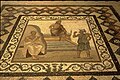
An Ancient Roman mosaic depicting the Abduction of Europa in the House of Europa in the Western Archaeological Zone of Kos town.
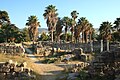
Ruins of the Ancient Gymnasion
View of the ancient Odeon (heavily restored)
Nerantzia Castle (Hospitalier period)

Mythological origins

[edit]

In Homer's Iliad, a contingent of Koans fought for the Greeks in the Trojan War.[24]

In classical mythology the founder-king of Kos was Merops, hence "Meropian Kos" is included in the archaic Delian amphictyony listed in the 7th-century Homeric hymn to Delian Apollo; the island was visited by Heracles.[25] Kos was said to be the birthplace of the goddess Leto; the mother of Apollo.[26] Supposedly Leto's father Coeus was the first inhabitant of the island.[27]

The island was supposedly colonised by the Carians, but Dorians invaded it in the 11th century BC, establishing a Dorian colony with a large contingent of settlers from Epidaurus, whose Asclepius cult made their new home famous for its sanatoria.[citation needed]

Archaic Era

[edit]

Its early history – as part of the religious-political amphictyonic league that included Lindos, Kamiros, Ialysos, Knidos and Halicarnassus, the Doric Hexapolis (hexapolis means 'six cities' in Greek),[28] – is obscure. At the end of the 6th century, Kos fell under Achaemenid domination but rebelled after the Greek victory at the Battle of Mycale in 479. Archaeological finds have shown the existence of a small shrine to Hemera and Helios; gods of the day and the sun respectively.[29]

Classical Era

[edit]

During the Greco-Persian Wars, before it twice expelled the Persians, Kos was ruled by Persian-appointed tyrants, but as a rule it seems to have been under oligarchic government. In the 5th century, it joined the Delian League, and, after the revolt of Rhodes, it served as the chief Athenian station in the south-eastern Aegean (411–407 BC). In 366 BC, a democracy was instituted and the capital was transferred from Astypalaea (at the west end of the island near the modern village of Kefalos) to the newly built town of Cos, laid out in a Hippodamian grid. After helping to weaken Athenian power, in the Social War (357–355 BC), it fell for a few years to king Mausolus of Caria.

Proximity to the east gave the island first access to imported silk thread. Aristotle mentions silk weaving conducted by the women of the island.[30] Silk production of garments was conducted in large factories by female slaves.[31]

Coae vestes

[edit]

Older research believed that the island was known in antiquity for the manufacture of transparent light dresses, the coae vestes.[32] This view goes back to Aristotle, and it has been challenged by modern research. The term Coae vestes seems to refer to a type of silk garment and not the site of production (the island of Kos). The origin of the term is ultimately unclear.[33]

Hellenistic Era

[edit]
View of the Asclepeion

During the course of the Fourth War of the Diadochi Ptolemy I Soter captured Kos from Antigonus I Monophthalmus, incorporating it into his kingdom.[34] In the Hellenistic period, Kos attained the zenith of its prosperity. Kos was valued by the Ptolemies, who used it as a naval outpost to oversee the Aegean. As a seat of learning, it arose as a provincial branch of the museum of Alexandria, and became a favourite resort for the education of the princes of the Ptolemaic dynasty. During the Hellenistic age, there was a medical school; however, the theory that this school was founded by Hippocrates (see below) during the Classical age is an unwarranted extrapolation.[35] It was the home of the major Hellenistic poet-scholar Philitas.

Despite the incorporation of Kos into the Ptolemaic Kingdom, the island kept its political autonomy (shown in a 3rd-century BC decree found at Kos).[36][37] The island was ruled autonomously through to its citizens assembly and magistrates (the monarch, the prostates, the exegetes, etc.). The fact that the city could legislate and apply its own laws shows political independence from the Ptolemaic Kingdom. The city-state remained in control of its political institutions and civil rights.[citation needed]

Kos also became a center of production of unrefined silk, oars and amphorae.[38] Kos economic development during the period can further be exemplified by the 3rd- and 2nd-century BC construction of a theatre, a new market with multiple stoas, a temple to Apollo at Alisarna, construction and expansion of the Asclepeion, fortification works at Alisarna and multiple richly decorated houses.[39] In 240 BC, Ziaelas of Bithynia, Seleucus II Callinicus and Ptolemy III Euergetes provided guarantees for the transformation of Kos Asclepeion into an asylum. This decision made Kos a more attractive destination for merchants and pilgrims.[40]

Kos had a strong reputation for justice from the late fourth century BC and was called on more frequently than any other city in the Hellenistic period to provide judges for the arbitration of disputes between and within other cities. Between 310 and 300 BC, Kos arbitrated a dispute between Klazomenai and Teos, provided a temporary law code for the synoecism of Teos and Lebedus, and accepted requests to send judges to resolve internal disputes at Ilium, Samos, and Telos.[41] In the following two centuries, they accepted further requests to send judges to Naxos, Thasos, Erythrae, Mytilene, and four cities whose names are not preserved.[42] The Koan settlement of the dispute at Telos is recorded in an inscription (IG XII.4.1 132); one of the most detailed surviving records of foreign judges activities in the Hellenistic period.[43][44] This judgement, drawing on Koan religious and financial regulations, allowed a group convicted of political crimes to pay off their fines and be reconciled with the wider community by paying for sacrifices and repairs to temples.[45]

Diodorus Siculus (xv. 76) and Strabo (xiv. 657) describe it as a well-fortified port. Its position gave it a high importance in Aegean trade; while the island itself was rich in wines of considerable fame.[46] Under Alexander the Great and the Ptolemies the town developed into one of the great centers in the Aegean; Josephus[47] quotes Strabo to the effect that Mithridates I of the Bosporus was sent to Kos to fetch the gold deposited there by queen Cleopatra of Egypt. Herod is said to have provided an annual stipend for the benefit of prize-winners in the athletic games,[48] and a statue was erected there to his son Herod the Tetrarch ("C. I. G." 2502 ). Paul briefly visited Kos according to Acts 21:1.

Roman Era

[edit]

Except for occasional incursions by corsairs and some severe earthquakes, the island's peace was rarely disturbed. Following the lead of its larger neighbour, Rhodes, Kos generally displayed a friendly attitude toward the Romans; in 53 AD it was made a free city. The island of Kos also featured a provincial library during the Roman period. The island first became a center for learning during the Ptolemaic dynasty, and Hippocrates, Apelles, Philitas and possibly Theocritus came from the area. An inscription lists people who made contributions to build the library in the 1st century AD.[49] One of the people responsible for the library's construction was the Koan physician Gaius Stertinius Xenophon, who lived in Rome and was the personal physician of the Emperors Tiberius, Claudius, and Nero.[50]

Herod, king of Judaea, ensured the perpetual funding for the gymnasiarch's annual office on Kos. An inscription from the assembly of the island, dating around 14 BC, honours Gaius Iulius Herodes, affirming Herod's adoption of the Roman tria nomina; possibly relating to this financial support or another endowment.[51]

Byzantine Era

[edit]

The bishopric of Kos was a suffragan of the metropolitan see of Rhodes.[52] Its bishop Meliphron attended the First Council of Nicaea in 325. Eddesius was one of the minority Eastern bishops who withdrew from the Council of Sardica in about 344 and set up a rival council at Philippopolis. Iulianus went to the synod held in Constantinople in 448 in preparation for the Council of Chalcedon of 451, in which he participated as a legate of Pope Leo I, and he was a signatory of the joint letter that the bishops of the Roman province of Insulae sent in 458 to Byzantine Emperor Leo I the Thracian with regard to the killing of Proterius of Alexandria. Dorotheus took part in a synod in 518. Georgius was a participant of the Third Council of Constantinople in 680–681. Constantinus went to the Photian Council of Constantinople (879).[53][54] Under Byzantine rule, apart from the participation of its bishops in councils, the island's history remains obscure. It was governed by a droungarios in the 8th–9th centuries, and seems to have acquired some importance in the 11th and 12th centuries: Nikephoros Melissenos began his uprising here, and in the middle of the 12th century, it was governed by a scion of the ruling Komnenos dynasty, Nikephoros Komnenos.[52]

Today the ecclesiastical metropolis of Kos remains under the direct authority of the Patriarchate of Constantinople, rather than the Church of Greece, and is also listed by the Catholic Church as a titular see.[55]

Genoese Era

[edit]
15th-century map by Cristoforo Buondelmonti

Following the 11th century, Kos passed under Genoese control, although it was a Byzantine territory and kept for a while by the Empire of Nicaea. Genoese ruled as protectorate and lasted over four centuries.[52] In the 1320s, Kos nominally formed a part of the realm of Genoese Vignolo de Vignoli. The Knights Hospitaller were hosted over the island paying a rent to Genoese republic.[52] From the 14th century onwards the island experienced raids of Turkish corsairs. During this period two towers were built in the southeast and southwest sections of the castle during the raids of Yıldırım Bayezid between 1391 and 1396. Kos faced its first serious Ottoman attack in 1455. The navy under the command of Hamza Bey attacked the island, besieged and destroyed the Andimacheia Castle.[9] The last Hospitaller governor of the island was Piero de Ponte.

Ottoman Era

[edit]

During the conquest of Rhodes in 1522, it was surrendered to the Ottomans due to the terms of the agreement. When Captain Behram Bey arrived in front of Kos and Bodrum, the castle guards handed over the castle to him and left, and this news reached the camp on 17 Safer 929 (5 January 1523). As soon as the island was taken, a qadi, a castellan and guards were sent to the largest and fortified castle, Nerantzia, which was repaired. The Greek Orthodox people of the island were left in their places and their residence was provided in the suburbs outside the castle.[9]

During the course of the Orlov revolt, a Russian fleet anchored off the Kos castle. On the night of 5 August 1773, the Russians dispatched a landing party intending to capture the castle. They suffered heavy casualties in the ensuing battle. The Russian ships departed Kos two days later, having failed to achieve their objective.[56]

According to the Ottoman General Census of 1881/82–1893, the kaza of İstanköy (استانكوی)[57] had a total population of 12,965, consisting of 10,459 Greeks, 2,439 Muslims and 67 Jews.[58] The island was occupied by the Kingdom of Italy on 20 May 1912.[9]

Italian Rule and WWII

[edit]

Kos was transferred to the Kingdom of Italy in 1912 after the Italo-Turkish War.[59] The Italians developed the infrastructures of the island, after the ruinous earthquake of 23 April 1933, which destroyed a great part of the old city and damaged many new buildings. Architect Rodolfo Petracco drew up the new city plan, transforming the old quarters into an archaeological park, and dividing the new city into a residential, an administrative, and a commercial area.[60]

In World War II, the island, as an Italian possession, was controlled by the Axis, until the Italians surrendered in 1943.[61] British and German forces then clashed for control of the island in the Battle of Kos as part of the Dodecanese Campaign, in which the Germans were victorious. Following the battle, 100 Italian officers who had refused to join the Germans were executed in what became known as the Massacre of Kos. German troops occupied the island until 1945, when it became a protectorate of the United Kingdom, which ceded it to the Kingdom of Greece in 1947 following the Paris Peace Treaty.

Contemporary

[edit]

There is a Closed Controlled Access Centre (CCAC), i.e. a refugee camp, with a stated capacity of 2,140.[62] It is one of a number on Greek islands.

Geology

[edit]

The island is part of a chain of mountains from which it became separated after earthquakes and subsidence that occurred in ancient times. The remnants of these mountains include the islands of Kalymnos and Kappari which are separated by an underwater chasm approximately 70 metres (230 ft; 38 fathoms) deep, as well as the volcano of Nisyros and the surrounding islands.

There is a wide variety of rocks in Kos which is related to its geographical formation. Prominent among these are the Quaternary layers in which the fossil remains of mammals such as horses, hippopotami and elephants have been found. The fossilised molar of an elephant of gigantic proportions was presented to the Paleontology Museum of the University of Athens.

Religion

[edit]
Gazi Hasan Pasha Mosque in Kos
Orthodox Cathedral of Kos

The people of Kos are predominantly Orthodox Christians; one of the four Orthodox cathedrals in the Dodecanese is located in Kos. In addition, there is a Roman Catholic church on the island and a mosque for the Turkish Muslim community. The synagogue is no longer used for religious ceremonies, as the Jewish community of Kos was targeted and destroyed by occupying German forces in World War II. It has, however, been restored and is maintained with all religious symbols intact, and is now used by the Municipality of Kos for various events, mainly cultural.

In the late 1920s, about 3,700 Turks lived in Kos city; slightly less than 50% of the population, who were mainly in the west part of the city. Today, the population of the Turkish community in Kos has been estimated at 2,000 people. A village with a significant Turkish population is Platani (Kermentes), near the town of Kos.

Main sights

[edit]

Ancient sites

[edit]

The ancient physician Hippocrates is thought to have been born in Kos, and in the center of the town is the Plane Tree of Hippocrates; a dream temple where the physician is traditionally supposed to have taught. The limbs of the now elderly tree are supported by scaffolding. The small city is also home to the International Hippocratic Foundation of Kos, and the Hippocratic Museum dedicated to him. Near the institute are the ruins of Asklepieion, where Herodicus taught Hippocrates medicine.

View of the municipal market, built in 1934–1935 by architect Rodolfo Petracco.

The ancient market place of Kos was considered one of the biggest in the ancient world. It was the commercial and commanding centre at the heart of the ancient city. It was organised around a rectangular yard 50 metres (160 ft) wide and 300 metres (980 ft) long. It began in the Northern area and ended south on the central road (Decumanus) which went through the city. The northern side connected to the city wall towards the entrance to the harbour. Here there was a monumental entrance. On the eastern side there were shops. In the first half of the 2nd century BC, the building was extended toward the interior yard. The building was destroyed in an earthquake in 469 AD.

In the southern end of the market, there was a round building with a Roman dome and a workshop which produced pigments including Egyptian Blue. Coins, treasures, and copper statues from Roman times were later uncovered by archaeologists. In the western side excavations led to the findings of rooms with mosaic floors which showed beastfights, a theme popular in Kos.[63]

Castles

[edit]
The Byzantine Antimachia Castle

The island has a 14th-century fortress at the entrance to its harbour, erected in 1315 by the Knights Hospitaller, and another from the Byzantine period in Antimachia.

Synagogue

[edit]
The synagogue Kahal Shalom designed by architects Armando Bernabiti and Rodolfo Petracco in 1935.

The synagogue Kahal Shalom of Kos, on 4, Alexandrou Diakou street in the historic city center, was built in 1935.[64] It was designed by architects Armando Bernabiti and Rodolfo Petracco, and was built by the construction company 'De Martis-Sardelli'.[65] The synagogue complex includes the synagogue and the adjacent rabbi's residence, today housing the offices of the organisation 'Hippocrates'. The Jewish community of Kos dates from antiquity. An older synagogue was destroyed in the earthquake of 13 April 1933. Following the deportation of nearly 100 members of the Jewish community on Sunday 23 July 1944, the synagogue was abandoned and later purchased by the Municipality in the 1980s. The synagogue has been used as a cultural center by the Municipality of Kos, for lectures and exhibitions. In 2022 the Municipality of Kos and the Central Board of Jewish Communities, commissioned architect Elias V. Messinas to restore the interior of the synagogue, and make possible a dual use of the building for religious services, and cultural activities.

People

[edit]

Transport

[edit]
[edit]
[edit]

See also

[edit]

References

[edit]

Sources

[edit]
  • Sartre, Maurice (2006). Ελληνιστική Μικρασία: Aπο το Αιγαίο ως τον Καύκασο [Hellenistic Asia Minor: From the Aegean to the Caucasus] (in Greek). Athens: Ekdoseis Pataki. ISBN 9789601617565.
  • Scafuro, Adele C. (2021). "Koan Good Judgemanship: Working for the Gods in IG XII.4.1 132". In Mackil, Emily Maureen; Papazarkadas, Nikolaos (eds.). Greek Epigraphy and Religion: Papers in Memory of Sara B. Aleshire from the Second North American Congress of Greek and Latin Epigraphy. Leiden; Boston: Brill. pp. 248–282. ISBN 978-90-04-44254-2.
[edit]
Revisions and contributorsEdit on WikipediaRead on Wikipedia
from Grokipedia
Kos is a Greek island and municipality in the Dodecanese archipelago of the southeastern Aegean Sea, with its capital at Kos Town. Covering an area of approximately 290 square kilometers, it ranks as the third-largest island in the Dodecanese by land area after Rhodes and Karpathos. The island has a population of around 35,000 residents, making it the second-most populous in the group after Rhodes. Renowned as the birthplace of Hippocrates, the ancient physician regarded as the father of Western medicine who lived around 460–370 BC, Kos preserves key archaeological sites such as the Asklepieion, a Hellenistic-era healing sanctuary dedicated to Asclepius that exemplifies early medical practices. The island's history reflects successive influences from ancient Greek, Roman, Byzantine, medieval Knights Hospitaller, Ottoman, and Italian administrations until its cession to Greece in 1947 following World War II, shaping its blend of classical ruins, medieval castles, and Ottoman mosques. Today, Kos thrives as a major tourist destination, drawing visitors to its sandy beaches, fertile plains, and mild Mediterranean climate conducive to agriculture and outdoor activities.

Name and Etymology

Historical and Linguistic Origins

The name Kos (Ancient Greek: Κῶς) is first attested in Homer's , composed around the 8th century BCE, where a contingent of warriors from the island participated in the under the leadership of Pheidippus and Antiphus, sons of . This early reference establishes Kos as the primary designation in , with the genitive form Κῶ and consistent usage thereafter in classical texts. Ancient sources record variant names reflecting mythological or descriptive associations, such as Kos Meropis (noted by in the 5th century BCE and in the 1st century BCE), linking the island to the legendary founder-king Merops from , who ruled the Meropidae people. Other designations include Nymphaea (by in the 1st century CE) and Karis (by of in the 6th century CE), possibly evoking nymphs or alternative local traditions. These variants suggest the name's roots in pre-Hellenic or early mythic layers, though direct linguistic derivation remains uncertain without attested pre-Greek substrates. Linguistically, one proposed etymology connects Kos to the ancient Greek term for crab (karkinos, καρκίνος), inferred from the crustacean's prevalence along the island's shores and its depiction as a civic emblem on Kos' silver tetradrachms issued circa 350–300 BCE, symbolizing local identity in numismatic tradition. However, phonetic divergence between Kōs and karkinos indicates this may represent a folk etymology rather than a strict Indo-European cognate, with no consensus in philological analysis. Alternative mythic derivations include naming after Koos, a daughter of King Triopas, or ties to Poseidon and Medusa's lineage, but these lack independent corroboration beyond later Hellenistic accounts.

Geography

Location, Topography, and Physical Features

Kos lies in the southeastern as part of Greece's island group, positioned approximately 4 kilometers from the Turkish mainland near . Its central coordinates are roughly 36.89° N and 27.29° E . The island covers an area of 290.3 square kilometers, extending about 45 kilometers in length and between 2 and 11 kilometers in width. The island's topography is largely flat, dominated by a fertile lowland plain along the northern coast that facilitates agricultural activity. This plain contrasts with the southern region's low , the Dikaios Mountains, where the highest , Mount Dikaios (also known as Dikaion), reaches 846 meters at its peak, Psilo Korifi. Salt pans characterize the northern coastal areas near the main town, while western zones feature pine-forested hills. Key physical features include volcanic activity remnants, evidenced by three varieties of mineral hot springs—warm, lukewarm, and cold—unique among islands. The terrain supports diverse landscapes, from sandy beaches and rocky cliffs along the 112-kilometer coastline to inland plateaus and valleys shaped by tectonic and sedimentary processes.

Climate Patterns and Environmental Conditions

Kos exhibits a Mediterranean climate (Köppen Csa), defined by hot, dry summers and mild, wet winters, with an annual average temperature of 18.5 °C and total precipitation of approximately 844 mm, concentrated primarily in the winter months. Summer temperatures peak in July and August, with average highs of 32 °C and lows of 24 °C, while winter conditions in January feature highs around 15 °C and lows near 9 °C. The island receives over 3,000 hours of sunshine annually, supporting prolonged dry periods from April to October, during which monthly rainfall often falls below 10 mm. Precipitation patterns show marked , with December averaging 150 mm of and 10.6 days of measurable (at least 1 mm), compared to negligible amounts in summer. Northeasterly Meltemi winds dominate summer, averaging 10-15 knots and moderating heat through , while relative humidity ranges from 50-60% in summer to 70-80% in winter. Sea surface temperatures reach 26 °C in , facilitating the island's appeal for coastal activities. Environmental conditions reflect the arid tendencies of the Aegean, with high evaporation rates exceeding , resulting in limited and dependence on overexploited aquifers supplemented by plants that supply up to 20% of needs during peak . trends indicate rising temperatures—evident in long-term from Kos stations showing increases of 1-2 °C since 1961—amplifying frequency and stress, particularly as demands spike in summer, consuming disproportionate shares of resources. persists in protected sites like the Natura 2000-designated Alyki and Mount Dikaios forests, harboring diverse taxa including migratory birds, endemic plants, and marine species, though from and reduced freshwater inflows pose ongoing risks. Projections under scenarios forecast further declines of 10-20% by mid-century, intensifying these pressures without adaptive measures like enhanced management.

Geological Formation and Natural Resources

The of consists of a composed of to marine metasediments intruded by a pluton exposed in the central part of the island. These metasediments reflect a pre-volcanic tectonic history involving bivergent extension in the central , part of broader post-orogenic processes in the Aegean region. Overlying these are Upper volcanic and plutonic rocks, including rhyolitic domes and pyroclasts, which preserve evidence of magmatic activity during the transition between Aegean extension and Anatolian collision dynamics. The island is predominantly non-volcanic but hosts to Pleistocene volcanic centers, such as the mid-Pleistocene Kamari caldera, linked to the South Aegean Active Volcanic Arc. Tectonic and earthquakes in antiquity separated Kos from a continuous chain of mountains extending toward the Anatolian mainland, contributing to its current insular topography with steep Alpine ranges alternating with sedimentary plateaus. This structural evolution, driven by , has resulted in diverse rock types including black schist limestones, shales, sandstones with fossils, and localized volcanic features. Kos's natural resources are limited in extractive minerals but support through fertile plains yielding olives, figs, vineyards, and , particularly around Andimachia village. Volcanic influences provide three types of mineral hot springs—warm, lukewarm, and cold—utilized historically for therapeutic purposes and . Additional features include salt lakes, wetlands, pine forests, and plane tree groves, with minor gas manifestations along the southern coast, but no significant metallic or deposits are commercially exploited on the island.

Administration and Demographics

Municipal Structure and Governance

The was formed on 1 January 2011 through the (Law 3852/2010), which consolidated the pre-existing municipalities of , Dikaios, and Irakleidon into a single entity covering the entire island of approximately 290 square kilometers. This reform aimed to streamline local administration by reducing the number of municipalities and enhancing efficiency in service delivery, with designated as a second-degree municipality due to its exceeding 10,000 residents. The municipality operates within the Regional Unit of Kos, part of the Region, and reports to the decentralized administration of the Aegean. Administratively, the municipality is divided into three municipal units (δημοτικές ενότητες): Dikaios, Irakleidon, and , each corresponding to the former municipalities and further subdivided into local communities (δημοτικές κοινότητες) such as Asfendiou, Pyli, Antimacheia, , , and the seat at Kos town. These units retain some devolved responsibilities for local issues like community councils, but centralized decision-making occurs at the municipal level. The structure includes 14 local communities in total, managed by elected community presidents and councils that handle minor administrative tasks under municipal oversight. Governance follows the standard framework for Greek municipalities post-Kallikratis: a directly elected serves as the executive head, supported by a municipal council of 33 members elected every five years via , and various committees including the economic, quality-of-life, and executive committees for specialized oversight. The appoints deputy mayors from council members to delegate portfolios such as , , and . Current Theodossios Nikitaras, leading the "Strong Kos" combination, was elected in 2019 with a plurality in the first round, assuming office amid priorities like resilience and management. The municipal council, chaired by Nikolaos Zervos, convenes publicly to approve budgets, bylaws, and development plans, with decisions enforceable by the subject to approval for major expenditures. The resident population of the Dodecanese island of , administered as a single (Dimos Kos), totaled 33,388 according to the 2011 Greek conducted by the Hellenic Statistical Authority (ELSTAT). By the 2021 , this had increased to 34,016, reflecting an average annual growth rate of 0.18% over the decade—a rare positive trend compared to 's national of approximately 2.5% in the same period, driven largely by net and low fertility. Ethnically, the population is overwhelmingly Greek, comprising over 95% of residents, with the remainder consisting of a small indigenous Muslim community of Turkish descent numbering around 2,000 individuals, primarily concentrated in Kos town and surrounding areas. This group traces its origins to Ottoman settlement beginning in the and was exempt from the 1923 Greco-Turkish population exchange due to the islands' status under Italian administration at the time. Recent immigration, mainly from , , and other Balkan or Eastern countries, accounts for a minor fraction of non-Greek residents, often tied to seasonal ; foreign-born individuals represent less than 5% of the total, lower than the national average of about 10%. Religiously, the vast majority adhere to the Greek Orthodox Church, while the Turkish-origin community practices , maintaining historic mosques such as the Defterdar Mosque in Kos town. Demographic trends on Kos mirror Greece's broader challenges of aging and but show relative stability due to the island's tourism-driven economy attracting internal migrants and temporary workers. The (TFR) in the Dodecanese region, including Kos, has historically exceeded the national average—averaging around 1.5 births per woman in recent decades versus Greece's 1.3—but remains below replacement level, contributing to a skewed toward the elderly (over 30% of residents aged 65+ in 2021). Net migration inflows, including EU labor mobility and some refugee processing (though not leading to permanent settlement), have offset natural decrease, with the region overall recording a 1.2% population rise from 2011 to 2021. distribution is nearly balanced, with males comprising 50.1% regionally. Future projections indicate sustained low growth unless offset by policy interventions, as youth outmigration to the mainland persists amid limited local opportunities outside .

History

Prehistoric and Mythological Foundations

Archaeological surveys have identified evidence of human habitation on dating to the period, with approximately 35 sites documented across the island, indicating early agricultural and coastal settlements integrated into broader Aegean patterns. The Halasarna Survey Project has yielded a corpus of and Early artifacts, including and tools, establishing a stylistic sequence that reflects continuity from pre-ceramic phases into proto-urban developments around 2900–2100 BCE. These finds, concentrated in areas like the Nerantzia and Koutlousi hills, suggest small-scale communities focused on maritime activities and resource exploitation, with settlement patterns shifting toward fortified hilltop sites in the Early . By the Middle and Late , Kos exhibited denser occupation, including Mycenaean-period settlements at sites such as Serayia, characterized by chamber and imported ceramics linking the island to mainland Greek influences. This era's , including fortified structures and evidence of trade in and metals, underscores Kos's role as a peripheral but connected node in the Aegean network, predating the historical Dorian migrations. In Greek mythological traditions, Kos is depicted as an ancient land with foundations tied to pre-Hellenic kingship, notably under Merops, the eponymous ruler who gave the island its early name, Meropida. Homeric epics reference Kos as the well-fortified domain of Eurypylus, a warrior-king allied with the Trojans, embedding the island in heroic narratives of the cycle. The island features prominently in the Gigantomachy myth, where , battling the giant , reportedly tore a massive rock from Kos (or adjacent ) to bury the Titan, symbolizing cosmic upheaval and explaining local geological features like volcanic craters. These tales, preserved in classical sources, intertwine with cults of healing deities like , portraying Kos as a sacred site of divine intervention and primordial order, though such accounts blend with later religious developments rather than direct prehistoric correlations.

Archaic and Classical Periods

The Archaic period on Kos saw the establishment of Dorian Greek settlements, following earlier and possibly Mycenaean influences, with resurgence in urban development from the seventh century BC. Kos joined the Dorian Hexapolis, a league of six cities including those on and in , centered around the worship of Triopian Apollo at the temple near Cnidus. This alliance facilitated trade and cultural exchange in the southeastern Aegean. By the late sixth century BC, the island came under Achaemenid Persian control, likely through subjugation by the satrapy of . In the early Classical period, during the , Kos initially aligned with the Persians under the influence of , participating on the losing side at key battles. The island twice expelled Persian garrisons and tyrants, rebelling decisively after the Greek victory at Mycale in 479 BC, which marked the end of Persian dominance in the Aegean. Subsequently, Kos joined the , contributing ships and tribute to the Athenian-led alliance against residual Persian threats, fostering naval power and economic ties. The fifth century BC witnessed the rise of Kos as a center of medical learning, epitomized by (c. 460–c. 370 BC), traditionally regarded as the father of systematic medicine for emphasizing observation, prognosis, and ethical practice over supernatural explanations. Born on Kos to a family tracing descent from the healer-god , Hippocrates established a school that separated medicine from philosophy and religion, producing texts on diagnostics, epidemics, and compiled in the . The Asklepieion sanctuary, developed during this era, served as a healing site combining temple rituals with clinical treatment, attracting patients across the Greek world. Archaeological evidence, including inscriptions and structures from the fifth and fourth centuries BC, underscores Kos's prosperity through maritime commerce in wine, textiles, and pottery.

Hellenistic and Roman Eras

Following the in 323 BC, Kos transitioned under the control of the , with seizing the island from amid the Wars of the . This marked the zenith of Kos' prosperity, characterized by significant economic growth through trade and its strategic role as a Ptolemaic naval outpost in the . The island's alliances with the Egyptian kings facilitated cultural flourishing, including advancements in medicine at the Asklepieion, which attained its classical form between the 4th and 2nd centuries BC on terraces overlooking the sea. Ptolemy II Philadelphus, born on Kos in 309 BC, underscored the island's importance within the Ptolemaic realm, where it served not only militarily but also as a hub for intellectual pursuits linked to Alexandrian influences. The Asklepieion, dedicated initially to Apollo from the late but expanded significantly in Hellenistic times, drew patients and scholars, reinforcing Kos' reputation as a center of healing and the Hippocratic tradition. Archaeological evidence from the site reveals temples, altars, and therapeutic facilities, including sacred springs and viewing terraces, active through this era. Kos established friendly relations with by 200 BC, aligning with Roman interests against Seleucid expansion and maintaining autonomy as a free city even after the island's integration into the of following the defeat of Mithridates VI in 82 BC. During the Roman period, Kos retained its status as a prosperous commercial and educational center, featuring a provincial library and continuing the medical legacy of the Asklepieion, which incorporated elements alongside traditional worship. The cityscape expanded with structures like the Odeon and Casa Romana, a luxurious 3rd-century AD villa with over 36 rooms exemplifying elite Roman residential . in goods such as wine, , and perfumes bolstered the economy, while the island's favorable status under Roman rule—evidenced by inscriptions granting privileges—supported ongoing cultural and architectural development until the late Empire.

Byzantine, Genoese, and Ottoman Periods

Kos entered the era in 395 AD upon the division of the , becoming part of the Eastern . The island experienced early , with basilicas constructed from the onward, reflecting its integration into Byzantine ecclesiastical structures. and contributed to prosperity, positioning Kos as a key Aegean outpost, though this was intermittently disrupted by Arab raids from the 7th to 9th centuries and later Seljuk incursions following the in 1071. By the , attacks had devastated settlements, weakening Byzantine hold while nominal imperial control persisted into the 13th century. Genoese influence emerged amid Byzantine decline after the (1204), with the island transitioning to Genoese oversight in the early despite lingering Byzantine claims. In 1304, Kos became a under the Genoese Zaccaria family, reflecting commercial expansion by Genoese maritime networks in the Aegean. This control proved transient; by 1306, the island was ceded to the Hospitaller, though Genoese arrangements, including those via the Maona di Chio , maintained economic ties into the 1320s. Ottoman conquest occurred in January 1523, following the siege of , when Hospitaller surrendered Kos to Sultan Suleiman the Magnificent's forces. The island integrated into the as part of the (province), administered by a Turkish kaimakam (vice-governor) overseeing Kos, , , and . Rule lasted nearly 400 years until 1912, marked by architectural imprints like mosques in Kos town and vulnerability to external raids by Algerian corsairs and Venetians, yet sustained by a mixed Greek-Turkish population under the millet system. Ottoman governance emphasized taxation and naval defense, with the port serving as a hub despite periodic instability.

Italian Occupation, World War II, and Post-War Integration

The islands, including Kos, were occupied by on May 20, 1912, during the , marking the end of Ottoman control over the archipelago. Italian authorities administered the islands as the "Possession of the ," investing in infrastructure such as roads, schools, hospitals, and urban redevelopment to combat diseases like and promote economic modernization. Following a destructive on April 23, 1933, that razed much of Kos town, Italian engineers under Rodolfo Petracco redesigned the with new public buildings, wide avenues, and fascist-era , transforming it into a showcase of colonial development. These efforts, while advancing material progress, were accompanied by policies that suppressed local Greek identity in favor of . During , Kos remained under Italian control as part of the Axis alliance until the Italian armistice on September 8, 1943, after which British forces landed on September 13 with from local Italian troops, aiming to secure the as a base for further Allied operations. German forces, leveraging air superiority from nearby , launched Operation Polar Bear on October 3, 1943, with amphibious and airborne assaults that overwhelmed the defenders; by October 4, Kos had fallen, resulting in the capture of over 1,300 British and Italian personnel. In reprisal for Italian collaboration, German commander Ulrich Kleemann ordered the execution of approximately 103 Italian officers on October 6, 1943, in what became known as the Massacre of Kos, with bodies interred in mass graves later exhumed as evidence in post-war trials. German occupation persisted until May 1945, during which the island's small Jewish community—numbering around 100 individuals—was arrested in June and July 1944 and deported to Auschwitz-Birkenau via , with nearly all perishing in . Post-war, Kos came under in 1945 as a temporary following German withdrawal. The 1947 Treaty of Paris formalized the cession of the from to , ratified on February 10, 1947, with sovereignty transfer effective by March 31, 1947, and full administrative integration occurring on March 7, 1948. This annexation fulfilled long-standing Greek irredentist aspirations, incorporating Kos into the Kingdom of Greece amid celebrations despite prior devastations from occupation and conflict.

Contemporary Developments and Events

The European beginning in 2015 placed significant strain on Kos, as the island's proximity to facilitated irregular sea arrivals, with authorities rescuing over 1,200 migrants in just two days that . By 2020, more than 4,100 asylum seekers, mainly from and , were registered on the island, often enduring , inadequate facilities, and makeshift encampments in Kos Town, prompting criticisms of inhumane conditions at sites like the Pyli reception center. Arrivals have since declined but persist, with ongoing challenges including among refugees ineligible for mainland transfers, exacerbated by stricter EU- deal enforcement and local resource limitations. A 6.7-magnitude struck the Bodrum-Kos region on July 20, 2017, claiming the lives of two tourists—a Swedish woman and a Turkish man—and injuring around 350 people, including over 100 on Kos itself. The event caused widespread structural damage, including to historical sites and the main harbor in Kos Town, which remained closed for weeks, alongside flight disruptions and temporary evacuations of hotels. Secondary effects included ground cracks and slope failures, with restoration efforts focusing on seismic retrofitting of ancient monuments like the Odeon. The disrupted Kos's tourism-dependent economy from 2020 onward, but recovery accelerated post-2022, aligning with Greece's national trends of record 20.9 billion euros in revenues for the first ten months of 2024, up 5.5% from 2023. islands, including Kos, saw sustained international air arrivals, though specific island data reflects broader regional growth amid efforts to extend the season beyond summer peaks. In the 2020s, initiatives have emphasized cultural preservation and , such as the 2025 restoration of the Ottoman Defterdar Mosque and its adjacent Fountain of Purification in Kos Town, funded through heritage programs. Kos has positioned itself as a model for climate-resilient island development, addressing vulnerabilities like and through EU-backed projects. Tourism promotion continues via familiarization trips and events, aiming to attract diverse visitors while managing environmental pressures.

Economy

Tourism Industry and Infrastructure

Tourism constitutes the dominant sector of Kos's economy, drawing primarily European visitors for its sandy beaches, ancient archaeological sites, and mild Mediterranean climate, with peak season from June to September. The island's appeal as a package holiday destination, particularly for families and young adults seeking nightlife in areas like Kardamena and Kos town, has positioned it as one of the Dodecanese's leading tourist hubs, alongside Rhodes. In 2023, Greece as a whole recorded over 30 million international arrivals, with Kos benefiting from the national recovery trend post-COVID, though specific island-level breakdowns indicate sustained demand for its coastal and cultural offerings. Kos International Airport (Ippokratis), located 27 km southwest of Kos town, serves as the primary entry point, handling predominantly charter flights from the , , and , with annual passenger traffic exceeding 2.7 million in recent peak years and continuing upward momentum in 2024 amid Greece's 9.8% national increase in arrivals. The airport features a single and terminal capable of accommodating up to 3 million passengers annually, supporting seasonal surges through expanded operations. Ferry infrastructure complements air access, with the main port in Kos town facilitating daily summer sailings from (9.5–14 hours) via operators like , as well as routes to , , and in , handling both passenger and small cruise ships that bolster day-trip tourism. Ongoing port expansions, including at for berthing vessels up to 90 meters, aim to enhance capacity for tourism-related maritime traffic. Accommodation infrastructure includes over 200 hotels and resorts, with concentrations in beachfront zones like Psalidi and Marmari, offering capacities from boutique options to large all-inclusives; a new 5-star development in Psalidi, set for completion in 2025, will add 1,200 beds to meet rising demand. Road networks, including a coastal encircling the island and extensive paths promoting eco-friendly exploration, connect key sites, supported by local bus services and car rentals, though peaks during high season. These elements enable diverse activities such as at Prasonisi and visits to the Asklepieion, sustaining tourism's role in employing a significant portion of the island's 37,000 residents.

Agriculture, Trade, and Other Economic Sectors

Agriculture in Kos relies on the island's fertile plains and , yielding vegetables such as tomatoes, cucumbers, courgettes, and watermelons, alongside fruits including lemons and oranges. Principal cash crops encompass olives for oil production, grapes for wine, and thyme for honey, with additional specialties like Krasotiri cheese and Kanelada, a traditional beverage derived from cinnamon and almonds. Initiatives such as Kos Locally Grown, managed by the local Agricultural Association, promote these products through certification and markets to encourage sustainable farming and reduce import dependency. Output has remained relatively stable over the past two decades, constrained by limited , , and competition from tourism-driven land use, failing to meet rising local demand from population growth and visitors. Livestock rearing supports and production, featuring for and , sheep and for cheese and lamb, as well as pigs and . The sector operates on small-to-medium holdings, with annual yields including thousands of tons of , , and from regional patterns applicable to Kos, though specific island data indicate modest scale insufficient for export dominance. Fishing contributes modestly to the through coastal capture of like and , supplemented by small-scale , but remains overshadowed by agricultural and service activities amid environmental pressures from and proposed industrial fish farms. Trade centers on intra-island and regional exchanges of agricultural goods, with exports limited to , wine, , and produce primarily serving Greek markets or tourists, while imports cover foodstuffs and essentials due to production shortfalls. No major industrial manufacturing or export hubs exist, reflecting a historical pivot from primary sectors to services, with non-tourism GDP contributions estimated below 10% from and related trade based on broader Aegean island trends. Other minor sectors include apiculture and limited extractive activities tied to volcanic hot springs, but these yield negligible economic impact compared to farming.

Culture and Society

Religious Composition and Practices

The inhabitants of Kos are overwhelmingly adherents of the , which forms the predominant religious affiliation on the island, consistent with broader patterns in where approximately 98% of the population identifies as Orthodox. This majority engages in standard Orthodox liturgical practices, including , icon veneration, and observance of the for fixed feasts, centered around historic churches such as the Cathedral of the Assumption in Kos Town and the Church of . Minorities include a small Muslim community of ethnic Turkish descent, estimated at 1,500 to 2,000 individuals primarily residing in villages like Platani (also known as Gkizos), where they maintain Sunni Islamic practices including mosque attendance and observances. Roman Catholics, numbering in the low hundreds and linked to historical Italian influences, worship at dedicated chapels, while a diminutive Jewish community, with roots tracing to medieval Sephardic and Romaniote settlers, utilizes the restored Kahal Shalom Synagogue for services, though membership has dwindled to fewer than 20 active participants post-World War II deportations. Religious practices on Kos emphasize communal panigiria, traditional feasts combining Orthodox vespers, processions with icons, folk dances, and roasted lamb or goat meals, held at local shrines on saints' days. Notable events include the feast of the Assumption of the Virgin Mary (Dormition) on August 15, drawing pilgrims to churches in Antimachia and Kos Town for all-night vigils and fireworks, reflecting the island's deep Marian devotion. Easter Monday features horse races following celebrations at Agios Georgios church in Pyli, blending liturgy with equestrian traditions symbolizing resurrection themes. In Platani, interfaith harmony manifests through joint village events where Orthodox and Muslim residents share spaces for holidays like Greek Independence Day, though Muslims preserve distinct customs such as Eid prayers at the local mosque. These practices underscore Kos's historical layering of Byzantine Christian dominance over Ottoman-era Islamic elements, with minimal contemporary tensions reported among the small minorities.

Cultural Heritage, Traditions, and Notable Figures

Kos's cultural heritage is deeply rooted in its ancient medical tradition, exemplified by the establishment of the of Kos, which emphasized empirical observation, natural causes of disease, and patient-centered care over superstition. This legacy, tied to the island's Asklepieion sanctuary, positioned Kos as a prominent center of learning in the world, influencing philosophical and scientific approaches to . The island also preserves artisanal crafts such as , , and , alongside culinary practices drawing from ancient recipes and local specialties like and wine production. Musical heritage dates to antiquity, with Hellenistic-era production of singers, players, flautists, and harpists, and traditional instruments including the , , and still used in contemporary celebrations. Local traditions emphasize religious and folk customs passed through generations, including church celebrations, horse races, and feasts honoring agricultural products. The "sianos" dance, a slow seven-step derived from "sigano" meaning slow, remains common at weddings and fairs. Festivals revive these practices: the Hippocratia Festival, held from to September, features the reading of the , concerts, theater performances, and traditional dances to honor the island's heritage. events in Antimachia and Kefalos involve the "kamouzeles" custom of wearing colorful costumes for satirical teasing. Religious feasts include the April 23 Agios celebration in Pyli with horse races, August 15 Dormition of the Virgin Mary in Antimachia and Kefalos, and August 29 Agios in multiple villages. Product-specific events comprise the August Wine Festival in Mastichari with tastings, music, and dancing; the post-August 15 Honey Festival in Antimachia featuring sweets; and Fish Festivals in Kefalos during early August and September. The most prominent notable figure associated with Kos is , born around 460 BC to a family of physicians descended from and , who trained at the local before traveling widely and founding the island's medical school. He authored or inspired the and , dying in at an advanced age, traditionally 104–109 years. His emphasis on , diet, and environment in treatment established foundational principles of Western medicine, with locals historically protecting him from external threats, underscoring his enduring cultural significance to the island. , born on Kos in 309 BC during the Ptolemaic era, further highlights the island's historical role in producing influential leaders.

Sights and Attractions

Ancient Archaeological Sites

The island of features several prominent ancient archaeological sites, reflecting its role as a Hellenistic and Roman center of culture, , and trade following the of its cities in 366 BC. Key excavations, including those conducted by Rudolf in the early and Italian archaeologists after the earthquake, have uncovered sanctuaries, public buildings, and residential structures spanning from the to the Roman period. The Asklepieion, located on a hillside northeast of Kos town, is the island's most renowned ancient site, functioning as a healing sanctuary dedicated to , the god of medicine. Constructed initially in the and expanded through the Hellenistic and Roman eras, it served as a therapeutic center where patients underwent rituals, incubation for divine dreams, and treatments influenced by , who established a on Kos around 400 BC. The complex includes three terraced levels with temples, altars, stoas, and a , where archaeological finds such as inscriptions and votive offerings attest to its operation until . In Kos town, the Ancient Agora occupies a vast area east of the harbor, dating primarily to the as the city's commercial and social hub. This expansive square, one of the largest agoras excavated in , originally measured approximately 300 by 160 meters and included shops, workshops, shrines to deities like and Hermes, public baths, and stoas; remnants of Hellenistic and Roman phases reveal mosaics, statues, and altars integrated into later structures. The Roman Odeon, situated southwest of the agora in town, was erected between the 1st and 2nd centuries AD atop an earlier Hellenistic , accommodating up to 800 spectators for musical contests, rhetorical performances, and senate meetings of the . Preserved elements include marble seating tiers, an , and underground passages possibly for scenic effects or drainage, highlighting Roman adaptations of Greek architectural traditions. Additional sites include the Casa Romana, a 3rd-century AD villa near the odeon, featuring well-preserved black-and-white mosaics depicting mythological scenes such as Europa's abduction, and the nearby of , a Hellenistic structure with reliefs honoring the wine god. These remains, accessible via footpaths and integrated into the urban landscape, underscore Kos's prosperity under Ptolemaic and Roman patronage, with artifacts now housed in the Archaeological Museum of Kos.

Medieval Castles and Fortifications

The Knights Hospitaller, who controlled Kos from 1310 until their defeat by the Ottomans in 1522, constructed several fortifications across the island to defend against invasions, particularly from Ottoman forces. These structures utilized strategic locations, incorporating materials from ancient sites like the Asklepieion, and featured robust walls, towers, and courtyards designed for both defense and habitation. The most prominent is the Neratzia Castle, also known as the Castle of , located at the entrance to Kos harbor. Built on the site of a Byzantine fortress, its construction began in 1436 under the Knights' initiative to bolster coastal defenses and was completed by 1514, despite interruptions from Ottoman raids. The fortress comprises two concentric enclosures with four circular towers, serving as a and providing panoramic views over the port and toward (ancient ). Inland, the Antimachia Castle, erected between 1322 and 1346, guarded central routes and sea passages toward . This towerless fortress enclosed an entire settlement within its massive stone walls, emphasizing communal defense in a plateau position that offered visibility across the island and Aegean approaches. It exemplifies the Knights' strategy of fortifying villages against raids. Smaller fortifications, such as those at Palio Pyli, , and Kastelli, supplemented these major sites, forming a network that protected inland areas and agricultural resources during the late medieval period. These castles, now in ruins, highlight the militarized landscape under Hospitaller rule, with remnants including walls and cisterns that underscore of terrain for sustained resistance.

Religious and Other Landmarks

Kos hosts diverse religious landmarks shaped by its Byzantine, Ottoman, and contemporary Greek heritage, including Greek Orthodox churches, Ottoman-era mosques, and a restored Jewish that underscore the island's historical pluralism. These sites, concentrated in Kos Town and surrounding areas, attract visitors for their architectural and cultural significance. The Church of , a Neo-Byzantine edifice in central Kos Town approximately 200 meters south of the port, stands as a key Orthodox site with intricate mosaics and a prominent role in local religious life. Built in the early amid Italian occupation, it exemplifies post-Ottoman reconstruction efforts blending traditional Byzantine elements with modern design. The Defterdar Mosque, erected between 1770 and 1780 in Eleftherias Square, honors Ottoman finance minister Ibrahim Efendi Defterdar and features a dome over twelve arches atop ancient ruins. Restoration of its structure and marble , damaged in prior earthquakes, approached completion by September 2025, preserving it as a functional . The Kahal Shalom Synagogue in Kos Town, destroyed in the April 1933 that claimed numerous lives and structures, underwent sustainable reconstruction and reopened in July 2023 after nearly 80 years of absence, supporting the island's modest Jewish community. Additional sites include the Loggia Mosque (Gazi Hasan Pasha Mosque), an 18th-century Ottoman structure with a , marble fountain, and 1996 roof restoration, highlighting Turkish architectural influence. The Chapel of Agios Nikolaos on Kastri islet serves as the island's lone and a monastic landmark accessible by sea.

Transportation and Accessibility

Air, Sea, and Road Networks

, situated approximately 27 kilometers southwest of Kos Town near Andimachia, functions as the island's sole and primary aerial entry point. It primarily accommodates seasonal and scheduled flights from European destinations during the summer peak, alongside year-round domestic services to via and . As of 2025, the airport supports non-stop flights to around 60 destinations across 16 countries, operated by carriers including , , , and Jet2, with five domestic routes emphasizing connectivity to mainland . Passenger traffic surges in high season, reflecting Kos's status as a major hub, though operations scale down in winter. Maritime access centers on the port of Kos Town, which handles ferry services linking the island to () and fellow isles such as , , , and , with operators like , , and Dodekanisos Seaways providing conventional and high-speed vessels. The -Kos route spans 9.5 to 14 hours, featuring at least one daily departure in summer and fewer in off-season, while shorter inter-island legs, such as to (2-3 hours), run multiple times weekly. Smaller ports at Kardamena, Mastichari, and support excursion boats, water taxis to beaches, and brief crossings to Turkey's (20-40 minutes via ). Year-round schedules adapt to demand, with peak summer frequencies enabling vehicle transport for an additional fee. The island's road infrastructure features a paved coastal encircling much of Kos, supplemented by secondary routes accessing inland villages and beaches, facilitating vehicular travel across its 290-square-kilometer area. relies on KTEL Dodekanisou for inter-village buses from Kos Town to destinations like (€5.20), Kardamena (€4), and Mastichari (€2.30), with services running from early morning to late evening and increased frequency in summer; urban routes within Kos Town are managed by DEAS, covering about 6 kilometers at lower fares. and scooter rentals are prevalent for flexibility, though narrow roads and seasonal congestion near tourist sites pose challenges, while offer metered service from (around €40 to town) and ports. Cycling paths exist along flatter coastal stretches, but the terrain limits extensive public biking networks.

Contemporary Challenges and Controversies

Migration Inflows and Local Impacts

, as part of Greece's islands, has served as a primary entry point for irregular migrants crossing from via the , particularly during the height of the European migrant crisis. In 2015, UNHCR recorded 58,503 migrant arrivals on the island, contributing to the overwhelming of local reception capacities amid Greece's total of over 850,000 sea arrivals that year. Arrivals dropped sharply to 5,147 in 2016 following the EU-Turkey Statement, but inflows persisted at lower volumes, with the region—including —registering thousands annually through 2024. By mid-2025, UNHCR data indicated approximately 784 migrants housed in Kos's Closed Controlled Access Centre (CCAC), amid a broader uptick in Aegean arrivals, though overtook the eastern islands as the dominant landing site. The influx strained local , with makeshift camps and requisitioned hotels initially used for processing, leading to sanitation failures, overcrowding, and risks during peak periods. In 2015, Kos's municipal facilities, designed for a resident population of around 34,000, faced daily arrivals exceeding capacities, prompting the Greek government to deploy naval assets and construct temporary Reception and Identification Centres (RICs). Resource pressures extended to water, medical services, and , exacerbating summer season disruptions when migrant boats frequently washed ashore near beaches. A 2018 study of Kos and similar islands documented hoteliers converting properties into migrant shelters, resulting in occupancy losses and revenue shortfalls estimated in millions of euros for affected establishments. Socially, the arrivals fostered tensions between residents and migrants, with local perceptions distinguishing economic migrants from and associating higher inflows with insecurity. Empirical analysis of Greek islands, including , found that a 1-percentage-point increase in the refugee share correlated with a 1.7–2.5 percentage-point rise in reported incidents, driven by property and violent offenses, though causation remains debated amid confounding factors like policing changes. Resident protests erupted in 2015–2016 against perceived government inaction, highlighting frustrations over unaccompanied minors and family units overwhelming . Economically, while some sectors like benefited from low-wage migrant labor in off-season periods, tourism—the island's mainstay, accounting for over 70% of GDP—suffered reputational damage and booking cancellations, with long-term recovery uneven due to persistent perceptions of instability. Ongoing management involves EU-funded hotspots like the Kos CCAC, operational since 2021, which aim to streamline asylum processing but have drawn criticism for conditions resembling detention, with occupancy fluctuating between 700 and 1,500 amid 2024–2025 arrival surges. Local authorities report sustained pressures on and integration, with limited returns or relocations leaving a residual migrant that competes for low-skilled jobs and public resources. Despite these challenges, some community-led initiatives provided during crises, reflecting mixed solidarity amid broader contestation over national policy failures in and .

Over-Tourism, Sustainability, and Resource Strain

Kos, with a resident population of approximately 34,000, receives over 1.5 million tourists annually, leading residents to oppose further development due to concerns over and . This influx, concentrated in peak summer months, contributes to overcrowding in popular areas like Kos Town and beach resorts, straining local infrastructure including roads and public services. As one of the most visited islands in the alongside , Kos exemplifies the broader challenges in the , where foreign hotel arrivals exceeded 3 million in 2023. Sustainability efforts on the island emphasize stakeholder involvement and political to balance growth with ecological preservation, though rapid shifts from to mass have intensified pressures on limited natural resources. The island's , heavily reliant on contributing up to 80% of local income in some areas, has led to environmental concerns including disruption and increased demands, with calls for forms to mitigate homogenization of cultural sites and natural landscapes. Resource strain is particularly acute in and . Kos, like other Greek islands, faces freshwater exacerbated by tourism's high consumption—hotels and visitors can double or triple seasonal demand—compounded by climate-driven droughts and limited reserves. Urban waste generation has risen with visitor numbers, challenging disposal systems; Greece as a whole buries nearly 80% of its trash, far above the average, with islands like Kos struggling to expand capacity amid tourism-fueled . Local initiatives, such as cleanups involving residents and tourists, highlight community responses, but systemic upgrades lag behind growth.

References

Add your contribution
Related Hubs
Contribute something
User Avatar
No comments yet.