



Community hub
Recent from talks
Knowledge base stats:
Talk channels stats:
Members stats:
Light-dependent reactions
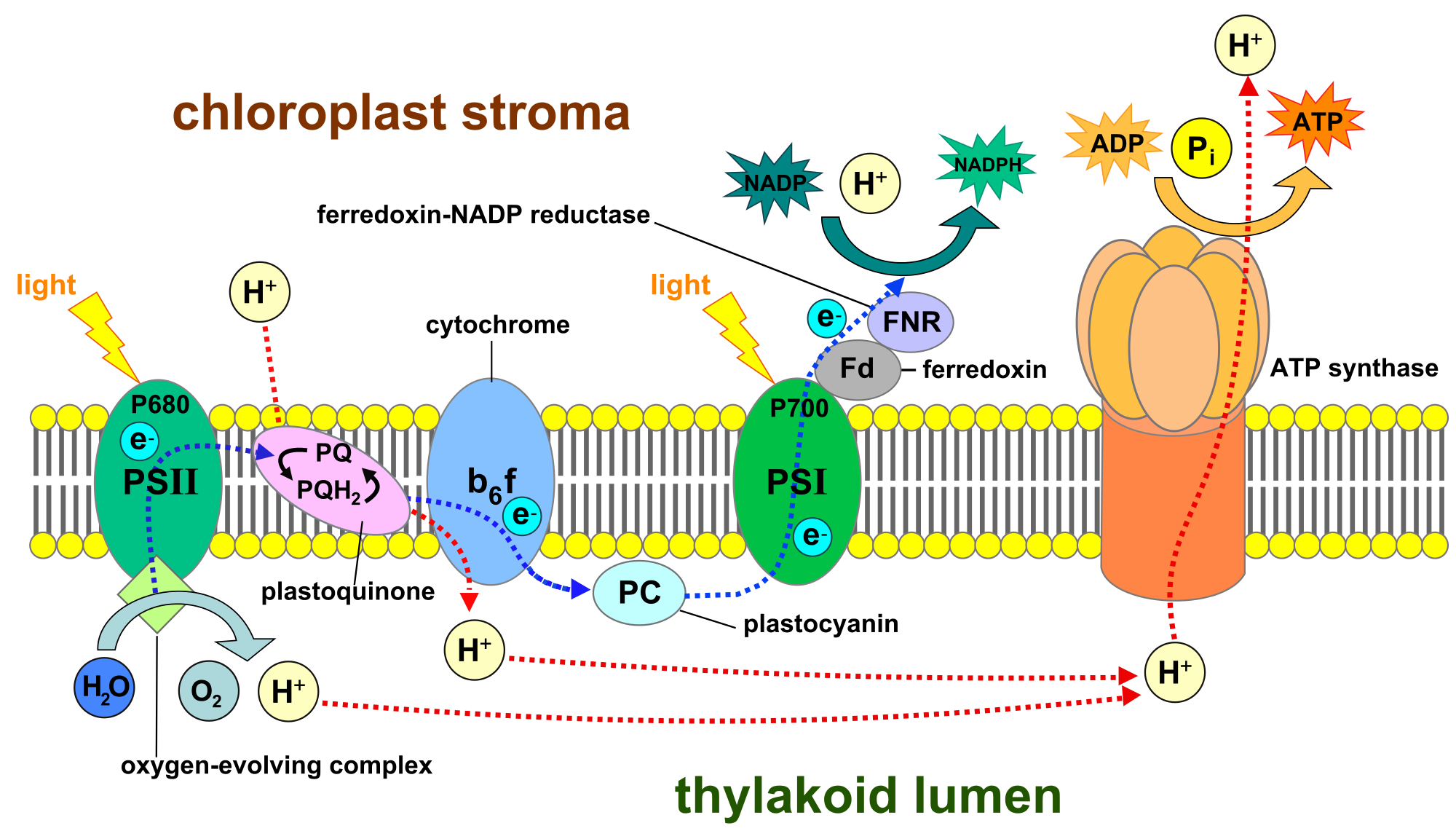
Light-dependent reactions are the chemical reactions involved in photosynthesis induced by light; all light-dependent reactions occur in thylakoids. There are two light-dependent reactions: the first occurs at photosystem II (PSII) and the second occurs at photosystem I (PSI).
PSII absorbs a photon to produce a so-called high energy electron which transfers via an electron transport chain to cytochrome b6f and then to PSI. The then-reduced PSI, absorbs another photon producing a more highly reducing electron, which converts NADP+ to NADPH. In oxygenic photosynthesis, the first electron donor is water, creating oxygen (O2) as a by-product. In anoxygenic photosynthesis, various electron donors are used.Cytochrome b6f and ATP synthase work together to produce ATP (photophosphorylation) in two distinct ways. In non-cyclic photophosphorylation, cytochrome b6f uses electrons from PSII and energy from PSI[clarification needed] to pump protons from the cytoplasm (or stroma in chloroplasts), to the lumen of the thylakoid. The resulting proton gradient across the thylakoid membrane creates a proton-motive force, used by ATP synthase to form ATP. In cyclic photophosphorylation, cytochrome b6f uses electrons and energy from PSI to create more ATP and to stop the production of NADPH. Cyclic phosphorylation is important to create ATP and maintain NADPH in the right proportion for the light-independent reactions.
The net-reaction of all light-dependent reactions in oxygenic photosynthesis is:
PSI and PSII are light-harvesting complexes. If a special pigment molecule in a photosynthetic reaction center absorbs a photon, an electron in this pigment attains the excited state and then is transferred to another molecule in the reaction center. This reaction, called photoinduced charge separation, is the start of the electron flow and transforms light energy into chemical forms.
In chemistry, many reactions depend on the absorption of photons to provide the energy needed to overcome the activation energy barrier and hence can be labelled light-dependent. Such reactions range from the silver halide reactions used in photographic film to the creation and destruction of ozone in the upper atmosphere. This article discusses a specific subset of these, the series of light-dependent reactions related to photosynthesis in living organisms.
The reaction center is in the thylakoid membrane. It transfers absorbed light energy to a dimer of chlorophyll pigment molecules near the periplasmic (or thylakoid lumen) side of the membrane. This dimer is called a special pair because of its fundamental role in photosynthesis. This special pair is slightly different in PSI and PSII reaction centers. In PSII, it absorbs photons with a wavelength of 680 nm, and is therefore called P680. In PSI, it absorbs photons at 700 nm and is called P700. In bacteria, the special pair is called P760, P840, P870, or P960. "P" here means pigment, and the number following it is the wavelength of light absorbed.
Electrons in pigment molecules can exist at specific energy levels. Under normal circumstances, they are at the lowest possible energy level, the ground state. However, absorption of light of the right photon energy can lift them to a higher energy level. Any light that has too little or too much energy cannot be absorbed and is reflected. The electron in the higher energy level is unstable and will quickly return to its normal lower energy level. To do this, it must release the absorbed energy. This can happen in various ways. The extra energy can be converted into molecular motion and lost as heat, or re-emitted by the electron as light (fluorescence). The energy, but not the electron itself, may be passed onto another molecule; this is called resonance energy transfer. If an electron of the special pair in the reaction center becomes excited, it cannot transfer this energy to another pigment using resonance energy transfer. Under normal circumstances, the electron would return to the ground state, but because the reaction center is arranged so that a suitable electron acceptor is nearby, the excited electron is taken up by the acceptor. The loss of the electron gives the special pair a positive charge and, as an ionization process, further boosts its energy.[citation needed] The formation of a positive charge on the special pair and a negative charge on the acceptor is referred to as photoinduced charge separation. The electron can be transferred to another molecule. As the ionized pigment returns to the ground state, it takes up an electron and gives off energy to the oxygen evolving complex so it can split water into electrons, protons, and molecular oxygen (after receiving energy from the pigment four times). Plant pigments usually utilize the last two of these reactions to convert the sun's energy into their own.
This initial charge separation occurs in less than 10 picoseconds (10-11 seconds). In their high-energy states, the special pigment and the acceptor could undergo charge recombination; that is, the electron on the acceptor could move back to neutralize the positive charge on the special pair. Its return to the special pair would waste a valuable high-energy electron and simply convert the absorbed light energy into heat. In the case of PSII, this backflow of electrons can produce reactive oxygen species leading to photoinhibition. Three factors in the structure of the reaction center work together to suppress charge recombination nearly completely:
Hub AI
Light-dependent reactions AI simulator
(@Light-dependent reactions_simulator)
Light-dependent reactions
Light-dependent reactions are the chemical reactions involved in photosynthesis induced by light; all light-dependent reactions occur in thylakoids. There are two light-dependent reactions: the first occurs at photosystem II (PSII) and the second occurs at photosystem I (PSI).
PSII absorbs a photon to produce a so-called high energy electron which transfers via an electron transport chain to cytochrome b6f and then to PSI. The then-reduced PSI, absorbs another photon producing a more highly reducing electron, which converts NADP+ to NADPH. In oxygenic photosynthesis, the first electron donor is water, creating oxygen (O2) as a by-product. In anoxygenic photosynthesis, various electron donors are used.Cytochrome b6f and ATP synthase work together to produce ATP (photophosphorylation) in two distinct ways. In non-cyclic photophosphorylation, cytochrome b6f uses electrons from PSII and energy from PSI[clarification needed] to pump protons from the cytoplasm (or stroma in chloroplasts), to the lumen of the thylakoid. The resulting proton gradient across the thylakoid membrane creates a proton-motive force, used by ATP synthase to form ATP. In cyclic photophosphorylation, cytochrome b6f uses electrons and energy from PSI to create more ATP and to stop the production of NADPH. Cyclic phosphorylation is important to create ATP and maintain NADPH in the right proportion for the light-independent reactions.
The net-reaction of all light-dependent reactions in oxygenic photosynthesis is:
PSI and PSII are light-harvesting complexes. If a special pigment molecule in a photosynthetic reaction center absorbs a photon, an electron in this pigment attains the excited state and then is transferred to another molecule in the reaction center. This reaction, called photoinduced charge separation, is the start of the electron flow and transforms light energy into chemical forms.
In chemistry, many reactions depend on the absorption of photons to provide the energy needed to overcome the activation energy barrier and hence can be labelled light-dependent. Such reactions range from the silver halide reactions used in photographic film to the creation and destruction of ozone in the upper atmosphere. This article discusses a specific subset of these, the series of light-dependent reactions related to photosynthesis in living organisms.
The reaction center is in the thylakoid membrane. It transfers absorbed light energy to a dimer of chlorophyll pigment molecules near the periplasmic (or thylakoid lumen) side of the membrane. This dimer is called a special pair because of its fundamental role in photosynthesis. This special pair is slightly different in PSI and PSII reaction centers. In PSII, it absorbs photons with a wavelength of 680 nm, and is therefore called P680. In PSI, it absorbs photons at 700 nm and is called P700. In bacteria, the special pair is called P760, P840, P870, or P960. "P" here means pigment, and the number following it is the wavelength of light absorbed.
Electrons in pigment molecules can exist at specific energy levels. Under normal circumstances, they are at the lowest possible energy level, the ground state. However, absorption of light of the right photon energy can lift them to a higher energy level. Any light that has too little or too much energy cannot be absorbed and is reflected. The electron in the higher energy level is unstable and will quickly return to its normal lower energy level. To do this, it must release the absorbed energy. This can happen in various ways. The extra energy can be converted into molecular motion and lost as heat, or re-emitted by the electron as light (fluorescence). The energy, but not the electron itself, may be passed onto another molecule; this is called resonance energy transfer. If an electron of the special pair in the reaction center becomes excited, it cannot transfer this energy to another pigment using resonance energy transfer. Under normal circumstances, the electron would return to the ground state, but because the reaction center is arranged so that a suitable electron acceptor is nearby, the excited electron is taken up by the acceptor. The loss of the electron gives the special pair a positive charge and, as an ionization process, further boosts its energy.[citation needed] The formation of a positive charge on the special pair and a negative charge on the acceptor is referred to as photoinduced charge separation. The electron can be transferred to another molecule. As the ionized pigment returns to the ground state, it takes up an electron and gives off energy to the oxygen evolving complex so it can split water into electrons, protons, and molecular oxygen (after receiving energy from the pigment four times). Plant pigments usually utilize the last two of these reactions to convert the sun's energy into their own.
This initial charge separation occurs in less than 10 picoseconds (10-11 seconds). In their high-energy states, the special pigment and the acceptor could undergo charge recombination; that is, the electron on the acceptor could move back to neutralize the positive charge on the special pair. Its return to the special pair would waste a valuable high-energy electron and simply convert the absorbed light energy into heat. In the case of PSII, this backflow of electrons can produce reactive oxygen species leading to photoinhibition. Three factors in the structure of the reaction center work together to suppress charge recombination nearly completely: