


Community hub
Recent from talks
Contribute something
Nothing was collected or created yet.
Lightweight TT
View on Wikipedia

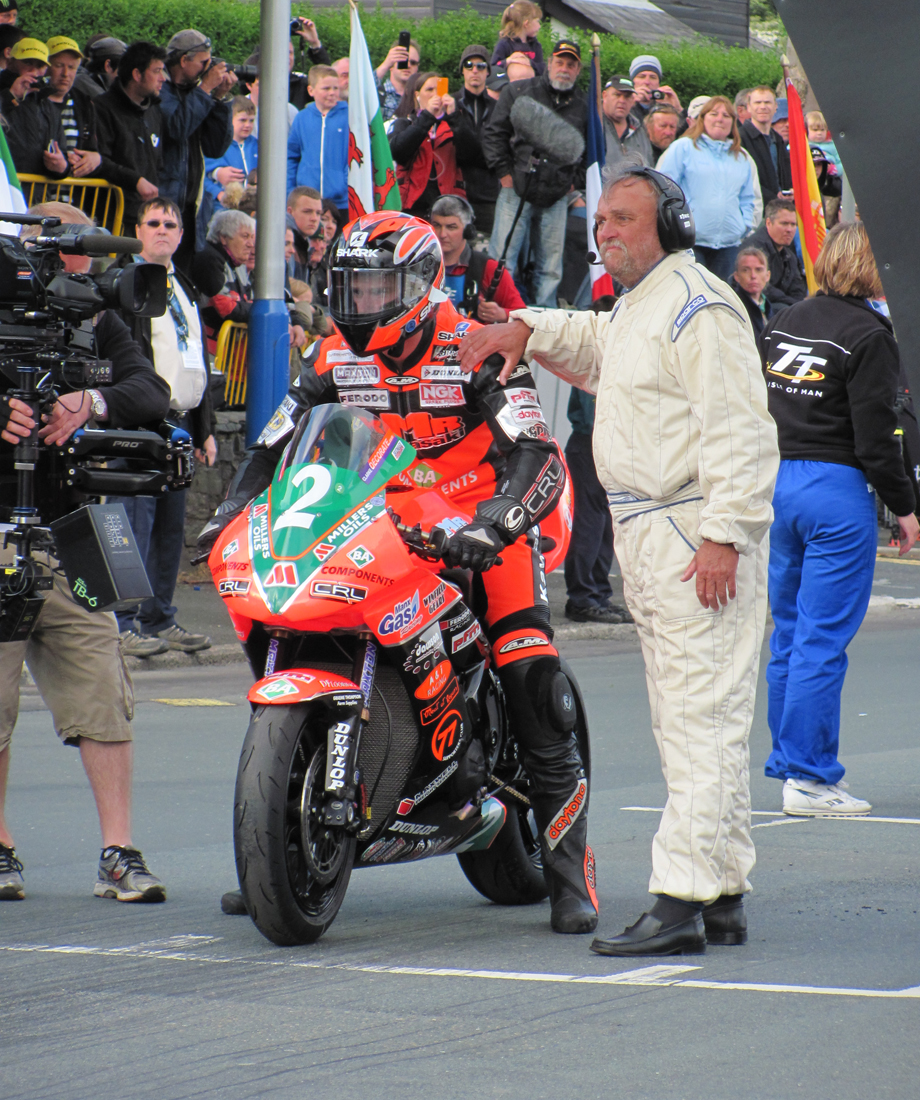
The Supertwin TT is a motorcycle road race that is a part of the Isle of Man TT festival - an annual motorcycle event traditionally held over the last week of May and first week of June. Prior to the 2022 edition of the TT, the race was known as the Lightweight TT.
History
[edit]The Lightweight class, as it was then known, was first present at the 1920 TT races, as a category in the Junior TT. However it was not until 1922 that the first time the Lightweight TT took place, won by motorcycle journalist Geoff S. Davison riding a Levis, at an average speed of 49.89 mph (80.29 km/h) for 5 laps of the Snaefell Mountain Course. Between 1949 and 1976, the Lightweight race was part of the Grand Prix motorcycle racing season.
In the changes following the loss of FIM World Championship status after the 1976 event, the Lightweight TT event was dropped with the 250 cc machines running for the Junior TT in place of the now defunct 350 cc formula. The Lightweight TT returned in 1995 before being split into two distinct events from 1999, dropping from the schedule again after 2004.
The Lightweight TT and the Ultra-Lightweight TT were later reinstated to the 2008 & 2009 race schedules, but were held on the 4.25 mile Billown Circuit in the south of the Isle of Man.[1] For the 2010 races, the Lightweight TT was again dropped from the race schedule on cost grounds.
The event was re-introduced for the 2012 races on the Mountain course, with a change to water-cooled four-stroke twin cylinder engines not exceeding 650 cc and complying with the ACU Standing Regulations.[2]
The event was renamed Supertwin TT in 2022.[3]
The Lightweight category
[edit]There have been several different categories of motorcycle that can compete in this event. In the 1950s and 1960s, the principal TT solo events were the Senior (500 cc), Junior (350 cc), and Lightweight (250 cc, or sometimes 125 cc). The 125 cc class was occasionally called the "Ultra-Lightweight" class.
Currently the Lightweight class comprises road-based "SuperTwin" solo machines with liquid-cooled four-stroke engines of up to 500 cc for Four-Cylinder and 800 cc Twin-Cylinder engine capacity.
Overview
[edit]- 1924–1948: For motorcycles not exceeding 250 cc engine capacity.
- 1949–1953: FIM World Championship event for motorcycles not exceeding 250 cc engine capacity, held on the Snaefell mountain course.
- 1954–1959: FIM World Championship event for motorcycles not exceeding 250 cc engine capacity, held on the Clypse Course.
- 1960–1976: FIM World Championship event for motorcycles not exceeding 250 cc engine capacity, held on the Mountain Course.
- 1977–1994: event not run (250 cc formula run as Junior TT).
- 1995–1998: For 2-stroke motorcycles not exceeding 250 cc engine capacity and 4-stroke motorcycles not exceeding 400 cc, held on the Mountain Course.
- 1999–2003: Lightweight 400 TT for 4-stroke motorcycles not exceeding 400 cc engine capacity, held on the Mountain Course.
- 1999–2002: Lightweight 250 TT for 2-stroke motorcycles not exceeding 250 cc engine capacity, held on the Mountain Course (the category running within Junior TT in 2003).
- 2008–2009: For motorcycles not exceeding 250 cc engine capacity, held on the Billown Circuit.
- 2012–2019: For water-cooled four-stroke twin cylinder not exceeding an engine capacity of 650 cc and complying with the ACU Standing Regulations.[4]
Speed and lap records
[edit]The lap record for the Lightweight TT is held by Michael Dunlop in a time of 18 minutes and 26.543 seconds, at an average speed of 122.750 mph (197.547 km/h) set during the 2018 race. The race record for the 4 lap (150.73 miles/242.58 km) Lightweight TT is a time of 1 hour, 15 minutes and 05.032 seconds, at an average race speed of 120.601 mph (194.088 km/h), also held by Dunlop during the 2018 race.[5][6]
List of Lightweight TT Winners
[edit]


Race winners (riders)
[edit]See also
[edit]References
[edit]- ^ Manx Independent pp44 dated 22 November 2007
- ^ International Isle of Man TT Regulations 2012 page 41-42 Appendix-E ACU Events (Isle of Man) Ltd (2012) Isle of Man Department of Economic Development
- ^ Miller, David (11 June 2021). "Lightweight TT becomes Supertwin TT in 2022". BikeSport News. Retrieved 23 November 2023.
- ^ International Isle of Man TT Regulations 2012 page 41-42 Appendix-E ACU Events (Isle of Man) Ltd (2012) Isle of Man Department of Economic Development
- ^ "Dunlop proves a heavy hitter in thrilling Bennetts Lightweight TT Race". Isle of Man TT. Duke Marketing Ltd. 6 June 2018. Retrieved 23 February 2019.
- ^ "Bennetts Lightweight TT - Result Sheet" (PDF). Isle of Man TT. Duke Marketing Ltd. 6 June 2018. Retrieved 23 February 2019.
- ^ "TT Fact Zone". Duke Marketing Ltd.
- ^ "TT & Manx Grand Prix - iMuseum". iMuseum.
Lightweight TT
View on GrokipediaIntroduction
Background and Significance
The Lightweight TT is a solo motorcycle racing class within the Isle of Man TT, an annual international event held on the Isle of Man's public roads, renowned for testing riders and machines on the challenging 37.73-mile Snaefell Mountain Course.[3] Originally designed for 250cc engines, the class was introduced to highlight agile, high-revving motorcycles that emphasized precision and speed on the demanding circuit, evolving from the broader Junior TT category which had previously encompassed 350cc machines.[9] This format allowed for the showcase of lightweight designs suited to the TT's twisty, elevation-changing layout, distinct from larger-displacement classes focused on outright power.[3] Historically significant as a standalone event first run in 1922, the Lightweight TT emerged after the Auto-Cycle Union (ACU) decided against restricting the Junior TT to 250cc machines, instead creating a dedicated five-lap race for the class to promote innovation in smaller engines.[9] It served as a key proving ground for technological advancements, including early developments in high-revving engines and chassis that later influenced grand prix standards, particularly as the Isle of Man TT became the British round of the FIM World Championship from 1949 to 1976.[10] The class's emphasis on reliability and performance under extreme conditions contributed to the evolution of global motorcycle racing norms, bridging amateur touring roots with professional competition.[3] Culturally, the Lightweight TT underscored rider skill and bravery over brute engine power, drawing international competitors and spectators to the Isle of Man and fostering a legacy of technical ingenuity in 250cc racing worldwide.[3] By prioritizing nimble handling on the Mountain Course's varied terrain—from urban streets to mountain ascents—the event attracted talent from Europe and beyond, shaping the appeal of lightweight grand prix categories and inspiring designs that balanced speed with controllability.[10] This focus not only elevated the TT festival's prestige but also highlighted the class's role in democratizing high-level racing for emerging manufacturers and riders.[3]Current Status and Successor
The Lightweight TT class was discontinued from the FIM World Championship after the 1976 Isle of Man TT, when the event lost its official status due to rider boycotts and safety concerns. It was revived as part of the main TT program from 1995 to 2004, running on the full 37.73-mile Mountain Course with 250cc two-stroke machines. Shorter versions of the Lightweight (250cc) and Ultra-Lightweight (125cc) races were then held in 2008 and 2009 on the 4.25-mile Billown Circuit in southern Isle of Man, elevated to official TT status to accommodate the two-stroke focus amid declining grand prix interest. The class returned to the Mountain Course from 2012 to 2019, restructured around 650cc four-stroke twin-cylinder engines to modernize the category; these were the final iterations before the 2020 TT cancellation due to the COVID-19 pandemic, with no subsequent revival under the Lightweight name. In 2022, the class underwent a significant rebranding to the Supertwin TT, expanding engine eligibility to four-stroke twin-cylinder motorcycles up to 700cc to incorporate more contemporary production-based machines such as the Aprilia RS660 and Yamaha YZF-R7, thereby enhancing competitiveness and entrant numbers. This evolution addressed the waning viability of smaller-displacement formats, building on the 2012 shift from two-strokes to sustain the category's relevance in line with advancing motorcycle technology and regulatory trends. The change marked a departure from the original 250cc two-stroke emphasis, prioritizing accessibility for modern riders and manufacturers while preserving the lightweight racing ethos. As of 2025, the Supertwin TT continues as a staple of the annual Isle of Man TT Races, scheduled from May 26 to June 7. Michael Dunlop dominated the category that year, securing victory in Race 1 on June 3 with a two-lap average speed of 122.307 mph aboard the MD Racing Paton S1-R, marking his 31st career TT win. He completed the double in Race 2 on June 6 over three laps, setting a new class lap record of 123.056 mph en route to an average exceeding 122 mph and his 33rd overall TT victory, further cementing his record as the most successful rider in event history.Historical Development
Inception and Early Races (1920-1948)
The Lightweight TT originated as a subclass within the 1920 Junior TT race, introduced by the Auto-Cycle Union (ACU) to accommodate 250 cc motorcycles alongside the standard 350 cc entries, marking the first inclusion of smaller-capacity machines in the Isle of Man Tourist Trophy events. Only four such Lightweight machines participated that year on the extended 37¾-mile Mountain Course, with R. O. Clark finishing first in the class aboard a Levis despite a crash, highlighting the class's experimental nature amid post-World War I resumption of racing.[11] By 1922, the category had evolved into a standalone Lightweight TT race over five laps, won by journalist Geoff Davison on a two-stroke Levis motorcycle at an average speed of 49.89 mph, establishing it as a distinct event focused on agile, lightweight designs suited to the demanding public-road circuit. Early innovations included the 1924 introduction of the Ultra-Lightweight TT class for machines not exceeding 175 cc, which was run for two years before being discontinued after 1925. Technical advancements emphasized overhead-camshaft (OHC) engines for improved power delivery and lightweight girder or duplex frames to handle the Mountain Course's steep climbs, narrow lanes, and high-speed sections like the Snaefell Mountain climb, where average speeds in the 1920s hovered around 50 mph.[12][13][14][15] In the 1930s, British manufacturers dominated the pre-World War II era, with AJS securing key victories such as Jimmie Guthrie's 1930 win at 64.71 mph, showcasing the marque's OHC V4 innovation that propelled the class forward. Excelsior also contributed to this era's highlights, with the "Mechanical Marvel" model achieving a breakthrough Lightweight TT triumph in 1929 and strong placings through the decade, underscoring the focus on reliable, high-revving singles for the circuit's technical challenges. The first foreign winner came in 1937, when Italian rider Omobono Tenni claimed victory on a Moto Guzzi at an average speed of 74.72 mph, signaling the growing international interest in the event. By 1939, speeds had risen to 74.26 mph, as demonstrated by E. A. Ted Mellors' Benelli win, before the outbreak of World War II led to a suspension of races from 1940 to 1947 due to wartime restrictions.[16][17][10][18][10]FIM World Championship Period (1949-1976)
The Lightweight TT debuted as a round of the inaugural FIM 250cc World Championship in 1949, serving as the British Grand Prix event and contributing points toward the world title.[10] It remained a fixture in the championship calendar through 1976, attracting top international talent and showcasing advancements in lightweight motorcycle design.[19] The race, held over the challenging 37.73-mile Snaefell Mountain Course, emphasized agility and precision in the 250cc class, with early winners like Manliffe Barrington on a Moto Guzzi in 1949 averaging 77.99 mph for the three-lap event.[20] During the 1950s, Italian manufacturers dominated, particularly MV Agusta, with Tarquinio Provini securing victories in the smaller classes, including the Ultra-Lightweight TT in 1957 on Mondial and the Lightweight TT in 1958 and 1959 on MV Agusta, contributing to MV Agusta's strong championship performances on the shorter Clypse Course variant used for these races from 1955 to 1960.[21] The 1960s marked a surge in Japanese participation, as Honda and Yamaha challenged European dominance; Honda claimed 10 of 11 250cc Grand Prix victories in 1961, including strong TT results, while Yamaha's Phil Read secured the 250cc world titles in 1964 and 1965, along with multiple TT wins on two-stroke machinery.[22][23] In the 1970s, Yamaha continued its success with riders like Read, while Walter Villa achieved three consecutive 250 cc world championships from 1974 to 1976 on Aermacchi-Harley Davidson machines.[24] Key milestones highlighted the era's intensity, such as the 1957 Lightweight TT won by Cecil Sandford on Mondial at an average of 75.81 mph, though exact lap records from that year remain tied to broader championship speeds.[21] The final championship Lightweight TT in 1976 was won by Tom Herron on Yamaha with a time of 1:27:26.8 over four laps, underscoring the event's evolution before its discontinuation.[25] Technological shifts favored two-stroke engines by the mid-1960s, with Yamaha's 1964 world title marking the first championship win for a two-stroke in the class, enabling higher power outputs and simpler designs.[26] Innovations like disc brakes, introduced in the late 1960s, and enhanced suspension systems improved handling on the demanding course.[27] The period saw increasing safety concerns, including multiple fatalities in the 1960s that prompted FIM rule adjustments for better rider protection and machine reliability.[28] Rider boycotts in the early 1970s, led by figures like Giacomo Agostini over the circuit's dangers, culminated in the TT losing its world championship status after 1976, shifting the British GP to safer circuits like Silverstone amid debates on cost and risk.[10][29]Post-Championship Revivals (1995-2019)
After a hiatus spanning nearly two decades following the end of its FIM World Championship status, the Lightweight TT was revived in 1995 as part of efforts to refresh the Isle of Man TT program. The race returned to the 37.73-mile Mountain Course, limited to 250cc two-stroke machines, marking a "back to basics" approach amid changes that reallocated the Junior TT to 600cc superbikes. Joey Dunlop claimed victory on a Castrol Honda, averaging 115.68 mph over two laps, securing his 25th TT win and underscoring the class's enduring appeal for lightweight specialists.[30][31] The event ran annually from 1995 to 2004, attracting consistent fields and witnessing progressive performance gains as riders and technology adapted to the demanding public roads. By the early 2000s, the class had evolved to include 400cc four-stroke options alongside two-strokes, reflecting broader shifts in production racing machinery. A notable highlight came in 2003, when John McGuinness won the Lightweight 400cc TT on a Honda at an average race speed of 109.52 mph, demonstrating the class's competitiveness despite the Mountain Course's challenges.[32] However, entries began to wane toward the decade's end, influenced by the global transition in Grand Prix racing from two-strokes to four-strokes in the 250cc class starting in 2002, which diminished the availability and relevance of dedicated 250cc two-stroke hardware. Following a four-year absence, the Lightweight TT briefly resurfaced in 2008 and 2009, but on the shorter 4.25-mile Billown Circuit in Castletown due to scheduling constraints and weather risks on the full Mountain Course. These races carried official TT status, marking the first time Billown hosted TT events, and helped conclude the fortnight's program in favorable conditions. In 2008, Ian Lougher dominated the 250cc class on a Yamaha, securing his eighth TT victory overall by a comfortable margin.[33][34] The 2009 edition followed a similar format, with Lougher again triumphant in the Lightweight category, though the off-Mountain layout drew mixed reactions for lacking the traditional TT prestige.[35] The class made a full comeback to the Mountain Course from 2012 to 2019, rebranded as the SuperTwin TT to accommodate 650cc parallel twins like Kawasakis and Yamahas, while retaining its focus on agile, production-derived machines. This revival boosted entries and excitement, with races spanning three laps and emphasizing rider skill over outright power. Performances escalated, exemplified by lap records exceeding 120 mph, as seen in Michael Dunlop's 2018 effort at 122.75 mph on a Paton.[36][37] The 2019 Bennetts Lightweight TT concluded the era thrillingly, with Michael Dunlop edging James Coward by 1.299 seconds on his SC-Project Paton at a race average of 121.65 mph, amid ongoing discussions about the two-stroke legacy's place in a four-stroke-dominated landscape.[38][39] Persistent challenges plagued the revivals, including steadily declining participant numbers as manufacturers phased out two-stroke support following the 250cc GP's shift to four-strokes in 2002 and the introduction of Moto2 prototypes in 2010, which further eroded the ecosystem for lightweight racing bikes. Debates intensified over the class's viability, with critics questioning the relevance of aging two-stroke technology against modern four-stroke alternatives. The COVID-19 pandemic led to the cancellation of the 2020 event, including the SuperTwin TT, by the Isle of Man government to curb virus spread. However, the class continued under the SuperTwin TT format in subsequent years, with the 2021 edition marking its resumption, and was also revived in classic form as the Lightweight Classic TT starting in 2013 as part of the annual Classic TT festival held in late August. This preservation effort included Michael Dunlop's dominant victory in the 2025 Lightweight Classic TT by a margin of 47 seconds on a Honda RS250, highlighting the ongoing heritage of the category as of November 2025.[40][8][7]Race Format and Category Rules
Circuit and Race Structure
The Lightweight TT races are contested on the Snaefell Mountain Course, a 37.73-mile (60.72 km) public road circuit that begins and ends in Douglas on the Isle of Man. This demanding layout incorporates over 200 turns, including narrow lanes, elevation changes up to 1,400 feet (427 m) across Snaefell Mountain, and sections of original Victorian-era road surfaces that test rider precision and machine handling.[41][42][43] Key challenges for lightweight motorcycles include the steep Bray Hill descent from the start line, where riders reach high speeds before navigating tight urban corners, and the Gooseneck section near Ramsey, a sharp, decreasing-radius right-hand turn that demands agile bike response amid uneven terrain and stone walls. The course's public road nature amplifies risks, with elements like manhole covers, jumps, and variable weather adding to the operational complexity for the lighter 250cc or 350cc machines.[44][45][43] The race format has evolved since the Lightweight TT's inception, but typically features one or two races per event within the broader TT festival, with lap counts varying by era from three to six laps for a total distance of approximately 113–226 miles (182–364 km) in the main program. Riders compete in a time-trial format, starting individually from a standing position at intervals of 10 to 30 seconds, determined by qualifying performance, to minimize on-track encounters. Qualifying occurs over three to six sessions during the preceding week, requiring riders to achieve a minimum lap speed (often around 100 mph or higher, depending on the era) on the full Mountain Course to secure a grid position.[46][47][48] In the post-championship period, such as 1995–2002, races were typically four laps. Since its revival as the Lightweight Classic TT in 2013, the event is part of the separate Classic TT festival held in late August, with races shortened to two or three laps for a total distance of approximately 75–113 miles (121–182 km). Preliminary qualifying for the Lightweight class occasionally utilizes the shorter 4.25-mile Billown Circuit near Castletown during Pre-TT events, providing an initial speed assessment before progressing to the Mountain Course. The main TT festival spans late May to early June, with road closures enforced from approximately 10:00 AM to 9:30 PM daily during practice and race weeks, accommodating up to 60 entrants per class, while the Classic TT follows a similar schedule in August. Weather contingencies are integral, with sessions subject to delay or cancellation due to rain or wind; a red flag halts proceedings immediately for incidents or poor visibility, often requiring restarts or shortened races.[49][50][51] Safety measures emphasize rigorous oversight, mandating participants hold a current ACU National or FIM International road racing license, verified through medical examinations and prior experience in closed-road or short-circuit events. All motorcycles undergo technical inspections at the TT paddock in Douglas, checking compliance with category rules like engine displacement limits up to 350cc for historical Lightweight classes. Post-1990s enhancements include sector timing across 12 points along the course for real-time lap monitoring and GPS tracking on all competing machines to enhance incident response. Medical teams are stationed at strategic locations, and a zero-tolerance policy on alcohol or substances applies to officials and riders.[52][53]Technical Specifications and Evolution
The Lightweight TT class was established in 1922 as part of the Isle of Man TT Races, limited to motorcycles with engine capacities not exceeding 250 cc.[54] Early regulations emphasized reliability and roadworthiness, permitting air-cooled single-cylinder or twin-cylinder engines without superchargers, while prohibiting forced induction to maintain fairness among production-derived machines.[10] During the FIM World Championship period from 1949 to 1976, the class adhered to international Grand Prix standards for 250 cc motorcycles, initially favoring four-stroke engines until two-strokes gained dominance in the early 1960s due to superior power-to-weight ratios.[55] FIM rules evolved to standardize two-stroke configurations by the mid-1960s, mandating liquid-cooled designs and allowing up to six-speed gearboxes for better acceleration on road circuits.[56] Post-1970, disc brakes became mandatory across classes, including the 250 cc, to improve stopping performance amid rising speeds, while exhaust systems faced noise and emissions limits to comply with emerging environmental standards.[57] The post-championship revival from 1995 to 2002 reintroduced the Lightweight TT with specifications tailored to classic Grand Prix machinery, allowing tuned 250 cc two-stroke engines such as the Yamaha TZ250 alongside 400 cc four-strokes until 2003. Races emphasized carbureted two-strokes with fuel capacities limited to 24 liters and exhaust restrictions to cap power output at approximately 60-70 hp, prohibiting electronic aids like traction control.[46] Minimum weights were set at 140-150 kg to balance handling and safety, with no four-valve heads or variable intake systems allowed to preserve the era's character.[58] Since 2013, the class has been revived as the Lightweight Classic TT, permitting 250 cc two-stroke Grand Prix replicas from the 1980s and 1990s (e.g., Yamaha TZ250, Honda RS250) alongside period Supersport 400 cc four-stroke machines like the Kawasaki ZXR400 and Honda RVF400. Technical rules maintain carbureted engines, with fuel limits of 24 liters, power outputs around 60-70 hp, and minimum weights of 140-150 kg. Electronic aids remain prohibited to emphasize the era's tuning challenges, including carburetor jetting and powerband optimization. As of 2025, these specifications continue unchanged, focusing on heritage preservation without modern emissions requirements.[2][5]Performance Records
Fastest Lap Records
The progression of fastest lap records in the Lightweight TT illustrates the dramatic evolution of the class, driven by innovations in engine design, chassis dynamics, and rider expertise on the challenging 37.73-mile Snaefell Mountain Course. The inaugural official lap record for the 250cc class was established in 1922 at approximately 49 mph by J. A. Walker on a Sunbeam during the first Lightweight TT.[1] By the mid-1950s, records advanced with four-stroke singles; in 1955, Siegfried Bettmann set a lap record of 92.45 mph on an NSU SportMax in the Lightweight TT, benefiting from improved two-stroke and four-stroke engine tuning.[59] The record advanced further in 1961 when Mike Hailwood on a Honda RC162 recorded 101.3 mph, leveraging the era's innovative four-cylinder two-stroke design for the demanding terrain.[60] During the final FIM World Championship year in 1976, Tom Herron on a Yamaha TZ250A set a fastest lap of 105.46 mph (21 minutes 27.800 seconds), marking the peak for 250cc machinery with reed-valve engines and enhanced braking. The class was discontinued after 2002, but revived elements appear in the Classic TT from 2013, permitting 250cc two-stroke GP replicas. The modern Classic Lightweight lap record stood at 109.82 mph, set by Lee Johnston on a Yamaha TZ250 in 2019.[2] As the successor Supertwin category (using 650cc twins), the benchmark extended in 2025 when Michael Dunlop recorded 123.056 mph on a Paton S1-R during the final lap of Supertwin TT Race 2, surpassing prior marks through superior aerodynamics and radial tire advancements.[61] These lap speeds are derived from the formula speed = distance / time, applied to the full 37.73-mile circuit, underscoring how incremental technical gains—such as radial tires for better cornering grip and aerodynamic refinements for reduced drag—have compounded over decades to elevate performance.[37]Race Average Speed Records
The Lightweight TT race average speed records highlight the evolution of sustained performance over the demanding 37.73-mile (60.72 km) Snaefell Mountain Course, where riders must maintain high velocities across multiple laps while managing mechanical reliability and strategic pit stops. Early iterations of the event, introduced in 1922 as a 250cc class, featured shorter distances to accommodate the technology of the era. Geoff S. Davison set the inaugural record at 49.89 mph over three laps (113.19 miles) on a Levis, completing the race in 3 hours, 46 minutes, and 56.8 seconds.[62] By 1949, during the first FIM World Championship season, Manliffe Barrington raised the bar to 77.99 mph over five laps on a Moto Guzzi, finishing in 3 hours, 23 minutes, and 13.2 seconds, reflecting post-war advancements in engine tuning and chassis design.[20] During the FIM World Championship period from 1949 to 1976, race average speeds climbed steadily as two-stroke engines and improved aerodynamics enabled greater consistency. In 1967, Bill Ivy achieved 94.45 mph over three laps on a Yamaha TD1, with a total time of 1 hour 54 minutes 10 seconds, surpassing previous marks.[63] The era's peak came in 1976 with Tom Herron posting 103.55 mph over three laps on a Yamaha TZ250A, completing the distance in 1 hour, 27 minutes, and 26.8 seconds; this effort edged out close competition and marked the final championship year for the class, influenced by fewer retirements due to enhanced reliability.[25] The original class was discontinued in 2002, with revivals in Classic TT from 2013 using period 250cc machines, where averages reflect heritage tuning. In 2019, Michael Dunlop established a Classic Lightweight benchmark of 108.23 mph over two laps on a Yamaha TZ250, with a race time of 35 minutes 2.456 seconds.[2] The transition to Supertwin regulations in 2020, allowing four-stroke 650cc twins, further elevated averages by favoring torque-rich engines. In the 2025 Metzeler Supertwin TT Race 1, Michael Dunlop averaged 121.8 mph over three laps on a Paton S1-R, securing victory by 22.6 seconds and highlighting the four-stroke configuration's advantages in acceleration and fuel efficiency during mandatory fuel stops.[64] These modern records emphasize reliability, as retirements from mechanical failures or crashes can drastically lower averages. Race average speeds are calculated by dividing the total distance (laps × 37.73 miles) by the rider's elapsed race time, excluding qualifying or practice sessions but incorporating any pit stop durations for refueling or adjustments. Factors like weather, traffic management, and machine durability significantly influence outcomes, with higher averages requiring not just peak lap speeds but consistent performance across the full distance—distinct from single-lap records that prioritize outright velocity.[65]Winners and Legacy
List of Overall Winners
The overall winners of the Lightweight TT (and its successor, the Supertwin TT from 2022) are compiled below in tabular form, grouped by historical eras for readability. Data includes the rider, nationality, machine marque, average race speed, and number of laps completed, drawn from official race results. Gaps in racing occurred during World War II (1939-1946) and from 1977 to 1994, after which the class was revived in a mixed 250/400cc format before evolving to Supertwin (up to 700 cc two-stroke or 650 cc four-stroke equivalents). Recent races (post-2019) are typically 2 laps.Pre-War Era (1922-1938)
| Year | Winner | Nationality | Machine | Average Speed | Laps |
|---|---|---|---|---|---|
| 1922 | Geoff S. Davison | Northern Ireland | Levis | 49.49 mph | 3 |
| 1923 | Jock Porter | Scotland | New Gerrard | 51.93 mph | 3 |
| 1924 | Edwin Twemlow | England | New Imperial | 55.44 mph | 3 |
| 1925 | Edwin Twemlow | England | New Imperial | 57.74 mph | 3 |
| 1926 | C. W. Johnston | Republic of Ireland | Cotton | 57.74 mph | 3 |
| 1927 | Wal Handley | England | Rex-Acme | 63.3 mph | 3 |
| 1928 | Frank Longman | England | OK-Supreme | 62.9 mph | 3 |
| 1929 | Syd Crabtree | England | Excelsior | 63.87 mph | 3 |
| 1930 | Jimmie Guthrie | Scotland | AJS | 64.71 mph | 3 |
| 1931 | Graham Walker | England | Rudge | 68.98 mph | 3 |
| 1932 | Leo Davenport | United Kingdom | New Imperial | 70.48 mph | 3 |
| 1933 | Syd Gleave | England | Excelsior | 71.59 mph | 3 |
| 1934 | Jimmy Simpson | England | Rudge | 70.81 mph | 3 |
| 1935 | Stanley Woods | Republic of Ireland | Moto Guzzi | 71.56 mph | 3 |
| 1936 | Bob Foster | England | New Imperial | 74.28 mph | 3 |
| 1937 | Omobono Tenni | Italy | Moto Guzzi | 74.72 mph | 3 |
| 1938 | Ewald Kluge | Germany | DKW | 78.48 mph | 3 |
Post-War and FIM World Championship Era (1947-1976)
| Year | Winner | Nationality | Machine | Average Speed | Laps |
|---|---|---|---|---|---|
| 1947 | Manliffe Barrington | Republic of Ireland | Moto Guzzi | 73.22 mph | 3 |
| 1948 | Maurice Cann | United Kingdom | Moto Guzzi | 75.12 mph | 3 |
| 1949 | Manliffe Barrington | Republic of Ireland | Moto Guzzi | 77.99 mph | 3 |
| 1950 | Dario Ambrosini | Italy | Benelli | 78.08 mph | 3 |
| 1951 | Tommy Wood | England | Moto Guzzi | 81.39 mph | 3 |
| 1952 | Fergus Anderson | Scotland | Moto Guzzi | 83.82 mph | 3 |
| 1953 | Fergus Anderson | Scotland | Moto Guzzi | 84.73 mph | 3 |
| 1954 | Werner Haas | Germany | NSU | 90.88 mph | 3 |
| 1955 | Bill Lomas | England | MV Agusta | 91.45 mph | 3 |
| 1956 | Carlo Ubbiali | Italy | MV Agusta | 92.89 mph | 3 |
| 1957 | Carlo Ubbiali | Italy | MV Agusta | 94.23 mph | 3 |
| 1958 | Carlo Ubbiali | Italy | MV Agusta | 95.56 mph | 3 |
| 1959 | Carlo Ubbiali | Italy | MV Agusta | 96.90 mph | 3 |
| 1960 | Gary Hocking | Rhodesia | MV Agusta | 93.64 mph | 3 |
| 1961 | Mike Hailwood | England | Honda | 98.38 mph | 3 |
| 1962 | Derek Minter | England | Honda | 96.68 mph | 3 |
| 1963 | Jim Redman | Rhodesia | Honda | 94.85 mph | 3 |
| 1964 | Jim Redman | Rhodesia | Honda | 97.45 mph | 3 |
| 1965 | Jim Redman | Rhodesia | Honda | 97.19 mph | 3 |
| 1966 | Mike Hailwood | England | Honda | 101.79 mph | 3 |
| 1967 | Mike Hailwood | England | Honda | 103.07 mph | 3 |
| 1968 | Bill Ivy | England | Yamaha | 99.58 mph | 3 |
| 1969 | Kel Carruthers | Australia | Benelli | 95.95 mph | 3 |
| 1970 | Kel Carruthers | Australia | Yamaha | 96.13 mph | 3 |
| 1971 | Phil Read | England | Yamaha | 98.02 mph | 3 |
| 1972 | Phil Read | England | Yamaha | 99.68 mph | 3 |
| 1973 | Charlie Williams | England | Yamaha | 100.05 mph | 3 |
| 1974 | Charlie Williams | England | Yamaha | 94.16 mph | 3 |
| 1975 | Chas Mortimer | England | Yamaha | 101.78 mph | 3 |
| 1976 | Tom Herron | Northern Ireland | Yamaha | 103.55 mph | 3 |
Post-Championship Revivals and Supertwin Era (1995-2025)
The Lightweight TT was revived in 1995 combining 250 cc and 400 cc (Supersport) machines, later focusing on 250 cc before evolving to the Supertwin TT format from around 2010 and officially renamed in 2022. The 250 cc class continued intermittently from 1977 to 1994 (e.g., Joey Dunlop wins in 1985 and 1994), bridging the gap. Races typically 3 laps until mid-2010s, then 2 laps.| Year | Winner | Nationality | Machine | Average Speed | Laps |
|---|---|---|---|---|---|
| 1995 | Joey Dunlop | Northern Ireland | Honda | 115.68 mph | 3 |
| 1996 | Joey Dunlop | Northern Ireland | Honda | 115.31 mph | 3 |
| 1997 | Joey Dunlop | Northern Ireland | Honda | 115.59 mph | 3 |
| 1998 | Joey Dunlop | Northern Ireland | Honda | 96.61 mph | 3 |
| 1999 | John McGuinness | England | Honda | 116.79 mph | 3 |
| 2000 | Joey Dunlop | Northern Ireland | Honda | 116.01 mph | 3 |
| 2002 | Richard Quayle | Isle of Man | Honda | 109.27 mph | 3 |
| 2003 | John McGuinness | England | Honda | 109.52 mph | 3 |
| 2004 | John McGuinness | England | Honda | 110.28 mph | 3 |
| 2008 | Ian Lougher | Wales | Honda | 100.74 mph | 3 |
| 2009 | Ian Lougher | Wales | Honda | 101.17 mph | 3 |
| 2012 | Ryan Farquhar | Northern Ireland | Kawasaki | 114.16 mph | 3 |
| 2013 | James Hillier | England | Kawasaki | 117.69 mph | 3 |
| 2014 | Dean Harrison | England | Kawasaki | 117.46 mph | 3 |
| 2015 | Ivan Lintin | England | Kawasaki | 118.94 mph | 3 |
| 2016 | Ivan Lintin | England | Kawasaki | 118.45 mph | 3 |
| 2017 | Michael Rutter | England | Paton | 118.65 mph | 3 |
| 2018 | Michael Dunlop | Northern Ireland | Paton | 120.60 mph | 2 |
| 2019 | Michael Dunlop | Northern Ireland | Paton | 121.65 mph | 2 |
| 2022 | Peter Hickman | England | Paton | 120.01 mph | 2 |
| 2023 (Race 1) | Michael Dunlop | Northern Ireland | Paton | 120.51 mph | 2 |
| 2023 (Race 2) | Peter Hickman | England | Yamaha | 119.32 mph | 2 |
| 2024 (Race 1) | Michael Dunlop | Northern Ireland | Paton | 120.70 mph | 2 |
| 2024 (Race 2) | Michael Dunlop | Northern Ireland | Paton | 121.00 mph | 2 |
| 2025 (Race 1) | Michael Dunlop | Northern Ireland | Paton | 122.00 mph | 2 |
| 2025 (Race 2) | Michael Dunlop | Northern Ireland | Paton | 122.50 mph | 2 |