


Community hub
Recent from talks
Contribute something
Nothing was collected or created yet.
Jim Redman
View on Wikipedia
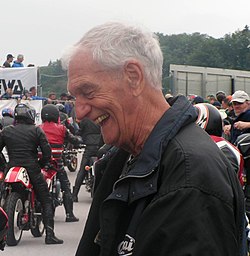
James Albert Redman, MBE (born 8 November 1931) is a Rhodesian former professional motorcycle racer. He competed in Grand Prix motorcycle racing from 1959 to 1966. Redman is notable for being a six-time Grand Prix road racing world champion.[1] In 2012, the F.I.M. inducted Redman into the MotoGP Hall of Fame.[2]
Key Information

.jpg)
History
[edit],_Giacomo_Agostini_(3)_bij_500_cc,_Bestanddeelnr_919-2883.jpg)
Born in London, England, he emigrated to Rhodesia (now Zimbabwe) in 1952, where he began his racing career. He met with John Love who was changing from motorcycle racing to single-seat cars. Redman enthusiastically helped Love prepare and maintain his Cooper F3 with a Manx Norton 500 cc engine. In recognition for Redman's assistance, Love allowed Redman to ride his Triumph Grand Prix including use of his riding gear for his first racing experiences.[3]
Redman acquired more experience on his home tracks, culminating in winning the 350 cc Rhodesian Championship, after which he aspired to European racing, starting at Brands Hatch in the company of Geoff Duke and a young, rising Mike Hailwood. After changing his riding style to better-suit the European circuits, Redman achieved some success, but retired from motorcycle racing and returned to Rhodesia in 1959. Still wanting to race, Redman returned to Europe where he hoped to secure a contract riding for Walter Kaaden's MZ team in 125 cc and 250 cc classes.[3] He unexpectedly gained factory rides in selected races with Honda for part of the 1960 season due to an injury suffered by regular rider Tom Phillis, and became himself contracted for the 1961 season.[3]
Redman would go on to claim four consecutive 350cc World Championships from 1962 to 1965. In 1962 and 1963 he claimed double championships winning both the 250cc and 350cc World Championships. After being injured at the 1966 Belgian Grand Prix, Redman made the decision to retire.[4]
Redman was also a six-time Isle of Man TT winner, taking double wins in 1963, 1964 and 1965 in the Lightweight & Junior TT Races.[5] He achieved a total of 45 Grand Prix victories. Redman was awarded the MBE for his achievements.
Personal life
[edit]In 1966, Jim Redman published a book about his racing career, Wheels of Fortune. In 2013, he published his book, Jim Redman: Six Times World Motorcycle Champion – The Autobiography.
Grand Prix motorcycle racing results
[edit]| Position | 1 | 2 | 3 | 4 | 5 | 6 |
| Points | 8 | 6 | 4 | 3 | 2 | 1 |
(key) (Races in italics indicate fastest lap)
| Year | Class | Team | 1 | 2 | 3 | 4 | 5 | 6 | 7 | 8 | 9 | 10 | 11 | 12 | 13 | Points | Rank | Wins |
|---|---|---|---|---|---|---|---|---|---|---|---|---|---|---|---|---|---|---|
| 1959 | 350cc | Norton | FRA - |
IOM - |
GER 6 |
NED - |
BEL - |
SWE 6 |
ULS - |
NAT - |
2 | 15th | 0 | |||||
| 500cc | Norton | FRA - |
IOM - |
GER - |
NED 5 |
BEL - |
SWE - |
ULS - |
NAT - |
2 | 15th | 0 | ||||||
| 1960 | 125cc | Honda | IOM - |
NED 4 |
BEL 9 |
ULS - |
NAT 4 |
6 | 7th | 0 | ||||||||
| 250cc | Honda | IOM - |
NED 8 |
BEL - |
GER NC |
ULS 3 |
NAT 2 |
10 | 4th | 0 | ||||||||
| 500cc | Norton | FRA - |
IOM - |
NED - |
BEL 5 |
GER - |
ULS 5 |
NAT 6 |
5 | 9th | 0 | |||||||
| 1961 | 125cc | Honda | ESP 3 |
GER 7 |
FRA 3 |
IOM 4 |
NED 2 |
BEL 3 |
DDR 6 |
ULS 4 |
NAT 5 |
SWE 3 |
ARG 2 |
28 | 4th | 0 | ||
| 250cc | Honda | ESP 4 |
GER 2 |
FRA 6 |
IOM 3 |
NED 3 |
BEL 1 |
DDR 2 |
ULS 3 |
NAT 1 |
SWE 4 |
ARG 3 |
36 | 3rd | 2 | |||
| 1962 | 125cc | Honda | ESP 2 |
FRA 2 |
IOM 5 |
NED 2 |
BEL 2 |
GER 10 |
ULS 3 |
DDR 2 |
NAT 4 |
FIN 1 |
ARG - |
38 | 2nd | 1 | ||
| 250cc | Honda | ESP 1 |
FRA 1 |
IOM 2 |
NED 1 |
BEL 2 |
GER 1 |
ULS 2 |
DDR 1 |
NAT 1 |
ARG - |
48 | 1st | 6 | ||||
| 350cc | Honda | IOM - |
NED 1 |
ULS 1 |
DDR 1 |
NAT 1 |
FIN 2 |
32 | 1st | 4 | ||||||||
| 1963 | 125cc | Honda | ESP 2 |
GER NC |
FRA 2 |
IOM 6 |
NED NC |
BEL 2 |
ULS 7 |
DDR 5 |
NAT 2 |
FIN - |
ARG 1 |
JPN 2 |
33 | 3rd | 1 | |
| 250cc | Honda | ESP 2 |
GER 3 |
IOM 1 |
NED 1 |
BEL - |
ULS 1 |
DDR 3 |
NAT 2 |
ARG 2 |
JPN 1 |
44 | 1st | 4 | ||||
| 350cc | Honda | GER 1 |
IOM 1 |
NED 1 |
ULS 1 |
DDR 3 |
NAT 1 |
FIN 2 |
JPN 1† |
32 | 1st | 5 | ||||||
| 1964 | 125cc | Honda | USA - |
ESP 2 |
FRA NC |
IOM 2 |
NED 1 |
GER 1 |
DDR 3 |
ULS NC |
FIN 3 |
NAT 6 |
JPN - |
36 | 2nd | 2 | ||
| 250cc | Honda | USA - |
ESP 2 |
FRA NC |
IOM 1 |
NED 1 |
BEL 2 |
GER 2 |
DDR 2 |
ULS 2 |
NAT 3 |
JPN 1 |
42 | 2nd | 3 | |||
| 350cc | Honda | IOM 1 |
NED 1 |
GER 1 |
DDR 1 |
ULS 1 |
FIN 1 |
NAT 1 |
JPN 1 |
40 | 1st | 8 | ||||||
| 1965 | 125cc | Honda | USA - |
GER - |
ESP - |
FRA - |
IOM - |
NED - |
DDR - |
CZE - |
ULS - |
FIN - |
NAT - |
JPN NC |
0 | – | 0 | |
| 250cc | Honda | USA - |
GER - |
ESP - |
FRA NC |
IOM 1 |
NED 2 |
BEL 1 |
DDR 1 |
CZE 3 |
ULS - |
FIN - |
NAT - |
JPN - |
34 | 3rd | 3 | |
| 350cc | Honda | GER NC |
IOM 1 |
NED 1 |
DDR 1 |
CZE 1 |
ULS NC |
FIN - |
NAT - |
JPN 2 |
38 | 1st | 4 | |||||
| 1966 | 250cc | Honda | ESP NC |
GER 2 |
FRA 2 |
NED 3 |
BEL 3 |
DDR - |
CZE - |
FIN - |
ULS - |
IOM - |
NAT - |
JPN - |
20 | 3rd | 0 | |
| 350cc | Honda | GER - |
FRA 3 |
NED - |
DDR - |
CZE - |
FIN - |
ULS - |
IOM - |
NAT - |
JPN - |
4 | 15th | 0 | ||||
| 500cc | Honda | GER 1 |
NED 1 |
BEL NC |
DDR - |
CZE - |
FIN - |
ULS - |
IOM - |
NAT - |
16 | 5th | 2 |
† The 1963 350cc Japanese Grand Prix was a non-championship event.
References
[edit]- ^ Jim Redman career statistics Archived 31 October 2018 at the Wayback Machine. MotoGP.com
- ^ "FIM Legends" (PDF). fim-live.com. Archived from the original (PDF) on 2 October 2020. Retrieved 29 April 2020.
- ^ a b c Carrick, Peter Motor Cycle Racing Hamlyn Publishing, 1969, p. 72 ISBN 0 600 02506 3
- ^ 50 Years of Moto Grand Prix (1st edition). Hazelton Publishing Ltd, 1999. ISBN 1-874557-83-7
- ^ Jim Redman. iomtt.com
External links
[edit]
- Redman images at Roy Hesketh Circuit motorcycle gallery Archived 17 October 2014 at the Wayback Machine
Jim Redman
View on GrokipediaEarly Life
Birth and Family Background
James Albert Redman was born on 8 November 1931 in Hampstead, London, England, to British parents.[1] His father served as a driver of ammunition lorries in North Africa during the Second World War, an experience that contributed to severe post-war trauma leading to his suicide in 1949 when Jim was 17.[4] Just 27 days later, his mother died from a cerebral haemorrhage brought on by shock from learning of the suicide.[5][6] As the second eldest child, Redman, then 17, assumed responsibility for his siblings alongside his 18-year-old sister Jackie, including their 11-year-old twin siblings Peter and Wendy.[1] Born with British nationality, he grew up in London amid the hardships of wartime bombings, which he survived as a child.[1] Although specific details of his early education are limited, he attended local schools in the capital before national service obligations intervened.[6] At age 18, Redman was called up for British Army service but received a two-year deferment to manage family affairs after his parents' deaths.[1] With no further extension possible and facing potential separation of his siblings into care, he chose emigration to Southern Rhodesia in 1952, where a friend awaited, marking a pivotal shift from his English roots.[1]Emigration to Rhodesia
In 1952, at the age of 21, Jim Redman emigrated from post-war Britain to Southern Rhodesia (now Zimbabwe) along with his three siblings, following the tragic deaths of their parents three years earlier—his father by suicide due to war trauma and his mother shortly thereafter from a cerebral haemorrhage—leaving him responsible for their care and prompting the move to avoid institutionalization and compulsory military service.[1][6][4] The decision was influenced by colonial ties and the promise of economic opportunities in the British settler colony, as well as Redman's connection to a friend already there, who facilitated their arrival in Bulawayo after a month-long journey on a cargo ship funded by selling his motorcycle.[1][6] Upon settling in Bulawayo, Redman settled in Rhodesia as a British subject, integrating into the local white settler society amid the colony's post-war expansion, where British immigrants often found work in mining, agriculture, and trade.[1][7] Living conditions contrasted sharply with urban London's austerity and bomb-damaged streets; Rhodesia's warmer climate, vast open landscapes, and relative prosperity offered a sense of freedom, though racial segregation and colonial hierarchies shaped daily life for European arrivals.[6] To support his family, Redman took up mechanical work, initially at the Colonial Mutual Engine Depot (CMED) in the car and engine sections, where he honed technical skills in vehicle repair and maintenance essential for the colony's rugged terrain and limited infrastructure.[6] He later established Curbside Motors, a small enterprise focused on automobile servicing, which built his expertise with engines and machinery while providing financial stability in a community reliant on imported British vehicles.[6] This period of hands-on labor in Rhodesia's emerging industrial scene laid the groundwork for his mechanical proficiency. This early exposure to vehicles in Rhodesia also ignited his longstanding interest in motorcycles, drawing him toward local racing circles.[4]Entry into Racing
Local Competitions in Africa
Jim Redman emigrated to Southern Rhodesia in 1952, where he soon took up motorcycle racing amid the region's burgeoning motorsport scene.[8] Upon arrival, he connected with local racer John Love, who was transitioning from motorcycles to single-seater cars, and began assisting with mechanical preparations and maintenance on Love's vehicles in exchange for racing advice and access to equipment.[4] This collaboration proved pivotal, as Love sold Redman one of his motorcycles in 1954, providing the means for Redman to enter the sport.[9] Redman's initial racing experiences came in local Rhodesian events starting in 1954, including club races on rudimentary tracks where he rode Love's 500cc Triumph Grand Prix twin, finishing seventh in his debut outing.[4] Over the next few years, he competed in regional competitions across Rhodesia and nearby areas, honing his skills on circuits like those in Bulawayo and gaining familiarity with hill climbs and road races that characterized African amateur motorsport at the time.[4] A notable early performance came in 1957, when riding an AJS 7R single-cylinder machine, he secured victory in the 350cc South African Gold Star Championship, marking his first significant triumph and demonstrating his growing prowess.[4] These formative years were marked by substantial challenges, including limited financial resources, basic equipment often requiring self-modification, and the inherent dangers of racing on unpaved or poorly maintained African venues with minimal safety provisions.[4] Despite frustrations with the amateur level's constraints, which led to a brief retirement in late 1957, Redman's local successes built a foundation for his international ambitions.[4]Transition to International Circuits
After his early local successes, Jim Redman made his initial foray into European racing in 1958, including a debut appearance at Brands Hatch in April where he finished second to Derek Minter on privateer machinery to gain experience on faster, more technical circuits compared to African tracks.[1] Later that year, he made his World Championship Grand Prix debut at the Isle of Man TT, finishing seventh in the Junior 350cc race on a Norton. He also competed in the 350cc West German Grand Prix at Hockenheim later in 1958 and the 1959 event, retiring due to mechanical issues and marking early lessons in the reliability demands of global competition.[10][2][11] Following the 1958 season and a return to Rhodesia to support his new family, Redman continued racing on non-Japanese bikes, primarily British models like the Norton, in a handful of European events, including additional outings at British circuits such as Brands Hatch and other national meetings, where he achieved modest finishes while adapting to the higher speeds and closer racing of the professional scene.[1][10] His 1959 season featured limited Grand Prix starts with no points, highlighting a steep learning curve as he navigated unfamiliar tracks and competitors from established European teams.[10] Traveling from Rhodesia presented significant logistical hurdles, including lengthy sea voyages or flights to ship motorcycles and parts across continents, compounded by limited financial resources that forced Redman to seek temporary work and borrow equipment upon arrival.[10][12] Building international contacts was equally challenging for the outsider from Africa, requiring him to network at events and rely on informal connections in the British racing community to secure rides and entries.[10] By 1960, these efforts yielded progress, including a victory in the 500cc Spanish Grand Prix on a Norton, which caught the attention of manufacturers and facilitated his entry into factory-supported racing.[1]Professional Career
Association with Honda
In 1960, Honda recruited Jim Redman to their factory racing team after regular rider Tom Phillis suffered a broken collarbone during practice for the Dutch TT at Assen, providing Redman with his first opportunities on factory machinery in selected Grand Prix events.[13] This recruitment aligned with Honda's broader strategy under founder Soichiro Honda to enter the European Grand Prix series aggressively, aiming to showcase Japanese engineering prowess and challenge established European manufacturers through competitive four-stroke motorcycles.[14] Redman's role within the team involved close collaboration with Soichiro Honda and lead engineer Michihiko Aika, where he offered critical rider feedback during testing sessions at Honda's facilities in Japan, influencing iterative improvements to chassis and power delivery.[15] Their dynamics emphasized a shared commitment to four-stroke technology, with Redman advocating for refinements that enhanced reliability and performance without compromising Honda's aversion to two-stroke designs.[3] During the 1960–1961 seasons, Redman competed in early non-championship and Grand Prix events on Honda's 250cc four-cylinder RC162, securing his first Grand Prix victory in the 250cc class at the 1961 Belgian Grand Prix at Spa-Francorchamps ahead of teammate Luigi Taveri.[1] His input extended to technical advancements, particularly in tuning the four-stroke engines for the 250cc and 350cc classes, where he tested modifications to valve timing and exhaust systems that improved mid-range torque and top-end power for better track adaptability.[16] This foundational work with Honda paved the way for the team's transition to sustained championship contention in subsequent years.Major Championships and Victories
Jim Redman's Grand Prix career peaked with six world championships, including back-to-back titles in the 250cc class in 1962 and 1963.[1] In 1962, riding the Honda RC162, he secured the 250cc crown by winning key races such as the German Grand Prix at Solitude and the Dutch Grand Prix at Assen, contributing to six victories overall that season and establishing Honda's dominance in the class.[17] His 1963 campaign was even more intense, marked by a fierce rivalry with Tarquinio Provini on the Moto Morini 250 Bialbero; despite Provini also securing 4 wins, Redman clinched the title by just two points after consistent podium finishes, including victories at the Dutch, German, and Finnish Grands Prix.[18][17] Redman's success extended to the 350cc class, where he achieved four consecutive world championships from 1962 to 1965, a record of dominance unmatched until later decades.[1] In 1962, he swept the Italian Grand Prix to seal the title alongside his 250cc success, while subsequent years saw him amass multiple wins and podiums per season on evolving Honda four-cylinder machines, such as the RC164 in 1964.[19] In 1964, Redman dominated the 350cc class, winning all eight rounds on the Honda RC164 and securing the title with 48 points. His 350cc seasons often featured double-digit podiums, underscoring his adaptability to high-speed circuits like Monza and the Nürburgring.[1] Across his Grand Prix career from 1959 to 1966, Redman recorded 45 victories and 98 podiums in 135 starts, spanning the 125cc, 250cc, 350cc, and 500cc classes.[1] These achievements, particularly his unbeaten streak in the 350cc from 1962 onward, solidified his status as Honda's premier rider during the Japanese manufacturer's formative World Championship era. Redman also holds the record for winning three classes (125cc, 250cc, and 350cc) in a single day at the 1964 French Grand Prix. His Grand Prix triumphs paralleled his successes at the Isle of Man TT, enhancing his reputation as a versatile road racer.[20]Isle of Man TT Successes
Jim Redman made his debut at the Isle of Man TT in 1961, riding a Honda four-cylinder 250cc machine to a third-place finish in the Lightweight TT, marking an impressive start for the Southern Rhodesian rider on the demanding 37.73-mile Mountain Course.[2] He followed this with a fourth place in the 125cc Ultra-Lightweight TT later that week, demonstrating his adaptability to the circuit's public roads and variable conditions while competing against established European riders.[2] Over the subsequent years, Redman's progression was rapid, as he secured podium finishes and increasingly competitive laps on Honda prototypes, building toward his breakthrough victories.[3] Redman's TT successes peaked with a unique hat-trick of double wins from 1963 to 1965, all aboard Honda machinery, totaling six victories that underscored his precision and speed on the twisting layout.[2] In 1963, he claimed the Lightweight 250cc TT and Junior 350cc TT, setting a new race record in the latter at 94.91 mph despite challenging wet patches on the course.[21] He repeated the double in 1964, winning the 250cc event at a race average of 97.45 mph and the 350cc at 100.02 mph, both establishing fresh benchmarks for multi-cylinder Hondas. The 1965 season brought another pair of triumphs in the Lightweight and Junior races, highlighted by a lap record of 102.85 mph in the 350cc class—pushing the Honda RC174 six-cylinder engine to its limits—and a victory in the 250cc on the innovative RC166, averaging 100.72 mph amid fierce competition from Yamaha rivals. These achievements not only elevated Honda's reputation but also solidified Redman's status in international road racing.[3] The Mountain Course presented formidable challenges for Redman, including unpredictable Isle of Man weather that could shift from dry to rain-slicked roads mid-race, demanding split-second adjustments on high-revving Hondas prone to handling quirks over the course's 200+ corners and elevations.[22] Bike handling was particularly testing on the public roads, where the four- and six-cylinder engines required precise throttle control to navigate narrow lanes and avoid curbs, as Redman noted in reflections on battling machine limitations during his TT campaigns.[3] Redman participated in 14 TT races across classes from 1961 to 1966, achieving his six wins before retiring from the event.[23] As of 2025, his total places him tied for 30th on the all-time TT winners list, sharing the mark with riders like John Surtees.[24]Retirement
The 1966 Belgian Grand Prix Incident
During the 500cc class of the 1966 Belgian Grand Prix on July 3 at the Spa-Francorchamps circuit, Jim Redman suffered a severe crash that marked the end of his active racing season. Riding for Honda, Redman was competing under treacherous conditions as a sudden thunderstorm unleashed heavy rain, turning the track into a slippery, puddle-filled surface exacerbated by its bumpy layout.[25] On only the second lap, he lost control and slid off the road after hitting a deep puddle, resulting in a high-speed separation from his Honda RC181 bike.[25] The accident caused Redman to break his right wrist in three places, with no immediate reports of additional injuries from mechanical failure such as a tire issue, though the wet conditions were the primary factor cited.[25][1] Medical personnel responded promptly at the scene, and Redman was transported to Liège Hospital in Belgium for treatment, where he began his initial recovery under observation.[26] This incident not only sidelined him for the remainder of the season but also dashed Honda's hopes in the 500cc championship, where Redman had been a leading contender with 16 points prior to the race; Giacomo Agostini capitalized on the misfortune to secure the title.[25] The crash came shortly after Redman's most recent victory in the 500cc class at the Dutch TT on June 24, where he had triumphed on his Honda RC181 ahead of Agostini, maintaining his strong form early in the year.[27] This injury ultimately prompted Redman's full retirement from professional racing.[26]Immediate Aftermath and Career End
Following the severe injury sustained during the 1966 Belgian Grand Prix, where he crashed in torrential rain at Spa-Francorchamps and broke his right wrist in three places after just two laps, Jim Redman effectively ended his Grand Prix motorcycle racing career at the age of 34.[25][16][1] The incident occurred on July 3, 1966, sidelining him for the remainder of the World Championship season and shifting Honda's focus to teammate Mike Hailwood, who went on to secure the 350cc title that year—breaking Redman's four-year dominance in the class.[1] Redman attempted a brief return at the Ulster Grand Prix five weeks later but was unable to continue due to ongoing recovery issues, prompting his full retirement from competitive racing.[1] Redman's retirement was announced in the months following the Belgian GP crash, driven primarily by the escalating risks of injury in an era of high-speed motorcycle racing without modern safety standards.[16] He reflected on his career with satisfaction, having amassed six world championships and 45 Grand Prix victories across multiple classes, crediting his success to Honda's innovative machinery and his own determination.[16] The handover to emerging talents like Hailwood was seamless within the Honda team, as Redman had already endorsed his teammate's potential prior to the season, ensuring continuity in Honda's championship pursuits.[1] In the immediate post-retirement period of 1966–1967, Redman maintained limited involvement in racing through a farewell appearance at the seventh Rhodesian Grand Prix in Bulawayo in December 1966, marking a symbolic close to his competitive days on home soil.[12] By mid-1967, he had transitioned fully away from the track, establishing a motorcycle agency in Durban, South Africa, to focus on business endeavors.[12]Personal Life
Family Details
Jim Redman married Marlene, a native of Durban, South Africa, prior to his return to Europe for the 1959 racing season, which added a sense of responsibility as he sought to provide for his growing family.[5][6] The couple had two sons: Jimmy, who occasionally rode motorcycles recreationally, and Brett, who pursued a professional career in motocross, becoming a multiple-time South African national champion.[6][28] During Redman's racing career, Marlene provided essential stability by managing the household in Rhodesia while he traveled extensively for competitions across Europe, Japan, and other locations, often commuting between Rhodesia and South Africa starting in 1964 to accommodate Jimmy's schooling needs.[6] This arrangement allowed Redman to focus on his professional commitments, though the frequent absences strained family dynamics and prompted a full relocation to South Africa in 1964 amid political unrest in Rhodesia and a desire for better educational opportunities for their children.[6] Redman later expressed regret over exposing his sons to racing memorabilia, deliberately hiding his trophies at home to discourage them from entering the dangerous sport, reflecting how his experiences shaped his protective approach to family life.[6] The couple separated after Redman's retirement.[6] Following his retirement, Redman remained based in South Africa for many years, where he managed businesses including a Yamaha agency and later a casino, while prioritizing a stable environment away from the uncertainties of racing.[6] In his later years, around 2016 at age 85, Redman relocated to England, returning to his country of birth to be closer to extended family and medical resources; he continues to reside there as of 2025.[6][29] Redman's relocation decisions post-retirement were influenced by a desire to safeguard well-being after the risks of his career culminated in the 1966 incident.[6]Publications and Writings
Jim Redman published his first book, Wheels of Fortune, in 1966 through Stanley Paul, offering an autobiographical account of his burgeoning motorcycle racing career during the early 1960s.[30] The work focuses on his Grand Prix victories and Isle of Man TT successes, highlighting the technical innovations in Honda machinery that propelled his rise, alongside the inherent risks of high-speed competition on international circuits.[31] Through vivid narratives, Redman explores personal growth amid the pressures of professional racing, from adapting to new technologies to overcoming early setbacks in his transition from amateur to world-class contender.[32] In 2013, Redman released a new edition of his comprehensive autobiography, Jim Redman: Six Times World Motorcycle Champion, published by Veloce Publishing, which chronicles his entire life story from humble origins in 1930s London to his retirement following the 1966 crash.[33] The book delves into his migration to Rhodesia, mid-1950s racing debut, six World Championships—including the unprecedented 1964 triple win that earned him an MBE—and post-retirement business ventures, with reflective insights on the physical and emotional toll of the sport.[34] Themes of technical innovation recur as Redman recounts Honda's engineering breakthroughs, while emphasizing the risks exemplified by his career-ending injury and the personal growth derived from resilience and adaptation in later classic racing returns in 1995.[35] Redman also contributed to racing literature through compiled print interviews in motorcycle magazines during the 1960s and 1970s, where he shared firsthand accounts of race strategies and bike developments, often republished in enthusiast collections.[36] These pieces reinforce the motifs of innovation and risk in his narratives, providing readers with insider perspectives on the era's evolving Grand Prix scene without delving into exhaustive technical manuals.[37]Legacy
Awards and Inductions
In recognition of his exceptional contributions to motorcycle racing, Jim Redman was appointed Member of the Order of the British Empire (MBE) in 1964 for services to sport, an honor that acknowledged his role in elevating the profile of motorcycling through his world championships and Grand Prix successes.[12] The award, formally presented to him in 1972, highlighted his status as a pioneering rider who helped establish Rhodesia on the international racing stage.[12] Redman's accomplishments were further honored by his induction into the MotoGP Hall of Fame in 2007, celebrating his six world championships and 45 Grand Prix victories, which underscored his dominance in the 250cc and 350cc classes during the 1960s.[10] This prestigious recognition affirmed his legacy as one of the sport's early icons, particularly for his partnership with Honda in advancing four-stroke technology.[10] In 2012, Redman was named an FIM Legend at the annual FIM Gala in Monaco, a distinction awarded by the Fédération Internationale de Motocyclisme to riders who have significantly shaped the history of motorcycle sport.[38] The honor specifically recognized his innovative riding style and contributions to road racing, including his record-setting performances at the Isle of Man TT.[38] Earlier in his career, Redman was named Rhodesia's Sportsman of the Year in 1964, following finalist placements in 1962 and 1963, an accolade that celebrated his back-to-back world titles and his representation of the nation abroad.[39] This national honor reflected the widespread admiration for his achievements in bringing global attention to Rhodesian athletics.[12]Ongoing Influence and Recent Engagements
Following his retirement from competitive racing, Jim Redman has continued to serve as an ambassador and mentor for Honda, sharing insights from his career that helped pioneer the company's four-stroke engine innovations, which remain foundational to modern MotoGP prototypes. In 2021, to commemorate the 60th anniversary of Honda's first motorcycle world title, Redman participated in an official "In Conversation" event hosted by Honda Racing, where he discussed the technological advancements and rider development that shaped the brand's enduring commitment to four-stroke performance.[40] Redman remains active in public appearances, engaging with fans and the motorsport community into the 2020s. Earlier in 2025, he appeared at the Bristol Classic MotorCycle Show on February 22–23, highlighting his role in Honda's historic Grand Prix successes alongside other legends.[41] He has also made recurring visits to events like the Brno Grand Prix Revival, contributing to the revival of classic motorcycle racing heritage.[42] The Redman family legacy extends through his son Brett, a multiple South African National Motocross Champion who competed successfully in the 1980s and 1990s, including podium finishes in national 250cc events.[43] Brett's achievements in off-road racing reflect the enduring passion for motorcycles passed down from his father's Grand Prix triumphs. Redman has significantly contributed to preserving motorcycle racing history through interviews, talks, and exhibits. In 2015, he delivered a detailed presentation on his career at Brooklands Museum, aiding efforts to document early Japanese motorcycle engineering.[44] These engagements, often tied to his 2013 autobiography Jim Redman: Six Times World Motorcycle Champion – The Autobiography, ensure his experiences continue to inspire archival collections and public exhibits.[6]Racing Statistics
Grand Prix Career Overview
Jim Redman's Grand Prix career spanned from 1958 to 1966, marking a transformative period in motorcycle road racing where he rose from a promising privateer to a factory-supported champion. Debuting at the 1958 British Grand Prix at Brands Hatch in the 350cc class on a Norton, he quickly demonstrated potential by winning the 500cc Spanish Grand Prix in 1960 on the same marque, establishing early credibility in the premier class.[1] From 1960 onward, Redman aligned with the Honda factory team, becoming its lead rider and instrumental in the manufacturer's aggressive entry into global Grand Prix competition as Honda sought to challenge European dominance. He competed across the 250cc, 350cc, and 500cc classes, leveraging innovative multi-cylinder four-stroke machines like the RC162 and RC181 to secure consistent top results. This partnership not only elevated Redman's profile but also symbolized Honda's technological ascent, with Redman adapting to evolving bike designs amid the company's international expansion.[3][45] Throughout his tenure, Redman achieved 45 Grand Prix victories and 98 podium finishes, reflecting a remarkable win rate and podium consistency that underscored his skill in high-stakes races. His aggregate accomplishments, including six world championships—two in 250cc and four in 350cc—highlighted a progression from underdog status to undisputed dominance, particularly in the mid-1960s before a severe injury at the 1966 Belgian Grand Prix prompted his retirement.[46][10][3]Championship Results and Records
Jim Redman secured six FIM Grand Prix world championships between 1962 and 1965, including a record four consecutive titles in the 350cc class from 1962 to 1965, the longest streak in that category during the early years of the series. His career total of 546 points across all classes underscored his dominance on Honda machinery, while his 45 Grand Prix victories placed him among the era's elite, trailing only Mike Hailwood's 76 GP wins as the leading scorer in the 1960s. These achievements highlighted Redman's consistency, with multiple double championships in 250cc and 350cc, though his 1966 season was curtailed by injury after early successes in the 500cc class.[1][3][47] Redman's year-by-year performances in the relevant classes are summarized below, focusing on final standings positions, points scored (based on the era's scoring system awarding 8-6-4-3-2-1 to the top six finishers, with best results counting), and race wins. Data reflects participation from 1961 onward, with limited entries in some classes post-1963 as he prioritized 350cc and later 500cc efforts.| Year | 250cc Position | 250cc Points | 250cc Wins | 350cc Position | 350cc Points | 350cc Wins | 500cc Position | 500cc Points | 500cc Wins |
|---|---|---|---|---|---|---|---|---|---|
| 1961 | 3rd | 36 | 2 | 5th | 12 | 0 | - | - | - |
| 1962 | 1st | 32 | 6 | 1st | 48 | 6 | - | - | - |
| 1963 | 1st | 34 | 3 | 1st | 32 | 5 | - | - | - |
| 1964 | 2nd | 4 | 1 | 1st | 40 | 8 | - | - | - |
| 1965 | Did not contest full season | 0 | 0 | 1st | 32 | 4 | - | - | - |
| 1966 | 3rd (partial) | 16 | 2 | Did not contest | - | - | 5th | 16 | 2 |