Hubbry Logo
UmberUmberMain
Open search
Umber
Community hub
Umber
logo
8 pages, 0 posts
0 subscribers
Be the first to start a discussion here.
Umber
Umber
from Wikipedia
Umber
 
About these coordinates     Color coordinates
Hex triplet#635147
sRGBB (r, g, b)(99, 81, 71)
HSV (h, s, v)(21°, 28%, 39%)
CIELChuv (L, C, h)(36, 15, 39°)
SourceColorHexa[1]
B: Normalized to [0–255] (byte)
Jules Bastien-Lepage, Pas Meche, 1882. An example of the shadows created by using umber in a painting.[2]

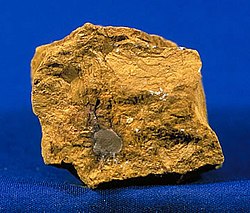
Umber is a natural earth pigment consisting of iron oxide and manganese oxide; it has a brownish color that can vary among shades of yellow, red, and green.[3]: 39  Umber is considered one of the oldest pigments known to humans.[4]: 378  Umber's advantages are its highly versatile color, warm tone, and quick drying abilities.[5]: 148–49  While some sources indicate that umber's name comes from its geographic origin in Umbria, other scholars suggest that it derives from the Latin word umbra, which means "shadow".[6]: 250  The belief that its name derives from the word for shadow is fitting, as the color helps create shadows.[6]: 250  The color is primarily produced in Cyprus.[6]: 250  Umber is typically mined from open pits or underground mines and ground into a fine powder that is washed to remove impurities.[7] In the 20th century, the rise of synthetic dyes decreased the demand for natural pigments such as umber.[citation needed]

History

[edit]

[4] Ocher, a family of earth pigments which includes umber, has been identified in the caves of Altamira in Spain and the Lascaux Cave in France.[6]: 251  Some sources indicate that umber was not frequently used in medieval art because of its emphasis on bright and vivid colors.[8]: 166  Other sources indicate, however, that umber was used in the Middle Ages to create different shades of brown, most often seen for skin tones.[9] Umber's use in Europe increased in the late 15th century.[8]: 168  Umber became more popular during the Renaissance when its versatility, earthy appearance, availability, and inexpensiveness were recognized.[6]: 251 

Reproduction of Lascaux cave paintings, which are around 17,000 years old.[2]

Umber gained widespread popularity in Dutch landscape painting in the eighteenth century.[4]: 378  Artists recognized the value of umber's high stability, inertness, and drying abilities.[5]: 148–49  It became a standard color within eighteenth-century palettes throughout Europe.[4]: 378  Umber's popularity grew during the Baroque period with the rise of the chiaroscuro style.[citation needed] Umber allowed painters to create an intense light and dark contrast.[citation needed] Underpainting was another popular technique for painting that used umber as a base color.[10] Umber was valuable in deploying this technique, creating a range of earth like tones with various layering of color.[citation needed]

Toward the end of the 19th century, the Impressionist movement started to use cheaper and more readily available synthetic dyes and reject natural pigments like umber to create mixed hues of brown.[citation needed] The Impressionists chose to make their own browns from mixtures of red, yellow, green, blue and other pigments, particularly the new synthetic pigments such as cobalt blue and emerald green that had just been introduced.[6] In the 20th century, natural umber pigments began to be replaced by pigments made with synthetic iron oxide and manganese oxide.[citation needed]

Criticism

[edit]

Beginning in the 17th century, umber was increasingly criticized within the art community. British painter Edward Norgate, prominent with British royalty and aristocracy, called umber "a foul and greasy color."[3]: 56  In the 18th century, Spanish painter Antonio Palomino called umber "very false."[3]: 56  Jan Blockx, a Belgian painter, opined, "umber should not appear on the palette of the conscientious painter."[3]: 56 

Visual properties

[edit]

Umber is a natural brown pigment extracted from clay containing iron, manganese, and hydroxides.[11] Umber has diverse hues, ranging from yellow-brown to reddish-brown and even green-brown. The color shade varies depending on the proportions of the components. When heated, umber becomes a more intense color and can look almost black. Burnt umber is produced by calcining the raw version.[citation needed] The raw form of umber is typically used for ceramics because it is less expensive.[12]

These warm and earthy tones make it a valuable and versatile pigment for oil painting and other artwork.[12] Umber's high opacity and reactivity of light allow the pigment to have strong hiding power.[13] It is insoluble in water, resistant to alkalis and weak acids, and non-reactive with cement, solvents, oils, and most resins.[12] Umber is known for its stability.[5]: 149 

Notable occurrences

[edit]
Leonardo da Vinci, Mona Lisa, Early 16th century. A laboratory analysis has revealed the presence of umber.[14]

Umber became widely used throughout the Renaissance period for oil paintings.[15] In the Mona Lisa, Leonardo da Vinci used umber for the brown tones throughout his subject's hair and clothing.[14] Da Vinci also extensively used umber in his painting the Last Supper to create shadows and outlines of the figures.[16] Throughout the Baroque period, many renowned painters used umber.[citation needed]

Varieties

[edit]

Raw umber

[edit]
Raw Umber
 
About these coordinates     Color coordinates
Hex triplet#826644
sRGBB (r, g, b)(130, 102, 68)
HSV (h, s, v)(33°, 48%, 51%)
CIELChuv (L, C, h)(45, 33, 52°)
SourceISCC-NBS
ISCC–NBS descriptorModerate yellowish brown
B: Normalized to [0–255] (byte)

This is the color raw umber.

Burnt umber

[edit]
Burnt umber
 
About these coordinates     Color coordinates
Hex triplet#8A3324
sRGBB (r, g, b)(138, 51, 36)
HSV (h, s, v)(9°, 74%, 54%)
CIELChuv (L, C, h)(34, 69, 17°)
SourceXona.com Color List
ISCC–NBS descriptorStrong reddish brown
B: Normalized to [0–255] (byte)

Burnt umber is made by heating raw umber, which dehydrates the iron oxides and changes them partially to the more reddish hematite. It is used for both oil and water color paint.[17]

The first recorded use of burnt umber as a color name in English was in 1650.[18]

See also

[edit]

References

[edit]
[edit]
Revisions and contributorsEdit on WikipediaRead on Wikipedia
from Grokipedia
Umber is a natural brown earth derived from clay and soil deposits rich in s and oxides, typically ranging from yellowish-brown to dark brown in color, and widely used in art, industry, and cosmetics for its versatile shading properties. The pigment's name originates from the region in , where high-quality deposits were historically sourced, with superior varieties now primarily mined in . Raw umber, in its unprocessed form, exhibits a cool, yellowish-brown or greenish-brown hue due to its composition of (an ) and 5-20% oxides and hydroxides, while burnt umber achieves a warmer, reddish-brown tone through , a heating process that alters its iron content. These earth pigments have been employed since prehistoric times, gaining prominence during the and eras in European for creating shadows, , and naturalistic effects in works by artists such as , , , and Vermeer. Umber's physical properties include a fine texture, density of 3.2-3.6 g/ml, and fast-drying behavior in mediums, making it non-toxic, lightfast, and permanent across applications like , watercolor, and . In artistic practice, it serves to tone canvases, develop initial sketches, and create smooth transitions between light and dark areas, often mixed with other pigments for depth without overpowering transparency. Beyond fine arts, umber finds use in production, building materials like bricks and mortar, and cosmetic formulations such as powders and eyeshadows, valued for its stability and earthy tones. Although synthetic alternatives emerged in the 20th century, umber remains prized for its authenticity and in traditional contexts.

Overview and Composition

Definition

Umber is a natural brown derived from clay-rich soils containing iron and oxides. As an , it consists of naturally occurring mineral mixtures that have been used in art for centuries due to their stability and versatility in producing shades from yellowish-brown to deep brown. The term "umber" originates from the Latin umbra, meaning "shadow," which alludes to the pigment's dark, shadowy tones; an alternative theory links it to the region in , where such deposits were historically mined. The word entered English usage around 1560, borrowed from French ombre or Italian ombra. Umber belongs to the family of earth pigments, which are characterized by their iron-based compositions, but it is distinguished from by its elevated content that results in cooler, darker browns rather than the warmer yellows of sienna. This classification places umber among the most enduring natural pigments, valued for its permanence in both raw and calcined forms.

Chemical Makeup

Umber is a natural primarily composed of iron oxides, including (Fe₂O₃) and (α-FeOOH), which contribute to its base reddish tones, along with 5-20% oxides (such as MnO₂) that impart darker brown hues. It also contains clay minerals (aluminosilicates), silica (SiO₂), and trace elements like calcium compounds, which form the matrix binding these oxides. The typical chemical representation of umber involves a combination of (Fe₂O₃) and (MnO₂) in varying ratios, often expressed as Fe₂O₃ · H₂O + MnO₂ · (n H₂O) + Al₂O₃ to account for hydration and aluminum from clay. Compositionally, natural umber generally features 20-60% iron oxides and 5-20% manganese oxides, with the exact proportions depending on the geological source. Variations in purity arise from impurities such as iron s and silicates, which can influence the pigment's consistency and reactivity; for instance, higher hydroxide content may indicate less processed deposits. While synthetic umbers exist, forms predominate in traditional use and are characterized by these heterogeneous admixtures rather than uniform synthetic formulations.

Physical and Visual Properties

Color Variations

Umber exhibits a spectrum of earthy brown hues, primarily ranging from yellowish-brown to greenish-brown in its raw form, often represented by the hex code #826644, which corresponds to a muted, neutral tone with RGB values of 130, 102, 68. When processed into burnt umber through calcination, the color shifts to a warmer reddish-brown, typically hex #8A3324 (RGB 138, 51, 36), due to structural changes in its mineral components. In terms of opacity, umber is generally semi-transparent when dispersed in oil, allowing underlying layers to subtly influence the final appearance, while in watercolor, it can appear more opaque depending on the formulation and application thickness, providing versatile coverage for artistic effects. The specific tones of umber are influenced by its composition, particularly the relative concentrations of and iron oxides. Higher content imparts cooler, more subdued greenish or neutral undertones in raw umber, contributing to its darker and less vibrant appearance compared to other earth pigments. In contrast, iron oxides promote warmer, reddish hues, especially after heating in burnt umber, where dehydration enhances the red form for increased intensity. Umber demonstrates excellent , rated ASTM I, indicating superior permanence and resistance to fading under prolonged exposure to light, making it a reliable choice for long-lasting artwork across various media. Relative to related earth pigments, umber produces darker and more neutral shades than or , owing to its elevated levels, which temper the brighter yellow-orange tones of ochre (primarily iron-based) and the warmer reds of sienna (with lower manganese). This neutrality allows umber to serve as an effective mid-tone or shadow color in palettes seeking balanced earthiness.

Stability and Handling

Umber demonstrates strong , remaining insoluble in and resistant to both dilute acids and alkalis, which makes it suitable for long-term use in various artistic media without degradation from environmental exposures. This inertness extends to non-reactivity with common solvents, oils, and resins, ensuring the pigment maintains its integrity during mixing and application. While generally non-toxic for skin contact in artistic contexts, dry umber powder poses an inhalation hazard and should be handled with care to avoid respiratory irritation. In handling, umber functions as a natural siccative in oil paints due to its content, accelerating the oxidation process and reducing times compared to slower- pigments, often achieving touch-dry states in 1-2 days under standard conditions. Its , typically ranging from 1 to 50 micrometers, influences , with finer-ground varieties offering smoother, less textured applications ideal for detailed work, while coarser particles may impart a more matte, earthy finish. High oil absorption (around 18-35%) requires careful proportioning during mixing to achieve optimal consistency without . The pigment's permanence is exceptional, with outstanding lightfastness rated ASTM I, resisting fading even under prolonged exposure to sunlight or artificial light. Chemical resistance further ensures durability against environmental factors, as evidenced by the absence of degradation in prehistoric and Renaissance-era artworks containing umber, where samples have retained their color integrity over centuries.

Varieties

Raw Umber

Raw umber is the unprocessed, uncalcined form of the natural known as umber, prized for its distinct cool, greenish-brown tone that imparts a more subdued and earthy quality to artistic applications. This hue, often approximated by the hexadecimal color code #826644, arises from its and content in an unaltered state, resulting in a semi-transparent appearance when dispersed in oil media. Unlike the warmer, redder variant produced through heating, raw umber's cooler undertones make it particularly suitable for depicting natural shadows and underpaintings, where its fine-grained texture and medium tinting strength allow for subtle layering without overpowering adjacent colors. The designation "raw" specifically denotes its unheated condition, a rooted in 16th-century Italian painting treatises that referred to it as terra d'ombra, highlighting its origin from shadowed earth deposits in regions like . This uncalcined state preserves the pigment's inherent properties, including a higher natural moisture content that contributes to its pliability and transparency in binding mediums. In contrast to burnt umber, which undergoes thermal alteration for intensified color, raw umber maintains a more neutral, greenish bias ideal for cooling warmer mixtures. In , raw umber offers advantages such as its semi-transparency, which facilitates smooth blending and gradual tonal transitions, making it a staple for artists seeking nuanced effects. Its presence in the prehistoric palette of earth pigments underscores its early use alongside ochres for basic color needs, while in , it was frequently employed in flesh tones to achieve realistic, subdued browns that harmonize with highlights and mid-tones. The pigment's drying characteristics in oils, influenced by its manganese content, enable reliable performance in multi-layer techniques without excessive haste.

Burnt Umber

Burnt umber is derived from raw umber through a process, where the natural is heated, transforming its color to a warmer, reddish-brown tone with the code #8A3324. This heat treatment oxidizes the oxides within the and dehydrates iron hydroxides to oxides, leading to deeper color saturation and a more intense hue compared to the cooler, greener tones of raw umber. The resulting is semi-transparent, similar to raw umber, and serves as a vigorous drier in oil-based media due to its elevated content. The first recorded use of "burnt umber" as a color name in English dates to 1650. During the period, artists employed burnt umber extensively for creating dramatic shadows and depth in compositions, particularly in the technique that emphasized light-dark contrasts. Its enhanced warmth and intensity made it ideal for rendering rich, velvety darks without the starkness of pure . In artistic applications, burnt umber offers distinct advantages, including greater intensity suitable for glazes and shadowed areas, where it provides a luminous depth when layered thinly. The pigment's rapid drying time in oil paints—often accelerating the process significantly—allows for quicker overpainting and building of layers, making it a staple for and tonal foundations. These properties stem directly from the , which not only alters the visual qualities but also enhances the pigment's handling in traditional media.

Historical Development

Ancient and Prehistoric Use

Umber, a natural brown earth composed primarily of iron and oxides, formed an essential component of the palette alongside other earth colors like and . Prehistoric artists exploited local natural deposits of umber without advanced processing, simply grinding the raw and mixing it with binders such as water, saliva, or animal fats to create paints. This straightforward exploitation allowed for immediate use in artistic and possibly ritualistic contexts, with evidence of pigment gathering sites indicating travels of up to 25 miles to source materials of desired quality. In cave paintings, umber provided deep, shadowy browns ideal for rendering animal hides, contours, and nocturnal scenes, as seen in the caves in , dated to around 17,000 BCE. These artworks, part of the tradition, demonstrate umber's role in the pigment repertoire, where manganese-rich variants produced the darkest tones for emphasizing form and depth. Beyond art, earth pigments like umber held symbolic significance in early rituals, often applied to bodies or objects to evoke connections to the , , or protection in hunting and burial practices, reflecting their perceived spiritual power. Extending into ancient civilizations, umber's unprocessed form continued in traditions for its stable earth tones. In , it joined red and yellow ochres as a foundational in decorations and wall paintings on dry , applied with or glues to achieve warm hues symbolizing the natural world. The Romans adopted and expanded these techniques, incorporating earth pigments into frescoes and encaustic , such as those in Pompeii, where they contributed to realistic shading and landscape elements. Similarly, in the of (circa 200 BCE–600 CE), umber served as a key in on mud , bound with animal glues to depict skin tones, shadows, and earthly motifs in Buddhist narratives.

Renaissance and Later Adoption

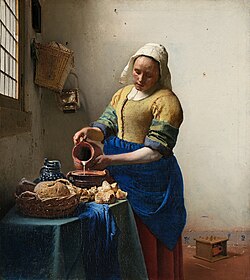
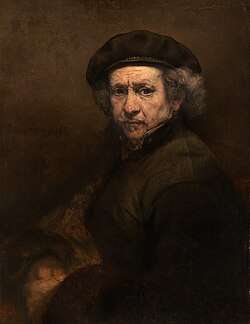
During the late in , umber gained prominence among artists for its ability to create subtle tonal transitions and depth in techniques, which emphasized contrasts between light and shadow to model forms realistically. employed burnt umber in the background layers of works like the , mixing it with ivory black and natural to achieve rich, earthy tones that enhanced atmospheric perspective. Similarly, incorporated umber in paintings such as , using it alongside other earth pigments to build layered shadows and warm browns that contributed to the luminous quality of Venetian art. From the 17th to 19th centuries, umber reached its peak usage during the and the broader period, where artists favored it for rendering deep shadows and dramatic lighting effects that heightened emotional intensity. In the , Rembrandt van Rijn frequently applied umber as a ground layer and in shadow areas, as seen in his self-portraits, to produce complex, warm browns that avoided the starkness of pure black while supporting his masterful use of . also relied on raw umber mixed with charcoal black and lead white for the subtle, nuanced shadows in his interior scenes, such as the white-washed walls in The Milkmaid, which lent a grounded warmth to his compositions. This period's emphasis on in art further elevated umber's role, as its transparent yet earthy properties allowed painters to layer glazes for convincing illusions of light penetrating darkness. In the , natural umber experienced a decline as synthetic alternatives offered greater color consistency and availability, gradually supplanting the variable natural in industrial production. However, a revival occurred within traditional movements and among artists seeking historical authenticity, where natural umber's unique and tonal subtlety were valued for recreating classical techniques.

Production and Sources

Natural Deposits

Umber deposits primarily originate from geological formations rich in iron and oxides, formed through sedimentary processes involving the of these minerals from seawater or hydrothermal fluids associated with volcanic activity. In , the most significant source, umber occurs as fine-grained mudstones in the Perapedhi Formation of the Troodos , resulting from the fallout of hydrothermally derived Fe-Mn oxyhydroxides on the ancient ocean floor during the period. These layers are typically interbedded with radiolarites and shales, reflecting deposition in deep marine environments near mid-ocean ridges. Similar sedimentary accumulations, derived from weathered volcanic rocks and enriched in iron-manganese compounds, characterize deposits in other regions, though many European sources date to the epoch. As of 2025, the primary global sources for natural umber remain and , with limited production in including and historical sites in . Historically, the name "umber" derives from the region in , where early deposits were identified and commercially sourced. High-quality umber has been mined in since antiquity, with ancient operations in the Tamasos area yielding material prized for its properties. Other notable locations include , where cool-toned raw umber is extracted from clay-rich soils, and , known for similar deposits. also hosts umber sources, historically marketed as "Turkey umber" alongside Cypriot varieties, contributing to the global supply through manganese-rich sedimentary layers. Extraction of umber has traditionally involved from open pits, a method employed since ancient times due to the shallow depth and widespread occurrence of these deposits. This approach, combined with the natural abundance of accessible outcrops, has allowed for sustained harvesting with relatively low disruption to surrounding landscapes. In , for instance, mining targets exposed sequences, while in , quarrying focuses on sedimentary basins yielding raw material for further processing.

Manufacturing Process

The manufacturing process of umber begins with the extraction of raw from natural deposits, typically through methods. The , a mixture of iron and manganese oxides with clays and silicates, is first crushed into smaller fragments to facilitate further processing. This is followed by washing the crushed material in to remove soluble impurities such as salts and , improving the pigment's purity. To achieve finer particle separation, the washed ore undergoes levigation, a wet process where it is suspended in water and allowed to settle in stages; coarser, heavier particles sink first, while finer ones are decanted and collected separately, yielding graded pigment suspensions based on . These suspensions are then dried, and the resulting material is ground into a powder, often to a micronized size of around 1-2 μm for optimal dispersibility in paints and coatings. This produces raw umber, a yellowish-brown suitable for various applications. For burnt umber, the raw pigment is subjected to by heating at 300-600°C in the presence of air, which oxidizes the iron and manganese compounds, dehydrates the structure, and intensifies the color to a deep reddish-brown. The calcined material is subsequently blended if needed for color consistency and ground to a fine powder, typically 0.7-1.8 μm, enhancing its transparency and drying properties in oil-based media. Quality control in umber involves rigorous testing for tinting strength—the pigment's ability to alter the hue of a base—and purity, assessed through chemical of (typically 40-55% Fe₂O₃) and (7-10% MnO₂) content, as well as oil absorption rates (around 47-54 g/100g) to ensure performance in formulations. Impurities are minimized to below 2-3% moisture and negligible soluble salts. Synthetic alternatives to natural umber are produced via methods, where and salts are reacted with alkalis to form precipitates, followed by , washing, drying, and milling; these offer greater color uniformity and reduced variability compared to mined sources.

Artistic and Practical Applications

Use in Painting Media

In oil painting, burnt umber serves as a natural siccative due to its manganese content, accelerating the drying of linseed oil mixtures and enabling faster layering for underpainting and glazing techniques. This property makes it particularly valuable for establishing tonal foundations and subtle transitions, such as in flesh shadows, where it blends seamlessly with other pigments to produce warm, realistic depths without compromising film integrity. Raw umber, with its cooler greenish undertone, complements these applications by offering a more neutral base for initial sketches and shadow work, enhancing the overall durability of oil layers. In watercolors, umber pigments provide semi-transparent washes ideal for building earth tones and granulating textures, while their low-staining nature allows easy lifting and reworking in monochromatic studies. Burnt umber's rich opacity in acrylic media, conversely, delivers strong coverage for earthy landscapes and shadowed forms, supporting both blending and dry-brush effects with excellent . Across both mediums, umber's permanence ensures vibrant, non-bleeding results in layered compositions. Historically, umber has been incorporated into for its opacity and , contributing to the longevity of panel paintings. In contemporary restoration, it is favored for and glazing to subtly "dirty" mixtures or shade retouches, mimicking aged patinas without introducing harsh contrasts.

Notable Examples in Art

One of the earliest notable uses of umber appears in the murals of the in , dating from the 2nd century BCE to the 6th century CE, where it served as a natural for rendering figures and architectural elements in the Buddhist frescoes. Analysis of decorative elements in Cave No. 10 reveals umber's presence in sherds showing elevated concentrations of and iron, contributing to the warm tones that enhanced the depth and realism of human forms against the cave walls. During the , prominently incorporated umber in his masterpieces to achieve subtle shading and depth. In the (c. 1503–1506), umber contributed to the shadowed areas of the distant landscape, creating atmospheric perspective through its earthy transparency when mixed with other . In the era, masters like van Rijn employed umber to build dramatic contrasts and deep tones. In (1642), umber formed part of the and shadowed areas, enhancing the tenebrist effects with its warm undertones mixed alongside ochres and siennas for the figures' clothing and background gloom. also favored umber in his domestic interiors, as seen in The Milkmaid (c. 1658–1660), where a mixture of umber, black, and rendered the textured shadows on walls and objects, lending a luminous yet grounded quality to the scene. Conservation analyses of Baroque paintings, including grounds from 17th-century works, consistently confirm umber's role as a foundational earthy pigment, often identified through its iron-manganese composition in cross-sectional studies. In , umber experienced a revival, particularly in underlayers for figurative and realist paintings, echoing traditional techniques amid a renewed interest in historical materials during the 20th and 21st centuries. This resurgence is evident in the works of contemporary artists drawing from methods, where umber provides a base for shadows without the opacity of synthetic alternatives.

Cultural Significance

Symbolism and Associations

The color umber derives its name from the Latin word umbra, meaning "shadow," reflecting its longstanding association with depth, mystery, and realism in artistic expression. In , particularly through techniques like , umber pigments create dramatic contrasts between light and dark, evoking emotional tension and psychological nuance by simulating the subtle gradations of natural shadows. This use underscores umber's role in portraying the enigmatic aspects of human experience, as seen in masters' works where it grounds figures in realistic, introspective environments. During the , umber was linked to earthiness and , symbolizing a connection to the natural world and human modesty amid the era's humanistic ideals. Sourced from iron- and manganese-rich soils, known as terra d'ombra or "earth of shadows," it embodied grounded realism in paintings, contrasting with more opulent hues to highlight themes of and earthly origins. By the , however, umber's connotations shifted toward debauchery and , often depicting and . In modern contexts, umber serves as a neutral evoking naturalism and stability in , promoting a sense of warmth and organic in and . Its prehistoric roots further tie it to grounding symbolism, with early humans applying umber-like earth pigments in cave art. These associations persist today, positioning umber as a versatile hue for evoking balance and connection to .

Historical Criticisms

In the , British painter and limner Edward Norgate expressed strong reservations about 's physical properties in his influential treatise Miniatura, or the Art of Limning. He described the as "a course, greazy, and foule colour," highlighting its coarse and greasy texture that made it difficult to grind and temper, particularly in oil media, where it proved troublesome and prone to uneven handling. Despite these flaws, Norgate conceded its utility for rendering shadows, hair, perspective, and other elements requiring depth, recommending that it be burnt in a to improve its workability. Practical criticisms of natural umber centered on its inherent variability, stemming from differences in geological deposits, which often resulted in inconsistent tones and hues across batches. Artists frequently complained that this unpredictability complicated color matching and reliable application, as the pigment's iron and manganese oxide content could vary significantly by source, leading to shifts in opacity, intensity, and overall in paints. Such issues were exacerbated by impurities like silica or clay contaminants, which affected and , prompting ongoing frustration among painters reliant on natural materials. By the 19th century, these practical drawbacks contributed to a broader transition away from natural umber toward synthetic and pigments, developed commercially to eliminate impurities and ensure uniform color and handling. This shift addressed longstanding complaints about the natural pigment's unreliability, allowing for more consistent results in industrial and artistic applications without the batch-to-batch variations inherent in mined earths.

References

Add your contribution
Related Hubs
User Avatar
No comments yet.