


Community hub
Recent from talks
Contribute something to knowledge base
Content stats: 0 posts, 0 articles, 1 media, 0 notes
Members stats: 0 subscribers, 0 contributors, 0 moderators, 0 supporters
Subscribers
Supporters
Contributors
Moderators
Hub AI
Lissencephaly AI simulator
(@Lissencephaly_simulator)
Hub AI
Lissencephaly AI simulator
(@Lissencephaly_simulator)
Lissencephaly
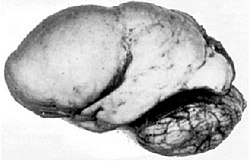
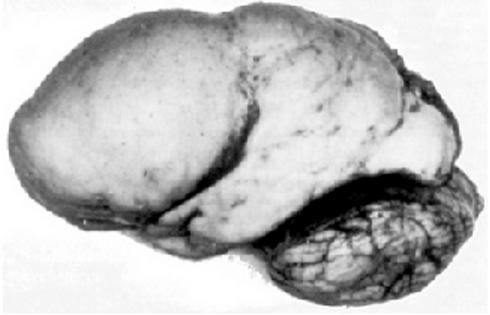
Lissencephaly (/ˌlɪs.ɛnˈsɛf.əl.i/, meaning 'smooth brain') is a set of rare brain disorders whereby the whole or parts of the surface of the brain are smooth. It is caused by defective neuronal migration during the 12th to 24th weeks of gestation, resulting in a lack of development of brain folds (gyri) and grooves (sulci). It is a form of cephalic disorder. Terms such as agyria (no gyri) and pachygyria (broad gyri) are used to describe the appearance of the surface of the brain.
Children with lissencephaly generally have significant developmental delays, but these vary greatly from child to child depending on the degree of brain malformation and seizure control. Life expectancy can be shortened, generally due to respiratory problems.
Affected children display severe psychomotor impairment, failure to thrive, seizures, and muscle spasticity or hypotonia. Other symptoms of the disorder may include unusual facial appearance, difficulty swallowing, and anomalies of the hands, fingers, or toes.
Symptoms of lissencephaly are detected via ultrasound at about twenty-three weeks of gestation and require confirmation via prenatal MRI. It is characterized by absence or reduction of the sulci and gyri of the cerebral surface and a thickened cortex.
There are anatomical symptoms that differ across the two main types of lissencephaly, Classical (Type I) and Cobblestone (Type 2). In classical lissencephaly, the cerebral cortex becomes thickened and has only four identifiable layers rather than the usual six.
Cobblestone lissencephaly is named after the pebbled or cobblestone appearance of the cortical surface. This uneven cortical surface is due to incomplete organogenesis which leads to no distinguishable layers in the cerebral cortex. Cobblestone lissencephaly shows a reduction and abnormalities in the grey matter of the cerebral cortex.
Causes of lissencephaly can include viral infections of the uterus or the fetus during the first trimester, or insufficient blood supply to the fetal brain early in pregnancy. There are also a number of genetic causes of lissencephaly, including mutation of the reelin gene (on chromosome 7), as well as other genes on the X chromosome and on chromosome 17. Genetic counseling is usually offered if there is a risk of lissencephaly, coupled with genetic testing.
Folding of the cerebral cortex is important in the development of overall brain function and cognitive abilities. Neuronal migration is the process by which neurons migrate to the final position in the brain during the development of the nervous system. This development of the nervous system occurs between 12 and 16 weeks of gestation. The neurons are created at the ventricular zone. The neurons then extend along the radial glia to reach the cortical zone. It is the disruption of the radial and tangential migration that causes reduced or absent gyri that is known as lissencephaly.
Lissencephaly
Lissencephaly (/ˌlɪs.ɛnˈsɛf.əl.i/, meaning 'smooth brain') is a set of rare brain disorders whereby the whole or parts of the surface of the brain are smooth. It is caused by defective neuronal migration during the 12th to 24th weeks of gestation, resulting in a lack of development of brain folds (gyri) and grooves (sulci). It is a form of cephalic disorder. Terms such as agyria (no gyri) and pachygyria (broad gyri) are used to describe the appearance of the surface of the brain.
Children with lissencephaly generally have significant developmental delays, but these vary greatly from child to child depending on the degree of brain malformation and seizure control. Life expectancy can be shortened, generally due to respiratory problems.
Affected children display severe psychomotor impairment, failure to thrive, seizures, and muscle spasticity or hypotonia. Other symptoms of the disorder may include unusual facial appearance, difficulty swallowing, and anomalies of the hands, fingers, or toes.
Symptoms of lissencephaly are detected via ultrasound at about twenty-three weeks of gestation and require confirmation via prenatal MRI. It is characterized by absence or reduction of the sulci and gyri of the cerebral surface and a thickened cortex.
There are anatomical symptoms that differ across the two main types of lissencephaly, Classical (Type I) and Cobblestone (Type 2). In classical lissencephaly, the cerebral cortex becomes thickened and has only four identifiable layers rather than the usual six.
Cobblestone lissencephaly is named after the pebbled or cobblestone appearance of the cortical surface. This uneven cortical surface is due to incomplete organogenesis which leads to no distinguishable layers in the cerebral cortex. Cobblestone lissencephaly shows a reduction and abnormalities in the grey matter of the cerebral cortex.
Causes of lissencephaly can include viral infections of the uterus or the fetus during the first trimester, or insufficient blood supply to the fetal brain early in pregnancy. There are also a number of genetic causes of lissencephaly, including mutation of the reelin gene (on chromosome 7), as well as other genes on the X chromosome and on chromosome 17. Genetic counseling is usually offered if there is a risk of lissencephaly, coupled with genetic testing.
Folding of the cerebral cortex is important in the development of overall brain function and cognitive abilities. Neuronal migration is the process by which neurons migrate to the final position in the brain during the development of the nervous system. This development of the nervous system occurs between 12 and 16 weeks of gestation. The neurons are created at the ventricular zone. The neurons then extend along the radial glia to reach the cortical zone. It is the disruption of the radial and tangential migration that causes reduced or absent gyri that is known as lissencephaly.
Recent media
Recent media