Hubbry Logo
search
logo
1493740

Lit Brothers

logo
Community Hub0 Subscribers
Read side by side
from Wikipedia

Lit Brothers Department Store
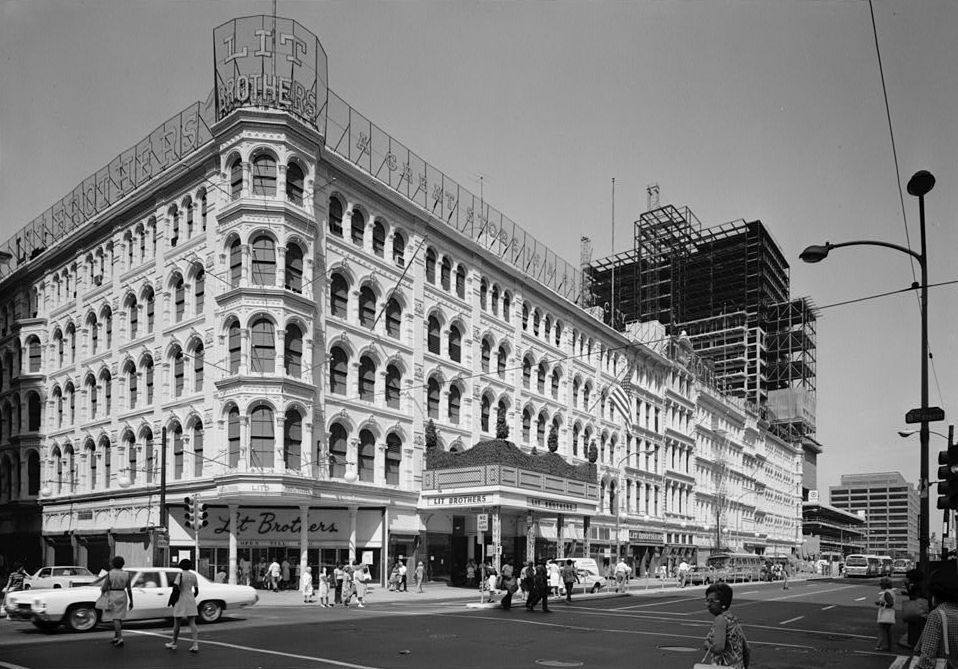
HABS, 1972–73
Lit Brothers is located in Philadelphia
Lit Brothers
Lit Brothers is located in Pennsylvania
Lit Brothers
Lit Brothers is located in the United States
Lit Brothers
LocationMarket between N. 7th and 8th streets
Philadelphia, Pennsylvania
Coordinates39°57′8″N 75°9′10″W / 39.95222°N 75.15278°W / 39.95222; -75.15278
Built1859–1918
ArchitectCollins & Autenreith; Simon & Bassett
Architectural styleRenaissance revival
NRHP reference No.79002322[1]
Added to NRHPMay 15, 1979
Lits department store final logo

Lit Brothers was a moderately-priced department store based in Philadelphia. Samuel and Jacob Lit opened the first store at Market and N. 8th streets in 1891. Lits positioned itself well as a more affordable alternate to its upscale competitors Strawbridge and Clothier, John Wanamaker, and Gimbels. The store's slogan was "A Great Store in A Great City," and it was noted for its millinery department.

The Lit Brother Store building was added to the National Register of Historic Places in 1979, and is located in the East Center City Commercial Historic District.[1][2]

History

[edit]

19th century

[edit]
The octagonal tower on the west end of the building in 2013
A Lit Brothers company share certificate, issued December 9, 1905

In 1891, Rachel P. Lit (1858-1919, later surnamed Weddel, still later Arnold) opened a women's clothing shop on the corner of Market and N. 8th Streets. With the administration and innovative advertising techniques of her brothers, Colonel Samuel David Lit (1859-1929) and Jacob David Lit (1872-1950), their small store soon became one of the largest retail stores in Philadelphia.

From 1895 to 1907, the store continued to expand, with the company taking over the remaining buildings on the North side of the block on Market between 7th and 8th Streets, including the J. M. Maris Dry Goods Store, the Bailey Store, and the J. B. Lippincott publishing house, and adding new buildings on the corners at either end of the block designed to blend in with the existing buildings.

20th century

[edit]

With alterations and additions, the Lit Brothers Store became the only full block of Victorian architecture in Philadelphia, composed of 33 buildings constructed between 1859 and 1918, with a common interior. The new buildings and the alterations were designed by Charles M. Autenrieth and Edward Collins.[3][4][5]

Although the store on Market Street was often called the "cast-iron building", only two of original building's facades at 719-721 Market and 714-718 Arch Street are cast iron. The other buildings are brick, faced with marble or granite. The two end buildings are brick and terra-cotta, with galvanized iron trim and octagonal towers. The uniformity of the entire Renaissance Revival-style facade is supported by the use of a classical arch window in all of the buildings, which are painted the same color.[4]

The company was purchased in 1928 by Albert M. Greenfield's Bankers Securities Corporation and was eventually merged into its City Stores Company – now CSS Industries, Inc. – a retail holding company consisting of stores located in urban centers throughout the south and east, such as the W & J Sloane furniture store, and the Washington, D.C.–based department store chain Lansburgh's.[6] In 1962, they purchased the suburban locations of Snellenburg's, another Philadelphia department store chain owned by Bankers Securities Corporation, which was closed in 1963. The Lit Brothers chain closed in 1977.

Enchanted Colonial Village

[edit]

Lits joined its fellow Center City department stores in presenting a Christmas season exhibit when, in 1962, it opened the Enchanted Colonial Village. The Village, designed by Philadelphia display designer Thomas Comerford, cost approximately $1 million (equivalent to $11 million in 2025). It was built by German toy manufacturer Christian Hofmann of Bad Rodach, West Germany. This room-by-room display of a colonial-era Christmas ran each year from Thanksgiving to New Year's Eve, and remained until the final Christmas season in 1976.

The exhibit itself was bought from liquidators for $35,000 by the Sun Oil Company, who later donated it to the Atwater Kent Museum. It has since been restored, and since 2001 sections are displayed around the holiday season at the Please Touch Museum. The Please Touch Museum donated the entire Lit Brothers Enchanted Colonial Village to the American Treasure Tour Museum in Oaks, Pennsylvania. As of December 2019, the American Treasure Tour Museum is in the process of rebuilding the entire display and featuring it as a permanent part of their collection.[7][8]

The former Lit Brothers Building, looking west down Market Street from 7th Street in 2013
The entrance to Market Place East in 2013

Growth and competition

[edit]

Lits saw the growing demand for suburban locations, and started building stores in mall locations around the greater Philadelphia market, including southern New Jersey. Lits also operated a store in nearby downtown Camden, and Lits was the only one of Philadelphia's department stores to maintain a branch along the New Jersey Shore, when it acquired the Blatt Department Store in downtown Atlantic City, and re-branded this location as Lits. Additional suburban locations were added with the acquisition of Snellenburg's in 1962.

Faced with growing competition in a changing retail landscape, Lit Brothers closed in April 1977.[9]

Suburban branch stores

[edit]

Repurposing of flagship store

[edit]

After the chain closed in 1977, the full-block flagship store was vacant until the late 1980s. In November 1985, Mellon Bank committed to a 25-year lease for half of the building's space.[9] The building was redeveloped as office and commercial space by Growth Properties. The project was designed by Burt Hill Kosar Rittelmann Associates and John Milner Associates.[4] The building reopened in 1987 as Mellon Independence Center, named after its principal occupant, the regional headquarters for Mellon Bank, and featured retail stores on the street level, and a food court on the lower level.[10]

The historic 720,000-square-foot (67,000 m2) building was put on the market in 2007, with an asking price of $70 million (~$102 million in 2024).[11] The main entrance, addressed as 701 Market Street, carried the name Market Place East, but was renamed the Lits Building in June 2013.[12] Five Below moved their headquarters to the Lits Building in 2018.[13]

As of 2020, a Lit Brothers neon sign labels the main entrance. The sign reading "Hats Trimmed Free of Charge" can still be seen today on the façade of the redeveloped flagship building.

References

[edit]
[edit]
Revisions and contributorsEdit on WikipediaRead on Wikipedia
from Grokipedia
Lit Brothers was a prominent American department store chain based in Philadelphia, Pennsylvania, that operated from 1893 until 1977, offering moderately priced goods as an alternative to more upscale competitors like Wanamaker's.[1] The chain originated from a millinery shop founded by Rachel Lit Wedell in 1891 on North Eighth Street, renowned for its "Hats Trimmed Free of Charge" slogan that attracted budget-conscious shoppers.[1] Her brothers, Samuel Lit (1859–1929) and Jacob Lit (1872–1950), joined in 1893 to transform it into a full department store at the northeast corner of Eighth and Market Streets, adopting the motto "A Great Store in a Great City" while expanding to occupy the full block at 701–739 Market Street with a distinctive cast-iron facade designed by architects Charles M. Autenrieth and Edward A. Collins.[2][1] The flagship store introduced innovative features for its era, including motorized delivery trucks, a direct entrance from the subway to its popular bargain basement, and expansive departments for clothing, home goods, and millinery that catered to Philadelphia's growing middle class.[3] Lit Brothers expanded beyond Center City in the post-World War II period, opening suburban branches in areas like Upper Darby, Northeast Philadelphia, Trenton, and Camden, New Jersey, and even acquiring and rebranding the Blatt Department Store in Atlantic City as Lit Brothers.[1] Ownership changed hands in the 1920s when it was sold to City Stores Company and later managed by Albert M. Greenfield's Bankers Securities Corporation during the Great Depression, allowing the chain to weather economic challenges through diversified merchandising and aggressive advertising.[1] The store became culturally iconic for its elaborate Christmas displays, particularly the "Enchanted Colonial Village" introduced in the 1960s by designer Thomas Comerford and craftsman Christian Hofmann, which drew families annually to experience animated scenes of colonial life.[4] Facing suburban flight, rising competition from discount retailers, and financial strain in the 1970s, Lit Brothers filed for bankruptcy and closed all locations by 1977, marking the end of an era for Philadelphia's "Big Six" downtown department stores.[1] The Market Street building, comprising approximately 33 interconnected Victorian-era structures and recognized as the city's only complete block of commercial Victorian architecture, stood vacant until the late 1980s when it was renovated into the Mellon Independence Center office complex, earning a National Preservation Honor Award in 1989 for preserving its historic integrity, including the original "Hats Trimmed Free of Charge" sign.[2] In 1979, the structure was added to the National Register of Historic Places (NRHP No. 79002322), ensuring its protection amid urban redevelopment, and today it operates as The Lits Building, a mixed-use property with office and retail spaces in the Market East neighborhood.[5]

Origins and Founding

Rachel Lit's Millinery Shop

Rachel Lit Wedell, born in 1858, founded a modest dress and millinery shop in Philadelphia in 1891, marking the initial venture of what would become the Lit Brothers retail empire.[6][7] The shop was located on Eighth Street above Filbert, in a burgeoning commercial area of the city, and specialized in hat trimming and related women's accessories.[8][2] As a pioneering member of a Jewish family in Philadelphia's retail scene, Rachel Lit Wedell operated the business independently, drawing on her entrepreneurial spirit to establish a foothold in the late 19th-century fashion market.[6] The shop's initial inventory centered on millinery goods, catering to the era's demand for stylish headwear among women in an increasingly urbanizing society.[3] Her innovative business model offered free hat trimming services to customers purchasing hats or materials, which quickly attracted clientele and fostered rapid growth by emphasizing affordability and personalized service.[2][8] This early success in a competitive women's fashion sector highlighted the shop's operational efficiency and customer-focused approach, with the modest establishment achieving notable profitability within its first year and prompting considerations for further expansion.[7] The venture laid essential groundwork, eventually transitioning under family involvement to a broader department store format.[3]

Establishment by the Lit Brothers

In 1891, brothers Samuel Lit (born 1859) and Jacob Lit (born 1872) joined their sister Rachel to formally establish Lit Brothers in Philadelphia, building upon her earlier dress and millinery shop by expanding its scope to include a broader range of merchandise. The store opened at 45 North Eighth Street, initially operating on a small scale with offerings centered on dresses, millinery, and basic dry goods, catering to local customers in a modest single storefront. Samuel, who had prior experience as a book salesman and plumbing apprentice, and Jacob, the younger sibling, took primary leadership roles, with Rachel providing advisory input drawn from her foundational work in the business. This family collaboration marked the transition from a niche specialty shop to a more diversified retail operation amid Philadelphia's burgeoning commercial landscape.[6][9] The early years saw rapid physical growth as the brothers acquired adjacent spaces to enlarge the footprint, reflecting the store's quick adaptation to increasing demand. By 1893, Lit Brothers had relocated to the prominent corner of Market and North 8th Streets, embracing the full department store model with the addition of multiple specialized sections such as clothing, household items, and notions, which allowed for one-stop shopping under one roof. This expansion solidified the store's identity as an accessible retailer, with Rachel continuing in a supportive capacity while the brothers managed daily operations and strategic decisions. The move positioned Lit Brothers at the heart of Philadelphia's retail district, enabling it to serve the city's expanding immigrant and middle-class populations who sought practical, everyday goods.[7][6] Lit Brothers' first advertising campaigns highlighted affordability and value, drawing on Philadelphia's frugal heritage by adopting Benjamin Franklin's proverb "A penny saved is a penny earned" to underscore cost-conscious shopping. These efforts, promoted through local newspapers and signage, emphasized low prices and quality merchandise without extravagance, distinguishing the store from upscale competitors and appealing directly to working families and newcomers. The slogan's use in promotions helped establish Lit Brothers as a reliable option for budget-minded consumers, contributing to its early success in capturing a loyal customer base amid the late 19th-century economic shifts in the city.[3][6]

Flagship Store Development

Architectural Evolution

The flagship Lit Brothers store at 8th and Market Streets in Philadelphia originated in 1891 as a cluster of mid-19th-century iron-fronted commercial buildings dating back to 1859, which the Lit brothers gradually acquired and interconnected to form a cohesive retail complex.[7] By the early 1900s, expansions included the addition of multiple floors to accommodate growing departments, transforming the site into a multi-level department store designed by architects Collins and Autenrieth in a uniform Renaissance Revival style.[7] These developments unified the block, incorporating cast-iron facades with ornate cornices and large display windows to enhance street-level visibility and customer access.[5] Further growth in the 1900s and into the 1920s resulted in 33 interconnected buildings spanning the entire block bounded by 7th, 8th, Market, and Filbert Streets, creating Philadelphia's only complete Victorian commercial block.[10] Internal features, such as a grand atrium, were integrated to provide natural light throughout the structure, supporting efficient retail flow across departments.[8] Later additions employed steel framing to bear heavy merchandise loads on upper floors, reflecting advanced structural engineering for large-scale retail operations.[7] By the mid-20th century, the complex had expanded to approximately 720,000 square feet, solidifying its role as a major retail landmark.[11] The building's architectural significance was recognized when it was listed on the National Register of Historic Places in 1979 (NRHP No. 79002322), celebrated for its intact Victorian details, including galvanized iron trim and semi-hexagonal bay windows at key corners, which exemplified innovative commercial design in urban Philadelphia.[5]

Holiday Displays and Features

Lit Brothers' flagship store in Philadelphia became a holiday destination through its elaborate seasonal attractions, which captivated families and boosted community spirit during the mid-20th century. The centerpiece was the Enchanted Colonial Village, an immersive animated Christmas display launched in 1961 to rival competitors on Market Street. This $1 million investment featured a block-long colonial hamlet with 18 scenes depicting workshops like a blacksmith, baker, toymaker, and matchmaker, all populated by dozens of 3/4 life-size animatronic figures powered by electrical mechanisms. Designed by Philadelphia display expert Thomas Comerford in partnership with a German toy manufacturer, the exhibit emphasized American history themes through custom-built animatronics, twinkling lights, and storytelling vignettes of holiday preparations. Housed in a dedicated second-floor space, it offered free public admission to draw shoppers, transforming the store into a festive gathering point.[12][13] The Enchanted Colonial Village ran annually from 1961 until the store's closure in 1977, attracting 500,000 to 700,000 visitors each season and significantly increasing foot traffic during the holidays. Complementing this were striking window displays for Christmas and Easter, which showcased affordable merchandise alongside whimsical scenes to promote community values and accessibility. Lit Brothers also engaged in Philadelphia's Thanksgiving Day parade traditions from the 1930s onward, contributing floats and promotions that enhanced the city's pre-Christmas festivities alongside other retailers. These features evolved to reflect contemporary events, maintaining their appeal through innovative designs that prioritized family entertainment over direct sales pitches.[12][4][14] Rising operational costs ultimately led to the discontinuation of the Enchanted Colonial Village in 1977, coinciding with Lit Brothers' bankruptcy and shutdown. Nevertheless, its cultural impact persists through preserved elements and recreations, including a full exhibit at the American Treasure Tour Museum in Oaks, Pennsylvania, where it continues to evoke nostalgia for baby boomers in 2025. This ongoing display highlights the village's pioneering role in animatronics, predating similar attractions at Walt Disney World.[13][12]

Expansion and Operations

Mergers and Acquisitions

In 1928, control of Lit Brothers transitioned from family ownership to external investors through its acquisition by Albert M. Greenfield's Bankers Securities Corporation in partnership with the City Stores Company for $10,521,000, involving the purchase of 501,000 shares at $21 each. This deal marked a significant shift, as the Lit family retained substantial ownership and the company continued operating under its established branding, while Greenfield's involvement brought financial resources and strategic oversight to support modernization efforts, including facility upgrades and operational efficiencies. The acquisition effectively integrated Lit Brothers into the City Stores portfolio, a national retail holding company focused on urban department stores, providing access to broader capital for growth without immediate dissolution of the Lit identity.[15][16] The 1928 transaction positioned Lit Brothers as a flagship brand within City Stores, enabling expansions and enhancements that solidified its role in Philadelphia's retail landscape during the late 1920s and beyond. Under the influence of Albert M. Greenfield, a board member and key investor through Bankers Securities Corporation, the company benefited from centralized management and investment, which facilitated post-acquisition improvements in merchandising and store infrastructure while preserving its moderate-price positioning to appeal to middle-class shoppers. This corporate structure persisted, with Lit Brothers operating semi-autonomously as part of the larger chain, contributing to its stability amid economic fluctuations.[6][1] In 1962, Lit Brothers further expanded through the acquisition of eight units from the struggling N. Snellenburg & Company, including four suburban branch stores and four tire outlets, amid Snellenburg's operational wind-down. These locations were promptly rebranded as Lit Brothers stores, with inventory from Snellenburg's—known for its thrifty, value-oriented assortments—integrated into Lit's existing moderate-priced merchandise lines to enhance variety without altering core pricing strategies. Staff transitions were managed to maintain continuity, as many employees from the acquired sites joined Lit's operations, supporting seamless reopening under the new ownership and bolstering Lit's suburban presence. This move exemplified Lit's strategy of absorbing local competitors to consolidate market share in the Philadelphia area.[17][1]

Retail Strategies and Competition

Lit Brothers developed a retail strategy focused on moderate pricing to attract middle-class and working-class shoppers in Philadelphia, positioning the store as an accessible alternative in a competitive market. By offering similar merchandise at lower prices than rivals, the company emphasized high-volume sales to drive profitability. This approach differentiated Lit Brothers from upscale competitors like John Wanamaker's, which catered to affluent customers with luxury goods and elaborate services, while carving out a niche against Gimbels' broad variety offerings and Strawbridge & Clothier's emphasis on quality at low prices with cash-only policies initially.[1][4][14] Marketing efforts highlighted affordability and customer conveniences, with prominent slogans such as "A Great Store in a Great City" to evoke civic pride and "Hats Trimmed Free of Charge" to promote value-added services in the millinery department. The company invested in newspaper advertising and in-store promotions to target families, reinforcing its reputation as a practical shopping destination during the store's peak in the early to mid-20th century. These tactics helped Lit Brothers maintain a strong presence among the "Big Six" Philadelphia department stores, appealing to budget-conscious urban consumers amid intense rivalry on Market Street.[1][14][4] Operationally, Lit Brothers structured its flagship store into specialized departments, including a renowned millinery section, fine jewelry, and apparel, to facilitate efficient browsing and sales. Credit accounts were available to encourage repeat business, aligning with the era's retail practices for building customer loyalty. Following its acquisition by City Stores in the 1920s, the company introduced employee incentives to enhance service quality, though specific profit-sharing details emerged later in legal contexts related to promotional coupons. This departmental organization and focus on middle-market accessibility sustained Lit Brothers' competitive edge through the 1930s and 1940s.[1][17]

Branch Stores

Philadelphia-Area Suburbs

Lit Brothers began expanding into Philadelphia's suburbs in the late 1940s to accommodate the growing car-centric shopping habits of post-war families, with the first branch opening at 69th Street and Ludlow Streets in Upper Darby in 1948.[18][19] This 115,000-square-foot store featured ample parking and a modern layout designed for easy access by automobile, reflecting the shift from downtown pedestrian traffic to suburban drive-up retail.[19] The expansion continued into the 1950s with the opening of a branch at Castor and Cottman Avenues in Northeast Philadelphia in February 1954, marking Lit Brothers' first purpose-built suburban store with dedicated parking facilities behind the building to cater to local drivers.[20][21] By the mid-1950s, another location followed, further emphasizing the chain's adaptation to suburban lifestyles through spacious lots and convenient access.[20] In the 1960s, Lit Brothers accelerated suburban growth following the 1962 acquisition of rival N. Snellenburg & Company's branches, which were rebranded under the Lit's name and positioned with a discount-oriented approach to attract budget-conscious suburban shoppers.[1] Key additions included the 100,000-square-foot store at Lawrence Park Shopping Center in Broomall, which opened as a Lit Brothers location in 1962 after previously operating as a Snellenburg's outlet.[19][22] This was soon followed by a 75,000-square-foot branch at Willow Grove's Snellenburg Shopping Center (York Road and Easton Pike) in 1963, also acquired and rebranded from Snellenburg's.[19] The decade's expansion peaked with the 185,000-square-foot anchor at Plymouth Meeting Mall in 1966, featuring integrated mall parking and layouts suited to family-oriented purchases.[19][23] These suburban stores generally mirrored the flagship's merchandise selection, including clothing, household items, and appliances, but placed greater emphasis on home goods and durable items appealing to suburban homeowners with larger living spaces and automotive lifestyles.[1] By the late 1960s, Lit Brothers operated around seven Philadelphia-area suburban branches, each typically spanning 75,000 to 185,000 square feet with extensive parking to support drive-in shopping.[19] A further extension came in 1975 with a branch at Neshaminy Mall in Bensalem, adding to the chain's suburban footprint before the overall decline set in.[24] During their peak in the 1960s, these branches integrated into local communities through sponsored events such as holiday promotions and seasonal displays, fostering customer loyalty in the growing suburban enclaves.[20] The discount rebranding post-1962 helped these locations compete with emerging discount chains by offering value-priced selections in appliances, furniture, and everyday essentials tailored to suburban needs.[1]

Regional Extensions

Lit Brothers ventured beyond Pennsylvania suburbs with its most ambitious regional expansion in Camden, New Jersey, opening a flagship branch there in 1955. Spanning Broadway from Market to Federal Streets, the store covered 155,000 square feet, making it the chain's largest branch and a deliberate effort to capture cross-state shoppers from the Philadelphia area.[19][25][26] Earlier regional efforts included the acquisition of Swern & Co. in Trenton, New Jersey, opening a branch at South Broad and Front Streets in 1948.[19] In the 1960s, the 1962 acquisition of N. Snellenburg & Company's branches further supported regional growth, including the rebranding of a location in Atlantic City, New Jersey, at Atlantic Avenue and Carolina Avenue as Lit Brothers (previously operating as Snellenburg's after acquiring Blatt Department Store). The acquisition encompassed three branches in suburban Philadelphia and this one in New Jersey.[19][17] Expansion continued with a branch at Echelon Mall in Voorhees, New Jersey, opening in 1970.[19] The Camden store adapted to its diverse urban clientele by focusing sales on moderately priced apparel suited to local economic conditions, while integrating with regional bus transit for easy access from Philadelphia. Performance peaked during the 1960s, when holiday displays attracted significant crowds, but the branch encountered early decline from suburban flight and competition from new malls like Cherry Hill in 1961. It ultimately closed in 1972 due to pervasive urban decay in downtown Camden.[27][28]

Decline and Closure

Post-War Challenges

Following World War II, Lit Brothers faced mounting pressures from suburbanization, as Philadelphia's growing middle-class population migrated to outlying areas in the 1950s and 1960s, favoring enclosed shopping malls over downtown shopping districts. This demographic shift significantly reduced foot traffic at the flagship store on Market Street, with customers increasingly drawn to suburban retail hubs that offered convenience, parking, and one-stop shopping experiences. National chains like Sears capitalized on this trend by establishing large, modern outlets in developing suburbs, eroding Lit Brothers' market share in the region.[1] Economic headwinds in the 1970s exacerbated these challenges, including persistent inflation and recessions that squeezed consumer spending and raised operational expenses. Rising labor costs, driven by strong unionization in the retail sector, added to the strain, as did the 1973 and 1979 energy crises, which spiked heating and electricity bills for the chain's expansive facilities. Efforts to diversify into discount formats after the 1962 acquisition of Snellenburg's branches—a thrifty-oriented chain—proved unsuccessful, failing to attract price-sensitive shoppers amid intensifying competition from discounters.[1][22] Internally, management transitions following the Snellenburg's integration and ongoing oversight by City Stores—under which Lit Brothers had operated since 1929—led to inefficiencies, including outdated inventory management systems that hindered responsiveness to market changes. Branch stores opened in Philadelphia-area suburbs, such as Upper Darby in 1948 and Northeast Philadelphia in 1954, aimed to recapture lost customers but often underperformed in urban-adjacent locations due to fierce local rivalry. By the mid-1970s, these factors contributed to sustained sales declines and mounting losses across the chain.[19][6]

Final Operations and Shutdown

During the 1970s, Lit Brothers, operating as a subsidiary of City Stores Company, reduced its footprint by closing non-core branches amid ongoing financial pressures. The Camden, New Jersey store, which had opened in 1955 as a major downtown anchor spanning Broadway from Market to Federal Street, became the first significant casualty when it shut down in 1972.[29] This closure reflected broader economic woes affecting urban retail, leaving the chain to consolidate around its Philadelphia-area locations. City Stores attempted to stem losses through targeted closures and customer redirection, announcing in late 1976 the shutdown of the flagship store at 8th and Market streets to funnel shoppers to surviving suburban outlets.[30] However, these efforts faltered amid escalating labor tensions. On April 30, 1977, the 84-year-old flagship—along with five other stores—permanently closed after U.S. District Judge Clifford S. Green denied a temporary restraining order sought by 11 unions, including Locals 1357 and 1358 of the Retail Clerks International Union, to pause operations until contract disputes could be arbitrated.[31] The rapid shutdown dissolved the entire chain, which had comprised 11 locations at its height. The closures triggered immediate repercussions, including widespread layoffs across the remaining workforce and ongoing legal disputes over labor contracts.[31] City Stores, burdened by years of low profits and net losses from its department store divisions, filed for bankruptcy in 1979, leading to the liquidation of assets to settle debts.[30]

Legacy

Cultural Significance

Lit Brothers served as a prominent emblem of Jewish-American entrepreneurial achievement in Philadelphia, founded in 1891 by Rachel P. Lit, a German Jewish immigrant, and later expanded by her brothers Samuel and Jacob Lit into a major department store chain.[6] The enterprise exemplified the success of Jewish immigrant families in building enduring retail institutions, with Samuel and Jacob holding influential roles in Jewish community organizations such as Mikveh Israel Congregation and the Young Men's Hebrew Association.[6] Over its 86-year operation, Lit Brothers provided employment to generations of Philadelphians, contributing significantly to the local economy as one of the city's "Big Six" department stores and fostering a diverse workforce that reflected the urban demographic.[1] The store's cultural legacy endures through widespread nostalgia for its shopping experiences and holiday traditions, particularly its annual Enchanted Colonial Village display, which drew 500,000 to 700,000 visitors each year in the mid-20th century and became a cherished family ritual.[12] This animatronic exhibit, featuring colonial-themed scenes with moving figures, evoked a sense of wonder and community gathering, with memories shared in oral histories from former employees and patrons emphasizing the store's inclusive atmosphere and role in intergenerational bonding.[12] In 2025, recreations of the display at the American Treasure Tour Museum in Oaks, Pennsylvania, continue to attract baby boomers and families, preserving these nostalgic elements for new audiences.[12] Lit Brothers played a key role in Philadelphia's urban retail evolution, representing mid-20th-century American consumerism through its affordable pricing and expansive Market Street presence, which democratized access to goods and entertainment for working-class residents.[1] Preservation efforts in the 1970s, including its 1970 listing on the Philadelphia Register of Historic Places and 1979 inclusion on the National Register of Historic Places, underscored its architectural and cultural value, culminating in 1981 when citizen coalitions successfully averted a planned demolition through protests and advocacy.[7]

Modern Repurposing

Following the closure of Lit Brothers in 1977, the flagship store at 8th and Market Streets in Philadelphia underwent a major $75 million renovation starting in 1986, transforming it into the Mellon Independence Center as the regional headquarters for Mellon Bank.[32] The project preserved the building's historic Victorian facades and cast-iron elements while converting the interior into modern office spaces on upper levels and retail areas on the lower floors, spanning approximately 720,000 square feet.[11] By 1987, the structure reopened as the Mellon Independence Center. Under management by Brickstone Companies since the early 2000s, The Lits Building has evolved into a mixed-use property featuring office spaces, retail outlets, and restaurants, with ongoing updates enhancing its viability in Philadelphia's Market East district.[33] In 2016, Brickstone initiated capital improvements including rooftop LED signage and full façade illumination to highlight the historic architecture, alongside energy-efficient LED lighting upgrades throughout the structure.[33] Collaborating with Stantec, Brickstone implemented public enhancements such as façade lighting, escalator widening, restroom upgrades, and streetscape improvements to improve accessibility and appeal.[34] The building serves as a creative hub, with Interior Architects designing tenant spaces that integrate Lit Brothers' original branding motifs—like floral patterns referencing its textile history—into modern offices.[10] The Lits Building maintains its listing on the National Register of Historic Places, added in 1979, which has guided its adaptive reuse to preserve architectural integrity amid commercial evolution.[5] This status ensures that renovations respect the site's role as the only complete block of Victorian commercial architecture in Philadelphia, supporting its transition from department store to a vibrant economic asset.[35] Most Lit Brothers suburban branch stores have been repurposed into components of shopping malls or big-box retail centers, reflecting the broader shift to suburban commercial landscapes.[36] For instance, the Plymouth Meeting Mall location was converted to a Hess's store in 1979 and later integrated into the mall's evolving tenant mix.[36] The Camden branch, opened in 1955 and closed in 1972, was repurposed as the Camden County Administration Building before its demolition in 2023 to clear space for potential redevelopment, including a temporary staging area and future park plans.[37][28]

References

User Avatar
No comments yet.