Hubbry Logo
Loch MorarLoch MorarMain
Open search
Loch Morar
Community hub
Loch Morar
logo
8 pages, 0 posts
0 subscribers
Be the first to start a discussion here.
Loch Morar
Loch Morar
from Wikipedia

Loch Morar (Scottish Gaelic: Loch Mòrair) is a freshwater loch in the Rough Bounds of Lochaber, Highland, Scotland.[2] It is the fifth-largest loch by surface area in Scotland, at 26.7 km2 (10.3 sq mi), and the deepest freshwater body in the British Isles with a maximum depth of 310 m (1,017 ft). The loch was created by glacial action around 10,000 years ago, and has a surface elevation of 9 metres (30 ft) above sea level. It separates the traditional district of North Morar (which contains the village of Morar), from Arisaig and Moidart.

Key Information

Geography

[edit]
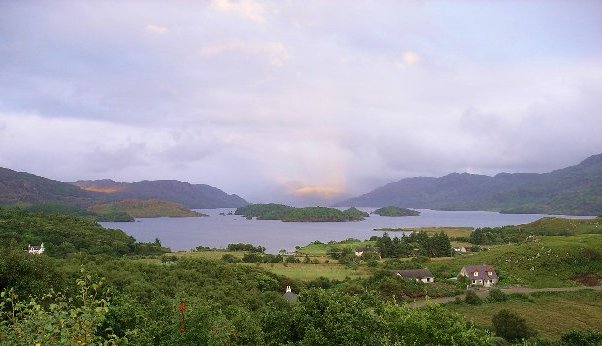
Loch Morar, and North Morar, with Loch Nevis in the distance, and Knoydart and Skye beyond that

Loch Morar is 18.8 kilometres (11.7 mi) long, has a surface area of 26.7 km2 (10.3 sq mi), and is the deepest freshwater body in the British Isles with a maximum depth of 310 m (1,017 ft).[3][4] In 1910, John Murray and Laurence Pullar found it to have a mean depth of 87 metres (284 ft) and a total volume of 2.3073 cubic kilometres (81,482,000,000 ft3) during their survey of Scottish lochs.[1] The bottom is deepened below the United Kingdom Continental Shelf, and until 1943, when a depth of 324 metres (1,063 ft) was observed in the Inner Sound, it was believed to be the deepest water in the United Kingdom.[5][6] The surface of the loch is 9 metres (30 ft) above sea level.[7]

The water of the loch is clear and oligotrophic, with a minimal intake of nutrients, making it a Site of Special Scientific Interest (SSSI).[8][9] The main inflow is the River Meoble on the southern side, which drains from Loch Beoraid, although there are three other major inflows at the eastern end of the loch and a stream draining a complex of lochans to the north-west of Loch Morar.[8][10] The outflow is the River Morar at the western end, which at a few hundred metres long is one of the shortest rivers in the British Isles.[8][11] At the shallower western end of the loch, there are a number of sizeable forested islands.[10][12]

At the western end of the loch is the village of Morar, which is between Arisaig and Mallaig on the coastal A830 road. The settlements of Bracorina and Bracara are located along the northern shore of the loch, but there is no road along the southern shore.[10] Tarbet, on the shore of Loch Nevis, is a short distance from Loch Morar.[10]

Folklore

[edit]
The banks of the loch are steep at the eastern end

According to the posthumously published dictionary of the Scottish Gaelic language collected by Fr. Allan MacDonald (1859–1905), "Loch Morar is said to be blessed by St. Columba and is called (Scottish Gaelic: Tobar Chaluim Chille), 'St. Columba's Well'. It is safe to drink its water though in the greatest heat and perspiration. It does not freeze. The only ice seen about it is at the foot of the mountain streams flowing into it." In relation to Loch Morar's traditional veneration as a holy well, MacDonald also collected, "a story of a young woman who had lost her hair which grew again after she had bathed her head in the Loch."[13]

In common with Loch Ness, occasional reports of large unidentified creatures in the loch's waters are made. The loch monster has been dubbed Mòrag.[14][15]

History

[edit]
Eilean Bàn in Loch Morar, as it appears today.

The island in Loch Morar known as Eilean Bàn was traditionally used by the local population as grazing for their cattle herds and was, until trees began being planted in the 19th-century, completely bare of the "dense, barely penetrable growth of timber", that covers the island today.[16] The same island was briefly the location first of a Mass stone and then of an illegal and clandestine Catholic minor seminary founded by Bishop James Gordon, until the Jacobite rising of 1715 forced its closure and eventual reopening at Scalan in Glenlivet.[17] Even long afterwards, Eilean Bàn remained a secret chapel and library for Bishop Gordon's successors.[18] According to Strathglass historian Flora Forbes, however, "a Catholic chapel at this time anywhere throughout the Highlands was usually a barn-like structure, with no windows and a mud floor."[19]

After the Battle of Culloden, a combined force of Royal Navy sailors under the command of Captain John Fergussone of HMS Furnace and Captain Duff of HMS Terror and troops from the Campbell of Argyll Militia portaged over nine miles of uncharted, rough, and previously thought to be impassable terrain. They were seeking to capture Bishop Hugh MacDonald, the underground Roman Catholic Vicar General of the Highland District, and high-ranking local Jacobite Army veterans, mainly from Clan Donald, who were correctly suspected of meeting together at the library, former seminary, and Catholic chapel on Eilean Bàn in Loch Morar on 8 June 1746.[20]

According to a later report for the Duke of Newcastle, "Upon their arrival at the lake, they immediately spread themselves opposite to the Isle, and in full view of the rebels thereon; who, concluding themselves quite free from danger, fired on our people, at the same time calling them by insulting and opprobrious names, being near enough to be heard. This exultation, however, was quickly at an end; for the King's ships having sailed round to that part of the coast where their boats had little more than a mile to be carried overland to the lake... the rebels immediately lost all courage..."[21]

Although the Bishop and the Jacobite leaders managed to quickly row from Eilean Bàn to the loch shore and "escaped into the mountains", according the same report for the Duke of Newcastle, when the government soldiers and sailors arrived upon Eilean Bàn, "They found the before-named Popish bishop's house and chapel; which the sailors quickly gutted and demolished, merrily adorning themselves with the spoils of the chapel. In the scramble, a great many books and papers were tossed about and destroyed."[22]

Some of the chapel and seminary foundation stones are still visibly upon Eilean Bàn. Watts has termed the 8 June 1746 book burning and the destruction of most of Bishop MacDonald personal papers, "an irreplaceable loss both for the eighteenth-century Church and the scholar of today."[23]

Roman Catholic Church of Our Lady and St Cumin, Morar.

At least some items, though, are believed to have been removed from Eilean Bàn in time. In 1917, Dom Odo Blundell of Fort Augustus Abbey wrote, "At Morar chapel-house is preserved a set of green vestments, with red and white intermingled, bearing the date 1745. It still has its original lining; there is also an altar front to match it. These were probably brought over from France by the adherents of Prince Charlie, and must have been part of the furnishings of the chapel on the island, though it is not known how they were saved when the building was ransacked and burned in 1746. The same remarks apply to the old chalice, which bears the inscription, Ad usum Pr Fr Vincenti Mariani, Missri Scot. Ord. Praedic. Anno 1658. This chalice, which is of silver, is very small indeed; it has its paten to match. Unfortunately, we have no further information regarding this early missioner. In the list of priests for 1668 it is stated that there were three Dominicans on this mission. Father Vincent was apparently one of these; the others being Father George Fanning - long in the Isle of Barra and Father Primrose - who died in prison in 1671."[24]

Following the action, however, Capt. John Fergussone suspected "that Lord Lovat's lameness must have rendered it utterly impracticable for him to travel in so rugged a country", and the crew of HMS Furnace accordingly continued meticulously searching inside the caves surrounding the Loch, "for three days and nights". They eventually, as Capt. Fergussone had expected, succeeded in capturing Lord Lovat, who was hiding inside a cave in nearby Glen Meoble.[20][25]

Chief of Clan Fraser and senior Jacobite Army leader Simon Fraser, 11th Lord Lovat, sketched by William Hogarth after his capture at Loch Morar and shortly before being tried for high treason before his peers in the House of Lords and afterwards executed by beheading on Tower Hill.

In his naval history of the Jacobite rising and its aftermath, historian John S. Gibson commented about the capture of Lord Lovat at Loch Morar, "London, which, with the events of the past year, had come to abhor highlanders, could scarcely have been more elated had Charles Edward himself been caught. A small mythology was quick to grow up about the circumstances of his capture, as in the contemporary print of Fergussone and the soldiers of Guise's bursting in on the aged peer disguised as an old woman."[26]

Following his escape into the mountains, Bishop MacDonald remained in hiding locally until he managed to escape to France, during the sixth attempt by the French Royal Navy and French privateers to find and rescue the Prince and his entourage, and was evacuated from what is now the Prince's Cairn at Loch nan Uamh on 19 September 1746.[20]

An abandoned house on Morar

During the period of the Highland Clearances, many residents emigrated to Canada.[27] Boats left in 1790,[27] 1802,[28] and 1826,[29] carrying people to Quebec, Glengarry in Ontario, and the Strait of Canso in Nova Scotia respectively.

Swordland Lodge, on the northern shore of the loch, was used as training school STS 23b by the Special Operations Executive during the Second World War.[30][31]

The hydroelectric power station on the River Morar

A 750 kW hydroelectric power station with a hydraulic head of 5.5 metres (18 ft) was built on the River Morar and commissioned in 1948.[32][33]

Geology

[edit]
The eastern end of the loch

Loch Morar is located entirely within the Morar Group of sediments, which were deposited in the latter part of the Cambrian, and subsequently subjected to many phases of deformation.[34]

The loch occupies a basin produced by the overdeepening of the valley by glacial erosion, along an east–west fault line.[35][36] It is not a sea loch due to isostatic rebound that raised the rock sill at the end of the loch.[37]

Based on estimates of erosion of between 2–4 mm (332532 in) per year, the deep basin was created over a period of 67,000 – 150,000 years of glacial action, which occurred intermittently during the last million years of the Quaternary glaciation.[35] An outwash fan made up of sand and gravels at the western end of the loch marks the limit of the re-advance in the Morar valley.[38] Subsequently, colonised by vegetation and known as Mointeach Mhòr (the mossy plain), these deposits blocked the outflow of the loch to the south, so that it drained from the north-west corner instead.[39]

The catchment area of the loch is 168 square kilometres (65 sq mi), and the geology is base-poor.[8][40] A site to the north of the loch was selected in 2011 as a SSSI for its characteristic rock exposures of the Moine group by the Geological Conservation Review, replacing the area around Mallaig harbour, which had been previously regarded as the most representative site.[34][41]

Wildlife

[edit]

The loch is surrounded by a mix of natural woodland, open hillside, sheep and cattle pasture and planted mixed coniferous and broadleaf woodlands.[42] Only around 0.7% of the surface of the loch can be colonised by plants.[8]

Fish

[edit]

Loch Morar's fish population is believed to be limited to Atlantic Salmon, brown trout and sea trout, Arctic char, eel, stickleback, and minnow.[8][43] Trout average around 340 g (34 lb) in size, but ferox trout of up to 7 kg (15 lb) have been caught.[44] The loch is also known to contain eels, although none were caught in a recent survey of eel populations in Lochaber, suggesting that they prefer the loch to the tributaries surveyed.[45] Catches of salmon and sea trout declined dramatically between the 1970s and 1980s, in common with other catchments on the west coast.[46] Artificial stocking of the River Morar with salmon and sea trout was suspended in 2007 after the hatchery was closed.[9]

The main salmonid spawning grounds are the River Meoble and the smaller burns that feed into the loch.[9] The hydroelectric power station, which contain one of only two fish counters in Lochaber, is shut down during the smolt run, following a study on smolt mortality in 1992.[8][9]

The catchment is managed by the Morar District Salmon Fishery Sub-board, which employs a full-time fisheries manager.[9] Poaching in the form of netting has been known to occur at the mouth of the River Morar.[9]

References

[edit]
[edit]
Revisions and contributorsEdit on WikipediaRead on Wikipedia
from Grokipedia
Loch Morar is a large freshwater loch in the district of the , renowned for its exceptional depth of 310 meters, the greatest among all freshwater bodies in the . Stretching 18.8 kilometers in length with a surface area of 26.7 square kilometers, it originated from glacial erosion during the Pleistocene epoch, forming a classic characterized by steep sides and a narrow, elongated basin. The loch drains via the short River Morar into the Sound of Arisaig, and since 1948, a small hydroelectric utilizing a of about 5.5 meters has generated electricity from its outflow, contributing to Scotland's infrastructure with a capacity of approximately 1 megawatt. While local persists regarding sightings of an elusive creature dubbed Morag, empirical surveys and expeditions, including investigations, have yielded no verifiable evidence of large unknown fauna, attributing reported phenomena to misidentifications of known species or optical illusions in the deep, oligotrophic waters. The loch supports diverse aquatic life, including , , and , and is designated a for its ecological and geological significance.

Physical Characteristics

Location and Dimensions

Loch Morar lies in the area of the , within the Highland council area of , formerly part of . The loch is situated in a remote, glacially scoured valley oriented southwest-northeast, approximately 10 kilometers inland from the western coast near . The freshwater body extends 18.8 kilometers in length with a maximum width of 2 kilometers and covers a surface area of 26.7 square kilometers. Its surface elevation stands at 9 meters above . Loch Morar is the deepest inland freshwater lake in the , reaching a maximum depth of 310 meters. The loch's basin features two deep troughs exceeding 270 meters, flanked by steep-sided hills and peaks rising over 800 meters, such as those in the surrounding , which underscore its isolation. Access is limited to a single-track minor road along the northern shore from the village of , emphasizing the area's rugged and sparsely populated terrain.

Hydrology and Bathymetry

Loch Morar receives inflows primarily from the River Meoble, draining Loch Beoraid at the southern side, supplemented by numerous smaller burns and streams, particularly at the eastern end. The loch drains westward via the short River Morar, which flows approximately 1 km to Morar Bay on the Sound of Sleat, incorporating a hydroelectric station that regulates discharge. The catchment covers 168.5 km² with annual rainfall often exceeding 2,500 mm, fostering low nutrient influx and an oligotrophic character marked by minimal and levels. Bathymetric profiling from the 1902 Murray and Pullar survey delineates an irregular basin featuring steep lateral slopes and a flattened central trough, accommodating two sub-basins deeper than 270 m and culminating in a maximum depth of 310 m, the greatest among British freshwater bodies. Marginal shallows, typically under 50 m, encircle the profound core, yielding a mean depth of 86.6 m across the 26.7 km² surface. Subsequent soundings have corroborated these , underscoring the loch's tectonic excavation by Pleistocene glaciation. Water levels exhibit subdued seasonal variation, stabilized by consistent high and controlled outflow, with elevations fluctuating less than 2 m annually under natural and regulated conditions. The loch's waters display exceptional transparency, with visibility penetrating up to 30 m in the oligotrophic , resulting from sparse , low dissolved organics, and reduced peat staining from the catchment's resistant bedrock.

Geological Formation

Tectonic and Glacial History

The basin of Loch Morar occupies a region underlain primarily by rocks of the Moine Supergroup, a sequence of metasedimentary strata including psammites and pelites deformed during the around 500 million years ago, overlying Archaean to Palaeoproterozoic Lewisian gneiss complex basement. These ancient, stable formations have experienced no significant tectonic deformation or subsidence in the era beyond minor adjustments associated with far-field plate stresses, lacking the active fault control seen in rift-influenced basins like along the . The loch's characteristic elongated, steep-sided trough formed through repeated glacial erosion during the Period, spanning approximately 2.58 million to 11,700 years ago, when successive ice sheets of the exploited pre-existing structural weaknesses in the to deepen and widen the valley. The most profound incision occurred during the Devensian glaciation, with the around 20,000 years ago featuring ice thicknesses exceeding 1,000 meters that scoured the basin to depths over 300 meters below present through abrasive quarrying and plucking mechanisms. commenced around 15,000 years ago, with full retreat by approximately 11,000–10,000 years ago, leaving an overdeepened characteristic of temperate glaciations rather than tectonic subsidence. Following deglaciation, the basin experienced marine incursion as meltwater and rising global sea levels temporarily connected it to the Atlantic, but subsequent glacio-isostatic rebound—driven by viscous relaxation of the mantle in response to ice unloading—elevated the outlet sill by about 10 meters relative to sea level, isolating Loch Morar as a freshwater body. This rebound process, which began intensifying post-Last Glacial Maximum, continues today across the Scottish Highlands at rates of approximately 1–2 mm per year, as modeled from relative sea-level records and GPS observations in northwest Scotland, contributing to ongoing subtle uplift without influencing the loch's morphology further.

Sedimentology and Water Clarity

Loch Morar exhibits predominantly organic-poor sediments in its deeper basins, consisting of fine-grained glacial deposits and surficial materials suitable for paleolimnological coring, with low accumulation rates driven by the catchment's rocky terrain and limited vegetation cover. These sediments reflect the loch's ice-scoured glacial basin, where minimal terrigenous inputs and oligotrophic conditions restrict organic matter deposition, preserving a record amenable to radiometric dating techniques like 210Pb analysis. The loch's water chemistry underscores its oligotrophic nature, characterized by very low nutrient levels that stem from the catchment's and , fostering limited primary productivity and negligible risk. Unlike peaty Scottish lochs with high , Loch Morar's granite-influenced inflows yield minimal allochthonous particulates, contributing to exceptional optical clarity that supports extended photic zones despite depth. Empirical limnological data reveal stable seasonal stratification, with well-defined thermoclines developing in Loch Morar akin to other deep Highland lochs, isolating the hypolimnion and promoting anoxic conditions below roughly 100 meters that constrain vertical fluxes. This stratification, coupled with long water residence times exceeding six years, maintains the loch's pristine quality by limiting hypolimnetic oxygen demand from decaying organics and preventing of reduced compounds.

Ecology and Biodiversity

Aquatic Ecosystems

Loch Morar supports oligotrophic aquatic ecosystems defined by low nutrient availability, resulting in sparse primary production and limited trophic biomass. Phytoplankton communities exhibit low diversity, dominated by diatoms such as Rhizosolenia longiseta and Tabellaria flocculosa, with overall algal densities constrained by nutrient scarcity and light penetration in this ultra-oligotrophic system. Zooplankton assemblages, including copepods like Diaptomus and Cyclops alongside cladocerans such as Daphnia, remain at low abundances, reflecting the loch's minimal organic input and supporting a simple pelagic food web. Benthic communities in the profundal zones are similarly depauperate due to cold hypolimnetic temperatures below 6°C and periodic oxygen depletion at depths exceeding 200 meters, favoring hypoxia-tolerant taxa. Dominant include chironomid larvae (e.g., midges of the Chironomidae) and oligochaete worms such as lumbriculids, which constitute the primary benthic biomass in sediment cores and trap samples. These organisms exhibit low metabolic rates adapted to the stable, low-energy environment, with empirical surveys indicating no proliferation of opportunistic indicative of . Macrophyte coverage is restricted to shallow littoral margins, comprising isoetid species like quillworts (Isoetes spp.), water lobelia (Lobelia dortmanna), shoreweed (Littorella uniflora), and alternate water-milfoil (Myriophyllum alterniflorum), occupying less than 1% of the loch's surface area due to steep bathymetry and wave-induced scouring on rocky substrates. The relictual presence of cold-stenotopic fish such as Arctic charr (Salvelinus alpinus), a glacial relict persisting in this refugial habitat alongside brown trout (Salmo trutta), underscores the loch's isolation and stability, though higher trophic dynamics are modulated by the underlying paucity of invertebrate prey. Recent monitoring confirms the absence of invasive species dominance, preserving the native trophic structure amid surface temperatures fluctuating between 4–12°C seasonally.

Fish Species and Populations

The ichthyofauna of Loch Morar is dominated by migratory and resident salmonids, including (Salmo salar) with seasonal runs from the River Morar, (Salmo trutta) exhibiting variations in coloration and foraging habits, as anadromous form of brown trout, and (Salvelinus alpinus), alongside (Anguilla anguilla). Smaller species such as (Gasterosteus aculeatus) and (Phoxinus phoxinus) are also present. The loch supports only five fish species in total, lacking (Esox lucius) and (Perca fluviatilis), which are precluded by the loch's profundal conditions and depth exceeding 300 meters, creating barriers to establishment for these littoral predators. Arctic char in Loch Morar form a population of national conservation importance, primarily planktivorous and confined to profundal zones, with limited empirical on densities due to survey challenges in deep waters. Scottish Arctic char stocks, including relict populations in oligotrophic lochs like , display low from historical isolation following post-glacial , rendering them susceptible to perturbations such as warming temperatures that favor competing species. Brown trout include ferox morphs that prey on char and juvenile , indicating dynamics. Population monitoring by the Fisheries Trust employs in spawning burns to assess juvenile and parr densities, rotary screw traps to quantify smolt emigration in the River Morar, and Vaki counters at passes to track returns and estimate marine survival rates. These methods reveal ongoing pressures on salmonids amid broader Scottish declines, with local conservation restricting harvest until June 20 annually to protect early runs. No large-scale programs are documented for Loch Morar, emphasizing reliance on natural amid sparse quantitative estimates for resident species like char.

Terrestrial and Avian Life

The habitats encircling Loch Morar encompass mixed and coniferous woodlands, open moorlands, and hillsides, which sustain populations of (Cervus elaphus) that graze on heather-dominated uplands and browse in edges. Eurasian otters (Lutra lutra) frequent riverine corridors and shoreline zones for foraging on fish and invertebrates, with sightings documented along burns feeding the . Scottish wildcats (Felis silvestris), a rare felid adapted to forested and scrubby terrains, inhabit the peripheral wild areas, though their elusive nature limits precise population estimates. Avian species thrive in the loch's upland cliffs and coastal fringes, where golden eagles (Aquila chrysaetos) nest on steep crags, preying on mammals like red deer fawns and leveraging the remote terrain for territory defense; observational records confirm their presence in the surrounding glens. White-tailed eagles (Haliaeetus albicilla), reintroduced to since 1975, have expanded into Highland lochsides, with sporadic sightings near Loch Morar indicating utilization of thermals over open water for hunting. Migratory waterfowl, including greylag geese (Anser anser) and waders such as common sandpipers (Actitis hypoleucos) and Eurasian oystercatchers (Haematopus ostralegus), exploit shoreline mudflats seasonally for roosting and feeding, per eBird census data from 2021 onward. influxes feature willow warblers (Phylloscopus trochilus) and Eurasian blackbirds (Turdus merula) in spring and autumn, without established large-scale breeding colonies, though a (Riparia riparia) nesting site persists at Rhubana burn. Grey herons (Ardea cinerea) maintain resident pairs along the loch margins, foraging in shallow bays. The Meoble valley, draining into the loch's eastern arm, represents a corridor of elevated biodiversity with native pinewoods and riparian zones that foster predator-prey interactions, such as pine martens (Martes martes) pursuing small mammals amid minimal anthropogenic disturbance. Designated as part of the (SSSI) since 1985, these woodlands prioritize habitat integrity for species like otters and eagles, with management emphasizing natural ecological balances over interventions like supplementary feeding or .

Human Interaction and History

Prehistoric and Medieval Use

Archaeological investigations have identified Mesolithic activity in the vicinity of Loch Morar, particularly through the discovery of a stone industry exhibiting Obanian affinities, characterized by microliths, scrapers, and beach pebbles used as hammerstones, indicative of coastal resource exploitation including fishing and shellfish gathering. These artifacts, dated to approximately 8000–6000 BCE, suggest seasonal campsites rather than permanent settlements, aligned with the mobile hunter-gatherer patterns of the Obanian culture prevalent in western Scotland's maritime environments. Evidence from later prehistoric periods remains sparse around the loch, with no confirmed major cairns or cup-marked stones directly on its shores, though regional patterns in include such features associated with ritual or territorial markers. utilization appears limited to subsistence practices, evidenced indirectly by analogous bone and shell middens in western Highland contexts, pointing to continued reliance on lacustrine amid challenging terrain that discouraged large-scale settlement. During the medieval period, Loch Morar fell within territories contested by branches of , including the MacDonells of , who leveraged the loch's waters for transport via small boats and for defensive retreats into its remote, island-dotted expanse, enhancing clan mobility and security in feuds. Historical records note minimal permanent habitation due to the steep surrounding gradients and isolation, with economic focus on localized fishing and rather than agriculture. Ties to monastic traditions from nearby are undocumented specifically for Morar, though broader Columban influence likely permeated Highland spirituality without yielding archaeological or textual evidence of direct establishments at the loch.

Modern Developments and Infrastructure

The extension of the West Highland Railway to , constructed between 1897 and 1901, significantly improved access to the Loch Morar area by providing a rail link from Fort William, crossing the Morar near the loch's eastern end. This infrastructure development facilitated transport of goods and passengers, supporting local economic activities in the remote Highland region. In 1948, a 750 kW hydroelectric was commissioned on the River Morar at the loch's outlet, managed by the North of Scotland Hydro-Electric Board, which raised the loch's water level by approximately 3 feet to generate for local supply. The scheme, utilizing Kaplan turbines with a 16-foot head, marked an early project in the Highlands, contributing to electrification efforts without reported major environmental disruptions at the time. Post-World War II, in the Morar area expanded due to enhanced rail and road connectivity, with the village of developing amenities for visitors drawn to the loch's scenery and beaches. The village population stabilized around 250 residents by the early , supporting seasonal influxes from and walking enthusiasts. Since 2000, eco-tourism initiatives have emphasized sustainable practices, including regulated through permits issued by local associations, with daily fees of £6 for adults and bag limits of 8 per day to maintain fish populations. launches require separate permits at £6 per day, restricting motorized access to preserve the loch's exceptional , which supports its status as one of Europe's clearest freshwater bodies. No significant incidents have been documented, reflecting effective by riparian owners and regulatory oversight.

Cryptid Phenomena: Morag

Historical Sightings and Folklore

The Gaelic name "Mòrag," from which the creature's moniker derives, appears in local folklore as a water spirit associated with omens of death or drowning, with traditions predating documented 19th-century accounts. Folklore collector Alexander Carmichael recorded resident testimonies around 1902, including statements that "Morag is always seen before a death and before a drowning" and descriptions of a beast inhabiting the loch's depths. These oral narratives, passed down through Highland communities, parallel broader Celtic motifs of shape-shifting water entities like kelpies, though localized to Loch Morar as a familial or clan harbinger. The earliest recorded sighting dates to 1887, with subsequent reports accumulating over decades, often detailing a dark, humped or form disturbing the surface. In 1948, nine individuals aboard a reported observing a 20-foot-long creature in the loch. A cluster emerged in the , including a 1968 account from John MacVarish, a Morar barman boating on the loch, who described a black, smooth-skinned entity with a discernible neck progressing steadily across the water. Another 1969 report involved two fishermen encountering a similar large, humped shape while angling. By 2013, researchers had cataloged over 30 eyewitness reports spanning from 1887 onward, with descriptions commonly featuring elongated, undulating bodies estimated between 10 and 20 meters in length, though measurements varied widely among observers. Many accounts remained anecdotal and orally transmitted until archival discoveries in 2013 highlighted Carmichael's materials and earlier testimonies, drawing renewed attention to the phenomenon without photographic corroboration. These reports consistently portray Morag as evading close approach, surfacing briefly before submerging.

Scientific Expeditions and Empirical Analysis

In 1975, the Loch Morar Expedition, organized by Adrian Shine under the Loch Ness Investigation Bureau, deployed hydrophones near shallow contours for continuous monitoring and a observation chamber for dives to 30 feet, alongside sonar-assisted surveys via glass-bottomed boat covering 200 miles of nearshore areas. These methods detected no large unknown , recording only small fish such as and sticklebacks via natural light filtration, with no anomalous sounds on hydrophones despite playback tests of prior data. Shallow-water sediment features, including grooves, were attributed to human activities like netting rather than creature propulsion, yielding no skeletal remains or other physical evidence of . The and Project extended investigations into the late 1970s and 1980s, utilizing manned submersibles, underwater television, and in Morar's clearer waters, which penetrate light to depths supporting rooted plants up to 30 feet—far exceeding the peaty opacity of . Over three months of operations covering areas 100 times larger than standard photography, no large creatures were observed, prompting a shift back to -focused work at due to Morar's inconclusive visual yields despite its 310-meter maximum depth and stable, oxygen-rich conditions. Later empirical assessments, drawing on eDNA sampling from analogous oligotrophic Scottish lochs like , have identified abundant DNA from eels, , and microscopic organisms but no traces of unreported , reinforcing the improbability of sustained cryptic populations in such ecosystems. Interpretations of anomalous or acoustic signals from earlier surveys favor prosaic causes like thermoclines, shoals, or , while surface sightings align with documented misperceptions including swimming deer, wakes, or refractive illusions in high-clarity waters, where absence of verifiable evidence outweighs unconfirmed eyewitness accounts.

References

Add your contribution
Related Hubs
User Avatar
No comments yet.