Hubbry Logo
Lake monsterLake monsterMain
Open search
Lake monster
Community hub
Lake monster
logo
8 pages, 0 posts
0 subscribers
Be the first to start a discussion here.
Lake monster
Lake monster
from Wikipedia
The Loch Ness Monster is a famous example of a “lake monster”

A lake monster is a lake-dwelling creature in myth and folklore. The most famous example is the Loch Ness Monster. Depictions of lake monsters are often similar to those of sea monsters.

In the Motif-Index of Folk-Literature, entities classified as "lake monsters", such as the Scottish Loch Ness Monster, the American Chessie, and the Swedish Storsjöodjuret fall under B11.3.1.1. ("dragon lives in lake").[1]

Theories

[edit]

According to the Swedish naturalist and author Bengt Sjögren (1980), present-day lake monsters are variations of older legends of water kelpies.[2] Sjögren claims that the accounts of lake-monsters have changed during history, as do others.[3] Older reports often talk about horse-like appearances, but more modern reports often have more reptile and dinosaur-like appearances; he concludes that the legendary kelpies have evolved into the present day saurian lake-monsters since the discovery of dinosaurs and giant aquatic reptiles and the popularization of them in both scientific and fictional writings and art.[2][4]

The stories cut across cultures, existing in some variation in many countries.[5][6][1] and have undergone what Michel Meurger calls concretizing (The process of turning items, drawings, general beliefs and stories into a plausible whole) and naturalization over time as humanity's view of the world has changed.[3]

In many of these areas, especially around Loch Ness, Lake Champlain and the Okanagan Valley, these lake monsters have become important tourist draws.

In Ben Radford and Joe Nickell's book Lake Monster Mysteries,[7] the authors attribute a vast number of sightings to otter misidentifications. Ed Grabianowski plotted the distribution of North American lake monster sightings and then overlaid this with the distribution of the common otter and found a near perfect match. It turns out that three or four otters swimming in a line look remarkably like a serpentine, humped creature undulating through the water, very easy to mistake for a single creature if you see them from a distance. "This isn't speculation. I'm not making this up," Nickell said. "I've spoken to people who saw what they thought was a lake monster, got closer and discovered it was actually a line of otters. That really happens."[8] Of course, not every supposed lake monster sighting can be attributed to otters, but it is an excellent example of how our perceptions can be fooled.[9]

Paul Barrett and Darren Naish note that the existence of any large animals in isolation (i.e., in a situation where no breeding population exists) is highly unlikely. Naish also observes that the stories are likely remnants of tales meant to keep children safely away from the water.[5][1]

There have been many purported sightings of lake monsters, and even some photographs, but each time these have either been shown to be deliberate deceptions, such as the Lake George Monster Hoax,[10] or serious doubts about the veracity and verifiability have arisen, as with the famous Mansi photograph of Champ.[11]

Still shot from 5 minute drone footage of Champ swimming behind boat containing two lead actors in the "Lucy & the Lake Monster" film

The most recent lake monster sighting to get widespread attention occurred during post-production of the Champ movie Lucy and the Lake Monster. The filmmakers reviewed their drone footage from production on August 2, 2024, and noticed what appears to be a large creature swimming just below the surface of the water, in Bulwagga Bay. The alleged plesiosaur image is visible in the bottom right portion of the screen, swimming behind a boat containing the two lead actors in the film. The boat was 142 inches from the tip of the bow to the stern and 50.5 inches at the widest point and the alleged plesiosaur appears bigger than the boat. One of the co-writers, Kelly Tabor, believes it to be a foundational piece of evidence for Champ. The second co-writer, Richard Rossi, referred to himself as the "Doubting Thomas," and he shared the entire five minutes of footage with a conclave of scientists with earned doctorates in science for further study of the Tabor-Rossi footage.[12][13]

Examples

[edit]

Well-known lake monsters include:

See also

[edit]

References

[edit]
Revisions and contributorsEdit on WikipediaRead on Wikipedia
from Grokipedia
A lake monster is a legendary aquatic cryptid reported to inhabit various freshwater lakes around the world, typically described as a large, or long-necked creature resembling prehistoric reptiles such as plesiosaurs or modern eels, with sightings often involving humps breaking the water's surface or elongated forms gliding silently. These beings form a prominent subset of , the pseudoscientific study of unverified animals, where proponents suggest they could be surviving relics of ancient species or unknown fauna adapted to isolated lake environments. The phenomenon spans diverse cultures and continents, with roots in ancient where such creatures often symbolize the dangers of deep waters or serve as guardians of natural features. In North American Indigenous traditions, for instance, lake entities like the (Mishipeshu) of the embody both peril and spiritual power, reflecting human interactions with unpredictable aquatic realms. Modern reports, dating from the onward, have fueled global interest, particularly through media and , as seen with the 1934 "Surgeon's Photograph" that popularized the (Nessie) in Scotland's —a deep, peat-stained lake where over 1,000 sightings have been documented since . Among the most notable examples are Champ of on the U.S.- border, described since the as a 30-foot-long, dark-bodied swimmer with possible humps; of 's , tied to First Nation legends of a malevolent spirit called N'ha-a-itk; and the Storsjöodjuret of Sweden's Lake Storsjön, a figure since the featuring a dragon-like form with a dog head. Investigations, including scans and photographic analyses, have largely attributed sightings to misidentifications of known animals like otters, logs, or large fish such as sturgeon, underscoring the role of optical illusions, cultural narratives, and psychological factors in perpetuating these mysteries. Despite extensive searches yielding no conclusive evidence, lake monster lore endures, influencing , , and environmental awareness by highlighting humanity's fascination with the unseen depths.

Overview

Definition

A lake monster is a type of cryptid, defined as a large, unidentified aquatic creature reported to inhabit deep freshwater lakes, often described in , eyewitness accounts, and local legends but lacking scientific verification or recognition in mainstream biology. These entities are central to the field of , which investigates "hidden animals" purportedly surviving beyond known events or undiscovered , though such claims are typically dismissed by zoologists due to insufficient . Lake monsters embody cultural narratives of the unknown, blending elements of fear, mystery, and environmental symbolism across diverse societies. Traditional descriptions portray lake monsters as serpentine or amphibious beings, combining features of oversized , reptiles, or mythical "water horses," with attributes such as humped backs, long necks, whiskers, horns, scaly hides, or serrated dorsal fins. In many accounts, especially from European and North American folklore, they are depicted as predatory or elusive, surfacing briefly to create wakes or humps on the water before submerging into the depths. Post-19th-century interpretations often liken them to prehistoric survivors like plesiosaurs, influenced by discoveries and popular media, shifting earlier monstrous fish imagery toward more dinosaurian forms. Scholarly analyses emphasize that these motifs reflect cross-cultural patterns, migrating with settler populations and adapting to local ecosystems, rather than evidence of biological reality.

Characteristics

Lake monsters in folklore and cryptozoological reports are commonly depicted as large, elongated aquatic creatures adapted to freshwater environments. Their bodies are typically described as serpentine, allowing for sinuous, wave-like propulsion through water, with lengths estimated between 20 and 100 feet or more based on eyewitness observations. A distinctive feature is the presence of one or more humps protruding above the surface, often interpreted as part of the creature's undulating form or separate anatomical ridges, as seen in accounts from North American lakes such as Payette Lake and . These humps contribute to the dramatic visual effect of sightings, where the creature appears to glide silently before submerging. The head of a lake monster is frequently portrayed as small relative to the body, with mammalian characteristics resembling a or seal, including forward-facing eyes for spotting prey or observers and occasionally a mane-like fringe or rudimentary horns. Coloration tends toward dark greens, grays, or blacks, providing effective in the dim, sediment-laden depths of lakes. Appendages, when reported, are minimal—such as small flippers or stubby legs—suggesting a semi-aquatic , though many descriptions emphasize a streamlined, limbless akin to a giant or prehistoric . Regional variations exist; for instance, some North American reports liken the form to a , while may incorporate more mythical elements like glowing eyes. Behaviorally, lake monsters are characterized as elusive and nocturnal, surfacing briefly to bask or hunt before retreating to underwater caves or deep trenches, which are believed to connect to larger bodies of . They are often said to generate significant wakes or splashes during movement, sometimes emitting low or whistles audible from shore. Interactions with humans are rare and non-aggressive in most accounts, with creatures fleeing upon detection, though occasionally attributes drownings or boat capsizings to their presence. These traits align with survival adaptations in isolated lake ecosystems, though scientific analyses frequently explain sightings as misidentifications of otters, sturgeon, or floating debris.

Historical Context

Folklore Origins

Lake monster folklore originates from ancient traditions across diverse cultures, where lakes were viewed as mysterious, liminal spaces inhabited by beings that embodied water's life-sustaining yet perilous qualities. In many societies, these entities served as moral and practical warnings against venturing too far into deep waters, reflecting pre-modern understandings of natural hazards like sudden currents or drownings. Globally, such myths often feature or water spirits that demand respect, with roots traceable to oral narratives predating written records. In Celtic , particularly Scottish Highland traditions, lake monsters frequently manifest as shape-shifting water-horses known as or , which lure humans—often children—to watery graves by appearing as attractive horses or companions. These creatures, described in 19th-century collections of Gaelic tales, were believed to dwell in lochs, using adhesive skin or hypnotic calls to ensnare victims, thereby reinforcing cultural taboos around solitary water travel. Swedish naturalist Bengt Sjögren proposed that contemporary lake monster depictions, such as long-necked serpents, evolved from these older legends as adapted to emerging paleontological knowledge of extinct reptiles like plesiosaurs. Scandinavian and Germanic folklore similarly features lake-dwelling nixies or nøkken, mischievous or malevolent water spirits that inhabit still waters and employ enchanting music from fiddles or harps to drown passersby. These beings, documented in 19th-century ethnographic accounts, often appear as beautiful youths or animals near lake edges, symbolizing the deceptive calm of deep waters and the need for caution in rural landscapes. In Welsh Celtic traditions, lake legends involve afanc-like beasts or spectral guardians that cause floods if disturbed, tying into broader motifs of water as a chaotic force requiring ritual appeasement. Indigenous North American provides parallel origins, with many lake monster tales rooted in spiritual narratives that emphasize harmony with aquatic environments. Among the people near Bear Lake, elders recounted stories of a gigantic, serpentine creature emerging to seize bathers, a predating European settlement and serving to instill reverence for the lake's depths as a domain of ancestral spirits. The Paiute of Pyramid Lake spoke of Water Babies—small, crying child-like entities that mimic lost infants to pull people underwater—reflecting beliefs in water as a realm connecting the living and the dead, with sightings tied to environmental warnings. These indigenous accounts, preserved through and early anthropological records, underscore lake monsters' role in teaching ecological and moral lessons across cultures.

Modern Emergence

The modern fascination with lake monsters gained significant traction in the early , largely catalyzed by a series of reported sightings at in . On May 2, 1933, the Inverness Courier published an account from Aldie Mackay, who described seeing a large, whale-like creature disturbing the water, initially likened to a traditional water but quickly sensationalized in the press as a mysterious beast. This report, combined with an August 1933 sighting by George Spicer of a massive, prehistoric-looking creature crossing the road near the loch, ignited global media interest and transformed sporadic into a cultural phenomenon. The Spicer incident, in particular, prompted early speculations of a surviving , drawing on emerging paleontological knowledge of extinct marine reptiles. This surge had a on lake monster lore worldwide, inspiring increased reports and investigations in other bodies of water during the mid-20th century. The 1934 "Surgeon's ," depicting a long-necked creature, cemented the -like in public imagination, leading to a noticeable uptick in similar descriptions elsewhere— a pattern known as the "Plesiosaur Effect," where pre-existing sightings were retrofitted to match the popularized image. For instance, legends of creatures like Champ in () and in (), which had roots in indigenous and 19th-century accounts, saw renewed attention and modern eyewitness claims in and , often mirroring Nessie's form. By the 1950s, hundreds of distinct Loch Ness encounters had been documented, with analogous reports emerging in lakes across and , fueled by improved media dissemination and tourism. The formalization of in the mid-20th century further propelled lake monster studies into a pseudoscientific framework, emphasizing empirical investigation over pure myth. Belgian zoologist , often credited as the field's founder through his 1955 book On the Track of Unknown Animals, analyzed lake monster reports alongside sea serpents, advocating for the possibility of relic populations of unknown species in isolated waters. His work influenced subsequent expeditions, such as the 1960s searches at , and inspired books like Peter Costello's 1974 In Search of Lake Monsters, which cataloged global cases and linked them to evolutionary holdovers. These efforts, while yielding no conclusive evidence, embedded lake monsters in contemporary discourse on and undiscovered fauna, sustaining interest through the latter half of the century.

Scientific Explanations

Misidentifications and Natural Phenomena

Many lake monster sightings worldwide can be attributed to misidentifications of ordinary animals, objects, or environmental features, as documented in scientific analyses of eyewitness reports. For instance, floating logs, debris, or large fish such as sturgeon have frequently been mistaken for serpentine creatures due to their elongated shapes and movements in water. In the case of , Scotland's most famous lake monster site, skeptics have long pointed to driftwood and other mundane objects as culprits for apparent humps or necks breaking the surface. Similarly, aquatic mammals like otters, seals, or even large birds such as cormorants can create the illusion of a multi-humped beast when swimming in formation or diving, a observed in various North American lakes including . These errors often stem from low visibility, distance, and the power of expectation, where observers interpret ambiguous shapes through the lens of . Photographic evidence, a cornerstone of lake monster claims, has repeatedly been debunked as misidentifications or deliberate fakes. The iconic 1934 "Surgeon's Photograph" of , showing a long-necked creature, was revealed in 1994 to be a involving a toy submarine with a sculpted head. Another 1951 image by Lachlan Stuart, depicting multiple humps, was later exposed as involving floating peat. Scientific scrutiny, including sonar and photographic analysis, has shown that many such images result from wave patterns, shadows, or underwater vegetation rather than unknown animals. (eDNA) studies further undermine exotic creature hypotheses; a 2019 expedition in found abundant eel DNA but no traces of plesiosaurs, sharks, or other large exotic species, suggesting oversized European eels (Anguilla anguilla) could account for some elongated sightings, as eels can grow up to 1.5 meters and migrate extensively. Led by geneticist Neil Gemmell of the , this analysis of 250 water samples sequenced over 500 million DNA fragments, highlighting eels as a plausible biological explanation. Beyond biological misidentifications, natural geological and hydrological phenomena contribute significantly to lake monster lore. lies along the , an active seismic zone, where minor s can generate underwater turbulence, waves, and bubbling sounds misinterpreted as a thrashing monster. Italian geologist Luigi Piccardi proposed this link in 2001, noting that a magnitude 5 in 1901 correlated with reports of commotion and waves; similar seismic activity elsewhere, such as in Lake Tianchi, , has been tied to "dragon" sightings. wakes, wind-driven ripples, or optical illusions from mirages over cold lake waters also produce transient "humps" or necks, especially in deep, murky bodies like , which reaches 230 meters but supports only a limited insufficient for a breeding population of large predators. These explanations, drawn from geophysical and ecological data, underscore how rare, explainable events amplify into enduring myths without invoking undiscovered species.

Hoaxes and Investigations

Numerous hoaxes have fueled the persistence of lake monster legends, often involving fabricated evidence to attract attention or perpetrate pranks. One of the most iconic examples is the 1934 "Surgeon's Photograph" depicting the as a long-necked creature rising from the water, taken by British surgeon and widely published in s. This image was later exposed as a deliberate created by big-game hunter Wetherell, who attached a sculpted wooden head and neck to a toy submarine to seek revenge against a that had ridiculed his earlier false claims of monster footprints. Scientific investigations into lake monster claims have employed advanced technologies but consistently yielded no verifiable evidence of unknown large aquatic creatures. At , the Loch Ness Investigation Bureau's sonar expeditions from 1962 to 1972 scanned the loch extensively, detecting anomalous echoes but attributing them to known phenomena like schools or debris rather than monsters; no physical specimens or fossils were recovered despite efforts. In 2018–2019, geneticist Neil Gemmell's environmental DNA () survey collected over 250 water samples from , analyzing genetic material to profile the ecosystem. The results revealed high concentrations of eel DNA, suggesting that oversized European eels—capable of growing up to about 1.5 meters (5 feet)—could account for many sightings, but found no traces of reptilian or unknown species. Similar scrutiny has debunked claims in other North American lakes. The purported 1977 photograph of "Champ" in Lake Champlain, showing a humped creature, was examined by skeptics Benjamin Radford and Joe Nickell, who determined it depicted a misidentified terrestrial object, such as a floating log or dog, based on perspective analysis and lack of corroborating evidence; their investigation highlighted how wave refraction and distance distort perceptions in large bodies of water. A 2009 video of an elongated form swimming in Lake Champlain, initially hailed as Champ footage, was analyzed by Radford as likely showing a known swimming mammal like an otter or beaver, or possibly manipulated debris, with no anomalous biology confirmed. Explicit hoaxes have also been documented in lesser-known cases. In 1921, reports of "Giganticus Brutervious," a massive serpentine beast in Nebraska's Lake Walgren, originated as a by local entrepreneur John G. Maher, who fabricated sightings and stories to boost ; folklorist Louise Pound exposed the scheme in , tracing it to exaggerated newspaper accounts without any physical proof. Likewise, the 1904 Lake George Monster in New York—a striped, eyed apparition towed across the water—was a prank engineered by artist Harry Watrous using a painted cedar log and pulley system to deceive editor d'Alton Mann; Watrous confessed in 1934, and forensic examination in 2003 by investigator verified the construction details. These investigations underscore that lake monster reports often stem from cultural , perceptual errors, or intentional deceptions rather than biological realities, with ecological constraints like limited food in deep lakes further undermining the feasibility of sustaining hidden populations of large predators. Recent efforts, such as the 2023 "Loch Ness Centre" and drone search involving over 100 volunteers, again detected no unusual sounds or visuals, reinforcing decades of null results from systematic probes.

Notable Examples

Loch Ness Monster

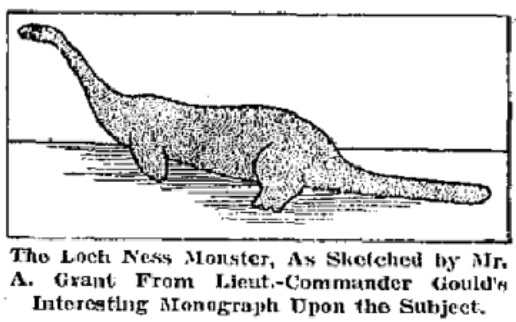
The Loch Ness Monster, affectionately known as Nessie, is one of the most famous purported lake monsters, said to dwell in , a large freshwater lake in the stretching about 23 miles long and over 700 feet deep at its maximum. Reports describe it as a large, long-necked creature resembling a , with a humped back, small head, and flippers, often estimated at 30 feet or more in length based on eyewitness accounts. The legend has captivated public imagination since ancient times, but scientific scrutiny has consistently failed to produce verifiable evidence of its existence, attributing sightings to misidentifications, hoaxes, and natural phenomena. The earliest documented reference to a creature in the Loch Ness area appears in the 7th-century hagiography Life of St. by , which recounts Saint 's 565 AD encounter with a "water beast" in the River Ness, a of the ; is said to have repelled it with the to save a swimmer, though this tale is widely regarded as pious legend rather than historical fact. Local from the medieval period alluded to water spirits or in the , but the monster remained a regional curiosity until the . The modern exploded in 1933 when local hoteliers Aldie and John Mackay reported seeing an enormous animal rolling and plunging on the surface of the , an account published in the Inverness Courier that drew international media attention and prompted the first organized searches. Subsequent sightings fueled the frenzy, including the iconic "Surgeon's Photograph" taken in April 1934 by gynecologist , depicting a sleek neck emerging from the water; this image became the defining visual of Nessie and inspired books, films, and expeditions, but was confessed as a in 1994 by Christian Spurling, who revealed it was staged using a with a sculpted head attached. Other notable reports include veterinary student Arthur Grant's 1934 land sighting of a long-necked creature emerging from the loch. Over 1,000 sightings have been logged since 1933 by the Official Loch Ness Monster Sightings Register, with descriptions varying from serpentine forms to overturning boats, though most lack photographic corroboration. Scientific investigations began earnestly in the 1930s, with big-game hunter Marmaduke Wetherell leading a land-based search in 1933 that found large footprints—later traced to a stuffed foot —and Edward Mountain's 1934 patrols spotting occasional ripples but no creature. The 1950s saw the first deployments by the and Oxford University, detecting large underwater objects moving at speeds up to 600 feet per minute, though these were inconclusive and possibly debris or fish schools. The Loch Ness Phenomena Investigation Bureau, active from 1962 to 1972, employed continuous monitoring and , capturing ambiguous images like a 1960 "flipper" photo by Tim Dinsdale, a pilot whose 30-year quest produced film of a distant hump in 1960 that experts debated as a wake or unknown . Further expeditions in the 1970s and 1980s, led by American lawyer Robert Rines through the Academy of Applied Science, used advanced and strobe-lit cameras, yielding a 1972 "gargoyle head" photo and a 1975 "flipper" image that suggested a large, diamond-shaped ; however, these were later discredited by experts as poor-quality artifacts, floating debris, or otters, with the Rines team acknowledging in 2019 that echoes were likely boat wakes or seals. Operation Deepscan in 1987 deployed 24 -equipped boats across the loch, detecting a large, unidentified object in Urquhart Bay moving mysteriously, but analysis attributed it to a known submerged feature or animal like a sturgeon. More recent efforts include the 2003 BBC-funded sweep covering 99.9% of the loch, which found no large mobile targets, and a 2018-2019 environmental DNA () survey by biologist Neil Gemmell, analyzing water samples that revealed abundant eel DNA but no traces of plesiosaurs, giant fish, or unknown vertebrates, suggesting extraordinary sightings might stem from large eels or optical illusions. More recent searches, including a 2023 expedition using drones and hydrophones, found no evidence of large unknown animals. As of 2025, the Official Sightings Register continues to log occasional reports, maintaining public fascination. Explanations for Nessie sightings emphasize natural causes: boat wakes, wind slicks, and floating logs mimic humps; otters, seals, or swimming deer create neck-like silhouettes; and binocular misjudgments amplify ordinary like , which can grow to 3 feet. Hoaxes, such as the 2007 "sighting" revealed as a pixelated , and cultural biases from —generating over £60 million annually for the region as of 2025—perpetuate the myth despite the absence of for surviving prehistoric reptiles in the isolated, post-glacial formed 10,000 years ago. As of 2025, ongoing monitoring by the Loch Ness Centre and exhibitions like the Nessieland themepark sustain interest, but no expedition has yielded irrefutable proof, leading most to classify Nessie as a rather than a biological reality.

Champ and Other North American Cases

Champ, also known as Champy, is the legendary creature purported to inhabit , a large freshwater body spanning New York, , and . Indigenous groups such as the and have described a great called Gitaskog or Tatoskok in their oral traditions, associating it with the lake's spiritual significance. The first documented European encounter is often attributed to 1609, when explorer reportedly fired at and wounded a 5-to-10-foot-long animal with a horse-like head, dark body, and white rings around its neck, though this is considered erroneous and likely a misidentification of a . Sightings of Champ continued sporadically through the 19th and 20th centuries, with over 300 reports compiled by local historical societies, often depicting a serpentine beast 25 to 30 feet long with 2 to 3 humps protruding from the water. A prominent piece of purported evidence is the Mansi photograph, showing a horned, elongated form emerging from the lake, which gained widespread attention but was later scrutinized through photogrammetric analysis revealing it likely depicted a floating branch or swimming family. Expeditions in the 1970s and 1980s, including sonar surveys by the Academy of Applied Science, detected large moving objects but yielded no conclusive proof of an unknown , attributing most anomalies to known fish like . Other notable North American lake monster reports include from in , , where First Nation legends warn of N'ha-a-itk, a malevolent requiring offerings for safe passage. European settler accounts from the 1870s onward describe a 40-to-50-foot-long, dark, humped serpent, with a cluster of sightings in 1926 prompting newspaper coverage and armed searches that found nothing. In 1989, multiple witnesses, including car salesman Ken Chaplin who captured video, reported observing the creature's undulating form, leading to further investigations with hydrophones and underwater cameras in the 1990s and , which recorded unexplained sounds but no visual confirmation. Memphre is the name for the alleged inhabitant of , straddling and , with lore tracing to stories of a water serpent and the first written sighting in 1816 by two farmers who saw a large, overturning object in the water. By the late , reports numbered in the dozens, portraying a 30-to-50-foot-long, log-shaped creature with a small head, culminating in over 200 documented cases by the 1990s. The International Memphre Research Expedition from 1993 to 1995 employed and video, detecting large submerged masses but concluding they were likely schools of or debris, with no evidence supporting a relict reptile. Lake Tahoe's , drawing from Washoe Tribe accounts of a massive underwater being, emerged in modern reports around , with a surge in the describing a 10-to-80-foot-long, grayish serpent or figure. Eyewitnesses in the and , including pilots and divers, claimed sightings of humps or a finned back, inspiring searches like a 2002 sonar expedition by that mapped the lake's depths but identified no anomalous large animals beyond known species like giant . These cases, like Champ, persist in cultural memory despite lacking verifiable physical evidence, often explained by misidentified sturgeon, otters, or optical illusions in deep, clear waters.

Cultural and Contemporary Impact

Influence on Media and Tourism

Lake monster legends have profoundly shaped popular media, often serving as metaphors for the unknown and inspiring a wide array of creative works. The Loch Ness Monster, or Nessie, stands as the archetype, appearing in over 50 films, documentaries, and television episodes since the 1930s, including family-friendly adaptations like Disney's The Water Horse: Legend of the Deep (2007), which grossed over $103 million worldwide and romanticized the creature as a gentle survivor. Similarly, animated series such as Scooby-Doo! and the Loch Ness Monster (2004) have introduced the legend to younger audiences, blending mystery with humor to perpetuate cultural fascination. In literature, anthologies like Nathan Ballingrud's North American Lake Monsters (2013) explore darker themes, using cryptids to delve into human fears and isolation, earning critical acclaim including a Shirley Jackson Award nomination. These portrayals, drawing from folklore, have globalized lake monster narratives, with non-fiction investigations like Benjamin Radford and Joe Nickell's Lake Monster Mysteries (2006) analyzing sightings through a skeptical lens while acknowledging their storytelling appeal. Television and news media have amplified these stories, turning anecdotal sightings into viral phenomena that blur fact and fiction. For instance, Champ, the purported monster of Lake Champlain, gained national attention through appearances on NBC's Unsolved Mysteries and a 2003 Discovery Channel special, which highlighted over 600 reported sightings and sparked renewed public interest. Ogopogo, the legendary inhabitant of Okanagan Lake in Canada, featured in episodes of In Search Of... and Unsolved Mysteries during the 1980s, coinciding with a $1 million reward offered by local tourism boards that drew international media coverage and solidified its status as "Canada's Loch Ness Monster." Such coverage often emphasizes adventure and mystery, fostering a cycle where media hype encourages further reports and artistic interpretations, as seen in horror novels and films like The Relic (1997), which incorporates lake-like aquatic horrors to evoke primal dread. The allure of lake monsters has driven substantial economies, transforming remote waterways into global destinations. In , the contributes approximately $80 million annually to the economy (as of 2025) through visitor spending on boat tours, exhibitions at the Loch Ness Centre & Exhibition, and accommodations, attracting hundreds of thousands of tourists yearly who often cite Nessie as a primary draw. This impact extends to merchandise and events, with the 1934 "Surgeon's Photograph"—later revealed as a —still inspiring pilgrimages that support local jobs in the Highlands. For Champ, the legend bolsters the region's appeal, promoting boating excursions, statues in Port Henry, and themed merchandise that ties into broader , with media-fueled festivals drawing families and enthusiasts. similarly enhances Kelowna's profile, featuring a waterfront statue and Indigenous-led tours that educate on cultural stories while generating revenue from souvenirs and events, underscoring how these myths foster sustainable, experiential without relying solely on "proof" of existence. Overall, lake monster lore exemplifies cryptid 's role in , blending , , and economic vitality.

Recent Sightings and Ongoing Interest

Interest in lake monsters persists into the 2020s, with reported sightings continuing to fuel public fascination and scientific scrutiny, particularly at well-known sites like Loch Ness in Scotland and Lake Champlain in North America. In March 2025, the first official sighting of the year at Loch Ness was reported from Dores Beach, where a visitor captured photographs of a dark, elongated mass emerging from the water, described as lasting several minutes and shared with the Official Loch Ness Monster Sightings Register. A second sighting occurred on May 23, 2025, during an organized hunt, when a participant observed an unidentified object surfacing near Urquhart Castle from a high vantage point, verified by local investigators. Later that year, in September, a longtime Nessie hunter reported seeing a creature "as big as three men" rising from the loch's depths during a boat patrol, adding to the tally of eyewitness accounts. By October 2025, webcam footage from Loch Ness captured a large, dark shape moving across the water surface, sparking renewed online debate and analysis by enthusiasts. On November 10, 2025, a Texas tourist reported the fifth official sighting of the year, observing a strange anomaly that was recognized by the Official Loch Ness Monster Sightings Register. Beyond , sightings of Champ, the legendary creature of , have also surfaced recently. In October 2025, filmmakers Richard Rossi and Kelly Tabor recorded drone video in Bulwagga Bay showing a large, serpentine form gliding underwater, which they described as the clearest evidence yet and submitted for expert review. Similarly, in August 2025, a Canadian photographed what appeared to be , the fabled serpent of in , capturing a humped breaking the water's surface during a lakeside walk. These reports align with historical patterns, as has amassed over 300 documented sightings since the , while accounts date back to Indigenous oral traditions. Ongoing investigations reflect a blend of traditional and modern science, sustaining interest in these phenomena. In May 2025, hundreds participated in a major hunt, deploying thermal drones, hydrophones, and live cameras across the loch to scan for anomalies, though no conclusive evidence emerged. Complementing such efforts, Neil Gemmell announced plans in January 2025 to expand (eDNA) sampling in , building on prior studies to detect traces of unknown aquatic species without invasive methods. Cultural initiatives further highlight the topic's enduring appeal; for instance, the Leahy Center for opened a permanent exhibit in August 2025 exploring Champ's history and through interactive displays and scientific . Additionally, a historical honoring Bear Lake's monster was unveiled in May 2025, recognizing over a century of local and boosting regional . These activities underscore how lake monster lore continues to inspire research, media coverage, and worldwide.

References

Add your contribution
Related Hubs
User Avatar
No comments yet.