


Community hub
Recent from talks
Contribute something
Nothing was collected or created yet.
Luc Alphand
View on Wikipedia
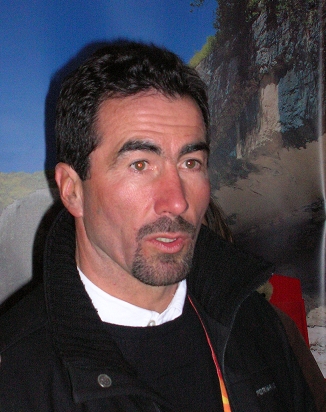
Luc Aimé Alphand (born 6 August 1965) is a former World Cup alpine ski racer from France. He specialized in the speed events and later became a race car driver.
Key Information


Ski racing
[edit]Born in Briançon (Hautes-Alpes), Alphand was world junior champion in 1983 and made his World Cup debut in 1984. It took a decade for him to make his breakthrough winning his first world cup at Kitzbühel 1995, and going on to take the overall downhill title 3 years in a row. In 1997 he won the World Cup overall title by collecting points only in the two speed disciplines, downhill and super G – a unique achievement in World Cup history. For this accomplishment he was voted L'Equipe Champion of Champions in 1997.[1] The previous year he won a bronze medal at the 1996 World Championships at Sierra Nevada, Spain.
In the village of Chantemerle (which neighbours his home town of Briançon in the Serre-Chevalier region) an expert ski run has been named in his honour.
His daughter, Estelle Alphand, represents Sweden in FIS Alpine Ski World Cup. His son Nils Alphand was skiing for France at the 2026 Olympics.
World Cup results
[edit]Season standings
[edit]| Season | Age | Overall | Slalom | Giant Slalom |
Super G | Downhill | Combined |
|---|---|---|---|---|---|---|---|
| 1988 | 22 | 61 | — | — | 16 | 37 | — |
| 1989 | 23 | 40 | — | — | 10 | — | — |
| 1990 | 24 | 80 | — | — | 21 | — | — |
| 1991 | 25 | 35 | — | — | 10 | 17 | — |
| 1992 | 26 | 53 | — | — | 19 | 25 | — |
| 1993 | 27 | 59 | — | — | 20 | 40 | 23 |
| 1994 | 28 | 27 | — | — | 17 | 14 | — |
| 1995 | 29 | 8 | — | — | 14 | 1 | 11 |
| 1996 | 30 | 4 | — | — | 4 | 1 | — |
| 1997 | 31 | 1 | — | — | 1 | 1 | — |
Season titles
[edit]| Season | Discipline |
|---|---|
| 1995 | Downhill |
| 1996 | Downhill |
| 1997 | Overall |
| Downhill | |
| Super G |
Race victories
[edit]- 12 wins (10 DH, 2 SG)
- 23 podiums (18 DH, 5 SG)
| Season | Date | Location | Discipline |
|---|---|---|---|
| 1995 | 13 Jan 1995 |  Kitzbühel, Austria Kitzbühel, Austria |
Downhill |
| 14 Jan 1995 | Downhill | ||
| 15 Mar 1995 |  Bormio, Italy Bormio, Italy |
Downhill | |
| 1996 | 1 Dec 1995 |  Vail, USA Vail, USA |
Downhill |
| 9 Dec 1995 |  Val-d'Isère, France Val-d'Isère, France |
Downhill | |
| 2 Feb 1996 |  Garmisch-Partenkirchen, Germany Garmisch-Partenkirchen, Germany |
Downhill | |
| 1997 | 20 Dec 1996 | Val Gardena, Italy |
Downhill |
| 29 Dec 1996 | Bormio, Italy |
Downhill | |
| 24 Jan 1997 | Kitzbühel, Austria |
Downhill | |
| 29 Jan 1997 |  Laax, Switzerland Laax, Switzerland |
Super-G | |
| 21 Feb 1997 | Garmisch-Partenkirchen, Germany |
Super-G | |
| 22 Feb 1997 | Downhill |
Other results
[edit]- Junior World Champion of the downhill in 1983
- French Alpine Skiing Championship
- Champion of the downhill in 1985, 1987, 1989, 1990 and 1994
- Champion of the super-G in 1988
- Champion of combined in 1987
Auto racing
[edit]| 24 Hours of Le Mans career | |
|---|---|
| Years | 2001–2009 |
| Teams | Luc Alphand Aventures |
| Best finish | 7th (2006) |
| Class wins | 0 |
He retired from competitive skiing in 1997 and started a career in auto racing. First in the Nissan Micra Stars Cup (1997–1998), then in the European Le Mans Series (2001), the FIA GT Championship (2002), and the Lamborghini Supertrophy (2002). He won the 2006 Dakar Rally, in which he had finished runner-up a year earlier. With this victory, he was the first ex-skier to win the Paris-Dakar. He recently purchased two Corvette race cars from Pratt & Miller for use in the Le Mans Series and 24 Hours of Le Mans.
Alphand suffered severe back injuries in an accident on the Rand'Auvergne all-terrain motorcycle race on 27 June 2009.[2] In November 2010 he retired from competitive auto racing for health reasons.
From 2021 to 2022, he was the sporting director for the Silk Way Rally. He departed the position following the Russian invasion of Ukraine.[3] Alphand became the Extreme E team principal for Veloce Racing in late 2022.[4]
24 Hours of Le Mans results
[edit]| Year | Team | Co-Drivers | Car | Class | Laps | Pos. | Class Pos. |
|---|---|---|---|---|---|---|---|
| 2001 | Warm-Up Luc Alphand Aventures JMB Racing
|
Michel Ligonnet Luis Marques
|
Porsche 911 GT3-RS | GT | 265 | 17th | 8th |
| 2002 | Luc Alphand Aventures
|
Christian Lavieille Olivier Thévenin
|
Porsche 911 GT3-RS | GT | 299 | 24th | 5th |
| 2003 | Luc Alphand Aventures
|
Jérôme Policand Frédéric Dor
|
Ferrari 550-GTS Maranello | GTS | 298 | 21st | 5th |
| 2004 | Luc Alphand Aventures
|
Christian Lavieille Philippe Almeras
|
Porsche 911 GT3-RS | GT | 316 | 16th | 5th |
| 2005 | Luc Alphand Aventures
|
Jérôme Policand Christopher Campbell
|
Porsche 911 GT3-RS | GT2 | 311 | 18th | 5th |
| 2006 | Luc Alphand Aventures
|
Patrice Goueslard Jérôme Policand
|
Chevrolet Corvette C5-R | GT1 | 346 | 7th | 3rd |
| 2007 | Luc Alphand Aventures
|
Patrice Goueslard Jérôme Policand
|
Chevrolet Corvette C6.R | GT1 | 327 | 12th | 7th |
| 2008 | Luc Alphand Aventures
|
Guillaume Moreau Jérôme Policand
|
Chevrolet Corvette C6.R | GT1 | 335 | 17th | 5th |
| 2009 | Luc Alphand Aventures
|
Stéphan Grégoire Patrice Goueslard
|
Chevrolet Corvette C6.R | GT1 | 99 | DNF | DNF |
Dakar Rally results
[edit]| Year | Class | Vehicle | Position | Stages won |
|---|---|---|---|---|
| 1998 | Car |  Mitsubishi Mitsubishi
|
DNF | 0 |
| 1999 | 16th | 0 | ||
| 2000 | Schlesser-Renault
|
DNF | 0 | |
| 2001 | DNF | 0 | ||
| 2002 | Mitsubishi
|
7th | 0 | |
| 2003 | BMW
|
9th | 1 | |
| 2004 | 4th | 2 | ||
| 2005 | Mitsubishi
|
2nd | 1 | |
| 2006 | 1st | 2 | ||
| 2007 | 2nd | 0 | ||
| 2008 | Event cancelled – replaced by the 2008 Central Europe Rally | |||
| 2009 | Car | Mitsubishi
|
DNF | 0 |
References
[edit]- ^ "Silk Way Rally 2016: The new adventure". Silk Way Rally. 16 November 2015. Archived from the original on 17 August 2016. Retrieved 19 July 2016.
- ^ Beer, Matt (29 June 2009). "Alphand injured in motorbike crash". autosport.com. Haymarket Publications. Retrieved 29 June 2009.
- ^ Minisini, Lucas (21 April 2023). "A Russian spy in Paris: Bulat Yanborisov, rally organizer and high-flying Kremlin agent". Le Monde. Retrieved 22 July 2024.
- ^ "Luc Alphand puts veloce Racing through its pre-season paces". Veloce Racing. 3 March 2023. Retrieved 22 July 2024.
External links
[edit] Media related to Luc Alphand at Wikimedia Commons
- Official website
- Luc Alphand at the International Ski and Snowboard Federation
- Luc Alphand World Cup standings at the International Ski Federation
- Luc Alphand at Ski-DB Alpine Ski Database
- Luc Alphand at Olympics at Sports-Reference.com (archived)

- Luc Alphand – Valeo MotorSports
- Luc Alphand and Valeo – 24H of Le Mans Luc Alphand and Valeo – 24H of Le Mans


Luc Alphand
View on GrokipediaEarly life
Family background
Luc Alphand was born on August 6, 1965, in Briançon, Hautes-Alpes, France.[9] He grew up in the nearby Serre-Chevalier area, a ski resort village in the French Alps.[10] Alphand's parents were Aimé Alphand and Josiane Alphand (née Verant).[11] He had an older brother, Lionel, who also pursued skiing. His father, Aimé, worked as a ski instructor with the École du Ski Français (ESF), a high mountain guide, and refuge guardian in the region, immersing the family in alpine activities from an early age.[12] Josiane, from a family with deep generational roots in the Serre-Chevalier village, held a position at the local post office while also engaging in the community's winter sports culture.[13] This familial involvement in guiding and instruction provided Alphand with immediate access to skis and mountain terrain, fostering his initial passion for speed-based outdoor pursuits.[14] At 1.80 meters tall and weighing around 75 kilograms in his youth, Alphand possessed a sturdy physique advantageous for the demands of alpine skiing.[1] Raised in the modest socio-economic setting of a tight-knit Alpine village centered on tourism and outdoor traditions, he benefited from an environment where skiing and mountaineering were integral to daily life and community identity.[10]Junior skiing career
Alphand's introduction to competitive skiing came early, shaped by his father's role as a mountain guide and ski instructor in the Briançon region, where the family resided in the French Alps. Growing up in this environment, he quickly joined local skiing clubs, such as those in the Serre Chevalier area, and began racing at a young age, securing his first notable victory in a high-standard event at 11 years old.[14][15] Throughout the early 1980s, Alphand built momentum with regional and national successes in France's junior circuits, honing his skills in speed disciplines amid a competitive domestic scene. These achievements positioned him as a rising talent, particularly in downhill, where his aggressive style and familiarity with steep terrain from his hometown slopes gave him an edge. By his mid-teens, he had established himself as a specialist in high-speed events, laying the groundwork for international recognition.[16] A pivotal moment arrived in 1983 at the age of 17, when Alphand claimed the gold medal in the downhill at the FIS Junior World Ski Championships in Sestriere, Italy, outperforming strong international fields.[13][16] This victory solidified his focus on downhill and emerging Super-G events within junior ranks, transitioning him toward senior competition. Alphand made his FIS Alpine Ski World Cup debut the following year in 1984, marking the end of his junior phase and the start of his professional trajectory.[2]Alpine skiing career
World Cup debut and breakthrough
Luc Alphand made his World Cup debut in the downhill event on January 9, 1984, in Wengen, Switzerland.[17] This marked his entry into the elite international circuit following a strong junior career that had honed his natural speed on steep courses. In his initial seasons from 1984 to 1990, Alphand posted modest results while building crucial experience in downhill racing, often finishing outside the top 20 but gradually improving his consistency across the demanding European venues. For instance, in the 1987/88 season, he competed in six downhill races and earned 5 World Cup points, reflecting the steep learning curve against established Austrian and Swiss dominators. His focus during this time was on adapting to the professional level's intensity, with occasional top-15 finishes signaling potential. At the 1988 Winter Olympics in Calgary, he placed fourth in the combined event.[1] The 1990-1991 season represented Alphand's breakthrough, as he achieved his first World Cup podium with a third-place finish in the downhill at Val Gardena, Italy, on December 15, 1990, trailing winner Franz Heinzer by 0.74 seconds.[18] This result, combined with consistent top-10 performances in races like the Val d'Isère downhill (13th place) and others, propelled him into the spotlight and earned him 37 points in the downhill standings that year, finishing 17th overall in the discipline and 35th in the overall World Cup.[19] Early signs of his rising prowess also appeared at Wengen, Switzerland, where he notched competitive runs amid the season's challenging conditions.[13] During this transitional period, Alphand emphasized technical development through intensive training regimens in the French Alps, refining his edge control, aerial awareness, and high-speed line selection to better navigate variable snow and terrain—skills rooted in his junior foundation of raw speed. These efforts, supported by the French national team's coaching, transformed him from a promising talent into a reliable top contender by the early 1990s.[13]Major titles and victories
Luc Alphand achieved his greatest success in the FIS Alpine Ski World Cup during the mid-1990s, culminating in the 1996/97 overall title, which he clinched with 1130 points ahead of Kjetil André Aamodt's 1096.[20][21] This victory marked the first time a Frenchman had won the men's overall World Cup since Jean-Claude Killy in 1968. In addition to the overall crown, Alphand secured multiple discipline championships, dominating the downhill category with titles in 1994/95, 1995/96, and 1996/97. He also claimed the super-G title in 1996/97, rounding out a remarkable season in the speed events.[5] Alphand amassed 12 World Cup victories throughout his career, including 10 in downhill and 2 in super-G. Notable downhill triumphs included double wins on the Hahnenkamm course in Kitzbühel in 1995—capturing both the classic and a training race adapted as an official event—and the sprint downhill there in 1997, as well as the Stelvio downhill in Bormio in December 1996. He also recorded 23 podium finishes in total, with 18 in downhill and 5 in super-G.[5][22][23] His consistency in downhill was evident in season standings, where he ranked first from 1994/95 through 1996/97, establishing him as the dominant force in the discipline during that period.[5]Other results and retirement
Alphand secured a bronze medal in the downhill at the 1996 FIS Alpine World Ski Championships in Sierra Nevada, Spain, finishing behind gold medalist Kristian Ghedina of Italy and silver medalist Tommy Moe of the United States.[5] This achievement marked his sole World Championships podium, highlighting his consistency in major international speed events outside the World Cup circuit.[1] In the Olympic Games, Alphand competed in three editions but did not medal. At the 1992 Albertville Olympics, he placed 12th in the downhill.[24] Two years later, at the 1994 Lillehammer Games, he achieved top-10 finishes with eighth place in both the downhill and super-G disciplines.[24][25] Alphand excelled in domestic competitions, winning the French National Alpine Ski Championships downhill a total of at least eight times, including in 1985, 1987, 1989, 1990, 1994, and 1997 at Alpe d'Huez, as well as super-G in 1988 and combined in 1987.[22][26] He also recorded strong results in other FIS-sanctioned events. Alphand announced his retirement from competitive skiing in March 1997, at the age of 31, shortly after clinching the overall World Cup title that season.[13] His decision stemmed from a desire to pursue new challenges, particularly an emerging interest in motorsport, which he viewed as a natural extension of his speed-oriented athletic background.[27]Transition to auto racing
Initial motorsport experiences
Upon retiring from competitive alpine skiing at the end of the 1997 season, Luc Alphand transitioned directly into motorsport, driven by his enduring passion for speed. His debut came in the Nissan Micra Stars Cup, an entry-level French touring car series featuring modified production cars, where he competed in 1997 and continued through 1998. This series provided Alphand with his first structured racing opportunities on circuits, allowing him to apply the high-speed decision-making and balance skills developed from years of downhill and super-G skiing to vehicle control.[27][28][29] Alphand's initial forays were marked by a steep learning curve, as he had limited prior driving experience beyond informal off-road practice and a guest appearance in the 1995 Andros Trophy ice racing event while still skiing. Adapting to the nuances of car handling—such as throttle modulation, braking under G-forces, and negotiating corners in a low-powered front-wheel-drive Micra—proved challenging compared to the intuitive edge control on skis, requiring him to build mechanical intuition from scratch.[30][27] These early efforts were supported by modest team affiliations, often through privateer entries in the Micra series, and sponsorship transitions from his skiing endorsements to automotive backers like Sonata, the French importer of Porsche and Mitsubishi vehicles, which facilitated equipment and logistical aid. Alphand's discreet performances in these amateur and national-level competitions laid the groundwork for his progression, emphasizing endurance and precision over outright speed during this novice phase.[30][29]Preparation for professional racing
After retiring from alpine skiing in 1997, Luc Alphand made his debut in the 1998 Dakar Rally driving a privateer Mitsubishi Pajero, where he encountered significant challenges, including spending 24 hours stuck in the desert before retiring two days from the finish; this experience proved instrumental in understanding the demands of rally raiding, prompting him to commit to further development despite initial vows to abandon the sport.[30] In 1999, he returned with his own Alphand Adventure team in another Mitsubishi Pajero, finishing 16th overall and 4th in the T2 class, which highlighted his growing proficiency in endurance navigation and vehicle handling across varied terrains.[31] Building on this foundation, Alphand progressed in the early 2000s by affiliating with established professional outfits for testing and competition, including the Schlesser-Renault-Elf team in 2000 and 2001, where he piloted prototype Schlesser Kangoo vehicles during Dakar preparations and entries—despite mechanical retirements, these stints allowed him to test advanced off-road prototypes and refine high-speed desert driving techniques.[31] By 2002, he joined Ralliart France, the French arm of Mitsubishi's motorsport division, competing in a factory-supported Pajero that yielded a 9th-place finish in the Dakar and marked his integration into semi-professional team structures with dedicated testing sessions.[31] This period also saw him experiment with BMW X5 under the X-Raid Team in 2003 and 2004, achieving 9th and 4th overall in the Dakar respectively, further solidifying his transition through exposure to diverse vehicle setups and team logistics.[31] Alphand's training regimen emphasized practical off-road skills, beginning with specialized sessions at the Sea Sand facility north of Paris under instructor Jean-Pierre Fontenay, focusing on sand extraction and recovery—essential for desert rallies—and drawing from his limited prior experience in the 1995 Andros Trophy ice races while still skiing.[30] He cultivated key co-driver partnerships to address rally's collaborative demands, starting with early navigators who taught critical techniques like left-foot braking; by the mid-2000s, this evolved into a stable alliance with Gilles Picard, enhancing roadbook interpretation and real-time decision-making during testing phases.[30][6] Transitioning from skiing's solitary precision to rally's team-oriented dynamics required Alphand to adapt his mental resilience and quick reflexes to shared responsibilities, such as delegating navigation to co-drivers while managing vehicle pace over unpredictable dunes—a process that took four to five Dakars to master fully, shifting focus from personal athletic output to synchronized crew performance.[30] Sponsorships evolved from initial backing by his skiing-era supporters and the Sonata importer for Porsche and Mitsubishi, which facilitated his 1998 entry, to more robust professional deals; by 2002 with Ralliart France and later X-Raid, these included technical partnerships for vehicle development, culminating in factory Mitsubishi support and Repsol branding around 2005 that funded intensive pre-event testing.[30][31] His high-profile status as a three-time World Cup downhill champion drew considerable media interest during this buildup, with coverage in motorsport outlets emphasizing his unconventional cross-sport leap and boosting visibility for emerging team collaborations in the early 2000s.[30]Auto racing career
Endurance racing results
Luc Alphand made his debut at the 24 Hours of Le Mans in 2002 with his own team, Luc Alphand Aventures, driving a Porsche 996 GT3-RS alongside co-drivers Christian Lavieille and Olivier Thévenin, finishing fifth in the GT class after completing 299 laps despite challenging weather conditions.[32] The following year, he switched to a Ferrari 550-GTS Maranello in the GTS class, achieving another fifth-place class finish with 298 laps, though the car encountered steering issues during the race.[33][34] In 2004 and 2005, Alphand returned to Porsche machinery with the 911 GT3-RS, securing consistent top-five class results—fifth in LM GT in 2004 (316 laps) and fifth in LM GT2 in 2005 (311 laps)—demonstrating growing reliability with the team.[35][36] Transitioning to Chevrolet Corvettes marked a significant step, starting in 2006 with the C5-R in the GT1 class; paired with Jérôme Policand and Patrice Goueslard, he achieved his career-best result of seventh overall and third in class after 346 laps, highlighting the team's competitive edge in endurance stints.[37][7] Alphand continued with Luc Alphand Aventures in Corvettes through 2010, posting multiple strong class performances, including second in GT1 in 2009 (336 laps) before an accident sidelined the second entry.[38][39] The team faced various setbacks, such as a destructive fire on the transporter en route to the circuit in one season, which destroyed a C5-R, and ongoing mechanical challenges that tested the squad's resilience.[40] As a former skier adapting to circuit-based GT racing, Alphand navigated a steep learning curve from open-road rally disciplines to the precision demands of prototypes and GT cars, emphasizing stamina honed from rally preparation in managing long stints under high-speed, team-relay conditions.[41]| Year | Car | Class Finish | Overall Finish | Laps Completed | Citation |
|---|---|---|---|---|---|
| 2002 | Porsche 996 GT3-RS | 5th (GT) | 24th | 299 | racingsportscars.com |
| 2004 | Porsche 911 GT3-RS | 5th (LM GT) | 16th | 316 | racingsportscars.com |
| 2005 | Porsche 911 GT3-RSR | 5th (LM GT2) | 18th | 311 | racingsportscars.com |
| 2006 | Chevrolet Corvette C5-R | 3rd (GT1) | 7th | 346 | 24h-lemans.com |
| 2009 | Chevrolet Corvette C6-R | 2nd (GT1) | 16th | 336 | racingsportscars.com |