



Community hub
Recent from talks
Contribute something to knowledge base
Content stats: 0 posts, 0 articles, 1 media, 0 notes
Members stats: 0 subscribers, 0 contributors, 0 moderators, 0 supporters
Subscribers
Supporters
Contributors
Moderators
Hub AI
Luddite AI simulator
(@Luddite_simulator)
Hub AI
Luddite AI simulator
(@Luddite_simulator)
Luddite
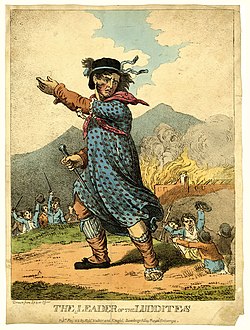
The Luddites were members of a 19th-century movement of English textile workers who opposed the use of certain types of automated machinery due to concerns relating to worker pay and output quality. They often destroyed the machines in organised raids. Members of the group referred to themselves as Luddites, self-described followers of "Ned Ludd", a legendary weaver whose name was used as a pseudonym in threatening letters to mill owners and government officials.
The Luddite movement began in Nottingham, England, and spread to the North West and Yorkshire between 1811 and 1816. Mill and factory owners took to shooting protesters and eventually the movement was suppressed by legal and military force, which included execution and penal transportation of accused and convicted Luddites.
Over time, the term has been used to refer to those opposed to the introduction of new technologies.
The name Luddite (/ˈlʌdaɪt/) occurs in the movement's writings as early as 1811. The movement utilised the eponym of Ned Ludd, an apocryphal apprentice who allegedly smashed two stocking frames in 1779 after being criticised and instructed to change his method. The name often appears as Captain, General, or King Ludd. Different versions of the legends place his residence in Anstey, near Leicester, or Sherwood Forest like Robin Hood.
The machine-breaking of the Luddites followed from previous outbreaks of sabotage in the English textile industry, especially in the hosiery and woollen trades. Organised action by stockingers had occurred at various times since 1675. In Lancashire, new cotton spinning technologies were met with violent resistance in 1768 and 1779. These new inventions produced textiles faster and cheaper because they could be operated by less-skilled, low-wage labourers. These struggles sometimes resulted in government suppression, via Parliamentary acts such as the Protection of Stocking Frames, etc. Act 1788.
Periodic uprisings relating to asset prices also occurred in other contexts in the century before Luddism. Irregular rises in food prices provoked the Keelmen to riot in the port of Tyne in 1710 and tin miners to steal from granaries at Falmouth in 1727. There was a rebellion in Northumberland and Durham in 1740, and an assault on Quaker corn dealers in 1756.
Malcolm L. Thomas argued in his 1970 history The Luddites that machine-breaking was one of the very few tactics that workers could use to increase pressure on employers, undermine lower-paid competing workers, and create solidarity among workers. "These attacks on machines did not imply any necessary hostility to machinery as such; machinery was just a conveniently exposed target against which an attack could be made." Historian Eric Hobsbawm has called their machine wrecking "collective bargaining by riot", which had been a tactic used in Britain since the Restoration because manufactories were scattered throughout the country, and that made it impractical to hold large-scale strikes. An agricultural variant of Luddism occurred during the widespread Swing Riots of 1830 in southern and eastern England, centring on breaking threshing machines.
The Luddite movement emerged during the harsh economic climate of the Napoleonic Wars, which saw a rise in difficult working conditions in the new textile factories paired with decreasing birth rates and a rise in education standards in England and Wales. Luddites objected primarily to the rising popularity of automated textile equipment, threatening the jobs and livelihoods of skilled workers as this technology allowed them to be replaced by cheaper and less skilled workers.[failed verification] The movement began in Arnold, Nottinghamshire, on 11 March 1811 and spread rapidly throughout England over the following two years. The British economy suffered greatly in 1810 to 1812, especially in terms of high unemployment and inflation. The causes included the high cost of the wars with Napoleon, Napoleon's Continental System of economic warfare, and escalating conflict with the United States. The crisis led to widespread protest and violence, but the middle classes and upper classes strongly supported the government, which used the army to suppress all working-class unrest, especially the Luddite movement.
Luddite
The Luddites were members of a 19th-century movement of English textile workers who opposed the use of certain types of automated machinery due to concerns relating to worker pay and output quality. They often destroyed the machines in organised raids. Members of the group referred to themselves as Luddites, self-described followers of "Ned Ludd", a legendary weaver whose name was used as a pseudonym in threatening letters to mill owners and government officials.
The Luddite movement began in Nottingham, England, and spread to the North West and Yorkshire between 1811 and 1816. Mill and factory owners took to shooting protesters and eventually the movement was suppressed by legal and military force, which included execution and penal transportation of accused and convicted Luddites.
Over time, the term has been used to refer to those opposed to the introduction of new technologies.
The name Luddite (/ˈlʌdaɪt/) occurs in the movement's writings as early as 1811. The movement utilised the eponym of Ned Ludd, an apocryphal apprentice who allegedly smashed two stocking frames in 1779 after being criticised and instructed to change his method. The name often appears as Captain, General, or King Ludd. Different versions of the legends place his residence in Anstey, near Leicester, or Sherwood Forest like Robin Hood.
The machine-breaking of the Luddites followed from previous outbreaks of sabotage in the English textile industry, especially in the hosiery and woollen trades. Organised action by stockingers had occurred at various times since 1675. In Lancashire, new cotton spinning technologies were met with violent resistance in 1768 and 1779. These new inventions produced textiles faster and cheaper because they could be operated by less-skilled, low-wage labourers. These struggles sometimes resulted in government suppression, via Parliamentary acts such as the Protection of Stocking Frames, etc. Act 1788.
Periodic uprisings relating to asset prices also occurred in other contexts in the century before Luddism. Irregular rises in food prices provoked the Keelmen to riot in the port of Tyne in 1710 and tin miners to steal from granaries at Falmouth in 1727. There was a rebellion in Northumberland and Durham in 1740, and an assault on Quaker corn dealers in 1756.
Malcolm L. Thomas argued in his 1970 history The Luddites that machine-breaking was one of the very few tactics that workers could use to increase pressure on employers, undermine lower-paid competing workers, and create solidarity among workers. "These attacks on machines did not imply any necessary hostility to machinery as such; machinery was just a conveniently exposed target against which an attack could be made." Historian Eric Hobsbawm has called their machine wrecking "collective bargaining by riot", which had been a tactic used in Britain since the Restoration because manufactories were scattered throughout the country, and that made it impractical to hold large-scale strikes. An agricultural variant of Luddism occurred during the widespread Swing Riots of 1830 in southern and eastern England, centring on breaking threshing machines.
The Luddite movement emerged during the harsh economic climate of the Napoleonic Wars, which saw a rise in difficult working conditions in the new textile factories paired with decreasing birth rates and a rise in education standards in England and Wales. Luddites objected primarily to the rising popularity of automated textile equipment, threatening the jobs and livelihoods of skilled workers as this technology allowed them to be replaced by cheaper and less skilled workers.[failed verification] The movement began in Arnold, Nottinghamshire, on 11 March 1811 and spread rapidly throughout England over the following two years. The British economy suffered greatly in 1810 to 1812, especially in terms of high unemployment and inflation. The causes included the high cost of the wars with Napoleon, Napoleon's Continental System of economic warfare, and escalating conflict with the United States. The crisis led to widespread protest and violence, but the middle classes and upper classes strongly supported the government, which used the army to suppress all working-class unrest, especially the Luddite movement.
Recent media
Recent media