Hubbry Logo
logo
Luddite
Community hub

Luddite

logo
0 subscribers
Read side by side
from Wikipedia

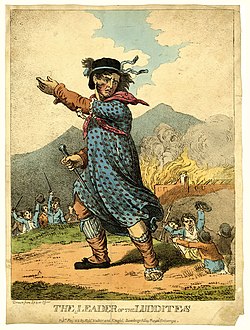
The Leader of the Luddites, 1812. Hand-coloured etching

The Luddites were members of a 19th-century movement of English textile workers who opposed the use of certain types of automated machinery due to concerns relating to worker pay and output quality. They often destroyed the machines in organised raids.[1][2] Members of the group referred to themselves as Luddites, self-described followers of "Ned Ludd", a legendary weaver whose name was used as a pseudonym in threatening letters to mill owners and government officials.[3]

The Luddite movement began in Nottingham, England, and spread to the North West and Yorkshire between 1811 and 1816.[4] Mill and factory owners took to shooting protesters and eventually the movement was suppressed by legal and military force, which included execution and penal transportation of accused and convicted Luddites.[5]

Over time, the term has been used to refer to those opposed to the introduction of new technologies.[6]

Etymology

[edit]

The name Luddite (/ˈlʌdt/) occurs in the movement's writings as early as 1811.[3] The movement utilised the eponym of Ned Ludd, an apocryphal apprentice who allegedly smashed two stocking frames in 1779 after being criticised and instructed to change his method. The name often appears as Captain, General, or King Ludd. Different versions of the legends place his residence in Anstey, near Leicester, or Sherwood Forest like Robin Hood.[7]

History

[edit]

Historical precedents

[edit]

The machine-breaking of the Luddites followed from previous outbreaks of sabotage in the English textile industry, especially in the hosiery and woollen trades. Organised action by stockingers had occurred at various times since 1675.[8][9][10] In Lancashire, new cotton spinning technologies were met with violent resistance in 1768 and 1779. These new inventions produced textiles faster and cheaper because they could be operated by less-skilled, low-wage labourers.[11] These struggles sometimes resulted in government suppression, via Parliamentary acts such as the Protection of Stocking Frames, etc. Act 1788.

Periodic uprisings relating to asset prices also occurred in other contexts in the century before Luddism. Irregular rises in food prices provoked the Keelmen to riot in the port of Tyne in 1710[12] and tin miners to steal from granaries at Falmouth in 1727.[a] There was a rebellion in Northumberland and Durham in 1740, and an assault on Quaker corn dealers in 1756.

Malcolm L. Thomas argued in his 1970 history The Luddites that machine-breaking was one of the very few tactics that workers could use to increase pressure on employers, undermine lower-paid competing workers, and create solidarity among workers. "These attacks on machines did not imply any necessary hostility to machinery as such; machinery was just a conveniently exposed target against which an attack could be made."[10] Historian Eric Hobsbawm has called their machine wrecking "collective bargaining by riot", which had been a tactic used in Britain since the Restoration because manufactories were scattered throughout the country, and that made it impractical to hold large-scale strikes.[13][14] An agricultural variant of Luddism occurred during the widespread Swing Riots of 1830 in southern and eastern England, centring on breaking threshing machines.[15]

Peak activity: 1811–1817

[edit]

The Luddite movement emerged during the harsh economic climate of the Napoleonic Wars, which saw a rise in difficult working conditions in the new textile factories paired with decreasing birth rates and a rise in education standards in England and Wales.[16] Luddites objected primarily to the rising popularity of automated textile equipment, threatening the jobs and livelihoods of skilled workers as this technology allowed them to be replaced by cheaper and less skilled workers.[1][failed verification] The movement began in Arnold, Nottinghamshire, on 11 March 1811 and spread rapidly throughout England over the following two years.[17][1] The British economy suffered greatly in 1810 to 1812, especially in terms of high unemployment and inflation. The causes included the high cost of the wars with Napoleon, Napoleon's Continental System of economic warfare, and escalating conflict with the United States. The crisis led to widespread protest and violence, but the middle classes and upper classes strongly supported the government, which used the army to suppress all working-class unrest, especially the Luddite movement.[18][19]

The Luddites met at night on the moors surrounding industrial towns to practise military-like drills and manoeuvres. Their main areas of operation began in Nottinghamshire in November 1811, followed by the West Riding of Yorkshire in early 1812, and then Lancashire by March 1813. They wrecked specific types of machinery that posed a threat to the particular industrial interests in each region. In the Midlands, these were the "wide" knitting frames used to make cheap and inferior lace articles.[20] In the North West, weavers sought to eliminate the steam-powered looms threatening wages in the cotton trade. In Yorkshire, workers opposed the use of shearing frames and gig mills to finish woollen cloth.[21]

Many Luddite groups were highly organised and pursued machine-breaking as one of several tools for achieving specific political ends. In addition to the raids, Luddites coordinated public demonstrations and the mailing of letters to local industrialists and government officials.[22] These letters explained their reasons for destroying the machinery and threatened further action if the use of "obnoxious" machines continued.[23] The writings of Midlands Luddites often justified their demands through the legitimacy of the Company of Framework Knitters, a recognised public body that already openly negotiated with masters through named representatives. In North West England, textile workers lacked these long-standing trade institutions and their letters composed an attempt to achieve recognition as a united body of tradespeople. As such, they were more likely to include petitions for governmental reforms, such as increased minimum wages and the cessation of child labor. Northwestern Luddites were also more likely to use radical language linking their movement to that of American and French revolutionaries. In Yorkshire, the letter-writing campaign shifted to more violent threats against local authorities viewed as complicit in the use of offensive machinery to exert greater commercial control over the labour market.

In Yorkshire, the croppers (who were highly skilled and highly paid) faced mass unemployment due to the introduction of cropping machines by Enoch Taylor of Marsden.[24] This sparked the Luddite movement among the croppers of Yorkshire, who used a hammer dubbed "Enoch" to break the frames of the cropping machines. They called it Enoch to mock Enoch Taylor, and when they broke the frames they purportedly shouted "Enoch made them, and Enoch shall break them."[25]

Luddites clashed with government troops at Burton's Mill in Middleton and at Westhoughton Mill, both in Lancashire.[26] The Luddites and their supporters anonymously sent death threats to, and possibly attacked, magistrates and food merchants. Activists smashed Heathcote's lace making machine in Loughborough in 1816.[27] He and other industrialists had secret chambers constructed in their buildings that could be used as hiding places during an attack.[28]

In 1817 Jeremiah Brandreth, an unemployed Nottingham stockinger and probable ex-Luddite, led the Pentrich Rising. While this was a general uprising unrelated to machinery, it can be viewed as the last major Luddite act.[29]

Government response

[edit]

12,000 government troops, most of them belonging to militia or yeomanry units, were involved in suppression of Luddite activity, which historian Eric Hobsbawm wrote was a larger number than the army that the Duke of Wellington led into Portugal in 1808 during the Peninsular War.[30][b] Four Luddites, led by a man named George Mellor, ambushed and assassinated mill owner William Horsfall of Ottiwells Mill in Marsden, West Yorkshire, at Crosland Moor in Huddersfield. Horsfall had remarked that he would "Ride up to his saddle in Luddite blood".[31] Mellor fired the fatal shot to Horsfall's groin, and all four men were arrested. One of the men, Benjamin Walker, turned informant, and the other three were hanged.[32][33][34] Lord Byron denounced what he considered to be the plight of the working class, the government's inane policies and ruthless repression in the House of Lords on 27 February 1812:

I have been in some of the most oppressed provinces of Turkey; but never, under the most despotic of infidel governments, did I behold such squalid wretchedness as I have seen since my return, in the very heart of a Christian country.[35]

Government officials sought to suppress the Luddite movement with a mass trial at York in January 1813, following the attack on Cartwrights Mill at Rawfolds near Cleckheaton. The government charged over 60 men, including Mellor and his companions, with various crimes in connection with Luddite activities. While some of those charged were actual Luddites, many had no connection to the movement. Although the proceedings were legitimate jury trials, many were abandoned due to lack of evidence and 30 men were acquitted. These trials were intended to act as show trials to deter other Luddites from continuing their activities. The harsh sentences of those found guilty, which included execution and penal transportation, quickly ended the movement.[5][36] Parliament made "machine breaking" (i.e. industrial sabotage) a capital crime with the Destruction of Stocking Frames, etc. Act 1812.[37] Lord Byron opposed this legislation, becoming one of the few prominent defenders of the Luddites after the treatment of the defendants at the York trials.[38]

Legacy

[edit]

The Luddites (specifically the croppers, those who operated cropping machinery) are memorialised in the Yorkshire-area folk song "The Cropper Lads", which has been recorded by artists including Lou Killen and Maddy Prior.[39] The croppers were very highly skilled and highly paid before the introduction of cropping machinery, and thus had more to lose and more reason to rebel against the factory owners' use of machinery. Another traditional song which celebrates the Luddites is the song "The Triumph of General Ludd", which was recorded by Chumbawamba for their 1988 album English Rebel Songs.[40]

In the 19th century, occupations that arose from the growth of trade and shipping in ports, also as "domestic" manufacturers, were notorious for precarious employment prospects. Underemployment was chronic during this period,[41] and it was common practice to retain a larger workforce than was typically necessary for insurance against labour shortages in boom times.[41]

Moreover, the organisation of manufacture by merchant capitalists in the textile industry was inherently unstable. While the financiers' capital was still largely invested in raw materials, it was easy to increase commitment when trade was good and almost as easy to cut back when times were bad. Merchant capitalists lacked the incentive of later factory owners, whose capital was invested in buildings and plants, to maintain a steady rate of production and return on fixed capital. The combination of seasonal variations in wage rates and violent short-term fluctuations springing from harvests and war produced periodic outbreaks of violence.[41]

Modern usage

[edit]

Nowadays, the term "Luddite" often is used to describe someone who is opposed or resistant to new technologies.[42]

In 1956, during a British Parliamentary debate, a Labour spokesman said that "organised workers were by no means wedded to a 'Luddite Philosophy'."[43] By 2006, the term neo-Luddism had emerged to describe opposition to many forms of technology.[44] According to a manifesto drawn up by the Second Luddite Congress (April 1996; Barnesville, Ohio), neo-Luddism is "a leaderless movement of passive resistance to consumerism and the increasingly bizarre and frightening technologies of the Computer Age".[45]

The term "Luddite fallacy" is used by economists about the fear that technological unemployment inevitably generates structural unemployment and is consequently macroeconomically injurious. If a technological innovation reduces necessary labour inputs in a given sector, then the industry-wide cost of production falls, which lowers the competitive price and increases the equilibrium supply point that, theoretically, will require an increase in aggregate labour inputs.[46] During the 20th century and the first decade of the 21st century, the dominant view among economists has been that belief in long-term technological unemployment was indeed a fallacy. More recently, there has been increased support for the view that the benefits of automation are not equally distributed.[47][48][49]

See also

[edit]

Explanatory notes

[edit]

References

[edit]

Sources

[edit]

Further reading

[edit]
[edit]
Revisions and contributorsEdit on WikipediaRead on Wikipedia
from Grokipedia
The Luddites were organized groups of skilled English textile workers, primarily frame-knitters and croppers, who between 1811 and 1816 engaged in coordinated machine-breaking actions across Nottinghamshire, Yorkshire, and Lancashire to protest the adoption of automated machinery that displaced artisanal labor and depressed wages.[1][2] Named after the mythical figure Ned Ludd, said to have initiated the destruction of knitting frames around 1779—a story lacking corroboration from primary sources of the 1770s and rooted in retrospective folk etymology—the movement emerged amid economic distress exacerbated by the Napoleonic Wars, including high grain prices, unemployment, and the influx of untrained workers willing to operate machines at lower rates.[3][4] Their tactics involved nighttime raids on factories, where they smashed wide-frame looms and shearing frames designed to produce cheaper, lower-quality goods, while issuing threatening letters to manufacturers demanding the removal of such equipment.[5][6] The British government responded harshly, deploying troops—outnumbering Napoleon's Peninsular army—and enacting laws making machine-breaking a capital offense, resulting in trials at York where seventeen Luddites were executed in 1813 despite limited evidence in some cases.[3][4] Although the protests failed to halt mechanization, which ultimately transformed the textile industry and contributed to broader industrialization, the Luddites highlighted early conflicts between technological innovation and labor interests, with contemporary analyses emphasizing their rational opposition to exploitative implementation rather than technology itself.[7][6] In modern usage, "Luddite" derogatorily denotes opposition to technological progress, often overlooking the historical context of skilled workers defending livelihoods against rapid deskilling and market disruptions.[5][1]

Origins

Etymology

The term "Luddite" originated in early 19th-century England as a designation for textile workers who destroyed mechanized machinery, deriving from the pseudonym "Ned Ludd" or "General Ludd" used to sign threatening letters and manifestos during the 1811 disturbances in Nottinghamshire.[8] These communications, such as an November 1811 letter to factory owners warning of frame-breaking, invoked Ned Ludd as a symbolic leader commanding the destruction of knitting frames deemed injurious to skilled labor.[9] The figure of Ned Ludd traces to a reported incident in 1779 involving a stocking weaver named Edward Ludlam (or Ludd) from Anstey, Leicestershire, who, in a fit of anger—possibly after being whipped for idleness or mocked by apprentices—smashed two knitting frames owned by his employer.[10] Parish records from St Mary's Church in Anstey record the burial of an Edward Ludlam on August 31, 1776, which raises questions about whether this individual could have been involved in the 1779 frame-breaking incident, potentially indicating the story is apocryphal or refers to another person with a similar name.[11] Contemporary accounts, including a 1811 Nottingham Review article, described this event as the historical kernel for the legend, transforming a local act of vandalism into folklore that protesters adapted three decades later to legitimize their organized resistance against wide-frame knitting machines.[4] While some portrayals embellished Ludd as a mythical Sherwood Forest dweller akin to Robin Hood, no primary sources from the 1770s corroborate a specific incident involving Ludlam or "Ned Ludd" destroying machinery, suggesting the connection relies on retrospective folk etymology rather than verifiable events, though its direct causal link to the later movement remains interpretive.[9]

Historical Precedents

Machine-breaking in Britain's textile industry occurred sporadically throughout the 18th century, primarily among framework knitters in Nottinghamshire who targeted stocking frames to enforce customary wage rates and production standards against employers adopting wider frames or cost-cutting practices.[2][12] These actions served as a form of collective bargaining by destruction, predating the organized Luddite movement and reflecting tensions over technological adaptations that threatened skilled labor's bargaining power.[4] Parliament responded to such incidents by enacting the Destruction of Stocking Frames Act in 1721, which criminalized the willful destruction of frames or engines used in wool or cotton working, making it a felony punishable by transportation or death, thereby confirming the prevalence of frame-breaking prior to that date.[12][13] Similar disturbances continued intermittently, as evidenced by the legendary 1779 incident involving "Ned Ludd," an apprentice who reportedly smashed two frames in a fit of anger over instructions to adjust a machine, an apocryphal tale that later mythologized the practice but underscored its familiarity in the hosiery trade.[13][10] These precedents differed from later Luddism in scale and organization but shared the causal mechanism of workers resisting machinery perceived to undercut wages and skills, often tied to broader economic grievances rather than outright opposition to innovation itself.[4] By the early 19th century, intensified industrialization amplified these tactics into widespread uprisings, building on established traditions of direct action against non-compliant machinery.[3]

Causes and Context

Economic Pressures

The Luddite movement arose amid acute economic distress in Britain's textile regions during the early 19th century, exacerbated by the ongoing Napoleonic Wars (1803–1815), which disrupted continental trade and led to widespread food shortages and poverty among working families. In textile centers like Nottinghamshire, the hosiery industry faced additional strain from a shift in men's fashion away from stockings toward trousers, reducing demand and prompting manufacturers to cut costs through mechanization and lower-paid, unskilled labor.[14] This period saw merchants exploit the downturn to depress wages, with framework knitters in Nottinghamshire experiencing explicit reductions tied to the adoption of wider knitting frames that required less skill and output more product at lower labor costs.[3] Unemployment surged as automated machinery, such as power looms, displaced skilled handloom weavers and knitters, enabling production rates up to 100 times faster than manual methods while bypassing traditional wage standards.[14] In Nottinghamshire, protests erupted in March 1811 against these wage cuts and job losses, with workers demanding better pay and more employment opportunities amid the trade blockade's effects from 1802 to 1812.[3] By November 1811, frame-breaking incidents targeted factories employing cheaper labor, reflecting broader desperation in regions where mechanization consolidated mills, lengthened hours, and intensified competition from untrained workers.[4] The combination of war-induced economic contraction and technological displacement strained the makeshift economy of rural textile workers, particularly in Nottinghamshire, where framework knitting had long supported family-based production but now yielded insufficient income for basics like rent and maintenance.[14] In Yorkshire and Lancashire, similar pressures mounted by 1812, as wool and cotton sectors adopted wide frames and power looms, leading to de-skilling and further unemployment among artisans who could not compete with machine outputs.[3] These factors, rather than opposition to technology per se, drove demands for restored livelihoods, as evidenced by early 1811 gatherings in Nottingham calling for higher wages and work amid scarce resources.[4]

Technological Innovations in Textiles

The mechanization of the British textile industry accelerated in the late 18th century, with inventions enabling faster production of yarn, fabric, and finished goods at lower costs, often at the expense of skilled labor. The stocking frame, a hand-powered knitting machine invented by William Lee in 1589, marked an early breakthrough by automating the production of silk and woolen stockings, previously done by hand.[15] By the early 19th century, modifications to this frame—such as widening it to produce coarser, cheaper hosiery—allowed less-skilled operators to undercut traditional framework knitters, who faced wage reductions and unemployment as masters adopted these adaptations to compete in expanding markets.[4] In spinning, James Hargreaves' spinning jenny, developed around 1764, introduced a multi-spindle device that a single worker could operate to produce multiple threads simultaneously, shifting production from home-based spinning wheels to centralized setups and increasing output dramatically.[16] This complemented later advances like Richard Arkwright's water frame (1769), which used water power for continuous spinning of stronger yarn, further mechanizing cotton processing. While these spinning innovations often created demand for more weavers initially, they flooded the market with cheap yarn, pressuring handloom weavers and contributing to broader labor displacement.[17] Weaving saw pivotal changes with Edmund Cartwright's power loom, patented in 1785, which automated the weaving process using mechanical power—initially water, later steam—to interlace warp and weft threads far faster than handlooms.[18] Early models were unreliable, but by the 1810s, steam-powered versions proliferated in Lancashire mills, enabling factories to produce cloth with fewer skilled operatives and threatening the livelihoods of thousands of handloom weavers who could not compete on speed or cost.[19] Additionally, gig mills—steam-powered shearing frames introduced around 1790—mechanized the cropping of woolen cloth, replacing skilled croppers whose manual labor ensured quality finishes.[3] These innovations collectively transformed textiles from artisanal crafts into factory-based industries, boosting productivity—such as power looms achieving up to 40 times the output of handlooms by 1815—but exacerbating unemployment among skilled workers in regions like Nottinghamshire (hosiery), Yorkshire (woolen finishing), and Lancashire (cotton weaving).[2] Frame owners' adaptations for low-quality goods and the shift to unskilled labor intensified grievances, as wages fell despite rising demand, setting the stage for organized resistance.[4]

The Luddite Uprising

Organization and Leadership

The Luddite movement operated without a centralized hierarchy, instead functioning through autonomous regional groups tailored to local textile industries and grievances. Primary activity concentrated in three areas: the East Midlands (Nottinghamshire, Derbyshire, and Leicestershire), where framework-knitters targeted wide knitting frames; the West Riding of Yorkshire, focused on croppers opposing shearing frames; and Lancashire with Cheshire, involving cotton weavers attacking power looms.[20][21] These groups coordinated via nighttime assemblies, mock military drills on moors, and encrypted communications, sustaining operations amid government surveillance from November 1811 through 1816.[21][22] Leadership remained symbolic and decentralized, with no verifiable single figure directing nationwide efforts; the persona of "Ned Ludd" or "General Ludd"—a mythical apprentice from a 1779 frame-smashing incident in Leicestershire—served as a unifying eponym in proclamations and threats, rather than a real commander.[22] Letters to manufacturers, often signed "By order of Ned Ludd" or "General Ludd's Army," demanded compliance under threat of destruction, as in a November 1811 Midlands missive warning of assembled forces of 20,000 men.[21] Local captains and agitators emerged ad hoc, such as Elias Carnil heading a Bulwell committee in February 1812 or George Mellor organizing Yorkshire raids culminating in the April 1812 murder of mill owner William Horsfall.[21][20] Binding cohesion were secret oaths administered during initiation, enforcing silence and vengeance against informants, as detailed in a Barnsley committee pledge from 1812: "I A. B. of my own free will and accord do hereby promise, and swear that I will never reveal any of the names of any one of this secret committee, under the penalty of being sent out of this world by the first brother that may meet me."[23] These oaths, coupled with recognition signals like specific hand gestures and passwords (e.g., "Determined" and "Free Liberty"), facilitated recruitment into cells of dozens to hundreds, excluding suspected outsiders such as Irish workers.[23] Committees in places like Barnsley handled funds, intelligence, and delegate exchanges with Leeds or Manchester, amassing reports of 7,000–8,000 armed sympathizers in some areas by early 1812, though actual operational units numbered in the low hundreds per raid.[23][21] This structure emphasized neighborhood loyalty over formal command, enabling resilience but limiting scalability against state suppression.[22]

Peak Activity: 1811–1817

The Luddite movement reached its height between November 1811 and 1812, originating among framework knitters in Nottinghamshire who targeted wide knitting frames that produced inferior wide-wale stockings, exacerbating unemployment amid falling wages and post-harvest distress.[3] Initial attacks involved small groups destroying dozens of frames, with approximately 1,000 machines smashed in Nottinghamshire from March 1811 to February 1812, inflicting damages estimated at £6,000 to £10,000.[12] These actions were often preceded by threatening letters purportedly from "Ned Ludd," demanding the removal of offending machinery and warning of reprisals against non-compliant employers.[3] By early 1812, the unrest spread to the West Riding of Yorkshire, where skilled croppers and finishers opposed gig mills and shearing frames that displaced labor-intensive hand-finishing of woolen cloth.[12] A pivotal incident occurred on April 11, 1812, when about 150 armed Luddites assaulted William Cartwright's Rawfolds Mill near Huddersfield, intending to destroy machinery; defenders fired on the attackers, killing two and repelling the raid.[5] Days later, on April 28, 1812, manufacturer William Horsfall, who had supported armed resistance to Luddites, was murdered in reprisal while traveling home from Huddersfield.[12] Concurrently, activity emerged in Lancashire, with Luddites burning Westhoughton cotton mill in April 1812 to protest power looms threatening handloom weavers.[12] Activity persisted sporadically through 18131816 across Nottinghamshire, Leicestershire, Derbyshire, and Lancashire, though intensity waned under military pressure; notable was the June 28, 1816, destruction of 53 frames at Heathcote and Boden's mill in Loughborough, causing £6,000 in losses.[12] Overall, the peak involved groups typically numbering 4–10, occasionally up to 100 or more, focusing destruction on machines deemed to undercut skilled wages rather than indiscriminate sabotage, amid broader economic strains from the Napoleonic Wars and poor harvests.[5] By 1817, isolated incidents tapered off as suppression intensified, marking the effective end of organized machine-breaking.[12]

Tactics and Specific Incidents

Luddites employed tactics centered on the targeted destruction of machinery deemed responsible for wage depression and unemployment, primarily through nocturnal raids conducted by organized bands of workers armed with hammers, axes, and sledgehammers.[20][2] These groups, often numbering in the dozens to hundreds, assembled in remote moorland locations before advancing on workshops or mills, focusing on frames and looms that automated textile production.[2] Prior to attacks, they disseminated threatening letters signed by the fictional "General Ned Ludd" or "Ned Ludd," warning manufacturers to dismantle offending equipment or face reprisals, as exemplified by an 8 November 1811 missive to a Bulwell employer demanding the removal of wide frames.[21] While initially avoiding violence against persons, confrontations escalated to gunfire when mill owners fortified defenses, reflecting a shift from symbolic protest to armed resistance against mechanization.[24] The uprising commenced in Nottinghamshire with frame-breaking actions against wide knitting frames used in hosiery production. On 11 March 1811, a band attacked a frame shop in Arnold, smashing multiple machines and marking the first major incident attributed to Luddites.[20] Subsequent raids in villages around Nottingham, such as on 23 March and 20 April 1811, targeted similar equipment without immediate arrests, sustaining momentum through winter into spring 1812.[20] By November 1811, stockingers near Bulwell escalated destruction, breaking into premises under Ludd's banner.[20] Activity spread to the West Riding of Yorkshire in early 1812, where Luddites demolished shearing frames and gig mills in cropping shops and larger mills, protesting devices that reduced skilled labor needs.[20] A pivotal event occurred on 11 April 1812, when approximately 150 armed men assaulted William Cartwright's Rawfolds Mill near Huddersfield; despite hours of bombardment with stones and gunfire, the reinforced structure held, resulting in Luddite casualties including two deaths from wounds sustained during the failed siege.[24][25] In Lancashire from December 1811, groups raided steam-powered cotton mills, destroying looms and clashing with troops at sites like Westhoughton Mill, which was set ablaze on 27 June 1812.[20] Further incidents included the 28 June 1812 attack on Heathcote's mill in Loughborough, targeting lace-making machinery.[24] These operations, varying by region—frames in Nottinghamshire, shearing equipment in Yorkshire, power looms in Lancashire—culminated in over 200 machines destroyed by mid-1812 before suppression intensified.[13]

Government Response

Legislative and Military Actions

In response to escalating Luddite machine-breaking, Parliament enacted the Destruction of Stocking Frames, etc. Act 1812 (commonly known as the Frame-Breaking Act) on February 28, 1812, which classified the willful destruction of any frame, machine, or tool used in the woollen, cotton, or lace manufacturing processes as a felony punishable by death, elevating it from a misdemeanor under prior laws like the 1788 Protection of Stocking Frames Act.[26][2] This measure aimed to deter sabotage by imposing capital penalties, with offenders subject to transportation or execution following conviction in special assize courts.[27] The government supplemented legislative efforts with extensive military mobilization, deploying approximately 12,000 troops—including regular army units, militia, and yeomanry—across Luddite hotspots in Nottinghamshire, Yorkshire, and Lancashire between 1811 and 1817 to protect mills and suppress riots.[28] These forces conducted patrols, guarded factories, and clashed directly with protesters; for instance, on March 11, 1811, British troops in Nottingham dispersed crowds demanding better wages and work, marking an early escalation of armed enforcement.[4] Factory owners, often armed by local authorities, also fired upon Luddite assemblies, contributing to casualties and further militarization of industrial sites.[20] To enhance intelligence and enforcement, the Home Office under Secretary of State for War and the Colonies Viscount Sidmouth authorized networks of government spies and informants to infiltrate Luddite groups, leading to preemptive arrests and raids that dismantled cells in regions like the West Riding of Yorkshire by 1812.[3] Military operations peaked during the 1812 "Heathcote's Mills" defense in Loughborough, where troops repelled a large Luddite attack on cotton mills, and continued through 1816-1817 disturbances in agricultural areas, where combined forces quelled frame-breaking tied to post-war economic distress.[3] These actions, coordinated with local magistrates, effectively curtailed organized resistance by mid-1817, though they strained resources amid the Napoleonic Wars.

Trials, Executions, and Suppression

The British Parliament enacted the Destruction of Stocking or Lace Frames Act (52 Geo. 3 c. 16) on 20 February 1812, elevating the breaking of textile frames from misdemeanor to felony status punishable by death or transportation, specifically to deter Luddite machine-breaking.[29] This legislation facilitated rapid prosecutions amid rising unrest, with special assize courts and commissions convened at locations including Chester (May 1812), Nottingham, Derby, Lancaster, York, and Leicester to handle Luddite cases alongside routine calendars.[30] The York Special Commission, opening on 2 January 1813 under Baron Thompson, marked the peak of judicial suppression, arraigning 64 men for frame-breaking, burglary, and related offenses tied to Luddite raids in Yorkshire and Lancashire.[31] [13] Of these, 17 received death sentences for capital crimes such as destroying powered machinery, with convictions often resting on informant testimony and circumstantial evidence from raids like the October 1812 attack on William Cartwright's Westhoughton mill, where two were killed.[27] [32] Six others were sentenced to seven years' transportation to Australia, and one death penalty was respited, reflecting the commission's mandate for exemplary punishment to restore order in industrialized regions.[27] Public executions of the York convicts occurred on 16 January 1813 in two batches of seven at York Castle's drop gallows, drawing crowds and serving as spectacles to demoralize sympathizers; the condemned, mostly young croppers and weavers aged 20-30, proclaimed innocence or framed their actions as resistance to wage cuts.[33] [34] Similar severity marked other proceedings: at Lancaster Assizes, eight Luddites were hanged in 1813 for northern attacks, while Leicester Assizes in 1817 culminated in three executions for a raid on a Loughborough factory, ending major Luddite trials.[35] [36] These trials, totaling over 100 convictions with approximately 25 executions and dozens transported, coincided with military reinforcements—up to 12,000 troops in affected counties—and informant networks, crippling Luddite organization by mid-1813 in the north, though isolated Midlands incidents persisted until suppression's completion around 1817.[35] [30] The proceedings' reliance on coerced or rewarded witnesses drew contemporary criticism for procedural haste, yet empirically quelled frame-breaking through fear of capital retribution, shifting worker grievances toward non-violent petitioning.[37]

Immediate Outcomes and Decline

Short-Term Economic Disruptions

The Luddite attacks between 1811 and 1812 destroyed or damaged hundreds of textile machines, particularly knitting frames in Nottinghamshire, with estimates indicating up to 1,000 frames targeted in the initial outbreaks alone.[38] This destruction, valued at approximately £10,000 in the first year, forced affected mill owners to suspend operations temporarily for repairs or replacements, disrupting local output in hosiery and lace production.[7] Factory owners incurred direct financial losses from smashed equipment and heightened security measures, including hiring guards and fortifying premises, which elevated operational costs in regions like Yorkshire and Lancashire.[14] These incidents exacerbated short-term unemployment among skilled workers, as damaged mills idled and some owners postponed mechanization investments amid fears of further sabotage, leading to localized wage pressures and reduced textile exports from affected areas during peak activity in 1811–1813.[39] However, the economic disruptions remained confined to specific textile subsectors and did not significantly impede broader British manufacturing growth, as undamaged factories ramped up production and replacements were swiftly procured, with property losses overshadowed by cyclical factors like wartime demand and harvest fluctuations.[40] By 1816–1817, as military suppression intensified, the movement's capacity to sustain interruptions waned, allowing industry to rebound without measurable national output decline.[40]

Factors Leading to Movement's End

The Luddite movement's organized machine-breaking activities largely ceased by mid-1816 due to escalating government repression, including the mobilization of military forces exceeding 10,000 troops in northern England to guard factories and conduct patrols.[2] This response intensified after high-profile incidents, such as the April 1812 murder of mill owner William Horsfall, prompting special commissions under Lord Castlereagh to prosecute suspects with swift trials.[4] Failed assaults, notably the April 1812 attack on Rawfolds Mill defended by entrepreneur William Cartwright, resulted in Luddite deaths and captures, eroding morale and operational capacity.[20] Legislative measures further deterred participation; the Destruction of Stocking Frames Act of 1812 elevated machine-breaking from a misdemeanor to a capital offense, leading to over 30 executions by hanging across Yorkshire and Lancashire trials in 18121813.[32] Public spectacles, including the January 1813 execution of 17 men in York for frame-breaking and related crimes, served as explicit warnings, with contemporary reports noting widespread fear among potential recruits.[32] Transportation to Australia and long prison terms for hundreds more fragmented networks, as leaders like George Mellor were eliminated.[4] Economic shifts contributed to the decline, as a bountiful 1812 harvest reduced food prices amid wartime inflation, easing immediate worker distress in textile regions.[40] The Napoleonic Wars' conclusion in 1815 initially boosted export orders for mechanized goods, undercutting arguments for sabotage, though postwar depression in 1816–1817 triggered sporadic unrest quickly quashed by existing security.[41] Internally, activists increasingly recognized the futility of isolated violence against entrenched industrial capital, pivoting toward union organization and parliamentary petitions by 1817, marking a strategic rather than total defeat.[42]

Long-Term Impacts

Effects on British Industry and Economy

The Luddite disturbances inflicted direct damage on machinery, with estimates indicating destruction of up to £10,000 worth in the first year of activity alone (18111812), primarily targeting frames and looms in the textile sector.[7] Such losses, while significant for individual manufacturers, were temporary and dwarfed by broader economic cycles, including fluctuations in export demand for British textiles.[40] Repairs and replacements proceeded apace, as the profitability of mechanized production—driven by labor-saving devices like power looms—outweighed the risks, ensuring no substantive delay in factory expansions. Mechanization adoption in the textile industry accelerated despite the unrest, with total factor productivity growth in Britain rising to approximately 5% per decade from 1810 to 1860, coinciding with and following the Luddite peak.[43] Cotton output expanded at an annual rate of about 5% in the early 19th century, fueled by innovations that increased efficiency and scaled production beyond artisan limits.[44] By 1820, cotton textiles accounted for roughly 46% of British exports, underscoring the sector's resilience and the movement's failure to impede technological diffusion.[45] In the longer term, the Luddite episode exerted negligible downward pressure on industrialization, as suppressed resistance allowed capital investment to flow unimpeded into machinery, yielding lower production costs and expanded market dominance.[40] This contributed to Britain's emergence as the global manufacturing leader, with textiles driving export-led growth that bolstered national income; cotton goods alone represented over 30% of 19th-century trade volume by mid-century.[46] While initial displacement of skilled labor persisted, overall industrial employment grew as factories absorbed workers into ancillary roles, and cheaper fabrics enhanced consumer access, fostering downstream economic activity without evidence of sustained stagnation attributable to the protests.[47]

Broader Societal Transformations

The Luddite movement unfolded against the backdrop of profound shifts in labor organization during the early Industrial Revolution, where mechanized production supplanted skilled artisanal work with semi-skilled factory operations, a process known as deskilling. Frame-knitting and weaving, once conducted in domestic settings by independent craftsmen earning piece-rate wages based on quality output, increasingly required operators to oversee automated looms producing lower-quality goods at scale, eroding workers' bargaining power and traditional skill premiums. This proletarianization converted self-reliant producers into dependent wage laborers vulnerable to market fluctuations and employer dictates, as evidenced by widespread wage cuts of up to 50% in affected Nottinghamshire and Yorkshire districts between 1810 and 1812.[48][3] These labor transformations exacerbated social dislocations, including the fragmentation of community networks and family structures long sustained by cottage industries. Artisans' oaths and mutual aid systems, which enforced quality standards and provided social insurance, gave way to impersonal factory discipline, fostering alienation and heightened class tensions between displaced skilled workers and rising industrial capitalists. The influx of cheaper, machine-made textiles intensified competition, displacing not only local craftsmen but also rural handloom weavers, who numbered over 240,000 in Britain by 1820 before declining sharply due to mechanization. Such changes highlighted the causal link between technological adoption—driven by profit motives—and the breakdown of pre-industrial social fabrics, where work integrated economic, familial, and communal life.[6] In tandem, Luddism coincided with rapid urbanization, as factory concentration in northern England drew displaced laborers from countryside to mill towns, swelling urban populations and straining social infrastructure. England's urban share rose from roughly 20% in 1801 to over 50% by 1851, with cities like Manchester expanding from 75,000 residents in 1801 to 300,000 by 1850, leading to overcrowded tenements, epidemics, and moral panics over rising crime and pauperism. This migration disrupted patriarchal family economies, compelling women and children into low-wage factory roles—comprising up to 50% of the textile workforce by the 1830s—and altering gender norms from domestic complementarity to collective industrial drudgery. While Luddite actions failed to halt these trends, they illuminated the human costs of industrialization's scale efficiencies, influencing subsequent discourse on state intervention to address resultant inequalities, though substantive reforms like the 1833 Factory Act emerged from cumulative pressures rather than Luddism alone.[49][50]

Interpretations and Debates

Sympathetic Narratives

Historians such as Eric Hobsbawm have portrayed the Luddites as rational actors within a broader tradition of working-class resistance, strategically employing machine-breaking not out of blind technophobia but as a targeted response to employers' violations of customary wage and labor practices.[51] In his 1952 analysis, Hobsbawm emphasized that Luddite actions in regions like Nottinghamshire and Yorkshire from 1811 to 1816 were extensions of earlier collective bargaining tactics, where destruction of specific machinery—such as wide knitting frames that produced inferior goods or gig mills that undercut shearing wages—served to enforce trade customs against profiteering masters who introduced labor-saving devices to deskill artisans and depress earnings.[51] This view counters contemporary depictions of the Luddites as irrational vandals, highlighting instead their organized oaths, letters demanding compliance, and initial non-violent petitions to Parliament, which were ignored amid post-Napoleonic economic distress including widespread unemployment and food riots.[51] Sympathetic accounts underscore the empirical grievances driving the movement: by 1811, handloom weavers in Lancashire and Cheshire faced wage cuts of up to 50% due to power looms operated by cheaper, unskilled labor, while frame rents imposed by owners exacerbated poverty among framework-knitters whose output was devalued by mechanized alternatives. E. P. Thompson's examination in The Making of the English Working Class frames the Luddites as defenders of artisanal independence against the encroaching factory system, where machinery enabled employers to bypass skilled labor guilds and impose regimented, low-wage work, leading to verifiable increases in pauperism—pauper rates in affected counties rose from 6-8% in 1801 to over 12% by 1815. These narratives argue that the Luddites' focus on "obnoxious" machines reflected causal awareness of how technological adoption, absent regulatory safeguards, concentrated wealth among mill owners while displacing thousands; for instance, the introduction of steam-powered looms in 1812 directly correlated with the eviction of handloom weavers from cottages converted to factories. In modern economic interpretations, figures like Paul Krugman have expressed sympathy by acknowledging short-term distributional harms of automation, citing the Luddites' protests against scribbling machines in 1786 Leeds as prescient warnings of how innovation can exacerbate inequality without compensatory policies.[52] Krugman notes that while long-run productivity gains occurred, the immediate effects included real wage stagnation for displaced workers until the 1820s, validating the Luddites' resistance as a legitimate claim for transition support rather than mere obstructionism.[52] Such views, echoed in analyses by David Noble, position Luddism as a critique of unchecked capitalist application of technology, where machines were tools for control rather than neutral progress, prompting calls for worker involvement in technological decisions to mitigate deskilling and job loss.[53] These narratives persist in labor historiography, emphasizing the Luddites' role in foreshadowing organized unionism and social reforms like the 1833 Factory Act, which addressed some of the very conditions they contested.

Critical Assessments of Luddism

Critics of Luddism, particularly economists emphasizing market dynamics, argue that the movement's resistance to machinery exemplified a misunderstanding of technological innovation's net benefits, as it temporarily displaced skilled artisans but ultimately expanded employment and productivity in the British textile sector. For instance, while handloom weavers experienced real wage declines of over 50% between 1806 and 1820 due to mechanization, overall manufacturing employment surged in the subsequent decades, with the cotton industry becoming Britain's largest employer by mid-century, absorbing labor into factories and ancillary roles.[54][55] This aligns with Joseph Schumpeter's concept of creative destruction, where innovations disrupt existing structures but foster broader economic renewal, as seen in the power loom's role in revolutionizing production without causing permanent net job losses.[56] From a first-principles perspective, Luddite tactics of machine-breaking violated property rights and failed to address root causes like wartime inflation and Napoleonic-era disruptions, instead deterring investment and prolonging short-term hardships without altering mechanization's trajectory. Historical analyses contend that suppressing the movement via military force in 1812–1816 enabled unchecked industrial expansion, leading to Britain's GDP per capita rising from approximately £1,700 in 1820 to £2,300 by 1850 (in 1990 dollars), a growth attributable to textile efficiencies that lowered cloth prices by up to 80% and boosted exports.[57] Pro-Luddite narratives often downplay this by framing the uprising as anti-capitalist rather than anti-technology, yet empirical data reveal that factory systems, despite initial exploitation, generated wealth that eventually raised average real wages by 50% from 1820 to 1850, outpacing population growth.[58] Further critiques highlight Luddism's impracticality: destroying frames did not restore pre-mechanized wages or skills but accelerated capital flight to safer innovations, as inventors like Joseph Whitworth advanced interchangeable parts and precision tools, catalyzing a manufacturing revolution that employed far more workers in diverse roles by the 1830s. Libertarian-leaning assessments dismiss sympathetic reinterpretations—prevalent in left-leaning outlets—as romanticized, ignoring how the movement's violence alienated potential allies and justified repressive laws like the Frame Breaking Act of 1812, which prioritized order over addressing legitimate grievances through negotiation.[57] In causal terms, Luddism represented a zero-sum fallacy, presuming fixed employment pools rather than recognizing how productivity gains create demand for new goods, services, and jobs, as evidenced by the textile sector's labor force expanding from under 100,000 in 1800 to over 1 million by 1860.[55]

Economic Realities and Creative Destruction

The mechanization targeted by Luddites, such as wide knitting frames and power looms in textile production, dramatically boosted productivity despite short-term displacement of skilled handloom weavers. By the 1820s, power looms operated at speeds exceeding three times those of handlooms, enabling factories to produce cloth more rapidly and at lower unit costs, which expanded output and reduced prices for consumers. [59] [60] This shift, while ending the relatively high earnings of independent weavers during their "golden age" around 1800-1820, increased overall industry profitability and spurred capital investment in machinery. [61] Joseph Schumpeter's concept of creative destruction—where innovation disrupts existing economic structures but generates net progress through new opportunities—frames the Luddite era as a case of inevitable technological upheaval in early industrial capitalism. [56] In Britain from 1780 to 1850, technical advances in manufacturing, combined with falling power costs and expanding trade, drove aggregate productivity growth, with estimates indicating English productivity was roughly 440% higher in 1850 than in 1500, accelerating sharply during the Industrial Revolution. [62] Luddite machine-breaking, concentrated in 1811-1816, failed to halt this process; government suppression via military force and legal penalties ensured adoption continued, as factory systems created more aggregate employment in textiles than cottage industries had sustained. [63] Empirical data reveal that while real wages for workers grew modestly—rising about 30% from 1780 to 1850 amid population pressures—the broader economy experienced structural transformation benefiting society through cheaper goods and rising per capita income. [64] Handloom weavers faced wage compression and unemployment as power looms displaced them, yet the mechanized sector absorbed labor into factories, contributing to Britain's GDP expansion and eventual wage acceleration post-1850. [65] This pattern underscores causal realities: resistance preserved obsolete skills at the cost of delayed prosperity, as mechanization's efficiency gains lowered cloth prices by factors of 50-80% over decades, enhancing living standards despite initial inequities. [66]

Modern Usage

Evolution of the Term

The term "Luddite" first appeared in November 1811 in letters from English textile workers in Nottinghamshire threatening manufacturers who introduced mechanized knitting frames, signed pseudonymously as originating from "Ned Ludd's Office" or similar, referencing a semi-legendary figure named Ned Ludd who allegedly smashed two frames in 1779 at a Leicestershire workshop.[9] This Ned Ludd, possibly inspired by a real individual such as Edward Ludlam or a folklore character, served as a symbolic leader for the movement of skilled artisans protesting wage reductions and unemployment caused by labor-saving machinery during the Napoleonic Wars' economic strains.[4] By early 1812, the term had spread to frame-breaking actions in Yorkshire and Lancashire, where workers explicitly identified as "Luddites" in manifestos demanding enforcement of pre-mechanization wage standards and quality controls, framing their actions as defense of traditional craftsmanship rather than blanket opposition to innovation.[2] Following the British government's military suppression of the uprisings by 1816, including over 12,000 troops deployed and executions of at least 17 convicted breakers, specific references to "Luddites" as an active force diminished sharply, with the term entering relative obscurity amid broader acceptance of industrialization.[3] Isolated 19th-century usages occasionally invoked Luddism metaphorically for resistance to railways or steam power, but without the organized connotation of the original events, as evidenced by low incidence in digitized book corpora until the mid-20th century.[67] The term's modern revival began in the late 1940s amid postwar anxieties over automation displacing jobs in manufacturing and agriculture, evolving from a historical descriptor to a pejorative label for perceived irrational resistance to technological progress.[9] A 1952 New York Times Magazine article exemplified this shift, contrasting 1810s machine-wreckers with contemporary "Luddites" opposing the "machine age" broadly, including early computing and mechanized farming.[9] By the 1960s, during debates on cybernation and computerization, economists like Paul Samuelson referenced the "Luddite fallacy" to critique fears that labor-saving devices cause permanent unemployment, solidifying the term's association with economic shortsightedness over the original Luddites' targeted grievances against exploitative implementation.[4] This generalization persisted into the late 20th century, applied to opposition against personal computers in the 1980s, genetic engineering in the 1990s, and digital surveillance, often without acknowledging the historical specificity of wage defense amid wartime inflation exceeding 20% annually from 1811-1813. In the 21st century, usages have expanded to critiques of social media algorithms and AI, though some scholars argue this dilutes the term's causal roots in employer-driven deskilling, favoring analogies that prioritize creative destruction's net gains in productivity and living standards.[6]

Neo-Luddism and Technology Resistance

Neo-Luddism emerged in the late 20th century as a philosophical and activist response to the perceived dehumanizing effects of advanced technologies, extending the original Luddites' concerns about mechanization's impact on labor and community to broader critiques of industrial and digital systems. Unlike the 19th-century machine-breaking, neo-Luddites typically advocate refusal, critique, and selective rejection rather than destruction, emphasizing technologies' role in deskilling workers, eroding social bonds, and exacerbating environmental degradation.[68][69] Key early proponents included Kirkpatrick Sale, who in works like his 1995 book Rebels Against the Future argued for halting computerization to preserve human-scale societies, drawing on historical Luddism to warn against unchecked technological momentum.[70] Influential texts such as Jacques Ellul's The Technological Society (1964) provided intellectual foundations, positing technology as an autonomous force dominating human autonomy, though Ellul's analysis predates the neo-Luddite label but shaped its causal view of tech-driven alienation.[71] In practice, neo-Luddism manifests as resistance to specific innovations perceived as threats to employment, privacy, or ecological balance. During the 1980s and 1990s, groups opposed nuclear power and biotechnology, citing risks like genetic engineering's unintended consequences on biodiversity, with events such as the 1980s protests against recombinant DNA research highlighting fears of "playing God" with natural systems.[72] More recently, resistance has targeted digital technologies: for instance, campaigns against algorithmic automation in manufacturing and services, where studies show up to 47% of U.S. jobs at high risk of computerization by 2010s estimates, fueling arguments that such systems prioritize efficiency over human welfare.[73] Neo-Luddites have also critiqued social media platforms for fostering addiction and surveillance, promoting "digital detox" initiatives—such as retreats disconnecting participants from devices—which gained traction post-2010 amid rising mental health data linking screen time to anxiety increases of 20-30% in youth cohorts.[74] Contemporary technology resistance under neo-Luddite banners intensified with artificial intelligence, as seen in 2023-2024 warnings from figures like those interviewed in analyses of AI's existential risks, advocating "politics of refusal" to block developments like autonomous weapons or mass data-harvesting systems that could deskill professions and centralize power.[75][76] Strategies include "digital Luddism," involving resistance (e.g., union-led slowdowns on AI implementation), removal (banning certain apps in workplaces), and replacement (favoring analog tools for craftsmanship), as articulated in 2025 scholarship emphasizing democratization over outright abolition.[77] Empirical critiques note that while neo-Luddite concerns align with evidence of technology-induced inequality—such as the 14% wage premium for tech-adopting firms displacing low-skill labor—their solutions often overlook historical patterns where resistance delayed but did not prevent adaptation, leading to net productivity gains despite short-term disruptions.[78][79] This tension underscores neo-Luddism's role not as blanket anti-progress but as a call for deliberate evaluation of causal chains from innovation to societal outcomes.

References

User Avatar
No comments yet.