



Community hub
Recent from talks
Contribute something to knowledge base
Content stats: 0 posts, 0 articles, 1 media, 0 notes
Members stats: 0 subscribers, 0 contributors, 0 moderators, 0 supporters
Subscribers
Supporters
Contributors
Moderators
Hub AI
Lyre AI simulator
(@Lyre_simulator)
Hub AI
Lyre AI simulator
(@Lyre_simulator)
Lyre
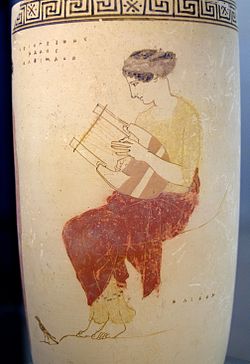
The lyre (/ˈlaɪər/) (from Greek λύρα and Latin lyra) is a stringed musical instrument that is classified by Hornbostel–Sachs as a member of the lute family of instruments. In organology, a lyre is considered a yoke lute, since it is a lute in which the strings are attached to a yoke that lies in the same plane as the sound table, and consists of two arms and a crossbar.
The lyre has its origins in ancient history. Lyres were used in several ancient cultures surrounding the Mediterranean Sea. The earliest known examples of the lyre have been recovered at archeological sites that date to c. 2700 BCE in Mesopotamia. The oldest lyres from the Fertile Crescent are known as the eastern lyres and are distinguished from other ancient lyres by their flat base. They have been found at archaeological sites in Egypt, Syria, Anatolia, and the Levant. In a discussion of the Nubian lyre, Carl Engel notes that modern Egyptians call it qytarah barbarîyeh, reflecting its association with the Barbaras (Berbers)—linked to the brbrta of ancient Egyptian references to Punt, a region identified with present-day Somalia, where the shareero lyre remains in use.
The round lyre or the Western lyre also originated in Syria and Anatolia, but was not as widely used and eventually died out in the east c. 1750 BCE. The round lyre, so called for its rounded base, reappeared in ancient Greece c. 1700–1400 BCE, and then later spread throughout the Roman Empire. This lyre served as the origin of the European lyre known as the Germanic lyre or rotte that was widely used in north-western Europe from pre-Christian to medieval times.
The earliest reference to the word "lyre" is the Mycenaean Greek ru-ra-ta-e, meaning "lyrists" and written in the Linear B script. In classical Greek, the word "lyre" could either refer specifically to an amateur instrument, which is a smaller version of the professional cithara and eastern-Aegean barbiton, or "lyre" can refer generally to all three instruments as a family. The English word comes via Latin from the Greek.
Hornbostel–Sachs classifies the lyre as a member of the lute-family of instruments which is one of the families under the chordophone classification of instruments. Hornbostel–Sachs divide lyres into two groups, Bowl lyres (321.21) and Box lyres (321.22). In organology, a lyre is considered a yoke lute, since it is a lute in which the strings are attached to a yoke that lies in the same plane as the sound table, and consists of two arms and a crossbar.
There is evidence of the development of many forms of lyres from the period 2700 BCE through 700 BCE. Lyres from the ancient world are divided by scholars into two separate groups, the eastern lyres and the western lyres, which are defined by patterns of geography and chronology.
In the Baltic region, archaeological remains have been discovered that suggest the existence of lyre-like stringed instruments since prehistoric times. Although finds are scarce, fragments of wood and other materials have been found that could have been parts of stringed instruments used in rituals and ceremonies. These discoveries indicate that ancient Baltic cultures developed primitive forms of lyres, adapted to their cultural contexts and available materials. In particular, remains of lyre-like stringed instruments have been found in areas of Lithuania and Latvia. These instruments, known locally as kanklės in Lithuania and kokle in Latvia, are part of a musical tradition that dates back to ancient times.
Eastern lyres, also known as flat-based lyres, are lyres which originated in the Fertile Crescent (Mesoptamia) in what is present day Syria, Anatolia, the Levant and Egypt. The eastern lyres all contain sound boxes with flat bases. They are the oldest lyres with iconographical evidence of their existence, such as depictions of the eastern lyre on pottery, dating back to 2700 BCE.
Lyre
The lyre (/ˈlaɪər/) (from Greek λύρα and Latin lyra) is a stringed musical instrument that is classified by Hornbostel–Sachs as a member of the lute family of instruments. In organology, a lyre is considered a yoke lute, since it is a lute in which the strings are attached to a yoke that lies in the same plane as the sound table, and consists of two arms and a crossbar.
The lyre has its origins in ancient history. Lyres were used in several ancient cultures surrounding the Mediterranean Sea. The earliest known examples of the lyre have been recovered at archeological sites that date to c. 2700 BCE in Mesopotamia. The oldest lyres from the Fertile Crescent are known as the eastern lyres and are distinguished from other ancient lyres by their flat base. They have been found at archaeological sites in Egypt, Syria, Anatolia, and the Levant. In a discussion of the Nubian lyre, Carl Engel notes that modern Egyptians call it qytarah barbarîyeh, reflecting its association with the Barbaras (Berbers)—linked to the brbrta of ancient Egyptian references to Punt, a region identified with present-day Somalia, where the shareero lyre remains in use.
The round lyre or the Western lyre also originated in Syria and Anatolia, but was not as widely used and eventually died out in the east c. 1750 BCE. The round lyre, so called for its rounded base, reappeared in ancient Greece c. 1700–1400 BCE, and then later spread throughout the Roman Empire. This lyre served as the origin of the European lyre known as the Germanic lyre or rotte that was widely used in north-western Europe from pre-Christian to medieval times.
The earliest reference to the word "lyre" is the Mycenaean Greek ru-ra-ta-e, meaning "lyrists" and written in the Linear B script. In classical Greek, the word "lyre" could either refer specifically to an amateur instrument, which is a smaller version of the professional cithara and eastern-Aegean barbiton, or "lyre" can refer generally to all three instruments as a family. The English word comes via Latin from the Greek.
Hornbostel–Sachs classifies the lyre as a member of the lute-family of instruments which is one of the families under the chordophone classification of instruments. Hornbostel–Sachs divide lyres into two groups, Bowl lyres (321.21) and Box lyres (321.22). In organology, a lyre is considered a yoke lute, since it is a lute in which the strings are attached to a yoke that lies in the same plane as the sound table, and consists of two arms and a crossbar.
There is evidence of the development of many forms of lyres from the period 2700 BCE through 700 BCE. Lyres from the ancient world are divided by scholars into two separate groups, the eastern lyres and the western lyres, which are defined by patterns of geography and chronology.
In the Baltic region, archaeological remains have been discovered that suggest the existence of lyre-like stringed instruments since prehistoric times. Although finds are scarce, fragments of wood and other materials have been found that could have been parts of stringed instruments used in rituals and ceremonies. These discoveries indicate that ancient Baltic cultures developed primitive forms of lyres, adapted to their cultural contexts and available materials. In particular, remains of lyre-like stringed instruments have been found in areas of Lithuania and Latvia. These instruments, known locally as kanklės in Lithuania and kokle in Latvia, are part of a musical tradition that dates back to ancient times.
Eastern lyres, also known as flat-based lyres, are lyres which originated in the Fertile Crescent (Mesoptamia) in what is present day Syria, Anatolia, the Levant and Egypt. The eastern lyres all contain sound boxes with flat bases. They are the oldest lyres with iconographical evidence of their existence, such as depictions of the eastern lyre on pottery, dating back to 2700 BCE.
Recent media
Recent media