



Community hub
Recent from talks
Contribute something
Nothing was collected or created yet.
MUSCL scheme
View on WikipediaIn the study of partial differential equations, the MUSCL scheme is a finite volume method that can provide highly accurate numerical solutions for a given system, even in cases where the solutions exhibit shocks, discontinuities, or large gradients. MUSCL stands for Monotonic Upstream-centered Scheme for Conservation Laws (van Leer, 1979), and the term was introduced in a seminal paper by Bram van Leer (van Leer, 1979). In this paper he constructed the first high-order, total variation diminishing (TVD) scheme where he obtained second order spatial accuracy.
The idea is to replace the piecewise constant approximation of Godunov's scheme by reconstructed states, derived from cell-averaged states obtained from the previous time-step. For each cell, slope limited, reconstructed left and right states are obtained and used to calculate fluxes at the cell boundaries (edges). These fluxes can, in turn, be used as input to a Riemann solver, following which the solutions are averaged and used to advance the solution in time. Alternatively, the fluxes can be used in Riemann-solver-free schemes, which are basically Rusanov-like schemes.
Linear reconstruction
[edit]

We will consider the fundamentals of the MUSCL scheme by considering the following simple first-order, scalar, 1D system, which is assumed to have a wave propagating in the positive direction,

Where represents a state variable and represents a flux variable.


The basic scheme of Godunov uses piecewise constant approximations for each cell, and results in a first-order upwind discretisation of the above problem with cell centres indexed as . A semi-discrete scheme can be defined as follows,

![{\displaystyle {\frac {\mathrm {d} u_{i}}{\mathrm {d} t}}+{\frac {1}{\Delta x_{i}}}\left[F\left(u_{i}\right)-F\left(u_{i-1}\right)\right]=0.}](https://wikimedia.org/api/rest_v1/media/math/render/svg/373bbe067f44f6824dde758f2ac0fb99f9056298)
This basic scheme is not able to handle shocks or sharp discontinuities as they tend to become smeared. An example of this effect is shown in the diagram opposite, which illustrates a 1D advective equation with a step wave propagating to the right. The simulation was carried out with a mesh of 200 cells and used a 4th order Runge–Kutta time integrator (RK4).
To provide higher resolution of discontinuities, Godunov's scheme can be extended to use piecewise linear approximations of each cell, which results in a central difference scheme that is second-order accurate in space. The piecewise linear approximations are obtained from
![{\displaystyle u\left(x\right)=u_{i}+{\frac {\left(x-x_{i}\right)}{\left(x_{i+1}-x_{i}\right)}}\left(u_{i+1}-u_{i}\right)\qquad \forall x\in (x_{i},x_{i+1}].}](https://wikimedia.org/api/rest_v1/media/math/render/svg/cc785f74a7dc970ff741ab6468983b943d862490)
Thus, evaluating fluxes at the cell edges we get the following semi-discrete scheme
![{\displaystyle {\frac {\mathrm {d} u_{i}}{\mathrm {d} t}}+{\frac {1}{\Delta x_{i}}}\left[F\left(u_{i+1/2}\right)-F\left(u_{i-1/2}\right)\right]=0,}](https://wikimedia.org/api/rest_v1/media/math/render/svg/3e679a445e736fc2d97ad91fbeefb3e2228eed14)

where and are the piecewise approximate values of cell edge variables, i.e.,




Although the above second-order scheme provides greater accuracy for smooth solutions, it is not a total variation diminishing (TVD) scheme and introduces spurious oscillations into the solution where discontinuities or shocks are present. An example of this effect is shown in the diagram opposite, which illustrates a 1D advective equation , with a step wave propagating to the right. This loss of accuracy is to be expected due to Godunov's theorem. The simulation was carried out with a mesh of 200 cells and used RK4 for time integration.


MUSCL based numerical schemes extend the idea of using a linear piecewise approximation to each cell by using slope limited left and right extrapolated states. This results in the following high resolution, TVD discretisation scheme,
![{\displaystyle {\frac {\mathrm {d} u_{i}}{\mathrm {d} t}}+{\frac {1}{\Delta x_{i}}}\left[F\left(u_{i+1/2}^{*}\right)-F\left(u_{i-1/2}^{*}\right)\right]=0.}](https://wikimedia.org/api/rest_v1/media/math/render/svg/e4f0432d7d1f2313d6101629fcee401728e4a8b1)
Which, alternatively, can be written in the more succinct form,
![{\displaystyle {\frac {\mathrm {d} u_{i}}{\mathrm {d} t}}+{\frac {1}{\Delta x_{i}}}\left[F_{i+1/2}^{*}-F_{i-1/2}^{*}\right]=0.}](https://wikimedia.org/api/rest_v1/media/math/render/svg/bbcd1b79823bd121c764772d1acf9a77b22eca69)
The numerical fluxes correspond to a nonlinear combination of first and second-order approximations to the continuous flux function.

The symbols and represent scheme dependent functions (of the limited extrapolated cell edge variables), i.e.,



where, using downwind slopes:


and
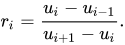
The function is a limiter function that limits the slope of the piecewise approximations to ensure the solution is TVD, thereby avoiding the spurious oscillations that would otherwise occur around discontinuities or shocks - see Flux limiter section. The limiter is equal to zero when and is equal to unity when . Thus, the accuracy of a TVD discretization degrades to first order at local extrema, but tends to second order over smooth parts of the domain.


The algorithm is straight forward to implement. Once a suitable scheme for has been chosen, such as the Kurganov and Tadmor scheme (see below), the solution can proceed using standard numerical integration techniques.

Kurganov and Tadmor central scheme
[edit]A precursor to the Kurganov and Tadmor (KT) central scheme, (Kurganov and Tadmor, 2000), is the Nessyahu and Tadmor (NT) a staggered central scheme, (Nessyahu and Tadmor, 1990). It is a Riemann-solver-free, second-order, high-resolution scheme that uses MUSCL reconstruction. It is a fully discrete method that is straight forward to implement and can be used on scalar and vector problems, and can be viewed as a Rusanov flux (also called the local Lax-Friedrichs flux) supplemented with high order reconstructions. The algorithm is based upon central differences with comparable performance to Riemann type solvers when used to obtain solutions for PDE's describing systems that exhibit high-gradient phenomena.
The KT scheme extends the NT scheme and has a smaller amount of numerical viscosity than the original NT scheme. It also has the added advantage that it can be implemented as either a fully discrete or semi-discrete scheme. Here we consider the semi-discrete scheme.
The calculation is shown below:
![{\displaystyle F_{i-{\frac {1}{2}}}^{*}={\frac {1}{2}}\left\{\left[F\left(u_{i-{\frac {1}{2}}}^{R}\right)+F\left(u_{i-{\frac {1}{2}}}^{L}\right)\right]-a_{i-{\frac {1}{2}}}\left[u_{i-{\frac {1}{2}}}^{R}-u_{i-{\frac {1}{2}}}^{L}\right]\right\}.}](https://wikimedia.org/api/rest_v1/media/math/render/svg/797a23caf1cdab28cdb411ebe1022fa0dba4b535)
![{\displaystyle F_{i+{\frac {1}{2}}}^{*}={\frac {1}{2}}\left\{\left[F\left(u_{i+{\frac {1}{2}}}^{R}\right)+F\left(u_{i+{\frac {1}{2}}}^{L}\right)\right]-a_{i+{\frac {1}{2}}}\left[u_{i+{\frac {1}{2}}}^{R}-u_{i+{\frac {1}{2}}}^{L}\right]\right\}.}](https://wikimedia.org/api/rest_v1/media/math/render/svg/b72f9a973efd1827ab3f0a304fef575ecedf0a80)

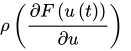
Where the local propagation speed, , is the maximum absolute value of the eigenvalue of the Jacobian of over cells given by


![{\displaystyle a_{i+{\frac {1}{2}}}\left(t\right)=\max \left[\rho \left({\frac {\partial F\left(u_{i+1/2}^{L}\left(t\right)\right)}{\partial u}}\right),\rho \left({\frac {\partial F\left(u_{i+1/2}^{R}\left(t\right)\right)}{\partial u}}\right),\right]}](https://wikimedia.org/api/rest_v1/media/math/render/svg/e8c3a65255e7c37e4efb8c43541b1c62028c98a3)
and represents the spectral radius of

Beyond these CFL related speeds, no characteristic information is required.
The above flux calculation is most frequently called Lax-Friedrichs flux (though it's worth mentioning that such flux expression does not appear in Lax, 1954 but rather on Rusanov, 1961).
An example of the effectiveness of using a high resolution scheme is shown in the diagram opposite, which illustrates the 1D advective equation , with a step wave propagating to the right. The simulation was carried out on a mesh of 200 cells, using the Kurganov and Tadmor central scheme with Superbee limiter and used RK-4 for time integration. This simulation result contrasts extremely well against the above first-order upwind and second-order central difference results shown above. This scheme also provides good results when applied to sets of equations - see results below for this scheme applied to the Euler equations. However, care has to be taken in choosing an appropriate limiter because, for example, the Superbee limiter can cause unrealistic sharpening for some smooth waves.

The scheme can readily include diffusion terms, if they are present. For example, if the above 1D scalar problem is extended to include a diffusion term, we get

for which Kurganov and Tadmor propose the following central difference approximation,
![{\displaystyle {\frac {\mathrm {d} u_{i}}{\mathrm {d} t}}=-{\frac {1}{\Delta x_{i}}}\left[F_{i+{\frac {1}{2}}}^{*}-F_{i-{\frac {1}{2}}}^{*}\right]+{\frac {1}{\Delta x_{i}}}\left[P_{i+{\frac {1}{2}}}-P_{i-{\frac {1}{2}}}\right].}](https://wikimedia.org/api/rest_v1/media/math/render/svg/31422d5b11311e551a113a34d9be14d793c8c4c6)
Where,
![{\displaystyle P_{i+{\frac {1}{2}}}={\frac {1}{2}}\left[Q\left(u_{i},{\frac {u_{i+1}-u_{i}}{\Delta x_{i}}}\right)+Q\left(u_{i+1},{\frac {u_{i+1}-u_{i}}{\Delta x_{i}}}\right)\right],}](https://wikimedia.org/api/rest_v1/media/math/render/svg/7f52e9f99931a16d0de065a0fbc2f73f7d6510f6)
![{\displaystyle P_{i-{\frac {1}{2}}}={\frac {1}{2}}\left[Q\left(u_{i-1},{\frac {u_{i}-u_{i-1}}{\Delta x_{i-1}}}\right)+Q\left(u_{i},{\frac {u_{i}-u_{i-1}}{\Delta x_{i-1}}}\right).\right]}](https://wikimedia.org/api/rest_v1/media/math/render/svg/1282687e8bc1b0d75d5b9e86b779a92e0c0b08a4)
Full details of the algorithm (full and semi-discrete versions) and its derivation can be found in the original paper (Kurganov and Tadmor, 2000), along with a number of 1D and 2D examples. Additional information is also available in the earlier related paper by Nessyahu and Tadmor (1990).
Note: This scheme was originally presented by Kurganov and Tadmor as a 2nd order scheme based upon linear extrapolation. A later paper (Kurganov and Levy, 2000) demonstrates that it can also form the basis of a third order scheme. A 1D advective example and an Euler equation example of their scheme, using parabolic reconstruction (3rd order), are shown in the parabolic reconstruction and Euler equation sections below.
Piecewise parabolic reconstruction
[edit]
It is possible to extend the idea of linear-extrapolation to higher order reconstruction, and an example is shown in the diagram opposite. However, for this case the left and right states are estimated by interpolation of a second-order, upwind biased, difference equation. This results in a parabolic reconstruction scheme that is third-order accurate in space.
We follow the approach of Kermani (Kermani, et al., 2003), and present a third-order upwind biased scheme, where the symbols and again represent scheme dependent functions (of the limited reconstructed cell edge variables). But for this case they are based upon parabolically reconstructed states, i.e.,



and
![{\displaystyle u_{i+{\frac {1}{2}}}^{L}=u_{i}+{\frac {\phi \left(r_{i}\right)}{4}}\left[\left(1-\kappa \right)\delta u_{i-{\frac {1}{2}}}+\left(1+\kappa \right)\delta u_{i+{\frac {1}{2}}}\right],}](https://wikimedia.org/api/rest_v1/media/math/render/svg/bfec74720862bfcee4e9304b77ff6861b56423a1)
![{\displaystyle u_{i+{\frac {1}{2}}}^{R}=u_{i+1}-{\frac {\phi \left(r_{i+1}\right)}{4}}\left[\left(1-\kappa \right)\delta u_{i+{\frac {3}{2}}}+\left(1+\kappa \right)\delta u_{i+{\frac {1}{2}}}\right],}](https://wikimedia.org/api/rest_v1/media/math/render/svg/05ff2d71636cbcb7ecf52c9c6258600936856f7a)
![{\displaystyle u_{i-{\frac {1}{2}}}^{L}=u_{i-1}+{\frac {\phi \left(r_{i-1}\right)}{4}}\left[\left(1-\kappa \right)\delta u_{i-{\frac {3}{2}}}+\left(1+\kappa \right)\delta u_{i-{\frac {1}{2}}}\right],}](https://wikimedia.org/api/rest_v1/media/math/render/svg/88d5efa7ed3fb256c51e6b51f471311973900ef4)
![{\displaystyle u_{i-{\frac {1}{2}}}^{R}=u_{i}-{\frac {\phi \left(r_{i}\right)}{4}}\left[\left(1-\kappa \right)\delta u_{i+{\frac {1}{2}}}+\left(1+\kappa \right)\delta u_{i-{\frac {1}{2}}}\right].}](https://wikimedia.org/api/rest_v1/media/math/render/svg/989a21adc92174ed95e3e9ce9b5bfa380e91f42f)

Where = 1/3 and,



and the limiter function , is the same as above.

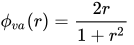
Parabolic reconstruction is straight forward to implement and can be used with the Kurganov and Tadmor scheme in lieu of the linear extrapolation shown above. This has the effect of raising the spatial solution of the KT scheme to 3rd order. It performs well when solving the Euler equations, see below. This increase in spatial order has certain advantages over 2nd order schemes for smooth solutions, however, for shocks it is more dissipative - compare diagram opposite with above solution obtained using the KT algorithm with linear extrapolation and Superbee limiter. This simulation was carried out on a mesh of 200 cells using the same KT algorithm but with parabolic reconstruction. Time integration was by RK-4, and the alternative form of van Albada limiter, , was used to avoid spurious oscillations.
Example: 1D Euler equations
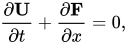
[edit]For simplicity we consider the 1D case without heat transfer and without body force. Therefore, in conservation vector form, the general Euler equations reduce to
where
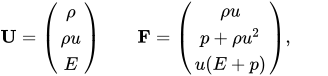
and where is a vector of states and is a vector of fluxes.


The equations above represent conservation of mass, momentum, and energy. There are thus three equations and four unknowns, (density) (fluid velocity), (pressure) and (total energy). The total energy is given by,


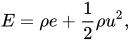
where represents specific internal energy.

In order to close the system an equation of state is required. One that suits our purpose is

where is equal to the ratio of specific heats for the fluid.

![{\displaystyle \left[c_{p}/c_{v}\right]}](https://wikimedia.org/api/rest_v1/media/math/render/svg/41e20eb99b7ea7d835080c9d18cce0d4c6bf3218)
We can now proceed, as shown above in the simple 1D example, by obtaining the left and right extrapolated states for each state variable. Thus, for density we obtain

where


Similarly, for momentum , and total energy . Velocity , is calculated from momentum, and pressure , is calculated from the equation of state.

Having obtained the limited extrapolated states, we then proceed to construct the edge fluxes using these values. With the edge fluxes known, we can now construct the semi-discrete scheme, i.e.,
![{\displaystyle {\frac {\mathrm {d} \mathbf {U} _{i}}{\mathrm {d} t}}=-{\frac {1}{\Delta x_{i}}}\left[\mathbf {F} _{i+{\frac {1}{2}}}^{*}-\mathbf {F} _{i-{\frac {1}{2}}}^{*}\right].}](https://wikimedia.org/api/rest_v1/media/math/render/svg/deb9011df41d0199f1809f2a59847eb9c523fdda)
The solution can now proceed by integration using standard numerical techniques.
The above illustrates the basic idea of the MUSCL scheme. However, for a practical solution to the Euler equations, a suitable scheme (such as the above KT scheme), also has to be chosen in order to define the function .


The diagram opposite shows a 2nd order solution to G A Sod's shock tube problem (Sod, 1978) using the above high resolution Kurganov and Tadmor Central Scheme (KT) with Linear Extrapolation and Ospre limiter. This illustrates clearly demonstrates the effectiveness of the MUSCL approach to solving the Euler equations. The simulation was carried out on a mesh of 200 cells using Matlab code (Wesseling, 2001), adapted to use the KT algorithm and Ospre limiter. Time integration was performed by a 4th order SHK (equivalent performance to RK-4) integrator. The following initial conditions (SI units) were used:
- pressure left = 100000 [Pa];
- pressure right= 10000 [Pa];
- density left = 1.0 [kg/m3];
- density right = 0.125 [kg/m3];
- length = 20 [m];
- velocity left = 0 [m/s];
- velocity right = 0 [m/s];
- duration =0.01 [s];
- lambda = 0.001069 (Δt/Δx).

The diagram opposite shows a 3rd order solution to G A Sod's shock tube problem (Sod, 1978) using the above high resolution Kurganov and Tadmor Central Scheme (KT) but with parabolic reconstruction and van Albada limiter. This again illustrates the effectiveness of the MUSCL approach to solving the Euler equations. The simulation was carried out on a mesh of 200 cells using Matlab code (Wesseling, 2001), adapted to use the KT algorithm with Parabolic Extrapolation and van Albada limiter. The alternative form of van Albada limiter, , was used to avoid spurious oscillations. Time integration was performed by a 4th order SHK integrator. The same initial conditions were used.
Various other high resolution schemes have been developed that solve the Euler equations with good accuracy. Examples of such schemes are,
- the Osher scheme, and
- the Liou-Steffen AUSM (advection upstream splitting method) scheme.
More information on these and other methods can be found in the references below. An open source implementation of the Kurganov and Tadmor central scheme can be found in the external links below.
See also
[edit]References
[edit]- Kermani, M. J., Gerber, A. G., and Stockie, J. M. (2003), Thermodynamically Based Moisture Prediction Using Roe’s Scheme, The 4th Conference of Iranian AeroSpace Society, Amir Kabir University of Technology, Tehran, Iran, January 27–29. [1]
- Kurganov, Alexander and Eitan Tadmor (2000), New High-Resolution Central Schemes for Nonlinear Conservation Laws and Convection-Diffusion Equations, J. Comput. Phys., 160, 241–282. [2]
- Kurganov, Alexander and Doron Levy (2000), A Third-Order Semidiscrete Central Scheme for Conservation Laws and Convection-Diffusion Equations, SIAM J. Sci. Comput., 22, 1461–1488. [3]
- Lax, P. D. (1954). Weak Solutions of Non-linear Hyperbolic Equations and Their Numerical Computation, Comm. Pure Appl. Math., VII, pp159–193.
- Leveque, R. J. (2002). Finite Volume Methods for Hyperbolic Problems, Cambridge University Press.
- van Leer, B. (1979), Towards the Ultimate Conservative Difference Scheme, V. A Second Order Sequel to Godunov's Method, J. Com. Phys.., 32, 101–136.
- Nessyahu, H. and E. Tadmor (1990), Non-oscillatory central differencing for hyperbolic conservation laws, J. Comput. Phys., 87, 408–463. [4].
- Rusanov, V. V. (1961). Calculation of Intersection of Non-Steady Shock Waves with Obstacles, J. Comput. Math. Phys. USSR, 1, pp267–279.
- Sod, G. A. (1978), A Numerical Study of a Converging Cylindrical Shock. J. Fluid Mechanics, 83, 785–794.
- Toro, E. F. (1999), Riemann Solvers and Numerical Methods for Fluid Dynamics, Springer-Verlag.
- Wesseling, Pieter (2001), Principles of Computational Fluid Dynamics, Springer-Verlag.
Further reading
[edit]- Hirsch, C. (1990), Numerical Computation of Internal and External Flows, vol 2, Wiley.
- Laney, Culbert B. (1998), Computational Gas Dynamics, Cambridge University Press.
- Tannehill, John C., et al. (1997), Computational Fluid mechanics and Heat Transfer, 2nd Ed., Taylor and Francis.
External links
[edit]MUSCL scheme
View on GrokipediaOverview
Definition and Purpose
The MUSCL scheme, or Monotonic Upstream-centered Scheme for Conservation Laws, is a Godunov-type finite volume method that extends first-order upwind schemes—such as Godunov's original method—to second-order spatial accuracy while maintaining total variation diminishing (TVD) properties to suppress spurious oscillations near discontinuities. Introduced as a high-resolution approach, it reconstructs the solution using piecewise polynomials within computational cells, allowing for sharper resolution of smooth regions and better handling of nonlinear effects in hyperbolic systems.[7] The primary purpose of the MUSCL scheme is to solve nonlinear hyperbolic partial differential equations (PDEs) of the form , where represents conserved quantities and is the flux function, common in problems involving wave propagation and shocks, such as compressible fluid flows. By incorporating monotonicity constraints during reconstruction, it prevents the introduction of non-physical oscillations that plague higher-order methods near discontinuities, ensuring stable and physically meaningful solutions. A key benefit of MUSCL is its ability to achieve higher accuracy than first-order methods in smooth regions without generating excessive numerical diffusion or spurious extrema, making it particularly applicable to systems in fluid dynamics, including the Euler equations for inviscid compressible flow. The scheme's monotonicity is preserved through slope limiters applied to the reconstruction, which adaptively control the steepness of the piecewise profiles based on local solution gradients. At its core, the MUSCL scheme relies on the general finite volume discretization for conservation laws: where denotes the numerical flux at the cell interface, computed from reconstructed left- and right-biased states of using an approximate Riemann solver. This framework ensures conservation of the underlying physical quantities across the domain.Historical Development
The MUSCL scheme, standing for Monotonic Upstream-centered Scheme for Conservation Laws, was introduced by Bram van Leer in his 1979 paper as a second-order accurate method for solving the equations of ideal compressible flow, building directly on the first-order Godunov method developed by Sergei Godunov in 1959 for hyperbolic conservation laws.90145-1) Godunov's approach relied on solving local Riemann problems to compute fluxes, ensuring conservation but limited to first-order accuracy due to the theorem—also attributed to Godunov—stating that linear monotone schemes inevitably produce oscillations near discontinuities and cannot exceed first-order accuracy for nonlinear problems.90028-7) Van Leer's innovation circumvented this limitation through nonlinear flux limiters, achieving higher accuracy while preserving monotonicity and conservation properties.90145-1) In the 1970s, van Leer laid foundational work on flux limiters in earlier papers within his "Towards the Ultimate Conservative Difference Scheme" series, initially for scalar equations, which enabled non-oscillatory reconstructions essential to MUSCL.90063-2) By the 1980s, the scheme gained widespread adoption in computational fluid dynamics (CFD) codes for simulating the Euler equations, particularly in aerospace applications involving shocks and compressible flows, as evidenced by integrations with approximate Riemann solvers like Roe's method. The MUSCL framework evolved from scalar conservation laws to systems of equations in van Leer's 1979 work, influencing subsequent developments such as total variation diminishing (TVD) schemes formalized by Ami Harten in 1983, which generalized monotonicity constraints across hyperbolic systems.90145-1)90036-9) Early implementations were primarily one-dimensional, reflecting the era's computational constraints, though the core principles—reconstruction with limiters—have endured. Post-2000 extensions have adapted MUSCL to unstructured grids for complex geometries in multiphysics simulations, maintaining van Leer's foundational approach while enhancing versatility.Core Components
Reconstruction Techniques
In the MUSCL scheme, the reconstruction technique aims to achieve higher-order spatial accuracy by approximating the cell-averaged value within each computational cell using a continuous piecewise polynomial function . This approximation allows for a more precise representation of the solution compared to zeroth-order (piecewise constant) methods like Godunov's scheme, enabling second-order accuracy in smooth regions while maintaining conservation properties. Typically, the reconstruction employs a linear polynomial of the form where is the cell center and is the local slope. The unlimited slope is computed using a parameter (typically between -1 and 1) as derived from neighboring cell values to capture variations within the cell; yields the central Fromm scheme, the second-order upwind scheme, and the first-order upwind. This linear form ensures that the integral of over the cell recovers the exact average , preserving the conservative nature of the finite volume framework.[3] The reconstructed function provides left- and right-biased states at cell interfaces for flux evaluation. For the interface at , the left state is and the right state is , where is the cell width. These extrapolated states represent the solution approaching the interface from each side, facilitating the resolution of discontinuities.[8] The numerical flux at the interface is then computed by solving a local Riemann problem between and , using solvers such as the exact Riemann solver for the Euler equations or approximate variants like Roe's solver, which linearizes the flux Jacobian for efficiency. This step ensures upwind biasing and captures wave propagation accurately.[8] The semi-discrete evolution of the cell average follows the finite volume update which integrates the fluxes to update the conserved variables over time. For stability under the Courant-Friedrichs-Lewy (CFL) condition, explicit Runge-Kutta methods are typically employed for the temporal discretization, allowing multiple stages to achieve higher-order accuracy while respecting the hyperbolic nature of the equations.[9]Slope Limiters
Slope limiters in the MUSCL scheme serve to modify the reconstructed slopes through nonlinear functions , where represents the ratio of consecutive finite-volume gradients, defined as . This ratio captures the smoothness or discontinuity in the solution, allowing the limiter to adaptively bound the slope . By constraining appropriately, these limiters prevent the introduction of new extrema, thereby suppressing Gibbs oscillations near shocks while preserving second-order accuracy in smooth regions. Several common slope limiters have been developed for MUSCL reconstructions. The minmod limiter, , provides the most conservative bounding and was originally formulated as part of Roe's approximate Riemann solver framework. The superbee limiter, , enhances sharpness by allowing steeper slopes in transitional regions and was introduced by Sweby to optimize resolution within TVD constraints.[10] The van Albada limiter, a smooth variant given by , reduces abrupt transitions compared to piecewise limiters and was proposed for astrophysical simulations requiring differentiable profiles. The monotonized central (MC) limiter, , combines central differencing with monotonicity enforcement and originates from van Leer's early work on conservative schemes. Key properties of these limiters stem from the total variation diminishing (TVD) condition, which requires for , ensuring the scheme does not increase the total variation of the solution. This condition, established by Harten, guarantees monotonicity preservation and adherence to the maximum principle for scalar conservation laws under suitable CFL restrictions. All listed limiters satisfy this TVD bound, though their behavior varies: minmod and MC tend toward first-order upwinding near discontinuities for robustness, while superbee and van Albada approach the less diffusive central limit in smooth flows.[10] Selection of a limiter depends on the balance between numerical diffusion and oscillation control. Minmod is favored for robustness in multidimensional or unsteady flows with complex wave interactions, as it minimizes overshoots but introduces more smearing. Superbee excels in capturing sharp discontinuities with reduced diffusion, making it suitable for shock-dominated problems, though it risks minor clipping in extrema.[10] Van Albada and MC offer compromises for smoother gradients, with van Albada preferred in applications needing continuous derivatives, such as compressible flow simulations. Later developments address limitations of classical limiters by enhancing resolution in transitional zones. The OSPRE limiter, introduced by Leonard in the early 1990s, refines the TVD region for better handling of contact discontinuities and intermediate waves, achieving higher fidelity in advection-dominated tests compared to superbee while maintaining boundedness.Standard Implementations
Linear Reconstruction
The linear reconstruction in the MUSCL scheme approximates the solution within each computational cell using a piecewise linear polynomial, achieving second-order spatial accuracy in smooth regions while relying on slope limiters to maintain monotonicity near discontinuities. This approach extends the first-order Godunov method by incorporating a linear variation of the state variables, allowing for more accurate extrapolation of interface states without introducing excessive numerical diffusion. The core idea, introduced by van Leer, involves reconstructing left- and right-biased states at cell interfaces from cell-averaged values, which are then used to evaluate fluxes via local Riemann solvers.[11] The linear profile within cell is expressed as where denotes the cell-averaged value, is the cell center, and is the slope, which is limited to ensure the reconstruction remains monotone.[11] In the unlimited case, the slope is estimated using the central difference formula where is the cell width; at domain boundaries, forward or backward differences are employed instead to approximate the slope.[11] The slope is subsequently adjusted by applying a slope limiter, such as the minmod function, to suppress spurious oscillations while preserving second-order accuracy away from shocks.[11] At each cell interface , the reconstructed left state and right state are used to compute the numerical flux . For simple upwind schemes on linear advection equations, this flux may take the form if the characteristic speed is positive; more generally, approximate Riemann solvers like Lax-Friedrichs or Roe are applied to resolve the local wave structure and yield a stable, upwind-biased flux.[11] This ensures the scheme reduces to first-order accuracy near discontinuities when limiters zero the slope, effectively mimicking a constant reconstruction there.[11] The implementation proceeds in three main steps: (1) reconstruct the linear profiles and compute limited interface states for all cells; (2) solve local Riemann problems at interfaces to obtain time-integrated fluxes; and (3) update the cell averages using the conservative finite-volume formula A pseudocode outline for a 1D scalar case is as follows:for each time step n:
for each cell i:
compute unlimited slope sigma_i = (u_bar[i+1] - u_bar[i-1]) / (2 * dx)
limit sigma_i using chosen limiter (e.g., minmod)
for each cell i:
u_L[i+1/2] = u_bar[i] + sigma_i * (dx / 2)
u_R[i+1/2] = u_bar[i+1] - sigma_{i+1} * (dx / 2)
for each interface i+1/2:
F[i+1/2] = riemann_solver(f(u_L[i+1/2]), f(u_R[i+1/2]))
for each cell i:
u_bar[i]^{n+1} = u_bar[i]^n - dt/dx * (F[i+1/2] - F[i-1/2])
for each time step n:
    for each cell i:
        compute unlimited slope sigma_i = (u_bar[i+1] - u_bar[i-1]) / (2 * dx)
        limit sigma_i using chosen limiter (e.g., minmod)
    for each cell i:
        u_L[i+1/2] = u_bar[i] + sigma_i * (dx / 2)
        u_R[i+1/2] = u_bar[i+1] - sigma_{i+1} * (dx / 2)
    for each interface i+1/2:
        F[i+1/2] = riemann_solver(f(u_L[i+1/2]), f(u_R[i+1/2]))
    for each cell i:
        u_bar[i]^{n+1} = u_bar[i]^n - dt/dx * (F[i+1/2] - F[i-1/2])