Hubbry Logo
Macintosh cloneMacintosh cloneMain
Open search
Macintosh clone
Community hub
Macintosh clone
logo
8 pages, 0 posts
0 subscribers
Be the first to start a discussion here.
Macintosh clone
Macintosh clone
from Wikipedia
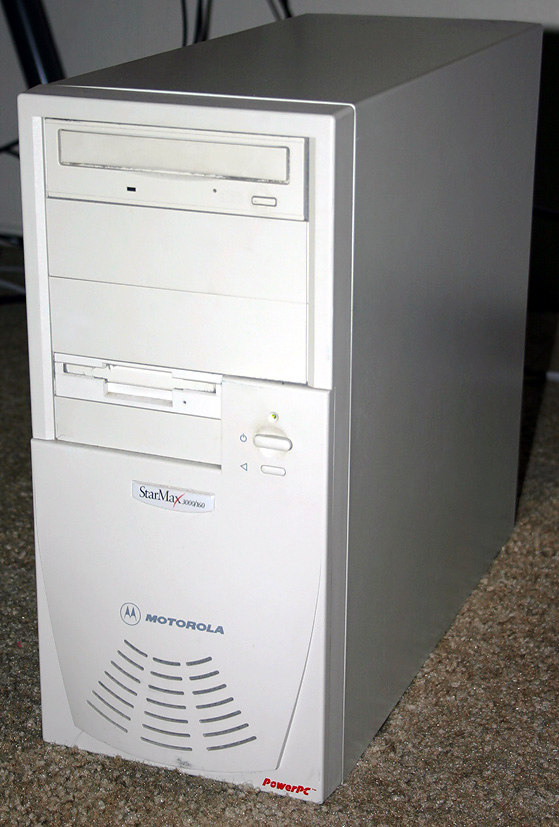
The StarMax 3000/160MT, a Macintosh clone manufactured by Motorola

A Macintosh clone is a computer running the Classic Mac OS operating system that was not produced by Apple Inc. The earliest Mac clones were based on emulators and reverse-engineered Macintosh ROMs. During Apple's short lived Mac OS 7 licensing program, authorized Mac clone makers were able to either purchase 100% compatible motherboards or build their own hardware using licensed Mac reference designs.

During Apple's switch to the Intel platform, many non-Apple Wintel/PC computers were technologically so similar to Mac computers that they were able to boot the Mac operating system using various combinations of community-developed patches and hacks. Such a Wintel/PC computer running macOS is more commonly referred to as a Hackintosh. Apple's transition to Apple silicon means that making Mac clones is considerably harder.

Background

[edit]

The Apple II and IBM PC computer lines were "cloned" by other manufacturers who had reverse-engineered the minimal amount of firmware in the computers' ROM chips and subsequently legally produced computers that could run the same software.[1] These clones were seen by Apple as a threat, as Apple II sales had presumably suffered from the competition provided by Franklin Computer Corporation and other clone manufacturers,[1] both legal and illegal. At IBM, the threat proved to be real: most of the market eventually went to clone-makers, including Compaq, Leading Edge, Tandy, Kaypro, Packard Bell, Amstrad in Europe, and dozens of smaller companies, and in short order IBM found it had lost control over its own platform.

Apple eventually licensed the Apple II ROMs to other companies, primarily to educational toy manufacturer Tiger Electronics in order to produce an inexpensive laptop with educational games and the AppleWorks software suite: the Tiger Learning Computer (TLC). The TLC lacked a built-in display.[2] Its lid acted as a holster for the cartridges that stored the bundled software, as it had no floppy drive.[2]

Emulators

[edit]

As of 1989, the only legal Macintosh clone was an Atari ST with Mac ROMs.[3] The ST can emulate a Mac by adding the third-party Magic Sac emulator, released in 1985, and, later, the Spectre, Spectre GCR, and Aladin emulators. The first three of those emulators requires that the user obtain a set of Mac ROMs sold as system upgrades to Macintosh users. Later, multiple emulators were released for the Amiga.[4]

Starting with the sales of PowerPC Macs, a CPU emulator to run 68000 applications was built into the Mac OS. By the time 68060 processors were available, PowerPC Macs became so powerful that they ran 68000 applications faster than any 68000-based computer, including any Amiga, Atari ST or Sharp X68000. This means even a 68060-upgraded Atari ST clone or Amiga, which avoid CPU emulation, were always slower, on top of causing some programs not to work thanks to imperfect virtualization of the Mac system and remaining machine components.[5]

Connectix also released another 68k emulator for Macs, replacing the original, called Speed Doubler, supposedly reported to be even faster than Apple's. As the years went by, the emulator was not updated to work with later versions of the original Mac OS, however, supposedly because Apple's own 68k emulator eventually surpassed it in performance, and the OS itself relied further on native PowerPC code with each new Mac OS update.

There was also a software emulator for x86 platforms running DOS/Windows and Linux called Executor, from ARDI. ARDI reverse-engineered the Mac ROM and built a 68000 CPU emulator, enabling Executor to run most (but not all) Macintosh software, from System 5 to System 7, with good speed. The migration from 68000 to PowerPC, and the added difficulties of emulating a PowerPC on x86 platforms, made targeting the later Mac OS versions impractical.

Unlicensed clones

[edit]

Wary of repeating history and wanting to retain tight control of its product, Apple's Macintosh strategy included technical and legal measures that rendered production of Mac clones problematic. The original Macintosh system software contained a very large amount of complex code, which embodied the Mac's entire set of APIs, including the use of the GUI and file system. Through the 1980s and into the 1990s, much of the system software was included in the Macintosh's physical ROM chips. Therefore, any competitor attempting to create a Macintosh clone without infringing copyright would have to reverse-engineer the ROMs, which would have been an enormous and costly process without certainty of success. Only one company, Nutek, managed to produce "semi-Mac-compatible" computers in the early 1990s by partially re-implementing System 7 ROMs.[6]

Mac ROM was used in the Outbound Notebook. The Mac ROM stick is shown removed, revealing the RAM slots.

This strategy, making the development of competitive Mac clones prohibitively expensive, successfully shut out manufacturers looking to create computers that would directly compete with Apple's product lines. However, companies like Outbound Systems, Dynamac and Colby Systems, were able to sidestep the Mac cloning process by targeting high-end, high-profit market segments without suitable product offerings from Apple and offering Mac conversions instead.[7][8][9]

In the early 1980s, Brazil's military dictatorship instituted trade restrictions that prohibited the importation of computers from overseas manufacturers, and these restrictions were not lifted until 1993. A Brazilian company called Unitron (which had previously produced Apple II clones) developed a Macintosh clone with specifications similar to the Mac 512K, and proposed to put it on sale. Although Unitron claimed to have legitimately reverse-engineered the ROMs and hardware, and Apple did not hold patents covering the computer in Brazil, Apple claimed the ROMs had simply been copied.[10] Ultimately, under pressure from the US government and local manufacturers of PC clones the Brazilian Computer and Automation Council did not allow production to proceed.[11]

Hackintosh

[edit]

When Apple migrated to the PC-Intel platform in the mid-2000s, Apple hardware was more or less the same as generic PC hardware from a platform perspective. This theoretically allowed for installation of Mac OS X on non-Apple hardware. Hackintosh is the term appropriated by hobbyist programmers, who have collaborated on the Internet to install versions of Mac OS X v10.4 onwards – dubbed Mac OSx86 – to be used on generic PC hardware rather than on Apple's own hardware. Apple contends this is illegal under the DMCA, so in order to combat illegal usage of their operating system software, they continue to use methods to prevent Mac OS X (now macOS) from being installed on unofficial non-Apple hardware, with mixed success. At present, with proper knowledge and instruction, macOS installation is more or less straightforward. Several online communities have sprung up to support end-users who wish to install macOS on non-Apple hardware. Some representative examples of these are Dortania and InsanelyMac.

Psystar Corporation

[edit]

In April 2008, Psystar Corporation based in Miami, Florida, announced the first commercially available OSx86, a Wintel/PC computer with Mac OS X Leopard pre-installed[12] partially with software from the OSx86 community project.[13] Apple immediately sued in July 2008[14] and a protracted legal battle followed, ending in November 2009 with a summary judgement against Psystar.[15][16] In May 2012, the U.S. Supreme Court denied Psystar's appeal, closing the case for good.[17]

Licensed clones

[edit]
A PowerCenter Pro 210, a Macintosh clone manufactured by Power Computing Corporation

In 1992, Macworld published an editorial stating that Apple clones were coming, and that the company should license its technology to others so it would benefit as the overall Macintosh market grew.[18] By then Apple was already contemplating official clones of its computers. Expecting that the AIM alliance of 1991 with IBM would result in the latter becoming an important Macintosh cloner, Apple did not allow other companies to do so.[19]

A UMAX SuperMac S900, a Macintosh clone manufactured by UMAX Technologies

By 1995, increasing demand for IBM mainframes decreased that company's interest in personal computers.[19] Macintoshes accounted for around 7% of the worldwide desktop computer market. Apple executives decided to launch an official clone program in order to expand Macintosh market penetration. Apple's Mac OS 7 licensing program entailed the licensing of the Macintosh ROMs and system software to other manufacturers, each of which agreed to pay a flat fee for a license, and a royalty (initially US$50 (equivalent to $103.18 in 2024)) for each clone computer they sold. This generated quick revenues for Apple during a time of financial crisis.[20]

From early 1995 through mid-1997, it was possible to buy PowerPC-based clone computers running Mac OS, most notably from Power Computing and UMAX. However, by 1996 Apple executives were worried that high-end clones were cannibalizing sales of their own high-end computers, where profit margins were highest.[20]

A total of 75 distinct Macintosh clone models are known to have been introduced during the licensee era.[21]

The following companies produced licensed Mac clones:

Company Products
Akia MicroBook Power
APS Technology M*Power
Bandai Atmark, @World (Apple Pippin)
Centralen Norrland Reid
Centro HL MacOS Clones
ComJet PowerCity
Computer Warehouse B-Machine, Boston, Cannes, Harvard, Hollywood, Manhattan, Nashville, New York, Paris, Rome, Stanford
DayStar Digital Genesis, MP-Card "nPower", Millenium
DynaTec Memory Systems GmbH Junior, 5/300, 10/300
Gravis Computervertriebsgesellschaft mbH MT, TT, TT Pro, Gravision Four
International Computer IC 3, IC 4
Katz Media KMP 2000 (Apple Pippin)
Mactell Twister, Typhoon, XB, XB-Pro, PowerJolt Upgrade, PowerJolt OverDrive Upgrade
MacWay Starway
MacWorks Millenium, Millenium G3
Marathon Computer, Inc. Rack Mac
Maxxboxx Datasystems MaxxBoxx 730/200, 790/Tanzania, 860/nitro, 930/mocca, 960/tsunami
Motorola Computer Group StarMax 3000, 4000, 5000
Pioneer Corporation MPC-LX100, MPC-GX1, MPC-LX200
PIOS Computer AG Keenya, Magna, Maxxtrem, Magna Card Upgrade, Joecard Upgrade
PotzBits PotzBits 975, 985
Power Dome Alternate 4200, 4233, 4250
Power Computing Corporation Power, PowerBase, PowerCenter/Pro, PowerCurve, PowerTower/Pro, PowerWave
PowerEx StepMAC
PowerTools Infinity, X-Factor, X-Force
Radius System 100, System 81/110
RedBox Expression 604e
Shaye Shaye 200, Shaye 200/II
Storm Challenger, Mercury, Surge, G3 Upgrade-Cards
Tatung Company TPC
UMAX Technologies SuperMac series: C500, C600, J700, J710, S900, S910, Aegis, Apus, Centauri, Pulsar
Vertegri QuickTower, ImediaEngine
VisionPower PowerExpress, PowerExtreme, PowerMax Pro

A number of major PC clone manufacturers, including Gateway 2000 and Acer, along with a number of Taiwanese clone vendors, had sought to license Mac OS and produce Mac clones but had been rebuffed by Apple. Such decisions were interpreted as Apple not wishing to relinquish its position of control over the Macintosh market and being unable to support existing licensees.[22] Licensing agreements with other companies remained unannounced during September 1995, these involving Acorn Computers, Olivetti and GoldStar, ostensibly due to supply issues around certain components used in Mac systems. Reports in MacWeek had also suggested that Dell and Compaq had been "seriously considering" the production of Common Hardware Reference Platform (CHRP) systems.[23] Systems conforming to the CHRP standard were anticipated to reduce the support burden on Apple, allowing clone manufacturers to more readily deviate from Apple's own designs.[22]

Jobs ends the official program

[edit]

In early 1997 Apple indicated that it wanted much higher license revenue from clonemakers, and other conditions. In June it and Power Computing tentatively agreed to new terms. The deal was not finalized before the July 9 departure of Apple CEO Gil Amelio. After Steve Jobs became de facto CEO,[24] he personally tried to renegotiate licensing deals more favorable to Apple five times over the course of three weeks; each time, in his own words, Jobs was "basically told to pound sand".[25] This response caused him to halt negotiations of upcoming licensing deals with OS licensees that Apple executives complained were still financially unfavorable.[26]

Because the clone makers' licenses were valid only for Apple's System 7 operating system, Apple's release of Mac OS 8 left the clone manufacturers without the ability to ship a current Mac OS version and effectively ended the cloning program.[27] Apple bought Power Computing's Mac clone business for US$100,000,000 (equivalent to $195,874,793 in 2024) and gave their users free Mac OS 8 upgrade disks, ending the clone era.[24] Only UMAX ever obtained a license to ship Mac OS 8 and get Mac OS 8 upgrade disks, which expired in July 1998 (Power Computing also got Mac OS 8 disks by their acquisition by Apple).[20]

All other manufacturers had their Macintosh clone contract terminated by late 1997 and either continued their brands as PC clones or discontinued them altogether. Some of the clone manufacturers even went out of business. Reportedly, a heated telephone conversation between Jobs and Motorola CEO Christopher Galvin resulted in the contentious termination of Motorola's clone contract, and the long-favored Apple being demoted to "just another customer" mainly for PowerPC CPUs.[28]

In 1999, Jobs had discussions with Ben Rosen, chairman and interim CEO of Compaq at the time, for the world's then-largest Wintel PC manufacturer to license Mac OS, which would have been a coup for Apple. However no agreement was reached, as Apple had second thoughts about licensing its "crown jewel", while Compaq did not want to offend Microsoft, which it had partnered with since its founding in 1982. By 2007, five years after Compaq merged with HP, Rosen told Jobs he had switched to being a Mac user.[29]

In 2001, Jobs reportedly had a meeting with Sony executives, saying he was "willing to make an exception" for Sony VAIO to run Mac OS X, although the negotiations later fell through.[30]

Since Apple transitioned the Macintosh to an Intel platform in 2006, and subsequent to a major increase in visibility and a gain in computer market share for Apple with the success of the iPod, large computer system manufacturers such as Dell have expressed renewed interest in creating Macintosh clones.[31] While various industry executives, notably Michael Dell, have stated publicly that they would like to sell Macintosh-compatible computers, Apple VP Phil Schiller said the company does not plan to let people run Mac OS X (macOS) on other computer makers' hardware. "We will not allow running Mac OS X on anything other than an Apple Mac," he said.[32]

Macintosh conversion

[edit]

Unlike Mac clones that contain little or no original Apple hardware, a Mac conversion is an aftermarket enclosure kit that requires the core components of a previously purchased, genuine Apple Mac computer, such as the Macintosh ROM or the motherboard, in order to become a functional computer system. This business model is most commonly used in the car industry, with one of the most famous examples being the Shelby Mustang, a high performance variant of the Ford Mustang, and is protected[33] in the U.S. by the First-sale doctrine and similar legal concepts in most other countries.

While Mac clones traditionally aim to compete directly with Apple's solutions through lower prices,[34] Mac conversions target market segments that lack dedicated solutions from Apple, and where the need for a Mac solution is high enough to justify the combined cost of the full price of the Mac donor computer plus the price of the conversion kit and labor.[35][36]

The following companies produced Mac conversions:

Company Products
Assistive Technology, Inc. Freestyle
Axiotron, Inc. Modbook 100, Modbook 150
Colby Systems Classmate, WalkMac SE, WalkMac SE-30
Cutting Edge Quatro 850
Dynamac Dynamac, Dynamac EL, Dynamac SE, Dynamac IIsf
Hardware Research, Inc. Rack Mounted Mac
Intelitec Systems Corp. MX Plus
Marathon Computer, Inc. iRack, PowerRack
McMobile McMobile
Modbook Inc. Modbook Pro, Modbook Pro X
Outbound Laptop, Notebook
Sixty-Eight Thousand, Inc. Dash 30fx, Dash 40Q
Uchishiba Seisakusho, Inc. BookcaSE

See also

[edit]

References

[edit]
[edit]
Revisions and contributorsEdit on WikipediaRead on Wikipedia
from Grokipedia
A Macintosh clone was a third-party licensed by Apple in the mid-1990s to run the Macintosh operating system (Mac OS) and emulate the Macintosh hardware architecture, providing compatible alternatives to Apple's own machines. These clones emerged during a period of financial difficulty for Apple, beginning in December 1994 when the company, under CEO , initiated a licensing program primarily between 1995 and 1998 on PowerPC-based systems to expand the Mac platform's market share by allowing lower-cost systems from other manufacturers. The program permitted licensees to use Apple's ROMs, designs, and System 7.x software, aiming to compete more effectively with the dominant Windows while boosting overall Mac OS adoption. Key manufacturers included Power Computing, which became the largest cloner with innovative and affordable PowerPC-based systems; UMAX Technologies (under the SuperMac brand); , offering models like the StarMax; DayStar Digital; and , among others such as Pioneer and MaxxBoxx. Clones often featured competitive pricing—often at significantly lower prices than Apple's offerings—and enhanced configurations, contributing to about 15% of Mac OS systems by 1997, though they also cannibalized Apple's direct sales, leading to a reported 30% drop that year. The clone era ended abruptly in 1997 following ' return to Apple after the acquisition of NeXT, as he viewed the program as diluting the brand and eroding profits through low royalties (initially around $50 per unit). A pivotal dispute arose over , which Apple rebranded from System 8 to exclude clones from licensing agreements, leading to public confrontations at Macworld Expo and non-renewal of contracts. By mid-1998, Apple had acquired Power Computing's assets for $100 million, terminated remaining licenses (with UMAX exiting last), and refocused on proprietary hardware, paving the way for innovations like the that revitalized the company.

Historical Context

Apple's early policies on cloning

Upon the launch of the Macintosh in , Apple established a strictly closed , integrating proprietary hardware designs with copyrighted software embedded in () chips to deter unauthorized replication and maintain control over the platform's integrity and profitability. This approach contrasted sharply with the open architecture of the PC, which facilitated widespread cloning by third parties. Apple's commitment to preventing cloning was reinforced through aggressive legal action, most notably the 1982 lawsuit against Franklin Computer Corporation for producing the ACE 100, an unauthorized clone that copied ROM-based operating system code. The U.S. Court of Appeals for the Third Circuit ruled in Apple's favor in 1983, affirming that in ROMs was eligible for protection as a literary work, thereby establishing a key precedent that extended to Macintosh systems and effectively halting early cloning efforts for Apple hardware. While Apple permitted limited licensing for Apple II-compatible systems in the —such as the 1979 deal with for educational markets—it steadfastly refused similar arrangements for the Macintosh, citing risks of market fragmentation and brand dilution. By the early , as Apple's declined amid intensifying from Windows-based PCs, internal debates emerged at the executive level regarding the potential benefits of allowing Macintosh as a for survival and expansion. Under leaders like , who became chief operating officer in 1990 and CEO in 1993, discussions weighed the pros of broader OS distribution against fears of eroding hardware margins and ecosystem cohesion, though no formal licensing program for Macintosh hardware was implemented until later pressures mounted.

Influence from other platforms

The success of IBM PC clones in the early 1980s provided a stark model for how open architectures could democratize computing markets. Starting in 1982, Computer Corporation pioneered the cloning effort by legally reverse-engineering 's through a clean-room process, enabling the production of fully compatible systems without infringing copyrights. This approach allowed to rapidly gain traction; by mid-1986, it held approximately 20% of the U.S. dealer market share for IBM-compatible PCs, contributing to the broader erosion of 's dominance from over 80% in 1982 to significantly less by 1987. Similarly, the faced widespread cloning during the , particularly in international markets protected by trade barriers, which influenced perceptions of hardware replication as a viable growth strategy. In , Unitron produced popular Apple II-compatible systems that achieved significant domestic sales despite high import tariffs limiting official Apple penetration. Apple's aggressive legal responses, including lawsuits and threats of trade sanctions, ultimately pressured Brazil to curb these efforts in the late 1980s, nearly escalating into a broader U.S.-Brazil . These external examples exerted mounting pressure on Apple as its own market position weakened. By 1994, Apple's global market share had declined to about 8%, amid intensifying competition from Windows-based systems. This downturn prompted CEO to reverse Apple's long-standing opposition to cloning, announcing a licensing program for Macintosh hardware to leverage third-party manufacturing and expand reach, drawing directly from the PC clone model's proven scalability. In contrast, ecosystems like the Atari ST and saw only limited partial attempts that failed to achieve similar scale, underscoring the risks of designs. While enthusiasts and small firms produced compatible expansions or limited-run hardware variants in the late and early , the tightly integrated custom chips and operating systems—such as Atari's TOS and Amiga's Kickstart—hindered widespread replication, preventing the kind of market explosion seen with the more modular PC architecture.

Emulation-Based Approaches

Early software emulators

In the late 1980s, the first significant attempts to run Macintosh software on non-Apple hardware emerged through software emulation on the Atari ST, a computer that shared the processor architecture with early Macintosh models. These emulators targeted users seeking access to the Mac's and application ecosystem without purchasing Apple's proprietary hardware, amid Apple's firm opposition to efforts that threatened its market control. One of the earliest products was the Magic Sac, developed by Data Pacific and released around 1987. This cartridge-based emulator required users to supply original 64 KB Macintosh ROM chips from models like the Mac 128K or 512K, allowing the Atari ST to boot and execute compatible Mac software. It supported basic via the optional Translator accessory for reading and writing Mac-formatted disks, but was limited to older Macintosh File System (MFS) disks and could not handle the newer 128 KB ROMs introduced with the Mac Plus in 1986. Compatibility was strong for applications adhering to Apple's programming guidelines, such as word processors and simple graphics tools, but it struggled with non-standard software or advanced features like Hierarchical File System (HFS) support. Performance was adequate for basic tasks on an 8 MHz Atari ST, though disk access and multitasking were slower due to the need for external hardware adapters. Building on this foundation, Gadgets by Small introduced Spectre 128 in 1988, followed by the enhanced Spectre GCR in 1989. These emulators used 128 KB Mac ROMs from the Mac Plus or SE, enabling broader compatibility with contemporary Macintosh applications, including System 6.0 and tools like 2.2 or PageMaker. Spectre 128 supported direct booting from HFS volumes and hard drives via , while the GCR variant added native handling of Macintosh's Group Code Recording (GCR) floppy format without additional peripherals, improving usability. Overall, these tools ran most standard Mac software effectively, though they excluded hardware-dependent features such as output and full color support, limited by the Atari ST's display and audio capabilities. Performance was comparable to or slightly better than a real 8 MHz Macintosh in screen redraws and CPU-bound tasks, thanks to optimized emulation and the ST's faster hardware, but complex graphics or peripheral interactions remained incomplete. Legally, these emulators operated in a gray area but avoided direct confrontation with Apple by requiring users to provide their own legitimate ROMs, rather than bundling copyrighted —a distinction that differentiated them from hardware clones involving reverse-engineered components. Apple, focused on litigating against look-alike interfaces like Digital Research's GEM, did not pursue action against these products, viewing them as niche third-party tools rather than widespread threats. However, as Macintosh hardware evolved with color displays and faster processors in the early , demand for Atari-based emulators waned, leading to their discontinuation around 1990.

x86 emulation developments

In the early 1990s, efforts to run Macintosh software on x86-based PCs gained traction through innovative emulation techniques that reimplemented key components of the Mac's ROM without relying on copyrighted Apple code. ARDI's , first developed around 1990 and reaching version 1.0 by 1993, served as a allowing classic Mac applications from to 6 to execute on DOS and Windows PCs. This approach used a software reimplementation called ROMlib to mimic the Macintosh , enabling users to launch Mac programs directly on x86 hardware while integrating with PC file systems for seamless exchange. Building on foundational 68000 emulation techniques like ROMlib, which acted as precursors by providing a clean-room implementation of Mac ROM functions, commercial products in the mid-1990s advanced performance for legacy software. Open-source initiatives emerged toward the late 1990s, with originating in 1998 as a commercial PowerPC Macintosh runtime for before becoming freely available in 2002. Designed to run up to version 9.0.4 on non-Mac platforms, including x86 systems via ports, emulated a full PowerPC environment requiring a user-supplied valid PowerMac . Its modular design supported multitasking integration, allowing classic Mac applications to operate alongside host OS tasks. Apple's transition to Intel x86 processors, announced in 2005 and completed by 2006, facilitated smoother emulation of classic Macintosh software on modern hardware. With Macs now sharing the x86 , tools like could run natively on hosts to emulate PowerPC and 68k-based , bypassing the inefficiencies of cross-endian emulation previously needed on PowerPC systems. Although Apple's handled PowerPC apps on x86 for OS X, classic environments required dedicated emulators like due to deeper architectural differences, enabling preservation of pre-OS X software with improved performance on x86 platforms.

Licensed Hardware Clones

Initiation of the Mac OS licensing program

In late 1994, Apple Computer, under CEO , announced the launch of its official licensing program for the Macintosh operating system (Mac OS), marking a significant shift from the company's long-standing policy against third-party hardware production. This initiative, detailed during the Macworld Expo in early 1995, permitted qualified manufacturers to license Mac OS 7.5 and produce compatible hardware, paying a flat royalty of $50 per unit sold. The program's primary objectives were to expand the overall Mac platform's presence amid intensifying competition from low-cost PC clones, aiming to double Apple's from roughly 10% to 20% within five years. By partnering with clone makers, Apple sought to leverage their established distribution channels, with a particular emphasis on penetrating the sector—where budget constraints favored affordable options—and international markets, where localized could address regional demands more effectively. To maintain software consistency and , the licensing agreement imposed strict requirements on participants: all clones had to incorporate Apple-approved hardware components, including processors such as the or emerging PowerPC chips, along with licensed ROMs and designs sourced directly from Apple. Additionally, prospective clones underwent comprehensive compatibility testing to verify seamless integration with Mac OS applications and peripherals, ensuring no deviations that could fragment the ecosystem. The response was swift, with around a dozen companies securing licenses in the program's early stages, among them prominent players like and as initial adopters, followed by major partners such as .

Key manufacturers and models

Power Computing Corporation emerged as the most successful manufacturer in Apple's licensed Macintosh cloning program, quickly capturing a dominant position in the market. The company debuted its PowerTower series in April 1996, equipped with PowerPC 604 processors clocked at 166 to 200 MHz, providing faster performance than equivalent Apple systems at the time due to early access to high-speed chips. By the end of 1996, Power Computing had generated $400 million in revenue, selling hundreds of thousands of units and holding approximately 30% of the clone segment, which collectively represented 20-30% of all Mac OS-compatible sales that year. UMAX Technologies, operating under the SuperMac brand, focused on clones tailored for graphics-intensive users such as design professionals, introducing models with enhanced video capabilities. The SuperMac C600, launched in 1996 as a compact minitower, featured a 200 MHz PowerPC 603e processor, 32 MB of RAM, and advanced support, priced at $1,495 to appeal to creative workflows. UMAX's lineup, including the C500 and J700 series, emphasized affordability and expandability, helping to broaden the appeal of Mac OS systems in professional markets. Several other companies produced notable licensed clones, diversifying the ecosystem with specialized offerings. Motorola's StarMax series, introduced in late 1996, included models like the StarMax 3000 with PowerPC 603e processors up to 180 MHz, designed for both general desktop use and embedded applications in industrial settings. DayStar Digital specialized in multi-processor configurations, launching the Genesis MP line in 1996 with up to four PowerPC 604 CPUs at 132-150 MHz, targeting high-end computing tasks like and scientific simulations. Radius Inc., an early participant, released the System 100 in March 1995 as one of the first licensed clones, featuring a 110 MHz PowerPC 601 and integrated display options, before selling its operations to UMAX in 1996. By 1997, these and other licensees had developed around 75 distinct models, with clones comprising about 12% of the overall Macintosh market and contributing to modest growth in the platform's adoption amid competition from Windows systems.

End of the licensing era

Upon his return to Apple as interim CEO in 1997, announced the termination of the Macintosh OS licensing program during his keynote at Macworld Expo Boston on , arguing that the clones were cannibalizing Apple's hardware sales, eroding profit margins, and diluting the company's brand identity by offering cheaper alternatives that confused consumers. This decision marked a pivotal shift, as Jobs emphasized the need for Apple to regain control over pricing and to ensure the seamless integration of hardware and software that defined the Macintosh platform. The release of on July 26, 1997, accelerated the program's demise, as Apple structured the licensing agreements to exclude most clone manufacturers from distributing or upgrading to the new operating system, leaving their systems incompatible with future software updates and effectively stranding them on older versions like System 7. Only UMAX Technologies secured a temporary license for , but this arrangement expired in July 1998, rendering clone hardware increasingly obsolete amid Apple's rapid evolution of the platform. In the immediate aftermath, Apple moved aggressively to consolidate the market by acquiring the core assets of —its largest clone producer—for $100 million in stock on September 2, 1997, gaining access to Power's customer database, engineering talent, and manufacturing expertise while terminating its cloning operations. Other manufacturers followed suit; UMAX, the last major player, shuttered its SuperMac clone division in May 1998 after incurring significant losses, pivoting instead to Intel-based PCs and imaging products. The end of the licensing era provided long-term stability to Apple's vertically integrated ecosystem, allowing tighter control over innovation and quality that fueled subsequent successes like the , but it also contributed to a short-term dip, with net sales declining 28% in fiscal amid the transition and ongoing inventory closeouts of clone-era stock. Overall Macintosh shipments hovered around 2.8 million units in before dipping slightly to 2.7 million in 1998, reflecting the challenges of recapturing without third-party support during Apple's recovery phase.

Unlicensed Hardware Clones

Early unlicensed attempts

In the and early , before Apple's official licensing program for Macintosh hardware, several companies attempted to produce unauthorized clones of Macintosh systems, primarily in regions with limited access to official Apple products or high import costs. These efforts often involved reverse-engineering Apple's ROMs and hardware designs, but they faced significant technical and legal hurdles, resulting in limited commercial success and eventual shutdowns. One of the earliest and most notable unlicensed Macintosh clones was the Unitron Mac 512, developed by the Brazilian company Unitron in 1986 as a direct copy of Apple's . Unitron, which had previously succeeded with clones in Brazil's protected market, replicated the Mac 512K's case design, custom chips, and ROM, while translating the operating system into to appeal to local users; it featured minor modifications like black keys and a dual floppy drive compatible with PC disks. Over 500 units were produced and sold domestically before production ceased in 1989, following pressure from the U.S. government, which threatened trade sanctions on Brazilian exports like oranges and shoes unless the project was halted to protect Apple's copyrights. In , NuTek, a company founded in in 1988 and later based in the U.S., pursued a more ambitious unlicensed approach with its 68030-based systems released in 1993, after four years of clean-room to create compatible ROMs without directly copying Apple's code. The NuTek One, a 33 MHz 68030 machine equivalent in performance to the 1992 , was designed as a semi-compatible workalike that could run some Macintosh software under , though it primarily used the Motif graphical user interface to sidestep full OS infringement; a dual-processor variant, the NuTek Duet, added x86 compatibility for DOS and Windows. These clones were marketed briefly in and the U.S. as affordable alternatives, but poor full compatibility with Macintosh applications—estimated at around 70% for basic tasks—and ongoing legal scrutiny limited sales, leading NuTek to cease operations by 1994. Other unlicensed efforts included the , a 1985 Apple II clone by Hong Kong-based that demonstrated the viability of reverse-engineering Apple's hardware without immediate legal repercussions, inspiring similar attempts for Macintosh systems in during the late 1980s and 1990s. In , Akkord Technology developed the Jonathan prototype around 1989 as an unlicensed clone using stolen ROM data, but Apple filed a lawsuit, resulting in a police raid and the project's abandonment before any market release. These Asian initiatives largely failed due to Apple's aggressive enforcement, with few units ever sold and no widespread adoption. The primary challenges for these early unlicensed clones stemmed from Apple's strict protection on its ROM , which contained essential low-level code for hardware-software integration, making full costly and time-intensive while exposing developers to lawsuits under U.S. laws. Compatibility issues further hampered viability, as clones often supported only 60-80% of Macintosh software due to subtle differences in hardware timing and custom chip behavior, leading to crashes or incomplete functionality in demanding applications. In contrast, Apple's later licensed program in the mid-1990s mitigated some risks by providing official ROMs and OS access to approved manufacturers.

Psystar Corporation case

Psystar Corporation was founded in 2006 by brothers Rudy and Robert Pedraza in , with the aim of producing affordable personal computers compatible with Apple's macOS. The company gained prominence in 2008 when it began offering its flagship product, the Open Computer, a desktop system built from generic Intel-based PC components such as Core 2 Duo processors, DDR2 RAM, and standard motherboards, pre-installed with . Priced starting at around $600 for base configurations—significantly undercutting comparable Apple hardware like the , which retailed for over $2,000—Psystar marketed the Open Computer as a cost-effective alternative that adhered to Apple's (EULA) by purportedly installing the operating system on hardware it claimed met compatibility standards. In 2009, amid escalating legal pressures, Psystar expanded its lineup with the Open(3), a slimmer tower model featuring upgraded options like 2.8 GHz Core 2 Duo processors and 500 GB hard drives, starting at $599. The company maintained that its systems complied with the EULA, which restricted Mac OS X to Apple-labeled hardware, by using unmodified installation media and avoiding direct copying of the OS during assembly. However, Psystar's approach involved circumventing Apple's installation restrictions through custom bootloaders and modifications, enabling the OS to run on non-Apple hardware—a practice that echoed earlier unlicensed efforts but represented the first major commercial post-Intel challenge to Apple's control. Apple initiated legal action against Psystar on July 3, 2008, filing suit in the U.S. District Court for the Northern District of , alleging , breach of the Mac OS X license agreement, and violations of the (DMCA) for circumventing technological protections that prevented OS installation on unauthorized hardware. Apple contended that Psystar's pre-installation of Mac OS X constituted unauthorized reproduction and distribution of its copyrighted software, while the DMCA claims targeted the technical workarounds used to bypass installation locks. In response, Psystar countersued on August 27, 2008, accusing Apple of antitrust violations by monopolizing the market for Mac OS X-compatible hardware and seeking a that its practices were lawful. The district court ruled in Apple's favor on multiple occasions, granting on the and DMCA claims in November 2009 and issuing a permanent on 15, 2009, prohibiting Psystar from selling, distributing, or installing Mac OS X on non-Apple computers. As part of a partial settlement in December 2009, Psystar agreed to pay Apple $2.67 million in for infringement, though it reserved the right to the copyright misuse defense. The U.S. Court of Appeals for the Ninth Circuit affirmed the district court's decision on September 28, 2011, rejecting Psystar's arguments and upholding the injunction, emphasizing that Apple's license restrictions did not constitute copyright misuse. Psystar's petition for was denied by the U.S. on May 14, 2012, effectively ending the litigation. The prolonged legal battle contributed to Psystar's financial collapse; the company filed for Chapter 11 bankruptcy protection in May 2009 to reorganize amid mounting legal fees exceeding $1 million, but it emerged only to face further setbacks. By 2012, following the Supreme Court's denial, Psystar had ceased operations entirely, with the $2.67 million settlement remaining unpaid in full due to its insolvency, marking the end of its brief tenure as a commercial Macintosh cloner.

Hackintosh and DIY Clones

Rise of Hackintosh post-Intel transition

Apple's announcement on June 6, 2005, that it would transition its Macintosh computers to x86 processors beginning in 2006 marked a pivotal shift, as Mac OS X had been secretly developed to run on Intel hardware since 2001. Despite violating Apple's (EULA), which restricts macOS to Apple hardware, this change enabled x86-compatible PCs to potentially boot modified installations of the operating system, igniting the DIY movement among enthusiasts seeking to replicate the Mac experience on non-Apple hardware. Prior commercial efforts like Psystar served as a precursor, but the Intel switch democratized access for individual builders. From 2006 to 2010, early efforts focused on overcoming technical hurdles such as custom kernels, BIOS incompatibilities, and limited graphics support to boot on standard PCs. Distribution tools like Kalyway and iATKOS emerged in 2006-2007, providing pre-patched installers that simplified the process for Intel-based systems despite frequent bugs and instability. Community forums, including tonymacx86 founded in January 2010, rapidly expanded to support users, growing substantially as adoption increased. Hackintosh popularity peaked between 2011 and 2019, driven by accessible builds on affordable hardware that offered superior customization and performance compared to Apple's offerings. For instance, systems featuring i5 processors could be assembled for around $500 to run , appealing to creative professionals in video editing, design, and development who avoided Apple's premium pricing for equivalent specs. These builds often incorporated high-end components like GPUs for CUDA-accelerated workflows, filling gaps in Apple's lineup such as expandable high-end desktops. By 2020, the community had grown substantially, exerting modest pressure on Apple's market by capturing users dissatisfied with hardware limitations and costs. This movement highlighted demand for more versatile Mac configurations, though it remained a niche segment relative to official sales.

Community tools and methods

The Hackintosh community developed OpenCore and as primary during the 2010s to enable macOS booting on non-Apple hardware, succeeding earlier tools like the now-obsolete . , originating from projects such as rEFIt and , provided flexible and legacy booting with customizable graphical interfaces and support for multiple operating systems, but it faced challenges with stability and security features in later macOS versions. OpenCore, introduced around 2018 by the Acidanthera team, addressed these limitations through a more secure, lightweight design that emphasizes (SIP) and compatibility, while offering advanced memory-based patching instead of disk modifications. OpenCore in particular extended support to macOS Ventura (version 13) and beyond via kernel extensions (kexts) for hardware spoofing, such as injecting fake SMBIOS data to mimic genuine Apple hardware and applying quirks for non-native components. Community hardware selections focused on Intel's 8th to 10th generation Core processors (Coffee Lake and Comet Lake architectures), which offered native-like performance without extensive patching, alongside AMD Radeon GPUs from the RX 400 and 500 series onward (post-2017) for reliable graphics acceleration under macOS's Metal API. Compatible motherboards, such as Gigabyte's Z390 chipset models, were favored for their robust UEFI implementations and minimal conflicts with OpenCore's requirements, though users often verified compatibility through community-maintained lists to avoid issues with onboard audio or networking. The installation process typically begins with creating a bootable USB installer using tools like the macOS installer app, followed by configuring an EFI partition on the USB with OpenCore or Clover files downloaded from official repositories. EFI patching involves editing the config.plist file to enable SMBIOS injection—spoofing identifiers like board serial numbers to pass Apple's hardware checks—and incorporating essential kexts for drivers, achieved through utilities like ProperTree for XML editing. Detailed guides from the Dortania project, including the OpenCore Install Guide, provide step-by-step instructions for generating unique SMBIOS profiles, mounting the EFI volume, and troubleshooting boot arguments, ensuring a vanilla installation that minimizes post-install tweaks. Common challenges in Hackintosh builds include driver incompatibilities for and , particularly with Intel-based modules that lack native macOS support, leading to recognition failures or intermittent connectivity. These are often resolved through community-developed patches, such as the Lilu kext—a foundational patching engine that enables runtime modifications to kernel processes—and its plugins like WhateverGreen, which apply targeted fixes for , including auxiliary support for networking stacks when combined with specialized kexts like IntelBluetoothFirmware. Users apply these via the OpenCore config, updating them regularly from Acidanthera repositories to maintain compatibility across macOS updates, though ongoing maintenance is required due to Apple's evolving security measures.

Decline with Apple Silicon

Apple's transition to its custom ARM-based Apple Silicon processors, beginning with the M1 chip in November 2020, fundamentally disrupted the Hackintosh ecosystem by shifting macOS from x86 architecture to , thereby preventing native installations on non-Apple x86 hardware. While Rosetta 2 translation layer enabled x86 applications to run on Apple Silicon Macs, the operating system's core requirements for signed firmware and proprietary hardware integration blocked attempts to port macOS to unauthorized machines, effectively halting new Hackintosh builds. Subsequent macOS releases accelerated the obsolescence of Intel-based systems, including legacy Hackintoshes. , released in September 2023, eliminated support for all Macs from 2017 and earlier, such as the 2017 and models, narrowing compatibility to newer hardware. By 2025, macOS Tahoe (version 26) marked the final release supporting any processors (following Apple's shift to year-based numbering from version 15), after which macOS 27 and beyond required exclusively, rendering all remaining Hackintoshes unable to receive security updates or new features. In response, the Hackintosh community pivoted toward alternative projects, notably , which reverse-engineers to enable distributions on Apple hardware like M1 and later Macs, though it does not support macOS on non-Apple systems due to Apple's secure boot restrictions. As of November 2025, surviving Hackintoshes from the pre-Apple Silicon era remain functional but unsupported, prompting users to adopt solutions like UTM for emulating macOS environments on Apple Silicon or cloud-based Mac services for remote access. The community has dramatically declined since , with forums and resources shifting focus away from active Hackintosh development.

Macintosh Conversion and Modifications

Aftermarket conversion kits

Aftermarket conversion kits for Macintosh systems emerged as a way for third-party developers to enhance or repurpose existing Apple hardware, often by integrating compatible components like hard drives, accelerators, or custom enclosures while relying on genuine Apple ROMs and internals to maintain compatibility. These kits targeted users seeking expanded functionality without purchasing entirely new machines, bridging the gap between official upgrades and full clones. In the , companies like Colby Systems offered such modifications, including hard drive additions and CPU accelerators for early Macintosh models such as the Mac Plus and Mac SE, which utilized Apple's proprietary ROMs to ensure seamless integration with the Mac OS. By the mid-2000s, conversion kits evolved to address emerging form factor needs, exemplified by Axiotron's , introduced in 2006 as a kit that transformed a standard into a pen-enabled tablet PC through a custom aluminum chassis, digitizer overlay, and modified internals. The retained the MacBook's Core Duo processor and Mac OS X while adding tablet-specific features like a rotatable screen and support, appealing to creative professionals for portable and sketching. Priced starting at around $2,000 for a full conversion, it represented a niche solution limited by its reliance on compatible MacBook models from 2006 onward. In more recent years, aftermarket kits have focused on performance and aesthetic enhancements for modern Macs. Sonnet Technologies released the eGPU Breakaway Box in 2017, an external enclosure connecting via Thunderbolt 3 to house compatible AMD graphics cards, boosting graphical capabilities for 2016-era MacBook Pros and 2017 iMacs in applications like video editing and 3D rendering. Complementing such hardware expansions, third-party enclosures like those from Ulanzi and custom designs inspired by the Mac Pro's "cheese grater" aesthetic allow users to rehouse Mac mini internals in aluminum cases for improved cooling, portability, or industrial looks, often reducing the overall footprint while preserving access to ports and upgrades. These modern kits typically range from $500 to $2,000, catering to professionals in fields like content creation and engineering who require tailored form factors beyond Apple's standard offerings. This trend parallels the DIY ethos of Hackintosh builds but emphasizes hardware modifications to genuine Apple systems rather than software emulation on non-Apple parts. In the United States, the first-sale doctrine, codified under 17 U.S.C. § 109(a), enables owners of lawfully acquired physical copies of copyrighted works to resell or transfer those copies without permission from the copyright holder. This principle applies to Apple hardware components, such as Macintosh ROM chips, permitting their inclusion and resale in aftermarket conversion kits as long as no unauthorized copying occurs. The 1983 appellate decision in Apple Computer, Inc. v. Franklin Computer Corp. affirmed copyright protection for Apple's operating system software embedded in ROMs but did not override the first-sale doctrine's allowance for reselling existing physical components acquired legitimately. The of 1998, particularly Section 1201, generally prohibits circumventing technological measures that protect access to copyrighted works, which can complicate modifications involving Apple's software protections. However, Section 1201(f) carves out an exemption for and circumvention solely to achieve between independently created software or hardware, thereby permitting limited modifications in conversion kits aimed at compatibility without broader distribution. This exemption does not shield activities that involve unauthorized OS installation or distribution, as demonstrated in the cautionary Psystar Corporation case, where courts found violations of both copyright and DMCA provisions for pre-installing macOS on non-Apple hardware. Apple's further reinforces these restrictions by explicitly limiting macOS use to Apple-labeled products. Internationally, variations in legal frameworks affect the permissibility of Macintosh conversion kits. In the , regulations, including the Directive on the repair of goods adopted in 2024, mandate manufacturers to supply spare parts, repair tools, and documentation for a minimum period, facilitating hardware modifications that promote and . These provisions support the use of conversion kits by independent repairers, directly contrasting Apple's EULA restrictions on software-hardware integration. Recent U.S. developments, including the Federal Trade Commission's 2021 policy statement and subsequent 2024 warnings on enforcing Section 5 of the FTC Act against unlawful repair restrictions, indirectly bolster access to parts and diagnostics for modifications, enhancing repairability without explicitly authorizing cloning or conversion activities. Apple's Self Service Repair program, introduced in 2021 and expanded as of 2025 to cover additional devices like iPads and the iPhone 17 lineup, further enables users to access genuine parts and tools for out-of-warranty repairs on Apple hardware. This enforcement targets anticompetitive practices that hinder independent repairs, providing a supportive environment for compliant kit-based modifications.

References

Add your contribution
Related Hubs
User Avatar
No comments yet.