Hubbry Logo
X68000X68000Main
Open search
X68000
Community hub
X68000
logo
8 pages, 0 posts
0 subscribers
Be the first to start a discussion here.
X68000
X68000
from Wikipedia
X68000
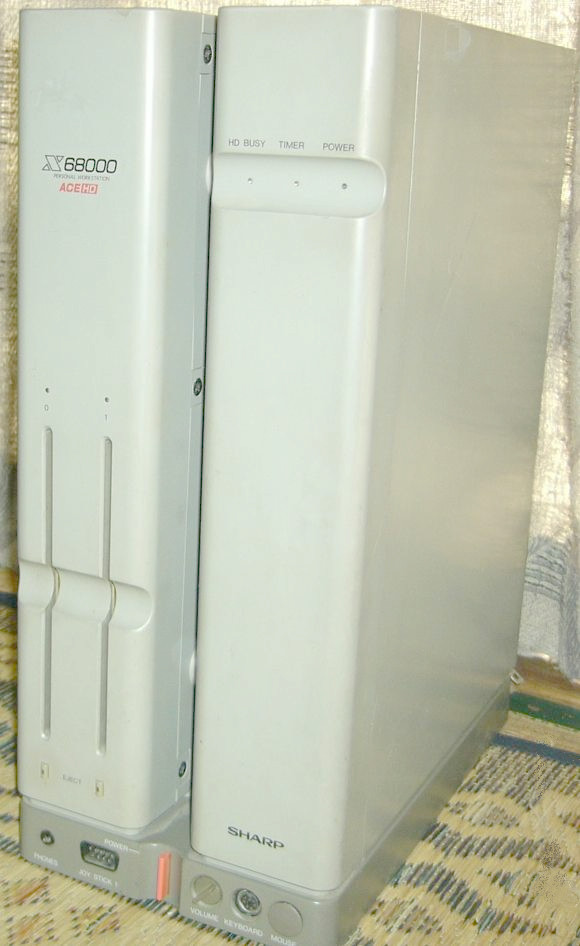
X68000ACE-HD
DeveloperSharp Corporation
ManufacturerSharp Corporation
TypeHome computer[1]
Release date1987[1]
Lifespan1987-1999
Discontinued1999
MediaFloppy disk
Operating systemHuman68k, NetBSD, OS-9
CPUMotorola 68000 family
Memory1 to 12 MB of RAM
Display14" CRT
256×256 to 1024×1024 pixels
16 bits
GraphicsVINAS 1 + 2, VSOP, CYNTHIA / Jr, RESERVE
SoundYamaha YM2151
OKI MSM6258
Controller inputD-pad, Keyboard, Mouse
Power100V AC 50/60 Hz
PredecessorX1
Main processor board of original 1987 CZ-600C model
Video board of original 1987 CZ-600C model
Cynthia sprite chip in the original 1987 CZ-600C model
VSOP Video processing chip in the original 1987 CZ-600C model
Sharp X68000 XVI front and back
Sharp X68030 and X68000 Expert

The X68000 (Japanese: エックス ろくまんはっせん, Hepburn: Ekkusu Rokuman Hassen) is a home computer created by Sharp Corporation. It was first released in 1987 and sold only in Japan.

The initial model has a 10 MHz Motorola 68000 CPU, 1 MB of RAM, and lacks a hard drive. The final model was released in 1993 with a 25 MHz Motorola 68030 CPU, 4 MB of RAM, and optional 80 MB SCSI hard drive. RAM in these systems is expandable to 12 MB, though most games and applications do not require more than 2 MB.

The X68000 has graphics hardware similar to arcade video games of the late-1980s, with custom coprocessors supporting scrolling, tiled backgrounds, and large numbers of sprites. Sound is supplied through multiple sound chips supporting 8 channels of FM synthesis and one channel of adaptive differential pulse-code modulation audio, which are mixed down to 2 analog stereo channels via a DAC chip. As such, video gaming was a major use of the X68000.

Operating system

[edit]

The X68k runs an operating system called Human68k which was developed for Sharp by Hudson Soft. An MS-DOS-workalike, Human68k features English-based commands very similar to those in MS-DOS; executable files have the extension .X.[2]Versions of the OS prior to 2.0 have command line output only for common utilities like "format" and "switch", while later versions included forms-based versions of these utilities. At least three major versions of the OS were released, with several updates in between.

Early models have a GUI called "VS" or "Visual Shell"; later ones were originally packaged with SX-WINDOW. A third GUI called Ko-Window exists with an interface similar to Motif. These GUI shells can be booted from floppy disk or the system's hard drive. Most games also boot and run from floppy disk; some are hard disk installable and others require hard disk installation.

Since the system's release, software such as Human68k itself, console, SX-Window C compiler suites, and BIOS ROMs have been released as public domain software and are freely available for download.[3] Other operating systems available include OS-9 and NetBSD for X68030.[4][5]

Case design

[edit]

The X68000 has two soft-eject 5.25-inch floppy drives, or in the compact models, two 3.5-inch floppy drives, and a very distinctive case design of two connected towers, divided by a retractable carrying handle. This system was also one of the first with a software-controlled power switch; pressing it signals the system's software to save and shut down. The screen fades to black and the sound fades to silence before the system turns off.

The system's keyboard has a mouse port built into either side. The front of the computer has a headphone jack, volume control, joystick, keyboard and mouse ports. The top has a retractable carrying handle only on non-Compact models, a reset button, and a non-maskable interrupt (NMI) button. The rear has a variety of ports, including stereoscopic output for 3D goggles, FDD and HDD expansion ports, and I/O board expansion slots.

Display

[edit]

The monitor supports horizontal scanning rates of 15, 24, and 31 kHz and functions as a cable-ready television (NTSC-J standard) with composite video input. It was a high quality monitor for playing JAMMA-compatible arcade boards due to its analog RGB input and support for all three horizontal scanning rates used with arcade games.

Disk I/O

[edit]

Early machines use the rare Shugart Associates System Interface (SASI) for the hard disk interface; later versions adopted the industry-standard Small Computer System Interface (SCSI). Per the hardware's capability, formatted SASI drives can be 10, 20 or 40 MB in size and can be logically partitioned as well.

Human68K does not support the VFAT long filenames standard of modern Windows systems, but it supports 18.3 character filenames instead of the 8.3 character filenames allowed in the FAT filesystem. By default, Human68K will not consider any additional characters beyond the first 8 without the use of a special driver, therefore files and folders that are named the same when viewed through a 8.3 filename but different when viewed through a 18.3 filename will be considered the same. Human68K is case sensitive and allows lower case and Shift JIS encoded Kanji characters in filenames, both of which cause serious problems when a DOS system tries to read such a directory. If a X68000 user restricts themselves to use only filenames according to the 8.3 characters scheme of DOS, using only Latin upper case characters, then a disk written on the X68000 is fully compatible with other Japanese standard platforms like e.g. the NEC PC-8801, the Fujitsu FMR and FM Towns computers. The Japanese standard disk format used by the X68000 is: 77 tracks, 2 heads, 8 sectors, 1024 bytes per sector, 360 rpm (1232 KiB).

Expansion

[edit]

Many add-on cards were released for the system, including networking (Neptune-X), SCSI, memory upgrades, CPU enhancements (JUPITER-X 68040/060 accelerator), and MIDI I/O boards. The system has two joystick ports, both 9-pin male and supporting Atari standard joysticks and MSX controllers. Capcom produced a converter that was originally sold packaged with the X68000 version of Street Fighter II that allowed users to plug in a Super Famicom or Mega Drive controller into the system. The adapter was made specifically so that users could plug in the Capcom Power Stick Fighter controller into the system.

List of X68000 series

[edit]
Release
Date
model name model
number
CPU body RAM Expan-
sion
I/O slot
FDD HDD Bundle
software
color shape SASI SCSI size
1987/03 X68000 CZ-600C Hitachi
HD68HC000
10 MHz
(Motorola
68000
clone)
Gray/Black Tower 1 MB 2 5¼ ×2 o Human68k ver1.0 (OS)
Gradius (Game)
1988/03 X68000 ACE CZ-601C Gray/Black Tower 1 MB 2 o Human68k ver1.01
X68000 ACE-HD CZ-611C 20 MB
1989/03 X68000 EXPERT CZ-602C Gray/Black Tower 2 MB 2 o Human68k ver2.0
X68000 EXPERT-HD CZ-612C 40 MB
X68000 PRO CZ-652C Gray/Black Horizontal 1 MB 4 o Human68k ver2.0
X68000 PRO-HD CZ-662C 40 MB
1990/03 X68000 EXPERT II CZ-603C Gray/Black Tower 2 MB 2 o Human68k ver2.0
SX-Window ver2.0
X68000 EXPERT II-HD CZ-613C 40 MB
1990/04 X68000 PRO II CZ-653C Gray/Black Horizontal 1 MB 4 o Human68k ver2.0
SX-Window ver2.0
X68000 PRO II-HD CZ-663C 40 MB
1990/06 X68000 SUPER-HD CZ-623C Titan Black Tower 2 MB 2 o 80 MB Human68k ver2.01
SX-Window ver2.0
1991/01 X68000 SUPER CZ-604C
1991/05 X68000 XVI CZ-634C Motorola
68000
16 MHz
Titan Black Tower 2 MB 2 o Human68k ver2.02
SX-Window ver2.0
X68000 XVI-HD CZ-644C 80 MB
1992/02 X68000 Compact CZ-674C Gray mini Tower 2 MB 2 3+12 ×2 o Human68k ver2.03
SX-Window ver2.0
1993/03 X68030 CZ-500 Motorola
MC68EC030
25 MHz
Titan Black Tower 4 MB 2 5¼ ×2 o Human68k ver3.0
SX-Window ver3.0
X68030-HD CZ-510 80 MB
1993/05 X68030 Compact CZ-300 Titan Black mini Tower 4 MB 2 3+12 ×2 o Human68k ver3.02
SX-Window ver3.0
X68030 Compact-HD CZ-310 80 MB
(Cancel-
led)
Power X
(provisional name)
CZ-xxxx IBM
PowerPC 601
66 MHz
Titan Black Tower 8 MB 2 o 240 MB SX-Window ver4.0

List of X68000 games

[edit]

Technical specifications

[edit]

Processors

[edit]

Memory

[edit]
  • ROM: 1 MB (128 kB BIOS, 768 kB Character Generator)
  • Main RAM: 1-4 MB (expandable up to 12 MB)
  • VRAM: 1056 kB
    • 512 kB graphics
    • 512 kB text
    • 32 kB sprites
  • SRAM: 16 kB static RAM

Graphics

[edit]
  • Color palette: 65,536[6] (16-bit RGB high color depth)[10]
  • Maximum colors on screen: 65,536 (in 512×512 resolution)
  • Screen resolutions (all out of 65,536 color palette)[9][10]
    • 256×240 pixels @ 16 to 65,536 colors
    • 256×256 pixels @ 16 to 65,536 colors
    • 512×240 pixels @ 16 to 65,536 colors
    • 512×256 pixels @ 16 to 65,536 colors
    • 512×512 pixels @ 16 to 65,536 colors
    • 640×480 pixels @ 16 to 64 colors
    • 768×512 pixels @ 16 to 64 colors
    • 1024×1024 pixels @ 16 to 64 colors
  • Graphics hardware (VINAS 1 + 2, VSOP, CYNTHIA / Jr, RESERVE): Hardware scrolling, priority control, super-impose, dual tilemap background layers,[9] sprite flipping[10]
  • Graphical planes: 1-4 bitmap planes, 1-2 tilemap planes, 1 sprite plane[10][11]
    • Bitmap planes[6][10]
      • 1 layer: 512×512 resolution @ 65,536 colors on screen, or 1024×1024 resolution @ 64 colors on screen (out of 65,536 color palette)
      • 2 layers: 512×512 resolution @ 256 colors on screen per layer (512 colors combined) (out of 65,536 color palette)
      • 4 layers: 512×512 resolution @ 16 colors on screen per layer (64 colors combined) (out of 65,536 color palette)
    • BG tilemap planes[10][11]
      • BG plane resolutions: 256×256 (2 layers) or 512×512 (1 layer)
      • BG chip/tile size: 8×8 or 16×16
      • Colors per BG layer: 256 (out of 65,536 color palette)
      • BG colors on screen: 256 (1 layer) or 512 (2 layers), out of 65,536 color palette
      • BG tiles on screen: 512 (16×16 tiles in 256×256 layers) to 4096 (8×8 tiles in 512×512 layer)
    • Sprite plane[6][10][11]
      • Sprite count: 128 sprites on screen, 32 sprites per scanline, 256 sprite patterns in VRAM (can be multiplied up to 512 sprites on screen with scanline raster interrupt method[12])
      • Sprite size: 16×16
      • Colors per sprite: 16 colors per palette, selectable from 16 palettes (out of 65,536 color palette)
      • Sprite colors on screen: 256 (out of 65,536 color palette)
      • Sprite tile size: 8×8 or 16×16
      • Sprite tile count: 128 (16×16) to 512 (8×8) on screen, 256 (16×16) to 1024 (8×8) in VRAM

Other specifications

[edit]
  • Expansion: 2 card slots (4 on Pro models)
  • I/O Ports:
    • 2 MSX compatible joystick ports
    • Audio IN / OUT
    • Stereo scope/3D goggles port
    • TV/monitor Control
    • RGB/NTSC Video Image I/O
    • Expansion (2 slots)
    • External FDD (up to 2)
    • SASI/SCSI (depending on model)
    • RS232 serial port
    • Parallel port
    • Headphone and microphone ports
  • Floppy Drives:
    • Two soft-eject 5.25-inch floppy drives, 1.2 MB each
    • Two 3.5-inch floppy drives, 1.44 MB each (compact models)
  • Hard Disk: 20-80 MB SASI/SCSI (depending on model)
  • Operating Systems: Human68k (MS DOS-alike developed by Hudson), SX-Windows GUI
  • Power Input: AC 100 V, 50/60 Hz
  • Weight: ~8 kg (~10 kg Pro)

Optional upgrades

[edit]
  • Upgradable CPU:[13]
    • HARP: Motorola 68000 @ 20 MHz
    • REDZONE: Motorola 68000 @ 24 MHz
    • X68030 D'ash: Motorola 68030 @ 33 MHz
    • Xellent30: Motorola 68030 @ 40 MHz
    • HARP-FX: Motorola 68030 @ 50 MHz
    • Xellent40: Motorola 68040 @ 33 MHz
    • 060Turbo: Motorola 68060 @ 50 MHz
    • Jupiter-EX: Motorola 68060 @ 66 MHz
    • Venus-X/060: Motorola 68060 @ 75 MHz
  • Additional CPU:[13]
    • CONCERTO-X68K: NEC V30 @ 8 MHz, with 512 kB RAM
    • VDTK-X68K: NEC V70 @ 20 MHz, with 2 MB DRAM and 128 kB SRAM
  • FPU (floating point unit) coprocessor:[13][14]
    • Sharp CZ-6BP1
    • Sharp CZ-6BP2: Motorola 68881 @ 16 MHz
    • Sharp CZ-5MP1: Motorola 68882 @ 25 MHz
    • Xellent30: Motorola 68882 @ 33 MHz
    • Tsukumo TS-6BE6DE: Motorola MC68882, with 6 MB RAM
  • Sound card:[13][15]
  • Graphics accelerator & sound card: Tsukumo TS-6BGA[16][17][18]
    • Graphics chip: Cirrus Logic CL-GD5434 (1994)
    • VRAM: 2 MB (2048 kB) 64-bit DRAM
    • Color palette: 16,777,216 (24-bit RGB true color depth) and alpha channel (RGBA)
    • Maximum colors on screen: 16,777,216
    • Maximum resolution: 2048×1024 pixels
    • Screen resolutions (all out of 16,777,216 color palette)
      • 768×512 pixels @ 32,768 to 16,777,216 colors
      • 800×600 pixels @ 32,768 to 16,777,216 colors
      • 1024×512 pixels @ 32,768 to 16,777,216 colors
      • 1024×768 pixels @ 32,768 to 16,777,216 colors
      • 1024×1024 pixels @ 32,768 colors
      • 1280×1024 pixels @ 256 colors
      • 2048×1024 pixels @ 256 colors
    • Graphical capabilities: 64-bit GUI acceleration, blitter, bit blit
    • Audio capabilities: 16-bit stereo PCM @ 48 kHz sampling rate
  • Hard disk drive storage:[14]
    • Sharp CZ-5H08: 80 MB
    • Sharp CZ-68H: 81 MB
    • Sharp CZ-5H16: 160 MB

Legacy

[edit]

In 2022, ZUIKI Inc. revealed a teaser for a new mini console called the X68000 Z, a miniaturized version of the X68000.[19][20]

See also

[edit]
  • X1, the predecessor of the X68000

References

[edit]
[edit]
Revisions and contributorsEdit on WikipediaRead on Wikipedia
from Grokipedia
The X68000 is a line of 16/32-bit personal computers developed and manufactured by Sharp Corporation, first released in Japan in March 1987 as a high-performance "personal workstation" targeted at advanced users and gamers. It evolved from Sharp's earlier X1 series and stood out for its arcade-like graphics and audio capabilities, including support for 65,536 colors and multichannel sound synthesis, making it one of the most powerful home computing platforms of the late 1980s. Sharp announced the X68000 in 1986, positioning it as a premium system with a base price of ¥369,000 (approximately $2,400 USD at the time), which limited its market to Japan and a niche audience of enthusiasts. The system was designed with input from game developers, incorporating hardware inspired by arcade machines, and it quickly became a development platform for titles from companies like Konami and Capcom. Its operating system, Human68k—developed by Hudson Soft—was command-line based and compatible with MS-DOS, featuring a graphical shell for easier navigation. At its core, the original X68000 model used a Motorola MC68000 processor clocked at 10 MHz, with 1 MB of standard RAM expandable to 12 MB, and dedicated video RAM for text (512 KB), graphics (512 KB), and sprites (32 KB). Graphics resolutions reached up to 768 × 512 pixels, supporting 65,536 colors in lower modes, while audio included an 8-channel FM synthesizer (Yamaha YM2151) and ADPCM for voice synthesis (OKI MSM6258). Connectivity options comprised two 5.25-inch floppy drives, SASI/SCSI interfaces for hard drives in later variants, and ports for keyboard, dual mice, joystick, and headphones. Later models upgraded to faster CPUs, such as the MC68030 at 25 MHz, and added features like 3.5-inch drives and 80 MB HDDs. The X68000's software library emphasized gaming, bundling titles like Gradius at launch and hosting ports of arcade hits such as Street Fighter II and Castlevania, which showcased its superior multimedia prowess over contemporaries like the PC-98 or Amiga. Its hardware influenced professional game development, notably serving as a reference for Capcom's CPS-1 arcade board due to architectural similarities. Over its lifespan, Sharp produced 20 models, including the X68000 ACE (1988), Expert series (1989–1990), XVI (1991), and X68030 (1993), with production ceasing amid the rise of more affordable consoles like the Sega Mega Drive. Today, the X68000 is revered in retro computing circles for its rarity and enduring software archive, with emulators and fan communities preserving its legacy as a pinnacle of 1980s Japanese computing innovation, including third-party hardware recreations such as the Zuiki X68000 Z series released in 2025.

History

Development

In the mid-1980s, Sharp Corporation sought to advance its personal computer lineup by developing a high-end system that combined workstation-level performance with multimedia capabilities, evolving directly from the earlier X1 PC-TV series. The project emphasized natural color graphics supporting 65,536 colors and high-fidelity sound to appeal to both professional and gaming applications in the Japanese market. Development focused on a Motorola 68000-based architecture to deliver robust computing power, with initial announcements occurring in 1986. Engineers prioritized compatibility with established operating systems, resulting in the Human68k OS, which was designed to run MS-DOS applications seamlessly while incorporating custom peripherals for enhanced functionality. Prototypes were tested throughout 1986, refining features like advanced graphics processing and SASI interfaces to meet the demands for multimedia content creation and consumption. By early 1987, the design was finalized as a "personal workstation," positioning it as a versatile platform for Japan's burgeoning home computing and entertainment sectors. This foundational work enabled the evolution into later models within the series.

Release and models

The Sharp X68000, designated as model CZ-600C, was initially released in March 1987 at a price of ¥369,000, positioning it as a high-end personal workstation targeted at hobbyists and professionals in Japan. This launch marked Sharp's entry into the 16-bit computing market, emphasizing advanced capabilities for graphics and multimedia applications within a domestic context. The X68000 lineup progressed through iterative series from 1987 to 1993, with enhancements focused on performance and storage to meet evolving user demands. The original series began with the 1987 CZ-600C featuring a 10 MHz Motorola 68000 CPU and 1 MB of RAM. Subsequent models in the ACE and EXPERT series (1988–1989, e.g., CZ-601C and CZ-602C) introduced hard drive options and doubled standard RAM to 2 MB in the EXPERT variants. The PRO series (1989–1990) offered horizontal form factors for space-constrained setups, maintaining 1 MB RAM but adding affordability, such as the CZ-652C at ¥298,000. Later iterations included the SUPER series in 1990 (e.g., CZ-604C), which upgraded to a SCSI interface from the earlier SASI standard and supported 80 MB hard drives, while retaining the 10 MHz 68000 CPU and 2 MB RAM. The XVI series (1991, CZ-634C) accelerated the CPU to 16 MHz for improved processing speed. The Compact models (1992, CZ-674C) shifted to 3.5-inch floppy drives for portability, also at 16 MHz with 2 MB RAM. The final X68030 series (1993, CZ-500C) featured a 25 MHz Motorola 68EC030 CPU and 4 MB standard RAM, representing the pinnacle of the line's upgrades. All models were exclusive to the Japanese market, reflecting Sharp's focus on local consumer and professional needs. Production of the X68000 ceased in 1993 amid the rising dominance of IBM PC-compatible systems in Japan, which offered greater software compatibility and lower costs.

Hardware design

Case and ergonomics

The original Sharp X68000, released in 1987 as the CZ-600C model, featured a distinctive metal chassis with a double-tower aesthetic, consisting of two stacked sections housing the main components and drives side by side for a compact yet robust desktop footprint. This design measured 363 mm in width, 270 mm in depth, and 155 mm in height, with a weight of approximately 7.7 kg, promoting stability on desks while the metal construction facilitated effective passive heat dissipation from the internal 68000 processor. Ergonomic considerations emphasized user-friendly access, including a separate full-size ASCII keyboard with an integrated numeric keypad for comfortable typing during programming and gaming sessions, alongside dual 5.25-inch high-density floppy drives (1.2 MB each) with soft-eject mechanisms positioned at the front for straightforward media handling. The rear panel provided access to the external SASI interface, later upgraded to SCSI in models like the 1990 Super variant, allowing seamless connection to peripherals without compromising the clean front layout. Subsequent models introduced chassis variations to suit diverse setups. The 1989 X68000 PRO adopted a more conventional desktop PC-style case, enhancing expandability with additional slots while maintaining similar ergonomic principles. Compact iterations, such as the 1992 CZ-674C (XVI Compact) series, shifted to a slimmer pizza-box form factor measuring around 330 mm wide, 260 mm deep, and 78 mm high at 4.2 kg, prioritizing space efficiency for professional and home environments without sacrificing drive accessibility or keyboard compatibility. These compact models featured dual 3.5-inch high-density floppy drives (1.44 MB each). The cooling system relied on multiple internal fans to manage thermal output from the processor and other components, a necessity given the era's high-performance demands; user communities later modified these for quieter operation, though original designs lacked built-in dust filters. The overall chassis evolution reflected expansion requirements, with larger cases in early towers accommodating up to four slots for peripherals.

Input/output interfaces

The Sharp X68000 provides a comprehensive set of input/output interfaces tailored for data transfer, peripheral connectivity, and multimedia integration, reflecting its role as both a workstation and gaming platform. Standard storage interfaces vary by model: early models include two 5.25-inch floppy disk drives supporting high-density (HD, 1.2 MB) formats, while compact models from 1992 feature two 3.5-inch floppy disk drives supporting high-density (HD, 1.44 MB) formats and limited double-density (DD, 720 KB) compatibility, enabling efficient disk-based data exchange and software distribution. These drives support dual-floppy operations. Mass storage connectivity is handled via a SCSI-1 interface on later models, which supports attachment of up to eight devices, including hard disk drives with common capacities ranging from 20 MB to 300 MB; the system can boot directly from these SCSI HDDs for enhanced performance over floppy-based startups. Earlier variants utilized a SASI interface for similar hard drive integration, bridging to SCSI standards in subsequent releases. Communication and peripheral ports encompass an RS-232C serial interface for connecting devices such as modems and terminals, facilitating data communication and remote access, and a parallel printer port for direct attachment of compatible printers. MIDI in/out ports available via optional expansion cards, such as the CZ-6BM1, enable linkage to external synthesizers and musical equipment, supporting real-time audio production workflows. User input interfaces feature two DB-9 joystick ports adhering to the MSX standard, allowing compatibility with gaming controllers and enabling seamless integration in entertainment software. The RGB analog video output port delivers high-fidelity signals to monitors, ensuring crisp display reproduction for graphics-intensive tasks. A custom 50-pin expansion bus further extends peripheral options, such as mice for graphical interfaces, with drivers provided in the Human68k operating system to ensure broad compatibility with printers, modems, and other devices.

Graphics and multimedia

Display capabilities

The Sharp X68000 series utilized analog RGB video output through a proprietary 21-pin connector, compatible with Japanese standards for high-fidelity display signals. This interface supported both interlaced and non-interlaced modes, enabling resolutions up to 1024×1024 pixels at 60 Hz, which allowed for detailed text and graphics rendering suitable for professional and gaming applications. The system required an external CRT monitor, as it lacked a built-in display, with Sharp recommending 14- to 19-inch multisync models from their CZ series, such as the CZ-614D, designed specifically for compatibility with the X68000's variable signal outputs. These monitors handled the computer's tri-sync requirements, supporting 15 kHz, 24 kHz, and 31 kHz horizontal frequencies for low- to high-resolution modes without distortion. Initial models featured a 16-bit color palette comprising 65,536 possible colors, with up to 65,536 colors displayable simultaneously in 512×512 resolution using single-plane 16-bpp mode. The graphics system supported multiple modes, including four-plane configuration at 16 colors or dual-plane at 256 colors from the palette, with dedicated 512 KB VRAM for graphics and 32 KB for sprites (up to 128 sprites). Color capabilities remained consistent across later variants, including the X68030, without upgrades to a 24-bit palette. Sync capabilities included a horizontal scan range of 15–31 kHz and vertical refresh rates from 50–120 Hz, facilitating arcade-accurate fidelity by accommodating diverse resolutions and reducing flicker in dynamic content.

Audio system

The Sharp X68000's audio system centers on a combination of frequency modulation (FM) synthesis and adaptive differential pulse-code modulation (ADPCM) for generating music and sound effects. The primary sound chip is the Yamaha YM2151 (OPM), a four-operator FM synthesizer operating at 4 MHz, providing 8 channels of polyphonic sound with support for complex waveforms and algorithms suitable for chiptune compositions. This chip delivers high-fidelity FM tones, often used in games for melodic and percussive elements, and interfaces with a YM3012 digital-to-analog converter for output. Complementing the FM capabilities is the Oki MSM6258 ADPCM chip, which handles 1 channel of sampled audio at software-selectable clock rates of 4 MHz or 8 MHz, yielding maximum sampling rates up to 15.625 kHz (at 8 MHz divided by 512) for voice samples and effects. Audio output is provided in stereo format through RCA jacks on the rear panel, enabling connection to external amplifiers or speakers for enhanced playback. While the core YM2151 and MSM6258 produce 8-bit equivalent resolution for FM and 4-bit for ADPCM, later models like the X68000 XVI incorporate improved digital processing that supports effective 16-bit stereo output via the system's DAC, improving dynamic range for music production. The hardware supports up to 9 total channels in base configuration (8 FM + 1 ADPCM), with enhanced setups via optional expansions reaching 16 channels by adding PCM capabilities. MIDI sequencing is facilitated through optional interface cards, allowing integration with external synthesizers for professional composition workflows. The audio system integrates seamlessly with software tools like Music Macro Language (MML) compilers, such as MXDRV, which program sequences for the YM2151's FM channels and MSM6258's ADPCM, enabling developers to create intricate chiptunes directly targeting the hardware's synthesis methods. This combination made the X68000 a favored platform for game audio, particularly in titles employing sampled voices and effects alongside FM melodies.

Expandability

Expansion slots

The X68000 utilizes a proprietary internal expansion bus architecture tailored to the Motorola 68000 processor, featuring a 16-bit data path synchronized to the system's 10 MHz clock speed in initial models. This design enables efficient communication between the CPU and add-on hardware, with support for direct memory access (DMA) that permits peripherals to handle data transfers independently, reducing CPU overhead for tasks like storage operations. Standard tower models provide two expansion slots, while horizontal Pro variants expand this to four, allowing users to integrate multiple components within the system's chassis. Typical expansions via these slots encompass graphics accelerators, exemplified by the TS-6BGA card, which augments the base video subsystem with additional VRAM and processing for higher resolutions and VGA-compatible output, alongside integrated PCM audio enhancements. SCSI controllers, such as the SX-68SC, are another prevalent addition, enabling faster hard disk integration over the original SASI interface. RAM expansion boards further leverage the bus to boost available memory, supporting the demands of resource-intensive applications and games. The bus's proprietary specifications preclude compatibility with widespread standards like ISA or PCI, confining expansions to Sharp's ecosystem and compatible third-party developments, which were largely Japan-exclusive and fostered a specialized hardware market. This closed architecture ensured stable performance but restricted broader adoption and aftermarket options beyond the system's lifecycle. The slots are positioned within the case to facilitate straightforward installation, with the Pro model's layout offering enhanced internal space for larger cards.

Optional upgrades

Sharp Corporation offered several official upgrade paths for the X68000 series, primarily through enhanced model variants and dedicated expansion hardware. The X68030 model, released in 1993, integrated a Motorola MC68EC030 processor running at 25 MHz with support for a floating-point unit (FPU) coprocessor, providing a significant performance boost over the base 68000 CPU in earlier models without requiring aftermarket modifications. Official RAM expansions, such as the CZ-6BE1A 1 MB board for ACE, PRO, and PRO II models, allowed users to increase system memory from 1 MB to 2 MB on early units, while later configurations supported up to 12 MB total through compatible Sharp memory modules installed via onboard headers or slots. Third-party manufacturers provided additional options to further enhance performance and functionality. CPU accelerator boards like the Xellent30s from Tokyo Systems Research, introduced in 1995, featured an MC68EC030 CPU at 25 MHz paired with a Motorola 68882 FPU at 33 MHz, enabling compatibility with demanding applications and offering speeds comparable to contemporary workstations. Storage upgrades included SCSI hard drive kits for later models, such as 100 MB units that connected via the system's SASI or SCSI interface, allowing faster data access than the base floppy drives and supporting larger game libraries. Audio enhancements came from cards like the TS-6BGA, which added multi-channel PCM capabilities to augment the built-in Oki MSM6258 ADPCM chip, enabling higher-fidelity sound reproduction for multimedia and gaming. Ethernet adapters, such as the rare homebrew Neptune-X developed post-1990, provided network connectivity for tasks like file sharing or early internet access, though adoption was limited due to the platform's regional focus. These upgrades were typically installed in the X68000's expansion slots, with RAM boards plugging directly into motherboard headers and peripheral cards occupying dedicated bays. CPU accelerators like the Xellent30s required slot insertion and often a BIOS ROM update or replacement in the system's empty sockets to ensure boot compatibility, particularly on pre-1991 models lacking MMU support. Early X68000 variants using SASI interfaces faced compatibility challenges with SCSI-based upgrades, necessitating adapters or firmware patches to bridge the protocols. Such modifications extended the X68000's viability into the mid-1990s, bridging the gap to emerging 32-bit systems and sustaining its use in professional graphics, music production, and gaming communities.

Software ecosystem

Operating system

The X68000 series utilized Human68k as its primary operating system, a 68000-specific disk operating system developed by Hudson Soft for Sharp and bundled with the initial models launched in March 1987. Human68k was designed as a single-tasking environment with limited cooperative multitasking capabilities in later versions, resembling MS-DOS in structure and functionality. It featured a command-line shell with English-based commands akin to those in MS-DOS, such as DIR for directory listing, CD for changing directories, and TYPE for viewing file contents, facilitating ease of use for developers familiar with PC environments. Executable files carried the .X extension, distinguishing them from standard MS-DOS .EXE files. Human68k evolved through multiple versions to support the expanding hardware capabilities of the X68000 line, starting with version 1.0 in 1987 and progressing to version 3.02 by 1993, with key releases including v2.01 in 1989, v2.02 in 1991, and v3.01 in 1993. The file system was based on a FAT-like structure optimized for the platform, supporting case-sensitive filenames (including lowercase letters) and Shift JIS-encoded Kanji characters, though this reduced direct compatibility with MS-DOS disks lacking such features. Floppy disks utilized the HDI (Human Disk Image) format for high-density media, while hard disk drives employed the HDF format for partitioning and imaging, enabling efficient storage management up to the system's maximum capacities. The boot process initiated from either a floppy drive or HDD, determined by settings in the battery-backed SRAM; by default, it attempted to load from the floppy, allocating approximately 640 KB of the base 1 MB RAM for user programs after reserving system memory. Human68k included support for device drivers tailored to X68000 peripherals, such as SCSI controllers for hard drives and MIDI interfaces for audio applications, loaded via configuration files like CONFIG.SYS. No native networking was provided in core versions, requiring third-party extensions for Ethernet or other connectivity. For software development, it served as a robust environment, compatible with C compilers including Sharp's PRO-68K version 2.1 and Microtec Research's 68000-targeted suite, enabling programmers to create and compile code directly on the system for tasks like arcade game porting. Later iterations incorporated GUI elements through add-ons like SX-Window, a windowing shell that provided graphical file management and multitasking interfaces atop the command-line base. The hardware also supported alternative operating systems, including NetBSD/x68k and OS-9.

Games and applications

The X68000 boasted an extensive software library exceeding 1,000 titles in total, encompassing over 640 commercial releases and more than 1,000 doujin or homebrew works. This collection featured high-fidelity arcade ports that capitalized on the system's hardware capabilities, such as Irem's R-Type (1988), which replicated the original arcade experience with enhanced visuals, and Capcom's Street Fighter II (1993), including its subsequent iterations like The World Warrior and Champion Edition, praised for their near-perfect adaptation of the coin-op controls and graphics. Original titles also flourished, notably Falcom's Brandish series (starting 1991), a dungeon-crawling action RPG that showcased intricate level design and real-time combat, becoming a hallmark of the platform's creative output. Shoot 'em ups dominated the genre landscape, with standout examples including Konami's Gradius (1987 port) and Irem's Image Fight (1988 port), both delivering arcade-accurate scrolling action and power-up systems that highlighted the X68000's sprite handling. RPGs similarly thrived, exemplified by titles like Bretonne Lays (1990) from SystemSoft, which offered expansive narratives and party-based exploration in a fantasy setting. Music-related software integrated deeply with gaming, particularly through drivers like the Professional Music Driver (PMD), a consumer-grade tool for FM synthesis that powered soundtracks in numerous shoot 'em ups and RPGs, enabling composers to craft complex chiptune compositions using the system's Yamaha YM2151 chip. Beyond gaming, the X68000 supported a range of productivity applications, particularly in creative fields. Music production tools included MXDRV, a popular driver and compiler for generating FM synthesis and ADPCM audio tracks, often used alongside editors like NOTE.X for composing game soundtracks and standalone pieces. Programming environments featured built-in IDEs like ED.X, a straightforward text editor integrated into the Human68k OS for writing and assembling 68000 assembly code directly on the system. Software distribution relied primarily on floppy disks, with most titles shipped on 1MB or 2MB media due to the era's storage limitations and the absence of an official online store. The doujin scene, which surged post-1990 amid declining commercial support, thrived through events like Comiket, where independent developers circulated floppy-based games and tools, fostering a vibrant indie ecosystem that extended the platform's lifespan into the early 2000s. As of 2025, the ecosystem continues with new releases for X68000-compatible hardware like the X68000 Z, including the Ys Legacy Collection (Ys I, II, III) planned for winter 2025 in Japan.

Technical specifications

Processors and memory

The Sharp X68000 series utilized processors from the Motorola 68000 family, starting with a base configuration designed for high-performance computing and graphics tasks in the late 1980s. The original models, released in 1987, featured a Hitachi HD68HC000 microprocessor, a compatible clone of the Motorola MC68000, operating at 10 MHz with a 16/32-bit internal architecture and delivering approximately 1 MIPS performance. This CPU employed a 16-bit external data bus and a 23-bit address bus, typical of the 68000 architecture, which introduced wait states when accessing slower peripherals to synchronize operations. Subsequent models enhanced processing power through clock speed increases and architectural upgrades while maintaining compatibility. The X68000 XVI variant, introduced in 1991, upgraded to a genuine Motorola 68000 at 16 MHz, improving overall throughput without altering the core instruction set. The final models, such as the X68030 released in 1993, incorporated a Motorola 68030 processor clocked at 25 MHz, which included an integrated paged memory management unit (PMMU) for virtual memory support—absent in earlier 68000-based systems—and offered roughly 9 MIPS performance, enabling better handling of complex applications. A sub-processor, the MSM80C51, handled keyboard scanning tasks independently. System memory configurations emphasized expandability for demanding software. All models included 128 KB of ROM for the BIOS and IPL, supplemented by 768 KB of ROM for the character generator, totaling 1 MB ROM. Main DRAM started at 1 MB in the base 1987 model (expandable to 4 MB), rising to 2 MB standard in the 1989 Expert series, and 4 MB in the X68030, with maximum expansion to 12 MB across the lineup via optional slots. Video RAM consisted of 512 KB for graphics, 512 KB for text modes, and 32 KB for sprites, totaling 1.056 MB VRAM, supporting the system's 2D graphics capabilities. Additionally, 16 KB of static RAM provided non-volatile storage for system parameters. The 68000-based architecture excelled in 2D graphics rendering due to its efficient integer operations and direct memory access, but base models lacked hardware multitasking support, relying on OS-level tweaks in Human68k for concurrent tasks, which limited performance in multi-threaded scenarios without expansions.

Graphics hardware

The X68000's graphics hardware centers on a custom chipset co-developed by Sharp and Hudson Soft, featuring dedicated controllers for 2D rendering tasks such as sprite manipulation and background scrolling. The CYNTHIA sprite controller, a key custom chip, manages sprite handling and supports up to 128 sprites sized at 16×16 pixels, allowing for complex layered compositions and fluid motion akin to contemporary arcade machines. This hardware enables efficient processing of multiple graphical layers without taxing the main CPU, facilitating high-frame-rate displays in games and applications. The color system employs an indexed palette architecture, with a 16-bit palette supporting 65,536 colors, with up to 256 or 512 colors displayable depending on resolution and layer configuration, while maintaining compatibility with earlier software. Supporting these features is a hardware blitter for accelerated bitmap transfers and copies, which speeds up operations like screen clearing and pattern filling essential for dynamic scenes. Notably, the system lacks dedicated 3D acceleration hardware, relying instead on software routines for any perspective transformations. Resolutions include a text mode at 80×25 characters for console-like interfaces and graphics modes reaching up to 1024 × 1024 pixels (64 colors) or 512 × 512 pixels (65,536 colors) in non-interlaced format, balancing detail with performance on standard CRT displays.

Storage and peripherals

The Sharp X68000 series primarily featured two built-in 5.25-inch floppy disk drives capable of handling high-density (2HD) disks with a formatted capacity of 1.2 MB each, utilizing modified frequency modulation (MFM) encoding for data storage. Some later compact models, such as the CZ-626C and CZ-636C, instead incorporated two 3.5-inch floppy drives supporting similar 1.2 MB capacities, with the ability to read MS-DOS formatted 1.44 MB disks via third-party adapters due to compatible spin speeds and controller adjustments. These drives included soft-eject mechanisms for user convenience, and the system supported both FM and MFM formats, though HD operation defaulted to MFM for optimal density. Hard disk storage was provided through an integrated SASI or SCSI interface, with official Sharp options ranging from 10 MB to 80 MB depending on the model, such as the 20 MB in the CZ-601C or 40 MB in the CZ-602C. In practice, the hardware and Human68k operating system could support SCSI drives up to 1 GB in total capacity through partitioning and BIOS tweaks, though capacities beyond this required additional modifications. The system lacked native CD-ROM support, relying on external expansions for optical media. Among built-in peripherals, the X68000 included a real-time clock (RTC) chip for maintaining system time and date, essential for file timestamps and scheduling in applications. A dedicated keyboard controller, implemented via an MSM80C51 microcontroller, handled input scanning and processing from the full-stroke keyboard, ensuring responsive text and command entry. The unit featured no integrated networking capabilities, requiring add-on cards for Ethernet or similar connectivity. Power was supplied by an internal unit designed for Japan's 100 V AC input at 50/60 Hz, with compatibility for both frequencies to accommodate regional variations. Thermal management relied on internal cooling fans to dissipate heat from the CPU, graphics hardware, and power components, maintaining operational stability during extended use.

Legacy

Cultural impact

The Sharp X68000 played a pivotal role in the Japanese doujin scene, serving as a key platform for independent game development during the late 1980s and early 1990s. Its powerful hardware, including high-resolution graphics and robust sound capabilities, allowed hobbyist developers to create sophisticated software that rivaled commercial releases, fostering a vibrant ecosystem of fan-made titles. Notable examples include doujin shoot 'em ups like Cho Ren Sha 68K, developed by Koichi Yoshida and inspired by arcade shooters, which exemplified the platform's accessibility for indie creators. This environment contributed to the broader doujin culture, influencing subsequent genres such as visual novels and chiptune music by enabling low-cost production and distribution at events like Comiket. Professionally, the X68000 bridged consumer and specialized markets, particularly in music production and early computer graphics. Sharp positioned the system as a personal workstation, equipped with built-in MIDI ports in models like the SUPER variant, which facilitated integration with external sound modules such as the Roland MT-32 for high-fidelity sequencing. This made it a tool in music studios for MIDI-based composition, leveraging its Yamaha YM2151 FM synthesis chip to produce professional-grade audio tracks compatible with game development and multimedia applications. In graphics, Japanese developers like Konami and Taito utilized the X68000 for designing 2D assets in the early 1990s, capitalizing on its 65,536-color palette and 768x512 resolution to prototype visuals that informed arcade and console titles, thus linking home computing with industry workflows. The X68000 achieved cult status among otaku communities for its arcade-perfect ports, which preserved the authenticity of titles like Gradius and Ghouls 'n Ghosts through superior hardware emulation of coin-op systems. This reputation stemmed from its ability to deliver near-identical experiences to 1980s arcade machines, appealing to enthusiasts seeking high-fidelity recreations outside commercial consoles. Fan-driven events in the 1990s, such as doujin software showcases at gatherings like Comiket, highlighted its niche appeal, where developers and collectors shared custom titles and modifications. Post-2000 revivals have sustained the X68000's cultural footprint, particularly in chiptune communities. Modern events, including the 2022 8Beats video game music showcase, have featured curated sets of X68000 soundtracks, celebrating its FM and ADPCM audio legacies alongside contemporary electronic acts. These festivals underscore the platform's enduring influence on chiptune production, with ongoing hardware recreations like the 2022 X68000 Z project drawing renewed interest from preservationists and musicians.

Emulation and preservation

Efforts to emulate the X68000 have been ongoing since the early 2000s, with several key projects providing varying levels of accuracy and compatibility. MAME, through its integrated MESS driver, has supported full system emulation of the X68000 since the mid-2000s, allowing users to run software on modern hardware with reasonable fidelity for most titles. XM6, originally developed by PI and later evolved into the open-source XM6 Pro-68k for Windows, stands out for its high accuracy in replicating the original hardware, including precise timing for the Motorola 68000 processor and custom graphics chips, making it a preferred choice for preservationists seeking cycle-accurate simulation. In the 2020s, FPGA-based recreations like the MiSTer core have gained traction, offering near-hardware-level performance through reconfigurable logic chips, with updates in 2025 improving compatibility for obscure peripherals and enhancing overall accuracy beyond software emulators. Preservation initiatives, primarily driven by Japanese enthusiast groups and international communities, have focused on archiving the platform's extensive software library to combat media degradation. Projects like Jouyou X68000 have systematically dumped original floppy disks, creating verifiable hash databases for hundreds of games and applications, ensuring pristine copies for future emulation without distributing copyrighted ROMs. The Japanese Game Preservation Society (GPS), a nonprofit established in 2001, has contributed to broader Japanese PC preservation, including X68000 titles, by migrating floppy-based software to digital formats and documenting installation processes, though financial challenges threatened its operations in early 2025 before being buoyed by public support later that year. Community efforts have also produced ISO and HDD images for operating systems like Human68k, enabling bootable virtual environments in emulators and preserving system-level software that was originally distributed on hard drives or CD-ROMs. These dumping projects have archived a significant portion of the estimated 700+ commercial games by the mid-2020s, often through collaborative verification to maintain authenticity. Recent interest in the X68000 has spurred hardware recreations and modern adaptations, bridging preservation with accessibility. Third-party reproductions, such as ZUIKI Inc.'s X68000 Z series—launched via crowdfunding in 2022 with retail release in 2023, and updated with models like the Z SUPER and Z XVI announced in 2025 (though international crowdfunding was canceled in July 2025)—replicate original boards using contemporary components, including compatible PCBs for expansion slots, allowing new builds without sourcing rare 1980s parts. FPGA advancements, including MiSTer's 2024-2025 core refinements for better SCSI and graphics emulation, were highlighted at events like Vintage Computer Festival West 2024, where playable X68000 setups demonstrated improved preservation viability. Limited virtual machine implementations in cloud services have emerged for remote access, though they remain niche due to the platform's specialized hardware requirements. Challenges in X68000 preservation stem largely from Japan's stringent copyright laws, which prohibit unauthorized ROM reproduction and console modifications, even for personal backups, complicating legal dumping and distribution. These restrictions have pushed efforts toward hash-based verification and private archives rather than public ROM sites, while events like the 2024 "Save the Games" preservation conference underscored the need for international cooperation to address such barriers without violating intellectual property rights.

References

Add your contribution
Related Hubs
User Avatar
No comments yet.