Hubbry Logo
Magnet keeperMagnet keeperMain
Open search
Magnet keeper
Community hub
Magnet keeper
logo
8 pages, 0 posts
0 subscribers
Be the first to start a discussion here.
Magnet keeper
Magnet keeper
from Wikipedia
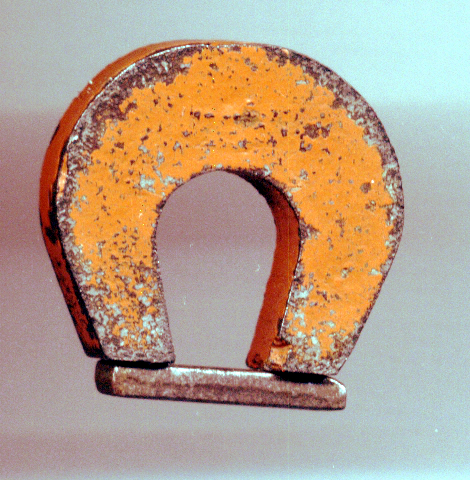
A "horseshoe magnet" made of Alnico 5, about 1 inch high. The metal bar (bottom) is a keeper.

A magnet keeper, also known historically as an armature, is a bar made from magnetically soft iron or steel, which is placed across the poles of a permanent magnet to help preserve the strength of the magnet by completing the magnetic circuit; it is important for magnets that have low magnetic coercivity, such as alnico magnets (0.07T).[1]

Keepers also have a useful safety function, as they restrict external metal from being attracted to the magnet.[clarification needed] Many magnets do not need a keeper, such as neodymium magnets, as they have very high coercivities; only those with low coercivities, meaning that they are more susceptible to stray fields, require keepers.

A magnet can be considered as the sum of many small magnetic domains, which may be only a few microns or smaller in size. Each domain carries its own small magnetic field, which can point in any direction. When all the domains are pointing in the same direction, the fields add up, yielding a strong magnet. When these all point in random directions, they cancel each other, and the net magnetic field is zero.

In magnets with low coercivities, the direction in which the magnetic domains are pointing is easily swayed by external fields, such as the Earth's magnetic field or the stray fields caused by flowing currents in a nearby electrical circuit. Given enough time, such magnets may find their domains randomly oriented, and hence their net magnetization greatly weakened. A keeper for low-coercivity magnets is just a strong permanent magnet that keeps all the domains pointing the same way and realigns any that have gone astray.

References

[edit]
Revisions and contributorsEdit on WikipediaRead on Wikipedia
from Grokipedia
A magnet keeper, also known historically as an armature, is a ferromagnetic bar constructed from soft iron or steel that is placed across the poles of a to preserve its magnetic strength by completing the and preventing field dissipation. This device is essential for long-term storage of bar or horseshoe magnets, as it minimizes self-demagnetization caused by exposure to external or gradual leakage of . When not in use, keepers are typically attached to the magnet's poles, forming a closed loop that redirects the magnetic lines of force internally rather than allowing them to radiate outward.

Definition and History

Definition

A magnet keeper is a ferromagnetic bar or plate made from soft iron or , placed across the poles of a permanent to preserve its magnetic strength during storage. This device functions by completing the , minimizing the loss of over time when the magnet is not in use. Historically known as an "armature" in early literature on , the term reflects its role in early experiments and storage practices for permanent magnets. In its basic physical form, a magnet keeper is typically a straight bar designed for use with bar magnets, positioned across the opposite poles, or a bridging bar for horseshoe magnets to ensure direct contact between the north and south poles.

Historical Development

The concept of using a soft iron bar to preserve the magnetism of permanent magnets emerged in the early , coinciding with advancements in and the production of stronger artificial magnets. William Sturgeon's invention of the in 1825, which involved winding insulated wire around an iron core, highlighted the need for management and indirectly influenced storage practices for permanent magnets by demonstrating how external fields could affect magnetic strength. By the mid-, such devices were routinely described in scientific texts as essential for preventing self-demagnetization during storage. For instance, Daniel Davis Jr.'s 1854 manual detailed the use of soft iron armatures or keepers to connect the poles of bar and horseshoe magnets, noting that they maintained magnetic power when the magnet was idle by completing the . The term "armature" was prevalent in 19th-century literature on , referring to these ferromagnetic bars that bridged poles to retain lines and avoid partial demagnetization over time. This usage appears in works like the 1892 Standard Electrical Dictionary, which defined a -keeper as a bar of iron connecting the poles of a permanent , often serving dual roles as both armature and keeper. As industrial production of permanent magnets scaled up in the early , the terminology evolved; by the mid-20th century, "keeper" became the standardized term in technical contexts, reflecting its specific role in safeguarding magnets during non-use in manufacturing and applications. Magnet keepers saw widespread adoption following the development of alloys in the 1930s, which offered higher magnetic strength but lower resistance to demagnetizing fields, necessitating protective measures for storage. Japanese metallurgist Tokushichi Mishima invented the first magnet in 1931, an alloy of aluminum, nickel, cobalt, and iron, which quickly became integral to military and industrial uses during . These magnets' susceptibility to self-demagnetization from stray fields or mechanical shock made keepers indispensable, ensuring longevity in devices like generators and sensors. In the , keepers remain essential for legacy magnet types like , particularly in specialized or historical applications where stability is critical. However, their use has declined since the with the advent of rare-earth magnets, such as neodymium-iron-boron (NdFeB) alloys developed in the early , which exhibit much higher and inherent stability against demagnetization without additional aids. This shift has relegated keepers primarily to contexts involving older, less stable permanent magnets.

Principle of Operation

Magnetic Demagnetization

Permanent magnets gradually lose their magnetic strength through demagnetization, a process where the ordered alignment of magnetic domains is disrupted, leading to reduced and . This loss primarily arises from thermal agitation, which randomizes atomic magnetic moments at elevated temperatures; exposure to strong opposing external magnetic fields that counteract the internal field; and mechanical shocks or vibrations that physically misalign domains. A key mechanism contributing to this degradation is self-demagnetization, particularly in open magnetic circuits where the magnet operates without a low-reluctance return path. In such configurations, lines emanate from the and loop through air to the , producing internal s (H_d) that oppose the magnet's (M) and shift the along the demagnetization curve toward lower density. This effect is visualized in diagrams contrasting open and closed paths: an open path shows diverging field lines in air, creating a strong opposing H_d inside the , while a closed path confines within high-permeability material, minimizing stray fields and stabilizing the internal field. The is fundamentally given by H_d = -N M, where N is the geometry-dependent demagnetizing factor (ranging from near 0 for long, thin shapes to about 1/3 for spheres), simplifying the opposition without detailed derivation. Several environmental factors accelerate demagnetization rates beyond baseline self-loss. High temperatures increase thermal agitation, potentially causing irreversible flux reduction and complete demagnetization above the point, which ranges from about 300–900 °C depending on the (e.g., 310–400 °C for neodymium-iron-boron, 800–900 °C for ). Mechanical vibrations or shocks disrupt domain walls, while opposing fields exceeding the can induce partial or full reversal. For instance, magnets, with their inherently low (around 50–160 kA/m), are particularly susceptible to self-demagnetization in open circuits, potentially experiencing partial loss of several percent of strength shortly after removal from a closed magnetic path. Overall, well-stored permanent magnets exhibit minimal long-term loss, typically less than 3% over decades under ambient conditions.

Role of the Keeper

The magnet keeper plays a crucial role in maintaining the integrity of a permanent magnet's field by completing the . When placed across the poles, the keeper provides a low-reluctance path for the lines, effectively shunting the field internally and reducing stray fields that could otherwise lead to demagnetizing effects. This closed-loop configuration confines the flux within the magnet-keeper system, minimizing the demagnetization field that arises from the magnet's own remanent magnetization in an open circuit. In operation, the soft iron keeper becomes temporarily magnetized through induction, as the external field from the permanent magnet aligns the keeper's magnetic domains in the direction of the . This induced magnetism reinforces the permanent magnet's field, creating a supportive loop where the keeper acts as a conduit rather than an opposing element. The alignment prevents the flux from dissipating outward, thereby stabilizing the domain structure of the permanent magnet. The primary preservation mechanism of the keeper involves minimizing the external exposure of the , which reduces the opportunity for random thermal agitation or external influences to reorient the domains irreversibly. This approach counteracts demagnetization risks inherent to open-circuit storage, such as self-demagnetizing fields. By maintaining a low-reluctance closed path, the keeper significantly preserves the magnet's strength over extended periods, preventing substantial loss that would occur without it. A key physical principle underlying this role is , which quantifies the opposition to in a , analogous to resistance in electrical circuits. Reluctance RR is defined as R=lμAR = \frac{l}{\mu A} where ll is the mean length of the magnetic path, μ\mu is the permeability of the material, and AA is the cross-sectional area. The high permeability μ\mu of the soft iron keeper (typically orders of magnitude greater than that of air or vacuum) substantially lowers the total reluctance of the circuit compared to an open path, where air gaps introduce high reluctance (μμ0\mu \approx \mu_0, the permeability of free space). To derive this from Ampere's circuital law, consider a closed magnetic path without enclosed current, where Hdl=0\oint \mathbf{H} \cdot d\mathbf{l} = 0. For a uniform material, this simplifies to Hl=0H l = 0 if flux is conserved, but in practice, the magnetomotive force (MMF = HlH l) drives the flux Φ\Phi. Since B=μHB = \mu H and Φ=BA\Phi = B A, substituting yields H=Φ/(μA)H = \Phi / (\mu A), so MMF = Hl=Φl/(μA)H l = \Phi l / (\mu A). Thus, Φ=\Phi = MMF /R/ R, with R=l/(μA)R = l / (\mu A). In the keeper system, the reduced RR due to high μ\mu ensures higher flux retention and lower demagnetizing HH fields within the permanent magnet.

Materials and Design

Materials

Magnet keepers are typically constructed from soft iron or low-carbon steel. These materials are chosen for their high magnetic permeability, which allows them to easily conduct , and low , ensuring they do not retain after the field is removed.

Design Variations

Magnet keepers for bar magnets typically consist of a straight iron or steel bar that is placed or clamped across the north and south poles to complete the during storage. These keepers are often designed with a length that approximates the width of the bar magnet for secure fit, and may include provisions for bolting or simple mechanical retention to ensure stability. For horseshoe magnets, keepers are generally straight bars that bridge the two closely spaced poles, preserving the magnet's field by shunting between them. In some designs, these keepers incorporate adjustable fittings or bridge-like plates to accommodate the curved pole faces of the U-shaped , allowing for a precise span across the gap. Custom keepers adapt to specialized magnet geometries, such as annular or ring-shaped forms for ring and disc , where soft iron pieces are placed between stacked discs to prevent demagnetization. Modern variants of these keepers may feature protective coatings, such as plating or , applied over the to mitigate while maintaining sufficient magnetic permeability. For certain magnets like , sizing guidelines suggest the keeper's thickness should be approximately two-thirds the pole face width to avoid magnetic saturation, scaled by the magnet's (e.g., (Br / 18,000) × pole width in appropriate units).

Usage for Different Magnet Types

Alnico Magnets

Alnico magnets exhibit low , typically ranging from 640 to 1,900 oersteds across grades 2 through 9, rendering them highly vulnerable to demagnetization from external and inherent self-demagnetizing tendencies. This property stems from their composition of , , , , and sometimes or , which provides high but limited resistance to demagnetizing forces. Without protective measures, Alnico magnets can experience partial irreversible losses, particularly in open-circuit storage where flux leakage accelerates degradation. Due to this susceptibility, keepers are essential for all Alnico grades during storage and non-operational periods to maintain a closed and minimize flux leakage. For bar-shaped magnets, full-length soft iron keepers are recommended to bridge the north and south poles along the magnet's axis, ensuring uniform flux containment. Cast Alnico configurations, such as horseshoe designs, require keepers with tight contact at the poles to prevent localized demagnetization and preserve overall integrity. The effectiveness of keepers in preserving Alnico magnet strength is well-documented; proper application helps mitigate losses from self-demagnetization and external influences. Irreversible demagnetization can occur rapidly if exposed to opposing fields stronger than the magnet's , underscoring the keeper's role in long-term stability. Historically, the adoption of keepers as a standard practice coincided with the invention of in by Japanese researcher T. Mishima, whose alloy innovation enabled widespread use in electric motors, sensors, and but highlighted the need for flux-shorting devices to ensure reliability. This integration of keepers facilitated Alnico's dominance in high-temperature applications through the mid-20th century, where demagnetization risks otherwise limited deployment.

Other Permanent Magnets

Neodymium-iron-boron (NdFeB) magnets exhibit high intrinsic , typically exceeding 10,000 Oe (approximately 800 kA/m), which provides substantial resistance to demagnetization from external fields or self-demagnetizing effects. This stability contrasts with magnets, reducing the necessity for keepers to preserve magnetic strength during storage. However, keepers or equivalent steel spacers may be employed optionally to contain stray magnetic fields, minimize interference with nearby devices, or enhance safety by preventing forceful attraction between multiple magnets during handling. Ferrite or ceramic magnets possess moderate coercivity, generally in the range of 2,000 to 4,000 Oe (about 160 to 320 kA/m), offering better demagnetization resistance than but lower than rare-earth materials. As a result, keepers are not standard for routine storage, given their inherent stability under normal conditions. They may be recommended, however, for long-term preservation in adverse environments, such as exposure to elevated temperatures near their operating limit of 250–300°C or strong opposing fields, to further mitigate potential flux loss. Samarium-cobalt (SmCo) magnets demonstrate high , often between 5,000 and 12,000 Oe (roughly 400 to 950 kA/m), along with excellent resistance and thermal stability up to 300–350°C, making them highly resistant to demagnetization. Consequently, keepers are rarely required for maintaining magnetic integrity during storage or use. In specific configurations, such as pot magnets, a keeper plate may accompany the assembly for mechanical protection against chipping or to shield fields, rather than for demagnetization prevention. Keepers find occasional application with these magnet types in hybrid systems integrating older or mixed materials, or in where field is prioritized. Steel plates serve as effective shields to reduce external fields but should ideally be soft iron to avoid inducing minor domain realignments if the material has residual .

Storage and Handling Practices

Applying the Keeper

To apply a magnet keeper effectively, begin with proper preparation of the magnet. Clean the poles to remove any rust, debris, or residue using a soft cloth and mild detergent if necessary, followed by thorough drying to ensure optimal contact and prevent corrosion during storage. Identify the north and south poles by bringing each end of the magnet near the north-seeking end of a compass; the end repelling the compass's north needle is the magnet's north pole, while the attracting end is the south pole. The placement process varies slightly by magnet shape but focuses on bridging the poles securely. For bar magnets, position the keeper—a soft iron or —perpendicular across the north and south poles to complete the , ensuring full surface contact; if the magnet is strong, use non-magnetic clamps to hold it in place without damaging the surfaces. For horseshoe magnets, slide the keeper plate or bar over the curved legs to connect the poles directly. Observe safety precautions during handling to minimize risks. Wear heavy-duty gloves to protect against pinching injuries from the magnet's strong attraction, and safety glasses to guard against potential fragments. Keep the magnet away from electronic devices, credit cards, and individuals with pacemakers, as stray fields can interfere with these items. Verify the keeper's application by sprinkling around the ; with the keeper properly placed, no external field leakage should occur, and the filings will not align or cling outside the keeper- assembly, confirming the flux path is contained.

Removing the Keeper

To safely remove a keeper from a permanent , such as an type, employ a gradual method to minimize mechanical shock and potential misalignment of magnetic domains. Remove the keeper carefully to avoid opposing pole alignment and mechanical shock; use non-magnetic spacers or aids for gradual separation rather than sliding, twisting, or direct pulling, which helps maintain the closed until the end. Use non-magnetic tools, like wooden or levers, if assistance is needed to avoid introducing external fields that could disrupt the magnet's alignment. Sudden or abrupt removal poses risks of partial demagnetization, particularly for low-coercivity materials like , where opposing pole alignment during separation can push the operating point below the of the demagnetization curve, leading to irreversible loss. This vulnerability ties into broader demagnetization risks from mechanical shock or stray fields, as discussed in magnet handling guidelines. For specifically, perform removal in a controlled environment with minimal external magnetic interference to aid domain stability. After removal, immediately deploy the in its intended application or reattach the keeper if storage is required, thereby preserving by limiting exposure to demagnetizing influences. If available, verify the magnet's performance post-removal using a gaussmeter to measure surface and detect any unintended degradation. To optimize longevity, minimize keeper removals and ensure the magnet spends the majority of its time in storage with the keeper applied.

References

Add your contribution
Related Hubs
User Avatar
No comments yet.