


Community hub
Recent from talks
Contribute something to knowledge base
Content stats: 0 posts, 0 articles, 1 media, 0 notes
Members stats: 0 subscribers, 0 contributors, 0 moderators, 0 supporters
Subscribers
Supporters
Contributors
Moderators
Hub AI
Magnetohydrodynamics AI simulator
(@Magnetohydrodynamics_simulator)
Hub AI
Magnetohydrodynamics AI simulator
(@Magnetohydrodynamics_simulator)
Magnetohydrodynamics
In physics and engineering, magnetohydrodynamics (MHD; also called magneto-fluid dynamics or hydromagnetics) is a model of electrically conducting fluids that treats all interpenetrating particle species together as a single continuous medium. It is primarily concerned with the low-frequency, large-scale, magnetic behavior in plasmas and liquid metals and has applications in multiple fields including space physics, geophysics, astrophysics, and engineering.
The word magnetohydrodynamics is derived from magneto- meaning magnetic field, hydro- meaning water, and dynamics meaning movement. The field of MHD was initiated by Hannes Alfvén, for which he received the Nobel Prize in Physics in 1970.
The MHD description of electrically conducting fluids was first developed by Hannes Alfvén in a 1942 paper published in Nature titled "Existence of Electromagnetic–Hydrodynamic Waves" which outlined his discovery of what are now referred to as Alfvén waves. Alfvén initially referred to these waves as "electromagnetic–hydrodynamic waves"; however, in a later paper he noted, "As the term 'electromagnetic–hydrodynamic waves' is somewhat complicated, it may be convenient to call this phenomenon 'magneto–hydrodynamic' waves."
In MHD, motion in the fluid is described using linear combinations of the mean motions of the individual species: the current density and the center of mass velocity . In a given fluid, each species has a number density , mass , electric charge , and a mean velocity . The fluid's total mass density is then , and the motion of the fluid can be described by the current density expressed as and the center of mass velocity expressed as:


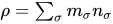
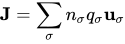
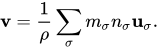
MHD can be described by a set of equations consisting of a continuity equation, an equation of motion (the Cauchy momentum equation), an equation of state, Ampère's law, Faraday's law, and Ohm's law. As with any fluid description to a kinetic system, a closure approximation must be applied to the highest moment of the particle distribution equation. This is often accomplished with approximations to the heat flux through a condition of adiabaticity or isothermality.
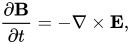
In the adiabatic limit, that is, the assumption of an isotropic pressure and isotropic temperature, a fluid with an adiabatic index , electrical resistivity , magnetic field , and electric field can be described by the continuity equation the equation of state the equation of motion the low-frequency Ampère's law Faraday's law and Ohm's law Taking the curl of this equation and using Ampère's law and Faraday's law results in the induction equation, where is the magnetic diffusivity.


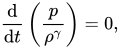





In the equation of motion, the Lorentz force term can be expanded using Ampère's law and a vector calculus identity to give where the first term on the right hand side is the magnetic tension force and the second term is the magnetic pressure force.


In view of the infinite conductivity, every motion (perpendicular to the field) of the liquid in relation to the lines of force is forbidden because it would give infinite eddy currents. Thus the matter of the liquid is "fastened" to the lines of force...
Magnetohydrodynamics
In physics and engineering, magnetohydrodynamics (MHD; also called magneto-fluid dynamics or hydromagnetics) is a model of electrically conducting fluids that treats all interpenetrating particle species together as a single continuous medium. It is primarily concerned with the low-frequency, large-scale, magnetic behavior in plasmas and liquid metals and has applications in multiple fields including space physics, geophysics, astrophysics, and engineering.
The word magnetohydrodynamics is derived from magneto- meaning magnetic field, hydro- meaning water, and dynamics meaning movement. The field of MHD was initiated by Hannes Alfvén, for which he received the Nobel Prize in Physics in 1970.
The MHD description of electrically conducting fluids was first developed by Hannes Alfvén in a 1942 paper published in Nature titled "Existence of Electromagnetic–Hydrodynamic Waves" which outlined his discovery of what are now referred to as Alfvén waves. Alfvén initially referred to these waves as "electromagnetic–hydrodynamic waves"; however, in a later paper he noted, "As the term 'electromagnetic–hydrodynamic waves' is somewhat complicated, it may be convenient to call this phenomenon 'magneto–hydrodynamic' waves."
In MHD, motion in the fluid is described using linear combinations of the mean motions of the individual species: the current density and the center of mass velocity . In a given fluid, each species has a number density , mass , electric charge , and a mean velocity . The fluid's total mass density is then , and the motion of the fluid can be described by the current density expressed as and the center of mass velocity expressed as:
MHD can be described by a set of equations consisting of a continuity equation, an equation of motion (the Cauchy momentum equation), an equation of state, Ampère's law, Faraday's law, and Ohm's law. As with any fluid description to a kinetic system, a closure approximation must be applied to the highest moment of the particle distribution equation. This is often accomplished with approximations to the heat flux through a condition of adiabaticity or isothermality.
In the adiabatic limit, that is, the assumption of an isotropic pressure and isotropic temperature, a fluid with an adiabatic index , electrical resistivity , magnetic field , and electric field can be described by the continuity equation the equation of state the equation of motion the low-frequency Ampère's law Faraday's law and Ohm's law Taking the curl of this equation and using Ampère's law and Faraday's law results in the induction equation, where is the magnetic diffusivity.
In the equation of motion, the Lorentz force term can be expanded using Ampère's law and a vector calculus identity to give where the first term on the right hand side is the magnetic tension force and the second term is the magnetic pressure force.
In view of the infinite conductivity, every motion (perpendicular to the field) of the liquid in relation to the lines of force is forbidden because it would give infinite eddy currents. Thus the matter of the liquid is "fastened" to the lines of force...
Recent media
Recent media