


Community hub
Recent from talks
Contribute something
Nothing was collected or created yet.
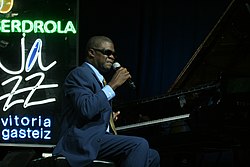
Marcus Roberts
View on WikipediaKey Information


Marthaniel "Marcus" Roberts (born August 7, 1963)[1] is an American jazz pianist, composer, arranger, bandleader, and teacher.
Early life
[edit]Roberts was born in Jacksonville, Florida, United States.[1] His mother was a gospel singer who had gone blind as a teenager, and his father was a longshoreman. Blind since age five due to glaucoma and cataracts,[2] Roberts started learning the piano at age five by picking out notes on the instrument at his church until his parents bought a piano when he was eight. He attended the Florida School for the Deaf and the Blind in St. Augustine, Florida,[3] the alma mater of Ray Charles. Roberts began teaching himself piano at an early age, having his first lesson at age 12, and then studying with Leonidas Lipovetsky while attending Florida State University.
Career
[edit]In the 1980s, Roberts replaced pianist Kenny Kirkland in Wynton Marsalis's band. Like Marsalis's, his music is rooted in the traditional jazz of the past. His style has been influenced more by Jelly Roll Morton and Fats Waller than McCoy Tyner and Bill Evans, with an emphasis on ragtime and stride piano rather than bebop. His album New Orleans Meets Harlem, Vol. 1 (2009) covers music by Scott Joplin, Duke Ellington, Morton, and Waller.[1]
The Atlanta Symphony Orchestra and the Savannah Music Festival commissioned Roberts's first piano concerto, Spirit of the Blues: Piano Concerto in C Minor. He has performed as a soloist in symphony orchestras with Marin Alsop (1992) and Seiji Ozawa. He returned to Japan in September 2014 to share the stage with Ozawa and the Saito Kinen Festival Orchestra.
In 2012, Roberts founded the band The Modern Jazz Generation, which released its first album in October 2014. It has 12 musicians ranging in age from early 20s to 50s. He served as associate artistic director for the Savannah Music Festival as well as the director of the annual Swing Central high school band competition. He is on the faculty at Florida State University.
In 2014, Roberts was profiled on the television show 60 Minutes.[4][5]
Roberts received an honorary doctorate from Brigham Young University (BYU) for the 2021 commencement on April 22. BYU conferred upon Roberts the degree of Doctor of Civic Engagement Through Music, honoris causa, for his outstanding life and contributions to society and to the world. In his address, Roberts said: "We need to take time to really see each person, especially those who don't look or act like us, because if we hold onto and build upon that thread that binds us together, our ties will become stronger, we'll develop more of a sense of communion and trust with each other". As part of his address, Roberts performed a special piano musical arrangement of the gospel hymn "Just a Closer Walk with Thee". The degree conferral and address were video-recorded the previous weekend in Boston before being shown at BYU's commencement.[6]
Bard College appointed Roberts distinguished visiting professor of music for the 2020–21 academic year.[7]
Discography
[edit]As leader/co-leader
[edit]- The Truth Is Spoken Here (Novus, 1989) – recorded in 1988
- Deep in the Shed (Novus/Sony, 1990) – recorded in 1989
- Alone with Three Giants (Novus, 1991)
- Prayer for Peace (Novus, 1991)
- As Serenity Approaches (Novus, 1991)
- If I Could Be with You (Novus, 1993)
- Gershwin for Lovers (Columbia, 1994)
- Portraits in Blue (Columbia/Sony, 1995)
- Time and Circumstance (Columbia/Sony, 1996)
- Blues for the New Millennium (Columbia, 1997)
- The Joy of Joplin (Sony, 1998)
- In Honor of Duke (Columbia, 1999)
- Cole after Midnight (Columbia/Sony, 2001)
- A Gershwin Night with Seiji Ozawa and Berlin Philharmonic (EuroArts Music International, 2004)[DVD-Video] – recorded in 2003
- Gershwin: Piano Concerto in F (Philips Classics, 2006)
- New Orleans Meets Harlem, Volume 1 (J-Master, 2009)
- Celebrating Christmas (J-Master, 2011)
- Deep in the Shed: A Blues Suite (J-Master, 2012)
- From Rags to Rhythm (J-Master, 2013)
- Together Again: In the Studio with Wynton Marsalis (J-Master, 2013)
- Together Again: Live in Concert with Wynton Marsalis (J-Master, 2013)
- Romance, Swing, and the Blues (J-Master, 2014)
- The Race for the White House (EP) (2016)
- Trio Crescent: Celebrating Coltrane (J-Master, 2017)[8][9]
As sideman
[edit]|
With Wynton Marsalis
|
With others
|
References
[edit]- ^ a b c Wynn, Ron. "Marcus Roberts". AllMusic. Retrieved 28 May 2018.
- ^ Hinson, Mark (March 27, 2014). "Marcus Roberts is next on '60 Minutes' this Sunday night". Tallahassee.com. Retrieved March 30, 2014.
- ^ Marsalis, Wynton (March 30, 2014). "The Virtuoso: Marcus Roberts". CBS. Retrieved March 30, 2014.
- ^ Wynton, Marsalis (June 22, 2014). "The Virtuoso: Marcus Roberts". video interview. Retrieved March 10, 2016.
- ^ "Awards and Honors". Marcus Roberts. Retrieved 2016-03-10.
- ^ BYUtv 4/22/21, 10:00am MDT (digital replay available at byutv.org)
- ^ "Bard College Appoints Renowned Pianist and Composer Marcus Roberts as Distinguished Visiting Professor of Music". Bard. Bard College. Retrieved 23 November 2021.
- ^ "Marcus Roberts | Album Discography | AllMusic". AllMusic. Retrieved 28 May 2018.
- ^ "Discography". Marcus Roberts. 16 August 2014. Retrieved 28 May 2018.
- ^ "Marcus Roberts | Credits | AllMusic". AllMusic. Retrieved 28 May 2018.
External links
[edit]- Official website
- Marcus Roberts 2025 Interview on The Tonearm Podcast

Marcus Roberts
View on GrokipediaEarly life and education
Childhood and family
Marcus Roberts, born Marthaniel Roberts on August 7, 1963, in Jacksonville, Florida, entered the world during a pivotal period of the Civil Rights movement in the American South.[5][6] At the age of five, Roberts lost his sight due to glaucoma and cataracts, an event that profoundly shaped his early sensory experiences by eliminating visual memories and heightening his reliance on auditory and tactile cues.[7] He later recalled having no recollection of vision from his childhood, instead finding profound stimulation in sounds like the piano, which he described as evoking an immediate sense of beauty and stability.[7] This blindness also influenced his initial approach to the instrument, as he oriented himself using the groupings of black keys in twos and threes to navigate the keyboard.[7] Roberts grew up in a working-class family in Jacksonville, where his father worked as a longshoreman and his mother, herself blind since her teenage years, served as a gospel singer in the local church.[7] His mother's musical involvement provided an early immersive environment rich in gospel traditions, fostering Roberts' innate sensitivity to emotional expression in performance even before formal training.[7] This familial context, set against the backdrop of a racially segregated Southern city, laid the personal foundation for his lifelong engagement with music.Musical beginnings
Marcus Roberts' early musical experiences were deeply rooted in the gospel traditions of his family's church in Jacksonville, Florida, where his mother, a blind gospel singer, provided a profound initial influence. Growing up in a musical household, Roberts was surrounded by the sounds of church services, which sparked his passion for the piano at a young age. His mother encouraged the purchase of a piano when he was eight years old, after he lost his sight to glaucoma and cataracts at age five, marking the beginning of his immersion in music as a primary means of expression and navigation.[7] Roberts taught himself the fundamentals of piano playing through informal guidance from his mother over the first four years, adapting techniques to his blindness by relying on the tactile layout of the keyboard, particularly the groupings of black keys for orientation. He developed an aural approach to learning, memorizing pieces and harmonies by ear while accompanying gospel singers in church, emphasizing emotional delivery as his mother instructed him to "play it until I feel something." This self-directed method honed his intuitive grasp of rhythm and melody, allowing him to internalize music without visual aids.[7][8] By his pre-teen years, Roberts began performing in local Jacksonville churches, securing his first gig at the Silas Missionary Baptist Church by demonstrating sufficient skill on the piano to accompany services and community gatherings. These early appearances in church and neighborhood events built his confidence and exposed him to communal musical interaction, reinforcing the gospel foundations that shaped his phrasing and swing.[8][9] During his teenage years, Roberts' horizons expanded through exposure to jazz via local radio broadcasts and records, where he first encountered the swing-era sounds of Duke Ellington, Earl Hines, and Teddy Wilson, igniting a fascination that complemented his gospel roots. Tuning into FM stations at an early age, he absorbed these influences aurally, dissecting improvisations and rhythms to incorporate into his playing.[10][11]Formal training
Roberts began his formal musical training at the age of 10 upon enrolling in the Florida School for the Deaf and the Blind in St. Augustine, Florida, where he started serious piano study under structured guidance.[12] At age 12, he received his first formal piano lessons at the school, building on his self-taught foundations from earlier exposure to church music.[13] Following high school, Roberts pursued higher education at Florida State University, where he majored in music and focused on classical piano studies.[3] There, at age 18, he trained under the renowned classical pianist Leonidas Lipovetsky, a former student of the celebrated Madame Rosina Lhévinne, who emphasized rigorous classical technique while allowing Roberts to integrate his jazz sensibilities.[14] This mentorship blended European classical precision with improvisational jazz elements, shaping Roberts' versatile approach to the instrument.[7] During his university years, Roberts demonstrated his emerging talent through early competition successes that bridged his education to professional opportunities. He won his first major piano competition at age 17 in the 1980 Mayport Jazz Festival in Jacksonville, Florida.[14] Two years later, in 1982, he secured the Young Artist's Award at the National Association of Jazz Educators annual convention, highlighting his proficiency as a jazz pianist.[3] These victories underscored the effectiveness of his formal training in preparing him for a career in jazz performance.[15]Career
Early collaborations
Roberts joined Wynton Marsalis' quintet in 1985 as pianist, replacing Kenny Kirkland and quickly becoming a key member of the ensemble during its shift toward more traditional jazz explorations.[16][17] He toured extensively with the band across the United States and internationally for the next six years, performing in major venues and contributing to Marsalis' emphasis on acoustic jazz rooted in the styles of Duke Ellington and Thelonious Monk.[9][18] His debut major recording as a sideman came on Marsalis' album J Mood, recorded in December 1985 at RCA Studio A in New York City and released the following year on Columbia Records.[19] On the album, Roberts provided piano throughout, supporting Marsalis' trumpet in a quartet setting with bassist Robert Hurst III and drummer Jeff "Tain" Watts, blending post-bop structures with swing-era influences in tracks like the title composition and "Blue Trance."[19][20] These studio sessions and accompanying live performances helped solidify Roberts' role in revitalizing straight-ahead jazz, earning praise for his rhythmic precision and harmonic depth.[18] Through these collaborations, Roberts established himself as a rising figure in the New York jazz scene, particularly as Marsalis co-founded Jazz at Lincoln Center in 1987, where Roberts became one of its earliest prominent pianists.[17] His work with Marsalis introduced him to influential circles at venues like the Village Vanguard and Blue Note, fostering connections that amplified his visibility among critics and peers.[21] Emerging directly from this formative period, Roberts released his debut album as a leader, The Truth Is Spoken Here, in 1989 on Novus Records.[22] The octet recording, produced by Steve Epstein and featuring Marsalis on trumpet, Elvin Jones on drums, and Charlie Rouse on tenor saxophone for select tracks, showcased Roberts' compositional voice through originals like "The Truth Is Spoken Here" and standards reinterpretations, marking his transition from sideman to bandleader.[23][22]Solo and ensemble work
Following his early collaborations with Wynton Marsalis, Marcus Roberts established an independent career in the 1990s, releasing several albums that highlighted his command of stride piano and blues traditions.[24] His 1990 album Deep in the Shed, recorded with a nonet, presents a blues suite influenced by Duke Ellington, featuring intricate arrangements and Roberts' virtuosic piano work that blends stride elements with modern jazz improvisation.[25][26] In 1994, Roberts issued Gershwin for Lovers, a solo piano recording offering intimate, jazz-inflected interpretations of George Gershwin standards such as "A Foggy Day" and "Summertime," emphasizing lyrical phrasing and romantic swing.[27] The 1997 release Blues for the New Millennium, featuring an ensemble with musicians like trumpeter Marcus Printup and drummer Jason Marsalis, explores fourteen blues compositions that showcase Roberts' stride piano roots alongside collective improvisation and rhythmic vitality.[28][29] Roberts extended his reach into orchestral settings with his trio in 2003, performing Gershwin works including an arranged Piano Concerto in F Major and Rhapsody in Blue under conductor Seiji Ozawa with the Berlin Philharmonic at the Waldbühne in Berlin, blending jazz spontaneity with symphonic precision.[30] In 2013, Roberts premiered his original composition Spirit of the Blues: Piano Concerto in C Minor, a three-movement work commissioned by the Atlanta Symphony Orchestra and the Savannah Music Festival, dedicated to Seiji Ozawa and Martin Luther King Jr., and conducted by Robert Spano; it fuses blues motifs with classical concerto form to evoke spiritual and historical depth.[24] Roberts founded The Modern Jazz Generation in 2012, a 12-piece multigenerational ensemble incorporating his trio with emerging and veteran players to reinterpret stride and swing-era jazz, promoting mentorship through collaborative performances of classics and originals.[31]Recent performances and projects
In 2020, Marcus Roberts was appointed Distinguished Visiting Professor of Music at Bard College for the 2020–21 academic year, a role that facilitated educational initiatives and live performances blending jazz and classical elements.[32] This position connected to collaborative projects, including a partnership with the American Symphony Orchestra (ASO) and his ensemble, the Modern Jazz Generation, to produce the short music film United We Play.[33] Premiering in December 2020, the 24-minute digital film featured three world-premiere compositions by Roberts—America Has the Blues, Seeking Peace, and United We Play—performed by the Modern Jazz Generation alongside the ASO's string section, emphasizing themes of unity and resilience amid societal challenges.[34] Building on the Modern Jazz Generation, which Roberts founded in 2012 to nurture emerging talent through innovative jazz arrangements, he secured a $39,995 Jazz Road Creative Residency grant from South Arts in 2021.[35] The funding supported a residency program in Tallahassee, Florida, in partnership with Florida State University, where the 10-piece ensemble created, performed, and recorded the multidisciplinary work Tomorrow's Promises. This project fused Roberts' original compositions with narration and spoken word, incorporating new technologies for visual impairment accessibility to explore jazz's narrative potential.[35] Roberts continued his international touring in 2025, reuniting with longtime collaborator Wynton Marsalis for a performance with the Wynton Marsalis Sextet at the Jazz in Marciac festival on July 28 in Marciac, France.[36] The set drew from Marsalis' The Integrity Suite, showcasing Roberts' piano in pieces like "No Surrender" and "Point/Counterpoint," highlighting their enduring synergy in blending traditional jazz improvisation with structured composition. Later that year, from November 9 to 10, Roberts joined the Hilton Head Symphony Orchestra under conductor John Morris Russell at First Presbyterian Church in Hilton Head Island, South Carolina, delivering a reimagined arrangement of George Gershwin's Rhapsody in Blue in F major alongside his trio and works by Carlos Simon and James P. Johnson.[37] On November 11, the Marcus Roberts Trio—featuring Roberts on piano, Martin Jaffe on bass, and Jason Marsalis on drums—presented the cabaret-style concert From New Orleans to Harlem at SoundWaves, tracing jazz evolution through intimate trio interpretations.[38] In a September 2025 interview, Roberts addressed the integration of artificial intelligence in music creation, viewing AI tools like ChatGPT as supportive aids for tasks such as writing and idea generation, particularly beneficial for visually impaired artists through accessible devices like the Braille Sense 6 Mini.[39] He highlighted technology's role in democratizing production—via affordable recording setups and low-latency systems funded by a Doris Duke grant—while stressing the irreplaceable value of human intuition and manual skill to prevent AI from supplanting authentic creativity.[39]Musical style and influences
Jazz roots and traditionalism
Marcus Roberts' musical foundation is deeply rooted in the early jazz piano traditions, particularly the stride and Harlem stride styles pioneered by figures such as Jelly Roll Morton, Fats Waller, and Duke Ellington. These influences shaped his interpretive approach, emphasizing rhythmic drive, blues-inflected harmonies, and a playful yet structurally rigorous execution that echoes the pre-swing era. For instance, Roberts has cited Ellington's sophisticated orchestration and Morton's foundational blues forms as key inspirations, informing his own command of the piano's left-hand ostinatos and right-hand improvisations characteristic of stride playing.[40][41] Roberts demonstrates a strong commitment to pre-bebop jazz, prioritizing swing rhythms, blues structures, and New Orleans collective improvisation over later harmonic complexities. This dedication is evident in his 2009 album New Orleans Meets Harlem, Vol. 1, where he reinterprets works by Morton, Waller, and Ellington to bridge Crescent City traditions with Harlem's urban pulse, preserving the earthy, danceable essence of early jazz while infusing subtle modern nuances. As Roberts noted, the album captures "the reconciliation of differences" between these regional styles, maintaining the general intent of originals like Morton's "New Orleans Blues" to honor their blues underpinnings.[42][43] In adapting traditional forms to contemporary settings, Roberts often reimagines ragtime as a precursor to jazz swing, as seen in his 1998 release The Joy of Joplin. Here, he transforms Scott Joplin's rags—such as "The Entertainer" and "Maple Leaf Rag"—by introducing bluesy swings and improvisational flourishes, highlighting ragtime's flexible themes and its direct lineage to jazz piano techniques without altering their core structures. This approach underscores his view of Joplin's music as a vital influence on modern jazz expression.[44] Roberts' blindness, which he has navigated since childhood, further enhances his intuitive, memory-based playing style, aligning closely with the oral transmission traditions of early jazz where pieces were learned aurally rather than from notation. This reliance on ear training and internalized phrasing allows him to internalize and reinterpret historical repertoires with a profound, instinctual depth, as reflected in his fluid command of stride elements. Early exposure to gospel music in his family's church also provided a foundational layer of rhythmic and emotional intensity that permeates his jazz interpretations.[45][24]Fusion with classical elements
Marcus Roberts' classical training under Leonidas Lipovetsky at Florida State University profoundly shaped his approach to integrating classical techniques into jazz improvisation, emphasizing precision in phrasing, dynamics, and structural form. This foundation allowed him to infuse jazz with elements of European concert traditions, creating a hybrid style that transcends genre boundaries. For instance, in his 2006 recording of George Gershwin's Piano Concerto in F, arranged for jazz trio and orchestra with the Saito Kinen Orchestra under Seiji Ozawa, Roberts reimagined the work by incorporating improvisational jazz solos within the concerto's symphonic framework, highlighting his ability to merge blues-inflected rhythms with classical orchestration.[46] Roberts further exemplified this fusion through orchestral collaborations, notably his 1992 performance as soloist with the Concordia chamber orchestra conducted by Marin Alsop, where he bridged jazz phrasing—characterized by syncopation and swing—with the formal rigor of symphonic works by James P. Johnson and others. Alsop's direction facilitated Roberts' exploration of how jazz's spontaneous elements could enhance classical scores, resulting in performances that balanced improvisatory freedom with orchestral cohesion. This approach underscores his philosophy of treating jazz and classical music as interconnected, as articulated in interviews where he described efforts to "marry jazz and classical music" by authentically incorporating classical understandings into jazz expression, without adhering to purist constraints.[47][48] In albums like Romance, Swing, and the Blues (2014), recorded with the Modern Jazz Generation, Roberts delved into romanticism by blending Chopin-inspired expressiveness—marked by lyrical melodies and emotional depth—with swing rhythms and blues harmonies. The suite's opening movements evoke the introspective tenderness of Chopin's nocturnes through Roberts' nuanced piano voicings, gradually evolving into propulsive jazz ensembles that maintain classical structural elegance. This work reflects his broader vision of a "jazz-classical continuum," where traditional jazz roots enable seamless genre integration, prioritizing artistic authenticity over stylistic silos.[49][50][10]Compositions and ensembles
Major compositions
Marcus Roberts has composed several significant original works that blend jazz traditions with orchestral and chamber forms, often commissioned by prestigious institutions. His compositional approach emphasizes thematic depth, drawing from African American musical roots while expanding into classical structures. Among his notable commissions are pieces supported by organizations such as Jazz at Lincoln Center, Chamber Music America, and ASCAP, which have enabled explorations of blues, ragtime, and holiday motifs.[50] One of Roberts' landmark compositions is Spirit of the Blues: Piano Concerto in C Minor, commissioned in 2010 by the Atlanta Symphony Orchestra and completed in 2012 as a three-movement work dedicated to Dr. Martin Luther King Jr.[10][51] Premiered in 2013, the concerto fuses blues-inspired elements—such as improvisational phrasing and harmonic tensions—with the formal architecture of a classical piano concerto, creating a dialogue between jazz expressiveness and symphonic scale.[4] This piece exemplifies Roberts' interest in honoring civil rights legacies through music that bridges genres. Roberts' second major concerto, Rhapsody in D for Piano and Orchestra, premiered in 2016 with the Detroit Symphony Orchestra. This work further explores the integration of jazz improvisation within orchestral frameworks, building on themes of rhythm and harmony from American musical traditions.[14] In 2012, Roberts reimagined his earlier suite Deep in the Shed: A Blues Suite, originally composed in 1990, as a nonet arrangement that delves into the African American musical heritage.[52] The work cycles through all twelve keys in six movements, treating the blues not only as an emotional core but as a structural foundation to evoke spirituals, work songs, and improvisational traditions central to Black American culture.[53][48] Through its layered textures and rhythmic intensity, the suite underscores the blues' role as a vessel for historical narrative and cultural resilience. Roberts' From Rags to Rhythm, a 12-movement suite composed in 2001 on commission from the University of Pennsylvania and later recorded in 2013, traces the evolution from ragtime syncopations to swing-era propulsion.[10][54] The composition progresses through idiomatic shifts, incorporating ragtime's structured bounces alongside the fluid, propulsive grooves of early jazz, to illustrate the genre's developmental trajectory in the early 20th century.[55] Among his holiday-themed commissions, Celebrating Christmas (2011) stands out as a trio suite that reinterprets seasonal standards through jazz-inflected arrangements, blending festive melodies with bluesy undertones and rhythmic vitality.[56][57] This work, supported by broader commissioning networks like ASCAP, highlights Roberts' versatility in adapting traditional forms to contemporary jazz expression.[58]The Modern Jazz Generation
In 2012, Marcus Roberts founded The Modern Jazz Generation, a 12-member multigenerational ensemble comprising his longstanding trio augmented by younger musicians, aimed at bridging historical and contemporary jazz eras through collaborative performance and mentorship.[39][59][60] The group emphasizes jazz's democratic principles, fostering intergenerational dialogue that loops knowledge from established artists to emerging talents, thereby sustaining the genre's evolution.[35] Roberts composes key pieces for the ensemble, drawing on his broad influences to create arrangements that highlight both traditional swing and modern improvisation. The ensemble debuted with the double album Romance, Swing, and the Blues in October 2014 on J-Master Records, a suite originally commissioned by Jazz at Lincoln Center in 1993 and reimagined to showcase the band's dynamic interplay across two discs.[49][61] Subsequent projects include the 2017 release Trio Crescent: Celebrating Coltrane, which reinterprets John Coltrane's classic album through the ensemble's lens, further demonstrating Roberts' commitment to honoring jazz icons while innovating within group settings.[62] The Modern Jazz Generation has contributed significantly to jazz education through residency programs and grants, such as the 2020 "Democracy Through Jazz" initiative at Brigham Young University, which engaged students in discussions of civic engagement via music.[35] In 2021, the ensemble received a $39,995 Jazz Road Creative Residencies Grant from South Arts to develop and record Tomorrow's Promises, a multimedia project incorporating original compositions, narration, and explorations of visual impairment technology for broader outreach.[35] As of 2023, the group continued its educational efforts with a performance and collaboration at Bard College Conservatory of Music.[63] These efforts underscore the group's role in mentoring the next generation of jazz artists. Performances by The Modern Jazz Generation have included appearances at the Savannah Music Festival, where Roberts serves as associate artistic director, integrating the ensemble into educational and concert programming to promote jazz's cultural impact.[50][14]Teaching and legacy
Academic positions
Roberts has served as a professor of jazz piano at Florida State University College of Music since the early 2000s, where he teaches jazz piano and improvisation to students in the jazz studies program.[3][64] His courses emphasize practical skills in performance, ensemble playing, and the historical foundations of jazz, contributing to the development of the university's jazz curriculum.[64] In addition to his university role, Roberts holds the position of associate artistic director at the Savannah Music Festival, where he curates educational programs focused on jazz education for young musicians.[14] He directs the annual Swing Central high school jazz band competition and related workshops, bringing hundreds of students to Savannah each year for intensive training in jazz improvisation and ensemble techniques.[65] Since 2020, Roberts has served as Distinguished Visiting Professor of Music at Bard College, during which he developed curricula integrating jazz and classical music traditions.[32] In this capacity, he leads master classes on jazz improvisation, the blues, and cross-genre composition, fostering innovative approaches to music education that highlight his expertise in blending idioms.[50] Roberts extends his teaching through masterclasses and residencies at various institutions, with a particular emphasis on accessibility for visually impaired students, including tailored performances and workshops that demonstrate adaptive techniques in jazz performance.[2][66] These efforts often incorporate his Modern Jazz Generation ensemble as an educational tool to illustrate collective improvisation and stylistic fusion in live settings.[58]Mentorship and impact
Roberts' educational philosophy emphasizes intuitive learning and ear training, particularly for blind musicians, drawing from his own experiences of self-teaching by replicating songs like Stevie Wonder's "I Wish" through attentive listening during childhood.[45] He advocates overcoming ignorance through rigorous education, warning that combining visual impairment with lack of knowledge leads to hardship, and inspires students to approach music with courage, as demonstrated in his interactions at the Florida School for the Deaf and Blind where he performed duets with young blind pianists.[45] In teaching composition and performance, Roberts promotes flexible, cue-based ensemble work in jazz trios to foster shared intuitive direction, enabling musicians to internalize rhythms and harmonies without reliance on visual notation.[3] Through his ensemble the Modern Jazz Generation, an 11-piece group formed in 2013 that integrates his trio with emerging talents, Roberts has profoundly influenced younger jazz artists by providing hands-on mentorship on the bandstand and in rehearsals.[60] This multigenerational format encourages intergenerational dialogue, allowing protégés to collaborate with seasoned players and absorb the evolution of jazz traditions firsthand, thereby bridging historical styles from New Orleans origins to contemporary polyrhythms.[60] His approach has mentored artists such as Marcus Printup, Nicholas Payton, Ronald Westray, and Jason Marsalis, shaping their careers through immersive performance opportunities that prioritize education via direct artistic exchange.[3] Roberts' advocacy for disability inclusion in music gained national attention in a 2014 60 Minutes profile by Wynton Marsalis, which highlighted his role as an icon for blind performers and his efforts to instill confidence in visually impaired students pursuing jazz.[45] Through academic positions, he has briefly extended this mentorship via outreach and residency programs for children, reinforcing accessible pathways in jazz education.[3] Roberts contributes to jazz preservation through extensive recordings that honor piano traditions and through performances at festivals, where he reinterprets classic works to sustain modern traditionalism.[67] His discography, exceeding 30 albums in his early career, blends improvisation with historical influences, such as in Portraits in Blue (1996), which fuses jazz roots with classical elements to maintain authenticity while innovating.[3] These efforts, including productions celebrating figures like Louis Armstrong, underscore his commitment to documenting and evolving jazz's foundational sounds for future generations.[3]Awards and honors
Early competitions
Roberts achieved his first notable success in piano competitions at the age of 17, winning the Mayport Jazz Festival in Jacksonville, Florida, in 1980.[14] This victory marked the beginning of his recognition in local jazz circles during his high school years. In 1982, while preparing for college, Roberts secured the Young Artists Award at the National Association of Jazz Educators' annual convention, building on his school-based performances and demonstrating his emerging talent.[3] His formal training up to that point provided a strong competitive edge in blending jazz improvisation with technical proficiency.[15] Roberts' breakthrough came in 1983 at age 19, when he won the inaugural Great American Jazz Piano Competition at the Jacksonville Jazz Festival, outperforming competitors including a young Harry Connick Jr. and gaining national attention in the jazz world.[9][68] These early triumphs established initial industry contacts through performances and exposure at major events, paving the way for further opportunities in jazz education and performance.[68] In 1987, Roberts won first prize at the inaugural Thelonious Monk International Jazz Piano Competition.[69]Major recognitions
In 1998, Marcus Roberts received the Helen Keller Achievement Award from the American Foundation for the Blind, recognizing his extraordinary personal accomplishments as a blind jazz musician who has overcome significant challenges to achieve international prominence.[3] This honor, which Roberts has described as particularly meaningful due to its emphasis on resilience and artistic excellence, underscored his early professional impact in the jazz world.[14] Roberts earned a Grammy Award nomination in 1997 for Best Large Jazz Ensemble Performance for his album Portraits in Blue, highlighting his innovative arrangements and leadership in blending traditional jazz with contemporary elements.[70] This recognition built on his rising profile from earlier competitions and affirmed his compositional skill during a pivotal period in his career. In 1995, he received the National Academy of Achievement Award.[58] Throughout the 2000s and 2010s, Roberts garnered several commissioning awards that supported his growth as a composer, including grants from Jazz at Lincoln Center for works exploring jazz orchestration, Chamber Music America for chamber music projects fusing jazz and classical influences, and ASCAP for original compositions that advanced American musical traditions.[50] These awards enabled the creation of significant pieces, such as orchestral arrangements and ensemble works, reflecting his commitment to expanding jazz's boundaries through institutional support. In 2014, The Juilliard School awarded him an honorary Doctor of Music degree.[71] In 2021, Brigham Young University conferred an honorary doctorate in civic engagement through music on Roberts during its commencement ceremonies, honoring his profound contributions to music performance, composition, and education as a beacon for civic engagement through the arts.[72] This accolade highlighted his role in inspiring diverse audiences and mentoring young musicians, aligning with his broader legacy of cultural bridge-building. In 2024, Roberts was awarded the Dorothy and David Dushkin Award by the Music Institute of Chicago, in recognition of his exceptional artistry as a pianist and composer alongside his dedicated efforts in music education and pedagogy.[73] Presented to distinguished figures in the field, this honor celebrated Roberts' innovative teaching methods and his influence on generations of performers, further solidifying his stature as a multifaceted leader in jazz.Discography
As leader or co-leader
Roberts began recording as a leader in the late 1980s, establishing himself with a series of albums that showcased his virtuosic piano playing rooted in the traditions of stride, swing, and post-bop jazz. His early leadership efforts often featured his trio, emphasizing original compositions alongside reinterpretations of jazz standards, and were released primarily on Novus and Columbia labels. Over the decades, his discography as leader or co-leader grew to encompass more than two dozen albums, reflecting evolving interests in classical-jazz fusions, tributes to iconic composers, and collaborative projects.[1] In the 1990s, Roberts focused extensively on creative interpretations of American songbook standards and the works of jazz and classical giants, blending technical precision with improvisational flair. This era's releases highlighted his trio's tight interplay and his ability to infuse historical material with modern vitality. Key albums include:- The Truth Is Spoken Here (1989), his debut as leader, featuring original pieces and standards performed by his trio with guest appearances, capturing the raw energy of his post-Marsalis Quintet sound.[22]
- Deep in the Shed (1990), a blues-infused exploration of swing-era influences with originals like the title track, emphasizing rhythmic drive and harmonic depth.[26]
- Alone with Three Giants (1991), a solo piano outing interpreting works by Jelly Roll Morton, Duke Ellington, and Thelonious Monk, demonstrating Roberts' command of stride and bebop idioms.[74]
- Prayer for Peace (1991), a reflective trio session incorporating spiritual themes and ballads, noted for its lyrical introspection.[1]
- As Serenity Approaches (1991), another trio effort with contemplative originals and standards, evoking a sense of calm amid complex improvisations, recorded in a cathedral for added resonance.[75]
- If I Could Be with You (1993), shifting to romantic standards with vocalists, showcasing Roberts' accompaniment skills and lush arrangements.[76]
- Gershwin for Lovers (1994), a romantic tribute to George Gershwin's melodies, featuring intimate trio and quartet settings.[1]
- Portraits in Blue (1995), an all-original suite evoking blues traditions through vivid storytelling in sound.
- Time and Circumstance (1996), delving into philosophical themes via extended improvisations on standards and originals.[1]
- Blues for the New Millennium (1997), bridging traditional blues forms with contemporary jazz sensibilities in a high-energy trio format.
- The Joy of Joplin (1998), reimagining Scott Joplin's ragtime piano rolls with jazz improvisation and orchestral elements.
- In Honor of Duke (1999), a big-band tribute to Duke Ellington's compositions, arranged by Roberts for expansive swing.[1]
- Cole after Midnight (2001), late-night interpretations of Nat King Cole's hits, blending jazz and pop with trio intimacy.[77]
- A Gershwin Night (2004), a live orchestral rendering of Gershwin's concert works, highlighting Roberts' concerto-style prowess.[1]
- Gershwin: Piano Concerto in F (2006), a classical-jazz hybrid with the Atlanta Symphony Orchestra, reinterpreting the composer's piano concerto.
- New Orleans Meets Harlem, Vol. 1 (2009), co-led with the Harlem Jazz Orchestra, fusing Crescent City rhythms with uptown swing in original charts.
- Celebrating Christmas (2011), a holiday album of jazz-infused carols and seasonal originals performed by his trio.[1]
- Deep in the Shed: A Blues Suite (2012), a reimagined and expanded version of his 1990 album, presented as a multi-movement suite with added orchestration.[21]
- From Rags to Rhythm (2013), an original 12-part suite tracing jazz evolution from ragtime to modern forms, performed by his big band.[41]
- Together Again series with Wynton Marsalis (2013), comprising In the Studio and Live in Concert, reuniting the former collaborators for duo and quartet explorations of standards and originals recorded in 2007.[15]
- Romance, Swing, and the Blues (2014), a trio album balancing lyrical ballads, upbeat swingers, and bluesy grooves drawn from the Great American Songbook.[1]
- The Race for the White House EP (2016), original compositions inspired by American political history, featuring piano trio with narrative flair.[1]
- Trio Crescent: Celebrating Coltrane (2017), a tribute to John Coltrane's Crescent album, reinterpreted through Roberts' trio with fresh arrangements.