



Community hub
Recent from talks
Knowledge base stats:
Talk channels stats:
Members stats:
Marine food web
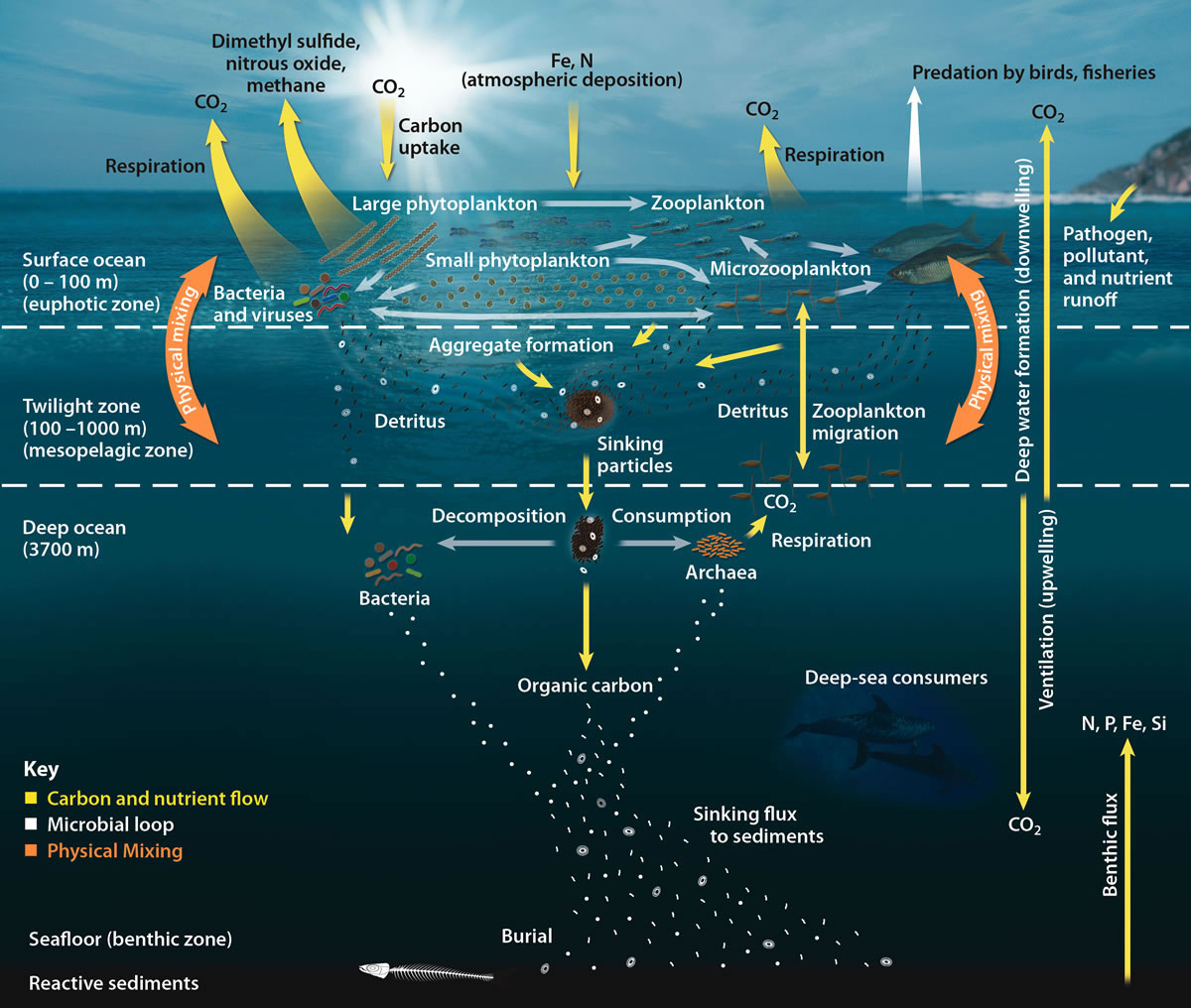
A marine food web is a food web of marine life. At the base of the ocean food web are single-celled algae and other plant-like organisms known as phytoplankton. The second trophic level (primary consumers) is occupied by zooplankton which feed off the phytoplankton. Higher order consumers complete the web. There has been increasing recognition in recent years concerning marine microorganisms.
Habitats lead to variations in food webs. Networks of trophic interactions can also provide a lot of information about the functioning of marine ecosystems.
Compared to terrestrial environments, marine environments have biomass pyramids which are inverted at the base. In particular, the biomass of consumers (copepods, krill, shrimp, forage fish) is larger than the biomass of primary producers. This happens because the ocean's primary producers are tiny phytoplankton which grow and reproduce rapidly, so a small mass can have a fast rate of primary production. In contrast, many significant terrestrial primary producers, such as mature forests, grow and reproduce slowly, so a much larger mass is needed to achieve the same rate of primary production. Because of this inversion, it is the zooplankton that make up most of the marine animal biomass.
Food webs are built from food chains. All forms of life in the sea have the potential to become food for another life form. In the ocean, a food chain typically starts with energy from the sun powering phytoplankton, and follows a course such as:
phytoplankton → herbivorous zooplankton → carnivorous zooplankton → filter feeder → predatory vertebrate
Phytoplankton don't need other organisms for food, because they have the ability to manufacture their own food directly from inorganic carbon, using sunlight as their energy source. This process is called photosynthesis, and results in the phytoplankton converting naturally occurring carbon into protoplasm. For this reason, phytoplankton are said to be the primary producers at the bottom or the first level of the marine food chain. Since they are at the first level they are said to have a trophic level of 1 (from the Greek trophē meaning food). Phytoplankton are then consumed at the next trophic level in the food chain by microscopic animals called zooplankton.
Zooplankton constitute the second trophic level in the food chain, and include microscopic one-celled organisms called protozoa as well as small crustaceans, such as copepods and krill, and the larva of fish, squid, lobsters and crabs. Organisms at this level can be thought of as primary consumers.
In turn, the smaller herbivorous zooplankton are consumed by larger carnivorous zooplankters, such as larger predatory protozoa and krill, and by forage fish, which are small, schooling, filter-feeding fish. This makes up the third trophic level in the food chain.
Hub AI
Marine food web AI simulator
(@Marine food web_simulator)
Marine food web
A marine food web is a food web of marine life. At the base of the ocean food web are single-celled algae and other plant-like organisms known as phytoplankton. The second trophic level (primary consumers) is occupied by zooplankton which feed off the phytoplankton. Higher order consumers complete the web. There has been increasing recognition in recent years concerning marine microorganisms.
Habitats lead to variations in food webs. Networks of trophic interactions can also provide a lot of information about the functioning of marine ecosystems.
Compared to terrestrial environments, marine environments have biomass pyramids which are inverted at the base. In particular, the biomass of consumers (copepods, krill, shrimp, forage fish) is larger than the biomass of primary producers. This happens because the ocean's primary producers are tiny phytoplankton which grow and reproduce rapidly, so a small mass can have a fast rate of primary production. In contrast, many significant terrestrial primary producers, such as mature forests, grow and reproduce slowly, so a much larger mass is needed to achieve the same rate of primary production. Because of this inversion, it is the zooplankton that make up most of the marine animal biomass.
Food webs are built from food chains. All forms of life in the sea have the potential to become food for another life form. In the ocean, a food chain typically starts with energy from the sun powering phytoplankton, and follows a course such as:
phytoplankton → herbivorous zooplankton → carnivorous zooplankton → filter feeder → predatory vertebrate
Phytoplankton don't need other organisms for food, because they have the ability to manufacture their own food directly from inorganic carbon, using sunlight as their energy source. This process is called photosynthesis, and results in the phytoplankton converting naturally occurring carbon into protoplasm. For this reason, phytoplankton are said to be the primary producers at the bottom or the first level of the marine food chain. Since they are at the first level they are said to have a trophic level of 1 (from the Greek trophē meaning food). Phytoplankton are then consumed at the next trophic level in the food chain by microscopic animals called zooplankton.
Zooplankton constitute the second trophic level in the food chain, and include microscopic one-celled organisms called protozoa as well as small crustaceans, such as copepods and krill, and the larva of fish, squid, lobsters and crabs. Organisms at this level can be thought of as primary consumers.
In turn, the smaller herbivorous zooplankton are consumed by larger carnivorous zooplankters, such as larger predatory protozoa and krill, and by forage fish, which are small, schooling, filter-feeding fish. This makes up the third trophic level in the food chain.