


Community hub
Recent from talks
Contribute something
Nothing was collected or created yet.
Martin Carthy
View on Wikipedia
Key Information


Martin Dominic Forbes Carthy MBE (born 21 May 1941) is an English singer and guitarist who has remained one of the most influential figures in English folk music, inspiring contemporaries such as Bob Dylan and Paul Simon, as well as later artists such as Richard Thompson, since he emerged as a young musician in the early days of the folk revival in the UK during the 1960s and 1970s.
Early life
[edit]Carthy was born in Hatfield, Hertfordshire, England,[1] and grew up in Hampstead, North West London. His mother was an active socialist and his father, from a family of River Thames lightermen, went to grammar school and became a trade unionist and a councillor for Stepney at the age of 21. Martin's father had played fiddle and guitar as a young man but Martin was unaware of this connection to his folk music heritage until much later in life. His vocal and musical training began when he became a chorister at the Queen's Chapel of The Savoy.[2]
He picked up his father's old guitar for the first time after hearing "Rock Island Line" by Lonnie Donegan. He has cited his first major folk music influences as Big Bill Broonzy[3][4] and the syncopated guitar style of Elizabeth Cotten.[citation needed] Carthy performed his first professional engagement at the age of 16 at The Loft, a coffee bar in Primrose Gardens, London.[5] Although his father wanted him to go to university to study classics, Carthy left school at 17 and worked behind the scenes as a prompter at the open-air theatre in Regent's Park, then as an assistant stage manager (ASM) on a tour of The Merry Widow, and then at Theatre in the Round in Scarborough.[6] He became a resident at the Troubadour folk club in Earl's Court in the early 1960s after his friend Robin Hall persuaded him to visit and listen to the piper Seamus Ennis.[2] Carthy joined Redd Sullivan's Thameside Four in 1961 as a skiffle guitarist and singer.[7][8]
In the early 1960s, Carthy visited Ewan MacColl's Ballads & Blues club to watch a friend, the singer Roy Guest. The main performer that night was Sam Larner. Carthy has since described how Larner's performance of "Lofty Tall Ship" altered his perception of how a traditional folk song could be sung, and how it was a key moment in his own development as an artist.[2]
When American singer Bob Dylan arrived in London for the first time in 1962 to perform in Madhouse on Castle Street, he visited Martin Carthy at the Troubadour, The King & Queen, and The Singers Club.[2] He learned the traditional song "Scarborough Fair" from Carthy, which he later developed into his own song "Girl from the North Country".
In 1963 and 1964 he contributed songs to the UK regional television folk and blues music series Hullabaloo, presented by the Scottish folksinger Rory McEwen; these sessions were released on DVD in 2020.[9]
Musical career
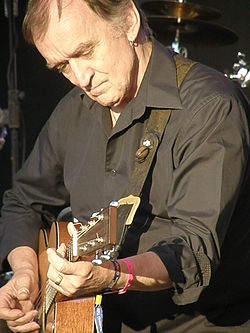
[edit].jpg)
Carthy is a mostly solo performer of traditional songs in a very distinctive style, accompanying himself on his Martin 000-18 acoustic guitar; his style is marked by the use of alternative tunings (notably CGCDGA), and a strongly percussive picking style that emphasises the melody.
In 1964, Carthy joined Marian Mackenzie, Ralph Trainer and Leon Rosselson in the group The Three City Four. The group concentrated on contemporary songs, including some of Rosselson's own, and made two albums – the first for Decca and a second, Smoke and Dust (Where the Heart Should Have Been), for CBS. The 1965 eponymous debut The Three City Four featured Carthy singing lead vocals on two tracks – Sydney Carter's "Telephone Song" and Rosselson's own "History Lesson".[10] Roy Bailey would replace Carthy when he later left the group.
Carthy's debut solo album, Martin Carthy, was released in 1965, and also featured Dave Swarbrick playing fiddle on some tracks, although he was not mentioned in the album's sleeve notes. Carthy's arrangement of the traditional ballad "Scarborough Fair" was adapted, without acknowledgement, by Paul Simon on the Simon and Garfunkel album recording Parsley, Sage, Rosemary and Thyme in 1966. This caused a rift between the pair which was not resolved until Simon invited Carthy to sing the song with him on-stage at the Hammersmith Apollo in 2000.[5][11]
Musical collaborations
[edit]He has also been involved with many musical collaborations. He has sung with The Watersons since 1972; was twice a member of British folk rock group Steeleye Span; was a member of the Albion Country Band 1973 line-up, with members from the Fairport Convention family and John Kirkpatrick, that recorded the Battle of the Field album; and was part of the innovative Brass Monkey ensemble, which mixed a range of brass instruments with Carthy's guitar and mandolin and John Kirkpatrick's accordion, melodeon and concertina. Carthy was also a member of The Imagined Village for all three of their albums (2007–2012).
For many years Carthy enjoyed a creative partnership with fiddle player Dave Swarbrick; later, Waterson:Carthy provided the forum for his successful musical partnership with wife Norma Waterson and their daughter Eliza Carthy.
Carthy has inspired contemporaries such as Bob Dylan and Paul Simon,[12] as well as later artists such as Richard Thompson.
Personal life
[edit]Carthy has lived for many years in Robin Hood's Bay, North Yorkshire.[13] In late 2025 he was diagnosed with late onset Alzheimer's disease after which it was announced that he would retire from touring.[14]
Awards and honours
[edit]In June 1998 he was appointed MBE in the Queen's Birthday Honours. He was named Folk Singer of the Year at the BBC Radio 2 Folk Awards in 2002, and again in 2005 when he also won the award for Best Traditional Track for "The Famous Flower of Serving-Men". In the 2007 Folk Awards Martin Carthy and Dave Swarbrick won Best Duo. In 2008 he was made an Honorary Fellow of the University of Central Lancashire. In 2014 he was awarded the Lifetime Achievement Award at the BBC Radio 2 Folk Awards.[15][16] On 10 September 2025, Transform Me Then Into a Fish was announced as one of 12 nominees for the 2025 Mercury Prize.[17]
A tribute concert to Carthy was held 27 September 2025 at EartH, Hackney in the UK, with performances by Billy Bragg, Graham Coxon, and many others, and video tributes from KT Tunstall, Robert Plant, Paul Weller, and Bob Dylan.[18]
Discography
[edit]Original/studio albums (solo, with Dave Swarbrick or with Eliza Carthy)
[edit]- Martin Carthy (1965) with Dave Swarbrick
- Second Album (1966) with Dave Swarbrick
- Byker Hill (1967) with Dave Swarbrick
- But Two Came By (1968) with Dave Swarbrick
- Prince Heathen (1969) with Dave Swarbrick
- Landfall (1971)
- Shearwater (1972 / 2005 with extra tracks)
- Sweet Wivelsfield (1974)
- Crown of Horn (1976)
- Because It's There (1979)
- Out of the Cut (1982)
- Right of Passage (1988)
- Life and Limb (1990) with Dave Swarbrick
- Skin and Bone (1992) with Dave Swarbrick
- Signs of Life (1998)
- Waiting for Angels (2004)
- Straws in the Wind (2006) with Dave Swarbrick
- The Moral of the Elephant (2014) with Eliza Carthy
- Transform Me Then Into a Fish (2025)[19]
Compilations and live albums
[edit]- This Is... Martin Carthy: The Bonny Black Hare and other songs (1971) with Dave Swarbrick [six tracks from Byker Hill and six tracks from But Two Came By]
- Selections (1971) with Dave Swarbrick [six tracks from Byker Hill; three tracks from No Songs EP, 1967; three tracks from But Two Came By]
- Selections (1972), New Zealand and Australia only
- Round Up (circa early 1970s) with Dave Swarbrick [second side of Martin Carthy and first side of Second Album]
- Brigg Fair (circa early 1970s) with Dave Swarbrick [reissue of Byker Hill]
- Tales of Long Ago (circa early 1970s) with Dave Swarbrick [reissue of But Two Came By]
- The Collection (1993)
- Rigs of the Time: The Best Of Martin Carthy (1993)
- The Kershaw Sessions (1994) [recorded for BBC Radio, 1987 and 1988]
- A Collection (1999)
- Both Ears and the Tail (2000, live recording from 1966) with Dave Swarbrick
- The Carthy Chronicles (2001), 4-CD 83-track box set
- The Definitive Collection (2003)
- Martin Carthy at Ruskin Mill (2005) [very limited release – only 200 copies]
- The January Man: Live In Belfast 1978 (2011)
- Walnut Creek: Live Recordings, 1989–1996 (2011)
- Essential Martin Carthy (2011)
- The Folk Vault: Martin Carthy, Live in Whitby 1984 (2013)
Releases on other formats
[edit]- No Songs (7-inch vinyl EP 1967) with Dave Swarbrick
- "The Bonny Lass of Anglesey" b/w "Palaces of Gold" (7-inch vinyl single 1976)
- 100 Not Out (1992), longform video with Dave Swarbrick
- British Fingerstyle Guitar (instructional VHS video released 1993, reissued on DVD 2006)
- Guitar Maestros (DVD 2006)
As a member of Steeleye Span
[edit]- Please to See the King (1971)
- Ten Man Mop, or Mr. Reservoir Butler Rides Again (1971)
- Storm Force Ten (1977)
- Live at Last (1978)
- The Journey (Live at The Forum, London, 1995) (1999)
With Ashley Hutchings, the Albion Country Band and the Albion Band
[edit]- Battle of the Field (1976, recorded 1973)
- Son of Morris On (1976)
- Rise Up Like the Sun (1978), as guest
- Lark Rise To Candleford (1980)
- The BBC Sessions (1998) (tracks 1–4 recorded 1973)
As a member of The Watersons and Waterson:Carthy
[edit]
- Lal & Mike Waterson: Bright Phoebus (1972)
- The Watersons: For Pence and Spicy Ale (1975)
- The Watersons: Sound, Sound Your Instruments of Joy (1977)
- The Watersons: Green Fields (1981)
- Waterson:Carthy: Waterson:Carthy (1994)
- Waterson:Carthy: Common Tongue (1996)
- Waterson:Carthy: Broken Ground (1999)
- Waterson:Carthy: A Dark Light (2002)
- The Watersons: The Definitive Collection (2003)
- Waterson:Carthy: Fishes & Fine Yellow Sand (2004)
- The Watersons: Mighty River of Song (2004) 4-CD & DVD box set of Watersons and related recordings
- The Watersons: A Yorkshire Christmas (2005)
- Waterson:Carthy: The Definitive Collection (2005)
- Waterson:Carthy: Holy Heathens and the Old Green Man (2006)
- Norma Waterson & Eliza Carthy with the Gift Band: Anchor (2018)
As a member of Brass Monkey
[edit]- Brass Monkey (1984)
- See How It Runs (1986)
- The Complete Brass Monkey (1993) compilation of the previous two albums
- Sound and Rumour (1999)
- Going and Staying (2001)
- Flame of Fire (2004)
- The Definitive Collection (2005)
- Head of Steam (2009)
As a member of Blue Murder
[edit]- No One Stands Alone (2002)
Other notable releases
[edit]- Thamesiders & Davy Graham (1963) 7-inch EP
- Three City Four: Three City Four (1965)
- Dave Swarbrick, Martin Carthy & Diz Disley: Rags, Reels & Airs (1967)
- Hedy West, Serves 'Em Fine (1967) (as accompanist)
- John Kirkpatrick: Plain Capers (1976)
- Yuletracks (1986)
- Band of Hope: Rhythm And Reds (1994)
- Wood, Wilson, Carthy: Wood, Wilson, Carthy (1998)
- Dave Swarbrick: Swarb! (2003) 4-CD box set career retrospective with numerous Carthy tracks
- Martins4: Guitar Nights presents the Four Martins (2003) released on CD and DVD (DVD has additional tracks)
- Various Artists: The Imagined Village (2007)
- The Imagined Village: Empire & Love (2010)
- The Imagined Village: Bending The Dark (2012)
- Three City Four: Smoke & Dust (2010), compilation of tracks from two 1960s albums.
References
[edit]- ^ Colin Larkin, ed. (1997). The Virgin Encyclopedia of Popular Music (Concise ed.). Virgin Books. p. 236. ISBN 1-85227-745-9.
- ^ a b c d Wilks, Jon (28 February 2018). "The Martin Carthy Interview". Tradfolk. Retrieved 9 February 2022.
- ^ Wilks, Jon (24 September 2023). "Not-so-rapid-fire questions with Martin Carthy". Tradfolk.
- ^ "Martin Carthy at 80: 'Trial and error? I've built an entire career on it'". 26 May 2021.
- ^ a b Interview on BBC Radio 4's Desert Island Discs broadcast 13 January 2013
- ^ Carthy, Martin (1987). Martin Carthy: A Guitar in Folk Music. Petersham, Surrey, UK: New Punchbowl Music. p. 5.
- ^ "Martin Carthy: Biography". mainlynorfolk.info.
- ^ "Redd Sullivan | Biography & History". AllMusic.
- ^ "Hullabaloo". Mainly Norfolk. Retrieved 19 March 2025.
- ^ "The Three City Four". Mainlynorfolk.info. 8 November 2013. Retrieved 11 January 2014.
- ^ "Martin Carthy - Paul Simon - Hammersmith Apollo - 25 Oct 2000". vimeo.com. Retrieved 24 November 2020.
- ^ Varga, George (10 February 2000). "SignOnSanDiego.com | The San Diego Union-Tribune | San Diego Green Guide". The San Diego Union. Archived from the original on 29 June 2011. Retrieved 1 November 2010.
- ^ "Eliza Carthy (and Family) in Robin Hood's Bay". Folk on Foot. Retrieved 20 October 2024.
- ^ Murray, Robin (23 January 2026). "Folk Legend Martin Carthy Diagnosed With Late-Onset Alzheimers Disease. His upcoming shows will be completed by his daughter, Eliza Carthy". Clash Music. Retrieved 27 January 2026.
- ^ "Martin Carthy receives a Lifetime Achievement Award". BBC Radio 2. 20 February 2014. Archived from the original on 21 April 2022. Retrieved 20 October 2025.
- ^ "Radio 2 Folk Awards 2014 winners announced". BBC Media Center. 19 February 2014. Archived from the original on 20 October 2025. Retrieved 20 October 2025.
- ^ Snapes, Laura (10 September 2025). "CMAT, Pulp and PinkPantheress among Mercury prize shortlist light on new names". The Guardian. Archived from the original on 10 September 2025. Retrieved 10 September 2025.
- ^ "Martin Carthy at EartH: 'Bob Dylan's appearance drew gasps at tribute to folk hero'". The Standard. 6 October 2025. Retrieved 2 January 2026.
- ^ "Transform Me Then Into a Fish". transformmethenintoafish.com.
External links
[edit]
- Mainly Norfolk's unofficial website
- John Crosby's 1993 Martin Carthy biography on Mainly Norfolk
- "BBC - Music Profiles - Martin Carthy". BBC Folk database. Archived from the original on 12 June 2007.
- discography on Slipcue e-zine
- Martin Carthy discography at Discogs
- Martin Carthy at IMDb
- "Martin Carthy and Friends" at BBC Four Sessions, Union Chapel, Islington, 30 April 2002
| |
| Studio albums |
|
| Live albums |
|
| Box sets |
|
| Related articles | |

| International | |
|---|---|
| National | |
| Artists | |
| People | |
| Other | |

Martin Carthy
View on GrokipediaEarly Life
Upbringing
Martin Carthy was born on 21 May 1941 in Hatfield, Hertfordshire, England.[1] His family relocated to Hampstead in north-west London during his early childhood, where he was raised in a politically active socialist household; his father was a trade unionist of Irish descent, and his mother was involved in socialist causes.[4][2] Carthy grew up in a middle-class environment in post-war Britain, with limited direct exposure to music in the home beyond radio broadcasts, which his parents enjoyed listening to regularly.[5] He attended several schools in London, including St Olave's and St Saviour's Grammar School for Boys, where he was a diligent student and choirboy during the 1950s.[4][5] As a teenager, Carthy pursued interests in theatre and acting, participating in school plays and later training briefly as an actor after leaving school, aspiring to a career on stage.[6] His first significant musical awakening came in the late 1950s through the skiffle craze, sparked by hearing Lonnie Donegan's recording of "Rock Island Line," which prompted him to pick up his father's guitar.[7][8]Initial Influences
Carthy's initial foray into music was sparked by the skiffle craze of the 1950s, particularly through Lonnie Donegan's television performances of songs like "Rock Island Line," which captivated British youth and democratized music-making with simple instruments such as guitars and washboards.[9] This phenomenon encouraged a generation to form amateur groups and experiment with folk and blues-derived styles, profoundly influencing Carthy as it did many others in post-war Britain.[10] Donegan's accessible approach ignited Carthy's passion, leading him to pick up his father's old guitar and begin self-teaching in his early teens by mimicking recordings.[11] Delving deeper into American roots music, Carthy was drawn to blues artists like Big Bill Broonzy, whose recordings and live tours in the UK during the 1950s introduced him to sophisticated fingerpicking techniques and narrative songwriting.[2] Broonzy's emotive style, blending rural blues with urban sophistication, became a cornerstone of Carthy's early listening, shaping his appreciation for the guitar's rhythmic and melodic potential in folk traditions.[12] He absorbed these influences through vinyl records and occasional live encounters, which highlighted the cross-Atlantic exchange fueling the British folk revival.[13] A transformative moment came in the late 1950s when Carthy encountered Elizabeth Cotten's recording of "Freight Train" on a Folkways album, mesmerizing him with her left-handed, syncopated fingerstyle played in open tunings.[2] Cotten's innovative approach, adapting standard techniques to her unique anatomy, inspired Carthy to explore alternate tunings like CGCGCD, fundamentally altering his self-taught method and laying the groundwork for his distinctive guitar sound.[14] This discovery, alongside jazz and folk records by artists like Lead Belly—though initially just names to him—fueled his experimentation, blending American idioms into an emerging personal repertoire.[8] In his late teens, Carthy frequented London's burgeoning jazz clubs and folk sessions, such as those in coffee bars and early folk venues, where he honed his skills by immersing himself in live performances and informal jams.[9] These environments allowed him to synthesize skiffle energy, blues depth, and Cotten's precision, forging a hybrid style rooted in traditional English folk while echoing transatlantic sources.[5]Musical Career
Early Performances
Carthy's entry into professional music began at the age of 16 with his first paid performance at The Loft, a coffee bar in Primrose Gardens, Belsize Park, London, where he sang and played guitar in an informal setting typical of the emerging skiffle scene.[15] This early gig marked the start of his shift from amateur interests to professional engagements, following brief work in theatre as an assistant stage manager after leaving school at 17. By 1961, he had joined the skiffle group Thameside Four, performing locally and honing his skills in ensemble settings.[16] Upon returning to music full-time in the early 1960s, Carthy immersed himself in London's burgeoning folk club circuit around 1962–1963, becoming a regular performer at venues that served as hubs for the British folk revival. He established himself as a resident guitarist at the Troubadour Folk Club, one of the city's premier spots, where his innovative arrangements of traditional songs drew crowds and influenced visiting American artists like Bob Dylan and Paul Simon.[17] This period positioned him alongside contemporaries such as Bert Jansch, whose intricate guitar work complemented Carthy's bold stylistic explorations, contributing to the revival's emphasis on reinterpreting English folk traditions with modern flair.[18] In 1965, Carthy co-formed The Three City Four, a folk-jazz ensemble featuring Leon Rosselson on banjo and guitar, Marian McKenzie on vocals, and Ralph Trainer on vocals, blending traditional ballads with jazz-inflected rhythms. The group debuted with their self-titled album in 1965 on Decca Records, recorded at Lansdowne Studios under producer Gerry Bron, which showcased Carthy's emerging guitar technique and the quartet's harmonious vocal interplay on tracks like "The False Bride" and "Standing by the Bedside."[19][20] These early performances and recordings solidified Carthy's role in the folk scene, later leading to a pivotal partnership with fiddler Dave Swarbrick.[1]Solo Development
Martin Carthy's solo career began with his debut album, Martin Carthy, released in 1965 on Fontana Records, which showcased his interpretations of traditional English ballads including "High Germany," "Sovay," and "The Queen of Hearts." This recording established Carthy as a prominent voice in the British folk revival, emphasizing unaccompanied singing and acoustic guitar arrangements drawn from the English canon. The album's raw, intimate style captured his early commitment to preserving and revitalizing folk traditions through personal delivery.[21][22] Building on this foundation, Carthy followed with Martin Carthy's Second Album in 1966, also on Fontana, featuring tracks like "Two Butchers" and "Lord Franklin" that highlighted his evolving acoustic guitar work alongside occasional fiddle contributions from Dave Swarbrick. His third solo effort, Byker Hill, arrived in 1967, further emphasizing fingerstyle guitar techniques in arrangements of songs such as "The Man of Burnham Town" and "Brigg Fair," solidifying his reputation for innovative yet rooted folk presentations. These early releases marked Carthy's initial progression as an independent artist, prioritizing acoustic depth and narrative storytelling over ensemble dynamics.[23][24][25] In the 1970s, Carthy shifted toward more personal and interpretive approaches to folk material in his solo output, reflecting greater artistic autonomy amid his group involvements. Albums like Shearwater (1972) on Pegasus Records explored introspective renditions of ballads such as "I Was a Young Man" and "Lord Randall," infusing them with emotional nuance and subtle guitar phrasing that deviated from strict traditionalism. Similarly, Sweet Wivelsfield (1972) on Dingle's Records delved into hybrid folk elements with tracks including "Trimdon Grange" and "Skewbald," showcasing Carthy's willingness to blend historical songs with contemporary sensibility for a more individualized expression. This period represented a maturation in his solo trajectory, where he prioritized lyrical depth and adaptive arrangements to convey personal resonance.[26][27][28] Carthy's solo output was limited in the 1980s amid ensemble projects, including the release of Right of Passage (1988) on Topic Records, featuring tracks like "The Ant and the Grasshopper" and "The Banks of the Nile" with contributions from collaborators such as Dave Swarbrick.[29][30] He returned to more consistent independent work in the late 1990s with Signs of Life (1998) on Topic Records, a collection blending traditional pieces like "Sir Patrick Spens" with unexpected covers such as Elvis Presley's "Heartbreak Hotel," underscoring his enduring versatility post-band commitments. This album signaled a renewed emphasis on solo exploration, drawing from decades of experience to merge folk roots with broader influences.[31] Carthy's recent solo endeavors culminated in Transform Me Then Into a Fish (2025) on Hem Hem Records, a reimagined revisit to his 1965 debut featuring updated arrangements of classics like "Scarborough Fair," released on his 84th birthday. The album earned a nomination for the 2025 Mercury Prize, highlighting its innovative take on longstanding material and affirming Carthy's lasting impact as a solo artist at an advanced stage of his career. This release not only bookended his early work but also demonstrated ongoing evolution in song choice and presentation.[32][33][34]Guitar Style and Innovations
Martin Carthy's guitar style is characterized by a distinctive fingerpicking approach that incorporates a heavy percussive attack, often likened to the drive of country blues or accordion rhythms, allowing him to emphasize melody lines within traditional song accompaniments.[35] He developed this technique through innovative use of alternate tunings, such as C-G-C-D-G-A and D-A-D-E-A-E, which facilitate modal playing and open-string resonances suited to English folk material.[36] These tunings were inspired by Elizabeth Cotten's left-handed, upside-down playing style, which Carthy adapted to create intricate, rhythmic textures, and by Davey Graham's pioneering DADGAD tuning from the early 1960s, which influenced his exploration of non-standard configurations for modal folk songs.[14] A hallmark of Carthy's innovations lies in his rearrangement of traditional ballads to highlight guitar as an equal partner to vocals, as exemplified by his 1965 version of "Scarborough Fair," where he transformed the ancient English lyric into a flowing, arpeggiated accompaniment that underscored the song's enigmatic narrative.[37] This arrangement, learned by Paul Simon during a 1965 London visit, formed the basis for Simon & Garfunkel's 1966 counterpoint adaptation on Parsley, Sage, Rosemary and Thyme, though initial lack of credit sparked controversy; Simon later acknowledged Carthy's influence.[38] Carthy's percussive elements—achieved through strong thumb strokes and thumb-index coordination—add propulsion to these accompaniments, enabling seamless transitions between melody and bass lines without strumming, a departure from more conventional folk guitar practices of the era.[39] Carthy extended his acoustic innovations into electric folk during his 1970–1972 tenure with Steeleye Span, where he adapted his fingerstyle to amplified guitars, blending traditional arrangements with rock energy on albums like Please to See the King.[40] This fusion helped pioneer the electric folk genre, incorporating his modal tunings and percussive phrasing to electric contexts, thus bridging acoustic roots with band amplification and influencing the broader evolution of British folk-rock.[1] His contributions earned him recognition as the "godfather" of British folk guitar, with direct impacts on artists like Bob Dylan, who sought lessons from Carthy in the mid-1960s, and Paul Simon, whose early folk explorations drew from Carthy's tunings and arrangements.[4]Collaborations
With Dave Swarbrick
Martin Carthy first met fiddler Dave Swarbrick in 1965, when Swarbrick contributed to Carthy's debut solo album, marking the start of their influential partnership. The duo quickly began performing together in British folk clubs, where their innovative arrangements of traditional songs captivated audiences and helped define the 1960s folk revival. Their chemistry stemmed from a shared commitment to revitalizing English folk traditions, blending Carthy's distinctive guitar style with Swarbrick's virtuoso fiddle playing.[41] Their early collaborative recordings captured this dynamic, including the 1965 album Martin Carthy, featuring contributions from Dave Swarbrick on several tracks, and the 1968 release But Two Came By, both issued by Topic Records. These works showcased bold reinterpretations of ballads and instrumentals, emphasizing rhythmic drive and melodic invention drawn from English folk sources. A particular focus was their exploration of traditional morris dance tunes, such as "Staines Morris" on their 1969 album Prince Heathen, which highlighted the lively, communal spirit of rural dance music. Swarbrick's fiddle provided intricate, empathetic accompaniment to Carthy's vocals, encouraging Carthy to experiment with unconventional chord voicings and tunings that enhanced the emotional depth of the songs.[42][41] The partnership paused in the 1970s as both pursued other projects, but they reunited in 1988 for a series of live tours and recordings, including Life and Limb (1990) and Skin and Bone (1992). These efforts continued into the 1990s despite Swarbrick's worsening emphysema, diagnosed in the early 1990s, which required oxygen support during performances; the duo's resilience was evident in their acclaimed shows, where Swarbrick's improved breath control post-2004 lung transplant allowed further tours. In turn, Carthy's precise phrasing and narrative delivery refined Swarbrick's own vocal interpretations in their joint sets, fostering a mutual evolution in their storytelling approach. Their enduring duo earned the BBC Radio 2 Folk Award for Best Duo in 2007.[41][8]Family and Waterson Groups
Martin Carthy married Norma Waterson in 1972, integrating him into the renowned Yorkshire folk singing family known as The Watersons.[43] Shortly thereafter, in the same year, Carthy joined the group as their guitarist later that year, following a brief period with Bernie Vickers who had replaced cousin John Harrison, contributing his distinctive acoustic style to their a cappella-rooted performances of traditional songs.[44] This collaboration revitalized The Watersons, allowing them to resume touring and recording while emphasizing unaccompanied harmonies drawn from East Yorkshire's oral traditions.[45] In 1994, Carthy and Norma Waterson, along with their daughter Eliza Carthy, formed the ensemble Waterson:Carthy, which blended the family's close-knit vocal harmonies with Carthy's innovative guitar arrangements and occasional mandolin work.[46] The group focused on interpreting traditional English folk material, often reworking ballads and sea shanties to highlight intricate family singing while incorporating Carthy's rhythmic and melodic embellishments. Key releases included the self-titled debut album Waterson:Carthy in 1994 and Broken Ground in 1999, the latter featuring tracks like "Raggle Taggle Gypsies" and "The Bay of Biscay" that showcased their collective vocal depth alongside subtle instrumentation. Earlier, The Watersons had issued For Pence and Spicy Ale in 1993, a compilation drawing from their 1970s catalog that underscored Carthy's role in preserving and adapting Yorkshire-sourced repertoire. Waterson:Carthy and The Watersons frequently performed at major British folk festivals, including Sidmouth and Cambridge, where they helped sustain Yorkshire folk traditions through live renditions of harvest songs, morris dance tunes, and narrative ballads rooted in regional history.[47] These appearances, often featuring unamplified group singing, reinforced the ensembles' commitment to communal music-making and influenced subsequent generations of folk revivalists.[9] Following Norma Waterson's death from pneumonia on January 30, 2022, at age 82, Carthy and Eliza continued performing select Waterson:Carthy material as tributes, including at the 2022 Sidmouth Folk Festival's "A True-Hearted Girl" concert dedicated to her legacy.[48] These efforts maintained the family's vocal heritage, with father and daughter adapting songs like those from Broken Ground to honor Norma's unparalleled phrasing and emotional delivery. In 2025, Carthy collaborated with Eliza on his album Transform Me Then Into A Fish, where she served as co-producer, further extending their family partnership.[49][50]Other Ensembles
Carthy played a foundational role in Steeleye Span, co-founding the group in 1969 alongside Ashley Hutchings, Tim Hart, and Maddy Prior, and suggesting its name derived from the character in the traditional song "Horkstow Grange."[51] He served as guitarist and vocalist from 1969 to 1971, contributing to the band's pioneering fusion of electric instrumentation with British folk traditions during its early acoustic and folk-rock phases.[40] Carthy rejoined for brief reunions in the 1970s and 2000s, including performances that highlighted the group's enduring influence on the electric folk genre.[9] In the early 1970s, Carthy collaborated with Ashley Hutchings in the Albion Country Band from 1971 to 1973, where he provided acoustic guitar and vocals for their exploration of traditional English country dance music and folk arrangements.[5] This lineup, featuring a rotating ensemble of prominent folk musicians, emphasized communal performances and recordings that preserved and revitalized rural British musical heritage.[52] Carthy co-founded Brass Monkey in the early 1980s with John Kirkpatrick, Howard Evans, and Roger Williams, blending folk songs with brass instruments like trumpet and trombone alongside accordion and percussion for an innovative, rhythmic sound.[53] The band, known for its intermittent activity from the 1980s through the present, has performed and recorded sporadically, integrating traditional material with unconventional instrumentation to expand folk's sonic palette.[54] During the 1980s, Carthy participated in the informal pub sessions band Blue Murder, a loose collective focused on acoustic renditions of folk covers in casual settings.[55] In his later career, Carthy joined The Imagined Village project starting in 2005, initiated by Simon Emmerson to fuse English folk traditions with global influences, world music elements, and contributions from youth choirs and diverse artists.[56] Active through the 2010s, the ensemble reinterpreted traditional songs in multicultural contexts, reflecting contemporary British identity through collaborative recordings and live performances.[9]Personal Life
Family Relationships
Martin Carthy married folk singer Norma Waterson in 1972 following her return to England from Montserrat.[43] Their marriage, which integrated Carthy into the renowned Waterson family of musicians, lasted nearly 50 years until Waterson's death on 30 January 2022 at the age of 82.[48] She had been hospitalized with pneumonia after years of ill health that prevented her from performing.[57] The couple had one daughter, Eliza Carthy, born on 23 August 1975 in Scarborough, North Yorkshire.[58] Eliza grew up immersed in the folk music tradition and emerged as a prominent artist in her own right, earning recognition including an MBE in 2014 for services to music.[59] Carthy maintained close familial bonds with Waterson's siblings, Lal Waterson and Mike Waterson, whose shared musical heritage profoundly shaped Eliza's upbringing within a tight-knit folk dynasty.[60] He also developed strong ties with Alison, daughter of Lal Waterson, further embedding him in the extended family network. Carthy supported Eliza's career through collaborative performances and productions, such as their work in the family ensemble Waterson:Carthy.[61]Residence and Later Years
Carthy has made his long-term home in Robin Hood's Bay, a picturesque coastal village in North Yorkshire, since the 1980s, when he and his family relocated there alongside the Waterson siblings. The choice was influenced by the area's rugged seaside landscape and its established folk music tradition, exemplified by the longstanding Robin Hood's Bay Folk Club, which hosts regular sessions and guest artists.[62][63][64] Entering his later years in the 2010s, Carthy adopted a semi-retired pace, prioritizing occasional live performances and mentoring roles over extensive touring, while emphasizing the joy of engaging with audiences despite his advancing age. The COVID-19 pandemic further shaped this period, prompting him to adapt with virtual concerts, including online streams recorded near his North Yorkshire home, to sustain connections during lockdowns when live income had significantly declined. By 2022, he resumed limited tours, balancing health considerations with his enduring passion for folk music.[14][65][66][67] The passing of his wife, Norma Waterson, from pneumonia in January 2022 at age 82, marked a profound personal loss, leading Carthy to participate in heartfelt tributes, such as the "A True-hearted Girl: A Tribute to Norma Waterson" concert at the Sidmouth Folk Festival in August 2022, where he performed alongside daughter Eliza Carthy. As of 2025, at age 84, Carthy continues selective activities, including promoting his first solo album in 19 years, Transform Me Then into a Fish, which earned a Mercury Prize nomination, through interviews and appearances that reflect his ongoing influence in folk music.[48][68][50][69]Recognition
Awards and Honors
In 1998, Martin Carthy was appointed Member of the Order of the British Empire (MBE) in the Queen's Birthday Honours for his services to folk music. Carthy has received multiple accolades from the BBC Radio 2 Folk Awards, recognizing his contributions to the genre. In 2002, he was named Folk Singer of the Year.[70] In 2005, he won the same award again, along with Best Traditional Track for "Famous Flower of Serving Men" from his album Waiting for Angels.[71] The following year, in 2007, he shared the Best Duo award with longtime collaborator Dave Swarbrick.[72] In 2014, Carthy was honored with the Lifetime Achievement Award at the ceremony, presented by Jarvis Cocker, acknowledging his enduring impact on British folk music. In 2025, at the age of 84, Carthy became the oldest artist ever nominated for the Mercury Prize, with his album Transform Me Then Into a Fish shortlisted for the award.[34] Additionally, in 2008, Carthy received the Gold Badge Award from the British Academy of Songwriters, Composers and Authors (now the Ivors Academy), sponsored by the Musicians' Union, for his outstanding contributions to music.[73]Legacy and Influence
Martin Carthy's arrangement of the traditional English ballad "Scarborough Fair" profoundly influenced international folk music in the 1960s, as Bob Dylan learned it directly from Carthy during Dylan's 1962 visit to London and incorporated melodic elements into his own composition "Girl from the North Country."[37][74] Similarly, Paul Simon encountered Carthy's version in 1965 while in London, adapting it for Simon & Garfunkel's 1966 recording "Scarborough Fair/Canticle," though an initial lack of credit sparked a brief public dispute between the two musicians.[37][75] These encounters underscore Carthy's early role as a conduit for British folk traditions to global audiences, shaping the songwriting and repertoires of some of the era's most prominent figures. Carthy's participation in Steeleye Span from 1970 to 1971 was instrumental in pioneering the electric folk movement, where he played electric guitar on the band's second album Please to See the King (1971), blending acoustic folk narratives with rock instrumentation to attract broader, rock-oriented listeners while revitalizing traditional English songs.[40] This fusion helped expand folk music's commercial viability and cultural reach in the UK, influencing subsequent bands like Fairport Convention and establishing a hybrid genre that persists in modern folk-rock.[51] Through decades of solo recordings and performances, Carthy has preserved numerous obscure English ballads and broadside traditions, such as "The Famous Flower of Serving-Men" and "Lizie Wan," drawing from historical sources like Child Ballads and 19th-century broadsheets to introduce them to contemporary audiences via innovative guitar arrangements.[76][77] His meticulous interpretations, often self-accompanied on guitar, have not only documented these songs but also emphasized their narrative depth and social commentary, ensuring their survival beyond oral traditions.[78] As a mentor, Carthy has guided younger folk artists in the 2000s and 2010s, collaborating with figures like fiddler Sam Sweeney and singer Jon Boden in projects such as The Full English, where he shared techniques for interpreting traditional material and encouraged adaptive performances.[4][79] His influence extends through workshops and informal teachings, fostering a new generation committed to evolving folk practices. In recent years, post-2023 activities including revivals of The Imagined Village at tribute events and his 2025 album Transform Me Then Into A Fish—shortlisted for the Mercury Prize—have further revitalized folk for younger listeners by merging archival songs with contemporary production.[80][34][78]Discography
Solo and Duo Albums
Martin Carthy's solo recordings, beginning with his debut in 1965, showcase his distinctive guitar style and interpretations of traditional English folk songs, often incorporating contemporary influences. These works, released primarily on labels like Fontana, Philips, and Topic Records, highlight his evolution as a solo artist while maintaining a focus on acoustic arrangements and narrative ballads. His duo collaborations, particularly with fiddler Dave Swarbrick in the 1960s and later decades, expanded on this foundation with intricate instrumental interplay, producing several influential albums that bridged traditional and revival folk scenes.[81]Solo Studio Albums
Carthy's solo studio output spans six decades, with releases emphasizing unaccompanied vocals, fingerpicked guitar, and occasional guest musicians. Key examples include:- Martin Carthy (1965, Fontana Records), his debut featuring tracks like "High Germany" and "Sovay."[82]
- Second Album (1966, Fontana Records), including "The Famous Flower of Serving-Men," a standout ballad arrangement.[81]
- Landfall (1971, Philips Records), exploring darker themes in songs such as "Here's Adieu to All Judges and Juries."[83]
- Shearwater (1972, Pegasus Records), a collection of sea shanties and ballads.[81]
- Sweet Wivelsfield (1974, Deram Records), recorded live in the studio with a raw, intimate feel.[81]
- Crown of Horn (1976, Topic Records), delving into industrial folk narratives like "Liverpool Lullaby."[84]
- Because It's There (1979, Topic Records), incorporating covers of modern songwriters alongside traditions.[84]
- Out of the Cut (1982, Topic Records), featuring bold arrangements of "Company Policy."[84]
- Right of Passage (1988, Topic Records), a mature reflection on folk traditions.[85]
- Signs of Life (1999, Topic Records), marking a return after a hiatus with songs like "The Bee's Wing."[85]
- Waiting for Angels (2004, Topic Records), produced by his daughter Eliza Carthy, blending old and new material.[86]
- Transform Me Then Into a Fish (2025, HemHem Records), his latest effort released on May 21, 2025, featuring reinterpretations of classics like "Ye Mariners All," produced by Eliza Carthy with her fiddle and shared vocals on select tracks.[32]
Duo Albums with Dave Swarbrick
Carthy and Swarbrick's partnership, starting in the mid-1960s, yielded dynamic albums combining Carthy's guitar and vocals with Swarbrick's fiddle, influencing the British folk revival. Notable releases include:- Martin Carthy with Dave Swarbrick (1965, Fontana Records), an early collaboration integrated into his solo debut sessions.[81]
- Byker Hill (1967, Fontana Records), capturing their energetic live chemistry on tracks like "Gentleman Soldier."[87]
- But Two Came By (1968, Fontana Records), including the epic "Prince Heathen."[88]
- Prince Heathen (1969, Fontana Records), a full-length expansion of the ballad cycle.[81]
- Life and Limb (1990, Special Delivery Records), a reunion album with renewed vigor.[89]
- Skin and Bone (1992, Special Delivery Records), featuring traditional instrumentals.[81]
- Both Ears and the Tail (2000, Atrax Records), showcasing their enduring rapport.[90]
- Straws in the Wind (2006, Topic Records), a studio duo recording with fresh arrangements.[89]
- Walnut Creek (2011, Fellside Records), drawn from live performances between 1989 and 1996.[91]
Compilations and Live Releases
Compilations often draw from Carthy's solo catalog to highlight career milestones, while live albums capture his performative energy.| Type | Title | Year | Label | Notes |
|---|---|---|---|---|
| Compilation | Round Up | 1970 | Fontana Records | Early singles and rarities.[81] |
| Compilation | The Best of Martin Carthy | 1987 | Topic Records | Selection from 1960s-1980s solo work.[84] |
| Live | Heat, Light & Sound | 1975 | Deram Records | Solo live recording from Wivelsfield.[81] |
| Compilation | Waiting for the Flood | 2002 | Topic Records | Post-millennium overview.[89] |
| Compilation | The Collection | 1993 | Green Linnet Records | U.S.-focused retrospective.[92] |
| Compilation | Essential Martin Carthy | 2011 | Topic Records | Double-disc career sampler.[93] |
Other Releases
Early EPs and singles supplemented Carthy's album output, often promoting his unique takes on folk standards.- No Songs EP (1967, Fontana Records), a duo EP with Swarbrick featuring instrumental tracks.[81]
- "The Famous Flower of Serving-Men" single (1966, Fontana Records), an early 7-inch release of the ballad.[94]
- Happiness / The Queen of Hearts single (2014, Topic Records), a duo single with Eliza Carthy.[91]
Family Collaborative Albums
Martin Carthy's contributions to family collaborative albums center on his involvement with The Watersons, the vocal ensemble formed by his wife Norma Waterson and her siblings Lal and Mike, where he joined as a core member from the mid-1970s onward, emphasizing the group's signature unaccompanied close harmonies in traditional English folk songs. These recordings often feature Carthy's guitar accompaniment alongside the family's a cappella style, capturing seasonal rituals, ballads, and carols that highlight their raw, unpolished vocal interplay. Later projects extended this tradition through Waterson:Carthy, incorporating their daughter Eliza Carthy, blending generations in harmony-driven interpretations of folk material.[45][95] Key releases with The Watersons include For Pence and Spicy Ale (Topic Records, 1993), a compilation drawing from 1975 sessions that marked Carthy's early integration into the group, with tracks like "Country Life" and "Swarthfell Rocks" showcasing polyphonic harmonies rooted in Yorkshire traditions. The album was reissued on CD with bonus material from related family sessions, underscoring the enduring appeal of their ritualistic song selections. Numerous reissues of 1970s–1980s Watersons albums, such as Green Fields (1981), have appeared through the 2020s on Topic Records, preserving Carthy's role in harmonized renditions of songs like "The Good Old Way" and maintaining the group's influence on revivalist folk.[96][97][98] Waterson:Carthy's debut album, Waterson:Carthy (Topic Records, 1994), united Norma Waterson's lead vocals, Carthy's guitar and tenor harmonies, and Eliza Carthy's fiddle and backing vocals on tracks including "Rags and Tatters," emphasizing intimate family dynamics in acoustic arrangements of ballads and shanties. The follow-up Broken Ground (Topic Records, 1999) continued this approach with songs like "The Delphinium," dedicated to traditional Morris and sword dance communities, where the trio's layered vocals evoke a sense of communal storytelling. These albums highlight the group's focus on unadorned, harmony-centric performances that bridge traditional and contemporary folk.[99][100] In more recent family efforts, Carthy collaborated with Eliza on The Moral of the Elephant (2014, Topic Records), a duo album blending traditional and contemporary songs with layered vocals and instrumentation. He also collaborated with Eliza on Transform Me Then Into a Fish (HemHem Records, 2025), a reimagining of his 1965 debut album featuring her production, fiddle, and shared vocals on select tracks like "Ye Mariners All," blending father-daughter harmonies in a nod to their shared heritage; the release earned a nomination for the 2025 Mercury Prize, recognizing its innovative take on classic material. Compilations such as Frost and Fire: A Calendar of Ritual and Magical Songs (Topic Records, originally 1965, vinyl reissue 2022) include foundational Watersons family sessions with Carthy's later contributions in reissues, structuring songs around the seasonal cycle with stark a cappella arrangements like "Holly Bears a Berry." Additionally, family performances from 1970s festivals yielded singles and EPs, notably contributions to Folk Festival: A Celebration of Music Recorded at the Sidmouth International Festival (Topic Records, 1970s live recordings), capturing live harmonies on tracks such as "The Wassail Song" amid festival energy.[32][69][101][102][103]| Album Title | Year | Group | Label | Key Features |
|---|---|---|---|---|
| For Pence and Spicy Ale | 1993 (orig. 1975) | The Watersons | Topic Records | Harmony-focused compilation of ritual songs; Carthy's guitar integrates with family vocals.[96] |
| Waterson:Carthy | 1994 | Waterson:Carthy | Topic Records | Debut trio album; close family harmonies on ballads and shanties. |
| Broken Ground | 1999 | Waterson:Carthy | Topic Records | Acoustic folk with dance tributes; layered vocals by Norma, Martin, and Eliza. |
| The Moral of the Elephant | 2014 | Martin & Eliza Carthy | Topic Records | Duo album blending traditions with family vocals and fiddle.[103] |
| Frost and Fire (reissue) | 2022 (orig. 1965) | The Watersons | Topic Records | Seasonal ritual album; a cappella family sessions preserved in modern format.[101] |
| Transform Me Then Into a Fish | 2025 | Martin & Eliza Carthy | HemHem Records | Father-daughter collaboration; re-recorded classics with shared vocals, Mercury-nominated.[32] |
| Green Fields | 1981 | The Watersons | Topic Records | Country life-themed songs with family harmonies including Carthy.[104] |
Band and Ensemble Albums
Martin Carthy contributed to numerous albums with various folk ensembles, showcasing his guitar work and vocals in collaborative settings that blended traditional English folk with innovative arrangements.Steeleye Span
Carthy joined Steeleye Span in 1970, contributing to several seminal albums during the band's early electric folk phase. Key releases include:- Please to See the King (1971), featuring Carthy on vocals and guitar.[105]
- Below the Salt (1972), where Carthy's distinctive flatpicking guitar defined tracks like "John Barleycorn."
- Parcel of Rogues (1973), highlighting Carthy's arrangements of traditional songs such as the title track.
- All Around My Hat (1975), Carthy's final album with the original lineup, including the hit title song.
Albion Country Band / Albion Band
Carthy participated in the Albion Country Band's experimental folk-rock recordings in the 1970s, emphasizing Morris dance tunes and traditional material.- Battle of the Field (1976, recorded 1973), with Carthy leading vocals and acoustic guitar on tracks rooted in English country music.[106]
- The Prospect Before Us (1977), a live album capturing the band's dance-oriented performances, featuring Carthy's guitar.
Brass Monkey
Formed in 1982 with John Kirkpatrick, Brass Monkey combined folk songs with brass instrumentation, with Carthy providing guitar and vocals across multiple releases up to the 2010s.- Brass Monkey (1984), the debut album blending traditional tunes with rhythmic brass.[107]
- Sound and Rumour (1999), featuring Carthy's interpretations of songs like "The Madley Monk."
- Flame of Fire (2004), a live recording from the band's ongoing tours.
- Head of Steam (2009), showcasing ensemble arrangements of folk standards.
Blue Murder
Blue Murder, a harmony-focused supergroup including Carthy and members of Waterson:Carthy, debuted in 1987 for anti-racism benefits and released studio material later.- No One Stands Alone (2002), a Topic Records album of a cappella and accompanied folk songs, with Carthy on vocals and guitar.[108]
Other Ensembles
- With The Imagined Village, a multicultural folk project: The Imagined Village (2007), reinterpreting English traditions with global influences, featuring Carthy on "John Barleycorn"; and Empire & Love (2010), exploring historical themes.
- Early ensemble Three City Four: The Three City Four (1965), Carthy's debut group album with jazz-inflected folk arrangements.