Hubbry Logo
Marx ReloadedMarx ReloadedMain
Open search
Marx Reloaded
Community hub
Marx Reloaded
logo
8 pages, 0 posts
0 subscribers
Be the first to start a discussion here.
Marx Reloaded
Marx Reloaded
from Wikipedia
Marx Reloaded
Directed byJason Barker
Written byJason Barker
Produced byJason Barker
Irene Höfer
Andreas Schroth
StarringJason Barker
John N. Gray
Michael Hardt
Antonio Negri
Nina Power
Jacques Rancière
Peter Sloterdijk
Alberto Toscano
Slavoj Žižek
Ivan Nikolic
Edited byNebojsa Andric
Stevan Djordjevic
Carsten Piefke
Music byMarkus Rieger
Production
companies
Films Noirs
Medea Film
ZDF
Distributed byArte
Release dates
  • 11 April 2011 (2011-04-11) (Germany, France)
  • 10 February 2012 (2012-02-10) (UK)
  • 1 September 2012 (2012-09-01) (USA)
[1][2]
Running time
52 minutes
CountryGermany
LanguagesEnglish
French
German

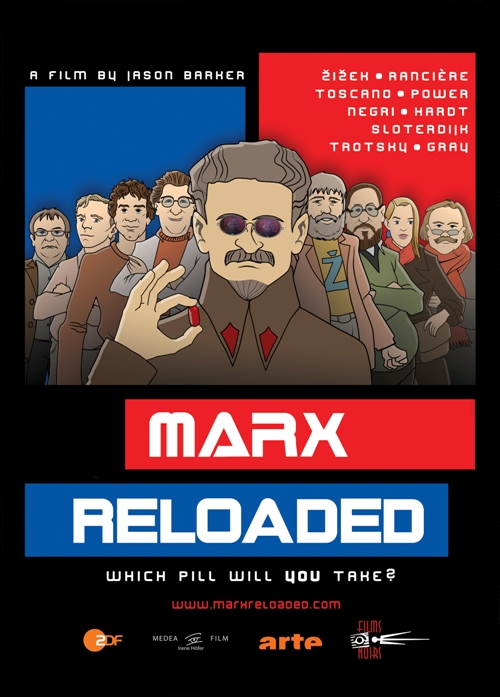
Marx Reloaded is a 2011 German documentary film written and directed by the British writer and theorist Jason Barker. Featuring interviews with several well-known philosophers, the film aims to examine the relevance of Karl Marx's ideas in relation to the Great Recession.[3][4][5][6] The film's title is a wordplay on The Matrix Reloaded, the sequel to The Matrix, which is parodied in the documentary.

Background

[edit]

According to the film's website, "Marx Reloaded … examines the relevance of German socialist philosopher Karl Marx's ideas for understanding the global economic and financial crisis of 2008–09." The film also considers, in the context of an alleged revival of Marxist thinking, whether "communism might provide the solution to the growing economic and environmental challenges facing the planet".[7]

In an interview with Verso Books, writer-director Jason Barker described his intention in making the film "to reload or reimagine Marx as a thinker, without the usual totalitarian moralising." Barker criticised the "cliché" according to which "Marx's diagnoses of capitalism are validated whereas his 'prescription' of communism is rubbished on the grounds that it's 'utopian'." Asked whether the renewed popularity of Marx is evidence of a return of communism as a political force, or "just the spectre of Marx haunting the academies", Barker replied that "political thinking today is again converging on precisely the type of social conditions in which Marx lived."[8]

In a separate interview, Barker also discussed the film's use of animation, in particular his decision to parody The Matrix, admitting that although it was an "obvious parody" and "fun to make", there was also a philosophical dimension to the animation scenes in which Marx meets Leon Trotsky and Slavoj Žižek.[9]

Film

[edit]

Marx Reloaded features interviews with several well-known philosophers, among them those often associated with Marxism and communist ideas, including John Gray, Michael Hardt, Antonio Negri, Nina Power, Jacques Rancière, Peter Sloterdijk, Alberto Toscano and Slavoj Žižek.[4][6][7] The film also includes animation scenes with Marx trapped in a surreal world resembling the 1999 science fictionaction film The Matrix, which starred Keanu Reeves and Laurence Fishburne. In one such animated scene Marx (Jason Barker) encounters Leon Trotsky (Ivan Nikolic) in a pastiche of the red pill and blue pill scene in The Matrix in which Reeves' character Neo first meets Fishburne's character Morpheus.

Reception

[edit]

Marx Reloaded had its TV premiere on Arte on 11 April and was repeated on 20 April. The film was subsequently broadcast on the Romanian television channel B1 TV on 12 August 2011,[10] followed by a studio debate involving political analyst Dinu Flămând, journalist Cristian Tudor Popescu and writer Vasile Ernu.

Yongjune Park, Jason Barker and Taek-Gwang Lee at DMZ Docs 2011.

On 25 September 2011 the film was screened (out of competition) at the 2011 DMZ International Documentary Film Festival.[11] The screening was followed by a panel discussion involving writer-director Jason Barker, Professor Taek-Gwang Lee of Kyung Hee University and Yongjune Park, the editor of Indigo, an English-language Korean humanities magazine.[12] Both the film and director[13] were the subject of national press coverage in the Hankook Ilbo.

On 3 October 2011 the film had its Serbian premiere at the Centre for Cultural Decontamination in Belgrade,[14] with further screenings planned in the same venue on 20, 21 and 24 October.[15]

Marx Reloaded premiered in the UK on 10 February 2012 at the Institute of Contemporary Arts in London, where it screened to sell-out audiences[16] until 20 April.[1]

Reviews of the film have been positive. Time Out London described it as containing "enough interesting ideas to make this well worth a watch for those with an interest in philosophy, politics and the general state of the world as we know it."[17] Little White Lies called it an "engaging hour-long talking-head-meets-animation doc"; "the film shines a light on the many causes of the financial crumble, creating a compelling dialogue of Marx's theories on capitalism as they apply to its contemporary form."[18] Subtitledonline.com awarded the film three out of a possible five stars, although criticized it for its "failure to balance quirky presentation with challenging content".[19]

As well as reviews The Financial Times featured the film as part of its "Capitalism in Crisis" series, followed by an interview with Jason Barker and the editor of New Left Review, Robin Blackburn.[20]

The London Evening Standard cited the film alongside the 2012 re-edition of The Communist Manifesto (introduced by Eric Hobsbawm) and Owen Jones' best-selling book Chavs: The Demonization of the Working Class as evidence of a resurgence of left-wing ideas.[16]

Blue or Red Pill?

[edit]

On 16 December 2011, the first in a series of public debates entitled "Blue or Red Pill?" (Crvena ili plava pilula?) was held at the Centre for Cultural Decontamination (CZKd), Belgrade, in which the social and political themes from the film were explored. Serbian film director Želimir Žilnik – himself noted for his socially-engaged film-making, most recently in the 2009 film Stara škola kapitalizma – participated in the event along with Jason Barker.[21]

A second debate took place on 15 February 2012 at the Institute of Contemporary Arts (ICA), in which the BBC Newsnight economics editor Paul Mason, the blogger and The Independent journalist Laurie Penny, and Robin Blackburn joined Jason Barker. The debate considered the implications of Marx's work in the context of a growing popular resistance to the global economic and financial crisis, and whether the revolutionary change advocated by Marx had finally arrived: "Is humanity standing at a crossroads where a decision – and by whom or in whose name? – for 'another world' must be taken?"[22]

See also

[edit]

References

[edit]
[edit]
Revisions and contributorsEdit on WikipediaRead on Wikipedia
from Grokipedia
is a 2011 German documentary film written and directed by British philosopher and filmmaker Jason Barker. The 52-minute production probes the applicability of Karl Marx's 19th-century critiques of to the 2008 global financial crisis, questioning whether Marxist theory offers insights into systemic failures like the $1 trillion U.S. bank bailout and the persistence of economic instability. The film structures its inquiry through interviews with a range of intellectuals, including Marxist proponents such as , , , and , alongside skeptics like John Gray, Peter , and Norbert Bolz, who debate the enduring validity of concepts like exploitation, alienation, and in contemporary economies. Complementing these discussions are animated sequences portraying Marx as a figure traversing a "matrix" of modern financial abstractions, alongside a short embedded film titled Marx for Beginners to illustrate core ideas. This approach aims to revive interest in Marx amid perceptions of neoliberal policy shortcomings, though critics have noted the film's selective emphasis on revivalist voices over empirical alternatives. Released amid ongoing debates over the crisis's causes and remedies, Marx Reloaded contributed to a broader post-2008 resurgence in Marxist scholarship and , highlighting tensions between historical theory and current data on inequality and market volatility, without resolving whether Marx's predictions of capitalism's collapse have materialized. Its reception has been mixed, with an IMDb user rating of 6.4/10 reflecting divided views on its analytical depth versus ideological framing.

Background and Production

Origins and Motivation

Marx Reloaded originated from research initiated by its writer and director, Jason Barker, a British philosopher and filmmaker with a background in and translation, who began exploring material for an animated feature film on as early as 2007. By late 2009, Barker commenced writing and directing the project with support from German television producers Medea Film Factory and co-producers such as and , transforming it into a format amid the global that had unfolded since 2008. Initially envisioned as a more experimental, fully animated cinema piece akin to , incorporating fictional elements from Marx's letters, the film adapted to a 52-minute television structure due to budgetary limitations, blending animation, interviews, and narrative devices to assess Marx's enduring analytical power. The primary motivation stemmed from the 2008 financial meltdown, which Barker viewed as a stark manifestation of capitalism's inherent crises, prompting a media resurgence of Marx's ideas—such as economist Nouriel Roubini's assertion that "Marx was right" about capitalism's contradictions. Barker aimed to "reload or reimagine Marx as a thinker" free from associations with totalitarian regimes, challenging clichés that dismissed as impractical theory, and instead probing its conceptual viability for addressing contemporary economic turmoil. Influenced by contemporary philosophers like , , and , the film sought to draw parallels between Marx's era—marked by the 1848 revolutions—and the post-2008 recession, fostering a non-dogmatic reevaluation of Marxist critique without prescribing political solutions. This approach reflected Barker's intent to engage broader audiences through accessible formats rather than journalistic oversimplification, positioning the work as a cultural intervention in ongoing debates over capitalism's stability.

Director and Key Personnel

Jason Barker directed, wrote, and co-produced Marx Reloaded, a 2011 German documentary examining the contemporary relevance of Karl Marx's ideas. A British philosopher with a doctorate from the , Barker has specialized in and Marxist theory, serving as a of English at in . He also voiced the character of in the film, drawing on his expertise as a translator and lecturer on Marx's works. Alexandra Weltz co-directed the project alongside Barker, contributing to its production as a cultural blending interviews, animations, and philosophical analysis. Producers Irene Höfer and Andreas Schroth oversaw the film's development and financing, with Höfer affiliated with German production entities focused on intellectual documentaries. Markus Rieger composed the original score, enhancing the film's thematic exploration of and crisis, while editor Nebojsa Andric handled assembly. These personnel collectively shaped the film's structure, which premiered in February 2011 at the International Festival in .

Development and Filmmaking

Jason Barker, a British philosopher and academic, began developing Marx Reloaded in late 2009, motivated by the 2008 global financial crisis and its implications for reevaluating Karl Marx's critiques of . The project sought to examine Marxism's contemporary relevance through interviews with prominent thinkers, while avoiding endorsements of historical communist regimes, as Barker emphasized reimagining Marx amid renewed philosophical interest from figures like and . Production was led by the German company Medea Film Factory , with Irene Höfer as and co-direction by Alexandra Weltz, resulting in a Germany-UK collaboration funded partly through public broadcasters like and . Barker handled writing, directing, and co-producing duties, overseeing a modest independent process that included securing interviews with intellectuals such as Žižek, , , , Nina Power, and , whose contributions provided diverse analyses of economic instability and potential alternatives to . The filmmaking incorporated high-definition digital capture and techniques suited to a 52-minute runtime, blending talking-head interviews with custom sequences depicting Marx in a Matrix-themed narrative of and alienation, designed to metaphorically illustrate abstract concepts for wider accessibility. was managed by a small crew, including second-unit work by Jakob Stark, emphasizing straightforward aesthetics over elaborate sets or effects. Challenges included balancing intellectual rigor with popular appeal, as Barker noted the need to counter media distortions of while sparking debate on crisis responses. The film wrapped principal production by 2010, premiering as a in 2011.

Content and Structure

Narrative Overview

is a 52-minute documentary that probes the pertinence of Karl Marx's 19th-century theories to the global economic disruptions of the early , particularly the 2007-2008 . Directed and written by Jason Barker, the film structures its inquiry around the central question of whether faces terminal decline and if might reemerge as a viable alternative, distinct from its historical implementations. The narrative commences with an animated vignette portraying Marx in dialogue with , who poses whether Marxist revolution could supplant the faltering capitalist order. This sets the tone for subsequent explorations of core Marxist concepts, including the extraction of through worker exploitation and the role of commodities in obfuscating class antagonisms. Interviews with intellectuals such as , , and economists like Norbert Walter assess the endurance of these dynamics amid shifts toward financial speculation and , with some arguing that exploitation has intensified via to the Third World. Visual elements, including further animations and excerpts from films like , metaphorically depict ideological awakenings and the illusions sustaining neoliberal hegemony. The film transitions to deliberations on capitalism's recurrent crises—evident in events like the subprime mortgage collapse—and their alignment with Marx's forecasts of systemic instability driven by overproduction and falling profit rates. Contributors debate adaptations of Marxist analysis to ecological degradation and the evolving composition of the proletariat in post-industrial societies. Concluding segments weigh the prospects for communist renewal, emphasizing philosophical reinterpretations over dogmatic revival, while underscoring Marx's utility in critiquing austerity measures and inequality exacerbated by . The documentary avoids prescriptive solutions, instead highlighting a perceived resurgence of interest in Marx post-2008 as evidenced by bestseller status of his works like Capital.

Interviews and Contributors

The documentary Marx Reloaded incorporates interviews with prominent philosophers, political theorists, and cultural critics to examine Karl Marx's ideas amid the 2008-09 global , blending endorsements of Marxist analysis with critiques of capitalism's instabilities. These discussions feature contributors such as , who rejects both 20th-century Marxist totalitarianism and decentralized self-organization models like or councils; and , known for their theories on empire and the multitude as alternatives to state-centric power; , addressing aesthetic and political dissensus; , offering philosophical commentary on modern critique; Nina Power, exploring feminist and cultural dimensions; John Gray, providing skeptical views on ideological utopias; Norbert Bolz, analyzing media and cultural theory; and Micha Brumlik, focusing on ethical and historical interpretations of . The interviews, directed by Jason Barker, emphasize empirical observations of economic contradictions—such as boom-bust cycles and —over abstract ideological allegiance, with contributors attributing capitalism's recurring crises to inherent tendencies like and profit-driven rather than isolated policy errors. Žižek, for example, highlights Marx's prescience in predicting financialization's role in systemic fragility, while Negri and Hardt contrast this with potential for networked resistance outside traditional labor paradigms. Critics like Gray caution against over-relying on Marx for solutions, noting historical failures in implementation without endorsing alternative systems untested at scale. This array of voices underscores the film's aim to revive debate on causal mechanisms in , drawing on primary Marxist texts like Capital for analysis of value production and alienation.

The Matrix as Metaphor

In Marx Reloaded, the 1999 science fiction film The Matrix and its sequels serve as a visual and narrative metaphor for Karl Marx's analysis of capitalist ideology and exploitation. The simulated reality depicted in The Matrix, where humans live in an illusory world controlled by machines that harvest their bioelectric energy, parallels Marx's notion of commodity fetishism and the superstructure that obscures underlying economic relations. Director Jason Barker uses clips from the trilogy to illustrate how individuals remain trapped in a system of false appearances, unaware of their role as mere "batteries"—a direct analogy to the proletariat's alienation and extraction of surplus value under capitalism. This metaphor extends to the process of awakening: offering Neo to reveal the truth mirrors the development of , where workers recognize their oppression and reject ideological myths perpetuated by the . Barker interweaves these scenes with interviews from scholars such as and , who argue that embodies the "symbolic order" of late capitalism, sustained by consumerist illusions rather than overt coercion. The film's animation sequences amplify this symbolism, portraying Marx himself navigating a Matrix-like digital realm to confront critiques of his ideas, such as their distortion by 20th-century communist regimes. Critics of the documentary, including some Marxist reviewers, contend that this framing oversimplifies Marx's by conflating technological with , potentially romanticizing revolution through cinematic tropes rather than empirical dialectics. Nonetheless, the metaphor underscores the film's thesis that the exposed cracks in the capitalist "matrix," prompting renewed interest in Marx's predictions of systemic instability. Barker employs these elements not as literal endorsement but as a device to make abstract theory accessible, drawing on ' film—which grossed over $460 million worldwide upon release—to evoke the urgency of ideological rupture.

Blue or Red Pill? Segment

The "Blue or Red Pill?" segment in Marx Reloaded consists of an opening animated sequence parodying the iconic pill choice scene from The Matrix (1999), framing the documentary's exploration of Marxist theory as a revelatory awakening from capitalist illusion. In this depiction, Leon Trotsky assumes the role of Morpheus, confronting Karl Marx portrayed as Neo in a simulated reality dominated by commodified existence and financial crises. Trotsky offers Marx the choice: the blue pill to remain in comfortable ignorance of systemic exploitation, or the red pill to perceive the "permanent revolution" and the underlying contradictions of capitalism exposed by events like the 2008-09 global financial crisis. This animation, lasting approximately 1-2 minutes, sets the film's metaphorical structure by equating Marxist critique with escaping a hegemonic "matrix" of bourgeois ideology, where alienation and class struggle manifest as economic instability rather than machine-controlled simulation. The segment's narrative posits Marx's acceptance of the red pill as initiating a journey through contemporary analyses, linking 19th-century concepts like surplus value and commodity fetishism to modern phenomena such as subprime mortgage defaults and banker bailouts. Trotsky's dialogue emphasizes reviving Marx's ideas to address "how far the permanent revolution goes," portraying capitalism not as eternal but as prone to recurrent crises that demand proletarian consciousness. Visually, the animation employs stark contrasts—shadowy corporate towers versus revolutionary sparks—to evoke dialectical tension, drawing directly from The Matrix's aesthetic while substituting philosophical materialism for digital existentialism. This choice underscores the film's thesis that ignoring Marxist insights perpetuates false consciousness, akin to choosing the blue pill's simulated bliss. By invoking this metaphor, the segment critiques liberal reforms as mere palliatives, aligning with interviewees' later arguments that only a post-capitalist can resolve inherent instabilities, as evidenced by the crisis's $13.8 trillion in U.S. economic losses by 2010. However, the portrayal risks oversimplifying historical Marxism's implementations, such as Soviet-era outcomes, by focusing selectively on theoretical revival without empirical counterexamples of state-led economies' failures, like the USSR's 1991 collapse amid inefficiencies. The animation thus functions as provocative framing, prioritizing ideological rupture over balanced causal assessment of capitalism's adaptive mechanisms, such as regulatory responses post-2008 that stabilized markets without systemic overthrow.

Release and Distribution

Premiere and Initial Screenings

Marx Reloaded premiered on television via the Arte channel on 11 April 2011 at 11:20 PM, with broadcasts in German and French versions. The documentary, commissioned by German public broadcaster ZDF in collaboration with Arte, marked the film's initial public airing amid discussions of the 2008 financial crisis and Marx's enduring relevance. The premiere occurred on 10 2012 at the Institute of Contemporary Arts (ICA) in , serving as an early theatrical screening for English-speaking audiences. This event introduced the international version of the , which incorporated English and for broader accessibility. Subsequent initial screenings were limited, focusing primarily on European cultural venues rather than major festivals, reflecting the documentary's origins as a television production.

Availability and Formats

Marx Reloaded was commercially released on DVD in 2012 by Icarus Films, with options for home use priced at $24.98 and institutional licensing at $298.00, distributed in format with a runtime of 52 minutes. Physical copies are also available through retailers such as Amazon, , and , often bundled with related short films like the animated Marx for Beginners. Digitally, the film can be streamed on OVID.tv, a platform specializing in documentary content. It is also offered for rental or purchase on , starting at $4.99 for rental, and on Apple TV for download or streaming. These digital formats support viewing on devices including , maintaining accessibility for individual and educational audiences without widespread free release.

Reception and Impact

Critical Reviews

Critical reviews of Marx Reloaded have been mixed, reflecting divided opinions on its effectiveness in reviving interest in Karl Marx's ideas following the 2008-2009 global financial crisis. While some praised its engaging format and timely linkage of Marxist concepts like to contemporary economic woes, others, particularly from traditional Marxist perspectives, criticized the film for superficial analysis, eclectic interviewee selection, and failure to convey Marxism's scientific and practical essence. The documentary's inclusion of philosophers such as , , and —figures often viewed skeptically by orthodox Marxists for their postmodern interpretations—drew particular ire, as did the absence of voices from labor movements or developing-world struggles. Thomas Riggins, writing in Dissident Voice, argued that the film "unloads" rather than reloads Marx, presenting a series of "" who misunderstand core concepts like the and , opting instead for abstract speculation over empirical historical analysis. He faulted the production for neglecting Marxism's real-world achievements and potential, including labor organizing and anti-imperialist efforts, while featuring capitalist apologists like Eamonn without counterbalancing practical Marxist advocates. Riggins concluded that the result dilutes Marx's relevance, prioritizing intellectual flights over substantive critique. A review in Socialist Worker echoed concerns about accessibility, describing the film's rapid pacing and partial debates as confusing for newcomers, with animations adding humor (e.g., a cartoon Leon Trotsky) but not compensating for skipped discussions on political action amid events like the Arab Spring or Occupy movement. Nonetheless, it acknowledged strengths in showcasing lively philosophical contention among contributors and affirming Marx's alternative lens on crisis capitalism, deeming it valuable for those already versed in the debates but insufficient as an entry point. More favorably, Time Out London highlighted the documentary's lively revisit of Marx's theories through academic commentary and animations, noting its exploration of communism's potential solutions to economic and environmental ills despite directorial sympathy toward it. The review appreciated the ideas' pertinence to , , and global economics, recommending it as worthwhile for engaged viewers despite evident low-budget constraints. Educational Media Reviews Online (EMRO) commended the production quality, including fun animations and clear narration, while recommending it for college audiences in , , and . However, reviewer Alexander Rolfe critiqued its incoherence from clashing viewpoints—ranging from salvaging Marx to outright rejection—resulting in "intellectual chaos" that undermines claims of Marx's enduring influence post-2007 crisis. Aggregate scores reflect this ambivalence: reports a 50% critics' rating based on limited reviews, while platforms like and show user averages around 6.4/10 and 3.3/5, respectively, with feedback often split on its entertainment value versus depth.

Public and Audience Reactions

Public reactions to Marx Reloaded were limited in scope, reflecting its niche appeal primarily among leftist intellectuals, students, and activists following its 2011 release and 2012 screenings. The documentary garnered an average audience rating of 6.4 out of 10 on , derived from 336 user evaluations, indicating moderate approval amid divided sentiments. Viewers frequently praised its accessibility in linking Marx's critiques to the , with some highlighting its thought-provoking elements, such as the provocative question "Why is the end of the world more likely than the end of capitalism?" echoed in interviews. Others commended the film's energy, simplification of complex philosophy without condescension, and humorous animated sequences featuring thinkers like , which elicited laughter and engagement for select audiences. However, many audience members, particularly from Marxist circles, criticized the film for superficiality and failure to deeply engage core tenets like class struggle or historical accomplishments of . Reviews noted confusion in its presentation of debates, partial omissions of working-class perspectives, and an overreliance on eclectic interviews that left newcomers disoriented. Stylistic choices drew ire, including "gaudy" animations, a "random" integration of metaphor, and pacing issues that hindered reflection, with some dubbing it aesthetically "garbage" despite intellectual sparks. On platforms like Reddit's r/, users expressed uncertainty over its takeaway, deeming it "decent" but humorous in parts rather than revelatory. Broader public discourse remained sparse, with little documented conservative pushback, possibly due to the film's targeted distribution via arthouse venues and online platforms rather than mainstream channels. Positive feedback from reviewers emphasized its rewarding accessibility for exploring communism's revival, though recommending it mainly for those seeking introductory provocation over rigorous . Overall, reactions underscored a polarization: appreciation for revitalizing Marx amid economic unrest contrasted with dismissals of its interpretive looseness and over substance.

Influence on Discourse

Marx Reloaded advanced discourse on Marxism's applicability to the 2008 global financial crisis, which prompted a $1 trillion U.S. bank bailout and triggered recessionary conditions worldwide, by positing that Karl Marx's analyses of capitalism's inherent contradictions provided explanatory frameworks for these events. Released in 2011, the film aligned with a documented resurgence of interest in Marxist ideas, occurring approximately 20 years after the 1989 , amid debates over capitalism's in the face of economic instability and . The documentary's innovative structure, incorporating The Matrix trilogy as a metaphor for ideological awakening alongside animated depictions of Marx's concepts such as commodity fetishism, facilitated accessible entry points into dense theoretical material for non-specialist audiences. Interviews with intellectuals including , , and emphasized practical reinterpretations of , countering dismissals of it as theoretically sound yet unfeasible, and linked Marx's 19th-century insights to post-Fordist labor dynamics and immaterial production. Director Jason Barker noted this approach responded to Marx's visibility in mainstream financial media, exemplified by economist Nouriel Roubini's 2011 statement that "Marx was right" in diagnosing capitalism's boom-bust cycles, thereby validating selective aspects of Marxist critique without endorsing systemic overhaul. In academic spheres, the film has informed analyses of in Marxist revivalism, including its employment of to interrogate the "idea of " and the tensions between logic and communal alternatives. Referenced in scholarly works on and included in educational resources, it has served as an introductory tool for exploring Marx's enduring diagnostic value, with endorsements highlighting its role in convening "heavyweights in ." Barker connected its themes to emergent movements like , framing Marx as pertinent to 21st-century contestations over wealth inequality and , though its impact appears confined primarily to leftist theoretical and pedagogical contexts rather than mainstream policy debates.

Critiques and Controversies

Ideological Framing

Marx Reloaded presents Karl Marx's ideas as prescient diagnostics of capitalism's instabilities, framing the 2008 global financial crisis as a manifestation of contradictions inherent to the system, such as and falling profit rates, as outlined in Capital. The film's narrative employs trilogy as an allegorical device, likening capitalist ideology to the simulated reality from which protagonists awaken; Marx serves as the ideological offering the "red pill" of to escape and alienation. This structure posits consumerist spectacle and not as aberrations but as logical extensions of capitalist accumulation, urging a revival of Marxist praxis to transcend these dynamics. Interviews with leftist philosophers—including , who critiques liberal democracy's complicity in market excesses; and , advocating autonomous "multitudes" against empire; and , emphasizing egalitarian redistribution—predominate, constructing a chorus affirming Marx's enduring analytical power amid neoliberal failures. Jason Barker, the director and a proponent of communist revival, curates these voices to argue that the crisis vindicates Marx's call for abolishing and wage labor, without engaging conservative or libertarian counterperspectives on and as proximal causes of the meltdown. Critiques highlight this framing's selectivity, noting the film's evasion of Marxism's empirical disconfirmations: capitalist economies rebounded post-2008 through and market adjustments, achieving global GDP growth averaging 3.1% annually from 2010-2019, contrary to Marx's forecast of terminal immiseration yielding in advanced nations. Historical applications of Marxist theory in the , from the USSR's collectivization-induced famines (resulting in 5-7 million deaths in alone, 1932-1933) to China's (20-45 million excess deaths, 1958-1962), demonstrate causal links between centralized planning and productive inefficiencies, with Soviet per capita income stagnating at 30-40% of U.S. levels by 1989. Such omissions suggest an ideological of theoretical over causal for regimes purporting Marxist . Even sympathetic reviewers decry the documentary's superficiality in ideological exposition, faulting its disjointed "" format for diluting Marx's materialist dialectics into eclectic philosophizing detached from organized labor or revolutionary strategy, thus failing to equip viewers for practical contestation of capital. The reliance on academics embedded in institutions exhibiting systemic ideological skew—evidenced by surveys showing over 80% of faculty in Western universities identifying as left-leaning—further compromises the framing's pretense to disinterested , favoring revivalist over rigorous falsification against post-communist .

Factual and Interpretive Accuracy

Marx Reloaded accurately recounts key factual elements of the 2008 financial crisis, including the subprime mortgage bubble, the Lehman Brothers bankruptcy on September 15, 2008, and central bank interventions such as the U.S. Federal Reserve's quantitative easing programs initiated in November 2008, which injected over $4 trillion into the economy by 2014. These depictions align with contemporaneous economic data from sources like the IMF, which reported global output contracting by 0.1% in 2009 before rebounding. The film also correctly notes surging sales of Das Kapital post-crisis, with Amazon.de reporting it as a top seller in 2009 amid public interest in alternatives to neoliberalism. Interpretively, however, the documentary frames primarily through Marx's of overaccumulation and falling profit rates, suggesting inherent capitalist necessitates a Marxist revival, without engaging countervailing evidence of regulatory and policy failures—such as lax oversight under the Gramm-Leach-Bliley Act of 1999—as primary causes rather than systemic inevitability. Critics from leftist outlets contend this results in a "confused and partial presentation" of Marxist , prioritizing cultural and philosophical reinterpretations (e.g., via Slavoj Žižek's focus on and spectacle) over Marx's emphasis on and , thus diluting the doctrine's call for transformative action amid events like the Arab Spring or Occupy movements. The film's selective emphasis on Marx's prescience ignores empirical outcomes contradicting its revivalist thesis: capitalist economies demonstrated resilience, with global extreme poverty falling from 36% in 1990 to under 10% by 2015, largely through market-driven growth in , rather than Marxist interventions. Historical implementations of , such as in the (1922–1991) and Maoist China (1949–1976), resulted in and famines claiming tens of millions of lives, facts unaddressed in the documentary's optimistic framing. This interpretive gap is compounded by the interviewee pool—dominated by academics like and , whose autonomist adapts classical ideas to immaterial labor but sidesteps the labor theory of value's empirical refutation via marginalist since the 1870s. While no major factual distortions are reported in reviews, the narrative's alignment with institutionally prevalent left-leaning scholarship—evident in the underrepresentation of empirically grounded critiques from economists like or —introduces a meta-bias toward interpretive leniency on Marxism's causal claims about inequality and , despite data showing income disparities correlating more with and than inevitable capitalist dynamics. Such framing risks overstating Marx's diagnostic while underplaying causal realism in alternatives like , which stabilized the post-2008 system without upending property relations.

Broader Implications for Marxist Revival

The documentary Marx Reloaded, released in 2011 amid discussions of the , posits that economic turmoil validates Karl Marx's theories of capitalism's inherent contradictions, potentially catalyzing a revival of Marxist thought. It features interviews with philosophers such as and , who argue that the crisis exposes the instability of financialized capitalism, echoing Marx's predictions of recurrent and class antagonism. However, empirical data post-2008 reveal no widespread political or economic adoption of Marxist prescriptions; instead, major economies implemented and fiscal stimuli, with U.S. GDP rebounding from a 2009 contraction of -2.5% to average annual growth of 2.3% through 2019. Global trade volumes recovered to pre-crisis levels by 2010, underscoring capitalism's adaptive resilience rather than collapse. This disconnect highlights a key implication: attempted Marxist revivals often remain confined to academic and cultural spheres, where left-leaning institutions amplify theoretical critiques without translating them into viable alternatives. For instance, while sales of Marx's Capital surged in —reaching 1,500 copies weekly in early 2009 amid crisis reflection—corresponding political movements failed to seize power, as evidenced by the decline of traditional social democratic parties in , with vote shares for Germany's SPD falling from 34.2% in 1998 to 25.7% by 2009. Marxist-oriented regimes, such as Venezuela under Hugo Chávez's successors, experienced exceeding 1 million percent annually by 2018 and GDP contraction of over 60% from 2013 to 2020, attributing failures to external sanctions but rooted in and nationalizations that disrupted production incentives. These outcomes align with historical patterns, including the Soviet Union's dissolution after decades of stagnation, where central planning yielded per capita GDP growth averaging under 2% annually from 1960-1989 compared to Western 's 3-4%. Critiques of Marx Reloaded itself underscore limitations in fueling genuine revival, with even sympathetic reviewers noting its "confused and partial" presentation of Marxist debates, diluting potential for . Broader causal analysis reveals Marxism's underemphasis on institutional incentives and information problems in planned economies, as articulated in economic literature post-2008, where crisis responses favored market-preserving reforms over abolition. Consequently, the film's implications affirm a : intellectual interest in Marx persists during downturns—spiking in philosophy citations and student enrollments in programs—but wanes without empirical success, as seen in the marginalization of Marxist parties globally, holding under 5% of seats in major legislatures by 2020. This suggests revivals serve more as diagnostic tools for inequality than blueprints for systemic change, constrained by Marxism's historical inability to account for innovation-driven growth, which lifted global from 36% in 1990 to 8.6% by under hybrid market systems.

References

Add your contribution
Related Hubs
User Avatar
No comments yet.