



Community hub
Recent from talks
Knowledge base stats:
Talk channels stats:
Members stats:
Matangi
Matangi (Sanskrit: मातङ्गी, IAST: Mātaṅgī) is a Hindu goddess. She is one of the Mahavidyas, ten Tantric goddesses and an aspect of the Hindu Divine Mother. She is considered to be the Tantric form of Sarasvati, the goddess of music and learning. Matangi governs speech, music, knowledge and the arts. Her worship is prescribed to acquire supernatural powers, especially gaining control over enemies, attracting people to oneself, acquiring mastery over the arts and gaining supreme knowledge.
Matangi is often associated with pollution, inauspiciousness and the periphery of Hindu society, which is embodied in her most popular form, known as Uchchhishta-Chandalini or Uchchhishta-Matangini. She is described as an outcaste (Chandalini) and offered left-over or partially eaten food (Uchchhishta) with unwashed hands or food after eating, both of which are considered to be impure in classical Hinduism.
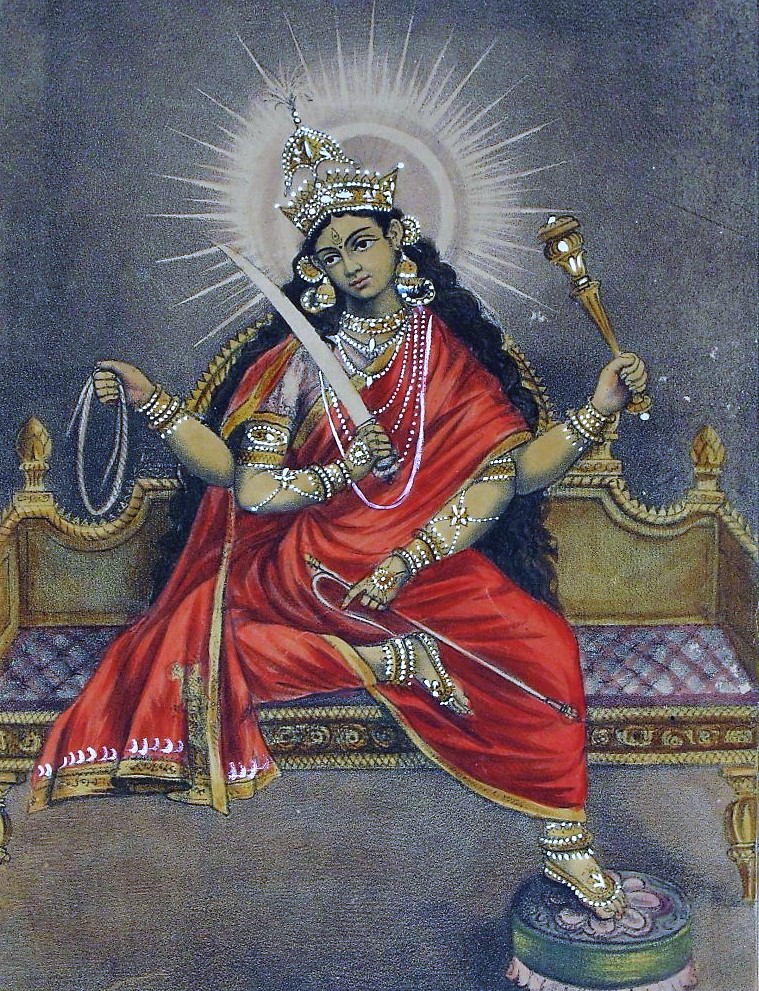
Matangi is represented as emerald green in colour. While Uchchhishta-Matangini carries a noose, sword, goad, and club, her other well-known form, Raja-Matangi, plays the veena and is often pictured with a parrot.
The Dhyana mantra (a mantra that details the form of the deity on which a devotee should meditate) of the Tantrasara describes Uchchhishta-Matangini, one of the most popular forms of the goddess. Matangi is seated on a corpse and wears red garments, red jewellery and a garland of gunja seeds. The goddess is described as a young, sixteen-year-old maiden with fully developed breasts. She carries a skull bowl and a sword in her two hands, and is offered leftovers.
The Dhyana mantras in the Purashcharyarnava and the Tantrasara describe Matangi as blue in colour. The crescent moon adorns her forehead. She has three eyes and a smiling face. She wears jewellery and is seated on a jewelled throne. She carries a noose, a sword, a goad, and a club in her four arms. Her waist is slim and her breasts well-developed.
The Dhyana Mantra of Raja-Matangi from the Purashcharyarnava describes Matangi as green in colour with the crescent moon on her forehead. She has long hair, a smiling expression and intoxicated eyes, and wears a garland of kadamba flowers and various ornaments. She perspires a little around the face, which renders her even more beautiful. Below her navel are three horizontal folds of skin and a thin vertical line of fine hair. Seated on an altar and flanked by two parrots, she represents the 64 arts. The Saradatilaka, adds to this description that Raja-Matangi plays the veena, wears conch-shell earrings and flower garlands, and has flower paintings adorning her forehead. She is also depicted wearing a garland of white lotus (here lotus signifies multi-colored world creation), similar to the iconography of goddess Saraswati, with whom she is associated with.
According to Kalidasa's Shyamaladandakam, Matangi plays a ruby-studded veena and speaks sweetly. The Dhyana Mantra describes her to be four-armed, with a dark emerald complexion, full breasts anointed with red kumkum powder, and a crescent moon on her forehead. She carries a noose, a goad, a sugarcane bow and flower arrows, which the goddess Tripura Sundari is often described to hold. She is also described to love the parrot and is embodied in the nectar of song.
The green complexion is associated with deep knowledge and is also the colour of Budha, the presiding deity of the planet Mercury who governs intelligence. Matangi is often depicted with a parrot in her hands, representing speech. The veena symbolizes her association with music.
Hub AI
Matangi AI simulator
(@Matangi_simulator)
Matangi
Matangi (Sanskrit: मातङ्गी, IAST: Mātaṅgī) is a Hindu goddess. She is one of the Mahavidyas, ten Tantric goddesses and an aspect of the Hindu Divine Mother. She is considered to be the Tantric form of Sarasvati, the goddess of music and learning. Matangi governs speech, music, knowledge and the arts. Her worship is prescribed to acquire supernatural powers, especially gaining control over enemies, attracting people to oneself, acquiring mastery over the arts and gaining supreme knowledge.
Matangi is often associated with pollution, inauspiciousness and the periphery of Hindu society, which is embodied in her most popular form, known as Uchchhishta-Chandalini or Uchchhishta-Matangini. She is described as an outcaste (Chandalini) and offered left-over or partially eaten food (Uchchhishta) with unwashed hands or food after eating, both of which are considered to be impure in classical Hinduism.
Matangi is represented as emerald green in colour. While Uchchhishta-Matangini carries a noose, sword, goad, and club, her other well-known form, Raja-Matangi, plays the veena and is often pictured with a parrot.
The Dhyana mantra (a mantra that details the form of the deity on which a devotee should meditate) of the Tantrasara describes Uchchhishta-Matangini, one of the most popular forms of the goddess. Matangi is seated on a corpse and wears red garments, red jewellery and a garland of gunja seeds. The goddess is described as a young, sixteen-year-old maiden with fully developed breasts. She carries a skull bowl and a sword in her two hands, and is offered leftovers.
The Dhyana mantras in the Purashcharyarnava and the Tantrasara describe Matangi as blue in colour. The crescent moon adorns her forehead. She has three eyes and a smiling face. She wears jewellery and is seated on a jewelled throne. She carries a noose, a sword, a goad, and a club in her four arms. Her waist is slim and her breasts well-developed.
The Dhyana Mantra of Raja-Matangi from the Purashcharyarnava describes Matangi as green in colour with the crescent moon on her forehead. She has long hair, a smiling expression and intoxicated eyes, and wears a garland of kadamba flowers and various ornaments. She perspires a little around the face, which renders her even more beautiful. Below her navel are three horizontal folds of skin and a thin vertical line of fine hair. Seated on an altar and flanked by two parrots, she represents the 64 arts. The Saradatilaka, adds to this description that Raja-Matangi plays the veena, wears conch-shell earrings and flower garlands, and has flower paintings adorning her forehead. She is also depicted wearing a garland of white lotus (here lotus signifies multi-colored world creation), similar to the iconography of goddess Saraswati, with whom she is associated with.
According to Kalidasa's Shyamaladandakam, Matangi plays a ruby-studded veena and speaks sweetly. The Dhyana Mantra describes her to be four-armed, with a dark emerald complexion, full breasts anointed with red kumkum powder, and a crescent moon on her forehead. She carries a noose, a goad, a sugarcane bow and flower arrows, which the goddess Tripura Sundari is often described to hold. She is also described to love the parrot and is embodied in the nectar of song.
The green complexion is associated with deep knowledge and is also the colour of Budha, the presiding deity of the planet Mercury who governs intelligence. Matangi is often depicted with a parrot in her hands, representing speech. The veena symbolizes her association with music.