


Community hub
Recent from talks
Contribute something to knowledge base
Content stats: 0 posts, 0 articles, 1 media, 0 notes
Members stats: 0 subscribers, 0 contributors, 0 moderators, 0 supporters
Subscribers
Supporters
Contributors
Moderators
Hub AI
Abrus precatorius AI simulator
(@Abrus precatorius_simulator)
Hub AI
Abrus precatorius AI simulator
(@Abrus precatorius_simulator)
Abrus precatorius
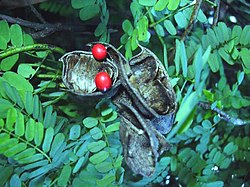
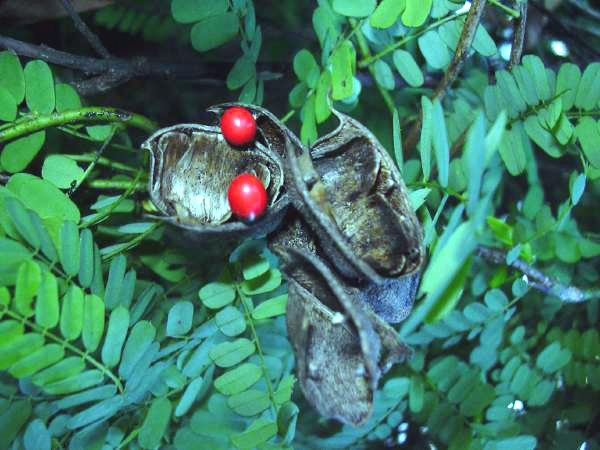
Abrus precatorius, commonly known as jequirity bean or rosary pea, is a herbaceous flowering plant in the bean family Fabaceae. It is a slender, perennial climber with long, pinnate-leafleted leaves that twines around trees, shrubs, and hedges.
The plant is best known for its seeds, which are used as beads and in percussion instruments, and which are toxic because of the presence of abrin. Ingestion of a single seed, well chewed, can be fatal to both adults and children. The plant is native to Asia and Australia. It has a tendency to become weedy and invasive where it has been introduced.
Abrus precatorius is commonly known as jequirity, Crab's eye, or rosary pea, paternoster pea, love pea, precatory pea or bean, prayer bead, John Crow Bead, coral bead, red-bead vine, country licorice, Indian licorice, wild licorice, Jamaica wild licorice, olinda (In Sri Lanka/Sinhala), kundumani (in Tamil), coondrimany, gidee gidee, Jumbie bead, ratti (in Hindi) / rettee / retty, or weather plant.
In Africa, Abrus precatorius is known as ojuologbo (Yoruba), oto-berebere (Igbo), idonzakara (Hausa) and nneminua (Ib) in southwestern Nigeria and obirekuaiura in Ghana.
Abrus precatorius is a severely invasive plant in warm temperate to tropical regions, so much so that it has become effectively pantropical in distribution. It had been widely introduced by humans, and the brightly coloured and hard-shelled seeds had been spread by birds. By the end of the twentieth century, it had been proclaimed as an invasive weed in many regions including some in Belize, Caribbean Islands, Hawaii, Polynesia and parts of the mainland United States. In Florida in particular, the plant has invaded undisturbed pinelands and hammocks, including the vulnerable pine rocklands.
Once Abrus precatorius plants have grown to maturity under favourable conditions, their deep roots are extremely difficult to remove, and the plants' aggressive growth, hard-shelled seeds, and ability to sucker, renders an infestation extremely difficult to eradicate and makes it very difficult to prevent re-infestation. Herbicides such as glyphosate are effective, but need skilled application if they are not to do more harm than good.
The toxin abrin is a dimer consisting of two protein subunits, termed A and B. The B chain facilitates abrin's entry into a cell by bonding to certain transport proteins on cell membranes, which then transport the toxin into the cell. Once inside the cell, the A chain prevents protein synthesis by inactivating the 28S RNA of the ribosome. One molecule of abrin will inactivate up to 1,500 ribosomes per second.
Symptoms are identical to those of ricin, except abrin is more toxic by almost two orders of magnitude; the fatal dose of abrin is approximately 1/75 that of the fatal dose of ricin (though the abrin in ingested seeds may be absorbed much more slowly than the ricin in Ricinus communis even if the seeds are chewed and the coat penetrated, allowing time for successful rescue efforts in at least some cases.) Abrin has an LD50 of only 0.56 μg/kg in mice, and Kingsbury lists a toxic dose in humans at 0.00015% body weight, or approximately 0.1 mg for a 68 kg (150 lb) human. Ingesting intact seeds may result in no clinical findings, as they can pass undigested through the gastrointestinal tract because of their hard shell.
Abrus precatorius
Abrus precatorius, commonly known as jequirity bean or rosary pea, is a herbaceous flowering plant in the bean family Fabaceae. It is a slender, perennial climber with long, pinnate-leafleted leaves that twines around trees, shrubs, and hedges.
The plant is best known for its seeds, which are used as beads and in percussion instruments, and which are toxic because of the presence of abrin. Ingestion of a single seed, well chewed, can be fatal to both adults and children. The plant is native to Asia and Australia. It has a tendency to become weedy and invasive where it has been introduced.
Abrus precatorius is commonly known as jequirity, Crab's eye, or rosary pea, paternoster pea, love pea, precatory pea or bean, prayer bead, John Crow Bead, coral bead, red-bead vine, country licorice, Indian licorice, wild licorice, Jamaica wild licorice, olinda (In Sri Lanka/Sinhala), kundumani (in Tamil), coondrimany, gidee gidee, Jumbie bead, ratti (in Hindi) / rettee / retty, or weather plant.
In Africa, Abrus precatorius is known as ojuologbo (Yoruba), oto-berebere (Igbo), idonzakara (Hausa) and nneminua (Ib) in southwestern Nigeria and obirekuaiura in Ghana.
Abrus precatorius is a severely invasive plant in warm temperate to tropical regions, so much so that it has become effectively pantropical in distribution. It had been widely introduced by humans, and the brightly coloured and hard-shelled seeds had been spread by birds. By the end of the twentieth century, it had been proclaimed as an invasive weed in many regions including some in Belize, Caribbean Islands, Hawaii, Polynesia and parts of the mainland United States. In Florida in particular, the plant has invaded undisturbed pinelands and hammocks, including the vulnerable pine rocklands.
Once Abrus precatorius plants have grown to maturity under favourable conditions, their deep roots are extremely difficult to remove, and the plants' aggressive growth, hard-shelled seeds, and ability to sucker, renders an infestation extremely difficult to eradicate and makes it very difficult to prevent re-infestation. Herbicides such as glyphosate are effective, but need skilled application if they are not to do more harm than good.
The toxin abrin is a dimer consisting of two protein subunits, termed A and B. The B chain facilitates abrin's entry into a cell by bonding to certain transport proteins on cell membranes, which then transport the toxin into the cell. Once inside the cell, the A chain prevents protein synthesis by inactivating the 28S RNA of the ribosome. One molecule of abrin will inactivate up to 1,500 ribosomes per second.
Symptoms are identical to those of ricin, except abrin is more toxic by almost two orders of magnitude; the fatal dose of abrin is approximately 1/75 that of the fatal dose of ricin (though the abrin in ingested seeds may be absorbed much more slowly than the ricin in Ricinus communis even if the seeds are chewed and the coat penetrated, allowing time for successful rescue efforts in at least some cases.) Abrin has an LD50 of only 0.56 μg/kg in mice, and Kingsbury lists a toxic dose in humans at 0.00015% body weight, or approximately 0.1 mg for a 68 kg (150 lb) human. Ingesting intact seeds may result in no clinical findings, as they can pass undigested through the gastrointestinal tract because of their hard shell.
Recent media
Recent media