


Community hub
Recent from talks
Contribute something
Nothing was collected or created yet.
Matt Schofield
View on Wikipedia |
Key Information


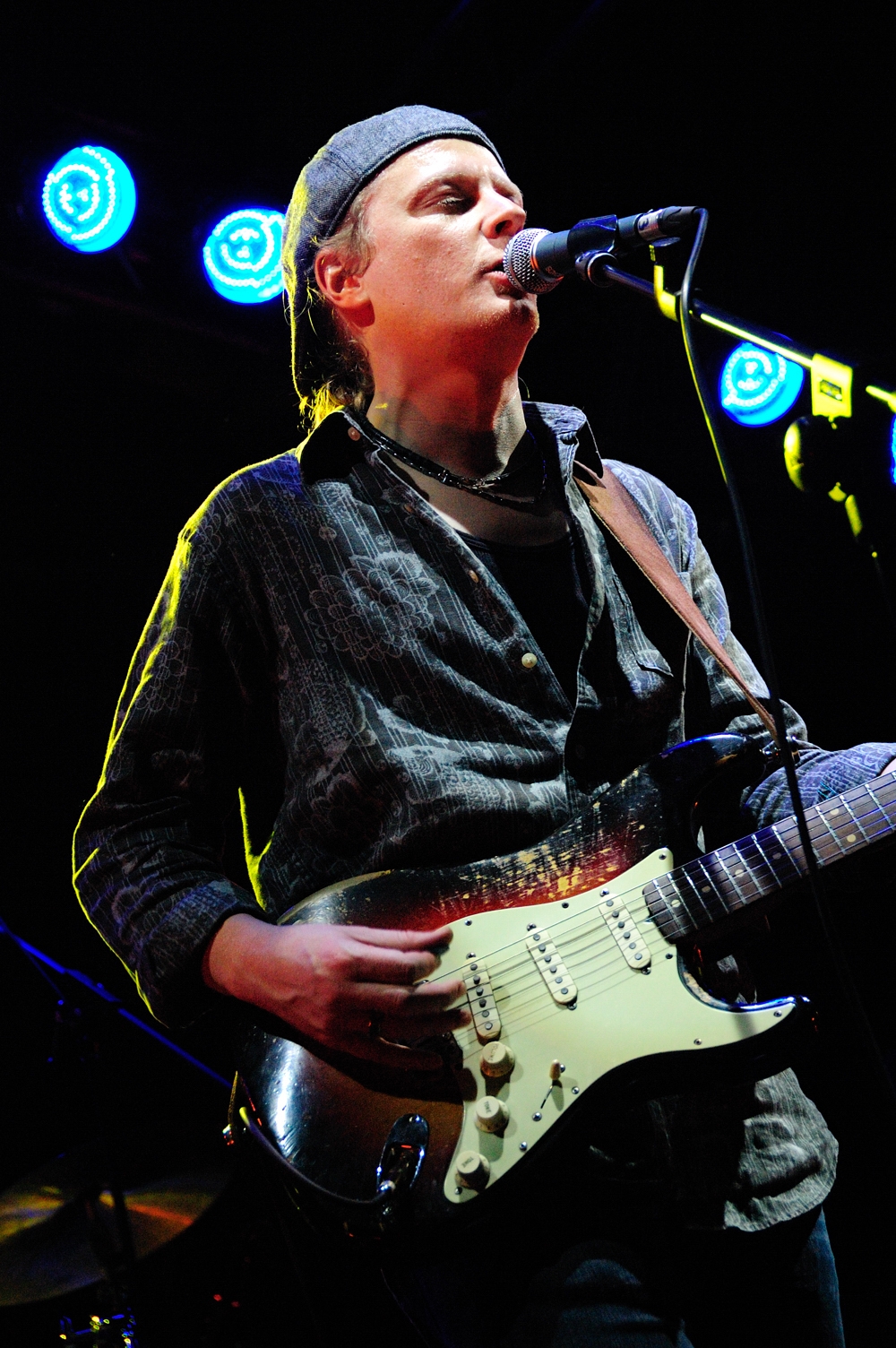
Matt Schofield (born 21 August 1977, Manchester, England)[1][2] is an English blues guitarist and singer. His band, the Matt Schofield Trio, play their own material, a blend of blues, funk and jazz, as well as covers of blues classics such as Albert Collins' "Lights Are On, But Nobody's Home".
Schofield is regarded as one of the most distinctive and innovative British blues guitarists, and has been rated in the top ten of British blues guitarists by Guitar & Bass Magazine. Schofield's prowess has taken his band to twelve countries, seen him playing with musicians including Buddy Guy and Robben Ford, and brought a note in the Penguin Book of Blues Recordings as one of only two living British artists to gain the maximum four-star rating. In addition, he has been admitted to the British Blues Awards Hall of Fame.[3]
Influences
[edit]Schofield's guitar playing is often likened to that of Robben Ford in its melodic and fluid style, and jazzy lines.[4]
Schofield has been influenced by B.B. King, Freddie King, Albert King, Muddy Waters, Steve Winwood, Eric Clapton, Albert Collins, Jimi Hendrix, Billy Gibbons, Stevie Ray Vaughan, Jimmie Vaughan, and Tomo Fujita.[5]
Career
[edit]Recordings
[edit]Schofield has recorded five studio albums and four live albums. The first of the live discs, The Trio, Live was recorded at the Bishop's Blues club at The Half Moon, Bishop's Stortford in 2004 and, funded and released by Richard Pavitt on his Nugene record label, gave the band their first breakthrough.[2] The first studio album, Siftin' Thru Ashes was released in 2005. This album showcased Schofield as a songwriter, writing or co-writing eight out of eleven of the tracks. AllMusic called Schofield's approach "an enjoyable demonstration of what can happen when blues-rock and blues-jazz are united". The second live album, Live at the Jazz Cafe! was recorded at the London Jazz Cafe in April 2005, and was made available as a web only release. Schofield is one of only two living British artists to be given a four star (excellent) rating in the Penguin Book of Blues Recordings.[citation needed]
The release of The Trio, Live prompted Schofield to be featured in a Guitarist magazine article, listing the nine notable up and coming blues guitarists, Schofield being the only non-American. Of the album they said "britblues meets jazz via N'Orleans – all played with the kind of sizzling guitar that just does not often surface in Fairford, Gloucestershire".[citation needed] In 2007, Guitar & Bass Magazine picked Schofield as one of the "Top 10 British Blues Guitarists of All Time". In August 2009, Schofield released Heads, Tails, & Aces, his third studio effort. The next year (2010) the band collected the Album of the Year award at the British Blues Awards[6] for this album, and released Live from the Archive,[7] recorded in 2007 in the Netherlands. Schofield won the British Blues Guitarist and Jonny Henderson won the British Keyboard Player award, and they both won these awards in 2011, too.[6]
In 2011, the trio released their fourth album Anything but Time, with Kevin Hayes on drums and John Porter as record producer.[8] Guitarinstructor.com, a part of the Hal Leonard organisation, has this album as No 5 in their top 10 albums of 2011, while Mojo magazine picked it as No 1 of Blues albums in 2011.
In 2012, Schofield made available a third live album Ten From The Road, consisting of material performed live in November 2011 by Schofield with Henderson & Hayes.
He released his fifth studio album, called Far As I Can See, in February 2014.[9]
Schofield has played guitar for a number of Dana Gillespie's albums, including Back to the Blues (1998), Experienced (2000), Songs of Love (2001), Staying Power (2002), These Blue Nights (2006), and Live With the London Blues Band (2007), and with The Lee Sankey Group's My Day Is Just Beginning (2000) and She's Not Alone (EP) (2000). He has also played guitar on Dino Baptiste's Two Timing Lover Boy (1999), The Lester Butler Tribute Band's So Lowdown Tour (2002), Earl Green's A Different Picture (2005), The Backbones' New Road Sessions Vol. 1 (2006), JL Fulks' On Down the Road (2016), and Federico Luiu's Walkin' The Blues. He co-produced Ian Siegal's Meat & Potatoes (2005) and produced Siegal's At The North Sea Jazz Festival (DVD) (2006), Swagger (2007), and Broadside (2009). Schofield appears on the compilation albums Mustique Blues Festival (1999, 2000, 2004), Basil´s Bar Blues (2003), and The Six Sessions (2010).
Band
[edit]Schofield performs with an organ trio (guitar, organ, and drums).[2] Organ trios are mostly associated with the 1950s and 1960s US soul jazz groups led by organists such as Jimmy Smith. Blues bands more commonly use trios of guitar, bass and drums, quartets (guitar, keyboards, bass, and drums) or quintets (guitar, rhythm guitar, keyboards, bass, and drums). In Schofield's organ trio, organist Jonny Henderson plays a Hammond organ, performing basslines using his left hand, and playing chords and lead lines with his right hand. The trio's drummer is Evan Jenkins. Jeff Walker played bass on the final track of Siftin' Thru' Ashes. In 2009, as of the recording of Heads, Tails & Aces, The Matt Schofield Trio became The Matt Schofield Band, a four-piece, featuring Jeff 'The Funk' Walker on bass, and also replacing Evan Jenkins with Alain Baudry. Jeff Walker was later replaced by Spanish bassist Javier Garcia Vicente. At a concert at the Swindon Arts Centre[10] on 22 October 2009, the band reverted to a trio. In June 2010, Kevin Hayes, replaced Evan Jenkins in the band. The 2012 Europe Tour, the trio was back with its original formation, with Matt Schofield, Evan Jenkins and Jonny Henderson.
Endorsements and gear
[edit]Boutique amplifier company Two-Rock developed the Schofield Signature amplifier for him. According to Schofield, the amplifier is "simply the best amplifier I've ever plugged into, and I'm honoured it carries my name".[11]
Japanese effects pedal company Free The Tone developed the MS SOV SPECIAL overdrive pedal for him and released it as a limited edition product in 2013. A full production version, the MS SOV MS-2V, was later released in 2014.[12]
Discography
[edit]- 2004: The Trio, Live (NUG601)
- 2005: Live at the Jazz Café (NUG503)
- 2005: Siftin' Thru' Ashes (NUG501)
- 2007: Ear to the Ground
- 2007: Live from the Archive
- 2009: Heads, Tails & Aces
- 2010:Live From The Archive
- 2011: Anything But Time
- 2012: Ten From The Road
- 2014: Far As I Can See
- 2025: Many Moons / Vol.1
References
[edit]- ^ "Artists". Nugene Records. Retrieved 11 December 2012.
- ^ a b c Chris True. "Matt Schofield". Allmusic. Retrieved 12 November 2011.
- ^ "Hall Of Fame". British Blues Awards. Retrieved 29 February 2016.
- ^ [1] Archived 2 October 2009 at the Wayback Machine
- ^ "Musician Matt Schofield (Guitar)". Allaboutjazz.com. Archived from the original on 20 July 2012. Retrieved 11 December 2012.
- ^ a b "Home Page". British Blues Awards. Retrieved 11 December 2012.
- ^ "Live From The Archive". Matt Schofield. 12 July 2010. Retrieved 18 July 2017.
- ^ "banned interdit verboden prohibido vietato proibido". archive.is. 26 August 2014. Archived from the original on 26 August 2014. Retrieved 21 June 2018.
- ^ "Far as I Can See - Matt Schofield | Releases". AllMusic. Retrieved 29 February 2016.
- ^ "Arts Centre – Swindon Borough Council". Swindon.gov.uk. Archived from the original on 1 December 2012. Retrieved 11 December 2012.
- ^ "Retired Models - Two-Rock Amplification". Two-rock.com. 20 June 2014. Retrieved 29 February 2016.
- ^ "Free The Tone – English | EFFECTS – SIGNATURE". Freethetone.com. 20 June 2014. Archived from the original on 29 February 2016. Retrieved 29 February 2016.
External links
[edit]
Matt Schofield
View on GrokipediaEarly life
Childhood and family background
Matt Schofield was born on August 21, 1977, in Manchester, England.[1] He spent his first seven years in the Manchester area, specifically in Radcliffe, where he was exposed to music through his father's extensive collection of vinyl records. Around age seven, Schofield's family relocated to Fairford in Gloucestershire, within the Cotswolds region, where he grew up immersed in a rural environment.[13][14] His father's record collection, featuring classic American blues artists, played a pivotal role in sparking Schofield's early interest in the genre during this period.[1][13] In 1988, when Schofield was 11, his father relocated to California.[15] Details about Schofield's immediate family members and other aspects of his non-musical upbringing remain limited in public records.[1]Introduction to music and early training
Matt Schofield first picked up the guitar at the age of 12, inspired by his exposure to blues records in his family home. Growing up in the Cotswolds after moving there at age seven, he was surrounded by his father's extensive vinyl collection featuring electric blues artists such as Albert Collins and B.B. King, which sparked his initial interest in the instrument.[1] His father further encouraged this passion by sharing a video of B.B. King, Albert Collins, and Stevie Ray Vaughan performing together during a visit to California at age 12, shortly after his father's relocation there, prompting him to dedicate himself to learning the guitar shortly thereafter.[16][1][14] Entirely self-taught, Schofield honed his skills through dedicated practice, drawing directly from the recordings and videos that captivated him as a young teenager. He experimented with basic blues techniques on an electric guitar, focusing on replicating the raw energy and phrasing he heard in those early influences, without any structured lessons or teachers at the outset. This hands-on approach allowed him to develop a foundational understanding of blues guitar fundamentals, emphasizing feel and expression over technical instruction.[3] Within months of starting, he formed his first band with school friends, marking the beginning of his practical engagement with music-making.[1][17] By age 13, Schofield had progressed to his debut public performance during a school concert in the Cotswolds, where he played guitar alongside peers, solidifying his commitment to the instrument over traditional academic paths like university. Soon after, he began participating in local jam sessions and small gigs, including one at a nearby American Air Force base, gaining early experience in front of audiences and refining his improvisational abilities through these informal settings. These teenage endeavors bridged his solitary practice sessions with collaborative playing, fostering the confidence that would propel his musical aspirations forward.[17]Musical influences
Primary blues inspirations
Matt Schofield's foundational blues influences stem from an early immersion in Chicago and Texas styles, primarily through his father's extensive vinyl collection of classic recordings. As a child, he regularly listened to albums by artists such as B.B. King, Muddy Waters, and Freddie King, which introduced him to the raw energy of electric blues and laid the groundwork for his guitar approach.[17][18] Among these, B.B. King emerged as a pivotal figure, captivating Schofield around age 12 through a video of King jamming with Albert Collins and Stevie Ray Vaughan, which ignited his passion for the instrument. King's majestic phrasing and warm, expressive tone profoundly shaped Schofield's melodic sensibility, emphasizing restraint and emotional depth over excessive notes in his playing.[19][20] Similarly, Freddie King and Albert King, representing the Texas blues tradition, influenced Schofield's phrasing and improvisational flow, with Freddie's dynamic shuffles and Albert's bold string manipulation informing his rhythmic drive and solo structures.[19][18] The electric blues pioneers, particularly Albert King and Albert Collins, directly impacted Schofield's technical development, especially his bending and vibrato techniques. Albert King's wide, vocal-like bends and controlled vibrato became hallmarks Schofield emulated to convey intensity and nuance, while Collins's icy tone and spontaneous phrasing enhanced his command of sustain and expressive sustain in leads.[19] Schofield also drew inspiration from Buddy Guy, learning directly from the master during early visits to the United States, incorporating Guy's innovative electric techniques into his playing.[17][18][19] This immersion in Chicago's urban grit via Muddy Waters and Texas's fiery edge through the Kings and Collins fostered a bedrock of authenticity in Schofield's style.[18] These influences manifested in Schofield's initial compositions and live improvisations by prioritizing blues structures with personal twists, such as extended solos rooted in King's economical phrasing and Freddie King's shuffle grooves. For his first four to five years of playing, Schofield focused intently on these originals, honing improvisations that balanced tradition with subtle innovation, evident in his early performances and songwriting that echoed the emotional directness of his heroes. Eric Clapton, as a leading figure in British blues, further influenced Schofield's fusion of blues with rock elements, evident in his melodic and tonal approach.[17][19][21]Broader stylistic impacts
Schofield's incorporation of broader influences beyond traditional blues has shaped a distinctive fusion-oriented sound, drawing notably from Robben Ford's approach to chordal complexity and improvisation. Ford's blend of jazz sophistication with blues phrasing inspired Schofield to explore melodic fluidity and advanced harmonic substitutions in his guitar lines, moving away from straightforward pentatonic solos toward more intricate, jazz-inflected explorations.[21][22] Elements of rock-blues intensity from Jimi Hendrix and Stevie Ray Vaughan further energize Schofield's playing, infusing it with dynamic energy and creative effects application that amplify emotional expression. Hendrix's experimental edge and Vaughan's high-octane phrasing contribute to Schofield's ability to deliver powerful, rhythmically charged performances that bridge blues roots with rock vitality.[19][8] In his arrangements, Schofield integrates jazz harmony—such as extended chords and modal interchanges—with organ-driven grooves, creating layered textures that enhance rhythmic propulsion and harmonic depth. The Hammond organ in his trio setup provides a soulful, pulsating foundation reminiscent of 1960s soul jazz, allowing for seamless transitions between blues structures and funkier, improvisational sections.[23][24] This synthesis has propelled Schofield toward a modern British blues fusion style, characterized by its innovative melding of genres and departure from purist traditions, establishing him as a forward-thinking voice in contemporary blues.[8][25]Career
Early professional years in the UK
At the age of 18 in 1995, Matt Schofield opted to pursue a career as a professional guitarist rather than attend university, marking the beginning of his full-time involvement in the music industry.[3] He soon relocated from Manchester to London to access greater opportunities in the vibrant blues scene.[16] Schofield's entry into professional work began with a jam session that led to his recruitment by harmonica player Lee Sankey for the Lee Sankey Group, where he served as lead guitarist.[16] This role involved performing at iconic venues like the 100 Club on Oxford Street and touring across Europe, honing his skills in a blues and R&B context.[16] He contributed guitar to the group's debut album, My Day Is Just Beginning, recorded in 1997 and released in 2001 on Ten Year Noose Records.[26] Following his time with Sankey, Schofield spent four years from the late 1990s to early 2000s as a sideman in Dana Gillespie's London Blues Band, touring extensively in the UK, Europe, and as far as India.[27] During this period, he provided guitar work on several of her albums, including Back to the Blues (1998) and Experienced (2000), blending blues with R&B elements.[28][29] These experiences solidified his reputation as a versatile session musician within the UK's blues community.[27] Throughout his early sideman years, Schofield built a strong presence in the UK blues circuit by performing at clubs and small venues, where he developed his distinctive guitar style influenced by blues traditions.[16] These gigs, often in intimate settings, allowed him to experiment with phrasing and tone, earning acclaim among peers and audiences in London's underground scene.[3]Formation and evolution of the trio
In 2003, following years of performing in various UK blues ensembles, Matt Schofield formed the Matt Schofield Trio as the primary vehicle for his original music, debuting with a live album release in 2004 that captured the band's raw energy. The original lineup featured Schofield on guitar and vocals, alongside organist Jonny Henderson and drummer Evan Jenkins, establishing a bass-less organ trio configuration that drew from classic blues organ sounds while incorporating jazz improvisation. This setup allowed Henderson to handle bass lines with his left hand on the Hammond organ, creating a fluid, interactive dynamic among the three musicians.[1] The trio's core sound emphasized extended improvisational jams blending blues roots with jazz fusion elements, soulful grooves, and rock-infused energy, setting it apart from traditional blues bands through its emphasis on spontaneous interplay rather than rigid structures. Early performances in UK clubs honed this approach, building on Schofield's prior gigging experience to refine a repertoire that showcased his virtuosic guitar phrasing and the organ's swirling textures. The format's innovation lay in its ability to evoke the spirit of 1960s soul jazz organ trios like those led by Jimmy Smith, while pushing boundaries with modern blues phrasing and harmonic exploration.[2][1] Over the years, the trio underwent key personnel shifts to maintain its momentum amid growing international demand. In 2010, Jenkins was temporarily replaced by drummer Kevin Hayes, a veteran from Robert Cray's band, introducing a more seasoned rhythmic drive during a period of expanded touring and recording. By 2012, however, the lineup reverted to its original configuration with Jenkins' return, solidifying the Henderson-Jenkins partnership that has endured for over two decades. This stability has been pivotal in the trio's evolution from a UK club staple to a globally recognized act, with consistent performances across Europe, North America, and beyond, culminating in recent reunions celebrating their longevity.[18][30]International tours and major milestones
Schofield's international touring career gained momentum in the mid-2000s following the release of his debut album The Trio Live in 2004, which showcased the organ trio format that became central to his dynamic live performances. By the late 2000s, the Matt Schofield Trio had embarked on extensive tours across nearly 30 countries, including major stops in Europe such as the North Sea Jazz Festival in the Netherlands, the Montreal International Jazz Festival in Canada, and headline shows at London's 100 Club. These European legs built on his UK roots while expanding his global footprint, with the trio's high-energy sets drawing acclaim for blending blues traditions with jazz-inflected improvisation.[2] The band's reach extended to North America and beyond starting around 2005, with regular U.S. tours featuring performances at iconic venues like New York's Iridium Jazz Club, where Schofield's expressive guitar work captivated audiences familiar with American blues giants. In Asia, a notable milestone came in 2011 and 2015 when Schofield headlined the Mahindra Blues Festival in Mumbai, India, sharing the stage with Buddy Guy in a cross-generational showcase that highlighted his rising international stature. Similarly, in 2015, he joined Robben Ford for an encore jam at the Guitar Town Festival, underscoring his ability to collaborate with jazz-blues luminaries and further solidifying his reputation as a bridge between British and global blues scenes.[2][8][31][32] Critical recognition for these tours peaked with Guitar & Bass Magazine ranking Schofield among the top ten British blues guitarists of all time in the early 2010s, placing him alongside icons like Eric Clapton and Peter Green for his innovative phrasing and tone. Live recordings captured the essence of these milestones, such as Live at the Jazz Café (2005), which documented a pivotal London performance during his initial European push, and Ten from the Road (2012), a compilation of standout tracks from international dates that exemplified the trio's onstage chemistry and improvisational peaks. These releases not only preserved the raw energy of his global tours but also propelled further bookings across continents.[2][27][33]Relocation to the United States
In the late 2010s, Matt Schofield relocated to the United States, establishing a permanent base in Jupiter, Florida, where he now resides full-time.[34][35] This move built on his extensive international touring experience, allowing him to deepen ties with the American music scene.[2] The relocation marked a significant pivot, enabling more consistent engagement with U.S.-based opportunities and audiences. Post-relocation, Schofield intensified his presence at American blues festivals and venues, performing at events such as the New York State Blues Festival in 2024.[36][37] He has also graced iconic spots like New York's Iridium and Jimmy's Jazz & Blues Club in Portsmouth, New Hampshire, expanding his live performances across the Northeast and beyond.[2][38] This shift facilitated greater access to the U.S. blues circuit, fostering a more direct connection with domestic fans. Adapting to the U.S. music industry, Schofield has pursued enhanced production roles, including recording sessions at local studios like Echo Beach in Jupiter, which supported vocal work on recent projects.[39] The move broadened his audience reach, aligning with the American market's demand for contemporary blues and providing logistical advantages for stateside operations.[3] His full-time U.S. residence has streamlined visa and tax considerations that previously complicated international work.[3] Recent activities underscore the relocation's impact, with Schofield undertaking extensive 2024-2025 U.S. tours featuring stops in multiple states, including Massachusetts, New York, and Indiana.[40][41] Tied to his Florida base, these efforts culminated in the March 2025 release of the album Many Moons, Vol. 1 by the Matt Schofield Trio, produced and arranged under his U.S.-centric workflow.[30][42]Band and collaborations
Trio lineup and personnel changes
The Matt Schofield Trio was formed in 2003 as an organ trio, with its debut album The Trio, Live released in 2004, featuring Matt Schofield on guitar and vocals, Jonny Henderson on Hammond organ, and Evan Jenkins on drums.[43][44] This lineup established the band's signature sound, drawing from classic American organ trios of the 1950s and 1960s, where Henderson's organ provided both melodic support and bass lines, eliminating the need for a traditional bassist, while Jenkins delivered a solid, groove-oriented foundation that complemented Schofield's blues-infused guitar work.[44][27] Over the years, the trio underwent personnel changes primarily on drums to accommodate touring schedules and evolving creative needs. In 2010, following Schofield's relocation to the United States, drummer Kevin Hayes—previously a long-time member of Robert Cray's band—joined the group, appearing on albums such as Anything But Time (2011) and Far As I Can See (2014), where his experience added a polished, dynamic rhythm section suited to extensive North American tours.[45][16] Hayes' tenure reflected the practical demands of international touring, allowing for more consistent U.S.-based performances without relying on transatlantic travel for Jenkins.[16] While maintaining its core organ trio format, the band occasionally expanded to a quartet by adding a bassist, such as Carl Stanbridge, who contributed electric upright bass on Far As I Can See and select live shows, freeing Henderson to focus more on jazz-infused organ solos and improvisations rather than doubling on bass lines.[46][47] This adjustment enhanced the band's sonic depth for larger venues and recordings, aligning with Schofield's interest in creative evolution beyond strict trio constraints.[17] By the mid-2010s, the trio reverted to its original core lineup, with Jenkins returning on drums alongside Henderson, who has remained a constant since the band's inception, his sophisticated keyboard work—blending jazz harmony with blues phrasing—continuing to define the group's innovative edge.[16] This reunion culminated in the 2025 album Many Moons, Vol. 1, celebrating over 20 years of collaboration and emphasizing the enduring chemistry that has sustained the trio through personnel shifts driven by logistical and artistic growth.[30][48]Key collaborations with other artists
Throughout his career, Matt Schofield has engaged in notable performances alongside blues legend Buddy Guy, including a memorable shared appearance at the Mahindra Blues Festival in Mumbai, India, in February 2011, where they performed together with artists such as Jonny Lang and [Shemekia Copeland](/page/Shemekia Copeland).[49] This event highlighted Schofield's rising international profile and allowed for direct interaction with one of his key influences, fostering mutual respect in the blues community.[50] Schofield has described these onstage moments as among the greatest honors of his career.[8] Schofield has also shared stages with jazz-blues guitarist Robben Ford, whose sophisticated phrasing and fusion-infused approach have notably shaped Schofield's own improvisational style, particularly in incorporating modal and chord-scale elements into blues tracks.[8] These collaborations, spanning live performances across multiple countries, have enriched Schofield's sound by blending traditional blues with jazzier harmonic explorations.[51] In the festival circuit, Schofield opened for the Tedeschi Trucks Band—led by Susan Tedeschi—at the 2018 Word of South Music & Arts Festival in Tallahassee, Florida, providing an opportunity to perform in close proximity to Tedeschi's dynamic guitar and vocal style.[52] This shared billing underscored Schofield's integration into broader American blues scenes and highlighted synergies between his organ trio format and Tedeschi's ensemble-driven energy. Building on his foundational trio dynamic, Schofield reunited with original members Jonny Henderson on Hammond B3 organ and Evan Jenkins on drums for the 2025 album Many Moons Vol. 1, marking their first studio recording together in over two decades and celebrating the chemistry that launched his career.[30] Recorded at Real World Studios, the album features eight tracks of original material and blues covers, emphasizing the trio's telepathic interplay without additional personnel.[53] Schofield has noted that this internal collaboration recaptures the raw, intuitive essence of their early work while evolving it for contemporary audiences.[53]Equipment and endorsements
Signature amplifiers and guitars
Matt Schofield's amplifier setup has evolved significantly throughout his career, beginning with classic Fender models that emphasized clean headroom and subtle breakup. In his early professional years, he relied on a 1964 Fender Super Reverb, a blackface-era amplifier known for its sparkling cleans and ability to handle overdrive gracefully, which he used for many live performances and recordings.[54][55] Over time, Schofield incorporated influences from vintage Fender Tweed circuits, appreciating their warm, responsive compression, though he transitioned toward more versatile modern designs to accommodate his expanding tonal palette.[56] A pivotal development in Schofield's gear came with his endorsement of the Two-Rock Matt Schofield Signature amplifier, a custom 100-watt (or 50-watt) head designed in collaboration with Two-Rock Amplifiers. This single-channel amp features a Classic Reverb circuit with adjustable front-end voicing that shifts between traditional Fender-style cleans and Two-Rock's signature warmth, incorporating treble, mid, and bass tone stacks with boost options, wide-range mids, and tube-driven tremolo via dual GZ34 rectifiers.[57][58] Tailored for blues expression, the Signature model's voicing prioritizes a rich, blooming warmth that enhances Schofield's fluid phrasing without excessive gain, making it his primary live and studio amplifier since its introduction around 2012.[55][59] Schofield's guitar choices complement his amplifier preferences, centering on modified Fender Stratocasters for their articulate snap and sustain. His main instrument is a recreation of his original 1961 Fender Stratocaster, built by luthier Simon Law of SVL Guitars, featuring hand-wound pickups and adjustments for enhanced sustain and tonal clarity, which he has used extensively on tour.[54][55] He occasionally employs Gibson Les Pauls to achieve thicker, more rounded tones suited to certain blues contexts, providing a contrast to the Stratocaster's brightness.[60] These equipment selections enable Schofield's signature dynamic range, allowing seamless transitions from pristine cleans to singing overdrive in both live performances and studio work. The Two-Rock Signature's responsive headroom pairs with the Stratocaster's sensitivity to deliver expressive volume swells and nuanced attack, while the Les Paul's heft adds depth for sustained leads, supporting his emotive style across varied settings.[21][61]Effects pedals and other gear
Matt Schofield's effects setup centers on a select array of pedals that complement his dynamic blues playing, prioritizing transparency and responsiveness over dense processing. Central to his rig is the Free The Tone MS SOV SPECIAL (MS-1V), a signature overdrive pedal co-designed with the Japanese manufacturer to deliver smooth, creamy blues distortion with a rich midrange emphasis.[62] This limited-edition model, released in 2013 and later revived as the MS-2V standard version, features a vintage low-mid drive circuit that enhances touch sensitivity, allowing Schofield to achieve expressive overdrive tones without overwhelming the core signal.[63] He has relied on variants of this pedal, including the earlier SOV-2, for over a decade to shape his signature grit.[54] In addition to overdrive, Schofield incorporates subtle time-based effects to add depth and space to his improvisations. For delays, he favors the Mad Professor Deep Blue Delay, often using two units—one configured for short slap-back echoes and another for ambient repeats—to maintain rhythmic phrasing without cluttering his lines.[54] Reverb duties are handled sparingly in live settings, with the Strymon Flint providing versatile spring and plate emulations primarily for studio work.[54] While wah pedals appear less frequently in his documented setups, his approach to effects overall avoids heavy modulation, focusing instead on pedals that preserve the natural bloom of his tube amplifiers. As of 2025, his setup has expanded to include additional pedals such as the Vemuram Jan Ray overdrive/boost and JAM Pedals Harmonius Monk tremolo, reflecting his endorsement with JAM Pedals since June 2025.[64][65] Schofield's rig philosophy emphasizes the organic response of his amplifiers, though his pedalboard has grown beyond early minimalist configurations of three or four units to accommodate a broader palette while retaining focus on dynamic playing. As he noted in a 2011 interview, "I use [the amp] for the clean sound and then get the dirt from my pedals. But I totally rely on the tone of the amp," underscoring his preference for setups that let the tube circuitry handle much of the harmonic complexity.[21][66] This configuration supports his improvisational style, enabling quick adjustments during performances. Following his relocation to the United States, Schofield adapted his gear for extensive touring by incorporating compact, portable solutions like travel pedalboards to ensure tonal consistency across international venues.[67] In discussions on lightweight rigs, he highlighted using durable, battery-powered pedals such as the Mad Professor series for reliability on the road, minimizing setup time while maintaining his established sound.[54] He also endorses Curt Mangan signature strings, tailored for his playing style.[2][68]Awards and recognition
British Blues Awards achievements
Matt Schofield achieved significant recognition through the British Blues Awards, securing three consecutive wins as British Blues Guitarist of the Year in 2010, 2011, and 2012. These victories highlighted his innovative fusion of blues, jazz, and soul influences on guitar, establishing him as a leading figure in the contemporary British blues scene.[2][9] In 2010, Schofield's album Heads, Tails & Aces was awarded British Blues Album of the Year, praising its sophisticated songwriting and dynamic performances that blended traditional blues structures with modern improvisation. This accolade underscored the album's critical and commercial success following its 2009 release.[8][69] Following his third Guitarist of the Year win, Schofield became the first guitarist inducted into the British Blues Awards Hall of Fame at the 2012 ceremony, honoring his sustained excellence and contributions to the genre. The induction cemented his legacy among British blues luminaries.[9][2] These awards markedly elevated Schofield's visibility in the UK, expanding his fan base and drawing attention from major labels, which facilitated enhanced recording contracts and broader distribution for his subsequent releases.[2][14]Other honors and industry acclaim
Schofield has been recognized in Guitar & Bass magazine's list of the top ten British blues guitarists of all time, placing him alongside luminaries such as Eric Clapton and Peter Green.[2] In 2011, his album Anything But Time was voted Blues Album of the Year by Mojo magazine, highlighting his songwriting and guitar work within the genre.[2] Following his relocation to the United States, Schofield has garnered further acclaim through headlining major blues festivals, including the Ice, Wine, Beer and Blues Fest in Marshall, Michigan, where he closed the main stage as a British Blues Hall of Famer, and the Festival Internacional de Blues de Tomares in Spain.[70][71] Critics have praised Schofield for his innovative fusion of blues with jazz, soul, and funk elements, with Blues Rock Review describing his 2025 release Many Moons Vol. 1 as "a masterclass in blues guitar" that showcases the unique chemistry of his trio and pushes genre boundaries.[53]Discography
Studio albums
| Album | Release Date | Label | Notes |
|---|---|---|---|
| Siftin' Thru Ashes | January 27, 2005 | Nugene Records | Debut studio album; 11 tracks including eight originals co-written by Schofield; personnel: Matt Schofield (guitar/vocals), Dave Steel (bass), Todd Sharman (drums); recorded at Rimshot Studios, Kent, England. Covers include The Box Tops' "The Letter." Blends gritty blues with funk influences.[33][72][73] |
| Ear to the Ground | 2007 | Nugene Records | Second studio album.[33] |
| Heads, Tails & Aces | 2009 | Nugene Records | Third studio album.[33] |
| Anything But Time | 2011 | Provogue Records | Fourth studio album; critically acclaimed, named Mojo Magazine's Blues Album of the Year.[33] |
| Far As I Can See | February 18, 2014 | Provogue Records | Fifth studio album blending blues with jazz and funk elements. Featuring nine original compositions and two covers, the record showcases sophisticated fusion through odd-time signatures and extended improvisations, as heard in tracks like the title song, which explores themes of perspective and resilience with Schofield's warm vocals and fluid solos. Produced by the band in collaboration with engineer Colin Towns, it was recorded in London, emphasizing a polished production that amplifies Schofield's growth as a bandleader, incorporating Hendrix-inspired explorations and rhythmic complexity absent in his earlier work.[74][75] |
| The Last Night | 2017 | Provogue Records | Sixth studio album.[76] |
| Many Moons, Vol. 1 | March 21, 2025 | Number 7 Records | Reunites Schofield with his original organ trio—organist Jonny Henderson and drummer Evan Jenkins—for an eight-track reflection on over two decades of collaboration. Produced and arranged by the trio, it was primarily recorded at Real World Studios in Wiltshire, UK, with engineering by Bob MacKenzie, yielding a 42-minute collection of introspective blues centered on themes of time, endurance, and renewal, exemplified by tracks like "Can't Catch My Breath," which features blistering guitar work over shuffling grooves. This release celebrates the trio's chemistry through a mix of slow burns and upbeat shuffles, underscoring Schofield's vocal maturity and harmonic depth.[77][78][53] |
Live albums and compilations
| Album | Release Date | Label | Notes |
|---|---|---|---|
| The Trio, Live | 2004 | Nugene Records | Captured the raw energy of his early trio performances across various UK venues, blending blues and funk in a high-octane live setting that highlighted the band's improvisational chemistry and Schofield's commanding guitar tone. Recorded without overdubs, the album emphasized the trio's tight interplay and spontaneous extensions on originals and covers, serving as an early documentation of their dynamic stage presence. Critics praised its greasy intensity and Schofield's mastery of tension and release, marking it as a critical success that showcased the unpolished vitality of their live sound.[33][79][80] |
| Live at the Jazz Café | 2005 | Nugene Records | Documented a performance at London's Jazz Café, further illustrating the trio's ability to deliver extended jams and audience-engaging improvisations over a 62-minute set of blues-infused material. This web-only release underscored the band's evolving stage dynamics, with Schofield's guitar work bleeding raw blues emotion amid the venue's intimate atmosphere, allowing for real-time exploration of phrasing and interplay that live settings uniquely enable. Elements from his emerging studio foundations, such as structured song forms, influenced the setlist while giving way to freer, jam-oriented developments.[33][81] |
| Live from the Archive | 2010 | Self-released | Presented a broadcast-quality capture of a 2007 show, featuring songs drawn from prior studio efforts alongside covers like "Black Cat Bone," which became an audience favorite for its extended improvisational flourishes. The album's modest production preserved the raw, no-retakes authenticity of the performance, highlighting the trio's precision and Schofield's stinging tone in real-time band interactions without studio polish. Reviewers noted the set's lively structure and tight execution, with standout versions like "Siftin' Thru Ashes" exemplifying the improvisational fire that defined their tours.[82][83][84] |
| Ten from the Road | 2012 | Self-released | Recorded during the band's 2011 UK tour, compiled ten tracks that documented their road-honed dynamics, including high-energy renditions of "Ear to the Ground" and "Don't Know What I'd Do," where Schofield's gear—such as his signature amplifiers—shone through in live mixes. This release emphasized the trio's improvisational prowess in varied venues, capturing the spontaneous extensions and audience rapport that live albums uniquely convey, while subtly reflecting studio song foundations in their extended formats. It served as a testament to the band's enduring stage vitality, with Schofield's guitar leading fluid jams that showcased real-time equipment responses and group synergy.[33][85][86] |