Hubbry Logo
Max SandlinMax SandlinMain
Open search
Max Sandlin
Community hub
Max Sandlin
logo
8 pages, 0 posts
0 subscribers
Be the first to start a discussion here.
Max Sandlin
Max Sandlin
from Wikipedia

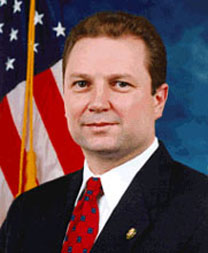
Max Allen Sandlin Jr. (born September 29, 1952) is an American politician who served eight years in the U.S. House of Representatives representing Texas's 1st congressional district from 1997 to 2005.

Key Information

Early life and career

[edit]

The son of the former Margie Beth Barnett and her husband Maxwell Allen Sandlin, Max Sandlin is a graduate of Baylor University, where he was a member of Phi Delta Theta and named Outstanding Young Alumni, and Baylor University School of Law, where he was a member of the National Championship Mock Trial Team. He was the Distinguished Speaker for the John William Minton and Florence Dean Minton Endowed Law School Lecture Series at Law Day 2004 at Baylor Law School.

He practiced law in Texas and had a broad-based litigation and business practice. He was active in the banking and energy industries. He also served on the Board of Directors of East Texas Legal Services.[1][2][3] He is a former County Judge and County Court at Law Judge.

Congress

[edit]

First elected to Congress in 1996, he rose to become a member of the senior House Democratic leadership, serving as Chief Deputy Whip. He served on the powerful and exclusive Ways and Means Committee, the Financial Services Committee, and the Transportation and Infrastructure Committee. He was an elected and later a leadership representative on the Democratic Steering and Policy Committee, and also among the small group of legislators selected for the Parliamentary Group, representatives called upon for rapid parliamentary and procedural action on the floor of the U.S. House.

Sandlin was a member of the Blue Dog Coalition and was Chairman of the Blue Dog Energy Task Force. Additionally, he served as Chairman of the Democratic Caucus Financial Services Task Force and was a member of the New Democrat Coalition.

While in the House, Sandlin was frequently asked to present and argue policy, and the Austin American-Statesman noted "Sandlin is a forceful and articulate speaker, a lawyer by trade who treats audiences like juries that can be charmed, coaxed, inspired and won over."[4] The Paris Daily News noted that "Sandlin is highly polished...with God-given speaking talents" and an "...ability to communicate eloquently."[5]

Consensus building

[edit]

Sandlin was known as a consensus builder, and The Almanac of American Politics noted that he had a "...moderate voting record that straddles Democratic wings."[6] The Democratic Caucus and leadership often called upon Sandlin's coalition-building skills and U.S. Rep. George Miller (D-CA) noted "We've always looked for a way to build that bridge [between liberals and centrists]. He [Sandlin] certainly has that talent."[7] The Austin American-Statesman added that "Sandlin's a versatile campaigner, equally at home with Unitarians as he is in a roomful of good ol' boys." [8]

Redistricting and defeat

[edit]

Sandlin was a primary target of the Republican 2003 re-redistricting process orchestrated by then-House Majority Leader Tom DeLay (R-TX). Sandlin's district was made significantly more urban and Republican than its predecessor. Sandlin denounced the reconfiguring of his district, calling it an illegal and unconstitutional effort to dilute and eliminate the voices of rural and minority voters. Sandlin lost to former district judge Louie Gohmert in a massive landslide, taking only 39 percent of the vote. Three other members of the so-called "Texas Five" were also defeated after their districts were radically altered.[9] No Democrat has garnered more than 35 percent of the vote since Sandlin left office.

Private life

[edit]

Sandlin is currently a partner and co-chairman of Mercury, a public strategy firm.[10]

Sandlin is a former youth baseball, basketball, and softball coach. He is the father of five children, has three grandchildren, and is married to former U.S. Representative Stephanie Herseth Sandlin (D-SD), who is currently the president of Augustana University.[11]

References

[edit]
[edit]
Revisions and contributorsEdit on WikipediaRead on Wikipedia
from Grokipedia
Max A. Sandlin Jr. (born September 29, 1952) is an American attorney, former , and public affairs executive who served as the U.S. Representative for from 1997 to 2005. A Democrat from , he represented a district encompassing rural and timber-dependent areas, emphasizing , rural , and fiscal restraint as a member of the moderate . Prior to his congressional service, Sandlin earned a B.A. from Baylor University in 1975 and a J.D. from Baylor Law School in 1978, after which he practiced law and worked as a business executive in private practice. He served as judge of the County Court at Law in Harrison County, Texas, from 1989 to 1996, following an earlier term as county judge from 1986 to 1989. Elected to the House in 1996, Sandlin sat on the Energy and Commerce Committee, where he advocated for legislation promoting domestic energy production and security, including provisions in energy tax bills aimed at enhancing fuel efficiency and reducing dependence on foreign oil. He was reelected three times before losing in 2004 amid Republican redistricting efforts that altered his district's composition. Following his departure from , Sandlin transitioned to and strategy, registering as a lobbyist for firms including and International Government Relations Group, before joining Mercury Public Affairs as a partner and general counsel for its Washington, D.C., government relations team. He is married to , a former U.S. Representative from .

Early Life and Education

Upbringing, Family Origins, and Formal Education

Max Sandlin was born on September 29, 1952, in Texarkana, Miller County, Arkansas. His family relocated shortly after his birth, spending his first five years in New Boston, Texas, before moving to Atlanta, Texas, where he was raised. Atlanta, located in Cass County near the Arkansas border, provided an upbringing influenced by the rural, self-reliant ethos of East Texas, amid a region marked by agricultural and small-town dynamics. Sandlin was the son of Maxwell Allen Sandlin and Margie Beth Barnett Sandlin, with limited public records detailing their occupations beyond typical involvement in local community life. He grew up with two younger siblings, contributing to a environment shaped by regional values of independence and in a border-area setting. Sandlin graduated from Atlanta High School in 1971. He then attended in , earning a degree in 1975. Continuing at the same institution, he obtained a from Baylor in 1978, marking the completion of his formal education.

Pre-Congressional Career

Following his graduation with a from in 1975 and a from Baylor in 1978, Max Sandlin was admitted to the Bar and established a private legal practice in . His early career involved handling civil and criminal litigation in , building expertise in regional legal matters amid the area's energy and business sectors. Sandlin's prosecutorial experience was limited, as his professional path emphasized private practice and subsequent judicial roles rather than service in a district attorney's office. No records indicate employment as a or in a DA's office prior to his judgeships. In 1986, Sandlin entered local through election as judge of , an administrative and quasi-judicial position overseeing county operations, budgets, and limited court functions under Texas law. He served in this role until 1989, gaining visibility among Democratic networks in by advocating for local and tied to oil, gas, and timber industries. In 1989, he transitioned to the elected position of judge for the Harrison County Court at Law, presiding over felony preliminaries, misdemeanors, civil disputes up to $200,000, and matters until 1996. These roles fostered prosecutorial-like familiarity through courtroom adjudication and collaboration with local , while his Democratic affiliation supported early involvement in party activities, including advisory roles for regional candidates without seeking higher office until his 1996 congressional bid.

Congressional Service

Elections, Terms, and District Representation

Max Sandlin was elected to represent in the November 5, 1996, general election, succeeding retiring Democratic incumbent Jim Chapman. The district, encompassing northeastern , had historically favored Democrats, enabling Sandlin's victory in an open-seat race against the Republican nominee. Sandlin secured re-election in subsequent cycles, defeating Republican challengers with margins that highlighted his appeal as a moderate Democrat in a district exhibiting conservative tendencies. In 1998, he received 80,788 votes (59.41 percent) against Republican Glynn Adams. He won again in 2000 with 56.64 percent of the vote (approximately 120,114 votes) over actor-turned-candidate , who garnered 91,886 votes (43.36 percent). In 2002, Sandlin prevailed with 84,765 votes (56.19 percent) against John Lawrence's 66,081 votes (43.81 percent), as Republican efforts intensified amid national partisan shifts. Sandlin served four terms in the U.S. House from , 1997, to , 2005, during the 105th through 108th Congresses. Texas's 1st district covered 17 counties in , including urban centers like Longview in Gregg County and Texarkana in Bowie County, alongside extensive rural territories. The region's economy relied heavily on production, particularly and , as well as —such as , , and —and sectors including timber processing and . Representation emphasized constituent services addressing local priorities like farm subsidies, infrastructure, and job retention in , with Sandlin navigating the district's conservative voter base through centrist positioning on economic issues. Demographic stability in the pre-2003 era supported Democratic incumbency, though underlying Republican growth foreshadowed future changes.

Committee Assignments and Legislative Roles

Sandlin served on the House Committee on Energy and Commerce during his early terms, addressing issues pertinent to his district's energy sector and telecommunications infrastructure, including subcommittees on energy and power, telecommunications and the , and oversight and investigations. In subsequent sessions, he secured a position on the influential House , which oversees taxation, trade, and social security—roles that allowed him to advocate for Texas-specific economic measures amid the district's reliance on and resource extraction. He also participated in the House Committee, contributing to regulatory frameworks affecting regional banking and housing interests. Beyond formal committees, Sandlin engaged in several congressional caucuses to advance bipartisan priorities, including the Congressional Arts Caucus, which promoted cultural funding; the Congressional Older Americans Caucus, focusing on senior care policies; and the Congressional Missing and Exploited Children's Caucus, supporting legislation. As a member of the moderate , he co-chaired its Energy Task Force, facilitating cross-party dialogue on and regulatory reforms tied to domestic production in oil- and gas-dependent areas like . In legislative roles, Sandlin demonstrated practical focus through district-relevant initiatives, notably co-sponsoring H.J. Res. 72 in 1999 to grant congressional consent for the Red River Boundary Compact between and , resolving long-standing jurisdictional ambiguities over a 1,300-mile waterway without altering private property rights or mineral ownership. This effort, passed by the House Committee in 2000, underscored his emphasis on interstate cooperation for boundary clarity, benefiting local governance in his Red River-adjacent district. His committee work yielded tangible outputs, such as co-sponsoring over 400 bills linked to Energy and priorities and contributing to infrastructure provisions in omnibus packages, though broader policy impacts are detailed elsewhere.

Key Legislation, Voting Record, and Policy Positions

During his tenure in the U.S. House from 1997 to 2005, Max Sandlin, a member of the fiscally conservative , compiled a voting record that frequently diverged from national Democratic priorities to reflect the economic realities of , which relied heavily on oil, gas, timber, and manufacturing sectors. His positions emphasized job preservation in energy production and supported targeted deregulation, as evidenced by a 35% lifetime score from the of Conservation Voters, indicating opposition to stringent environmental mandates that could hinder local industries. Sandlin sponsored H.R. 1436, the Energy Independence and Security Act, which promoted tax incentives for nonconventional fuels and renewable sources like , balancing reliance with incremental diversification without imposing broad regulatory burdens. On energy policy, Sandlin voted in favor of the Bush administration's national energy strategy in November 2003 and June 2004, endorsing measures that facilitated and increased domestic production to address supply constraints and support district employment in extraction industries. He opposed prohibiting oil exploration in the in August 2001, prioritizing resource development over ecological restrictions, a stance aligned with causal economic impacts on energy-dependent communities rather than abstract conservation goals. Additionally, he supported expediting forest thinning projects in November 2003 to mitigate risks while sustaining timber jobs. In , Sandlin backed reform-oriented votes, including yea on H.R. 2726 in February 2002, which permitted incumbent local exchange carriers to enter markets without immediate line-sharing mandates, fostering and investment in rural areas like his district. This reflected extensions of the 1996 Act's deregulatory framework, prioritizing over monopoly protections. Sandlin's fiscal record showed moderation, with support for the 2001 and 2002 Bush tax cuts, including elimination of the estate tax, and a stated goal to retire half of the public debt by 2006 through spending restraint. However, as a Democrat, he voted for select spending measures, such as intelligence reform in 2004 tracking 9/11 Commission recommendations, while co-sponsoring alternatives to Senate versions for bipartisan balance. On trade, he approved free trade agreements with Australia, Singapore, and Chile in 2003 and 2004, though his overall 22% rating from the Cato Institute suggested selective protectionism favoring fair-trade adjustments for domestic workers. Social policy votes leaned conservative: Sandlin supported the in September 2004 to ban and earned a 30% pro-choice score from NARAL, indicating reservations on abortion expansion. He also introduced H.R. 848 to repeal the Social Security Windfall Elimination Provision, aiding public employees and aligning with district retiree interests without broader entitlement expansions. These positions, informed by empirical district needs over partisan orthodoxy, contributed to his sponsorship of the Permanent Sales Tax Deduction Act in 2004 for state-level fiscal relief.

Achievements, Criticisms, and Partisan Debates

Sandlin achieved notable bipartisan successes in , introducing legislation on March 25, 2003, to extend tax incentives under sections 29 and 45 of the for nonconventional fuels, wind energy, and other domestic production methods aimed at reducing reliance on foreign oil imports. As a member of the House Energy and Commerce Committee, he collaborated with Republicans on aspects of electricity market reforms relevant to Texas's deregulated energy sector, contributing to cross-aisle efforts that supported local infrastructure and in oil- and gas-dependent areas. His vote in favor of the Intelligence Reform and Terrorism Prevention Act of 2004 exemplified post-9/11 bipartisan consensus, enacting recommendations from the to restructure intelligence agencies despite initial Republican delays. Criticisms from conservative sources focused on Sandlin's occasional alignment with Democratic positions that enabled regulatory expansions, such as votes supporting measures with environmental components that imposed compliance costs on Texas's industry, reflected in his 35% lifetime rating from the League of Conservation Voters for pro-regulatory stances on select issues like and . Right-leaning opponents, including figures in his 2004 campaign, accused him of insufficient conservatism by backing national party priorities, such as campaign finance restrictions and liability adjustments that critics argued favored bureaucratic oversight over free-market principles in energy production. These critiques portrayed his record as compromising district interests in unfettered resource extraction for broader partisan gains. Partisan debates surrounding Sandlin's Blue Dog moderation pitted views of it as pragmatic district adaptation—evidenced by bipartisan cosponsorships like the Bipartisan Patient Protection Act of 2001—against charges of diluted principles, where remaining tied to Democratic leadership allegedly subordinated local to national agendas on spending and regulations. His voting patterns showed higher fiscal restraint, with support for tax relief and waste cleanup liability reductions, but divergences on regulatory votes fueled arguments that moderation masked inadequate opposition to overreach. Absent major Democratic primary challenges across his terms, indicating intra-party tolerance for his approach, these tensions manifested more in scrutiny, underscoring trade-offs between electoral viability in a Republican-leaning district and ideological purity.

Electoral Defeat and Redistricting

2004 Campaign, Redistricting Effects, and Political Shift Analysis

In the 2004 United States House of Representatives election for , incumbent Democrat Max Sandlin faced Republican challenger , a state district judge from Tyler, on 2. Gohmert secured victory with 161,171 votes (59.6 percent) to Sandlin's 109,127 votes (40.4 percent), marking a significant margin in a race influenced by recent boundary changes. The contest occurred amid a national Republican wave, including George W. Bush's reelection, but local dynamics centered on the district's reconfiguration, with Gohmert emphasizing conservative priorities like border security and Second Amendment rights while Sandlin highlighted his incumbency and bipartisan record. The defeat stemmed directly from the 2003 mid-decade redistricting orchestrated by Texas Republicans under the influence of U.S. House Majority Leader Tom DeLay, enacted after the GOP gained full control of the state legislature following the 2002 elections. This plan, passed in October 2003 during a special session, redrew the 1st district—covering East Texas counties like Gregg, Smith, and Upshur—to incorporate more rural, Republican-leaning areas aligned with 2000 census data, shifting its Cook Partisan Voting Index from a competitive D+2 under the prior Democratic-drawn map to a solidly Republican R+13 configuration. Republicans argued the changes rectified imbalances from the 1990s Democratic gerrymanders, which had preserved minority-party incumbents despite statewide GOP gains in presidential and legislative races, including Bush's 59 percent Texas victory in 2000; the new boundaries better reflected voter distributions and the GOP's legislative majorities won through popular elections. Democrats, including Sandlin, contested the redistricting as an illegitimate partisan power grab, citing its rarity outside decennial cycles and alleging it violated Voting Rights Act preclearance requirements by diluting minority influence, though primarily in other districts like the 23rd and 25th. Legal challenges reached the U.S. Supreme Court in League of United Latin American Citizens v. Perry (2006), where plaintiffs argued the mid-decade timing and intent rendered the plan unconstitutional; the Court, in a 5-4 decision, rejected the per se ban on intercensus redistricting, upheld the statewide plan's validity including District 1, and found no racial gerrymandering violation there, though it invalidated aspects of two other districts for diluting Latino voting power. This outcome allowed the map's use for the 2004 cycle, contributing to Republicans netting six Texas House seats overall. The results underscored a broader empirical shift toward Republican dominance in Texas's 1st , evident in pre-redistricting indicators like the area's consistent GOP presidential margins (Bush won the old by 25 points in 2000) and state legislative sweeps, rather than solely . Under the prior map, Sandlin had won reelection in with 66.4 percent against a token opponent, but the underlying conservative electorate—rural, evangelical, and energy-dependent—aligned more closely with Gohmert's platform, as subsequent elections confirmed with his margins exceeding 60 percent through 2010. This transition mirrored Texas's statewide realignment, where Republican overtook Democrats by and gubernatorial control solidified, prioritizing causal voter preferences over narratives of artificial manipulation.

Post-Congressional Activities

Transition to Private Sector and Lobbying Career

Following his electoral defeat, Sandlin departed on January 3, 2005, and promptly entered the sphere, registering as a federal lobbyist that year and representing two clients amid the post-redistricting wave of former Democrats shifting to K Street firms. This transition capitalized on his eight years in the , including membership on the Energy and Commerce Committee, to provide strategic counsel on regulatory and legislative matters. In November 2006, Sandlin joined Fleishman-Hillard's government relations practice as co-chairman, a role centered on federal advocacy and public affairs for corporate interests rather than partisan or ideological campaigns. His efforts targeted business clients in regulated industries, with subsequent disclosures revealing work for entities like in coal and mining policy (energy sector) and the on spectrum and media issues (). Media outlets frequently profiled him as a leading Democratic strategist in these capacities, emphasizing his utility in navigating bipartisan Washington dynamics for revenue-generating engagements. Sandlin's activities complied with federal cooling-off restrictions, which barred paid congressional for one year post-service but permitted executive branch and strategic advisory work immediately. Nonetheless, his swift pivot—mirroring patterns among the five Texas Democrats unseated in 2004—drew scrutiny in reports on the , where ex-lawmakers' insider knowledge can facilitate client access to policymakers, prompting debates over whether disclosure rules sufficiently mitigate risks of despite no verified improprieties in his case. By the late , his practice had expanded to dozens of clients annually, underscoring a business-focused orientation over advocacy for nonprofit or activist causes.

Current Role and Strategic Consulting

Max Sandlin serves as a partner and general counsel at Mercury Public Affairs, a bipartisan public strategies firm, where he leads the -based government relations and public strategies team. In this role, which he has held since at least following the firm's integration with related entities, Sandlin directs efforts to develop regulatory and legislative strategies for clients operating in highly regulated sectors, including , healthcare, and . Drawing on his experience as a former Democratic congressman, Sandlin facilitates bipartisan negotiations to advance client objectives amid polarized congressional dynamics, such as those following the periods after the 2020 and elections. His team's work emphasizes pragmatic policy navigation, with documented activities on issues like and municipal interests through 2023. Mercury's D.C. operations under Sandlin's oversight have sustained a roster of cross-partisan expertise, including Republican alumni like former Senator , enabling comprehensive advisory services for corporate and governmental clients facing federal oversight challenges as of 2025. Verifiable client engagements, such as those reported in lobbying disclosures, underscore the firm's focus on tangible outcomes rather than unsubstantiated influence metrics.

Personal Life

Family, Relationships, and Private Interests

Sandlin was married to Leslie Howell from April 3, 1982, until their divorce prior to 2007; the couple had four children: Hillary, Max III (known as Trey), Emily, and Christian. In March 2007, Sandlin married Stephanie Herseth, then the U.S. Representative for South Dakota's at-large district. The couple welcomed a son, Zachary Lars Sandlin, born December 15, 2008, while Herseth Sandlin was serving in . Sandlin and his immediate family reside in , alongside the older children who live independently in other locations; the family has prioritized privacy amid public scrutiny of Herseth Sandlin's political career, including Republican criticisms during her 2010 Senate campaign that highlighted Sandlin's post-Congress activities as tied to family influence. Outside politics, Sandlin has engaged in youth sports coaching, including during his time as a state representative. The family maintains Baptist affiliations, reflecting regional ties in and .

References

Add your contribution
Related Hubs
User Avatar
No comments yet.