


Community hub
Recent from talks
Contribute something
Nothing was collected or created yet.
Maxim Shabalin
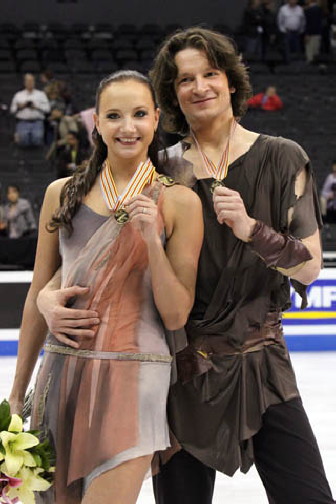
View on WikipediaMaxim Andreyevich Shabalin (Russian: Максим Андреевич Шабалин;[1] born 25 January 1982) is a Russian former competitive ice dancer. He and partner Oksana Domnina are the 2010 Olympic bronze medalists, the 2009 World Champions, the 2008 & 2010 European Champions, the 2007 Grand Prix Final champions, and three-time (2005, 2007, 2010) Russian national champions.
Key Information


Career
[edit]Early career
[edit]Shabalin began skating aged four in Samara – although pushed into the sport by his parents, he grew to enjoy it by the age of 11.[2] He began competing in ice dancing aged 11 or 12.[2] At the age of 15, he moved to Bulgaria to skate with Margarita Toteva for that country but the partnership ended due to her injury.[2][3] He then competed with Elena Khalyavina for Russia.[2]
Partnership with Domnina
[edit]Shabalin was paired with Oksana Domnina in May 2002 by coach Alexei Gorshkov.[4] In their first season together, they won every junior level competition they entered, including the 2002–03 Junior Grand Prix Final and the 2003 World Junior Championships.[5]
Shabalin sustained a meniscus injury in spring 2007 and had surgery on his right knee in May.[4][6] They initially worked on a free dance to Schindler's List but when they wanted to add a faster section they thought it looked too much like a hodgepodge; after consultation with Tatiana Tarasova, they began working on a new free dance to Masquerade Waltz at the start of August.[6] In September 2007, Shabalin also had surgery due to appendicitis.[4] He then had problems with his left knee and had another operation in December.[4] He returned to win the 2008 Europeans but limped off the ice.[4][6] The pain persisted despite therapy, preventing them from training fully and resulting in their withdrawal from the 2008 World Championships.[4] Shabalin spent five weeks in treatment in Munich, Germany, while Domnina trained on her own in Odintsovo, near Moscow.[4]
In June 2008, Domnina/Shabalin announced they were leaving their longtime coach Alexei Gorshkov and moving from Russia to the United States to train with husband-and-wife coaches Natalia Linichuk and Gennadi Karponosov at the IceWorks Skating Complex in Aston, Pennsylvania.[7] The move was considered surprising as their rivals Tanith Belbin / Benjamin Agosto had also moved to the same coaches a couple months prior, but Domnina said the competition at the rink was stimulating.[4]
Domnina/Shabalin won the silver medal at the 2008-09 Grand Prix Final, and then took gold at 2009 Worlds. Afterwards, Shabalin returned to Germany for another four months of therapy on his left knee.[8] They missed the 2009–10 Grand Prix series as a result of his knee problems.[8] They resumed training in November 2009. Shabalin decided to use a brace in practice and competition to limit the movement and protect his knee.[8]

Their original dance based on Australian Aboriginal folk dances sparked controversy in early 2010. Australian Aboriginal leaders were offended by the dance. Domnina/Shabalin said they meant no disrespect and would do the dance at the Olympics. When it was first skated at the 2010 Russian Championships, they wore face makeup but removed it for the 2010 European Championships.[9] Domnina/Shabalin won the bronze medal at the 2010 Olympics and withdrew from the World Championships as a result of continued problems with his knee. He was diagnosed with osteoarthritis.[10] Shabalin received the Overcoming Award at the 2010 Crystal Ice Awards held in October 2010 in Moscow.[11][12] He was also appointed head coach of the Russian national ice dancing team.[13]
Television
[edit]He appeared in the eighth season of ice show contest Ice Age.
Personal life
[edit]Shabalin was born on 25 January 1982 in Samara, Russia.[14] He studied civil administration.[6] He married Russian actress Irina Grineva in November 2010.[10][15] Their daughter, Vasilisa, was born on 6 July 2013 in Marbella, Spain.[16]
Programs
[edit]With Domnina
[edit]
| Season | Original dance | Free dance | Exhibition |
|---|---|---|---|
| 2009–2010 [14][17] |
|
|
|
| 2008–2009 [18][17][19] |
|
|
|
| 2007–2008 [20][17] |
Cossack dance:
|
|
|
| 2006–2007 [21][17] |
|
|
|
| 2005–2006 [22][17] |
Waltz of the Spirits:
|
||
| 2004–2005 [23][17] |
|
|
|
| 2003–2004 [24][17] |
Brasileiro:
| ||
| 2002–2003 [25][17] |
|
Brasileiro:
|
|
With Khalyavina
[edit]| Season | Original dance | Free dance |
|---|---|---|
| 2001–2002 [26] |
|
|
| 2000–2001 [27] |
|
|
Competitive highlights
[edit]GP: Grand Prix; JGP: Junior Series/Junior Grand Prix
With Domnina for Russia
[edit]

| International[28] | ||||||||
|---|---|---|---|---|---|---|---|---|
| Event | 02–03 | 03–04 | 04–05 | 05–06 | 06–07 | 07–08 | 08–09 | 09–10 |
| Olympics | 9th | 3rd | ||||||
| Worlds | 15th | 10th | 8th | 7th | 5th | 1st | ||
| Europeans | 12th | 7th | 6th | 6th | 2nd | 1st | WD | 1st |
| GP Final | 5th | 3rd | 1st | 2nd | ||||
| GP Cup of China | 4th | 1st | 2nd | 1st | ||||
| GP Cup of Russia | 6th | 4th | 3rd | 2nd | 1st | 2nd | ||
| GP Skate America | 3rd | |||||||
| GP Skate Canada | 6th | |||||||
| Finlandia Trophy | 2nd | |||||||
| Schäfer Memorial | 1st | |||||||
| Skate Israel | 2nd | |||||||
| International: Junior[28] | ||||||||
| Junior Worlds | 1st | |||||||
| JGP Final | 1st | |||||||
| JGP France | 1st | |||||||
| JGP Serbia | 1st | |||||||
| National[29] | ||||||||
| Russian Champ. | 3rd | 2nd | 1st | 2nd | 1st | 1st | ||
| Russian Jr. Champ. | 1st | |||||||
| WD: Withdrew | ||||||||
With Khalyavina for Russia
[edit]| International[5][26][27] | |||
|---|---|---|---|
| Event | 1999–2000 | 2000–01 | 2001–02 |
| World Junior Champ. | 10th | 3rd | 2nd |
| JGP Final | 2nd | 1st | |
| JGP Czech Republic | 1st | ||
| JGP Italy | 1st | ||
| JGP Norway | 3rd | 1st | |
| JGP Poland | 1st | ||
| JGP Slovenia | 1st | ||
| National[29] | |||
| Russian Junior Champ. | 3rd | 2nd | 1st |
With Toteva for Bulgaria
[edit]| International[27] | |
|---|---|
| Event | 1997–98 |
| World Junior Championships | 14th |
| JGP Bulgaria | 6th |
| JGP Slovakia | 6th |
| National | |
| Bulgarian Championships | 2nd |
References
[edit]- ^ СПИСОК кандидатов в спортивные сборные команды Российской Федерации по фигурному катанию на коньках на 2011-2012 гг. [2011–2012 list] (PDF). Russian Figure Skating Federation (in Russian). Russian Sports Ministry. 2011. Archived from the original (PDF) on 12 November 2012.
- ^ a b c d Rosewater, Amy (9 February 2010). "For Domnina, Shabalin, Olympics is all business". icenetwork.com. Retrieved 23 September 2010.
- ^ "1997/1998 ISU Junior Series results". Figure Skating Corner. Archived from the original on 2008-10-09.
- ^ a b c d e f g h Flade, Tatjana (12 October 2008). "Fresh start for Domnina and Shabalin". GoldenSkate.com. Retrieved 14 September 2010.
- ^ a b "World Junior Figure Skating Championships: ISU Results: Dance" (PDF). International Skating Union. Archived from the original (PDF) on 4 October 2013.
- ^ a b c d "Interview Oksana Domnina/Maxim Schabalin (Jan 2008/Nov 2007)". figureskating-online. 10 March 2008. Archived from the original on 16 March 2012.
- ^ Hinckley, Todd (20 June 2008). "Domnina, Shabalin Team with Linichuk". Icenetwork.com. Retrieved 14 September 2010.
- ^ a b c Flade, Tatjana (2 January 2010). "Oksana Domnina and Maxim Shabalin: On the comeback trail". GoldenSkate.com. Retrieved 14 September 2010.
- ^ Hersh, Philip (23 January 2010). "Australian Aborigines find ice dance performance 'offensive'". Los Angeles Times. Retrieved 14 September 2010.
- ^ a b Mustafina, Mira (30 September 2010). Если не под венец, то в монастырь, так считают наши сегодняшние герои [If not marriage, then a monastery] (in Russian). Archived from the original on 27 September 2011.
- ^ Golinsky, Reut (19 November 2010). "Ice festival in Moscow". AbsoluteSkating.com. Retrieved 22 December 2010.
- ^ Kozina, Anna (20 October 2010). "Хрустальный лед" растаял : В Москве наградили лучших фигуристов ["Crystal Ice" melted: Top skaters awarded in Moscow]. Rossiyskaya Gazeta (in Russian). Retrieved 21 October 2010.
- ^ Максим Шабалин стал старшим тренером по танцам в сборной России по фигурному катанию [Maxim Shabalin became senior dance coach in the Russian national figure skating]. allsportinfo.ru (in Russian). 20 October 2010. Archived from the original on 9 November 2011.
- ^ a b "Oksana DOMNINA / Maxim SHABALIN: 2009/2010". International Skating Union. Archived from the original on 7 April 2010.
- ^ Yakovleva, Arina (4 December 2010). Свадьба Ирины Гриневой и Макса Шабалина [Wedding of Irina Grineva and Maxim Shabalin] (in Russian). spletnik.ru. Archived from the original on 15 March 2012.
- ^ "Ирина Гринева и Максим Шабалин о новорожденной дочке" [Irina Grineva and Maxim Shabalin on their newborn daughter]. Hello Magazine (Russian version) (in Russian). 2013. Archived from the original on 30 December 2013.
- ^ a b c d e f g h "Programs". Official website of Domina/Shabalin. Archived from the original on 30 April 2010. Retrieved 2 October 2012.
- ^ "Oksana DOMNINA / Maxim SHABALIN: 2008/2009". International Skating Union. Archived from the original on 6 May 2009.
- ^ "Oksana Domnina: ice dancing, Maxim and I". ArtOnIce.it. 15 March 2009. Retrieved 3 January 2012.
- ^ "Oksana DOMNINA / Maxim SHABALIN: 2007/2008". International Skating Union. Archived from the original on 13 May 2008.
- ^ "Oksana DOMNINA / Maxim SHABALIN: 2006/2007". International Skating Union. Archived from the original on 29 April 2007.
- ^ "Oksana DOMNINA / Maxim SHABALIN: 2005/2006". International Skating Union. Archived from the original on 15 July 2006.
- ^ "Oksana DOMNINA / Maxim SHABALIN: 2004/2005". International Skating Union. Archived from the original on 15 April 2005.
- ^ "Oksana DOMNINA / Maxim SHABALIN: 2003/2004". International Skating Union. Archived from the original on 3 June 2004.
- ^ "Oksana DOMNINA / Maxim SHABALIN: 2002/2003". International Skating Union. Archived from the original on 15 April 2003.
- ^ a b "Elena KHALIAVINA / Maxim SHABALIN: 2001/2002". International Skating Union. Archived from the original on 21 December 2002.
- ^ a b c "Elena KHALIAVINA / Maxim SHABALIN: 2000/2001". International Skating Union. Archived from the original on 28 April 2001.
- ^ a b "Competition Results: Oksana DOMNINA / Maxim SHABALIN". International Skating Union. Archived from the original on 15 October 2013.
- ^ a b "Максим Андреевич Шабалин" [Maxim Andreyevich Shabalin] (in Russian). fskate.ru.
External links
[edit]
- Oksana Domnina / Maxim Shabalin at the International Skating Union
- Elena Khalyavina / Maxim Shabalin at the International Skating Union
- Oksana Domnina / Maxim Shabalin - official website


