


Community hub
Recent from talks
Contribute something
Nothing was collected or created yet.
Andrew Poje
View on Wikipedia
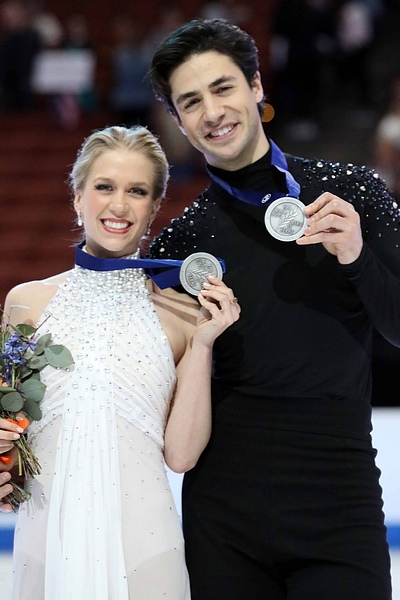
Andrew Poje (born February 25, 1987) is a Canadian ice dancer. With partner Kaitlyn Weaver, he is a three-time World medalist (2014 silver, 2015 and 2018 bronze), a two-time Four Continents champion (2010, 2015), a two-time Grand Prix Final champion (2014–15, 2015–16), and a three-time Canadian national champion (2015, 2016, 2019).
Key Information


Personal life
[edit]Andrew Poje was born on February 25, 1987, in Waterloo, Ontario.[1] His ancestry is Slovak — his mother was born in Bratislava[2] — and Slovenian Gottscheer.[3] He is the great-nephew of former pair skater and coach Agnesa Búřilová (née Wlachovská).[2] He has some knowledge of French.[4]
Career
[edit]Early career
[edit]Poje took up ice dancing at age seven and also skated in singles until he was 13.[5] In his early career, he competed with Alexandra Nino, with whom he is the 2001 Canadian novice silver medalist. He teamed up with Alice Graham in late spring 2004.[6] They trained in Kitchener-Waterloo with coaches Paul MacIntosh, Rebecca Babb, Susie McGrigor, and Bernie Ford.[7] They won the bronze medal on the junior level at the 2005 Canadian Championships and placed ninth at the senior level at the 2006 Canadian Championships.
2006–07 season: Junior World bronze
[edit]Poje teamed up with American-born Kaitlyn Weaver in August 2006.[5] They trained in Kitchener-Waterloo, Ontario[8] under coach Paul MacIntosh.
Weaver/Poje competed on the 2006–07 ISU Junior Grand Prix, winning two bronze medals. They went to the 2007 Canadian Championships and won the bronze medal in their first season together. They were placed on the team to the 2007 Junior Worlds. Weaver dislocated her left shoulder in the warm-up before the original dance but was able to compete and the couple won the bronze medal.[9][10] They placed twentieth at the 2007 World Championships.
2007–08 season
[edit]In the 2007–08 season, Weaver/Poje competed on the senior Grand Prix series at the 2008 Skate Canada International, where they placed 6th, and at the 2007 Trophée Eric Bompard, where they placed seventh. They won the silver medal at the 2008 Canadian Championships, placed 5th at the 2008 Four Continents, and seventeenth at the 2008 World Championships. In January 2008, they moved to Toronto to train with new coach Shae-Lynn Bourne.[11][12][13]
2008–09 season
[edit]In the 2008–09 season, Weaver/Poje competed on the Grand Prix series at the 2008 Cup of China, where they placed 6th, and at the 2008 NHK Trophy, where they placed 7th. They won the bronze medal at the 2009 Canadian Championships and placed fifth at the 2009 Four Continents. Weaver was granted Canadian citizenship in June 2009.[14] Advised by Bourne that they needed a more competitive atmosphere, they switched training bases in 2009 to the Detroit Skating Club in Bloomfield Hills, Michigan, where they were coached by Pasquale Camerlengo and Anjelika Krylova.[15] They also continued to work with Bourne.[15][16] Massimo Scali, Natalia Annenko, and Elizabeth Punsalan were also members of the coaching team in Michigan.[15]
2009–10 season: Four Continents gold
[edit]During the 2009–10 season, Weaver/Poje won their first Grand Prix medal, bronze at 2009 Skate Canada International. They also won bronze at the 2010 Canadian Championships. They were sent to the 2010 Four Continents where they won the gold medal. They did not qualify for the Olympic or World teams.
2010–11 season
[edit]During the 2010–11 season, Weaver/Poje won silver medals at the 2010 NHK Trophy and the 2011 Canadian Championships. They qualified for their first Grand Prix Final, where they finished 5th. They were fourth at the 2011 Four Continents. They were sent to the 2011 World Championships and placed fifth, a significant improvement over their previous best result of seventeenth at the event.[17]
2011–12 season: Four Continents bronze
[edit]
In the 2011–12 season, Weaver/Poje chose their free dance music on the suggestion of an anonymous fan.[18] Karl Hugo composed additional music to add greater variation to the program.[18] Weaver/Poje competed at three Grand Prix events and won three silver medals. They took the bronze medal at 2012 Four Continents before ending their season at the 2012 World Championships, where they placed fourth.[19]
2012–13 season
[edit]For the 2012–13 season, Weaver/Poje decided to go in a new direction and asked a contemporary dancer, Allison Holker, to work with them on their free dance.[20][21] They began their season by winning gold at the 2012 Ondrej Nepela Memorial.[2] Weaver/Poje's Grand Prix assignments were the 2012 Skate America and 2012 Cup of China. At both events, they were second in the short and third in the free dance and won the bronze medal overall behind Russians Ekaterina Bobrova / Dmitri Soloviev.
Weaver fractured her left fibula on December 14, 2012, when she fell into the boards during training in Bloomfield Hills, Michigan, and underwent surgery on December 18 in Toronto.[22][23] As a result, the duo withdrew from the 2013 Canadian Championships.[22] Hoping to compete at Worlds, Poje continued to train in Michigan, with Krylova acting as his partner, while Weaver recovered in Toronto.[23][24] In mid-February, Weaver/Poje were added to Canada's World team.[25] They placed fifth at the 2013 World Championships in London, Ontario.
2013–14 season: Sochi Olympics and World silver
[edit]In the 2013–14 season, Weaver/Poje won two silver medals on the Grand Prix series and placed fifth at the Grand Prix Final. After taking silver at the 2014 Canadian Championships, they were selected to represent Canada at the 2014 Winter Olympics in Sochi, where they finished seventh. At the 2014 World Championships in Saitama, Japan, Weaver/Poje placed second in the short dance and third in the free dance. Finishing 0.02 of a point behind Italy's Cappellini/Lanotte and 0.04 ahead of France's Pechalat/Bourzat, they ended the competition as silver medalists.[26]
2014–15 season: Grand Prix Final and Four Continents gold, World bronze
[edit]In the 2014–15 season, Weaver/Poje took gold at both of their Grand Prix assignments, the 2014 Skate Canada International and 2014 NHK Trophy. In December 2014, they won the Grand Prix Final in Barcelona,[27] having ranked first in both segments ahead of the United States' Madison Chock / Evan Bates. In January, Weaver/Poje won their first Canadian Championship title. They again defeated Chock/Bates at the Four Continents Championships,[28] held in Seoul in February 2015. Weaver/Poje were third in the short dance but first in the free dance, en route to their second Four Continents title. They capped off the season with a bronze medal at the 2015 World Figure Skating Championships.
2015–16 season: Second Grand Prix Final gold
[edit]At the beginning of the 2015–16 season, Weaver/Poje placed first at the 2015 Finlandia Trophy. However, they received the feedback from the judges that their Elvis Presley medley did not have clear rhythm required for the short dance. They changed the music to a set of Johann Strauss II pieces and won the 2015 Skate Canada International three weeks later.[29][30] The team went on to win the 2015 Rostelecom Cup as well as their second consecutive gold at the 2015–16 Grand Prix of Figure Skating Final.[31]
In the second half of the 2015–16 season, Weaver/Poje won their second consecutive national title [32] and finished third at the 2016 Four Continents Figure Skating Championships the following month. The team capped of their season with a fifth-place finish at the 2016 World Figure Skating Championships.
2016–17 season
[edit]During the 2016–17 season, Weaver/Poje began working with Nikolai Morozov as their new coach, training in both New Jersey and Moscow, Russia.[33] They placed second at the Cup of China and third at the 2016 Rostelecom Cup. They won the silver medal at the Canadian Championships and placed fifth at Four Continents. Weaver/Poje finished their season in fourth place at the 2017 World Figure Skating Championships.
2017–18 season: Pyeongchang Olympics and third Worlds medal
[edit]For the 2017–18 season, Weaver/Poje returned with a free dance from the 2011–12 season, 'Je Suis Malade'.[34] They came in second at 2017 Skate Canada and placed fourth at 2017 Inernationaux de France. The couple came in third at the 2018 Canadian Championships, behind Virtue/Moir and Gilles/Poirier. Weaver/Poje represented Canada at the 2018 Winter Olympics in Pyeongchang, placing seventh in ice dancing. At the 2018 World Figure Skating Championships, Weaver/Poje won the bronze medal after placing third in the short dance and fourth in the free dance.
2018–19 season: Four Continents silver
[edit]For the 2018–19 season, Weaver/Poje chose for their free dance "S.O.S. d'un terrien en détresse", a song from the French musical Starmania, after seeing it used by Kazakhstani figure skater Denis Ten. Ten was murdered in July 2018, at which point the pair came to regard the program as a tribute to their friend. They competed at and won the 2018 CS Autumn Classic International, before planning to skip the 2018–19 Grand Prix in favour of a nationwide tour organized by Virtue and Moir.[35]
Returning to competition for the 2019 Canadian Championships, Weaver/Poje placed first in the rhythm dance. As one of the few senior teams who had previously competed the Tango Romantica pattern when it was a compulsory dance in the 2009–10 season, Poje commented that this was both "a benefit and a detriment" due to the changing style of judging.[36] They came second in the free dance, behind Gilles/Poirier, but won the gold medal overall by 1.47 points, their narrowest victory over Gilles/Poirier at Canadian Nationals. Weaver said that, in addition to Ten, the program had been skated in tribute to their recently deceased friend, American pairs skater John Coughlin.[37]
At the 2019 Four Continents Championships, Weaver/Poje placed third in the rhythm dance, behind Madison Hubbell / Zachary Donohue and Chock/Bates. In the free dance, they again ranked third, behind Chock/Bates and Gilles/Poirier, with Hubbell/Donohue falling into fourth place due to a major error on their stationary lift. Weaver/Poje won the silver medal overall.[38]
Weaver/Poje next competed at the 2019 World Championships. They came in fifth place in both segments, scoring a personal best of 82.84 points in the rhythm dance, only 0.26 points out of third. They then scored 122.78 points in the free dance, scoring 205.62 points in total and coming in fifth overall.[39] They concluded their season at the 2019 World Team Trophy, representing Team Canada. They scored 79.60 points in the rhythm dance and a new personal best of 124.18 points in the free dance, while Team Canada finished fifth overall.[40]
2019–20 season
[edit]On June 19, 2019, Weaver and Poje announced that they would not compete in the Grand Prix that autumn, and that they were going to evaluate their future plans.[41]
Post-competitive career
[edit]Following his retirement from competition, Poje continued to perform with Stars on Ice.[42] He appeared on two seasons of the CBC competition program Battle of the Blades, finishing in second place in the fifth season partnered with Natalie Spooner, and later being eliminated in the second round of the sixth season partnered with Meghan Agosta.
In August 2021, it was announced that he would be joining the coaching staff of the Kelowna Skating Club in Kelowna, British Columbia.[42]
Programs
[edit]With Weaver
[edit]| Season | Short dance | Free dance | Exhibition |
|---|---|---|---|
| 2018–19 [43][35] |
|
|
|
| 2017–18 [46][47][48][49] |
|
|
|
| 2016–17 [52][53][54] |
Theme: Country swing
|
Michael Jackson medley[56]
| |
| 2015–16 [57][58][29][30][59][60] |
|
Elvis Presley medley[62]
| |
| 2014–15 [65][66][67] |
|
|
|
| 2013–14 [70][71][66][72][73] |
|
|
|
| 2012–13 [12][20] |
|
|
|
| 2011–12 [75][66] |
|
|
|
| 2010–11 [77][66] |
|
|
|
| Original dance | |||
| 2009–10 [78][79][66] |
|
|
|
| 2008–09 [80][66] |
|
| |
| 2007–08 [81][66] |
|
|
|
| 2006–07 [5][82][66] |
|
|
Competitive highlights
[edit]Ice dance with Kaitlyn Weaver
[edit]
- GP – Event of the ISU Grand Prix Series
- JGP – Event of the ISU Junior Grand Prix Series
- CS – Event of the ISU Challenger Series
- WD – Withdrew from competition
| Season | 2006–07 | 2007–08 | 2008–09 | 2009–10 | 2010–11 | 2011–12 | 2012–13 | 2013–14 | 2014–15 | 2015–16 | 2016–17 | 2017–18 | 2018–19 |
|---|---|---|---|---|---|---|---|---|---|---|---|---|---|
| Winter Olympics | 7th | 7th | |||||||||||
| World Championships | 20th | 17th | 5th | 4th | 5th | 2nd | 3rd | 5th | 4th | 3rd | 5th | ||
| Four Continents Championships | 5th | 5th | 1st | 4th | 3rd | 1st | 3rd | 5th | 2nd | ||||
| Grand Prix Final | 5th | 4th | 5th | 1st | 1st | ||||||||
| Canadian Championships | 3rd | 2nd | 3rd | 3rd | 2nd | 2nd | WD | 2nd | 1st | 1st | 2nd | 3rd | 1st |
| World Team Trophy | 2nd (2nd) |
4th (1st) |
4th (1st) |
5th (4th) | |||||||||
| GP Cup of China | 6th | 6th | 3rd | 2nd | |||||||||
| GP France | 7th | 4th | |||||||||||
| GP NHK Trophy | 7th | 2nd | 2nd | 1st | |||||||||
| GP Rostelecom Cup | 2nd | 2nd | 1st | 3rd | |||||||||
| GP Skate America | 4th | 3rd | |||||||||||
| GP Skate Canada | 6th | 3rd | 2nd | 2nd | 1st | 1st | 2nd | ||||||
| CS Autumn Classic | 2nd | 1st | |||||||||||
| CS Finlandia Trophy | 1st | ||||||||||||
| CS Nebelhorn Trophy | 1st | ||||||||||||
| CS Ondrej Nepela Trophy | 1st | ||||||||||||
| CS U.S. Classic | 2nd | ||||||||||||
| Team Challenge Cup | 1st (1st) |
| Season | 2006–07 |
|---|---|
| World Junior Championships | 3rd |
| JGP Chinese Taipei | 3rd |
| JGP Czech Republic | 3rd |
Ice dance with Alexandra Nino
[edit]| Season | 2001–02 | 2002–03 | 2003–04 |
|---|---|---|---|
| JGP Poland | 5th | ||
| JGP Serbia | 7th | ||
| Canadian Championships | 9th | 6th | 4th |
Detailed results
[edit]Ice dance with Kaitlyn Weaver
[edit]| Segment | Type | Score | Event |
|---|---|---|---|
| Total | TSS | 205.62 | 2019 World Championships |
| Rhythm dance | TSS | 82.84 | 2019 World Championships |
| TES | 45.24 | 2019 World Championships | |
| PCS | 37.60 | 2019 World Championships | |
| Free dance | TSS | 124.18 | 2019 World Team Trophy |
| TES | 68.79 | 2019 World Team Trophy | |
| PCS | 56.08 | 2019 Four Continents Championships |
| Segment | Type | Score | Event |
|---|---|---|---|
| Total | TSS | 192.35 | 2018 World Championships |
| Short dance | TSS | 78.31 | 2018 World Championships |
| TES | 41.14 | 2018 World Championships | |
| PCS | 37.31 | 2015–16 Grand Prix Final | |
| Free dance | TSS | 114.04 | 2018 World Championships |
| TES | 57.90 | 2017 Skate Canada International | |
| PCS | 56.47 | 2018 World Championships |
- Small medals for the short program and free skating are only awarded at ISU Championships.
- Medals at team events are awarded for the team results only. Individual placements at team events are listed in parentheses.
Senior level
[edit]| Date | Event | CD | OD | FD | Total | ||||
|---|---|---|---|---|---|---|---|---|---|
| P | Score | P | Score | P | Score | P | Score | ||
| Oct 15–18, 2006 |  2006 JGP Czech Republic 2006 JGP Czech Republic
|
5 | 27.30 | 2 | 47.30 | 2 | 67.58 | 3 | 142.18 |
| Oct 19–22, 2006 |  2006 JGP Chinese Taipei 2006 JGP Chinese Taipei
|
3 | 29.34 | 3 | 46.12 | 3 | 64.62 | 3 | 140.08 |
| Jan 15–21, 2007 |  2007 Canadian Championships 2007 Canadian Championships
|
7 | 27.07 | 3 | 49.84 | 3 | 83.74 | 3 | 160.65 |
| Feb 26 – Mar 4, 2007 |  2007 World Junior Championships 2007 World Junior Championships
|
6 | 30.43 | 4 | 49.03 | 2 | 72.05 | 3 | 151.51 |
| Mar 20–25, 2007 |  2007 World Championships 2007 World Championships
|
18 | 25.76 | 23 | 42.58 | 20 | 71.80 | 20 | 140.14 |
| Date | Event | CD | OD | FD | Total | ||||
|---|---|---|---|---|---|---|---|---|---|
| P | Score | P | Score | P | Score | P | Score | ||
| Nov 1–4, 2007 | 2007 Skate Canada International
|
8 | 25.07 | 8 | 45.74 | 5 | 77.96 | 6 | 148.77 |
| Nov 15–18, 2007 |  2007 Trophée Éric Bompard 2007 Trophée Éric Bompard
|
7 | 27.47 | 7 | 46.99 | 6 | 79.74 | 7 | 196.89 |
| Jan 16–20, 2008 | 2008 Canadian Championships
|
3 | 32.54 | 2 | 55.60 | 4 | 87.47 | 2 | 175.61 |
| Feb 11–17, 2008 |  2008 Four Continents Championships 2008 Four Continents Championships
|
5 | 30.94 | 5 | 55.95 | 4 | 88.47 | 5 | 174.36 |
| Mar 16–23, 2008 |  2008 World Championships 2008 World Championships
|
20 | 27.74 | 17 | 48.62 | 17 | 78.48 | 17 | 154.84 |
| Date | Event | CD | OD | FD | Total | ||||
|---|---|---|---|---|---|---|---|---|---|
| P | Score | P | Score | P | Score | P | Score | ||
| Nov 5–9, 2008 |  2008 Cup of China 2008 Cup of China
|
6 | 29.91 | 6 | 48.77 | 6 | 78.52 | 6 | 157.20 |
| Nov 27–30, 2008 | 2008 NHK Trophy
|
7 | 28.70 | 7 | 46.58 | 7 | 80.36 | 7 | 151.10 |
| Jan 14–18, 2009 | 2009 Canadian Championships
|
5 | 31.69 | 3 | 52.92 | 2 | 85.42 | 3 | 170.23 |
| Feb 2–8, 2009 | 2009 Four Continents Championships
|
5 | 30.62 | 5 | 53.33 | 5 | 84.81 | 5 | 168.76 |
| Date | Event | CD | OD | FD | Total | ||||
|---|---|---|---|---|---|---|---|---|---|
| P | Score | P | Score | P | Score | P | Score | ||
| Oct 29 – Nov 1, 2009 | 2009 Cup of China
|
5 | 30.40 | 9 | 41.11 | 4 | 80.36 | 6 | 151.87 |
| Nov 19–22, 2009 | 2009 Skate Canada International
|
3 | 32.18 | 4 | 51.18 | 4 | 82.28 | 3 | 165.64 |
| Jan 11–17, 2010 | 2010 Canadian Championships
|
3 | 36.87 | 2 | 57.92 | 3 | 89.61 | 3 | 184.40 |
| Jan 27–30, 2010 | 2010 Four Continents Championships
|
1 | 32.67 | 3 | 48.42 | 1 | 85.07 | 1 | 166.16 |
| Date | Event | SD | FD | Total | |||
|---|---|---|---|---|---|---|---|
| P | Score | P | Score | P | Score | ||
| Oct 22–24, 2010 | 2010 NHK Trophy
|
2 | 58.69 | 3 | 82.88 | 2 | 136.93 |
| Nov 11–14, 2010 |  2010 Skate America 2010 Skate America
|
3 | 59.48 | 4 | 82.86 | 4 | 142.34 |
| Dec 8–12, 2010 | 2010–11 Grand Prix Final
|
4 | 55.51 | 5 | 80.83 | 5 | 136.34 |
| Jan 17–23, 2011 | 2011 Canadian Championships
|
2 | 65.64 | 2 | 97.54 | 2 | 153.90 |
| Feb 15–20, 2011 | 2011 Four Continents Championships
|
3 | 65.45 | 4 | 85.69 | 4 | 151.14 |
| Apr 24 – May 1, 2011 |  2011 World Championships 2011 World Championships
|
7 | 65.07 | 4 | 92.57 | 5 | 160.32 |
| Date | Event | SD | FD | Total | |||
|---|---|---|---|---|---|---|---|
| P | Score | P | Score | P | Score | ||
| Oct 27–30, 2011 | 2011 Skate Canada International
|
2 | 63.31 | 3 | 92.68 | 2 | 155.99 |
| Nov 10–13, 2011 | 2011 NHK Trophy
|
2 | 60.07 | 2 | 91.69 | 2 | 151.76 |
| Nov 24–27, 2011 | 2011 Rostelecom Cup
|
2 | 64.45 | 2 | 96.73 | 2 | 161.18 |
| Dec 8–11, 2011 | 2011–12 Grand Prix Final
|
4 | 66.24 | 4 | 99.83 | 4 | 166.07 |
| Jan 16–22, 2012 | 2012 Canadian Championships
|
2 | 68.27 | 2 | 106.26 | 2 | 174.53 |
| Feb 7–12, 2012 | 2012 Four Continents Championships
|
3 | 64.23 | 3 | 99.03 | 3 | 163.26 |
| Mar 26 – Apr 1, 2012 | 2012 World Championships
|
4 | 66.47 | 4 | 100.18 | 4 | 166.65 |
| Date | Event | SD | FD | Total | |||
|---|---|---|---|---|---|---|---|
| P | Score | P | Score | P | Score | ||
| Oct 3–7, 2012 |  2012 Ondrej Nepela Memorial 2012 Ondrej Nepela Memorial
|
1 | 63.77 | 1 | 97.61 | 1 | 161.38 |
| Oct 19–21, 2012 | 2012 Skate America
|
2 | 65.79 | 3 | 91.53 | 3 | 157.32 |
| Nov 2–4, 2012 | 2012 Cup of China
|
2 | 65.59 | 3 | 93.38 | 3 | 158.97 |
| Mar 10–17, 2013 | 2013 World Championships
|
6 | 67.54 | 5 | 98.66 | 5 | 166.20 |
| Apr 11–14, 2013 | 2013 World Team Trophy
|
2 | 62.42 | 2 | 97.66 | 2 (2) | 160.08 |
| Date | Event | SD | FD | Total | |||
|---|---|---|---|---|---|---|---|
| P | Score | P | Score | P | Score | ||
| Sep 12–14, 2013 | 2013 U.S. International Classic
|
2 | 62.61 | 2 | 99.38 | 2 | 161.99 |
| Oct 25–27, 2013 | 2013 Skate Canada International
|
2 | 70.35 | 2 | 104.88 | 2 | 175.23 |
| Nov 22–24, 2013 | 2013 Rostelecom Cup
|
2 | 61.50 | 1 | 101.64 | 2 | 153.37 |
| Dec 5–8, 2013 | 2013–14 Grand Prix Final
|
4 | 67.68 | 5 | 97.36 | 5 | 165.04 |
| Jan 9–15, 2014 | 2014 Canadian Championships
|
2 | 72.68 | 5 | 110.86 | 2 | 183.54 |
| Feb 6–22, 2014 | 2014 Winter Olympics
|
7 | 65.93 | 5 | 103.18 | 7 | 169.11 |
| Mar 24–30, 2014 | 2014 World Championships
|
2 | 69.20 | 3 | 106.21 | 2 | 175.41 |
| Date | Event | SD | FD | Total | |||
|---|---|---|---|---|---|---|---|
| P | Score | P | Score | P | Score | ||
| Sep 24–27, 2014 | 2014 CS Nebelhorn Trophy
|
1 | 65.59 | 2 | 99.73 | 1 | 165.32 |
| Oct 31 – Nov 2, 2014 | 2014 Skate Canada International
|
1 | 68.61 | 1 | 102.49 | 1 | 171.10 |
| Nov 28–30, 2014 | 2014 NHK Trophy
|
1 | 67.51 | 1 | 101.91 | 1 | 169.42 |
| Dec 11–14, 2014 |  2014–15 Grand Prix Final 2014–15 Grand Prix Final
|
1 | 71.34 | 1 | 109.80 | 1 | 181.14 |
| Jan 19–25, 2015 | 2015 Canadian Championships
|
1 | 76.26 | 1 | 111.62 | 1 | 187.88 |
| Feb 9–15, 2015 | 2015 Four Continents Championships
|
3 | 68.31 | 1 | 109.15 | 1 | 177.46 |
| Mar 23–29, 2015 | 2015 World Championships
|
2 | 72.68 | 3 | 106.74 | 3 | 179.42 |
| Apr 16–19, 2015 | 2015 World Team Trophy
|
1 | 73.14 | 2 | 109.79 | 4 (1) | 182.93 |
| Date | Event | SD | FD | Total | |||
|---|---|---|---|---|---|---|---|
| P | Score | P | Score | P | Score | ||
| Oct 9–11, 2015 |  2015 CS Finlandia Trophy 2015 CS Finlandia Trophy
|
1 | 65.13 | 1 | 96.54 | 1 | 161.67 |
| Oct 30 – Nov 1, 2015 | 2015 Skate Canada International
|
1 | 68.00 | 1 | 105.79 | 1 | 173.79 |
| Nov 20–22, 2015 | 2015 Rostelecom Cup
|
1 | 69.49 | 1 | 104.09 | 1 | 173.58 |
| Dec 10–13, 2015 | 2015–16 Grand Prix Final
|
1 | 72.75 | 1 | 109.91 | 1 | 182.66 |
| Jan 18–24, 2016 | 2016 Canadian Championships
|
1 | 76.20 | 1 | 115.53 | 1 | 191.73 |
| Feb 16–21, 2016 | 2016 Four Continents Championships
|
2 | 72.42 | 4 | 101.43 | 3 | 173.85 |
| Mar 28 – Apr 3, 2016 | 2016 World Championships
|
4 | 71.83 | 5 | 110.18 | 5 | 182.01 |
| Apr 22–24, 2016 | 2016 Team Challenge Cup
|
– | – | 1 | 111.56 | 1 (1) | – |
| Date | Event | SD | FD | Total | |||
|---|---|---|---|---|---|---|---|
| P | Score | P | Score | P | Score | ||
| Nov 4–6, 2016 | 2016 Rostelecom Cup
|
3 | 69.81 | 2 | 108.76 | 3 | 178.57 |
| Nov 18–20, 2016 | 2016 Cup of China
|
1 | 73.78 | 2 | 107.76 | 2 | 181.54 |
| Jan 16–22, 2017 | 2017 Canadian Championships
|
2 | 78.92 | 2 | 113.98 | 2 | 192.90 |
| Feb 15–19, 2017 | 2017 Four Continents Championships
|
5 | 71.15 | 4 | 108.94 | 5 | 180.09 |
| Mar 29 – Apr 2, 2017 | 2017 World Championships
|
6 | 74.84 | 6 | 109.97 | 4 | 184.81 |
| Apr 20–23, 2017 | 2017 World Team Trophy
|
2 | 76.73 | 1 | 113.83 | 4 (1) | 190.56 |
| Date | Event | SD | FD | Total | |||
|---|---|---|---|---|---|---|---|
| P | Score | P | Score | P | Score | ||
| Sep 20–23, 2017 | 2017 CS Autumn Classic International
|
2 | 69.32 | 2 | 104.24 | 2 | 173.56 |
| Oct 27–29, 2017 | 2017 Skate Canada International
|
2 | 77.47 | 3 | 112.54 | 2 | 190.01 |
| Nov 17–19, 2017 | 2017 Internationaux de France
|
5 | 68.94 | 3 | 108.03 | 4 | 176.97 |
| Jan 8–14, 2018 | 2018 Canadian Championships
|
4 | 70.31 | 2 | 120.78 | 3 | 191.09 |
| Feb 9–25, 2018 | 2018 Winter Olympics
|
8 | 74.33 | 7 | 107.65 | 7 | 181.98 |
| Mar 21–24, 2018 |  2018 World Championships 2018 World Championships
|
3 | 78.31 | 4 | 114.04 | 3 | 192.35 |
| Date | Event | RD | FD | Total | |||
|---|---|---|---|---|---|---|---|
| P | Score | P | Score | P | Score | ||
| Sep 20–22, 2018 | 2018 CS Autumn Classic International
|
1 | 76.53 | 1 | 120.74 | 1 | 197.27 |
| Jan 13–20, 2019 | 2019 Canadian Championships
|
1 | 85.19 | 2 | 128.59 | 1 | 213.78 |
| Feb 7–10, 2019 | 2019 Four Continents Championships
|
3 | 80.56 | 3 | 123.37 | 2 | 203.93 |
| Mar 18–24, 2019 | 2019 World Championships
|
5 | 82.84 | 5 | 122.78 | 5 | 205.62 |
| Apr 11–14, 2019 | 2019 World Team Trophy
|
5 | 79.60 | 4 | 124.18 | 5 (4) | 203.78 |
References
[edit]- ^ "Andrew POJE". Sochi2014.com. Organizing Committee of the XXII Olympic Winter Games and XI Paralympic Winter Games of 2014 in Sochi. Archived from the original on March 28, 2014.
- ^ a b c Bőd, Titanilla (October 19, 2012). "Kaitlyn Weaver and Andrew Poje: "Inspiration can come from anywhere if you are open to ideas"". Absolute Skating.
- ^ "Profiles". Official website of Weaver and Poje. Archived from the original on July 15, 2014. Retrieved July 15, 2014.
- ^ Zeitlin, Anna (July 14, 2016). "Kaitlyn Weaver and Andrew Poje: "It's been a great journey so far"". Absolute Skating.
- ^ a b c Mittan, Barry (May 1, 2007). "Color Them Bronze". SkateToday.
- ^ "Alice Graham & Andrew Poje". ice-dance.com. August 12, 2004. Archived from the original on October 11, 2007. Retrieved January 8, 2013.
- ^ Mittan, Barry (September 4, 2004). "Graham and Poje Off to Good Start". Golden Skate.
- ^ McConnell, Sheila (April 2009). "From Humble Beginnings to Childhood Dreams Come True: Kaitlyn Weaver goes the distance with Waterloo". University of Waterloo. Archived from the original on June 23, 2011. Retrieved March 20, 2012.
- ^ Kaye, Rosaleen (March 2, 2007). "Bobrova and Soloviev maintain lead at Junior Worlds". GoldenSkate. Retrieved September 13, 2011.
- ^ Kaye, Rosaleen (March 3, 2007). "Bobrova and Soloviev win Junior World title". GoldenSkate. Retrieved September 13, 2011.
- ^ "Official website: Kaitlyn Weaver & Andrew Poje". weaverpoje.com. Archived from the original on March 21, 2012. Retrieved August 11, 2012.
- ^ a b "Kaitlyn WEAVER / Andrew POJE: 2012/2013". International Skating Union. Archived from the original on June 20, 2013.
- ^ Hoyt, Melanie (March 22, 2008). "Shae-Lynn Bourne". ice-dance.com. Archived from the original on March 25, 2008. Retrieved January 8, 2013.
- ^ "Olympic hopeful Kaitlyn Weaver obtains Canadian citizenship". Citizenship and Immigration Canada. June 22, 2009. Archived from the original on March 19, 2012. Retrieved September 13, 2011.
- ^ a b c Russell, Susan D. (November 29, 2011). "Kaitlyn Weaver, Andrew Poje and the Detroit Dynasty". IFS Magazine. Archived from the original on January 17, 2012. Retrieved December 2, 2011.
- ^ Elfman, Lois (July 6, 2011). "Training ramps up for Weaver, Poje". Icenetwork. Archived from the original on September 23, 2012. Retrieved July 6, 2011.
- ^ Brodie, Rob (July 27, 2011). "Kaitlyn Weaver and Andrew Poje Twizzle Into the Top Five". IFS Magazine. Archived from the original on September 12, 2011. Retrieved August 2, 2011.
- ^ a b Elfman, Lois (March 19, 2012). "Weaver, Poje anything but 'Malade' before worlds". Ice Network. Archived from the original on January 5, 2013. Retrieved March 20, 2012.
- ^ Walker, Elvin (June 10, 2012). "Weaver and Poje push towards World podium". Golden Skate.
- ^ a b Elfman, Lois (August 16, 2012). "Weaver and Poje go modern, take new direction". Icenetwork. Archived from the original on January 21, 2014. Retrieved August 23, 2012.
- ^ Elfman, Lois (August 23, 2012). "Holker brings 'crazy ideas' to dance choreography". Icenetwork. Archived from the original on December 22, 2015. Retrieved August 23, 2012.
- ^ a b "Ice dance duo out of Canadian championships after Kaitlyn Weaver injures ankle". The Canadian Press. The Province. December 18, 2012. Archived from the original on February 4, 2013. Retrieved October 4, 2018.
- ^ a b Brodie, Rob (January 22, 2013). "Kaitlyn Weaver and Andrew Poje: Taking it One Day at a Time". IFS Magazine. Archived from the original on January 26, 2013. Retrieved January 23, 2013.
- ^ "Virtue, Moir take big lead in ice dance at Nationals". The Canadian Press. TSN. January 19, 2013.
- ^ "Weaver, Poje join Skate Canada's world team". Skate Canada. IceNetwork. February 15, 2013. Archived from the original on February 19, 2013. Retrieved February 19, 2013.
- ^ Brodie, Rob (August 24, 2014). "Kaitlyn Weaver & Andrew Poje". IFS Magazine. Archived from the original on February 6, 2015. Retrieved March 21, 2015.
- ^ Slater, Paula (December 14, 2014). "Weaver and Poje: 'We've got tons of room to grow'". Golden Skate.
- ^ Slater, Paula (February 13, 2015). "Weaver and Poje not 'placeholders'". Golden Skate.
- ^ a b Smith, Beverley [@BevSmithWrites] (October 21, 2015). "Weaver and Poje have completely their SD from Elvis Presley to Strauss after Finlandia. They compete next week at Skate Canada" (Tweet) – via Twitter.
Smith, Beverley [@BevSmithWrites] (October 21, 2015). "Weaver and Poje have quickly adopted a new short dance, to ensure the rhythms they are using are clear to judges" (Tweet) – via Twitter. - ^ a b Smith, Beverley (October 28, 2015). "Chan-Hanyu rematch highlights Skate Canada". IceNetwork. Archived from the original on October 31, 2015. Retrieved October 29, 2015.
- ^ Slater, Paula (December 18, 2015). "Weaver and Poje coming full circle". Golden Skate.
- ^ Flett, Ted (January 24, 2016). "Weaver and Poje capture second national title". Golden Skate.
- ^ "Coaching News for Two Canadian Skaters, and Music News for Two More". Culturess. September 1, 2016. Retrieved April 28, 2018.
- ^ "Weaver, Poje hoping judges fall in love with old favourite dance | CBC Sports". CBC. Retrieved May 2, 2018.
- ^ a b Smith, Beverley (September 23, 2018). "Weaver and Poje Masterpieces". BEVERLEY SMITH - A figure skating insider (WordPress).
- ^ Curley, Sean (January 18, 2019). "No evidence of "lost time" for Weaver and Poje". Golden Skate.
- ^ Curley, Sean (January 20, 2019). "Weaver and Poje win third national ice dance title". Golden Skate.
- ^ Slater, Paula (February 10, 2019). "Chock and Bates take surprise gold in Ice Dance at Four Continents". Golden Skate.
- ^ Slater, Paula (March 23, 2019). "Papadakis and Cizeron defend World title". Golden Skate.
- ^ Slater, Paula (April 13, 2019). "Team USA wins fourth World Team Trophy gold". Golden Skate.
- ^ "Ice dancers Kaitlyn Weaver, Andrew Poje put career on hold". CBC Sports. June 19, 2019.
- ^ a b Harmel, Isabella (August 4, 2021). "Former Olympian set to coach at the Kelowna Skating Club". Kelowna Capital News.
- ^ "Kaitlyn WEAVER / Andrew POJE: 2018/2019". International Skating Union. Archived from the original on October 6, 2018.
- ^ a b c d e f "Stars on Ice - Music: 2018 Investors Group Stars on Ice presented by Lindt". Stars on Ice. Archived from the original on May 2, 2018. Retrieved May 2, 2018.
- ^ a b Weaver, Kaitlyn (April 4, 2018). "WHAT DO YOU LIVE FOR? @sergeonik #NEWEXH @apoje" (Instagram). Archived from the original on December 24, 2021.
- ^ Smith, Beverley (August 31, 2017). "WEAVER AND POJE WATCH FLOOD FROM AFAR". BEVERLEY SMITH - A figure skating insider (WordPress).
- ^ "Kaitlyn WEAVER / Andrew POJE: 2017/2018". International Skating Union. Archived from the original on October 17, 2017.
- ^ Smith, Beverley (October 26, 2017). "WEAVER AND POJE: JE SUIS MALADE". BEVERLEY SMITH - A figure skating insider (WordPress).
- ^ "Kaitlyn WEAVER / Andrew POJE: 2017/2018". International Skating Union. Archived from the original on October 26, 2017.
- ^ Christmas on Ice 2017 (Television production). TV Tokyo. December 16, 2017.
- ^ ISU Grand Prix of Figure Skating 2017 Skate Canada International - Gala Exhibition (Television production). Eurosport. October 29, 2017.
- ^ Weaver / Poje: 2016 Skate Canada High Performance Camp (YouTube). Skate Canada. September 1, 2016.
- ^ "Kaitlyn WEAVER / Andrew POJE: 2016/2017". International Skating Union. Archived from the original on October 26, 2016.
- ^ "Kaitlyn WEAVER / Andrew POJE: 2016/2017". International Skating Union. Archived from the original on November 3, 2016.
- ^ Canadian Tire National Skating Championships 2017 (Television production). TSN. January 28, 2017.
- ^ a b Christmas on Ice 2016 (Television production). BS Japan. December 22, 2016.
- ^ Kwong, P. J.; Dore, Paul (September 7, 2015). "Episode 142: Kaitlyn Weaver & Andrew Poje". Open Kwong Dore Podcast (Podcast).
{{cite podcast}}: CS1 maint: multiple names: authors list (link) - ^ "Kaitlyn WEAVER / Andrew POJE: 2015/2016". International Skating Union. Archived from the original on October 17, 2015.
- ^ "Kaitlyn WEAVER / Andrew POJE: 2015/2016". International Skating Union. Archived from the original on October 31, 2015.
- ^ "Kaitlyn WEAVER / Andrew POJE: 2015/2016". International Skating Union. Archived from the original on April 23, 2016.
- ^ a b "Stars on Ice - Music: 2016 Investors Group Stars on Ice presented by Lindt". Stars on Ice. Archived from the original on May 3, 2016. Retrieved May 3, 2016.
- ^ Christmas on Ice 2015 (Television production). BS Japan. December 24, 2015.
- ^ The ICE 2015 (Television production). Japan: Chūkyō TV. August 15, 2015.
- ^ a b c Thayer, Jacquelyn (August 6, 2014). "Weaver and Poje Aim to Dominate". ice-dance.com. Archived from the original on April 2, 2015. Retrieved March 2, 2015.
- ^ "Kaitlyn WEAVER / Andrew POJE: 2014/2015". International Skating Union. Archived from the original on July 27, 2015.
- ^ a b c d e f g h "Programs". Official website of Weaver and Poje. Archived from the original on July 15, 2014. Retrieved July 15, 2014.
- ^ Smith, Beverley (August 20, 2014). "Kaitlyn Weaver and Andrew Poje look to push the limits with intense and detailed focused programs". Skate Canada. Archived from the original on April 2, 2015. Retrieved March 2, 2015.
- ^ "2015 Stars on Ice Canada :: Music". Stars on Ice. Archived from the original on May 2, 2015. Retrieved May 2, 2015.
- ^ Christmas on Ice 2014 (Television production). BS Japan. January 7, 2015.
- ^ "Kaitlyn WEAVER / Andrew POJE: 2013/2014". International Skating Union. Archived from the original on July 2, 2014.
- ^ "Kaitlyn Weaver / Andrew Poje: 2013/2014". Skate Canada. Archived from the original on February 13, 2014.
- ^ Smith, Beverley (October 9, 2013). "Geoffrey Tyler brings tap dancing to the ice with Kaitlyn Weaver and Andrew Poje's 42nd Street short dance". Skate Canada. Archived from the original on March 3, 2016. Retrieved March 1, 2015.
- ^ Tone, Florentina (August 7, 2014). "Kaitlyn Weaver and Andrew Poje: "We are focusing on the here and now"". Inside Skating.
- ^ a b "2014 Canadian Stars on Ice - Music" (PDF). Stars on Ice. Retrieved December 18, 2015.
- ^ "Kaitlyn WEAVER / Andrew POJE: 2011/2012". International Skating Union. Archived from the original on June 8, 2012.
- ^ a b "2012 Canadian Stars on Ice - Music" (PDF). Stars on Ice. Retrieved February 10, 2016.
- ^ "Kaitlyn WEAVER / Andrew POJE: 2010/2011". International Skating Union. Archived from the original on May 19, 2011.
- ^ Nealin, Laurie (June 23, 2009). "Weaver adds red and white to red, white and blue". IceNetwork. Archived from the original on October 10, 2017. Retrieved January 9, 2013.
- ^ "Kaitlyn WEAVER / Andrew POJE: 2009/2010". International Skating Union. Archived from the original on May 11, 2010.
- ^ "Kaitlyn WEAVER / Andrew POJE: 2008/2009". International Skating Union. Archived from the original on June 3, 2009.
- ^ "Kaitlyn WEAVER / Andrew POJE: 2007/2008". International Skating Union. Archived from the original on June 7, 2008.
- ^ "Kaitlyn WEAVER / Andrew POJE: 2006/2007". International Skating Union. Archived from the original on April 30, 2007.
- ^ a b c d e f g h i j k l m n o p q "CAN–Kaitlyn Weaver/Andrew Poje". SkatingScores.
External links
[edit]
- Kaitlyn Weaver & Andrew Poje official website
- Kaitlyn Weaver & Andrew Poje at the International Skating Union
- Kaitlyn Weaver & Andrew Poje at Skating Scores
- Andrew Poje at Team Canada
- Andrew Poje at Olympics.com
- Andrew Poje at Olympedia


Andrew Poje
View on GrokipediaEarly Life and Background
Family and Ancestry
Andrew Poje was born on February 25, 1987, in Waterloo, Ontario, Canada. He grew up in the nearby Kitchener-Waterloo region, a twin-city area known for its close-knit communities and emphasis on family-oriented activities. Poje was raised by his parents, Bill Poje and Tanja Poje, alongside his older sister, Julia Poje.[6][1] Poje's family heritage reflects Eastern European roots on both sides. His mother, Tanja, was born and raised in Bratislava, Slovakia, and immigrated to Canada at age 18 in 1968 amid the Soviet-led invasion of Czechoslovakia. This background connected the family to Slovak traditions, including later reunions with relatives such as aunts and cousins during Poje's visit to Bratislava in 2012. Poje's great-aunt, Agnesa Búrilová, was a former Czechoslovakian pairs skater, further linking the family to figure skating traditions. His father, Bill, traces his ancestry to the Gottscheer people, a German-speaking ethnic group historically from the Kočevje region in Slovenia. The Poje surname itself originates from Slovenian and Croatian contexts, often linked to Gottscheer heritage.[7][8] The multicultural influences from his parents' backgrounds contributed to a supportive upbringing in the Kitchener-Waterloo area, where Poje's early years were shaped by strong familial bonds and exposure to diverse cultural elements, including language and traditions from Slovakia and Slovenia. Tanja Poje, a former figure skater, played a key role in fostering an active family environment that emphasized perseverance and community involvement.[6][7]Introduction to Skating and Training
Andrew Poje was introduced to figure skating at the age of seven in Waterloo, Ontario, where he grew up. His mother, a former figure skater, enrolled his sister in lessons at a local rink, and Poje joined her while spending time there, initially intending to pursue hockey but soon becoming engrossed in skating.[2][9] Poje's early training occurred at the Kitchener-Waterloo Skating Club, where he began with singles skating until the age of 13 before transitioning to ice dance at age 13. His decision to focus on ice dance stemmed from observing that all the male figure skaters at his rink were ice dancers, sparking his interest in the discipline and revealing his natural affinity for dance.[1][10][7] This early exposure laid the foundation for his technical development, emphasizing rhythm, expression, and partnership elements essential to ice dance. During his youth, Poje's formative experiences included off-ice conditioning and skill-building under local coaches, honing the precision and artistry that would define his style. He entered initial competitions at the juvenile and novice levels, competing with early partner Alexandra Nino and achieving notable success. These phases prioritized foundational elements like edge control, lifts, and musical interpretation, preparing him for junior-level partnerships without yet entering senior international circuits.[10]Personal Life
Relationships and Family
Andrew Poje shares a close, enduring friendship with his former competitive ice dancing partner Kaitlyn Weaver, with whom he continues to collaborate on professional performances in shows such as Stars on Ice following their retirement from competition in 2019.[11][12] Poje has not publicly disclosed details of a marriage or children as of 2025, maintaining a private personal life focused on his post-competitive endeavors.[2] In his leisure time, Poje pursues a variety of hobbies that complement his athletic background, including cooking, outdoor sports, cycling to explore restaurants, and watching food documentaries as a self-described foodie.[13][2] He also enjoys classic movies, cartoons, and rock music, often incorporating these interests into downtime away from the rink.[14] Poje's heritage includes Slovak roots through his mother, who was born in Bratislava, and Gottscheer Slovenian ancestry; while he does not speak Slovak fluently, he has expressed appreciation for his family's cultural background during visits to Slovakia.[7][15] These ties influence his broader interests in travel and cultural exploration, balancing personal growth with his ongoing involvement in the skating community.[16]Interests and Philanthropy
Andrew Poje maintains a keen interest in culinary pursuits outside his skating career, describing himself as a foodie who enjoys watching documentaries on the subject and cycling to discover new restaurants during his off-days. He has also pursued academic endeavors in biomedical science, earning a Bachelor of Science degree from the University of Waterloo and a Master of Management in Innovation and Entrepreneurship from the Smith School of Business at Queen's University, which reflects his broader curiosity in health and science-related fields.[2][17] These hobbies provide a counterbalance to the rigors of competitive and professional skating, allowing him to explore personal passions in the 2020s amid his post-retirement activities.[2] Poje has been actively involved in philanthropy as an ambassador for Right to Play since 2013, a global organization that leverages sport and play-based programs to empower children facing adversity in more than 15 countries, focusing on education, health, and gender equality. Alongside his former ice dancing partner Kaitlyn Weaver, he promotes the initiative's mission to foster inclusive opportunities for youth through play, emphasizing its role in building resilience and community access to sports. His ambassadorship highlights a commitment to using his platform as an Olympian to support underprivileged children worldwide.[18][19] In the late 2010s and early 2020s, Poje participated in charitable events tied to his athletic background, including the CBC reality series Battle of the Blades. In 2019, paired with hockey player Natalie Spooner, he competed to raise funds for Right to Play and Fast and Female, an organization promoting girls' participation in sport; as runners-up, they secured over $17,000 in donations for these causes. The following year, he teamed with Meghan Agosta to support the BC Children's Hospital Foundation, further demonstrating his dedication to pediatric health and sports accessibility through high-profile fundraising performances.[20][21][22]Competitive Career
Early Partnerships
Andrew Poje's first significant ice dance partnership was with Alexandra Nino, formed through the Kitchener-Waterloo Skating Club where they met as children around age seven. Their collaboration, spanning from the mid-1990s to 2004, focused on novice and junior levels, with the pair training primarily in Kitchener-Waterloo under local coaches such as Paul MacIntosh. During this time, Nino and Poje built a foundation in competitive ice dancing, progressing through regional and national events while developing technical elements like lifts and footwork essential to the discipline.[23][24] At the junior level, Nino and Poje competed internationally, including a seventh-place finish at the 2002 Junior Grand Prix in Yugoslavia. Domestically, they showed steady improvement, highlighted by their fourth-place result at the 2004 Canadian Championships, which marked one of their strongest national performances and demonstrated their growing synchronization and artistic expression. These results positioned them as promising juniors within Canadian ice dance, though they did not yet qualify for senior international assignments.[25][26] The partnership with Nino concluded after the 2004 season, prompting Poje to seek a new collaborator amid the challenges of partner transitions common in ice dance. In late spring 2004, he teamed up with Alice Graham, another Canadian skater from Ontario, and the duo trained under coaches Paul Macintosh, Rebecca Babb, and Susie MacGregor at the same Kitchener-Waterloo base. Their brief but successful tenure culminated in a bronze medal at the 2005 Canadian Junior Championships, showcasing Poje's adaptability and competitive edge in compulsory and free dances.[24][10][25] Following the end of the Graham partnership in early 2006, Poje navigated a short transition period involving partner assessments and skill maintenance to remain eligible for higher-level competition. This phase, typical for dancers seeking long-term compatibility, involved testing sessions and local exhibitions to refine his elements without a fixed partner. By mid-2006, these efforts led to his pairing with Kaitlyn Weaver, marking the start of his most enduring professional collaboration.[27][28]Seasons with Kaitlyn Weaver: Junior and Early Senior (2006–2010)
Kaitlyn Weaver and Andrew Poje formed their ice dancing partnership in August 2006, after both had previously competed with other partners.[13] Weaver, originally from the United States, relocated to Waterloo, Ontario, to train with Poje under coach Igor Shpilband at the Detroit Skating Club in Michigan.[29] This move marked a significant commitment for the duo, who quickly adapted to international-level training and began competing together within months. In their debut 2006–07 season, Weaver and Poje achieved immediate success by earning the bronze medal at the senior level of the Canadian Figure Skating Championships, surprising many as newcomers to the partnership.[30] Representing Canada at the ISU World Junior Championships, they secured another bronze medal, finishing third with a total score of 139.05 points behind Russians Elena Chernyshova/Michail Tumanovsky and Americans Madison Chock/Gregory Zuerlein. The pair also made their senior World Championships debut in Tokyo, placing 20th overall with 140.14 points, qualifying them for the free dance segment.[31] The 2007–08 season saw Weaver and Poje continue their rise with a silver medal at the Canadian Championships, finishing second to Tessa Virtue and Scott Moir with 162.77 points.[32] Assigned to the ISU Grand Prix series for the first time, they competed at Skate Canada International, placing eighth with 148.77 points. At the World Championships in Göteborg, Sweden, they improved to 17th place, scoring 152.72 points and advancing to the original dance. During the 2008–09 season, the duo earned bronze at the Canadian Championships, placing third behind Virtue/Moir and Vanessa Crone/Paul Poirier with a total of 170.23 points.[33] They received Grand Prix assignments at NHK Trophy, where they finished sixth, and Trophée Eric Bompard, placing seventh, gaining valuable international experience.[34] This period included a coaching change in January 2008, when they switched to Shae-Lynn Bourne, a former world champion, to refine their technical elements and artistic expression.[35] The 2009–10 season represented a breakthrough, highlighted by their first Grand Prix medal—a bronze at Skate Canada International—and gold at the ISU Four Continents Championships in Jeonju, South Korea, where they tallied 166.16 points to edge out Russia's Jana Khokhlova/Sergei Novitski.[36] Weaver obtained Canadian citizenship that year, solidifying their eligibility for higher-level competitions.[35] Although they placed third at the Canadian Championships, behind Virtue/Moir and Crone/Poirier, the season underscored their growing consistency without major injuries reported during this formative period.Seasons with Kaitlyn Weaver: Mid-Career Development (2011–2013)
During the 2010–11 season, Weaver and Poje demonstrated significant progress in their partnership, securing a silver medal at the NHK Trophy after placing fourth at [Skate America](/page/Skate America), which qualified them for their first ISU Grand Prix Final where they finished fifth.[37] They also claimed silver at the Canadian Figure Skating Championships, earning selection for the Four Continents Championships where they placed fourth, before achieving a career-best fifth place at the World Championships in Moscow.[37][38] These results marked an improvement from their previous season's ninth-place finish at Worlds, highlighting their growing technical consistency and competitive maturity under coach Igor Shpilband.[37] In the 2011–12 season, the duo continued their upward trajectory, winning silver medals at both Skate Canada International and the NHK Trophy, followed by a second-place finish after the short dance at the Rostelecom Cup before ultimately placing second overall there as well.[37] This strong Grand Prix performance led to a fourth-place result at the ISU Grand Prix Final.[37] At the Canadian Championships, they again earned silver, then captured bronze at the Four Continents Championships in Colorado Springs—their first medal at that event—and concluded the season with a fourth-place finish at the World Championships in Nice, their best result to date.[39][37] Their free dance to "Je suis malade" by Lara Fabian, choreographed by Pasquale Camerlengo, emphasized emotional vulnerability and narrative depth, reflecting a stylistic evolution toward more interpretive artistry after transitioning their primary training to the Detroit Skating Club with Camerlengo and Anjelika Krylova in 2011.[7][40] The 2012–13 season represented a breakthrough, as Weaver and Poje won their first Canadian senior title at the national championships in Mississauga, surpassing training mates Tessa Virtue and Scott Moir who were returning from injury.[41] On the Grand Prix circuit, they earned silver at Skate Canada International, bronze at the Cup of China, and bronze at Skate America, securing qualification for the Grand Prix Final where they placed fourth.[37] They followed with gold at the Ondrej Nepela Memorial and a fifth-place finish at the World Championships in London, Ontario, solidifying their status as consistent top contenders.[37] Building on their artistic focus, their free dance to "Humanity" by Nathan Lanier incorporated contemporary elements developed in collaboration with dancer Allison Holker, further enhancing emotional expressiveness and innovative movement under Camerlengo's guidance.[42] This period underscored the partnership's mid-career development, transitioning from technical refinement to a balanced emphasis on passionate, story-driven performances.Seasons with Kaitlyn Weaver: Olympic Cycle and World Success (2013–2015)
The 2013–14 season marked the Olympic cycle for Weaver and Poje, beginning with their first national title at the 2014 Canadian Figure Skating Championships in Ottawa, where they defeated Piper Gilles and Paul Poirier by over 10 points.[43] Their short dance featured a paso doble to "La Virgen de la Macarena," while their free dance was set to "María de Buenos Aires" by Ástor Piazzolla, choreographed by Pasquale Camerlengo.[44] At the 2014 Winter Olympics in Sochi, Russia, they placed 17th in the short dance but advanced to the free dance, where they finished fifth and ended seventh overall with a total score of 169.11 points.[45] Following the Games, they secured a silver medal at the 2014 World Figure Skating Championships in Saitama, Japan, finishing second in the short dance and third in the free dance, just 0.02 points behind gold medalists Meryl Davis and Charlie White.[43][46] Post-Olympics, Weaver and Poje adjusted their training by increasing time in Toronto under Shae-Lynn Bourne while maintaining technical work in Detroit with coaches Pasquale Camerlengo and Anjelika Krylova, focusing on refining their elements and artistic expression to build on their Olympic experience.[47] This shift helped them enter the 2014–15 season strongly, winning their second consecutive Canadian title in Halifax with a free dance to "The Four Seasons" by Antonio Vivaldi, choreographed by Camerlengo.[48] Their short dance that year incorporated flamenco rhythms to music by Karl Hugo and Jesse Cook.[44] On the Grand Prix circuit, they claimed gold at both Skate Canada International and the NHK Trophy, qualifying them for the ISU Grand Prix Final in Barcelona, Spain, where they won the ice dance title with 181.14 points, edging out Madison Chock and Evan Bates by less than three points.[44] They extended their undefeated streak with gold at the 2015 Four Continents Championships in Seoul, South Korea, leading after the short dance and winning the free dance by over six points.[48] At the 2015 World Figure Skating Championships in Shanghai, China, Weaver and Poje earned bronze with 179.42 points, placing third in both segments after leading much of the competition but yielding to Papadakis and Cizeron in the free dance.[49][50] Their Olympic debut and consecutive world medals drew significant media coverage from Canadian outlets, highlighting their resilience after Weaver's 2012 injury and their role as emerging leaders in Canadian ice dance during Virtue and Moir's hiatus.[51][52] Poje later reflected that the high-stakes events fostered personal growth, teaching them to manage pressure and embrace the visibility of elite competition.[53]Seasons with Kaitlyn Weaver: Continued Achievements and Second Olympics (2016–2018)
In the 2015–16 season, Weaver and Poje achieved significant success on the ISU Grand Prix circuit, culminating in their second consecutive gold medal at the Grand Prix Final in Barcelona, where they earned a total score of 182.66 points after placing first in both the short dance to "The Blue Danube" by Johann Strauss II and the free dance to "On the Nature of Daylight" by Max Richter and "This Bitter Earth/On the Nature of Daylight" medley.[54][55] They followed this with a bronze medal at the 2016 Four Continents Championships in Taipei, scoring 168.94 points overall despite facing challenges from a nagging foot injury that required extensive physiotherapy for Weaver.[56] At the 2016 World Championships in Boston, the duo secured fourth place with 182.26 points, marking their best finish at the event since 2014 and demonstrating resilience amid Weaver's injury management, which limited training time but did not prevent a strong free dance performance. The 2016–17 season saw Weaver and Poje maintain competitive momentum, beginning with a gold medal at the NHK Trophy in Japan, where they scored 190.09 points, and a silver at the Cup of China in Beijing with 184.99 points, qualifying them for the Grand Prix Final though they placed sixth there.[57] At the 2017 Canadian Championships, they earned silver behind returning Olympic champions Tessa Virtue and Scott Moir, totaling 190.13 points in programs featuring a short dance to blues medley including "The Way You Make Me Feel" by Michael Jackson and a free dance to "Concierto de Aranjuez" by Joaquín Rodrigo.[58] Their season concluded with a fourth-place finish at the 2017 World Championships in Helsinki, scoring 190.56 points— a personal best—highlighting how their growing experience as a veteran pair, with over a decade of partnership, allowed them to refine emotional depth and technical precision in high-pressure settings.[59] Heading into the 2017–18 Olympic cycle, Weaver and Poje, now in their early 30s and early 30s respectively, leveraged their maturity to deliver mature, narrative-driven programs that emphasized storytelling over sheer athleticism, contributing to consistent top-tier placements despite the physical toll of age on recovery and endurance. Their short dance to "Je suis malade" by Lara Fabian and free dance to "Boléro" by Maurice Ravel propelled them to bronze at the 2018 Canadian Championships (191.09 points) and a seventh-place finish at the PyeongChang Olympics with 181.98 points, their second Olympic appearance where they ranked seventh in both segments.[60] The season's highlight came at the 2018 World Championships in Milan, where they captured their third career world medal—a bronze—with 198.33 points, placing third in the short dance and fourth in the free, a performance that underscored the positive impact of their extensive experience in overcoming minor setbacks like fatigue and maintaining competitive edge against younger rivals.[61][62]Seasons with Kaitlyn Weaver: Final Years and Retirement (2018–2020)
The 2018–19 season marked the final competitive year for Weaver and Poje, who opened with a gold medal at the 2018 Skate Canada Autumn Classic in Oakville, Ontario, earning 197.27 points for their performances to "Libertango" by Astor Piazzolla in the rhythm dance and "S.O.S. d'un terrien en détresse" by Andreas Johnson in the free dance, the latter dedicated as a tribute to the late figure skater Denis Ten. At the 2019 Canadian Championships in Saint John, New Brunswick, they secured their third national title with a total score of 213.78 points, placing first in the rhythm dance and second in the free dance despite a challenging season marked by injuries and coaching transitions.[63] In February 2019, at the ISU Four Continents Championships in Anaheim, California, Weaver and Poje earned the silver medal with 203.93 points, finishing third in the rhythm dance and third in the free dance behind Madison Chock and Evan Bates of the United States.[64] They concluded the season at the 2019 ISU World Figure Skating Championships in Saitama, Japan, where they placed fifth overall with a personal best total of 205.62 points, including a season-best rhythm dance score of 82.84, marking Canada's best result in the discipline at the event.[65] Later that month, at the 2019 ISU World Team Trophy in Fukuoka, Japan, they contributed to Canada's fourth-place team finish by placing fourth in the free dance with 124.18 points.[66] Following the season, Weaver and Poje announced on June 19, 2019, that they would take an indefinite break from competition during the 2019–20 season to focus on professional ice shows, personal development, and exploring other opportunities, while leaving open the possibility of a return.[67] This decision came amid evolving ISU qualification rules that emphasized participation in Grand Prix and Challenger Series events, which they chose to skip. The COVID-19 pandemic further disrupted the figure skating calendar, leading to the cancellation of the 2020 ISU World Figure Skating Championships in March 2020, an event for which they might have sought qualification had they continued competing.[68] Following their indefinite break from the 2019–20 season, Weaver and Poje retired from competitive skating after 14 years of partnership since teaming up in 2006, reflecting on their enduring collaboration that produced three World medals, two Four Continents titles, and a lasting impact on Canadian ice dance through innovative programs and emotional storytelling. The duo expressed gratitude for their shared journey, noting the emotional weight of their final free dance as a poignant closure to their elite career, while transitioning to professional performances that allowed them to maintain their artistic connection on the ice.[69]Post-Competitive Career
Professional Performances and Media
Following his retirement from competitive ice dancing after the 2018 season, Andrew Poje transitioned to professional performances, showcasing his artistry in touring ice shows and television productions.[70] In 2019, Poje appeared on the fifth season of the CBC television series Battle of the Blades, where he paired with professional hockey player Natalie Spooner to raise funds for Right To Play.[71] The duo performed routines blending hockey and skating elements, including numbers to songs like "Higher Love" and "Powerful," and finished in second place behind winners Sheldon Kennedy and Kaitlyn Weaver.[72][73] This appearance marked an early foray into entertainment skating, highlighting Poje's versatility in partnering outside his competitive discipline.[74] Poje has since become a staple in the Stars on Ice tours, performing annually with longtime partner Kaitlyn Weaver in productions that feature elaborate choreography and live music. The 2020 tour, themed "Journey," included Weaver and Poje in group and solo segments across North American venues before the COVID-19 pandemic curtailed events.[75] In 2021, they joined the holiday edition in select cities, such as Austin, Texas, where they delivered festive routines emphasizing emotional storytelling.[29] The pair continued with the 2022 Canadian tour, debuting new show programs that incorporated contemporary music and innovative lifts, as seen in practice sessions shared publicly.[76] By 2024, Weaver and Poje headlined the Stars on Ice Holiday Tour, performing holiday classics like "Let It Snow! Let It Snow! Let It Snow!" in Canadian arenas, including stops in Kelowna and Victoria.[12][77] This tour celebrated seasonal themes with a cast of Olympic medalists, drawing large audiences for its blend of athleticism and holiday spirit.[78] In 2025, Poje and Weaver participated in the Stars on Ice US Tour, which concluded in May and featured them alongside skaters like Kurt Browning and Satoko Miyahara in dynamic group numbers and pas de deux.[79] These performances have allowed Poje to repurpose elements from his competitive repertoire, such as fluid transitions and expressive partnering, in a professional context. Throughout these tours, Poje has contributed to skating specials broadcast on networks like CBC, providing behind-the-scenes insights and enhancing the visibility of ice dance in media.[80] His ongoing involvement underscores a seamless shift from competition to entertainment, maintaining his status as a prominent figure in professional figure skating.Coaching and Skating Development
In August 2021, Andrew Poje joined the coaching staff of the Kelowna Skating Club in British Columbia, where he focuses on mentoring young ice dancers and contributing to athlete development programs.[81][82] As a former Olympian, Poje emphasizes technical proficiency in ice dance elements, such as edge work and partnering, while fostering holistic growth for skaters at various levels within the club's competitive and recreational streams.[10] Poje has served as Skater in Residence for Skate Ontario since at least March 2023, a role in which he shares expertise on athlete development through blog contributions and social media engagement.[83] In his blogs, he addresses key aspects of mental preparation, such as overcoming the fear of failure by reframing it as an opportunity for growth, drawing from personal experiences like performance setbacks during national team camps.[84] He also explores intuition in skating, highlighting how accumulated experiences enhance decision-making under pressure, including partnership dynamics where trust and risk-taking are essential for synchronized routines.[85] Through these platforms, Poje conducts virtual and in-person clinics on ice dance technique, mental resilience, and building effective partnerships, often integrating off-ice elements like mindfulness exercises to support young athletes.[17] His work extends to collaborations with Skate Canada, where as a Director at Large on the Board of Directors (term 2024–2026, as of November 2025), he contributes to ongoing inclusivity initiatives, including policy advancements for gender-diverse teams in domestic competitions.[86][87] These efforts align with Skate Canada's broader commitment to equity and accessibility in figure skating as of 2025.[88]Speaking and Executive Coaching
Following his retirement from competitive ice dancing after the 2018 season, Andrew Poje became a certified executive coach, specializing in mindset mastery and goal achievement for professionals seeking career excellence. Drawing on his experiences as a two-time Olympian, Poje offers personalized coaching through his Untethered Performance Coaching program, which emphasizes transformative personal development and overcoming self-limiting beliefs.[17][89][70] Poje has established himself as a keynote speaker, delivering talks on leadership and resilience informed by his Olympic journey, including themes of thriving under pressure and deliberate self-growth. His presentations highlight the importance of adapting to challenges, as seen in his discussions on mastering life's pressures and building resilience through intentional discomfort. These engagements focus on empowering audiences in business and personal contexts, with corporate talks available for booking to foster motivation and transformation.[17][89][90] In youth performance coaching, Poje holds certification as a Youth Coach through Youthfully and mentors young athletes on academic and performance strategies, incorporating elements of mental well-being such as stress management and emotional balance. His work includes guiding children in applying Olympian-level learning techniques to build confidence and resilience, with ongoing programs extending into 2025. Poje also contributes to broader youth development as an ambassador for Right to Play, integrating motivational insights into non-sporting growth.[91][70][92] Poje shares his expertise on personal growth through online publications, including LinkedIn posts and Medium articles post-2019, such as explorations of embracing change, the power of curiosity, and navigating adversity with unity. These writings, often rooted in his transition from athletics to coaching, provide practical advice on self-development and have garnered engagement from professional audiences.[17]Programs and Choreography
Ice Dance Programs with Kaitlyn Weaver
Kaitlyn Weaver and Andrew Poje's ice dance programs spanned their partnership from 2006 to 2019, featuring a mix of classical, theatrical, and contemporary music selections that highlighted their artistic synergy and technical prowess. Early programs often drew from opera and film scores for dramatic flair, while later ones incorporated modern arrangements and popular medleys for emotional depth. Choreography was primarily developed under coaches like Igor Shpilband, Pasquale Camerlengo, and Shae-Lynn Bourne, evolving toward innovative lifts and intricate footwork that earned acclaim for their maturity and storytelling.[13] Their programs are listed chronologically below, with music selections for the compulsory/original/short/rhythm dance and free dance.| Season | Short/Original/Rhythm Dance | Free Dance | Choreographer(s) | Notes/Stylistic Themes |
|---|---|---|---|---|
| 2006–2007 | “Jeanne y Paul” by Astor Piazzolla; “Verano Porteno” from The Story of Tango by Raul Garello | “One Fine Day” from Madame Butterfly by Giacomo Puccini | Not specified | Theatrical opera theme emphasizing passion and narrative.[93] |
| 2007–2008 | “Dorogoi Dlinnoyu” by Martin Lass | “Blues for Klook” by Eddie Louis | Not specified | Blues-infused, sultry style with smooth transitions.[93] |
| 2008–2009 | “Swing” and “Harlem Nocturne” from Swing! | Dr. Zhivago Suite by Maurice Jarre | Not specified | Swing rhythm for energy; cinematic romance in free dance.[93] |
| 2009–2010 | Spanish Flamenco | “Phantasia” by Andrew Lloyd Webber | Not specified | Fiery flamenco contrasts ethereal, contemporary free dance.[93] |
| 2010–2011 | “At Last” by Etta James; “Cheek to Cheek” by Irving Berlin | “Sparkling Diamonds,” “Come What May,” “El Tango de Roxanne” from Moulin Rouge! | Not specified | Vintage romance in short; dramatic, tango-driven theatricality in free.[93] |
| 2011–2012 | “Historia de un Amor” and “Batacuda” | “Je Suis Malade” by Lara Fabian (arr. Karl Hugo) | Not specified | Latin rhythms; emotional, introspective free dance with vocal intensity.[93] |
| 2012–2013 | “Edelweiss,” “Do Re Mi,” “Favorite Things” from The Sound of Music | “Humanity in Motion” by Nathan Lanier | Not specified | Playful waltz medley; abstract, modern contemporary free dance.[93] |
| 2013–2014 | “42nd Street Finale” by Harry Warren | “A levare,” “Yo soy Maria,” “Milonga de la Anunciacion” by Gideon Kramer and Astor Piazzolla | Not specified | Quickstep energy; tango-infused religious narrative theme.[93] |
| 2014–2015 | “La Virgen de la Macarena” | “Spring,” “Summer 1,” “Summer 3,” “Winter” from Four Seasons by Antonio Vivaldi | Shae-Lynn Bourne | Paso doble rhythm; cyclical, nature-inspired classical evolution.[93][94] [Note: Choreographer verified via secondary confirmation, primary from official bio context.] |
| 2015–2016 | “Can’t Help Falling in Love” and “Heartbreak Hotel” by Elvis Presley | “On the Nature of Daylight” by Max Richter; “Walk” and “Run” by Ludovico Einaudi | Peter Tchernyshev, Shae-Lynn Bourne (free dance) | Elvis medley for nostalgia; poignant, minimalist contemporary piano.[93][95] |
| 2016–2017 | “The Way You Make Me Feel” by Judith Hill; “Dangerous” and “Jam” by Michael Jackson | “Concierto de Aranjuez” by Joaquin Rodrigo | Not specified | Upbeat pop fusion; lyrical classical guitar for elegance.[93] |
| 2017–2018 | “Tango” by Dianne Reeves feat. Raul Midon; “Do You Only Wanna Dance” by Lester Mendez, Sy Smith, Arturo O’Farrill | “Je suis malade” by Alice Dona, Serge Lama (perf. Lara Fabian) | Not specified | Caribbean tango rhythm; revival of 2011–12 free dance for deepened emotional resonance.[93] |
| 2018–2019 | “Libertango” by Astor Piazzolla | “S.O.S. d’un terrien en détresse” by Lue Plamondon, Michel Berger (arr. Maxime Rodriguez) | Igor Shpilband (rhythm dance); Pasquale Camerlengo (free dance) | Passionate tango; space-themed tribute to late friend Denis Ten, emphasizing vulnerability.[93][13][96] |
Competitive Record
Major Achievements with Kaitlyn Weaver
Andrew Poje and Kaitlyn Weaver achieved significant success in ice dancing, highlighted by three medals at the ISU World Figure Skating Championships: silver in 2014 and bronze in 2015 and 2018. Their World silver in Saitama, Japan, while their bronzes in Shanghai and Milan solidified their status as consistent podium contenders.[98] At the ISU Four Continents Championships, the duo secured two gold medals in 2010 and 2015, a bronze in 2012, and a silver in 2019, demonstrating their dominance across non-European competitions. The 2010 victory in Colorado Springs was an early breakthrough, followed by the 2015 gold in Seoul that capped an undefeated season.[36][48][99][100] Poje and Weaver also claimed two ISU Grand Prix Final titles in 2014 and 2015, along with three Canadian national championships in 2015, 2016, and 2019. These domestic wins qualified them for two Olympic appearances, where they placed seventh at both the 2014 Sochi Games and the 2018 PyeongChang Games.[101][102][63][68]Major Achievements with Alexandra Nino
Andrew Poje formed an early competitive partnership with Alexandra Nino in ice dancing, beginning around 1994 and lasting about 10 years until 2004.[23] This collaboration marked Poje's initial foray into structured pair skating at the national level, following his transition from singles skating, and provided a platform for honing fundamental techniques in rhythm, expression, and partnership dynamics essential for future senior-level success.[25] Their most notable achievement came in 2001 at the Canadian Figure Skating Championships, where Nino and Poje earned the silver medal in novice ice dance, performing to music from Beauty and the Beast.[23] Advancing to the junior level, they placed fifth at the 2003 Canadian Championships and improved to fourth in 2004, demonstrating steady progress in competitive placements during the early 2000s.[23][26] These national results, while not reaching the podium in junior divisions, contributed to Poje's foundational experience in high-stakes competitions, bridging his novice beginnings toward more advanced partnerships and eventual senior transitions.[25]Detailed Results
Results with Kaitlyn Weaver
Kaitlyn Weaver and Andrew Poje competed together from 2006 to 2019, progressing from junior to senior levels and achieving consistent success at the Canadian Championships, where they earned three national titles and multiple medals. Their results at these events reflect their development, starting with a bronze in their debut senior season and culminating in a personal best total score of 213.78 in 2019.[103][59]| Season | Event | Placement | Short/Rhythm Dance Score | Free Dance Score | Total Score |
|---|---|---|---|---|---|
| 2006–2007 | Canadian Championships | 3rd | 49.84 | 83.74 | 160.65 |
| 2007–2008 | Canadian Championships | 2nd | 55.60 | 87.47 | 175.61 |
| 2008–2009 | Canadian Championships | 3rd | 52.92 | 85.42 | 170.23 |
| 2009–2010 | Canadian Championships | 3rd | 57.92 | 89.61 | 184.40 |
| 2010–2011 | Canadian Championships | 2nd | 65.64 | 97.54 | 163.18 |
| 2011–2012 | Canadian Championships | 2nd | 68.27 | 106.26 | 174.53 |
| 2012–2013 | Canadian Championships | 2nd | 70.98 | 103.50 | 174.48 |
| 2013–2014 | Canadian Championships | 2nd | 72.68 | 110.86 | 183.54 |
| 2014–2015 | Canadian Championships | 1st | 76.26 | 111.62 | 187.88 |
| 2015–2016 | Canadian Championships | 1st | 76.20 | 115.53 | 191.73 |
| 2016–2017 | Canadian Championships | 2nd | 78.92 | 113.98 | 192.90 |
| 2017–2018 | Canadian Championships | 3rd | 70.31 | 120.78 | 191.09 |
| 2018–2019 | Canadian Championships | 1st | 85.19 | 128.59 | 213.78 |
| Event | Placement | Notes/Scores |
|---|---|---|
| ISU JGP Liberec | 3rd | Junior level |
| ISU JGP Chinese Taipei Cup | 3rd | Junior level |
| World Junior Championships | 3rd | Junior level |
| HomeSense Skate Canada | 6th | Grand Prix debut |
| Trophée Eric Bompard | 7th | - |
| World Championships | 20th | - |
| Event | Placement | Notes/Scores |
|---|---|---|
| Cup of China | 6th | Compulsory Dance: 27.74, Original Dance: 48.62, Free Dance: 78.48 (total implied from partial) |
| NHK Trophy | 7th | - |
| Four Continents Championships | 5th | - |
| World Championships | 17th | - |
| Event | Placement | Notes/Scores |
|---|---|---|
| HomeSense Skate Canada International | 3rd | - |
| Cup of China | 6th | - |
| Four Continents Championships | 5th | - |
| Event | Placement | Notes/Scores |
|---|---|---|
| Four Continents Championships | 1st | First major international gold |
| Event | Placement | Notes/Scores |
|---|---|---|
| ISU GP Skate America | 4th | - |
| ISU GP NHK Trophy | 2nd | - |
| ISU Grand Prix Final | 5th | - |
| Four Continents Championships | 4th | Short Dance: 65.07, Free Dance: 87.22 |
| World Championships | 5th | - |
| Event | Placement | Notes/Scores |
|---|---|---|
| ISU GP Skate Canada International | 2nd | - |
| ISU GP NHK Trophy | 2nd | - |
| ISU GP Rostelecom Cup | 2nd | - |
| ISU Grand Prix Final | 4th | - |
| O. Nepela Memorial | 1st | - |
| Four Continents Championships | 3rd | - |
| World Championships | 4th | Short Dance: 66.47, Free Dance: 100.18 |
| Event | Placement | Notes/Scores |
|---|---|---|
| ISU GP Skate America | 3rd | - |
| ISU GP Cup of China | 3rd | - |
| U.S. International FS Classic | 2nd | - |
| ISU World Team Trophy | 2nd | - |
| World Championships | 5th | Short Dance: 67.54, Free Dance: 98.66 |
| Event | Placement | Notes/Scores |
|---|---|---|
| Nebelhorn Trophy | 1st | - |
| ISU GP Skate Canada International | 2nd | Short Dance: 70.35, Free Dance: 104.88 |
| ISU GP Rostelecom Cup | 2nd | - |
| ISU Grand Prix Final | 5th | - |
| Olympic Winter Games | 7th | - |
| World Championships | 2nd | Short Dance: 69.20, Free Dance: 106.21 |
| Event | Placement | Notes/Scores |
|---|---|---|
| ISU GP Skate Canada International | 1st | - |
| ISU GP NHK Trophy | 1st | - |
| ISU Grand Prix Final | 1st | - |
| Four Continents Championships | 1st | Short Dance: 73.14, Free Dance: 109.79 |
| World Championships | 3rd | Short Dance: 72.68, Free Dance: 106.74 |
| Event | Placement | Notes/Scores |
|---|---|---|
| ISU CS Finlandia Trophy | 1st | - |
| ISU GP Skate Canada International | 1st | - |
| ISU GP Rostelecom Cup | 1st | - |
| ISU Grand Prix Final | 1st | - |
| Four Continents Championships | 3rd | Free Dance: 111.56 (personal best at time) |
| World Championships | 5th | Short Dance: 71.83, Free Dance: 110.18 |
| Event | Placement | Notes/Scores |
|---|---|---|
| ISU GP Rostelecom Cup | 3rd | - |
| ISU GP Cup of China | 2nd | - |
| Four Continents Championships | 5th | Short Dance: 71.15, Free Dance: 108.94 |
| World Championships | 4th | Short Dance: 74.84, Free Dance: 109.97 |
| Event | Placement | Notes/Scores |
|---|---|---|
| ISU CS Autumn Classic International | 2nd | Rhythm Dance: 76.53, Free Dance: 120.74 |
| ISU GP Skate Canada International | 2nd | Short Dance: 77.47, Free Dance: 112.54 |
| ISU GP Internationaux de France | 4th | - |
| Olympic Winter Games | 7th | - |
| World Championships | 3rd | Short Dance: 78.31, Free Dance: 114.04 |
| Event | Placement | Notes/Scores |
|---|---|---|
| ISU CS Autumn Classic International | 1st | - |
| Four Continents Championships | 2nd | - |
| World Championships | 5th | - |
Results with Alexandra Nino
Andrew Poje and Alexandra Nino competed together in junior ice dance from approximately 1999 to 2004, focusing on domestic and international junior events during this period.[23] Their partnership concluded after the 2004 season, after which Poje transitioned to a new partner. The following table summarizes their key junior-level competition results, including placements at Canadian Junior Nationals and assigned ISU Junior Grand Prix events.| Season | Competition | Placement | TFP/Notes |
|---|---|---|---|
| 2000–01 | Canadian Championships (Novice Ice Dance) | 2nd | - |
| 2002–03 | ISU JGP Yugoslavia | 7th | CD: 7th, OD: 7th, FD: 7th |
| 2003–04 | ISU JGP Poland | 5th | CD: 5th, OD: 5th, FD: 5th |
| 2003–04 | Canadian Championships (Junior Ice Dance) | 4th | TFP: 8.0 |