


Community hub
Recent from talks
Contribute something
Nothing was collected or created yet.
Maxime Chaya
View on WikipediaMaxime Chaya (Arabic: مكسيم شعيا; born 16 December 1961) is a Lebanese mountaineer and explorer. On May 15, 2006, he was the first Lebanese to climb Mount Everest and the Seven Summits.[1][2][3] On December 28, 2007, Max also became the first from the Middle East to reach the South Pole on foot from the Antarctic coast,[2] after an unsupported and unassisted journey that lasted 47 days. Then, on April 25, 2009, he reached the North Pole also on foot, all the way from Canada.[4][5]
Key Information


Biography
[edit]Maxime Edgard Chaya was born and raised in Beirut until the year 1975 when the civil war saw him and his family take refuge abroad. He pursued his education overseas in Greece, France, Canada and the United Kingdom, graduating with a Bachelor of Science Honors degree from the London School of Economics (LSE).[citation needed]
Chaya then spent a year as a trainee at Republic National Bank of New York's head office on Fifth Avenue before foregoing post-graduate studies and returning home to take over the family's foreign exchange business. In 1999, he founded his own company VO2max, and through it, organized races and competitions for Lebanese youth of all ages. Cycling, both road and mountain biking, triathlon, road running, trail-running, rock climbing, ski touring, and freeride were all part of the VO2MAX challenge series of events from 1999 to 2003.[6]
Besides organizing events for others, and the youth in particular, Chaya showed great interest in competing personally, and seemed to excel in every discipline he would adopt. Despite the lack of professional training and advice (owing in part due to the Lebanese Civil War), his rigorous training, coupled with unfailing determination, perseverance and willpower won him several awards and trophies in a host of disciplines both at national and international level.
Chaya now resides in Lebanon with his two children: Edgard and Kelly. Despite work and family life, he has kept his fitness level at the very top but has gradually put down his rackets, skates, and various balls to take up more open-air sports such as trail running, biking, backcountry skiing, and climbing.
Since his partnership with Bank Audi on the "Seven Summits Project" in January 2003,[7] it has been one successful expedition after another for Chaya, acquiring experience, knowledge and wisdom, while discovering new limits within him, and 'Growing Beyond His Potential' summit after summit.
On August 5, 2013, Chaya and his two crew-mates beat the world speed record in rowing the Indian Ocean. The three adventurers, Chaya, the Faroese Livar Nysted and the British Stuart Kershaw crossed 5,801 kilometres (3,132 nmi) from Geraldton in the Western Australia and rowed alternatively, during 57 days, 19 hours, 25 minutes and 52 seconds exactly. They were also the first crew of three ever to cross any ocean.
In December 2016, Maxime and his British friend and teammate Steve Holyoak were the first ever to cross a sand desert on bicycles. They chose the Empty Quarter and rode their fat bikes unassisted from Abu Dhabi UAE on the Arabian Gulf all the way south to Salalah Oman on the Indian Ocean some 1,500 km and 21 days later.
Major sporting achievements
[edit]
National
[edit]- National champion in several disciplines including squash, cross-country skiing and cycling
- Four times winner of the Redbull Sno-to-Sea (Lebanon – 2003 to 2006)
International
[edit]Numerous national representations at international events.
- 2nd overall: "Trophée du Nil" (Egypt – 1998)
- 3rd overall: "Raid Thai" (Thailand – 1999)
- 1st place: "Kenya Sports Safari" (Kenya – 2001)
- 23rd: UCI World Masters Championships (Canada – 2001)
- Among the first Lebanese to complete an "Ironman" triathlon (the Netherlands – 2002)
Expeditions
[edit]In 2000, while on a visit to Kenya for an international mountain biking stage race that he won, Chaya went on to climb Mount Kilimanjaro in nearby Tanzania. Little did he know that this was to be the first of his 'Seven Summits', and as he watched the sunrise from the roof of Africa, he pondered over his desire to challenge himself yet further on these new sports grounds in the great outdoors: the high mountain.
Over a three-year climbing odyssey, Chaya took on each of the 'Seven Summits' (the highest peak on each continent), raising the Lebanese flag – and national pride – on every occasion. Still intent on thriving, Chaya subsequently went on to achieve the 'Three Poles'.
In 2006, Discovery Channel launched a reality television series entitled Everest: Beyond the Limit. It is a multi-episode documentary that portrays the two-month expedition and the struggles, highs, lows, triumphs and despairs of 11 climbers aspiring to stand on the summit of the world's highest peak. Chaya was one of those climbers. The series turned-out to be a tremendous success to the point that it was repeated in subsequent years, with different climbers in what was known as Series II and Series III.

As Chaya said in many interviews about his Everest expedition,[8] reaching the summit – and more importantly, coming back – should never be taken for granted. This is a serious endeavor that could put even the finest climbers' lives at risk. Everest may not be as technical as some other 8,000 meter peaks, yet its sheer height greatly magnifies any problem that is not dealt with immediately. This – the altitude – is what makes Chomolungma (the Tibetan name for Everest) unique and worthy of all the respect it deserves.
On May 15, 2006, Chaya, exhausted after his successful summit bid, saw his triumph turn to tragedy, as he encountered a dying climber on his way back from the summit of Everest in a cave in Death Zone, alongside the body of another dead climber known as Green Boots. The name of the mortally ill climber was David Sharp. Chaya and his Tibetan Sherpa Dorjee, tried their utmost to help, despite the risk to their own lives under depleted oxygen conditions. They spent more than an hour next to the stricken climber, whom they did not know, desperately trying to revive him. Unfortunately, Sharp was unconscious and frozen from the knees down and did not respond to the oxygen administered. Chaya, distraught by the man's condition, as evident by the recorded transcripts of his frantic radio calls to basecamp, eventually forced himself to come to terms with the fact that nothing more could have been done for Sharp at that critical stage. He reported, "He was much closer to death than he was to life." Chaya was deeply touched by David Sharpe's mother, who expressed her gratitude to him and reassured him that she was confident that he had done the best possible for her son, under impossible conditions.
Chaya subsequently went on to achieve the Three Poles Challenge. He reached the South Pole – S90 – unassisted and unsupported on December 28, 2007, after setting off from the Hercules Inlet 48 days earlier with his teammates from Canada, Great Britain, Norway and Switzerland.[9] A year and a half later, on April 25, 2009, Chaya and his two teammates from the USA reached the North Pole – N90 – after a 53 days on the ice unassisted.[10] He then became the 16th person to achieve the Three Poles Challenge and the 6th ever to achieve both the Seven Summits and the Three Poles Challenge.
Still intent on thriving, Chaya took to the high seas. After years of planning, preparation and training he set off from Geraldton, Western Australia[11] on June 9, 2013 aboard his rowboat "tRIO". Along with his two crewmates from the Faroe Islands and Great Britain they reached Mauritius[12] 57 days later on August 5. The trio were awarded two Guinness World Records when the Ocean Rowing Society homologated their time as the fastest row across the Indian Ocean in 57 days 15 hours 49 minutes. They are also the first three-man crew ever to row an ocean. Chaya is believed to be the only person ever to have succeeded in climbing the Seven Summits, reaching the Three Poles Challenge and rowing an ocean.
Climbed peaks and reached landmarks
[edit]
- Mont Blanc (France/Italy)
- Cho Oyu (Tibet/Nepal)
- Mount Aspiring / Tititea (New Zealand)
- The Geographical North Pole (the Arctic Circle)
- The South Pole (Antarctica)
- Mount Ama Dablam (Nepal)
- The Matterhorn (Switzerland/Italy)
Climbed, and raised the Lebanese flag on all Seven Summits
[edit]- Mount Kilimanjaro – 5,895m (Tanzania – September 2001)
- Mount McKinley/Denali – 6,196m (Alaska – June 2003)
- Aconcagua – 6,961m (Argentina – January 2004)
- Vinson Massif – 4,892m (Antarctica – December 2004)
- Mount Elbrus – 5,642m (Russia – July 2005)
- Carstensz Pyramid – 4,884m (Indonesia – November 2005)
- Mount Everest – 8,848m (Tibet / Nepal – May 2006)
Public recognition
[edit]Awards and distinctions
[edit]
- December 2003: Knighted by the President of the Republic. "National Order of the Cedar" – Rank: Knight.
- May 2006: Decorated by the President of the Republic. "National Order of the Cedar" – Rank: Officer.
- May 2008: Awarded the "Paul Harris Fellowship" by the Rotary Foundation of Rotary International.
Stamps
[edit]- July 2007: Postal Stamp Issued by the Ministry of Finance commemoration Chaya's ascent of Mount Everest[13]
- April 2008: Fiscal Stamp Issued by the Ministry of Finance commemorating Chaya's South Pole Success.
Calling cards
[edit]- March 2008: Kalam Cards (calling cards) issued by the Ministry of Telecommunications commemorating Chaya's successes. Two cards: One commemorating the Everest success on May 15, 2006; and another card commemorating the South Pole success on December 28, 2007.
Inspirational speaking
[edit]Schools, Universities and Clubs
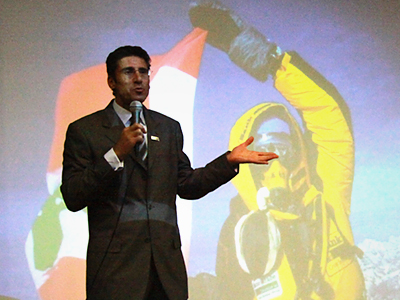
[edit]As part of his own CSR, Chaya regularly visits school, universities and clubs across the region delivering his presentation entitled: "There is an Everest for Everyone".

List of some Schools and Universities visited by Maxime Chaya to address and motivate the students:[14]
- International College
- Antonine Sisters School - Mar Elias Ghazir-Lebanon
- Repton School – Dubai
- Beirut Modern School
- Notre Dame de la Paix des filles de la Charite – Kobayat
- Modern Community School
- Wellspring Community School Exhibition – Max Museum
- Graduation Sagesse Technique
- City International School
- ACS
- American School of Dubai
- École des Sœurs des Saints Cœurs – Zahle
- Collège des Sœurs des St Cœurs -Kfar Hbaab Ghazir
- Lycée Franco - Libanais / Remise des Diplômes
- Collège Saint Joseph – Antoura – Aintoura
- Collège des Sœurs des Saints Cœurs – Bouchrieh
- Saydet Al Ataya – Dekwaneh
- St. Hripsimiantz College
- Grand Lycée Franco-Libanais
- Alba – Lebanese Academy of Fine Arts
- Dubai Women's College
- Armenian Mesrobian School
- Collège Notre Dame de Jamhour on the independence day celebration November 2010
Companies
[edit]Chaya also speaks to companies at annual events. He delivers a more elaborate, corporate presentation also entitled "There is an Everest to Everyone" where he draws the parallel between mountain climbing and the challenge of business and life.[15]

- Royal Dutch Shell – Qatar (July 2009)
- PepsiCo – Lebanon (June 2009)
- Johnson & Johnson – Sharm el Sheikh (May 2008)
- United Motors Agency – KSA (April 2008)
- Honeywell – Abu Dhabi (April 2008)
- Abbott Pharmaceuticals – Sri Lanka (March 2008)
- General Motors – UAE (March 2008)
- RasGas – Qatar (February 2008)
- L'Oréal – United States (January 2008)
- OBEGI Consumer Products – Lebanon (June 2007)
- Hewlett Packard – Nepal (May 2007)
- Schneider Electric – Lebanon (March 2007)
- Leo Burnett – Dubai, UAE (February 2007)
- Medco – Lebanon (January 2007)
- Boston Scientific – Lebanon (July 2006)
- Procter & Gamble – Lebanon (January 2006)
Philanthropy
[edit]Charities
[edit]
In spite of controversy concerning mountaineer David Sharp, Chaya is increasingly solicited to endorse and speak on behalf of charities and NGOs across the region and beyond:
- Oum El Nour[16]
- Tobacco Free Initiative – Lebanon
- Arc-En-Ciel[17]
- Social and Economic Action for Lebanon (SEAL)[18][19] – Lebanon
- Toufoula – Lebanon[20]
- Chance – Lebanon[21][22]
- Heartbeat – Lebanon
NGOs
[edit]Board memberships
[edit]- Beirut Marathon Association[24]
- World Links[25]
Publications
[edit]- Book: Steep Dreams: My journey to the Top of the World
- Comic book: Maximum Max - Vol.1: Metamorphosis on the Magic Mountain
- Comic book: Maximum Max - Vol.2: Prince of Peaks
Lebanon's foremost sportsman and climber, Maxime Chaya was the first person from his country to hoist its flag atop Everest, and he did so en route to ascending the highest mountain on every continent – the Seven Summits – while also skiing to the North and South Poles. Written in conjunction with New York Times bestselling author Richard Buskin, and illustrated with more than 700 stunning, high-quality, comprehensively captioned photos, 'Steep Dreams: My Journey to the Top of the World' tells the story of Max's adventure-based achievements; of his brushes with death in a wide variety of settings, along with the physical pain, mental anguish, soul-searching, emotional highs and ultimate satisfaction of not only surviving, but also learning to contend with the forces and marvels of nature. It is, in short, the gripping, sometimes harrowing, always rewarding tale of one man's incredible trans-global journey and the realization of his most heartfelt lifelong ambition.
References
[edit]- ^ "Talking To: Maxime Chaya". NOW Lebanon. February 3, 2008.
- ^ a b Furniss, Jamie (February 6, 2008). "Conquering oneself". Al-Ahram Weekly. Archived from the original on September 11, 2009.
- ^ Breed, Allen G.; Gurobacharya, Binaj (July 16, 2006). "Did Everest Climber Sharp Have to Die?". Fox News. Associated Press.
- ^ Mahdawi, Dalila (April 29, 2009). "Lebanese explorer first Arab to reach N. Pole". Daily Star.
- ^ Werner, John (June 29, 2009). "Waco attorney and Mount Everest climber make trip to North Pole". Waco Tribune. Archived from the original on July 3, 2009.
- ^ Klotz, Nina Anika (30 April 2011). "Ein Banker als Gipfelstürmer". Financial Times Deutschland (in German). Archived from the original on 2 April 2012.
- ^ "Bank Audi 7 summits". Archived from the original on 3 March 2016.
- ^ "Max Chaya". Discovery Channel. March 2007. Archived from the original on 2010-12-02.
- ^ "Maxime Chaya Reaches The South Pole!!!". Blogging Beirut. December 29, 2007.
- ^ "Maxime Chaya reached the north pole". Plus 961. 27 April 2009.
- ^ "Maxime Chaya's RIO – 2 New World Records!". prwebme. 8 August 2013. Archived from the original on 15 March 2014.
- ^ "Maxime Chaya rows from Australia to Mauritius in a record time". Travel and Tour World. August 24, 2013.
- ^ "Maxime Chaya Everest Lebanon Stamp". The Three Poles. July 2007. Archived from the original on 2011-07-17. Retrieved 2011-01-07.
- ^ "Presentations: Schools & Universities" (PDF). maximechaya.com. Archived from the original (PDF) on 2012-03-14. Retrieved 2011-04-15.
- ^ "Presentations: Companies" (PDF). maximechaya.com. Archived from the original (PDF) on 2012-03-14. Retrieved 2011-04-15.
- ^ "Maxime, Lutte contre la drogue". L'Orient-Le Jour (in French). June 30, 2006. Archived from the original on July 13, 2011.
- ^ "Mr. Maxime Chaya, parrain libanais du projet: L'École agit". Arc-en-ciel Lebanon (in French). December 12, 2008. Archived from the original on September 7, 2010.
- ^ "Seal Events 2010". SEAL USA. Archived from the original on 2012-09-11.
- ^ "Maxime pour la levée de fonds au profit de SEAL". Facebook. October 1, 2010.
- ^ "Chaya's Toufoula Fund raising". Blogging Beirut. February 11, 2010. Archived from the original on December 13, 2010.
- ^ "Children Fighting Cancer Given a CHANCE at SkyBar". Beirut Night Life. August 16, 2010.
- ^ "Chance Against Cancer at Skybar". Beirut Night Life. August 16, 2010.
- ^ "Founder Maxime Chaya". ThinkGreen. Archived from the original on 2011-02-28.
- ^ "Maxime Chaya Running for Nine Partner Charities". beirutmarathon.org. Archived from the original on 2011-01-11.
- ^ "Mr. Maxime Chaya, Member". WLAR.
External links
[edit] Media related to Maxime Chaya at Wikimedia Commons
| International | |
|---|---|
| National | |
| Other | |

Maxime Chaya
View on GrokipediaEarly life and education
Childhood and family background
Maxime Edgard Chaya was born in Beirut, Lebanon, on December 16, 1961, to a family that instilled values of resilience amid the country's turbulent socio-political landscape. Raised in the vibrant yet increasingly unstable capital, his early years were marked by the everyday rhythms of Lebanese urban life, including exposure to Mediterranean culture and community traditions that emphasized physical activity and outdoor pursuits. In 1975, at the outset of the Lebanese Civil War, Chaya's family was forced to flee Beirut, seeking refuge abroad to escape the escalating violence and destruction. This relocation disrupted his adolescence, scattering the family across multiple countries and exposing him to diverse environments that would later influence his worldview. The war's chaos limited access to organized sports and education in Lebanon, fostering a sense of adaptability and determination in young Chaya.[6][7] From an early age, Chaya showed a keen interest in competitive sports, aspiring to pursue athletics professionally, though the civil war thwarted these ambitions by curtailing training opportunities and stability. His family's encouragement of fitness and adventure, combined with the disruptions of wartime displacement, shaped his enduring passion for physical challenges and exploration. This period of upheaval ultimately transitioned him to education abroad in places like Greece, France, Canada, and the United Kingdom.[3][8][6] As of 2013, Chaya resided on the Mediterranean coast north of Beirut with his two children, Edgard and Kelly, maintaining close family ties in Lebanon despite his global experiences. He is married to Pascale Melhem Kesrouani and continues to prioritize family life alongside his personal pursuits.[6][9][7][10]Academic and professional beginnings
Chaya pursued higher education abroad amid the Lebanese Civil War, which displaced his family and prompted studies in multiple countries including Greece, France, Canada, and the United Kingdom. He ultimately earned a Bachelor of Science with honors from the London School of Economics in 1983.[6] Following graduation, Chaya trained for one year at the Republic National Bank of New York's head office on Fifth Avenue in 1985–1986, gaining experience in finance.[6] He then returned to Lebanon to manage his family's foreign exchange business, forgoing further postgraduate studies. In 1999, he founded VO2max, a company that imported and distributed outdoor gear while organizing youth sports events such as cycling, triathlon, road running, mountain biking, trail running, and rock climbing competitions across Lebanon; the organization operated until 2003.[6][11] A pivotal moment occurred in 2000 during an international mountain biking stage race in Kenya, where Chaya suffered a crash that dislocated his collarbone, requiring hospital treatment and forcing his withdrawal despite leading the event. He later won the race and accepted an invitation to climb Mount Kilimanjaro in nearby Tanzania, igniting his passion for mountaineering.[11][12]Sporting career
National-level accomplishments
Maxime Chaya emerged as a prominent figure in Lebanese endurance sports during the 1990s and early 2000s, participating in cycling, squash, and cross-country skiing, which contributed to his reputation as one of the country's leading athletes in these disciplines.[13] These activities included competing in cycling events organized by the Lebanese Cycling Federation and participating in squash tournaments under the Lebanese Squash Federation, demonstrating his stamina and versatility.[7] In triathlon and running, Chaya was a pioneer in multi-sport endurance activities within Lebanon, including early domestic competitions. He distinguished himself by winning the Red Bull Sno-to-Sea challenge—a grueling Lebanese multi-sport event combining skiing, cycling, kayaking, and running from the mountains to the sea—four consecutive times from 2003 to 2006, setting a benchmark for national-level performance in adventure racing.[7] Chaya's influence extended beyond personal achievements through the founding of VO2max in 1999, his sports organization that hosted numerous local events and youth programs in cycling, triathlon, running, and climbing across Lebanon, fostering the next generation of adventure athletes and establishing him as a key promoter of domestic sports culture.[6] These national-level successes, including endurance challenges that highlighted his ability to endure extreme physical demands, laid the groundwork for his broader recognition in Lebanon's sports scene without venturing into international arenas.International competitions
Chaya's international competitive career began in the late 1990s, marking his progression from regional events in Lebanon to elite global endurance challenges that tested his skills in adventure racing, mountain biking, and triathlon. These competitions highlighted his versatility across disciplines, including multi-stage races combining cycling, trekking, and navigation in diverse terrains.[7] In 1998, Chaya secured second place overall in the Trophée du Nil, an adventure race in Egypt that involved navigating the Nile region's challenging landscapes. The following year, in 1999, he achieved third place in the Raid Thai, a demanding multi-sport event in Thailand emphasizing teamwork and endurance over rugged terrain. These early international results established his reputation beyond Lebanon.[7][14] By 2001, Chaya's performance elevated further, as he claimed first place in the Kenya Sports Safari, a prestigious mountain bike stage race across East African savannas and trails. That same year, he competed in the UCI World Masters Championships in Canada, finishing 23rd in the mountain bike category at Mont-Sainte-Anne, Quebec—a notable debut on the global cycling stage. These achievements underscored his adaptation to high-level international fields.[1][7][14] In 2002, Chaya became one of the first Lebanese athletes to complete an Ironman triathlon in Almere, Netherlands. This grueling 3.8 km swim, 180 km bike, and 42.2 km run solidified his transition to world-class endurance sports during the early 2000s.[14]| Event | Year | Location | Achievement |
|---|---|---|---|
| Trophée du Nil | 1998 | Egypt | 2nd overall[7] |
| Raid Thai | 1999 | Thailand | 3rd overall[7] |
| Kenya Sports Safari | 2001 | Kenya | 1st place[1] |
| UCI World Masters Championships | 2001 | Canada | 23rd place[7] |
| Ironman Triathlon | 2002 | Netherlands | Completed[14] |
Major expeditions
Seven Summits ascents
Maxime Chaya embarked on his Seven Summits challenge in 2001, aiming to become the first Lebanese mountaineer to summit the highest peak on each continent, a feat that demanded exceptional endurance built from his prior background in competitive mountain biking and skiing. His expeditions spanned from 2001 to 2006, involving meticulous planning amid diverse environmental hazards such as extreme cold, high winds, and logistical complexities in remote regions. Over these climbs, Chaya accumulated more than 500,000 feet of vertical elevation gain, testing his physical and mental limits across varied terrains from African savannas to Antarctic ice fields.[1][3][1] Chaya's initial ascent was Mount Kilimanjaro in Tanzania, Africa, which he summited in September 2001 at 5,895 meters. This non-technical but altitude-demanding climb served as his introduction to high-altitude trekking, with challenges including rapid weather shifts and the physical strain of ascending from equatorial lowlands to near-freezing summit conditions in a matter of days. Motivated by this success, he progressed to Mount Rainier in Washington, USA, in May 2003, reaching 4,392 meters as preparatory training. The expedition highlighted crevasse navigation and unpredictable Pacific Northwest storms, building essential skills for glaciated peaks.[1][15] In June 2003, Chaya tackled Denali (formerly Mount McKinley) in Alaska, North America's highest peak at 6,194 meters, summiting on June 17. Known for its massive vertical rise of over 5,500 meters from base to summit and extreme Arctic weather, including temperatures dropping to -40°C and gale-force winds, the climb required self-sufficiency in a remote, roadless environment with limited rescue options. Later that year, in September 2003, he ascended Cho Oyu in the Himalayas at 8,201 meters, the world's sixth-highest mountain and his first foray into the "death zone" above 8,000 meters. Harsh monsoon-season conditions and thin air posed risks of altitude sickness and avalanches, demanding acclimatization over weeks in Tibet.[1][15][1] Chaya's 2004 expeditions advanced his progress across the Americas and Australasia. In January, he summited Aconcagua in Argentina, South America's rooftop at 6,961 meters, enduring the arid Andes' intense solar radiation, high winds up to 100 km/h, and logistical hurdles of transporting gear to remote base camps. By March, he had climbed Mount Kosciuszko in Australia at 2,228 meters, a relatively accessible hike through snow gums but complicated by variable weather in the Snowy Mountains. That same month, he conquered Mount Aspiring in New Zealand at 3,030 meters, a technically demanding "Matterhorn of the South" involving steep ice and rock faces, where rockfall and exposure were primary threats. In December, Chaya reached the Vinson Massif in Antarctica at 4,897 meters on December 26, facing the continent's brutal isolation, katabatic winds exceeding 200 km/h, and temperatures as low as -30°C, with all supplies airlifted to the ice shelf.[1][15][1] The following year brought European and additional preparatory climbs. In July 2005, Chaya summited Mount Elbrus in Russia, Europe's highest at 5,642 meters, via a backcountry ski approach that navigated volcanic terrain and sudden Caucasian storms. Immediately after, he scaled the Matterhorn in Switzerland at 4,478 meters, a classic Alpine test of mixed climbing on knife-edge ridges, where loose rock and afternoon thunderstorms amplified the risks of this iconic, crowded route. Closing 2005, Chaya ascended Carstensz Pyramid (Puncak Jaya) in Indonesia's Papua province at 4,884 meters on December 7, opting for the Bass list's Oceanic peak over Kosciuszko; the jungle-surrounded approach involved helicopter logistics, river crossings, and technical free-climbing on slippery limestone karsts amid tropical humidity and potential tribal encounters.[1][15][1] Chaya culminated his Seven Summits quest on May 15, 2006, by summiting Mount Everest in the Himalayas at 8,850 meters, becoming the first Lebanese to complete the challenge. Approaching from the north side in Tibet as part of the Audi-sponsored project, he faced the mountain's infamous jet stream winds, icefalls, and oxygen deprivation, with only half his team reaching the top amid the 2006 season's crowded and hazardous conditions. At the summit, he raised the Lebanese flag, symbolizing national pride after years of relentless preparation. This achievement not only verified his mastery of global mountaineering extremes but also highlighted the logistical orchestration required for such multinational endeavors.[1][15][8]Polar explorations
Maxime Chaya began his polar explorations with last-degree ski expeditions to build experience in extreme cold conditions, drawing on the endurance gained from his Seven Summits ascents. In April 2004, he joined a Norwegian team led by Børge Ousland for an unassisted ski to the North Pole, covering the final 60 nautical miles (approximately 111 km) over several days amid Arctic sea ice.[1] Similarly, in December 2004, following his ascent of Vinson Massif, Chaya completed a one-week last-degree ski to the South Pole, honing cold-weather techniques on the Antarctic plateau.[1] Chaya's full unassisted traversal to the South Pole commenced in November 2007 from Hercules Inlet on the Antarctic coast, where he and his international team—comprising members from Canada, Norway, Switzerland, and Lebanon—pulled sleds weighing over 100 kg each, carrying all food, fuel, and equipment for the journey without resupply or support.[16][17] The 1,130 km route across the polar plateau exposed them to katabatic winds gusting up to 100 km/h, sastrugi ice formations, temperatures dropping to -40°C, and frequent whiteouts that reduced visibility to near zero, demanding precise navigation via GPS and compass.[18] After 47 days of skiing 20-30 km daily, the team arrived at the Amundsen-Scott South Pole Station on December 28, 2007, marking Chaya as the first person from the Middle East to reach the geographic South Pole on foot from the coast; upon arrival, he raised the Lebanese flag in a symbolic gesture of national pride.[19][20] In 2009, Chaya undertook the full unassisted traversal to the North Pole as part of the Peary-Henson Centennial Expedition, starting from Ward Hunt Island off northern Canada on March 3 with American teammates Lonnie Dupre and Stuart Smith.[21] The 800 km journey involved hauling 120 kg sleds across shifting Arctic sea ice, navigating pressure ridges up to 10 m high, open water leads that required detours or improvised bridges, and temperatures as low as -50°C, compounded by storms and thin ice that posed risks of plunging into frigid waters.[18][21] Covering distances of 15-25 km per day while managing wildlife threats like polar bears, the team reached the North Pole on April 25 after 53 days, with Chaya becoming the first Lebanese to arrive there; he again planted the Lebanese flag at the top of the world.[22][20]Ocean and desert traversals
In 2013, Maxime Chaya completed a record-setting row across the Indian Ocean as part of Expedition RIO, departing from Geraldton, Western Australia, on June 9 and arriving at Cap Malheureux, Mauritius, on August 6, after 57 days, 15 hours, and 49 minutes at sea.[23] Accompanied by teammates Livar Nysted from the Faroe Islands and Stuart Kershaw from the United Kingdom, the trio rowed an ocean rowing boat named tRIO, navigating approximately 3,132 nautical miles while facing severe physical and logistical challenges unique to open-ocean conditions, including a non-functional water maker that forced reliance on limited rations and emergency desalination, a broken daggerboard that compromised steering, and the need to prepare rescue contingency plans on three separate occasions due to deteriorating weather and equipment failures.[23] This endeavor built on Chaya's prior polar skiing experiences, which provided foundational endurance training for the relentless physical demands of sustained oceanic propulsion.[1] Chaya's ocean traversal contributed to his career total of over 5,000 nautical miles rowed, emphasizing the navigational intricacies of vast, featureless seascapes where celestial fixes, GPS, and wind patterns were critical for maintaining course amid unpredictable currents and storms.[23] Transitioning from water to arid extremes, Chaya extended his Explorer's Grand Slam achievements with a pioneering cycling crossing of the Rub' al-Khali, or Empty Quarter, the world's largest continuous sand desert, in November–December 2016.[24] Partnered with British endurance athlete Steve Holyoak, he cycled from Abu Dhabi, United Arab Emirates, to Salalah, Oman, covering over 2,000 kilometers in 21 days on specialized fat bikes designed for deep sand traction, enduring hyper-arid heat exceeding 40°C (104°F), daily distances up to 100 kilometers, and logistical hurdles such as pre-buried water and food caches to sustain unassisted progress through shifting dunes that often buried routes and equipment.[24] The expedition highlighted desert-specific challenges like sand ingestion affecting bike mechanics, extreme dehydration risks, and the psychological strain of isolation in an environment devoid of landmarks, contrasting sharply with the fluid dynamics of oceanic travel.[25] In 2022, Chaya completed another unassisted bicycle crossing of the Empty Quarter, this time from Jeddah, Saudi Arabia, to Muscat, Oman, in 33 days alongside Steve Holyoak. Covering approximately 2,500 kilometers on fat bikes, the journey involved navigating vast dunes, extreme temperatures up to 45°C, and self-managed caches, further demonstrating his expertise in desert endurance.[3] Post-2020, amid Lebanon's economic and social crises, Chaya launched the "Seven Summiting" cycling challenge in late 2020 to inspire national resilience, selecting seven hill segments across Lebanese terrain and ascending and descending each one over seven consecutive days to replicate the vertical gains of the Seven Summits—for instance, achieving 8,848 meters of positive elevation on the day dedicated to Everest.[26] This initiative, conceived after his October 2020 Everesting effort, underscored cycling's role in building mental fortitude through repetitive, grueling climbs on varied gradients, with Chaya's career cycling total surpassing 200,000 kilometers across diverse global expeditions.[26] By framing these traversals as metaphors for perseverance, Chaya's ocean and desert feats collectively closed his pursuit of extreme non-polar environments, blending human propulsion against elemental forces to advance personal and communal boundaries.[1]Public recognition
Awards and honors
Maxime Chaya has received the Officer rank in the National Order of the Cedar, Lebanon's highest civilian honor, for his contributions to mountaineering and exploration. He was initially knighted in the order in December 2003 and promoted to Officer in May 2006 following his successful ascent of Mount Everest, marking him as the first Lebanese to reach the summit.[27] Chaya has been knighted multiple times by the Lebanese government in recognition of his sporting achievements, including his completion of the Seven Summits and polar expeditions. These honors underscore his role in elevating Lebanon's profile on the global stage through extreme athletic endeavors.[28] In 2019, Chaya was knighted as a Chevalier in the French National Order of Merit.[13] In 2013, Chaya set a Guinness World Record as part of a three-person team for the fastest row across the Indian Ocean from Geraldton, Australia, to Cap Malheureux, Mauritius, completing the 5,700-kilometer journey in 57 days, 15 hours, and 49 minutes. This feat also earned recognition as the first such crossing by a three-man crew.[23] Chaya is celebrated as a national icon in Lebanon, with his accomplishments featured in educational books and prominent national media outlets, inspiring generations through his representation of Lebanese resilience and adventure.[8][29]Commemorative philatelic and postal issues
In recognition of Maxime Chaya's groundbreaking expeditions, the Lebanese government issued several commemorative philatelic and postal items, marking a rare honor for a civilian explorer and symbolizing national pride in his feats.[20] These tributes were prompted by Chaya's historic ascent of Mount Everest in May 2006 and his arrival at the South Pole on December 28, 2007.[30] On July 2, 2007, LibanPost released a 3,000 Lebanese lira postage stamp and souvenir sheet depicting Chaya raising the Lebanese flag atop Mount Everest, the first such ascent by a Lebanese national.[31][32][30] In March 2008, the Ministry of Telecommunications produced Kalam Cards—prepaid telephone calling cards—with separate designs honoring Chaya's Everest summit and South Pole achievement, further embedding his accomplishments in everyday postal culture.[33] In April 2008, the Ministry of Finance issued a 1,000 Lebanese pound fiscal stamp illustrating Chaya planting the Lebanese flag at the South Pole, commemorating his polar traversal.[34]Inspirational speaking
Engagements with educational institutions
Maxime Chaya has conducted extensive motivational engagements with educational institutions through his program "There is an Everest for Everyone," which has reached over 20,000 youth.[1] These talks target students in schools, universities, and youth clubs, promoting resilience and personal achievement.[1] Chaya's visits span institutions in Lebanon, including the Lebanese American University and the American University of Beirut, as well as surrounding countries like the United Arab Emirates, such as Zayed University.[35][36] In these sessions, he emphasizes overcoming obstacles by sharing personal stories from the Lebanese civil war, during which his family sought refuge abroad in 1975, and his own adventures, including climbing Mount Everest.[1] He draws parallels between these experiences and the challenges faced by young people, using his expeditions as metaphors for pursuing ambitious goals.[35] The interactive nature of these engagements encourages participants to reflect on their aspirations, fostering discussions on career paths and personal goal-setting to build determination and self-belief.[1]Corporate and professional talks
Maxime Chaya has delivered keynote speeches to over 100 multinational companies, drawing parallels between the challenges of his extreme expeditions and corporate strategies for success.[1] His talks emphasize resilience, teamwork, and risk management, using vivid anecdotes from his ascents of the Seven Summits, polar traversals, and ocean rowing to illustrate how overcoming physical and environmental extremes translates to navigating business obstacles such as market volatility and team dynamics.[2] For instance, he recounts the unassisted ski to the South Pole in 2008 to highlight calculated risk-taking in high-stakes environments, a theme that resonates with professional audiences facing strategic decisions.[1] In these engagements, Chaya focuses on fostering professional growth by encouraging executives to "find their Everest"—identifying personal and organizational summits that demand perseverance and innovation.[1] His presentations to global firms, including a 2021 event for Oracle, underscore how expedition teamwork, as demonstrated in his 2013 Guinness World Record row across the Indian Ocean, mirrors collaborative efforts needed in corporate projects.[2] These sessions have impacted professional audiences by promoting a mindset of adaptability, with Chaya's stories from the Empty Quarter desert traversal in 2016 serving as metaphors for endurance in prolonged business challenges.[1] Chaya's corporate talks extend his inspirational outreach, applying adventure-derived lessons to enhance leadership and motivation in business contexts without delving into educational or charitable elements.[2]Philanthropy
Fundraising and charitable initiatives
Chaya has actively participated in fundraising through endurance events, notably raising $57,033 for nine non-governmental organizations during the Beirut Marathon in November 2010, the inaugural year the event featured a "running for a cause" initiative where participants directed donations to partner charities.[37] He integrates his adventures with charitable efforts, such as donating proceeds from the 2020 Everesting Lebanon challenge to support children with heart defects.[38]NGO affiliations and board roles
Maxime Chaya serves as an ambassador for Heartbeat - La Chaîne de l'Espoir, a Lebanese NGO dedicated to providing cardiac care for children born with heart defects, where he has leveraged his public profile to promote awareness and fundraising initiatives since at least 2020.[39] In this role, Chaya has contributed to programs by participating in high-profile challenges, such as the 2020 Everesting Lebanon event, which aimed to support the NGO's surgical and rehabilitation efforts for vulnerable children amid Lebanon's economic crisis.[40] Chaya has maintained a longstanding affiliation with arcenciel, a Lebanese environmental NGO focused on sustainability and community development, acting as the Lebanese godfather (parrain) for its educational projects. In 2008, he sponsored the launch of arcenciel's "L’école agit ! Pour le développement durable" initiative, which promotes environmental education in schools through student-led projects on themes like biodiversity and waste management, emphasizing practical contributions to Lebanon's ecological challenges.[41] His involvement extends to Social and Economic Action for Lebanon (SEAL), an NGO addressing poverty and social welfare in Lebanon, where Chaya has supported policy-oriented programs through high-visibility endorsements. In 2010, he headlined a New York fundraising gala for SEAL, highlighting the organization's efforts to empower marginalized communities via economic development and aid distribution, aligning with his broader advocacy for social equity in adventure and welfare contexts.[6] Chaya has also collaborated with Oum El Nour, a rehabilitation NGO combating drug addiction and promoting youth welfare, contributing to anti-drug awareness campaigns that integrate sports and adventure as preventive tools. In 2007, he joined forces with the organization for public outreach events targeting adolescents, stressing physical activity as an "antidrug" strategy to foster resilience and social reintegration.[42]Publications
Autobiographical works
Maxime Chaya's primary autobiographical work is the memoir Steep Dreams: My Journey to the Top of the World, co-authored with Richard Buskin and published in 2009 as a 496-page coffee table book featuring 720 fully captioned photographs.[43][44] The book chronicles Chaya's transformation from a career in finance to a mountaineer, detailing his early life in Lebanon, the challenges of pursuing ambitious goals amid personal and professional transitions, and his successful completion of the Seven Summits challenge, which culminated in his 2006 ascent of Mount Everest as the first Lebanese to reach its summit.[43][3] Central to the narrative are the 16 expeditions spanning three years that formed the core of Chaya's Seven Summits journey, including accounts of physical and mental obstacles encountered on peaks like Kilimanjaro, Aconcagua, and Denali, interwoven with reflections on the cultures and mythologies of the regions visited.[43] The memoir emphasizes themes of perseverance, portraying setbacks such as harsh weather, logistical hurdles, and moments of profound solitude as pivotal to personal growth and self-discovery, while drawing broader life lessons on resilience, ambition, and the pursuit of "steep dreams" beyond mountaineering.[43][45] Upon release, Steep Dreams was launched at the Salon du Livre in Beirut and received acclaim as an inspirational text, particularly for its motivational insights into overcoming adversity, with Chaya signing copies at events tied to his role as Bank Audi's corporate ambassador.[45] The book has been highlighted in interviews and speaking engagements for its role in encouraging readers to tackle their own "Everests," establishing it as a key resource for understanding Chaya's philosophy of determination and exploration.[3][46]Comic book series
The Maximum Max comic book series features illustrated adventures inspired by the real-life exploits of Lebanese explorer Maxime Chaya, designed specifically to captivate and educate younger audiences through dynamic storytelling. Published by Hachette Antoine in Arabic and French editions, the series combines factual accounts of extreme challenges with fictionalized elements to promote themes of perseverance, self-discovery, and environmental stewardship.[47] Written by Rabih Haddad and illustrated by Tony Abou Jaoude, it serves as an engaging educational tool that encourages children to read while fostering awareness of nature's importance and the rewards of pushing personal limits.[47] Volume 1, Metamorphosis on the Magic Mountain, centers on Chaya's pivotal 2001 ascent of Mount Kilimanjaro, portraying it as a catalyst for his lifelong passion for adventure and transformation. The narrative highlights his journey from novice to committed mountaineer, emphasizing respect for nature and the thrill of self-surpassing amid the mountain's majestic landscapes. Launched in 2016 at the Beirut International Book Fair, this installment blends adventure with inspirational messages to ignite young readers' curiosity about exploration.[48] Volume 2, Prince of Peaks, builds on the first by chronicling Chaya's subsequent quests in the Seven Summits challenge, including his 2002 summit of Mount Elbrus, a near-miss on Aconcagua in 2003, and successful climb of Denali that same year.[49] It depicts the physical and mental trials of high-altitude mountaineering, culminating in triumphant moments like planting the Lebanese flag atop these peaks, to illustrate resilience and national pride.[49] Released in 2022, this volume continues the series' mission to empower the next generation through relatable heroic tales rooted in Chaya's documented journeys.[49] Volume 3, The Challenge of the Three Poles, released in May 2025, explores Chaya's polar expeditions to the North and South Poles, highlighting his completion of the Explorers' Grand Slam as one of only 12 athletes to achieve this feat. The volume emphasizes endurance in extreme conditions and the integration of mountaineering with polar traversal.[50][51] As of October 2025, Volume 4 is in development, continuing to adapt Chaya's adventures for young readers.[52] The comics draw thematic inspiration from Chaya's autobiographical memoir Steep Dreams: My Journey to the Top of the World, adapting its core motifs of ambition and discovery into visually compelling formats for children.[43]References
- https://commons.wikimedia.org/wiki/File:Fiscal_Stamp_Max.jpg
- https://commons.wikimedia.org/wiki/File:Maxfunds.jpg