Hubbry Logo
search
logo

Maximum principle

logo
Community Hub0 Subscribers
Read side by side
from Wikipedia

In the mathematical fields of differential equations and geometric analysis, the maximum principle is one of the most useful and best known tools of study. Solutions of a partial differential equation (or, more generally, of a differential inequality) in a domain D are said to satisfy the maximum principle if they achieve their maxima at the boundary of D. Harmonic functions and, more generally, solutions of elliptic partial differential equations satisfy the maximum principle.

The graph (red) of a typical function in two dimension satisfying the maximum principle: maxima (and minimal) occur on the boundary of the domain (blue).

The maximum principle enables one to obtain information about solutions of differential equations without any explicit knowledge of the solutions themselves. In particular, the maximum principle is a useful tool in the numerical approximation of solutions of ordinary and partial differential equations and in the determination of bounds for the errors in such approximations.[1]

In a simple two-dimensional case, consider a function of two variables u(x,y) such that
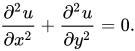
The weak maximum principle, in this setting, says that for any open bounded subset M of the domain of u, the maximum of u on the closure of M is achieved on the boundary of M. The strong maximum principle says that, unless u is a constant function, the maximum cannot also be achieved anywhere on M itself. Note that both statements are also true for the minimum of u, since -u solves the same differential equation.

In the field of convex optimization, there is an analogous statement which asserts that the maximum of a convex function on a compact convex set is attained on the boundary.[2]

Intuition

[edit]

A partial formulation of the strong maximum principle

[edit]

Here we consider the simplest case, although the same thinking can be extended to more general scenarios. Let M be an open subset of Euclidean space and let u be a C2 function on M such that
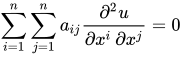
where for each i and j between 1 and n, aij is a function on M with aij = aji.

Fix some choice of x in M. According to the spectral theorem of linear algebra, all eigenvalues of the matrix [aij(x)] are real, and there is an orthonormal basis of n consisting of eigenvectors. Denote the eigenvalues by λi and the corresponding eigenvectors by vi, for i from 1 to n. Then the differential equation, at the point x, can be rephrased as
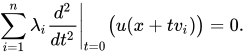
The essence of the maximum principle is the simple observation that if each eigenvalue is positive (which amounts to a certain formulation of "ellipticity" of the differential equation) then the above equation imposes a certain balancing of the directional second derivatives of the solution. In particular, if one of the directional second derivatives is negative, then another must be positive. At a hypothetical point where u is maximized, all directional second derivatives are automatically nonpositive, and the "balancing" represented by the above equation then requires all directional second derivatives to be identically zero.

This elementary reasoning could be argued to represent an infinitesimal formulation of the strong maximum principle, which states, under some extra assumptions (such as the continuity of a), that u must be constant if there is a point of M where u is maximized.

Note that the above reasoning is unaffected if one considers the more general partial differential equation

since the added term is automatically zero at any hypothetical maximum point. The reasoning is also unaffected if one considers the more general condition

in which one can even note the extra phenomena of having an outright contradiction if there is a strict inequality (> rather than ) in this condition at the hypothetical maximum point. This phenomenon is important in the formal proof of the classical weak maximum principle.

Non-applicability of the strong maximum principle

[edit]

However, the above reasoning no longer applies if one considers the condition

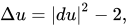
since now the "balancing" condition, as evaluated at a hypothetical maximum point of u, only says that a weighted average of manifestly nonpositive quantities is nonpositive. This is trivially true, and so one cannot draw any nontrivial conclusion from it. This is reflected by any number of concrete examples, such as the fact that

and on any open region containing the origin, the function x2y2 certainly has a maximum.

The classical weak maximum principle for linear elliptic PDE

[edit]

The essential idea

[edit]

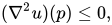
Let M denote an open subset of Euclidean space. If a smooth function is maximized at a point p, then one automatically has:

  • as a matrix inequality.

One can view a partial differential equation as the imposition of an algebraic relation between the various derivatives of a function. So, if u is the solution of a partial differential equation, then it is possible that the above conditions on the first and second derivatives of u form a contradiction to this algebraic relation. This is the essence of the maximum principle. Clearly, the applicability of this idea depends strongly on the particular partial differential equation in question.

For instance, if u solves the differential equation
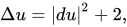
then it is clearly impossible to have and at any point of the domain. So, following the above observation, it is impossible for u to take on a maximum value. If, instead u solved the differential equation then one would not have such a contradiction, and the analysis given so far does not imply anything interesting. If u solved the differential equation then the same analysis would show that u cannot take on a minimum value.

The possibility of such analysis is not even limited to partial differential equations. For instance, if is a function such that
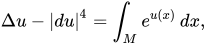
which is a sort of "non-local" differential equation, then the automatic strict positivity of the right-hand side shows, by the same analysis as above, that u cannot attain a maximum value.

There are many methods to extend the applicability of this kind of analysis in various ways. For instance, if u is a harmonic function, then the above sort of contradiction does not directly occur, since the existence of a point p where is not in contradiction to the requirement everywhere. However, one could consider, for an arbitrary real number s, the function us defined by

It is straightforward to see that

By the above analysis, if then us cannot attain a maximum value. One might wish to consider the limit as s to 0 in order to conclude that u also cannot attain a maximum value. However, it is possible for the pointwise limit of a sequence of functions without maxima to have a maxima. Nonetheless, if M has a boundary such that M together with its boundary is compact, then supposing that u can be continuously extended to the boundary, it follows immediately that both u and us attain a maximum value on Since we have shown that us, as a function on M, does not have a maximum, it follows that the maximum point of us, for any s, is on By the sequential compactness of it follows that the maximum of u is attained on This is the weak maximum principle for harmonic functions. This does not, by itself, rule out the possibility that the maximum of u is also attained somewhere on M. That is the content of the "strong maximum principle," which requires further analysis.

The use of the specific function above was very inessential. All that mattered was to have a function which extends continuously to the boundary and whose Laplacian is strictly positive. So we could have used, for instance,


with the same effect.

The classical strong maximum principle for linear elliptic PDE

[edit]

Summary of proof

[edit]

Let M be an open subset of Euclidean space. Let be a twice-differentiable function which attains its maximum value C. Suppose that
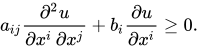
Suppose that one can find (or prove the existence of):

  • a compact subset Ω of M, with nonempty interior, such that u(x) < C for all x in the interior of Ω, and such that there exists x0 on the boundary of Ω with u(x0) = C.
  • a continuous function which is twice-differentiable on the interior of Ω and with
and such that one has u + hC on the boundary of Ω with h(x0) = 0

Then L(u + hC) ≥ 0 on Ω with u + hC ≤ 0 on the boundary of Ω; according to the weak maximum principle, one has u + hC ≤ 0 on Ω. This can be reorganized to say
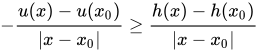
for all x in Ω. If one can make the choice of h so that the right-hand side has a manifestly positive nature, then this will provide a contradiction to the fact that x0 is a maximum point of u on M, so that its gradient must vanish.

Proof

[edit]

The above "program" can be carried out. Choose Ω to be a spherical annulus; one selects its center xc to be a point closer to the closed set u−1(C) than to the closed set M, and the outer radius R is selected to be the distance from this center to u−1(C); let x0 be a point on this latter set which realizes the distance. The inner radius ρ is arbitrary. Define

Now the boundary of Ω consists of two spheres; on the outer sphere, one has h = 0; due to the selection of R, one has uC on this sphere, and so u + hC ≤ 0 holds on this part of the boundary, together with the requirement h(x0) = 0. On the inner sphere, one has u < C. Due to the continuity of u and the compactness of the inner sphere, one can select δ > 0 such that u + δ < C. Since h is constant on this inner sphere, one can select ε > 0 such that u + hC on the inner sphere, and hence on the entire boundary of Ω.

Direct calculation shows

There are various conditions under which the right-hand side can be guaranteed to be nonnegative; see the statement of the theorem below.

Lastly, note that the directional derivative of h at x0 along the inward-pointing radial line of the annulus is strictly positive. As described in the above summary, this will ensure that a directional derivative of u at x0 is nonzero, in contradiction to x0 being a maximum point of u on the open set M.

Statement of the theorem

[edit]

The following is the statement of the theorem in the books of Morrey and Smoller, following the original statement of Hopf (1927):

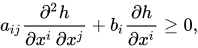
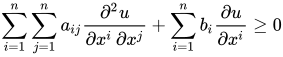
Let M be an open subset of Euclidean space n. For each i and j between 1 and n, let aij and bi be continuous functions on M with aij = aji. Suppose that for all x in M, the symmetric matrix [aij] is positive-definite. If u is a nonconstant C2 function on M such that

on M, then u does not attain a maximum value on M.
The point of the continuity assumption is that continuous functions are bounded on compact sets, the relevant compact set here being the spherical annulus appearing in the proof. Furthermore, by the same principle, there is a number λ such that for all x in the annulus, the matrix [aij(x)] has all eigenvalues greater than or equal to λ. One then takes α, as appearing in the proof, to be large relative to these bounds. Evans's book has a slightly weaker formulation, in which there is assumed to be a positive number λ which is a lower bound of the eigenvalues of [aij] for all x in M.

These continuity assumptions are clearly not the most general possible in order for the proof to work. For instance, the following is Gilbarg and Trudinger's statement of the theorem, following the same proof:

Let M be an open subset of Euclidean space n. For each i and j between 1 and n, let aij and bi be functions on M with aij = aji. Suppose that for all x in M, the symmetric matrix [aij] is positive-definite, and let λ(x) denote its smallest eigenvalue. Suppose that and are bounded functions on M for each i between 1 and n. If u is a nonconstant C2 function on M such that

on M, then u does not attain a maximum value on M.

One cannot naively extend these statements to the general second-order linear elliptic equation, as already seen in the one-dimensional case. For instance, the ordinary differential equation y″ + 2y = 0 has sinusoidal solutions, which certainly have interior maxima. This extends to the higher-dimensional case, where one often has solutions to "eigenfunction" equations Δu + cu = 0 which have interior maxima. The sign of c is relevant, as also seen in the one-dimensional case; for instance the solutions to y″ - 2y = 0 are exponentials, and the character of the maxima of such functions is quite different from that of sinusoidal functions.

See also

[edit]

Notes

[edit]

References

[edit]
Revisions and contributorsEdit on WikipediaRead on Wikipedia
from Grokipedia
The maximum principle is a fundamental theorem in the theory of partial differential equations (PDEs), particularly for elliptic equations, which states that if a function uu satisfies Δu0\Delta u \leq 0 (subharmonic) in a bounded domain Ω\Omega, then the maximum value of uu is attained on the boundary Ω\partial \Omega, unless uu is constant throughout Ω\Omega.[1] This principle extends to more general elliptic operators of the form Lu=aij(x)iju+bi(x)iu+c(x)u0Lu = a^{ij}(x) \partial_i \partial_j u + b^i(x) \partial_i u + c(x) u \leq 0 with c(x)0c(x) \leq 0, ensuring that non-constant subsolutions cannot achieve an interior maximum.[2] A strong maximum principle refines this result: if uu attains its maximum at an interior point x0Ωx_0 \in \Omega and satisfies Lu0Lu \leq 0 with the conditions above, then uu must be constant in Ω\Omega.[1] This version relies on Hopf's lemma, which asserts that at a boundary maximum point where u(x0)>u(x)u(x_0) > u(x) for all xΩx \in \Omega, the outward normal derivative satisfies uν(x0)>0\frac{\partial u}{\partial \nu}(x_0) > 0, preventing "flat" maxima and enabling proofs of uniqueness for Dirichlet boundary value problems.[2] The principle also implies comparison results: if Lu0Lu \leq 0 and Mv0Mv \leq 0 with uvu \leq v on Ω\partial \Omega, then uvu \leq v in Ω\Omega.[1] Historically, the maximum principle traces its origins to properties of harmonic functions in complex analysis and the Laplace equation, with key developments in the 20th century, including Hopf's contributions in the 1920s that generalized it to nonlinear elliptic PDEs.[2] For parabolic PDEs, such as the heat equation tuΔu0\partial_t u - \Delta u \leq 0, the maximum principle adapts to space-time domains, stating that the maximum of uu occurs on the parabolic boundary (initial time or spatial boundary), again unless uu is constant.[3] This extension applies to evolution equations like tuΔu+X,u+F(u)\partial_t u \leq \Delta u + \langle X, \nabla u \rangle + F(u), bounding solutions by comparison with ODEs solving dϕdt=F(ϕ)\frac{d\phi}{dt} = F(\phi).[3] The principle's robustness provides a priori bounds without explicit solutions, aiding regularity theory and symmetry results, such as those for positive solutions via moving planes methods.[2] In applications, it underpins uniqueness in boundary value problems, Harnack inequalities for controlling oscillations (e.g., supUuCinfUu\sup_U u \leq C \inf_U u for positive harmonic functions), and geometric analysis, including Ricci flow where it controls curvature evolution.[3]

Overview and Intuition

Intuitive Explanation

The maximum principle is a fundamental property in the analysis of solutions to elliptic partial differential equations (PDEs), which model diffusion-like phenomena such as heat conduction or electrostatic potentials. At its core, the principle asserts that a non-constant solution to such an equation cannot attain its maximum value at any interior point of the domain; instead, the maximum must occur on the boundary. This reflects the smoothing or averaging behavior inherent in these equations, preventing "peaks" or local extremes from forming inside the region without the function being constant throughout.[4] A key intuition arises from the mean value property satisfied by solutions to Laplace's equation, the prototypical elliptic PDE, where the value of the solution at any interior point equals the average of its values over a surrounding ball or sphere. If a maximum were achieved inside, the surrounding values would all need to be less than or equal to it, making the average strictly less unless the function is constant in that ball—leading to constancy everywhere by connectedness. This averaging effect ensures that interior points "inherit" their values from the boundary, much like how a calm water surface in a container takes its shape from the edges without isolated highs or lows in the middle.[5][6] In one dimension, consider the simple case of solutions to u=0-u'' = 0 on an interval (a,b)(a, b), which are linear functions u(x)=cx+du(x) = cx + d. Such a function can only achieve its maximum at one endpoint unless c=0c = 0, in which case it is constant; there are no interior maxima for non-constant solutions. This extends the intuition to higher dimensions, where non-linear but smooth solutions behave similarly, rising or falling toward the boundary.[4] Physically, the principle manifests in steady-state heat distribution: in a heated object like a metal plate with fixed boundary temperatures, the interior temperature equilibrates to a value between the hottest and coldest boundary points, never exceeding them inside, as heat flows to equalize differences without creating isolated hot spots. This boundary-driven behavior underscores the principle's role in ensuring stable, equilibrium solutions in diffusive systems.[6][5]

Key Examples and Counterexamples

A classic example illustrating the applicability of the maximum principle is the harmonic function u(x,y)=xu(x, y) = x defined on the unit disk Ω={(x,y)R2:x2+y2<1}\Omega = \{(x, y) \in \mathbb{R}^2 : x^2 + y^2 < 1\}. Since Δu=0\Delta u = 0, uu is harmonic, and its maximum value of 1 is attained at the boundary point (1,0)(1, 0), with no interior point exceeding this value.[7] A related partial formulation of the maximum principle applies to subharmonic functions, where if uC2(Ω)u \in C^2(\Omega) satisfies Δu0\Delta u \geq 0 in a bounded domain ΩRn\Omega \subset \mathbb{R}^n, then maxΩu=maxΩu\max_{\overline{\Omega}} u = \max_{\partial \Omega} u. This extends the harmonic case (Δu=0\Delta u = 0) and underscores the role of the Laplacian's sign in ensuring boundary maxima.[7] In contrast, for non-elliptic partial differential equations such as the heat equation utΔu=0u_t - \Delta u = 0, interior maxima can occur due to time evolution, particularly on the initial time slice, distinguishing it from the elliptic setting where no such interior extrema are possible unless the solution is constant. While a space-time maximum principle holds—with the global maximum attained on the parabolic boundary (initial or lateral boundaries)—the time-dependent nature allows non-constant solutions to start with interior maxima that influence the evolution.[8] The maximum principle fails to hold in its elliptic form for hyperbolic partial differential equations, such as the wave equation uttΔu=0u_{tt} - \Delta u = 0. For instance, solutions can develop interior extrema through wave propagation, even if initial and boundary data are zero; this violates the boundary maximum condition, as energy conservation permits oscillations creating local maxima inside the domain.[9] The strong maximum principle provides a sharper result, implying constancy for non-constant solutions attaining interior maxima, though its details are addressed elsewhere.[7]

Mathematical Foundations

Elliptic Partial Differential Equations

The maximum principle is a fundamental result in the theory of partial differential equations (PDEs), particularly for elliptic equations, asserting that solutions to certain PDEs attain their maximum and minimum values on the boundary of the domain rather than in the interior. This principle has profound implications for understanding the behavior of solutions and is essential in applications ranging from physics to geometry. Originating from classical analysis, it provides bounds and regularity insights without solving the PDE explicitly.

Elliptic Partial Differential Equations

Elliptic partial differential equations form a class of second-order linear PDEs that model equilibrium or steady-state problems in various physical contexts. The general form of a second-order linear elliptic PDE in $ n $ dimensions is given by
i,j=1naij(x)2uxixj+i=1nbi(x)uxi+c(x)u=f(x), \sum_{i,j=1}^n a_{ij}(x) \frac{\partial^2 u}{\partial x_i \partial x_j} + \sum_{i=1}^n b_i(x) \frac{\partial u}{\partial x_i} + c(x) u = f(x),
where $ u = u(x) $ is the unknown function, $ x \in \Omega \subset \mathbb{R}^n $, and the coefficients $ a_{ij} $, $ b_i $, $ c $, and $ f $ are sufficiently smooth functions.[10] This equation is classified as elliptic at a point $ x $ if the symmetric matrix $ A(x) = (a_{ij}(x)) $ is positive definite, meaning that for every nonzero vector $ \xi \in \mathbb{R}^n $, the quadratic form $ \sum_{i,j=1}^n a_{ij}(x) \xi_i \xi_j > 0 $.[11] A stronger condition often imposed for analytical purposes is uniform ellipticity, which ensures the positive definiteness holds globally with quantitative bounds. Specifically, the operator is uniformly elliptic if there exist constants $ \lambda > 0 $ and $ \Lambda > 0 $ such that for all $ x \in \Omega $ and all $ \xi \in \mathbb{R}^n $,
λξ2i,j=1naij(x)ξiξjΛξ2. \lambda |\xi|^2 \leq \sum_{i,j=1}^n a_{ij}(x) \xi_i \xi_j \leq \Lambda |\xi|^2.
This condition prevents degeneracy and facilitates estimates on solutions, such as energy inequalities derived from integration by parts.[10][12] Canonical examples of elliptic PDEs include Laplace's equation, $ \Delta u = 0 $, where $ \Delta $ is the Laplacian operator $ \sum_{i=1}^n \frac{\partial^2}{\partial x_i^2} $, and Poisson's equation, $ \Delta u = f $, which generalizes it to a nonhomogeneous right-hand side. These equations arise in modeling steady-state phenomena, such as electrostatic potentials where $ u $ represents the electric potential satisfying Poisson's equation with $ f $ related to charge density.[13][14] The modern study of elliptic PDEs, particularly boundary value problems, was pioneered by Henri Poincaré in the 1890s, who developed variational methods and integral representations to address issues like the Dirichlet problem for Laplace's equation.[15] Poincaré's contributions laid the groundwork for existence and uniqueness theories, influencing subsequent developments in functional analysis and PDE regularity.

Relevant Function Spaces and Domains

The maximum principle for elliptic partial differential equations is typically considered in bounded open domains ΩRn\Omega \subset \mathbb{R}^n equipped with smooth boundaries Ω\partial \Omega, often assumed to be of class C1,αC^{1,\alpha} for some α>0\alpha > 0 to facilitate boundary regularity and analysis near Ω\partial \Omega. Such domains ensure that the closure Ω\overline{\Omega} is compact, which is essential for attaining maxima and controlling solution behavior. This geometric setting allows for the application of integration by parts and other local estimates without complications from unboundedness or irregularities. Classical solutions to the elliptic equation are functions uC2(Ω)C(Ω)u \in C^2(\Omega) \cap C(\overline{\Omega}), which are twice continuously differentiable in the interior Ω\Omega and continuous on the closed domain Ω\overline{\Omega}. These solutions satisfy the partial differential equation pointwise almost everywhere in Ω\Omega, enabling direct verification of differential inequalities central to the principle. The continuity up to the boundary is particularly important, as it permits evaluation of the solution on Ω\partial \Omega and comparison with interior values. Although weak solutions, defined in Sobolev spaces such as H1(Ω)H^1(\Omega) or W1,p(Ω)W^{1,p}(\Omega) for appropriate pp, play a key role in existence and variational formulations, the maximum principle is most straightforwardly applied to classical solutions or to weak solutions that belong to C(Ω)C(\overline{\Omega}) via embedding theorems. Uniform ellipticity of the operator guarantees well-posedness of boundary value problems in these spaces, ensuring unique solutions under suitable conditions. For Dirichlet boundary conditions, the solution satisfies u=gu = g on Ω\partial \Omega, where gg is a given continuous function on the boundary. This prescription is fundamental, as the principle often relates the maximum of uu in Ω\overline{\Omega} to the values of gg, emphasizing the need for continuity of uu up to Ω\partial \Omega to rigorously state and prove bounds.

Weak Maximum Principle

Formal Statement

The weak maximum principle states that subsolutions to certain elliptic partial differential equations attain their maximum value on the boundary of the domain.[16] Specifically, let ΩRn\Omega \subset \mathbb{R}^n be a bounded open domain, and consider the uniformly elliptic operator
Lu=aij(x)iju+bi(x)iu+c(x)u, Lu = a_{ij}(x) \partial_{ij} u + b_i(x) \partial_i u + c(x) u,
where the coefficients satisfy 0<λI(aij(x))ΛI0 < \lambda I \leq (a_{ij}(x)) \leq \Lambda I for some constants 0<λΛ0 < \lambda \leq \Lambda with Λ/λ<\Lambda / \lambda < \infty, and supΩ(bi/λ+c/λ)<\sup_\Omega (|b_i| / \lambda + |c| / \lambda) < \infty, with c(x)0c(x) \leq 0. If uC2(Ω)C(Ω)u \in C^2(\Omega) \cap C(\overline{\Omega}) satisfies Lu0Lu \geq 0 in Ω\Omega, then supΩu=supΩu\sup_{\overline{\Omega}} u = \sup_{\partial \Omega} u.[16] This result holds under the assumptions of uniform ellipticity and bounded coefficients, ensuring the operator is non-degenerate. The connectedness of Ω\Omega is not required for the weak principle. In the case of subharmonic functions, where Δu0\Delta u \geq 0 in Ω\Omega (corresponding to L=ΔL = \Delta), the principle takes a similar form: if uC2(Ω)C(Ω)u \in C^2(\Omega) \cap C(\overline{\Omega}), then supΩu=supΩu\sup_{\overline{\Omega}} u = \sup_{\partial \Omega} u.[16] The uniform ellipticity assumption ensures the operator's principal part is strictly positive definite, while the boundedness of lower-order coefficients prevents degeneracy.[16]

Proof Outline

The proof of the weak maximum principle proceeds by contradiction, assuming that a subsolution uu to the elliptic equation Lu0Lu \geq 0 in a bounded domain ΩRn\Omega \subset \mathbb{R}^n achieves its maximum value MM at an interior point x0Ωx_0 \in \Omega. At this point, the first derivative vanishes, u(x0)=0\nabla u(x_0) = 0, and the Hessian is negative semi-definite, Hessu(x0)0\mathrm{Hess}\, u(x_0) \leq 0. For a uniformly elliptic operator Lu=aijiju+biiu+cuL u = a^{ij} \partial_{ij} u + b^i \partial_i u + c u with aija^{ij} positive definite, the second-order term satisfies aijiju(x0)0a^{ij} \partial_{ij} u(x_0) \leq 0, the first-order term is zero, and if c0c \leq 0, the zeroth-order term cu(x0)0c u(x_0) \leq 0 (or 0\geq 0 if u0u \leq 0), yielding Lu(x0)0L u(x_0) \leq 0. This contradicts Lu0L u \geq 0 unless uu is constant, in which case the maximum aligns with the boundary values. To rigorously exclude the equality case and ensure the maximum cannot occur interiorly even when Lu=0L u = 0 at x0x_0, an auxiliary function v=u+εx2v = u + \varepsilon |x|^2 is introduced for small ε>0\varepsilon > 0, where x2|x|^2 is chosen relative to a fixed origin. The maximum of vv occurs near that of uu, and since uu is continuous up to the boundary Ω\partial \Omega, for sufficiently small ε\varepsilon, this maximum remains interior if uu's was. However, Lv=Lu+ε2trace(A)ε2λ>0L v = L u + \varepsilon \cdot 2 \mathrm{trace}(A) \geq \varepsilon \cdot 2 \lambda > 0 at the maximum of vv, where λ>0\lambda > 0 is the ellipticity constant from the positive definiteness of the matrix A=(aij)A = (a^{ij}), contradicting the fact that Lv0L v \leq 0 at an interior maximum of vv. Thus, the maximum of uu must lie on Ω\partial \Omega. If the coefficient c<0c < 0 in the zeroth-order term, the simple critical-point argument may not yield a strict contradiction when u(x0)u(x_0) is negative, as cu(x0)>0c u(x_0) > 0 could offset the second-order negativity. In such cases, a modified perturbation like v=ueαx2v = u e^{\alpha |x|^2} for suitable α>0\alpha > 0 is used, transforming the operator to one where the adjusted zeroth-order coefficient becomes non-positive, allowing the auxiliary function argument to apply similarly and force the maximum to the boundary. The continuity of uu up to Ω\partial \Omega guarantees that the global maximum over the compact closure Ω\overline{\Omega} is attained, and the above arguments show it cannot be interior, hence it must occur on Ω\partial \Omega.[16]

Strong Maximum Principle

Formal Statement

The strong maximum principle asserts that non-constant solutions to certain elliptic partial differential equations cannot attain their maximum value in the interior of the domain.[17] Specifically, let ΩRn\Omega \subset \mathbb{R}^n be a connected open domain, and consider the uniformly elliptic operator
Lu=aij(x)iju+bi(x)iu+c(x)u, Lu = a_{ij}(x) \partial_{ij} u + b_i(x) \partial_i u + c(x) u,
where the coefficients satisfy 0<λI(aij(x))ΛI0 < \lambda I \leq (a_{ij}(x)) \leq \Lambda I for some constants 0<λΛ0 < \lambda \leq \Lambda with Λ/λ<\Lambda / \lambda < \infty, and supΩ(bi/λ+c/λ)<\sup_\Omega (|b_i| / \lambda + |c| / \lambda) < \infty. If uC2(Ω)u \in C^2(\Omega) satisfies Lu=0Lu = 0 in Ω\Omega and attains its maximum at an interior point x0Ωx_0 \in \Omega, then uu is constant throughout Ω\Omega.[17] This result, originally established by Hopf for linear elliptic equations of second order, extends the weak maximum principle by implying strict constancy rather than mere non-positivity of the interior maximum. In the case of subharmonic functions, where Δu0\Delta u \geq 0 in Ω\Omega (with L=ΔL = \Delta), the principle takes a similar form: if uC2(Ω)u \in C^2(\Omega) attains its supremum over Ω\overline{\Omega} at an interior point x0Ωx_0 \in \Omega, then uu must be constant in Ω\Omega.[17] The uniform ellipticity assumption ensures the operator's principal part is strictly positive definite, while the boundedness of lower-order coefficients prevents degeneracy.[17] A key corollary is Harnack's inequality, which quantifies the oscillation of positive solutions. For positive solutions u>0u > 0 to Lu=0Lu = 0 in Ω\Omega, and for any compact subset KΩK \subset \Omega, there exists a constant C=C(K,Ω,L)>0C = C(K, \Omega, L) > 0 such that
supKuCinfKu. \sup_K u \leq C \inf_K u.
This follows directly from the strong maximum principle applied to differences of solutions and holds under the same assumptions of connectedness, uniform ellipticity, and coefficient boundedness.[17]

Detailed Proof

The strong maximum principle for solutions to elliptic partial differential equations asserts that non-constant subsolutions cannot attain their maximum in the interior of the domain. We begin with the case of harmonic functions, where $ \Delta u = 0 $ in a connected bounded domain $ \Omega \subset \mathbb{R}^n $, and $ u \in C^2(\Omega) \cap C(\overline{\Omega}) $. Assume, for contradiction, that $ u $ attains its maximum $ M = \sup_{\overline{\Omega}} u $ at an interior point $ x_0 \in \Omega $. By the mean value property for harmonic functions, for any ball $ B_r(x_0) \subset \Omega $,
u(x0)=1Br(x0)Br(x0)u(x)dxM, u(x_0) = \frac{1}{|B_r(x_0)|} \int_{B_r(x_0)} u(x) \, dx \leq M,
with equality only if $ u \equiv M $ on $ B_r(x_0) $. Since $ u(x_0) = M $, it follows that $ u \equiv M $ on $ B_r(x_0) $. Repeating this argument over overlapping balls covering $ \Omega $ and using the connectedness of $ \Omega $, we conclude $ u \equiv M $ in $ \Omega $, contradicting the assumption that $ u $ is non-constant. For the general linear elliptic case, consider the operator $ Lu = a_{ij}(x) \partial_{ij} u + b_i(x) \partial_i u + c(x) u \geq 0 $ in $ \Omega $, where $ L $ is uniformly elliptic with bounded measurable coefficients and $ c \leq 0 $. The proof relies on reducing to the harmonic case via transformations and applying the Hopf boundary point lemma. First, a change of variables eliminates the first-order terms: locally, choose ϕ\phi such that ϕb/2\nabla \phi \approx -b/2, transforming LL into a Schrödinger operator Δ~v+c~v0\tilde{\Delta} v + \tilde{c} v \geq 0 with no first-order terms and c~0\tilde{c} \leq 0. For the zero-order term, consider perturbations or barrier functions on small balls around the assumed interior maximum point. If vv attains a nonnegative interior maximum, a local barrier argument or the weak maximum principle combined with the Hopf lemma leads to a contradiction unless vv (and hence uu) is constant. A quantitative refinement is the strong Harnack inequality, which bounds the oscillation of positive solutions. For $ u > 0 $ solving $ Lu = 0 $ in a ball $ B_r(x_0) \subset \Omega $, integral representations or chaining local estimates yield
supBr/2uCinfBr/2u, \sup_{B_{r/2}} u \leq C \inf_{B_{r/2}} u,
with $ C $ depending on $ n $ and ellipticity constants, extending to global domains. Finally, the Hopf boundary point lemma provides a rigorous gradient estimate near the boundary, underpinning the strictness of the maximum principle. Suppose $ u $ solves $ Lu \geq 0 $ in $ \Omega $, attains maximum $ M $ at $ y \in \partial \Omega $ with an interior ball tangent at $ y $, and $ u < M $ in $ \Omega $. Then, $ \partial u / \partial \nu (y) > 0 $, where $ \nu $ is the outward normal. To prove, consider auxiliary function $ \phi(x) = e^{-\alpha |x - z|^2} - e^{-\alpha R^2} $ for center $ z $ inside the tangent ball of radius $ R $, choosing $ \alpha $ large so $ L\phi > 0 $ in $ \Omega $. Set $ w = u - M + \epsilon \phi \leq 0 $ in $ \Omega $, with $ w(y) = 0 $. By the weak maximum principle (applied appropriately to the sign), $ w < 0 $ in $ \Omega $, and differentiating at $ y $ gives $ \partial w / \partial \nu (y) \leq 0 $, so $ \epsilon \partial \phi / \partial \nu (y) \geq \partial u / \partial \nu (y) > 0 $ for small $ \epsilon $, yielding the strict inequality.[18]

Generalizations and Applications

Extensions to Other PDE Types

The maximum principle extends naturally to parabolic partial differential equations (PDEs), such as the heat equation $ u_t - \Delta u = 0 $ in a bounded domain ΩRn\Omega \subset \mathbb{R}^n for $ t > 0 $, where solutions satisfy a weak maximum principle forward in time: the maximum value of $ u $ over the cylinder $ [0, T] \times \overline{\Omega} $ is attained on the parabolic boundary consisting of the initial time $ t = 0 $ and the lateral boundary $ \partial \Omega \times [0, T] $.[19] This principle arises from the smoothing and diffusive properties of parabolic operators, ensuring that interior maxima cannot exceed boundary values unless the solution is constant.[20] For the strong maximum principle in the parabolic setting, if a subsolution attains its maximum at an interior space-time point (x0,t0)(x_0, t_0), then the subsolution is constant throughout the backward parabolic cylinder Ω×[0,t0]\Omega \times [0, t_0].[19] In contrast, hyperbolic PDEs like the wave equation $ u_{tt} - \Delta u = 0 $ do not admit a comparable interior maximum principle due to the finite propagation speed of disturbances, which allows waves to carry maxima from the boundary into the interior without diffusion.[21] Solutions can thus achieve local maxima inside the domain that surpass boundary values, as information propagates along characteristics rather than smoothing out irregularities, highlighting a fundamental limitation absent in elliptic or parabolic cases.[21] For fully nonlinear elliptic PDEs of the form $ F(D^2 u) = 0 $, where $ F $ is concave (implying degenerate ellipticity), the maximum principle is established in the framework of viscosity solutions, pioneered by Crandall and Lions in the 1980s. Viscosity solutions, defined via test functions and subsolution/supersolution inequalities, ensure uniqueness and a comparison principle under structural conditions on $ F $, such that if a subsolution is less than or equal to a supersolution at a maximum point, the inequality holds globally.[22] This extension accommodates nonclassical solutions where traditional $ C^2 $ regularity fails, relying on the degenerate elliptic nature to control oscillations. Time-dependent generalizations of the maximum principle to broader classes of evolution equations leverage semigroup theory, where the solution operator $ e^{tA} $ generated by an elliptic operator $ A $ preserves positivity or bounds for appropriate initial data.[23] For abstract semilinear parabolic equations $ u_t = Au + f(u) $ in Banach spaces, with $ A $ sectorial and $ f $ Lipschitz, the semigroup approach yields maximum bound principles that bound $ |u(t)|_\infty $ by initial and forcing terms, extending classical results to nonlinear and infinite-dimensional settings.[23] This framework unifies handling of boundary conditions and nonlinearities, ensuring the principle holds uniformly in time under contractivity assumptions on the semigroup.[24]

Practical Applications in Analysis

The maximum principle plays a pivotal role in establishing uniqueness for solutions to the Dirichlet problem associated with the Poisson equation Δu=f\Delta u = f in bounded domains. Specifically, for two solutions u1u_1 and u2u_2 satisfying the same boundary conditions on Ω\partial \Omega, the difference w=u1u2w = u_1 - u_2 is harmonic and attains its maximum and minimum on the boundary, implying w0w \equiv 0 and thus uniqueness. [25] This result extends to existence via Perron's method, where the maximum principle ensures the convergence of the supremum of subsolutions to a harmonic function matching the boundary data. [7] In unbounded domains, the Phragmén–Lindelöf principle extends the maximum principle to control the growth of solutions at infinity, preventing unbounded oscillations for elliptic equations. For instance, in a sector of the plane, if a positive harmonic function is bounded by an exponential growth rate on the boundary rays, it remains controlled throughout the sector, yielding boundedness or constancy under suitable conditions. [26] This principle is crucial for analyzing asymptotic behavior in exterior domains, such as in potential theory, where it implies that solutions to Δu=0\Delta u = 0 with prescribed growth cannot exceed boundary estimates without violating the principle. [27] A direct consequence is the Liouville theorem, which states that any bounded entire harmonic function on Rn\mathbb{R}^n must be constant. The proof relies on the maximum principle applied to balls of increasing radius: since the function is bounded, its maximum on each ball occurs on the boundary, but uniformity of bounds forces constancy via the mean value property. [28] This theorem underscores the rigidity of harmonic functions in Euclidean space, with applications in complex analysis where it parallels the constancy of bounded entire holomorphic functions. In modern analysis, the maximum principle ensures regularity in free boundary problems, such as the classical obstacle problem, where the solution uψu \geq \psi minimizes the Dirichlet energy subject to an obstacle ψ\psi. By applying the principle to the difference between uu and ψ\psi, one verifies that uu is C1,1C^{1,1} regular away from the free boundary {u>ψ}\partial \{u > \psi\}, facilitating higher-order expansions and blow-up analysis for the interface. [29] Similarly, in optimal control problems governed by elliptic PDEs, like minimizing a cost functional subject to Δy=f(u)\Delta y = f(u) with control uu, the maximum principle provides a priori bounds on the state yy, enabling uniqueness of the adjoint state and characterization of optimal controls via Pontryagin-type conditions adapted to the elliptic setting. [30] These applications highlight the principle's utility in guaranteeing solution stability and smoothness in variational frameworks.

References

User Avatar
No comments yet.