
Recent from talks
Mekong giant catfish
Knowledge base stats:
Talk channels stats:
Members stats:
Mekong giant catfish
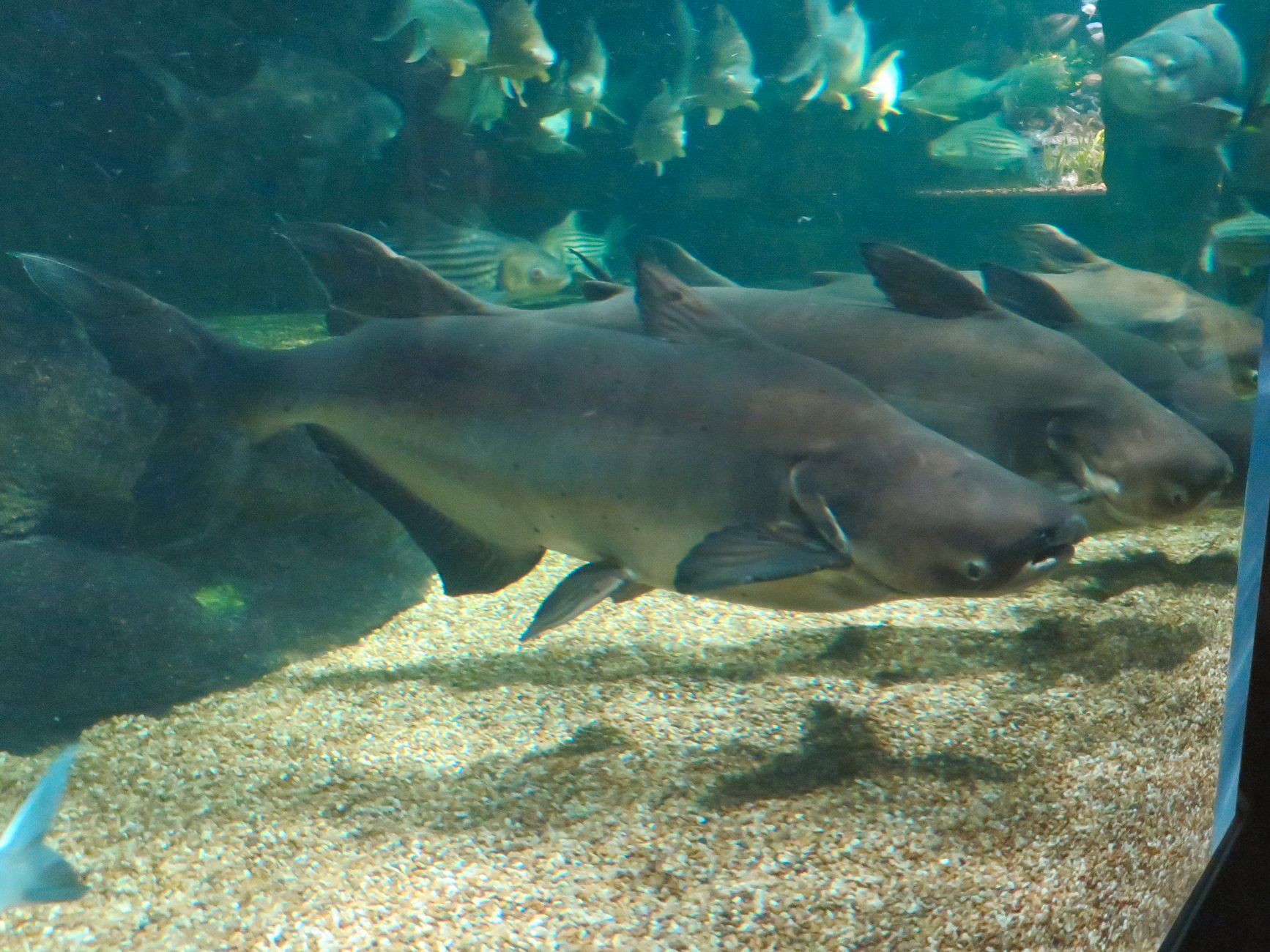
The Mekong giant catfish (Pangasianodon gigas; Thai: ปลาบึก, RTGS: pla buek, pronounced [plāː bɯ̀k]; Khmer: ត្រីរាជ /trəy riec/; Vietnamese: cá tra dầu) is a large species of catfish (order Siluriformes) in the shark catfish family (Pangasiidae), native to the Mekong basin in Southeast Asia and adjacent China. It is considered critically endangered due to overfishing and habitat loss.
Grey to white in color and lacking stripes, the Mekong giant catfish is distinguished from other large catfish species in the river by the near-total lack of barbels and the absence of teeth. Young Mekong catfish do exhibit barbels and oral teeth, but these features diminish as they age and are absent by the time they grow to be 30–50 cm in length.
Mekong giant catfish are one of the largest species of freshwater fish. In 2005, the Mekong giant catfish attained the Guinness World Record for the world's largest freshwater fish. Attaining a length of up to 3 m (9.8 ft), the Mekong giant catfish grows extremely quickly, reaching a mass of 150 to 200 kg (330 to 440 lb) in only six years. It can reportedly weigh up to 350 kg (770 lb). The largest catch recorded in Thailand since record-keeping began in 1981 was a female measuring 2.7 m (8 ft 10 in) in length and weighing 293 kg (646 lb). This specimen, caught in 2005, was widely recognized as the largest entirely freshwater fish ever caught (the largest sturgeon species, the beluga, can far exceed this size, but they are anadromous), until surpassed in June of 2022 by a giant freshwater stingray specimen caught in Cambodia. Thai fisheries officials stripped the giant catfish, caught in 2005, of its eggs as part of a breeding program, intending then to release it, but the fish died in captivity and was sold as food to local villagers.
The Mekong giant catfish is a threatened species in the Mekong, and conservationists have focused on it as a flagship species to promote conservation on the river. Although research projects are currently ongoing, relatively little is known about this species. Historically, the fish's natural range reached from the lower Mekong in Vietnam (above the tidally influenced brackish water of the river's delta) all the way to the northern reaches of the river in the Yunnan Province of China, spanning almost the entire 4,800 km (3,000 mi) length of the river. Due to threats, this species no longer inhabits the majority of its original habitat. It is now believed to only exist in small, isolated populations in the middle Mekong region. Fish congregate during the beginning of the rainy season and migrate upstream to spawn. They live primarily in the main channel of the river, where the water depth is over 10 m (33 ft), while researchers, fishermen and officials have found this species in the Tonlé Sap River and Lake in Cambodia, a UNESCO Biosphere Reserve. In the past, fishers have reported the fish in a number of the Mekong's tributaries. In December of 2024, 6 of the Mekong giant catfish were sighted and caught along the Tonle Sap River, in Cambodia. However, In 2005 the biggest Mekong giant catfish to be caught was in northern Thailand and weighed up to 292 kg.
As fry, this species feeds on zooplankton in the river and is known to be cannibalistic. After about one year, the fish becomes herbivorous, feeding on filamentous algae, probably ingesting larvae and periphyton accidentally.[citation needed] The fish likely obtains its food from algae growing on submerged rocky surfaces, as it does not have any sort of dentition. The Mekong giant catfish are toothless herbivores that live off of the plants and algae in the river. One scientific study found zooplankton and phytoplankton in their stomach contents.
Understanding of the species' migration pattern is incomplete. The fish are thought to rear primarily in the Mekong and Cambodia's Tonlé Sap lake and migrate hundreds of miles north to spawning grounds in Thailand. Spawning fish in the upper Cambodia are being over-harvested. Fragmentation caused by infrastructure development of dams are becoming increasingly common posing threats to larval fish and reducing breeding abilities. Overfishing, damming, destruction of spawning and breeding grounds and siltation have taken a toll on the species' habitat.
In Thai folklore, this fish is regarded with reverence, and special rituals are followed and offerings are made before fishing it. The species is represented as ancient art along the Mekong River.
In The Anthropologists' Cookbook (1977), Jessica Kuper noted the importance of the pa beuk to the Lao people and remarked, "In times gone by, this huge fish, which is found only in the Mekong, was fairly plentiful, but in the last few years, the number taken annually has dwindled to forty, thirty or twenty, and perhaps in 1976 even fewer. This is sad, as it is a noble fish and a mysterious one, revered by the Lao." In 2000, fishermen hauled out 11 giant catfish. In 2001 they caught seven. In 2002 they caught just five.
Hub AI
Mekong giant catfish AI simulator
(@Mekong giant catfish_simulator)
Mekong giant catfish
The Mekong giant catfish (Pangasianodon gigas; Thai: ปลาบึก, RTGS: pla buek, pronounced [plāː bɯ̀k]; Khmer: ត្រីរាជ /trəy riec/; Vietnamese: cá tra dầu) is a large species of catfish (order Siluriformes) in the shark catfish family (Pangasiidae), native to the Mekong basin in Southeast Asia and adjacent China. It is considered critically endangered due to overfishing and habitat loss.
Grey to white in color and lacking stripes, the Mekong giant catfish is distinguished from other large catfish species in the river by the near-total lack of barbels and the absence of teeth. Young Mekong catfish do exhibit barbels and oral teeth, but these features diminish as they age and are absent by the time they grow to be 30–50 cm in length.
Mekong giant catfish are one of the largest species of freshwater fish. In 2005, the Mekong giant catfish attained the Guinness World Record for the world's largest freshwater fish. Attaining a length of up to 3 m (9.8 ft), the Mekong giant catfish grows extremely quickly, reaching a mass of 150 to 200 kg (330 to 440 lb) in only six years. It can reportedly weigh up to 350 kg (770 lb). The largest catch recorded in Thailand since record-keeping began in 1981 was a female measuring 2.7 m (8 ft 10 in) in length and weighing 293 kg (646 lb). This specimen, caught in 2005, was widely recognized as the largest entirely freshwater fish ever caught (the largest sturgeon species, the beluga, can far exceed this size, but they are anadromous), until surpassed in June of 2022 by a giant freshwater stingray specimen caught in Cambodia. Thai fisheries officials stripped the giant catfish, caught in 2005, of its eggs as part of a breeding program, intending then to release it, but the fish died in captivity and was sold as food to local villagers.
The Mekong giant catfish is a threatened species in the Mekong, and conservationists have focused on it as a flagship species to promote conservation on the river. Although research projects are currently ongoing, relatively little is known about this species. Historically, the fish's natural range reached from the lower Mekong in Vietnam (above the tidally influenced brackish water of the river's delta) all the way to the northern reaches of the river in the Yunnan Province of China, spanning almost the entire 4,800 km (3,000 mi) length of the river. Due to threats, this species no longer inhabits the majority of its original habitat. It is now believed to only exist in small, isolated populations in the middle Mekong region. Fish congregate during the beginning of the rainy season and migrate upstream to spawn. They live primarily in the main channel of the river, where the water depth is over 10 m (33 ft), while researchers, fishermen and officials have found this species in the Tonlé Sap River and Lake in Cambodia, a UNESCO Biosphere Reserve. In the past, fishers have reported the fish in a number of the Mekong's tributaries. In December of 2024, 6 of the Mekong giant catfish were sighted and caught along the Tonle Sap River, in Cambodia. However, In 2005 the biggest Mekong giant catfish to be caught was in northern Thailand and weighed up to 292 kg.
As fry, this species feeds on zooplankton in the river and is known to be cannibalistic. After about one year, the fish becomes herbivorous, feeding on filamentous algae, probably ingesting larvae and periphyton accidentally.[citation needed] The fish likely obtains its food from algae growing on submerged rocky surfaces, as it does not have any sort of dentition. The Mekong giant catfish are toothless herbivores that live off of the plants and algae in the river. One scientific study found zooplankton and phytoplankton in their stomach contents.
Understanding of the species' migration pattern is incomplete. The fish are thought to rear primarily in the Mekong and Cambodia's Tonlé Sap lake and migrate hundreds of miles north to spawning grounds in Thailand. Spawning fish in the upper Cambodia are being over-harvested. Fragmentation caused by infrastructure development of dams are becoming increasingly common posing threats to larval fish and reducing breeding abilities. Overfishing, damming, destruction of spawning and breeding grounds and siltation have taken a toll on the species' habitat.
In Thai folklore, this fish is regarded with reverence, and special rituals are followed and offerings are made before fishing it. The species is represented as ancient art along the Mekong River.
In The Anthropologists' Cookbook (1977), Jessica Kuper noted the importance of the pa beuk to the Lao people and remarked, "In times gone by, this huge fish, which is found only in the Mekong, was fairly plentiful, but in the last few years, the number taken annually has dwindled to forty, thirty or twenty, and perhaps in 1976 even fewer. This is sad, as it is a noble fish and a mysterious one, revered by the Lao." In 2000, fishermen hauled out 11 giant catfish. In 2001 they caught seven. In 2002 they caught just five.
Recent media