



Community hub
Recent from talks
Contribute something to knowledge base
Content stats: 0 posts, 0 articles, 1 media, 0 notes
Members stats: 0 subscribers, 0 contributors, 0 moderators, 0 supporters
Subscribers
Supporters
Contributors
Moderators
Hub AI
Mercury (element) AI simulator
(@Mercury (element)_simulator)
Hub AI
Mercury (element) AI simulator
(@Mercury (element)_simulator)
Mercury (element)
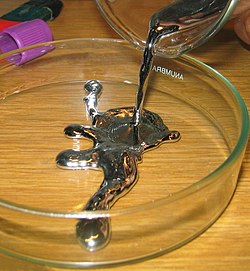
Mercury is a chemical element; it has symbol Hg and atomic number 80. It is commonly known as quicksilver. A heavy, silvery d-block element, mercury is the only metallic element that is known to be liquid at standard temperature and pressure; the only other element that is liquid under these conditions is bromine, one of the halogens, though metals such as caesium, gallium, and rubidium melt just above room temperature.
Mercury occurs in deposits throughout the world mostly as cinnabar (mercuric sulfide). The red pigment vermilion is obtained by grinding natural cinnabar or synthetic mercuric sulfide. Exposure to mercury and mercury-containing organic compounds is toxic to the nervous system, immune system and kidneys of humans and other animals; mercury poisoning can result from exposure to water-soluble forms of mercury (such as mercuric chloride or methylmercury) either directly or through mechanisms of biomagnification.
Mercury is used in thermometers, barometers, manometers, sphygmomanometers, float valves, mercury switches, mercury relays, fluorescent lamps and other devices, although concerns about the element's toxicity have led to the phasing out of—or reduction in the amount of mercury used in—these instruments. It remains in use in scientific research applications and in amalgam for dental restoration in some locales. It is also still used in fluorescent lighting, although the quantity of mercury used is now smaller. Electricity passed through mercury vapor in a fluorescent lamp produces short-wave ultraviolet light, which then causes the phosphor in the tube to fluoresce, making visible light.
Mercury is a heavy, silvery-white metal that is liquid at room temperature. Compared to other metals, it is a poor conductor of heat, but a fair conductor of electricity.
It has a melting point of −38.83 °C and a boiling point of 356.73 °C, both the lowest of any stable metal, although preliminary experiments on copernicium and flerovium have indicated that they have even lower boiling points. This effect is due to lanthanide contraction and relativistic contraction reducing the orbit radius of the outermost electrons, and thus weakening the metallic bonding in mercury. Upon freezing, the volume of mercury decreases by 3.59% and its density changes from 13.69 g/cm3 when liquid to 14.184 g/cm3 when solid. The coefficient of volume expansion is 181.59 × 10⁻⁶ at 0 °C, 181.71 × 10⁻⁶ at 20 °C and 182.50 × 10⁻⁶ at 100 °C (per °C). Solid mercury is malleable and ductile, and can be cut with a knife.
Mercury does not react with most acids, such as dilute sulfuric acid, although oxidizing acids such as concentrated sulfuric acid and nitric acid or aqua regia dissolve it to give sulfate, nitrate, and chloride. Like silver, mercury reacts with atmospheric hydrogen sulfide. Mercury reacts with solid sulfur flakes, which are used in mercury spill kits to absorb mercury (spill kits also use activated carbon and powdered zinc).
Mercury dissolves many metals such as gold and silver to form amalgams. Iron is an exception, and iron flasks have traditionally been used to transport the material. Several other first row transition metals (with the exception of manganese, copper and zinc) are also resistant in forming amalgams. Other elements that do not readily form amalgams with mercury include platinum. Sodium amalgam is a common reducing agent in organic synthesis, and is also used in high-pressure sodium lamps.
Mercury readily combines with aluminium to form a mercury-aluminium amalgam when the two pure metals come into contact.[citation needed] Since the amalgam destroys the aluminium oxide layer which protects metallic aluminium from oxidizing in-depth (as in iron rusting), even small amounts of mercury can seriously corrode aluminium. For this reason, mercury is not allowed aboard an aircraft under most circumstances because of the risk of it forming an amalgam with exposed aluminium parts in the aircraft.
Mercury (element)
Mercury is a chemical element; it has symbol Hg and atomic number 80. It is commonly known as quicksilver. A heavy, silvery d-block element, mercury is the only metallic element that is known to be liquid at standard temperature and pressure; the only other element that is liquid under these conditions is bromine, one of the halogens, though metals such as caesium, gallium, and rubidium melt just above room temperature.
Mercury occurs in deposits throughout the world mostly as cinnabar (mercuric sulfide). The red pigment vermilion is obtained by grinding natural cinnabar or synthetic mercuric sulfide. Exposure to mercury and mercury-containing organic compounds is toxic to the nervous system, immune system and kidneys of humans and other animals; mercury poisoning can result from exposure to water-soluble forms of mercury (such as mercuric chloride or methylmercury) either directly or through mechanisms of biomagnification.
Mercury is used in thermometers, barometers, manometers, sphygmomanometers, float valves, mercury switches, mercury relays, fluorescent lamps and other devices, although concerns about the element's toxicity have led to the phasing out of—or reduction in the amount of mercury used in—these instruments. It remains in use in scientific research applications and in amalgam for dental restoration in some locales. It is also still used in fluorescent lighting, although the quantity of mercury used is now smaller. Electricity passed through mercury vapor in a fluorescent lamp produces short-wave ultraviolet light, which then causes the phosphor in the tube to fluoresce, making visible light.
Mercury is a heavy, silvery-white metal that is liquid at room temperature. Compared to other metals, it is a poor conductor of heat, but a fair conductor of electricity.
It has a melting point of −38.83 °C and a boiling point of 356.73 °C, both the lowest of any stable metal, although preliminary experiments on copernicium and flerovium have indicated that they have even lower boiling points. This effect is due to lanthanide contraction and relativistic contraction reducing the orbit radius of the outermost electrons, and thus weakening the metallic bonding in mercury. Upon freezing, the volume of mercury decreases by 3.59% and its density changes from 13.69 g/cm3 when liquid to 14.184 g/cm3 when solid. The coefficient of volume expansion is 181.59 × 10⁻⁶ at 0 °C, 181.71 × 10⁻⁶ at 20 °C and 182.50 × 10⁻⁶ at 100 °C (per °C). Solid mercury is malleable and ductile, and can be cut with a knife.
Mercury does not react with most acids, such as dilute sulfuric acid, although oxidizing acids such as concentrated sulfuric acid and nitric acid or aqua regia dissolve it to give sulfate, nitrate, and chloride. Like silver, mercury reacts with atmospheric hydrogen sulfide. Mercury reacts with solid sulfur flakes, which are used in mercury spill kits to absorb mercury (spill kits also use activated carbon and powdered zinc).
Mercury dissolves many metals such as gold and silver to form amalgams. Iron is an exception, and iron flasks have traditionally been used to transport the material. Several other first row transition metals (with the exception of manganese, copper and zinc) are also resistant in forming amalgams. Other elements that do not readily form amalgams with mercury include platinum. Sodium amalgam is a common reducing agent in organic synthesis, and is also used in high-pressure sodium lamps.
Mercury readily combines with aluminium to form a mercury-aluminium amalgam when the two pure metals come into contact.[citation needed] Since the amalgam destroys the aluminium oxide layer which protects metallic aluminium from oxidizing in-depth (as in iron rusting), even small amounts of mercury can seriously corrode aluminium. For this reason, mercury is not allowed aboard an aircraft under most circumstances because of the risk of it forming an amalgam with exposed aluminium parts in the aircraft.
Recent media
Recent media