Hubbry Logo
Mercury glassMercury glassMain
Open search
Mercury glass
Community hub
Mercury glass
logo
8 pages, 0 posts
0 subscribers
Be the first to start a discussion here.
Contribute something
Mercury glass
Mercury glass
from Wikipedia
English mercury glass objects

Mercury glass (or silvered glass) is glass that was blown double walled, then silvered between the layers with a liquid silvering solution, and sealed. Although mercury was originally used to provide the reflective coating for mirrors, elemental mercury was never used to create tableware. Silvered glass was free-blown, then silvered with a solution containing silver nitrate and grape sugar in solution, heated, then closed. Sealing methods include metal discs covered with a glass round or a cork inserted into the unpolished pontil scar. "Mercury" silvered glass was produced originally around 1840 until at least 1930 in Bohemia (now the Czech Republic), Germany and was also manufactured in England from 1849 to 1855.

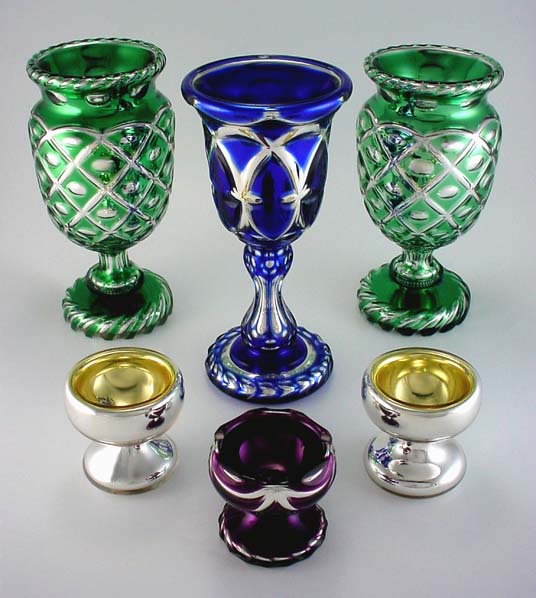
Edward Varnish and Frederick Hale Thomson patented the technique for silvering glass vessels in 1849. The double walled blanks were furnished by James Powell. The English examples were often cased with a layer of colored glass in jewel tones of ruby red, cobalt blue, amethyst purple and emerald green then cut to silver as illustrated in the photograph. English signatures on silvered glass include E. Varnish & Co. London, Thomson, London and Thomas Lund.

Blown glass is made utilizing a long metal blowpipe by the glass blower who shapes and heats the object. The piece is attached to a long, flat-topped iron called a pontil to the end of the piece, with a small piece of molten glass, and the blowpipe is now cracked off. The workman completes the object and then, the pontil rod or "punty" is cracked off leaving the familiar rough pontil scar.

Companies in the United States, including the Boston and Sandwich Glass Company, New England Glass Company, Union Glass Co., and the Boston Silver Glass Company, made silvered glass from about 1852–1880. The New England Glass Company displayed a variety of silvered glass articles including copper wheel engraved goblets, vases and other tableware at the 1853 New Crystal Palace Exhibition.

Silvered mercury glass from Bohemia was also decorated with a variety of techniques including painting, enameling, etching, and surface engraving.

Silvered "mercury" glass is considered one of the first true "art glass" types, that is, glass that was made for display and for its inherent artistic value rather than for utilitarian use.

Authentic antique silvered glass pieces are still available in a wide range of decorative items and usually sold as mercury glass.

There are many reproductions currently marketed as "mercury glass", in table form, ornaments and other objects. New "mercury glass" can be distinguished from antique silvered glass in several ways, including lack of a double wall, and solid bottoms that are different from true antique silvered glass.[1][2]

References

[edit]
Revisions and contributorsEdit on WikipediaRead on Wikipedia
from Grokipedia
Mercury glass, also known as silvered glass, is a form of decorative glassware characterized by its silvery, mirror-like appearance, created by applying a solution between the walls of a double-walled vessel, which is then sealed to preserve the reflective coating. Despite its name, mercury was only briefly used in early production methods for mirroring glass in the early and was quickly replaced due to its high cost, with the term "mercury glass" persisting as a for the later silvered technique. The technique originated in around 1840 as an economical alternative to and ornaments, allowing the middle and working classes to afford luxurious-looking items often called "poor man's silver" or "Bauernsilber" in German. It gained widespread popularity in and the during the mid-19th century. The process was patented in in 1849 by Edward Varnish and Frederick Hale Thomson, who developed a method using and a like glucose to deposit the silver layer without mercury, and in the United States in 1855 by Leighton of the Glass Company. By the early 20th century, demand had declined due to changing tastes and the development of new production techniques, leading to the end of widespread production around 1900, though modern reproductions using safer silvering formulas continue for decorative purposes. Today, authentic 19th-century pieces are prized by collectors for their aged , known as "foxing," which creates subtle spots and imperfections over time.

Overview

Definition and characteristics

Mercury glass is a form of decorative glassware characterized by its silvery, mirrored interior effect, achieved through a double-walled construction where a is applied between the layers. This technique creates an illusion of , making it a popular alternative to more expensive metalware in the . The outer layer is typically made of clear or lightly tinted , allowing light to pass through and interact with the inner silvered surface to produce a luminous, aesthetic. Key characteristics include a translucent exterior that diffuses softly, paired with a highly reflective inner layer that imparts a shimmering, ethereal glow reminiscent of on . The silvering, often created using a solution of , can vary in density, enabling subtle gradations of opacity and depth that enhance the piece's visual intrigue. Pieces are crafted from various types of , including soda-lime and , resulting in durable forms suitable for vases, candlesticks, and ornaments. This combination of transparency and reflection gives mercury glass its distinctive, jewel-like quality, where the interplay of produces dynamic highlights and shadows. Authentic mercury glass often exhibits unique visual traits such as subtle imperfections, including small bubbles from the hand-blowing process or uneven silvering that adds to its organic, aged charm. These irregularities, such as slight mottling or oxidation over time, distinguish genuine examples from modern reproductions, which tend to have a more uniform, machine-perfected finish. The overall effect is one of rustic elegance, with the silvered interior providing a soft, diffused radiance rather than sharp reflection. The term "mercury glass" derives from early 19th-century experiments using mercury amalgams to achieve a similar silvery mirror effect on surfaces, though this hazardous material was largely abandoned in favor of safer silver-based solutions due to and cost concerns. Despite the name, most production of mercury glass does not involve actual mercury, emphasizing its evolution as a for this silvered technique.

Distinction from mirrors and silvered glass

Mercury glass, despite its silvery appearance, serves primarily as a decorative material rather than a functional reflective surface like traditional mirrors. Traditional mirrors consist of a single pane of flat glass coated with a thin layer of silver or aluminum on the back, designed to provide clear, precise reflections for viewing purposes. In contrast, mercury glass is formed from double-walled, hollow vessels where the silvering—typically achieved through a chemical deposition of silver nitrate—is applied internally between the walls and then sealed, rendering the exterior non-reflective and unsuitable for practical use as a mirror. This internal silvering creates a shimmering, metallic sheen visible from the outside but without the optical clarity or flatness required for image reflection. While mercury glass falls under the broader category of silvered glass, it is distinct in its specific construction and purpose from other forms of silvered glass, such as Victorian silvered overlays or surface-applied silvering techniques. General silvered glass encompasses any glass coated with silver, often for functional mirrors or etched decorative effects, but mercury glass exclusively refers to sealed, double-walled objects where the silver nitrate solution is trapped inside to mimic the look of solid silver without exposing the coating to air or wear. Unlike overlays, which involve applying silver leaf or foil directly to the glass surface for ornamental patterns, mercury glass's silvering is fully enclosed, protecting it from tarnish and emphasizing its role as an imitation metal rather than a coated surface. A key differentiator of mercury glass lies in its intention as "poor man's silver," crafted for ornamental display in households seeking an affordable alternative to genuine silverware, rather than achieving the optical precision of functional silvering. This decorative focus often results in artistic irregularities, such as mottled or spotted patterns in the silvering due to variations in the chemical deposition process, which are absent in the uniform, high-reflectivity coatings of mirrors or precision silvered glass. These imperfections enhance its aesthetic appeal as a faux metal, positioning it as a collectible art form rather than a utilitarian product. A common misconception is that mercury glass derives its name and from the use of mercury, similar to early historical mirror-making processes that employed toxic mercury-tin amalgams. In reality, true mercury was rarely used in mercury glass production and only in very early, short-lived experiments around the , as it proved unsuitable for the double-walled technique; instead, solutions became the standard, making the term "mercury glass" a that persists despite the material containing no mercury. This distinction is crucial, as it separates mercury glass from the hazardous legacy of mercury-based mirrors, which posed significant health risks to artisans.

History

Origins in the 19th century

Mercury glass, also known as silvered glass, emerged in the mid-19th century as an innovative technique to create objects with a silvery luster resembling polished metal, initially developed in around 1840 during the waning years of the period. This period, characterized by a desire for functional yet elegant domestic items, saw Bohemian glassmakers experimenting with affordable alternatives to expensive silverware, adapting traditional mirror-silvering methods—originally involving tin-mercury amalgams—to hollow decorative wares like vases and candlesticks. The technique allowed for the production of luminous, reflective pieces that appealed to the burgeoning , reflecting broader industrial advancements in and chemical deposition that made such effects scalable beyond elite craftsmanship. The formal invention gained legal recognition in with a granted in 1849 to Frederick Hale Thomson and Edward , who refined the double-walled glass process to encase a silver solution between layers, preventing tarnish and enabling of ornate hollowware. This breakthrough built directly on Bohemian precedents, transforming sporadic artisanal efforts into a viable industrial method responsive to rising demand for opulent home decor amid the Industrial Revolution's expansion of consumer markets. Early pieces from this era emphasized the silvery sheen as a symbol of and accessibility, bridging the gap between luxury and everyday use for emerging bourgeois households. Mercury glass debuted internationally at the of 1851 in London's , where English producers showcased vases and ornaments that captivated visitors with their metallic glow, solidifying the technique's appeal as a democratic luxury. Across the Atlantic, the Glass Company displayed similar items at the 1853 Exhibition, marking the material's American introduction and spurring local adoption. These expositions highlighted mercury glass's role in democratizing ornate aesthetics, fueled by advances in glass manufacturing that lowered costs and met the era's enthusiasm for reflective, Victorian-era embellishments. In 1855, William Leighton of the Glass Company secured the first U.S. patent for silvering glass, particularly for durable items like doorknobs, further adapting the Bohemian-inspired process to practical applications.

Peak production and international spread

The peak period of mercury glass production occurred from the 1860s to the 1880s, marked by mass manufacturing in regions such as , , and , with Bohemian output continuing robustly until around 1920. During this era, factories in Bohemian centers like Iglau and Haida scaled up from artisanal techniques to industrialized processes, enabling the creation of vast quantities of decorative items that transitioned from luxury novelties to everyday adornments. This surge in output was driven by innovations in silvering methods, which allowed for efficient replication of the glass's characteristic metallic sheen within double-walled forms. Mercury glass gained international prominence through widespread exports, particularly as affordable souvenirs from European spas such as Karlsbad in the , where tourists purchased items like beakers and vases as mementos. Its popularity spread to the via waves of European and exposure at world's fairs, including the Exhibition in 1853, where American firms like the New England Glass Company displayed their versions, fostering domestic production until about 1880. Adoption extended to France and , where the glass complemented local decorative traditions, and it reached broader markets through sales at international fairs, resorts, and religious outlets across Europe and beyond. Economically, the affordability of mercury glass production—leveraging inexpensive materials and streamlined factory methods—facilitated its integration into Victorian-era households, serving as a "poor man's silver" alternative for middle- and lower-class consumers seeking reflective decor. Pre-electric , the era's reliance on candlelight and gas lamps heightened demand for such shimmering objects, which enhanced illumination and added opulent visual effects to interiors without the cost of genuine silverware. Notable international exhibitions, such as in in , showcased mercury glass to global audiences, lauding its innovative brilliance in scientific journals and accelerating its fame and export volume. This visibility, combined with the shift to mechanized output, propelled mercury glass from a regional to a staple of 19th-century .

Production techniques

Traditional manufacturing process

The traditional manufacturing process of mercury glass, also known as silvered glass, began with the free-blowing of a double-walled vessel using a hollow blowpipe and punty rod to create a hollow space between the inner and outer layers. The glassblower shaped the molten into spheres, vases, or other forms, ensuring the walls were thin and uniform. Once the desired shape was achieved, the piece was cracked off the punty rod, leaving a small or pontil scar at the base through which the silvering solution would be introduced. Next, a silvering solution, typically consisting of and a like glucose or grape sugar, was poured into the space between the walls via the base hole. The solution was allowed to coat the interior surface evenly. After the reduced to metallic silver, excess solution was drained, and the piece was allowed to dry. The process demanded high dexterity to achieve uniform coverage. The final step involved sealing the aperture to protect the silver layer from oxidation and leaks. Common methods included affixing a metal disc impressed with the manufacturer's mark, covered by a wafer or plug cemented with , or using simple corks for less expensive pieces; regional variations existed, such as Bohemian lead seals or American cork stoppers. This labor-intensive craftsmanship evolved in the mid-19th century, shifting from unsuccessful early trials with toxic mercury amalgams—which suffered from poor adhesion and health risks—to the safer method by the 1850s, following patents in (1849) and the (1855). Quality control centered on airtight sealing to preserve the reflective interior, with intact seals serving as markers of authenticity. Common defects included incomplete silvering from uneven distribution, air bubbles trapped during blowing, or eventual tarnishing if seals failed, often manifesting as cloudiness or peeling over time. These imperfections, while reducing value, also distinguish genuine 19th-century pieces from later reproductions.

Materials and chemical composition

Mercury glass production primarily utilizes clear or colored soda-lime glass to form the double-walled structure, providing the transparent outer and inner layers that enclose the reflective coating. This type of glass, composed mainly of silica, soda ash, and lime, was common for 19th-century blown glassware due to its workability and affordability. The key silvering agent is (AgNO₃), which is dissolved in a solution and reduced to metallic silver to create the mirror-like interior surface. The chemical process involves a reduction reaction where silver ions from the solution are converted to neutral silver atoms, depositing as a thin, adherent metallic layer on the inner surface. This deposition is facilitated by reducing agents such as glucose (also known as grape sugar) or other organic reducers like , which donate electrons to the silver ions, promoting uniform coating without the need for or . The resulting silver layer achieves the characteristic pearlescent, reflective effect that mimics liquid mercury. Early 19th-century experiments with mercury-tin amalgams for silvering hollow objects proved unsuccessful due to poor and , as the amalgam failed to form a stable, even coating inside the confined space, often leading to flaking or incomplete coverage. Additionally, these amalgams posed significant health risks from mercury vapor exposure during application and over time, prompting their abandonment. By the , the standard formula shifted to non-toxic solutions, establishing a safer and more reliable method that avoided mercury entirely. In the United States in 1855 by William Leighton of the New England Glass Company. Auxiliary materials include sealing agents such as metal discs, plugs, or cork stoppers inserted into a small after silvering to prevent oxidation and maintain the vacuum-like interior. For decorative variations, occasional washes—applied as a gold-colored or metallic solution—could be used on select pieces to create a warm, gilded effect alongside the silver.

Variations and forms

Common object types

Mercury glass, prized for its shimmering, mirrored appearance, was fashioned into a range of decorative objects during the , primarily for ornamental display rather than everyday utility. Among the most common forms were goblets, vases, beakers, candlesticks, bottles, and spheres, which exemplified the technique's versatility in creating elegant, silver-like effects at a more accessible cost. These items were often produced in , , and , where artisans crafted them to mimic fine silverware, earning the material nicknames like "poor man's silver." The scale of these objects varied widely to suit different settings, from intimate tabletop accents to grand centerpieces. Small spheres and bottles, typically measuring 2 to 3 inches in height, served as souvenirs or holiday ornaments, such as early decorations internally coated with for a luminous glow. Larger pieces, like vases and beakers reaching up to 7 inches tall or compotes spanning 5.25 inches across, provided dramatic focal points in Victorian interiors. Symmetrical shapes were a hallmark design feature, ensuring uniform silvering and visual balance, while many goblets and candlesticks incorporated stems or feet for stable placement on dining tables or mantels. Specialized hollowware extended to functional yet decorative forms like ewers for wine or water service and compotes for fruit display, often part of coordinated sets. Religious items also featured prominently, including chalices, crucifixes, madonnas, and reliquaries, which highlighted mercury glass's appeal in and devotional contexts due to its radiant, jewel-like quality. Elaborate multi-part ensembles, such as footed vases up to 12 inches tall, underscored the material's role in creating sophisticated, multi-tiered tableaus for special occasions.

Decorative styles and embellishments

Mercury glass, prized for its silvery sheen mimicking fine silverware, was often enhanced through various post-production decorative techniques that added artistic depth and personalization. Common methods included painting with enamels in white or colored motifs, such as birds or florals, applied directly to the exterior surface. Wheel engraving using copper tools created intricate patterns like vines and foliage on higher-quality pieces, while or frosting produced delicate, frosted designs featuring ferns and geometric elements. Enameling, either or hot-fired for durability, allowed for vibrant additions, and occasional with gold washes on interiors provided a luxurious contrast to the silvered base. Less frequent embellishments involved jewel-like glass inlays or granulated textures resembling coralene, achieved by stenciling and refiring crushed for raised patterns of grapes or flowers. The evolution of decorative styles on mercury glass reflected broader European design movements, adapting the material's affordability to period aesthetics. In the Biedermeier era (circa 1815–1848), embellishments emphasized simplicity, with pieces often left plain or lightly etched with understated florals to suit middle-class homes seeking elegant restraint. Victorian production from the mid-19th century introduced more elaborate rococo-inspired motifs, including hand-painted enamel scenes of parrots or flowers, combined with lacy raised paste and accents for opulent, narrative-driven decoration. Toward 1900, influences brought organic curves, tendrils, and forest themes like ferns, often rendered through etching or enameling to evoke natural fluidity on vases and goblets. While clear glass dominated mercury glass production for its neutral showcase of the silver interior, color variations added subtle contrast and rarity. Tinted exteriors in hues like or were cased over the silvering and sometimes cut through to reveal patterns, particularly in Bohemian examples. Gold-washed or lacquered interiors enhanced the reflective quality, creating a warm glow, as seen in engraved goblets from the . Ruby casing or bright enamel banding appeared on select pieces for dramatic effect. High-end mercury glass pieces are distinguished by rarity markers that signal skilled craftsmanship and limited production. Hand-painted narrative scenes, such as detailed bird motifs on vases, or intricate wheel-engraved cuttings exposing the silver layer, indicate or luxury items from workshops like those in around 1870–1880. Intact seals or signatures, like those from English holders, further denote scarcity, as many fragile examples deteriorated over time due to the material's delicacy.

Manufacturers and regions

European producers

Europe's production of mercury glass, also known as silvered glass, was dominated by Bohemian manufacturers during the late , with significant contributions from British innovators and smaller-scale operations in other countries. Bohemian glassworks, located in regions now part of the , emerged as the primary hubs for high-volume output, exporting vast quantities of the material between 1860 and 1900. Key producers included Josef Janke & Co. in Haida (present-day Nový Bor), renowned for its quality craftsmanship in double-walled silvered items such as vases and ornaments. Similarly, Hugo Wolff's firm, operating in Iglau () and Haida, specialized in similar exports, marking pieces with "HW" to denote origin. These Bohemian centers advanced sealing techniques using metal discs and lead plugs to protect the silver nitrate coating from oxidation, enabling durable, tarnish-resistant products for international markets. In Britain, the technique was pioneered through the 1849 granted to Frederick Hale Thomson and Edward Varnish for creating double-walled glass blanks suitable for silvering. Production often occurred at James Powell's Whitefriars Glassworks in , which supplied blanks and manufactured finished pieces under the , focusing on engraved varieties adorned with copper-wheel motifs for enhanced decorative appeal. Edward Varnish & Co. marked items with "E.V." seals, emphasizing precision in pontil finishing to prevent leaks and breakage, a refinement over earlier methods. British output prioritized ornate and lighting, with techniques adding intricate floral and figural designs to the silvered surfaces. German firms, particularly in Saxony's glassmaking regions, contributed to continental production, though on a smaller scale than , supplying local and export markets with utilitarian silvered items like candlesticks. In and , numerous small factories produced mercury glass for domestic use, often of inferior quality compared to Bohemian exports, focusing on affordable vases, figurines, and spa souvenirs from areas like Karlsbad (). These regional specializations highlighted Europe's diverse adaptations, with Bohemian volume and British innovation driving the material's popularity during its peak.

American and other international makers

In the , mercury glass production commenced with the granted to Leighton of the Glass Company in , on January 16, 1855, for a method to silver the interior of objects, particularly door-knobs, creating a lustrous, tarnish-resistant finish resembling polished silver. This innovation spurred the establishment of manufacturing facilities in , where the Glass Company became a primary producer of silvered items, including curtain tie-backs, vases, and decorative accessories, during the mid- to late 19th century. American output remained on a limited scale relative to European efforts, with factories such as the Glass Company concentrating on the domestic market from the 1870s to the 1890s, often crafting simpler forms suited to everyday household use rather than elaborate exports. Other firms, including the Glass Company, produced limited quantities of silvered glass items in the 1880s and 1890s. Production emphasized practical applications, with engravings and cuttings that echoed colonial motifs for broader appeal. Beyond the U.S., mercury glass saw modest production in regions outside , such as , where there was no significant local manufacturing and items were primarily imported from and America to serve decorative needs in emerging households. No notable manufacturing occurred in or , where mercury glass arrived primarily through trade routes as luxury imports.

Uses and significance

Decorative and household applications

Mercury glass found widespread use in 19th-century households as an affordable alternative to , often dubbed "poor man's silver" for its shimmering, metallic appearance that mimicked luxury metalware. In Victorian parlors and dining rooms, it appeared in such as goblets and cordial glasses, which added elegance to formal meals without the high cost of genuine silver. Candlesticks crafted from mercury glass were particularly prized for their reflective surfaces, which caught and amplified candlelight to create a warm, ambient glow in dimly lit interiors. These items were commonly placed on mantels, sideboards, or as centerpieces, enhancing the overall opulence of middle-class homes aspiring to aristocratic aesthetics. Beyond dining, mercury glass served as a key decorative element in everyday domestic settings, with vases and small ornamental pieces displayed prominently in cabinets or on shelves to showcase affluence. Its soft luminescence made it ideal for holiday accents, such as Christmas ornaments or festive table decorations, where the subtle sheen complemented seasonal greenery and lighting. In social contexts, these objects symbolized upward mobility for emerging middle-class families during the Victorian era, allowing them to emulate the grandeur of wealthier estates without prohibitive expense. Production peaks in Bohemia and the United States from the 1840s to 1880s facilitated this accessibility, with items like engraved goblets becoming popular souvenirs from European spas. Despite its aesthetic appeal, mercury glass had practical limitations that confined it primarily to ornamental rather than functional roles. The silver nitrate coating rendered it unsuitable for food contact, as it was not food-safe and could leach harmful substances, making items strictly for display or non-edible uses like holding flowers or candles. Additionally, the internal silvering was vulnerable to and oxidation if the sealing layer—often a thin glass disc or —deteriorated, leading to cloudiness or mottled discoloration over time and diminishing its reflective quality. These constraints underscored its status as a decorative novelty rather than durable household ware, best preserved in controlled environments to maintain its silvery allure.

Cultural and religious roles

In Catholic regions of 19th-century , mercury glass found notable application in religious artifacts due to its luminous, silver-like appearance that evoked and heavenly shimmer. Items such as crucifixes, madonnas, saints' figures, and icons were crafted from this material, often for use in chapels, altars, and personal devotion. In poorer churches, particularly in rural , mercury glass was employed for candlesticks, crosses, statuary, and even chalices as an affordable alternative to precious metals, earning it the nickname "Bauernsilber" (farmer's silver) in German-speaking areas. These objects, produced mainly between 1860 and 1890 in Bohemian workshops, allowed congregations to adorn sacred spaces without the expense of silver, aligning with the era's emphasis on accessible piety. Beyond settings, mercury glass played a role in culture, especially in the spa towns of , where it symbolized health, leisure, and regional craftsmanship. Small goblets, flasks, and beads from fashionable resorts like Karlsbad (now ), Marienbad, and Franzensbad were popular mementos for tourists between 1860 and 1890, often engraved with spa motifs or personal inscriptions to commemorate visits. This trade highlighted Bohemia's glassmaking heritage, as visitors from across sought these shimmering, portable items as tokens of wellness and exotic travel, fostering a link between industrial innovation and . Symbolically, mercury glass embodied the and of luxury during the 19th-century industrial era, offering a tarnish-resistant, cost-effective of silver that made elegance attainable for the emerging . Known as "poor man's silver" in , it represented technological progress in while evoking aspirations of refinement and prosperity. Occasionally incorporated into traditions or given as wedding gifts in , such pieces underscored themes of enduring beauty and communal celebration, though its primary appeal lay in bridging artisanal heritage with mass accessibility. Regionally, mercury glass held stronger cultural resonance in Central European traditions, where its use in religious and contexts thrived amid vibrant glassmaking centers such as Iglau and Haida.

Decline and modern aspects

Factors contributing to decline

The introduction of electric lighting in the late 19th and early 20th centuries significantly diminished the appeal of mercury glass, as its reflective qualities were originally designed to enhance the soft glow of candlelight in dimly lit interiors. With brighter, more consistent illumination becoming widespread, the ornate, shimmering effect of silvered glass lost its practical and aesthetic necessity in household decor. Concurrently, advancements in glass manufacturing, such as the adoption of cheaper techniques, provided more affordable alternatives to the labor-intensive process of blowing double-walled vessels and silvering them internally with silver nitrate solutions. Economic disruptions from the World Wars further accelerated the decline of mercury glass production, particularly in where most manufacturers were based. During , exports of were severely disrupted, with about 60% of utility glass and nearly all luxury items reliant on foreign sales that became difficult amid the conflict, devastating key glassworks. imposed stricter restrictions, classifying as a nonessential material and halting its use in decorative glass items, including silvered ornaments and vessels, which effectively ended remaining artisanal output in many regions. Rising costs of post-1900, driven by industrial demand and wartime shortages, also made the process less viable for mass production. Shifting market preferences played a pivotal role in the obsolescence of mercury glass, as public taste evolved away from Victorian-era opulence toward simpler, more modern aesthetics by the early . Silvered glass, once prized for its affordable imitation of , came to be viewed as and outdated, leading to a sharp drop in demand around the . The rise of in the emphasized geometric minimalism and materials like chrome and polished metals, favoring sleek functionality over the intricate, reflective embellishments of mercury glass, with production largely ceasing in most areas by the . Although mercury glass production relied on silver nitrate rather than actual mercury—contrary to persistent myths about toxicity—the chemical's known hazards as a skin and eye irritant likely contributed to growing caution among manufacturers and workers in the early 20th century. Historical records indicate that earlier experimental methods using mercury amalgams were abandoned due to severe health risks, including neurological damage, which may have heightened overall awareness of chemical silvering dangers even as silver nitrate became standard. This recognition, combined with regulatory scrutiny on industrial chemicals, indirectly supported the shift away from hazardous artisanal techniques.

Revivals and contemporary reproductions

Interest in mercury glass experienced sporadic revivals in the , with production continuing into the early for decorative items like ornaments, evoking for Victorian-era . Post-World War II, the growing popularity of collecting further boosted the perceived value of surviving pieces, with Bohemian examples from 1840–1920 becoming sought-after at auctions and flea markets for their rarity and condition. In the 21st century, modern reproductions have proliferated through accessible DIY methods, such as applying a mixture of and followed by mirror-finish spray paint to create a faux silvered effect on glassware, allowing crafters to mimic the antique look affordably for home decor. Mass-produced imports from , often featuring distressed or etched finishes to imitate styles, are widely available and have made mercury glass-inspired items ubiquitous in retail settings. Safety concerns surrounding antique mercury glass primarily stem from misconceptions about its composition; authentic pieces contain no mercury, as the silvering process uses silver nitrate and reducing agents rather than amalgam, debunking myths of poisoning risks from handling or use in tableware. Experts recommend careful handling of antiques to avoid breakage, though sealed items present no significant hazard if kept intact. As of November 2025, contemporary trends highlight a continued resurgence in mercury glass for holiday decor, with ornaments like shimmering balls and figurines prized for their nostalgic glow and charm, as noted by interior designers who value their timeless sparkle on trees. High-end artisans occasionally recreate pieces using traditional silvering techniques for collectors, commanding premium prices due to the labor-intensive process that preserves the original luminous quality.

References

Add your contribution
Related Hubs
Contribute something
User Avatar
No comments yet.