Hubbry Logo
WilliamWilliamMain
Open search
William
Community hub
William
logo
8 pages, 0 posts
0 subscribers
Be the first to start a discussion here.
Contribute something
William
William
from Wikipedia
William
William the Conqueror
The name William became popular in England after the Norman conquest in 1066 by William the Conqueror.
Pronunciation/wɪljəm/
GenderMale
LanguageNorman French, & Germanic languages
Name dayOctober 28
Origin
Meaning"Vehement protector"
Region of originNorthern Europe
Other names
Nicknames
Related names
Popularitysee popular names
[1]

William is a masculine given name of Germanic origin. It became popular in England after the Norman conquest in 1066,[2] and remained so throughout the Middle Ages and into the modern era. It is sometimes abbreviated "Wm." Shortened familiar versions in English include Will or Wil, Wills, Willy, Willie, Bill, Billie, and Billy.

A common Irish form is Liam. Scottish diminutives include Wull, Willie or Wullie (as in Oor Wullie). Female forms include Willa, Willemina, Wilma and Wilhelmina.

Etymology

[edit]

William is related to the German given name Wilhelm. Both ultimately descend from Proto-Germanic *Wiljahelmaz, with a direct cognate also in the Old Norse name Vilhjalmr and a West Germanic borrowing into Medieval Latin Willelmus. The Proto-Germanic name is a compound of *wiljô "will, wish, desire" and *helmaz "helm, helmet".[3]

By regular sound change, Proto-Germanic *Wiljahelmaz should have also descended into English as *Wilhelm, but this latter form is unattested in written English of any period; the Anglo-Saxon Chronicle refers to William the Conqueror as Willelm, a back-formation from the Medieval Latin variant.[4] The form William is a back-borrowing from Old Norman Williame, a specifically northern Norman reflex of Medieval Latin Willelmus (compare the Central French cognate Guillaume). The development of the name's northern Norman form can be traced in the different versions of the name appearing in Wace's Roman de Rou.[5]

The first well-known bearer of the name was Charlemagne's cousin William of Gellone (755–812). This William is immortalized in the Chanson de Guillaume, and the esteem in which he was held may account for the name's subsequent popularity among European nobility.

English history

[edit]

The English "William" is taken from the Anglo-Norman language and was transmitted to England after the Norman conquest in the 11th century, and soon became the most popular name in England[6][7][8], along with other Norman names such as Robert (the English cognate was Hrēodbeorht, which by regular sound changes would have developed into something along the lines of "Reedbart"[9][10])[better source needed], Richard, Roger (the English cognate was Hroðgar[11]), and Henry (all of Germanic origin and may have been transmitted through the Normans' use of Old French).

The name Wilkin/Wilkins is also of medieval origin, taken from the shortened version of William (Will) with the suffix "kin" added.[12][better source needed]

Variants

[edit]

People named William

[edit]

See also

[edit]

References

[edit]
Revisions and contributorsEdit on WikipediaRead on Wikipedia
from Grokipedia
William is a masculine given name of Germanic origin, derived from the elements willa ("will" or "desire") and helm ("helmet" or "protection"), translating to "resolute protector" or "strong-willed warrior." The name entered widespread use in following the of , where it was introduced in its French form Guillaume (from Willehelm), quickly becoming one of the most common names in English-speaking regions. Historically, William has maintained enduring popularity, ranking consistently among the top names for boys in the and for over a century, with peaks in the early and a resurgence in recent decades due to associations with notable figures like . Its variants include Wilhelm in German, Guillaume in French, and Vilhjálmr in , reflecting its broad European adoption. The name's cultural significance is amplified by famous bearers such as , the renowned English playwright, and , the first Norman King of , who helped cement its legacy. In modern contexts, William symbolizes strength, determination, and , often shortened to nicknames like Will, Bill, or , the latter of which has evolved into an independent name. Its timeless appeal continues to influence naming trends globally, underscoring its role as a cornerstone of Western .

Origins and Meaning

Etymology

The name William derives from the compound Willahelm, formed by combining willa, meaning "will" or "desire," with helm, signifying "helmet" or "protection." This etymological structure yields interpretations such as "resolute protector" or "helmet of will," emphasizing determination and safeguarding. Tracing further back, Willahelm evolved from Proto-Germanic roots, specifically wiljô for "will" and helmaz for "helmet," reflecting the Germanic tradition of names that blend aspirational qualities with imagery. The earliest recorded use of a form of this name appears in the , associated with the Frankish noble , an early bearer who exemplified its adoption in Carolingian Europe. Following the of in , the name entered English usage through the Old French variant Willaume, an of the Frankish Willahelm, which standardized the spelling and pronunciation as "William" in contexts. This linguistic shift solidified its prominence in English-speaking regions while preserving the core Germanic meaning.

Linguistic Roots

The name William originates from the Proto-Germanic compound Wiljahelmaz, a dithematic that underwent significant phonetic evolution in the West Germanic branch, particularly in the transition to forms like Willahelm during the 8th and 9th centuries. Morphologically, Wiljahelmaz exemplifies the common Germanic of compounding two thematic elements (dithematic names), where the prefix wilja- derives from wiljô meaning "will" or "desire," and the suffix -helmaz means "" or "," together evoking the concept of a "resolute protector." This structure parallels other Germanic names, such as (from wilja- + friþuz "") and Helmrich (from helmaz + rīkja- "power"), highlighting a cultural preference for aspirational compounds that combined personal qualities with symbols of strength or safeguard. Such formations were prevalent in early Germanic societies, allowing for flexible recombination of elements to convey desired attributes. Early attestations of the name in its form, Willahelm, appear in 8th-century Frankish texts from the Carolingian era, including diplomatic and historical records documenting figures like (c. 755–814), a military leader and cousin of who served as . The name entered English usage after the , adapted as William in , incorporating Norman and .

Historical Usage

In Medieval Europe

The name William, of Germanic origin meaning "resolute protector," spread through the Frankish nobility during the Carolingian period, becoming associated with martial prowess and religious devotion. A key early bearer was (c. 755–814), a cousin of who served as from 790 to 811 and led campaigns against Muslim forces in . After retiring to monastic life, he founded the Abbey of Gellone (later ), where he died as abbot; his in 1066 further elevated the name's prestige among the Frankish elite. By the , the name had taken root in , where Viking settlers adopted Frankish naming conventions to consolidate power. (Guillaume Longue-Épée, c. 893–942), son of the Norse chieftain and second ruler of the Norman territory, exemplified this integration; as Nortmannorum, he expanded Norman influence through alliances and warfare, embedding the name in the region's feudal structure. This adoption underscored the name's role in denoting authority and protection, essential for Norman lords navigating vassalage and inheritance practices. In 11th-century and , the name's variants—Guillaume and Wilhelm—prevailed among knights and nobles, as documented in historical records reflecting its status as a marker of aristocratic identity. Chronicles such as the Gesta Normannorum Ducum by William of Jumièges (c. 1070) frequently reference Williams among Norman warriors, portraying them as exemplars of chivalric duty in the context of ducal courts and military campaigns. This widespread use highlighted the name's conceptual ties to resilience and in medieval continental society.

In English-Speaking Regions

The name William gained prominence in England following the of 1066, when (c. 1028–1087), , became king and introduced the name to the English court and nobility. Previously rare in Anglo-Saxon naming practices, where dithematic names like Ælfric dominated, William rapidly rose in popularity as a marker of Norman elite status, appearing frequently in post-conquest records such as the of 1086, often in its Latin form Willelmus. This elevation was reinforced by its adoption as a royal name, with William II (r. 1087–1100), son of the Conqueror, succeeding to the throne, and later William III (r. 1689–1702), who co-ruled with Mary II during the , further embedding the name in English monarchical tradition. During the Middle English period (roughly 12th–14th centuries), the name underwent standardization from its earlier Norman-French form Willaume or Latin Willelmus to the anglicized William, as seen in vernacular texts and administrative records. This shift reflected broader linguistic assimilation after the Conquest, with English scribes adapting the name to fit emerging orthographic norms. Geoffrey Chaucer's works, such as The Canterbury Tales (late 14th century), exemplify this, employing "William" consistently in various narratives. Legal documents from the period, including charters and court rolls, similarly standardized the spelling as William by the 14th century, aiding its integration into everyday usage across social classes. The name persisted and spread through English colonial expansion in the 17th and 18th centuries, becoming one of the most common given names in America due to British settler influences. In colonial records, William ranked among the top male names, as evidenced by its frequent appearance in vital statistics and censuses from to the , symbolizing continuity with English heritage. This endurance continued into the , with notable peaks during the (1837–1901) in both Britain and America, where it held a share of up to 12.2% of male births in early Victorian samples, driven partly by literary associations with figures like and characters in novels by , such as William Dorrit in . By the late , its popularity began a gradual decline but remained in the top ranks, underscoring its enduring appeal.

Variants and Forms

Germanic Variants

In Germanic languages, the name William manifests in several distinct variants, each retaining the core elements of "will" (*wiljô) and "helmet" (*helmaz) from Proto-Germanic *wilja-helmaz, signifying a "resolute protector."<grok:render type="render_inline_citation"> 1 </grok:render> These forms evolved through regional linguistic adaptations, maintaining prominence in historical and modern contexts across German-speaking, Dutch, and Scandinavian regions. The German variant Wilhelm is the most direct cognate, pronounced approximately as /ˈvɪlhɛlm/ with a soft 'v' sound at the beginning and emphasis on the first syllable.<grok:render type="render_inline_citation"> 14 </grok:render> It gained widespread prominence in the 19th century, notably borne by Wilhelm I (1797–1888), the first King of Prussia and German Emperor, whose reign marked the unification of Germany under Prussian leadership.<grok:render type="render_inline_citation"> 66 </grok:render> This form has been a staple in German nomenclature, reflecting royal and imperial associations. In Dutch, the name appears as , pronounced /ˈʋɪləm/, featuring a 'w' similar to English 'v' and a schwa in the final syllable.<grok:render type="render_inline_citation"> 21 </grok:render> Common in the and , it has historical roots dating to the , exemplified by of Orange (1533–1584), known as , who led the Dutch Revolt against Spanish rule and is regarded as of the Dutch royal lineage.<grok:render type="render_inline_citation"> 38 </grok:render><grok:render type="render_inline_citation"> 39 </grok:render> Scandinavian variants, primarily Vilhelm in Danish, Norwegian, and Swedish, trace their adoption to medieval influences around the , integrating the through linguistic channels during periods of and trade.<grok:render type="render_inline_citation"> 47 </grok:render><grok:render type="render_inline_citation"> 51 </grok:render> Pronunciations vary slightly by language: in Swedish, it is /ˈvɪlːhɛlm/ with a prolonged 'l'; in Danish, closer to /ˈvilˌhelˀm/ with glottal reinforcement; and in Norwegian, /ˈvɪl̩hɛlm/ akin to the German form.<grok:render type="render_inline_citation"> 59 </grok:render><grok:render type="render_inline_citation"> 58 </grok:render> This adaptation has persisted in royal and cultural contexts, such as Danish kings and .

Romance and Other Language Variants

In Romance languages, the name William has undergone distinct adaptations influenced by Latin and regional phonetic shifts. The French variant, Guillaume, originates from the Norman form Willame, reflecting the Germanic roots adapted through during the medieval period. This form emerged prominently in the , as evidenced in the epic poem Chanson de Guillaume (also known as Chançun de Willame), a composed around 1130 CE that recounts the heroic deeds of William of Orange and his kin, highlighting the name's integration into French literary traditions. In Italian, the equivalent is , a direct borrowing from the Latinized Germanic Gulielmus, maintaining the original structure while aligning with Italic phonology. The Spanish form, , similarly derives from Gulielmus but features a characteristic Romance evolution with the intervocalic /l/ becoming /ʎ/ (as in "ll"). This variant entered Spanish nomenclature during the medieval period through Latin and Germanic influences in Iberian Christian kingdoms. Extending beyond Romance languages, adaptations appear in other European traditions, such as the Welsh Gwilym, which preserves a Celtic phonetic rendering of the Germanic elements while softening the initial consonant. In , the name manifests as Viljem in Slovenian and Croatian, adapting the Germanic Wilhelm through local orthography and pronunciation norms. Common diminutives, even in these contexts, echo broader patterns like the English-derived Will or Bill, emphasizing affection and familiarity. Pronunciation varies significantly across these variants, underscoring cultural and linguistic diversity. For instance, French Guillaume is typically pronounced /ɡi.jɔm/, with a soft "g" and ; Italian as /ɡuʎˈʎɛlmo/, featuring a palatal "gl"; and Spanish as /ɡiˈʎeɾmo/, with a yeísmo-influenced "ll" sound. These differences highlight how the name's core meaning—"resolute protector"—has been reshaped by regional sound systems without altering its foundational identity.

Cultural Significance

In the United States, the name William has maintained significant popularity throughout the , ranking consistently in the top 5 for male babies from the through the according to U.S. (SSA) data, with peaks at #2 in years like 1914 and 1920 during the and . By the late , its ranking began to decline amid preferences for shorter, modern names, falling outside the top 10 by the , though it reentered the top 20 in the . In recent years, William has stabilized around the top 10, ranking #10 in , while its nickname form has surged to #1 since 2017, reflecting a resurgence tied to the original name's legacy. In the , (ONS) records indicate William held a steady position in the top 10 for boys from the early 1900s through the 1990s, often boosted by royal influences such as Prince William. Its popularity waned slightly in the due to rising international names, but it remains prominent, ranking #12 in in 2023 and #11 in 2024, partly driven by celebrity endorsements and media exposure. Globally, William ranks highly in English-speaking countries outside the US and UK, placing #6 among boys' names in in 2024 per McCrindle's national analysis of birth registrations, and #17 in based on 2024 data. In contrast, usage is declining in , where it ranked outside the top 200 in 2023 data from Beliebte-Vornamen.de and continues to fall due to cultural preferences for shorter names like Leon or , though immigration from English-speaking regions and global media have sustained modest interest. These trends are influenced by factors such as migration patterns, which introduce the name in diverse communities, and media portrayals that reinforce its classic appeal. Preliminary data for 2025 suggests continued stability in the top 10-15 in the US and UK. William is overwhelmingly associated with males, comprising over 99.9% of usages in SSA and ONS records since 1880. Rare female applications include variants like Willa, a Germanic meaning "resolute ," which has seen minor upticks in the top 500 since the 2010s but remains uncommon.

In Literature and Media

In , the name William often embodies the archetype of the steadfast hero or figure, reflecting its etymological roots in protection and resolve. In William Shakespeare's Henry V (c. 1599), the character Michael Williams, a common , engages in a philosophical with the disguised king, symbolizing the ordinary subject's moral fortitude and loyalty amid war's uncertainties. Similarly, in Charles Dickens's (1855–1857), William Dorrit serves as the tragic patriarch of the , clinging to delusions of grandeur while embodying quiet endurance and familial devotion despite his downfall. These portrayals highlight William as a resilient guardian, navigating personal and societal adversities. In modern media, the name evokes heroic protectors in epic narratives. Mel Gibson's portrayal of in the 1995 film depicts him as a fierce Scottish rebel leader, rallying his people against oppression and sacrificing for , cementing the character's image as a symbol of defiant courage. In J.K. Rowling's series (1997–2007), Bill Weasley, the eldest son of the Weasley family, appears as a brave curse-breaker and loyal brother, using his expertise to safeguard his loved ones during the wizarding war, reinforcing themes of familial protection. Culturally, William represents reliability and steadfastness in Western tropes, often invoked in tales of guardianship, with humorous parodies underscoring its familiarity. The legendary , the Swiss known for his marksmanship to defend , inspires comedic references, such as in episode "The Cartridge Family" (1997), where mimics the apple-shooting feat with a gun, satirizing the archetype's adventurous resolve. As of 2025, portrayals in streaming media continue to shape perceptions of royal Williams, notably through Netflix's The Crown (2016–2023), where Ed McVey embodies a young Prince William navigating grief and public scrutiny in season 6, influencing global views of the name's association with poised leadership amid personal trials.

Notable Individuals

Rulers and Leaders

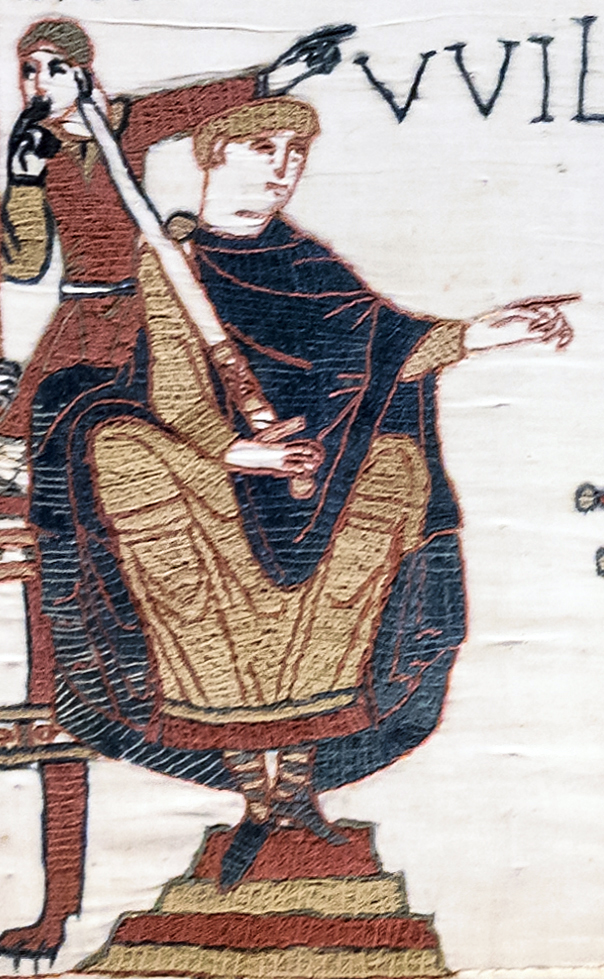
William the Conqueror (c. 1028–1087), originally Duke William II of Normandy, led the pivotal Norman invasion of England in 1066, culminating in the Battle of Hastings on October 14, where he defeated and killed King Harold Godwinson, thereby claiming the English throne as William I. This conquest established the Norman dynasty, fundamentally reshaping England's feudal system, land ownership, and cultural landscape by integrating Norman French influences into Anglo-Saxon society. His reign centralized royal authority through the Domesday Book survey of 1086, which documented land holdings to bolster taxation and control, solidifying Norman dominance for generations. William III of England (1650–1702), also known as William of Orange, ascended as co-monarch with his wife Mary II in 1689 following the , a nearly bloodless overthrow of Catholic King James II that affirmed Protestant succession and parliamentary supremacy. Invited by English nobles to invade with a Dutch army in November 1688, William's forces landed at and prompted James's flight , averting a broader civil war and establishing constitutional limits on monarchical power through the Bill of Rights 1689. His joint rule stabilized against Jacobite threats and allied it with the against French expansion in the , influencing the formation of the Kingdom of in 1707. William of Orange (1533–1584), revered as William the Silent, emerged as the foremost leader of the Dutch Revolt against Spanish Habsburg rule, initiating the that secured the independence of the United Provinces in 1648. As and a key noble in the , he shifted from loyalty to Philip II to open rebellion after the 1566 Iconoclastic Fury, forming the in 1579 to unite northern provinces in their Protestant resistance. His by a Spanish agent in 1584 did not halt the revolt; instead, it galvanized Dutch national identity, transforming the into a prosperous and maritime power. William Henry Harrison (1773–1841) served as the ninth President of the United States, elected in 1840 on the Whig ticket for his military heroism, particularly the decisive victory over Native American forces at the in 1811, which advanced American expansion into the . A seasoned and who governed the from 1801 to 1812, Harrison's brief presidency—lasting only 31 days until his death from —highlighted the era's partisan divides but symbolized the growing influence of frontier leaders in national politics. William, Prince of Wales (born June 21, 1982), is the to the British throne as the elder son of King Charles III. He has undertaken extensive public duties, focusing on advocacy through initiatives like Heads Together and environmental causes via The , while serving in military and diplomatic roles to prepare for kingship. These Williams profoundly shaped national identities through conquest, revolution, and governance: William the Conqueror's legacy endures in the , an 11th-century embroidered narrative commissioned to justify his rule and depict the invasion's events, serving as a cornerstone of Anglo-Norman historical memory. William III's actions entrenched constitutional monarchy in Britain, while William the Silent's defiance birthed modern Dutch sovereignty, and Harrison's career underscored American , each reinforcing the name's association with transformative leadership.

Artists, Writers, and Thinkers

(1564–1616), an Elizabethan and , is renowned for his profound influence on English literature through his innovative use of language and exploration of . His surviving works include approximately 38 plays, encompassing tragedies like and , comedies such as , and histories including Henry V, as well as 154 sonnets that delve into themes of love, time, and mortality. Shakespeare's contributions expanded the English vocabulary with over 1,700 words and phrases, shaping modern dramatic structure and character development. William Wordsworth (1770–1850), a central figure in the movement, revolutionized poetry by emphasizing emotion, nature, and the ordinary language of common people. He co-authored (1798) with , a seminal collection that marked the onset of in English literature through its focus on rustic life and personal introspection. Wordsworth's iconic poem "I Wandered Lonely as a Cloud" (1807) exemplifies his philosophy, portraying daffodils as a source of enduring joy and spiritual renewal amid solitude. William James (1842–1910), an American philosopher and psychologist, pioneered pragmatism and functionalism, bridging empirical science with philosophical inquiry. His two-volume The Principles of Psychology (1890), a foundational text in the field, integrated physiology, introspection, and evolutionary theory to examine consciousness as a stream of thought rather than isolated states. James's pragmatic philosophy, outlined in works like Pragmatism (1907), asserted that truth is verified through practical consequences, influencing modern psychology, education, and ethics. William Blake (1757–1827), a , painter, and printmaker, blended and social critique in his multimedia works, anticipating Romanticism's emphasis on imagination. His illuminated books, such as Songs of Innocence and of Experience (1794), used hand-engraved illustrations and text to contrast innocence with the corruptions of society and religion. Blake's prophetic visions, including epic poems like , challenged and industrial oppression, establishing him as a precursor to later artistic and revolutionary thought. In contemporary literature, (born 1948), a writer, is credited with inventing the genre through his depiction of high-tech, low-life futures intertwined with digital realities. His debut novel (1984) introduced concepts like "," profoundly impacting and cultural understandings of technology and .

References

  1. https://en.wiktionary.org/wiki/Reconstruction:Proto-Germanic/Wiljahelmaz
Add your contribution
Related Hubs
Contribute something
User Avatar
No comments yet.