


Community hub
Recent from talks
Contribute something
Nothing was collected or created yet.
Métis flag
View on Wikipedia
 | |
| Use | Blue version |
|---|---|
| Adopted | 1816 |
| Design | Infinity symbol on a blue background |
 | |
| Use | Red version |
| Adopted | 1815 |
| Design | Infinity symbol on a red background |
The Métis flag was first used by Métis resistance fighters in Rupert's Land before the 1816 Battle of Seven Oaks. According to only one contemporary account, the flag was "said to be" a gift from the North West Company in 1815,[1][2][3] but no other surviving accounts confirm this. Both the red and blue versions of the flag have been used to represent the political and military force of the Métis since that time.[4] The Métis flag predates the Flag of Canada by at least 150 years, and is the oldest patriotic flag that is indigenous to Canada.
The blue background flag has been accepted by the Métis National Council as the official flag of the Métis Nation. In 2013, the Métis National Council secured an official mark for the flag to protect it as a symbol of the Métis Nation, and ensure its collective ownership by citizens of the Métis Nation.[4]
Adoption of the flag in modern times
[edit]The first flag of the Métis was long forgotten among the other flags adopted and flown by the Métis at various points of their political and national growth. In the mid 1970s, the Métis flag being flown by the Native Council of Canada had a green background, and on the flag was a ring of alternating shamrocks and fleur-de-lys around a bison. However, there was friction due to difference of opinions between the Métis Society of Saskatchewan and the Native Council of Canada, and this friction helped to spur the debate about whether there was a historic Métis flag that they should be using. A consultant was tasked by the Métis Society of Saskatchewan board of directors to research and present on historic flags used by Métis. There was debate about which flag to adopt, and especially the red or blue infinity flag, and the Métis Society of Saskatchewan board chose the blue version. The red and blue versions were subsequently adopted by other Métis governments across Western Canada.[5]
Design and symbolism
[edit]The flag shows a white infinity symbol on a field of either blue or red. There are many interpretations of what the colours and symbol mean.
Several origins and meanings have been suggested for the infinity symbol flag:
- The faith that Métis culture shall live on forever[6]
- The mixing of the European immigrants and the First Nations peoples, with the two conjoined circles symbolizing the unity of two cultures.[6]
- There might be a connection to the ouroboros, an ancient symbol that depicts a serpent or dragon eating its own tail, represented either in a circle or figure eight, symbolizing renewal and rebirth.[5]
- Another possible interpretation of the infinity symbol is that it relates to traditional Métis and French Canadian dances, such as the quadrille, in which dancers move in a figure-eight pattern.[7]
- There might also be a connection to Celtic knotwork and Scottish influences that include Celtic knots, figure of eight in Scottish country dance, jewellery, etc.[8]
- Others have suggested that the symbol is derived from the Plains First Nations Sign Language for Métis (reported as the symbol for "cart" combined with the symbol for "Man" in reference to the Métis' use of the Red River cart), with the symbol for cart being formed by joining the thumb and forefingers on each hand with the hands held together to form two circles.[9]
There is debate about the historical interpretations of the colours of the Métis flags.
- Some claim that the red background represents the colours of the Hudson's Bay Company and that the blue background represents the North West Company,[10] (though both the Hudson's Bay Company and the North West Company flew red flags that were a modification of the Red Ensign).
- Others argue that the blue flag represents the francophone Métis and the red flag represents the anglophone Métis.[citation needed]
- Still others argue that the blue and white combination is based on both the Flag of Scotland, and the traditional colours of Quebec.[9][11]
- And yet others have said that the red flag is for Manitoba and the Northwest Territory Métis, and the blue is for the Saskatchewan Métis (despite the first recorded sighting of the red flag in what is now Saskatchewan and the blue flag first being recorded in what is now Manitoba).[citation needed]
- Another explanation for the colours of the flags is that they depend on how the flag is being used. Some argue that the red flag is the Métis Hunting Flag, letting the people around know that they were a hunting party and not a group going to war, and the guide for the day would be the flag-bearer.[12][13] Due to the potential for skirmishes and battles on the bison hunting trips, such as the Battle of Grand Coteau, the red flag could serve as a standard.[14]
- Some have also suggested that the flag started out as someone's attempt to design a flag for the Métis, and was putting out feelers to trial a design, which is why there are both red and blue flags with the common feature being the white infinity symbol.[15]
The difficulty in knowing the accurate history of the origin of the flag and potential interpretations of the symbolism is that there are no known records that accurately describe the origin of the flag in a first-hand account or other written records of its creation.
Alternative hypothesis on the colours of the flag
[edit] | This theory does not follow established publications and is based on one person's opinion not peer-reviewed. Narine, Shari (29 July 2020). "One Flag, Two Flags, Red Flag, Blue: Métis flag not a gift from North West Company, says historian". Windspeaker.com. Retrieved 30 July 2020. has been flagged as possibly containing fringe theories without giving appropriate weight to mainstream views. (March 2024) |
Prominent Métis lawyer, historian, and author Jean Teillet argues that the story of the origin of the Métis flag is an urban myth. Of the first three historic accounts of the Métis flag, only James Sutherland attributed the flag as a gift from the North West Company, based on rumours that he was told, and she argues for an exercise of caution in taking it as fact. Teillet and others argue that the Métis had a more active role in the origin of the flag, rather than being passive recipients of the flag or being manipulated by the North West Company.[2][3][5][16]
In 1815, popular fabrics in tradings posts that were available were calico, corduroy, plaid, and stroud. Stroud, a woollen, felt-like, broadcloth commonly used in making coats, was the only suitable material available for making flags. The common colours that were available at the time were green, red, and blue.[17] Teillet asserts that as a matter of practicality, the Métis would have used the material that was available to them for making flags. When they needed to make a new flag, they purchased the material that was available, and if red was not available, they might have chosen to use blue instead. Rather than being a strategic ideological decision to align colours with particular trading companies, her assertion is that the colour was a reaction to what was practical in that time and location.[2][3]
Until somebody shows me evidence of it I will stand firmly on my line, which is don't repeat that story. Just don't repeat it and have some faith in your own people that they have the intelligence enough to come up with their own ideas and don't attribute everything to everybody else.
History
[edit]Originally, the flags that would have been flown in Rupert's Land and across the North-Western Territory were the Hudson's Bay Company flag and North West Company flag, respectively, and the Union Jack.
Métis oral tradition tells that the Métis developed the infinity flag for themselves, and called the flag Li Paviiyoon di Michif in the Michif language.[5][16] Some people tell a story that Alexander Macdonell of Greenfield gifted the Métis employed by the North West Company a flag in 1814, helping to create the Métis Nation,[16] but there are no records that directly confirm this version of events, and some that potentially contradict this story.
James Sutherland's accounts of the Métis flag
[edit]The flag was first reported by James Sutherland in 1815 as red with an infinity symbol, and that it was being flown by Cuthbert Grant at Fort John in the Qu'Appelle area when a Hudson's Bay Company crew were rebuilding Fort Qu'Appelle (not to be confused with Fort Qu'Appelle, Saskatchewan built in 1864). In his account, Sutherland reported that the flag was said to be a gift from the North West Company given in early 1815, but provided no evidence to confirm this origin story for the flag nor did he state that it was a gift from Alexander Macdonell of Greenfield. The events reported in this account happened prior to Sutherland's arrival at Qu'Appelle on December 8, 1815, so were conveyed to him by Hudson's Bay Company Officer John Richards McKay and his party, who had arrived there in early October 1815 and had witnessed the events described.
... Alexander McDonell partner of the N.W.Co. arrived with a great parade of 40 or 50 Canadians, Freemen & Half-Breeds forming two distinct companies. McDonell led one of these consisting of Canadians with the Colours flying the other Company were Metis headed by Cuthbert Grant a Half Breed who has been regularly educated at Canada and has acted for several years as Clerk & still continue to act as such, to the N.W.Co. This Tribe had another Flag hoisted of what nation I know not it is red with a figure of 8 placed horizontally on the middle and it is said to be a present from the N.W.Co. along with some Swords and a few pairs of Pistols to these deluded young men the Half Breeds as a recompence for their exertions against the Colony Spring 1815 and as an incentive to encourage them to further mischief this ensuing season ...
— James Sutherland, Selkirk Papers, Narrative of James Sutherland, P.A.C., MG19E1, vol. 5, pp. 1946–47.[1]
Sutherland would also describe his first time seeing the flag at the arrival of John McDonald from Swan River in early 1816, though he did not provide an additional description of the flag.
Soon after Cameron returned to the Forks John McDonald of Swan River came on a visit & on his arrival two Flags were hoisted that is the N.W.Cos. Flag as the Flag Staff & the Half Breeds flag on a pole errected the top of their Bastion this was the first time they had shown the Half Breed Flag since my arrival indicated something.
— James Sutherland, Selkirk Papers, Narrative of James Sutherland, P.A.C., MG19E1, vol. 5, pp. 1950.[18]
Sutherland also discussed what he had been told about why the flag was flying.
However, we heard no more of the business for two or three days at this time the Canadians were in a state of intoxication. One old Canadian who was attached to us came to our house in this state. I put many Questions to him concerning what was going on at the N.W. House & what was the reason for hoisting the Half Breed flag he said I would know that before Summer came, that every thing bad against us & the Colony were in agitation. The flag was flying in honour of Cuthbert Grant having been appointed Captain General of all the Half Breeds in the Country and likewise as a rejoicing for the news brought by Swan River McDonald that the Half Breeds in Athabasca English River, Saskatchewan & Swan River were collecting under their several chiefs & had sent information that they would all join Grant Early in the Spring to sweep Red River of all the English.
— James Sutherland, Selkirk Papers, Narrative of James Sutherland, P.A.C., MG19E1, vol. 5, pp. 1951.[19]
Sutherland's account of these events was written sometime after the events and based on his memory, as he had destroyed his papers to prevent them from being taken by the North West Company.[1]
Potential contradictions of James Sutherland's account of the Métis flag as a gift
[edit]However, the assertion that the flag was a gift for the Métis from Alexander Macdonell of Greenfield and the North West Company is potentially contradicted by other accounts of gifts being given to the Métis by the North West Company and people they employed, in which the accounts do not mention of the flag among other gifts being given.
A potential contradiction of Sutherland's suggestion that the flag may have been a gift is found in an account of gifts being given to the Métis by the North West Company on June 28, 1815, at Fort William. The gifts, which included two swords, were given for the actions of the Métis against the Red River Colony, but there is no mention of a flag being gifted to the Métis.
As respects the partners of the North West Company, whatever doubt may exist as to their being accessaries to the present and other offences before the fact, there can be little or none of many of them having become so afterwards; as also that they were thanked publicly for the services rendered the company, a feast prepared for them, and a suit of clothes given to each, and swords to two (Bostonois and Antoine Houle) who are in the regular employment of the North West Company and chiefs of their own party. Amongst the partners present on this occasion at Fort William, the following only are named; viz. Simon McGillvray (of London), Archibald N. McLeod, Duncan Cameron, Alexander McDonnell, Alexander McKenzie, Kenneth McKenzie and John McDonald of Fort Dauphin, although probably many others were there at the time, as Daniel McKenzie acknowledges of himself in his letter before-mentioned.
— Lieutenant General Sir John Coape Sherbrooke, Papers Relating to the Red River Settlement.[20]
Colin Robertson (then employed by the Hudson's Bay Company) describes gifts being given to the Métis at Fort Gibraltar in his journal entry from September 15, 1815 at Fort Douglas, but there is no mention of a flag being given by Macdonnell among the other presents given by Duncan Cameron to the Métis for their activity against the Colony in Spring 1815 (Macdonell and Cameron had arrived at Fort Gibraltar on two days before on September 13, 1815[21]).
The Metifś and Freemen were called into the Hall of the North West Company's Fort, commonly termed Gibraltar or Forks, where Cameron made a long speech praising their values and independent spirit, in driving away those that came to enslave them, and threw out some sarcastic remarks on myself, but unfortunately for him his presents, which consisted for 6 Gallons of Shrub and forty pounds of Plug tobacco, excited such discontent, that one half of his audience left the room before the harangue was finished, and came over to my house. When things were in this state at Gibraltar, I sent over Mr McLean and Geo Yearns to claim some horses belonging to the Settlement. On Mr McLean's arrival he demanded an interview with Mr A. McDonnell and Seraphim, when he asked them if they had given away his two horses to Marcella's Son. Mr A. McDonnell turned around to Seraphim and asked him, did you ever hear Marcella's Son say that I gave him the Horses. Yes Oh! I remember says Mr McDonnell that I said to the Halfbreeds in general "my lads all the Horses are certainly yours". Cameron came forward, and said, he would take his Bible Oath that he never said so, but he presumed the Halfbreeds considered the Horses as free booty, however, it appeared clear to me that the North West Company had given the Colonial Horses, Dogs, &c to the Metifś as payment for the active part they took in the affairs of last spring, so I shall act upon this in my attempt to disunite the Metifś and the North West Company.
— Colin Robertson, Colin Robertson diary, 1 July 1815 – 30 November 1815 pp. 211–2.[21]
Robertson also recorded details reported to him of a speech and gifts by Cameron upon Cameron's arrival in the Fall of 1814, and the gifts did not include a flag.
Rode out this morning with Meſsrs. Pambrun et Nolin, met with Cameron in his uniform, attended by Seraphim & Pangman. The Captain wished to be polite, but I mean to keep him at arms length until I bring him to a sense of his duty, a few of the Freemen called on me to day, and one of the them who appeared to be a good meaning and rather an intelligent fellow, gave me the heads of Cameron's speech on his arrive in the Fall of 1814. when the destruction of the Colony was resolved on at Fort Williams, after his arrival he sent for all of the Freemen and Metifś, within one or two days march of his Fort, some of the most credulous of them, he ordered in the name of the King, when he had aſsembled them in his Hall at Fort Gibraltar, he placed before them a Keg of Rum and half a roll of Tobacco, and addressed them in the following terms:
"My friends you are aware of the continuation of the war with America, and that an old Friend Mr W McKay is appointed a Colonel in the Army, he intends to attack the Americans at Prairie des Chien, should he not find them there, it is his intention to come here, for reinforcements. I therefore expect you will render him every aſsistance, but in the first place you must aſsist me in driving away the Colonists. If they are not driven away the consequences will be, that they will prevent you from hunting and by that means starve your families, for the truth of what I aſsert; here is a proclamation, forbidding you on pain of death to kill food for your children."
Here Seraphim, read that unfortunate edict of Captn McDonnells
"You hear my friends, continued Cameron, what he says, who gave him a right to the soil? by and bye he will be claiming your private property? will you be slaves? will you allow this man who calls himself Governor to put his foot upon your neck? Join me, and resist such acts of Tyranny! I would beg to inform you that I am appointed commanding Officer of Red River by an order of Sir George Prevosts the Governor of Canada and I still expect higher promotion, but even at present I have authority to bring such Freemen to Montreal to be tried for disobedience of orders." A person of the name of Lavemdom [?] observed "that if the Americans came to Red River and that he was commanded in the name of the King, he would certainly take up arms against them, but he conceived the Colonists to be British Subjects like himself and would not take up arms against them, indeed (continued this man) "before the Colonists came here I was clothed in leather, but now I am comfortable, and myself and family have plenty of both Cloth and Blankets."
Cameron felt extremely indignant at his remark, Lavemdom [?] then took up his hat and left the room, he was soon followed by a number of others, who refused the presents which Cameron had laid out for them. I am greatly astonished that these proceedings of Cameron did not put Captn McDonnell on his guard, or induce him to take some steps to counter the views of the North West Company.
— Colin Robertson, Colin Robertson diary, 1 July 1815 – 30 November 1815 pp. 218–220.[21]
Further to potential contradictions of Sutherland's account of the flag being a gift is a dismissal of rumours about Duncan Cameron's gifts to the Métis and the use of the Métis as a militia of the North West Company that was written by Alexander Macdonell of Greenfield in his book A Narrative of Transactions in the Red River Country in 1819. In this book, Macdonell does not mention himself or others gifting a flag to the Métis.
It has been falsely asserted, that the Bois-brulés were paraded and exercised in arms under the immediate inspection of Duncan Cameron. Mr. Cameron had only two Bois-brulés, Bostonnois Pangman and a boy, wintering with him: but there was a Camp of Bois-brulés and Canadian hunters at Pembina River, winter 1815, assembled as usual at that season for the collection of provisions, against whom Miles McDonell marched with a body of armed men, intending to possess himself of the produce of their hunt; but on his near approach, they called in their stragglers, and put themselves in a posture to receive the Governor, which astonished the party, and caused him to retreat to his government-house at Fort Daer; and to this attempt, may principally be attributed to the part which the Bois-brulés in general afterwards took against him and the Colonists.
— Alexander Macdonell of Greenfield, A Narrative of Transactions in the Red River Country: From the commencement of the operations of the Earl of Selkirk, till the summer of the year 1816.[22]
Macdonell also mentioned a general meeting that occurred at Fort William in 1815, but again he did not discuss a flag being given to the Métis.
At the succeeding general meeting at Fort William, Mr. Cameron was, unfortunately for himself, reinstated in his joint charge of the Red River district; but he had positive injunctions from his Partners to be guarded, cautious, and prudent, and to avoid all collision with his Lordship's Agents and Settlers; and it was found expedient that I should conduct the provision posts of Upper Red River as usual.
— Alexander Macdonell of Greenfield, A Narrative of Transactions in the Red River Country: From the commencement of the operations of the Earl of Selkirk, till the summer of the year 1816.[23]
Peter Fidler's accounts of the Métis flag
[edit]Peter Fidler first reported a red Métis flag with an infinity symbol around March 12, 1816, on the Qu'Appelle River, and said that it had been see the previous fall, which corroborated Sutherland's account of John McDonald's visit to Qu'Appelle.[18][19] Fidler reported a rumour that he had heard that the North West Company was trying to direct the Métis to action against the Hudson's Bay Company and the newly established Red River Colony (the support was not unanimous among the Métis), but he did not attribute the flag to being a gift to the Métis.
About the 12th of March, the Canadian Northern Express arrived at River Qu'Appelle, accompanied by Mr. Jn. McDonald a partner of the N.W.Co. of the Swan River Department,— The Canadian and half-Breeds were liberally supplied with rum & was kept in a state of intoxication for two days — The day after the N.W.Co. Express arrived their flag was hoisted on the flag-staff, & a flag of the half-Breeds on the new Bastion. — The flag of the half-Breeds is about 41⁄2 feet square, red & in the middle is a large figure of Eight horizontally of a different colour. This flag was first displayed to the view of HBCo people last fall on the arrival of Mr. Alexr McDonell from the Forks, followed by the halfbreeds & freemen; at the same time the N.W.Co. flag was hoisted & followed by McDonell and all the Canadian Servants on their arrival at River qu'appelle house. The day after it was hoisted Polly, an old servant of the N.W.Co. & their Batteau builders came over to Mr. Sutherland on a visit in a private manner, who asked him the meaning of the half-Breeds flag being hoisted, a thing he had never before seen, he very emphatically replied that "before he left the River he would know it" — he was shortly after acquainted in a private manner that the half-Breeds had been directed by the N.W.Co. all to assemble at that place early in May, & that it was the intention of the N.W.Co. not only to root up the Colony but to seize all the Pemmican &c. belonging to the HBCo. — In consequence of hearing these alarming accounts Mr. Sutherland sent down an Express to the Colony sometime afterwards for a re-inforcement of armed men to assist in protecting the HBCo. property, on their passage down the River when the Ice permitted the Navigation; & Mr. Pambrun & 10 men was sent up from the Forks, & 6 from Brandon House for that purpose. — Reports were also current that the Servants of the HBCo. should all be driven from the Red River. — Mr. Cuthbert Grant, a Clerk to the N.W.Co. at River Qu'Appelle, a half-Breed is appointed to act as Commander-in-Chief over all the half-Breeds.
— Peter Fidler, Selkirk Papers, Narrative of Peter Fidler, P.A.C., MG19E1, vol. 6, pp. 2515.[24]
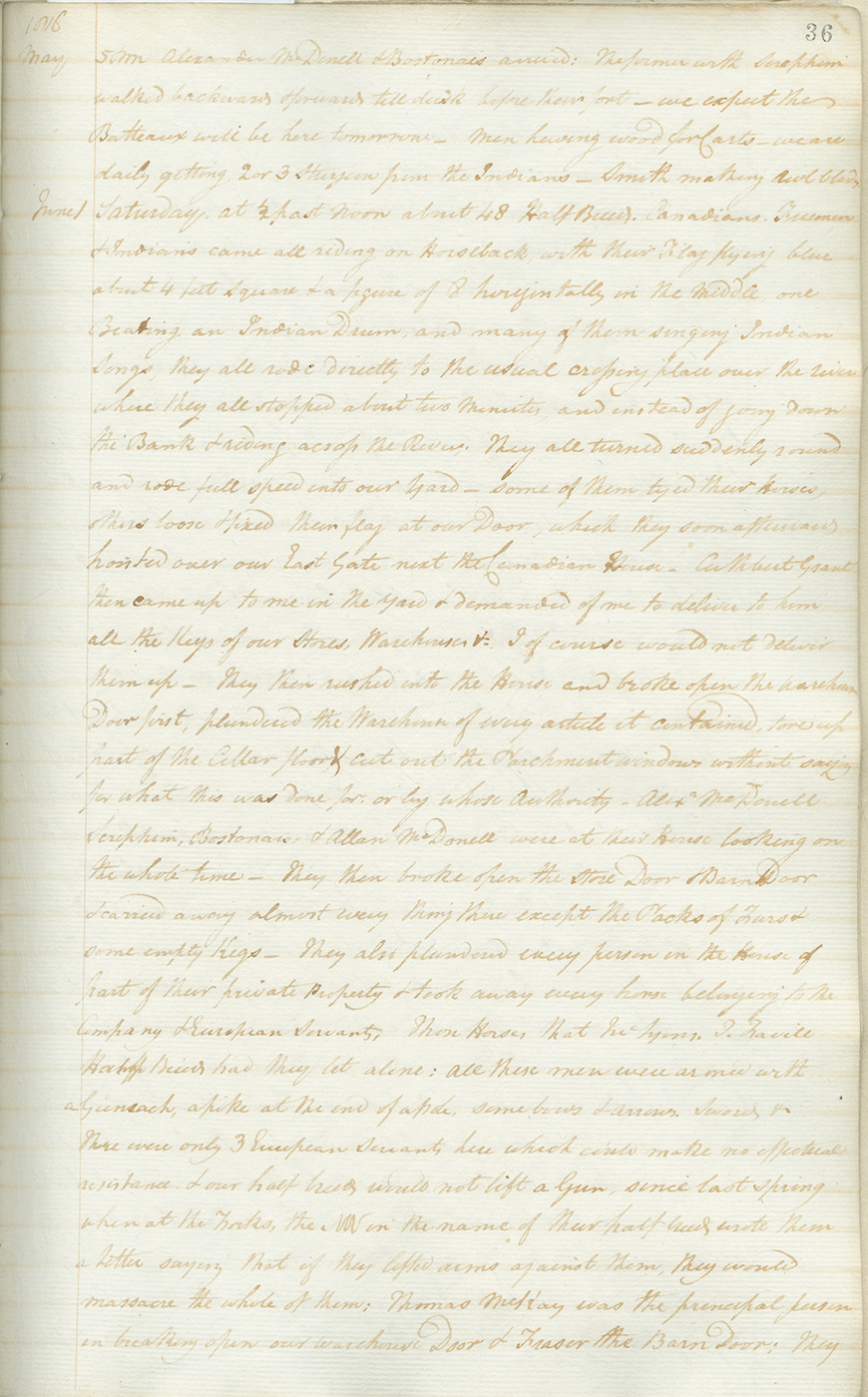
On June 1, 1816, Peter Fidler recorded in his Brandon House Journal that the Métis, under the leadership of Cuthbert Grant, were flying the blue flag with an infinity symbol when they attacked the Hudson's Bay Company's Brandon House, mere weeks before the Battle of Seven Oaks that happened on June 19, 1816. The reason for the change in the colour of the flag is not known, and Fidler did not provide information about the origin of the flag. In his narrative of the events to Lord Selkirk, Fidler did not report the changed colour, stating only that the flag was present.[25]
Saturday, at 1⁄2 past noon about 48 Half Breed, Canadians, Freemen & Indians came all riding on horseback, with their Flag flying blue about 4 feet square & a figure of 8 horizontally in the middle one Beating an Indian Drum, and many of them singing Indian Songs, they all rode directly to the usual croſing place over the river where they all stopped about two minutes, and instead of going down the Bank & riding acroſ the River, they all turned suddenly around and rode full speed into our yard — some of them tyed their horses, others loose fixed their flag at our Door, which they soon afterwards hoisted over our East Gate next to the Canadian House. Cuthbert Grant then came up to me in the yard & demanded of me to deliver to him all the keys of our Stores, Warehouses, &. I of course would not deliver them up — They then rushed into the House and broke open the Warehouse Door first, plundered the Warehouse of every article it contained, tore up part of the Cellar floor, & cut out the Parchment windows without saying for what this was done for or by whose Authority — Alexr McDonell Seraphim, Bostonois, & Allan McDonell were at their house looking on the whole time
— Peter Fidler, Brandon House post journal.[26]
Other flags used by the Métis
[edit]Legislative Assembly of Assiniboia
[edit]The provisional government, the Legislative Assembly of Assiniboia, established by the Métis under Louis Riel on December 8, 1869, flew a flag. There are numerous descriptions of the flag that was flown by the provisional government:
- A fleur-de-lis and shamrock on a white background[7][27][28][29][30][31][32]
- A golden fleur-de-lis on a white background[7][33]
- A golden fleur-de-lis with a black border on a white background[7][34]
- A fleur-de-lis, shamrock, and small bison on the fly on a white background[7][35]
- Three fleur-de-lis across the top and a shamrock in the centre of the bottom edge on a white background[7][36]
- A fleur-de-lis and a shamrock with a large bison on the lower part on a white background[7][15]
- A fleur-de-lis with a small bison in one corner on a white background[7][37]
- A blue fleur-de-lis with a green harp and shamrock on a white background with a gold border[7][38]
- Three crosses: a large scarlet-coloured cross in the centre, flanked by two smaller gold crosses; on a white background with a gold border[7][39]
- A ring of fleur-de-lis and shamrocks arranged around a bison on a white background.[7][40]
- A ring of fleur-de-lis and shamrocks arranged around a bison on a green background.[5]
Provisional government of Saskatchewan
[edit]The provisional government was established by Louis Riel at Batoche on March 19, 1885. There were at least two flags used by the provisional government. The first was described as:
Louis Riel raised the standard the day before St. Joseph's Day [March 18], calling the revolt the holiest of actions and placing it under the protection of St. Joseph and Our Lady of Lourdes. As a flag he chose the white flag of ancient France [with a royal blue shield bearing three golden fleurs de lys], saying that he was called to renew its ancient glories. On it he placed a large image of Mary's immaculate heart.
— Father Vital Fourmond, [41]
Riel also flew a personal banner at Batoche, which some sources say was the main flag of the Métis at Batoche and used as a battle standard. The flag consisted of an image of Notre Dame de Lourdes on one side and an inscription at the bottom that lists family members and a poem to Our Lady, and the reverse side contained poetry of a similar theme.[7][41][42][43] The Roman Catholic priests expressed concern during the Battle of Batoche that if they raised a white peace flag to signal to the Canadian forces to stop firing on the church and rectory that the white flag would be confused for Riel's white emblazoned flag and would attract shots and shelling from the troops, but white flag was recognized and respected.[44][45]
During the Battle of Batoche, Gabriel Dumont reported "on Baker's house [on the West side of the river] ... flew a flag of the Blessed Virgin. Another flag of Our Lord was in the midst of [Batoche], on the Council's house."[46][47] It was reported by witnesses that a flag was flying above a small building at the centre of Batoche that was used as the Council's chamber and located next to Xavier Letendre dit Batoche's house that was used as a headquarters, but these reports did not provide a description of this flag other than it was white and emblazoned.[48][49]
There is a claim that there was a Métis Battle Standard used at the Battle of Batoche that is described as being a blue background, with a wolf's head and hand (palm outward) in the middle, and a banner with the Michif words "maisons ... autels ... Surtout Liberté" (literally translated, this means "homes, altars, above all liberty").[7] This flag was said to have been created by the Métis women at Batoche to encourage the men in the battle.[50] However, the earliest known reference to this flag is a hand-drawn picture from 1975.[51]
See also
[edit]References
[edit]- ^ a b c Sutherland, James. "Report or a narrative of outrages committed against The Hudson's Bay Company's Servants by the North West Company at Qu'Appelle House during winter 1815–1816.". Selkirk collection, Vol. 5 (MG19-E1, microfilm reel C-2). Thomas Douglas, 5th Earl of Selkirk. pp. 1946–47. Retrieved 14 July 2020.
- ^ a b c d Narine, Shari (29 July 2020). "One Flag, Two Flags, Red Flag, Blue: Métis flag not a gift from North West Company, says historian". Windspeaker.com. Retrieved 30 July 2020.
- ^ a b c d Narine, Shari (29 July 2020). "One Flag, Two Flags, Red Flag, Blue: Métis flag not a gift from North West Company, says historian". Battlefords News-Optimist. Retrieved 30 July 2020.
- ^ a b "The Métis Nation Flag". Métis National Council. 21 December 2018. Archived from the original on 15 July 2020. Retrieved 14 July 2020.
- ^ a b c d e Hamilton, Murray (Winter 2007). "Flying the Flag" (PDF). New Breed Magazine. Saskatoon, SK, Canada: Gabriel Dumont Institute. Retrieved 7 March 2024.
- ^ a b Gaudry, Adam (Spring 2018). "Communing with the Dead: The "New Métis," Métis Identity Appropriation, and the Displacement of Living Métis Culture". American Indian Quarterly. 42 (2): 162–190. doi:10.5250/amerindiquar.42.2.0162. JSTOR 10.5250/amerindiquar.42.2.0162. S2CID 165232342.
- ^ a b c d e f g h i j k l m Racette, Calvin (1987). Flags of the Métis (PDF). Gabriel Dumont Institute. ISBN 0-920915-18-3.
- ^ Préfontaine, Darren R (Winter 2007). "Flying the Flag: Editor's Note" (PDF). New Breed Magazine. Saskatoon, SK, Canada: Gabriel Dumont Institute. Retrieved 7 March 2024.
- ^ a b Barkwell, Lawrence J. "The Metis Infinity Flag". Virtual Museum of Métis History and Culture. Gabriel Dumont Institute. Retrieved 15 July 2020.
- ^ "The Métis Flag". Louis Riel Institute. Retrieved 15 July 2020.
- ^ "The Metis Flag". Indigenous Corporate Training Inc. 22 May 2012. Retrieved 15 July 2020.
- ^ Gardiner, Jessee (March–April 2004). "Colour Adds a Whole New Meaning: The Métis Sash". New Breed Magazine. Vol. 33, no. 2. p. 20. Retrieved 15 July 2020.
- ^ ᐊᔨᓯᔨᓂᐘᐠ — ayisiyiniwak: A Community Guide — kâ-isi-pîkiskwâtoyahk (PDF) (2 ed.). City of Saskatoon. September 2019. p. 59.
- ^ "The Sash". Manitoba Metis Federation. Manitoba Metis Federation Inc. Retrieved 15 July 2020.
- ^ a b Hamilton, Gwain (6 November 1965). "What's One More New Flag? Manitoba has had 14 of them". Winnipeg Free Press.
- ^ a b c Fauchon, Joseph Jean (2007). The Métis Alphabet Book Study Prints (in English and Michif). Translated by Fleury, Norman. Illustrated by Mauvieux, Sheldon. Saskatoon, SK: Gabriel Dumont Institute.
- ^ Cole, John (25 September 2018). "Appendix I". The Material Culture of Hudson's Bay Company Servants at Edmonton House in the Early 19th Century (MA thesis). University of Alberta. Retrieved 7 March 2024.
- ^ a b Sutherland, James. "Report or a narrative of outrages committed against The Hudson's Bay Company's Servants by the North West Company at Qu'Appelle House during winter 1815–1816.". Selkirk collection, Vol. 5 (MG19-E1, microfilm reel C-2). Thomas Douglas, 5th Earl of Selkirk. p. 1951. Retrieved 14 July 2020.
- ^ a b Sutherland, James. "Report or a narrative of outrages committed against The Hudson's Bay Company's Servants by the North West Company at Qu'Appelle House during winter 1815–1816.". Selkirk collection, Vol. 5 (MG19-E1, microfilm reel C-2). Thomas Douglas, 5th Earl of Selkirk. p. 1951. Retrieved 14 July 2020.
- ^ Goulburn, Henry, ed. (12 July 1819). "No. 37.—Copy of a Letter from Lieut. General Sir John C. Sherbrooke to the Earl Bathurst, K. G.; dated Quebec, 20th July 1818:—One Inclosure; viz. A general Statement and Report relative to the disturbances in the Indian Territories of British North America, by W. B. Coltman, Special Commissioner for inquiring into the Offences committed in the said Indian Territories, and the circumstances attending the same.". Papers Relating to the Red River Settlement. London: The House of Commons. pp. 172–3. Retrieved 19 August 2020.
- ^ a b c Robertson, Colin. Colin Robertson diary. pp. 211–2 (fo. 109d–110). Retrieved 15 August 2020.
- ^ Macdonell, Alexander (1819). Narrative of Transactions in the Red River Country: From the commencement of the operations of the Earl of Selkirk, till the summer of the year 1816. B. McMillan. pp. 33–4. Retrieved 19 August 2020.
- ^ Macdonell, Alexander (1819). Narrative of Transactions in the Red River Country: From the commencement of the operations of the Earl of Selkirk, till the summer of the year 1816. B. McMillan. pp. 41–2. Retrieved 26 August 2020.
- ^ Fidler, Peter. "A Narrative of the re-establishment, progress and total destruction of the Colony in Red River 1816, with a concise account of the conduct and proceedings of the N.W.Co. in their effecting it, by P. Fidler". Selkirk collection, Vol. 6 (MG19-E1, microfilm reel C-3). Thomas Douglas, 5th Earl of Selkirk. pp. 2515–16. Retrieved 14 July 2020.
- ^ Fidler, Peter. "A Narrative of the re-establishment, progress and total destruction of the Colony in Red River 1816, with a concise account of the conduct and proceedings of the N.W.Co. in their effecting it, by P. Fidler". Selkirk collection, Vol. 6 (MG19-E1, microfilm reel C-3). Thomas Douglas, 5th Earl of Selkirk. p. 2521. Retrieved 14 July 2020.
- ^ Fidler, Peter (1 June 1816). Brandon House post journal (photograph). Hudson's Bay Company Archives. p. 36. Retrieved 14 July 2020.
- ^ Begg, Alexander. "The Red River Troubles". The Globe (Letter to the Editor).
- ^ Morice, Adrien Gabriel (1935). A Critical History of the Red River Insurrection, after official documents and non-Catholic sources. Winnipeg: Canadian Publishers. pp. 193, 195.
- ^ Healy, William J. (1923). Women of Red River; being a book written from the recollections of women surviving from the Red River era (PDF). Winnipeg: Russell, Lang & Co. Ltd. p. 229. Retrieved 1 August 2020.
- ^ McCourt, Edward (1967). Remember Butler: The Story of Sir William Butler. McClelland and Stewart Limited. p. 49.
- ^ Hayes-McCoy, Gerard Anthony (1979). A History of Irish Flags from Earliest Times. Ireland: Academy Press. p. 187. ISBN 9780816184002.
- ^ Gunn, Donald; Tuttle, Charles Richard (1880). History of Manitoba. Ottawa: MacLean, Roger & Co. pp. 371, 378. Retrieved 1 August 2020.
- ^ Howard, Joseph Kinsey (1952). Strange empire: Louis Riel and the Métis people. Toronto: J. Lewis & Samuel. p. 169. Retrieved 1 August 2020.
- ^ Friesen, John W.; Lusty, Terry (1980). The Metis of Canada: An Annotated Bibliography. Toronto: Ontario Institute for Studies in Education Press. ISBN 0774402156.
- ^ Rasky, Frank (1967). The Taming of the Canadian West. Toronto ON: McClelland and Stewart Limited. p. 205.
- ^ Woodington, Henry (1913). Diary of a prisoner in Red River Rebellion. Niagara, ON: Niagara Historical Society.
- ^ Charette, Guillaume; De Tremaudan, Auguste-Henri. "La Nation Métisse". Un Nation, un Leader de la naissance au gibet (in French). Saint-Boniface MB: Société historique de Saint-Boniface et le Collège universitaire de Saint-Boniface.
- ^ Charlebois, Peter (1975). The Life of Louis Riel. New Canada Publications. p. 42. ISBN 0919600360.
- ^ Kreutzweiser, Erwin Elgin (1936). The Red River insurrection: Its causes and events. Gardenvale, QC: Garden City Press. p. 50.
- ^ Osler, Edmund Boyd (1961). The Man Who Had to Hang Louis Riel. Longmans Green. p. 69.
- ^ a b Payment, Diane P (February 2009). "A National Feast Day, a Flag, and Anthem". The Free People - Li Gens Libres: A History of the Métis Community of Batoche, Saskatchewan (2 ed.). Calgary, AB, Canada: University of Calgary Press. ISBN 978-1-55238-239-4.
- ^ Flanagan, Thomas; Rocan, C.M. (1980). "A Guide to the Louis Riel Papers". Archivaria. 11 (Winter 1980/81): 135–169. Retrieved 11 May 2023.
- ^ The Riel Rebellion, 1885. Montreal, QC, Canada: Witness Printing House. 1885. p. 29. Retrieved 8 May 2024.
- ^ Hildebrandt, Walter (1989). "9 May: Firefight for Mission Ridge". The Battle of Batoche: British small warfare and entrenched Métis (PDF) (Rev. ed.). Ottawa, ON, Canada: National Historic Parks and Sites, Canadian Parks Service, Environment Canada. p. 43. ISBN 0-660-13105-6. Retrieved 8 May 2024.
- ^ Cloutier, Gabriel (1886). Journal de l'abbé Cloutier. Vol. 1. Archives de l’Archevêché de Saint-Boniface. pp. 5085–5086. Retrieved 8 May 2024.
- ^ Charlebois 1975, pp. 194–195.
- ^ Ouimet, Alphonse (1889). La vérité sur la question métisse au nord-ouest. Montreal, QC, Canada: [publisher not identified]. p. 137.
- ^ Charlebois 1975, p. 193.
- ^ The Riel Rebellion 1885, p. 25.
- ^ "Batoche 125th Anniversary Commemorative Program". Métis Nation of Ontario Veterans Council. Back to Batoche. July 18, 2010. Retrieved 1 August 2020.
- ^ Charlebois 1975, p. 196.
| Modern Governments | |
|---|---|
| Historic Governments |
|
| Organizations | |
| History |
|
| Society | |
| Culture | |
Métis flag
View on GrokipediaThe Métis flag features a white infinity symbol superimposed on a solid blue or red field, embodying the perpetual fusion of Indigenous and European heritages that defines Métis identity and signifies the nation's enduring continuity.[1][2] Introduced during the early 19th century amid tensions in the Red River region, it was first documented in use by Métis leader Cuthbert Grant in 1815 at Qu'Appelle, where a red variant bearing the symbol was observed, and subsequently flown by Métis resistance fighters preceding the 1816 Battle of Seven Oaks against Hudson's Bay Company forces.[3] This emblem predates the modern Canadian flag by over 150 years, establishing it as the oldest patriotic banner originating within Canada and intrinsically tied to Métis assertions of autonomy and cultural distinctiveness.[4] The blue version serves as the official standard of the Métis Nation—Saskatchewan, while the red variant holds historical associations with eastern Métis communities or rival fur trade entities like the Hudson's Bay Company, though both colors underscore shared symbolism without rigid exclusivity.[4]
Design and Symbolism
Core Elements and Layout
![Métis Flag Blue][float-right]The Métis flag consists of a white infinity symbol, depicted as a horizontal figure-eight, centered on a rectangular field that is either sky blue or red.[2][5] The infinity symbol is the primary emblem, rendered in white against the colored background, with no additional motifs or text incorporated in the core design.[2] Historical accounts from the early 19th century describe the flag as approximately square in shape, with trader Peter Fidler noting on June 1, 1816, a blue flag measuring about 4 feet square bearing the horizontal figure-eight.[5] Similarly, James Sutherland's 1815 description references a red version with the figure-eight placed horizontally in the middle, implying a comparable layout without specified dimensions.[2] These eyewitness reports indicate the symbol was prominently centered, occupying a significant portion of the field to ensure visibility from a distance.[5][2] Modern reproductions often adopt rectangular proportions, such as 3 by 5 feet, diverging from the square format in primary historical descriptions, while retaining the centered white infinity symbol on blue or red backgrounds.[6] This standardization facilitates contemporary use but represents an adaptation rather than a direct replication of 19th-century variants.[7] The flag's materials in historical contexts were likely wool or cotton fabric, typical for fur trade era banners, though specifics remain unverified beyond general period practices.[5]
Infinity Symbol's Geometric and Historical Basis
The infinity symbol on the Métis flag takes the form of a lemniscate, a geometric figure comprising two symmetrical loops interconnected at a single central node and oriented horizontally to resemble a figure eight lying on its side. This design exhibits uniform line thickness and bilateral symmetry, facilitating its reproduction in simple materials like cloth during the early 19th century.[2] Historical precedents for this motif appear limited, with one empirical basis traced to Plains Indian sign language employed in fur trade networks for inter-tribal and trader communication. The gesture denoting "cart"—formed by interlocking two circles using thumbs and forefingers—visually mirrors the lemniscate shape, aligning with the Red River carts central to Métis economic activities from 1801 onward, when Scottish settlers introduced wheeled transport to the region.[2][8] Another potential influence derives from the Scottish saltire, an X-shaped white cross (crux decussata) on colored fields dating to at least the 12th century and borne by North West Company personnel of Scottish origin, many of whom fathered Métis children. Hypotheses suggest the infinity form emerged by rotating and looping the saltire's arms, adapting a heraldic element to local hybrid contexts without direct replication in pre-1815 artifacts.[2] No verified Indigenous heraldic traditions or European flags prior to the fur trade era feature this exact lemniscate configuration, underscoring its likely origin as an ad hoc innovation within 18th-19th century trade enclaves blending European geometry and practical signage.[2]Background Colors and Their Variations
Primary historical accounts document the Métis flag with a blue background as early as June 1, 1816, when fur trader Peter Fidler observed Métis forces under Cuthbert Grant displaying a flag approximately four and a half feet square, featuring a white horizontal infinity symbol on a blue field during events near Brandon House.[9] This description aligns with Fidler's journal entry detailing the flag's use in a confrontation involving pistols, swords, and uniforms.[10] In contrast, an earlier 1815 observation by James Sutherland, a Hudson's Bay Company employee, described a Métis flag with a red background and a horizontal figure eight symbol at its center, flown by mixed groups of freemen and half-breeds organized into distinct companies.[2] Sutherland's account precedes Fidler's by about a year, indicating red as a contemporaneous variant without evidence of exclusivity.[11] Preserved flags and illustrations from Métis collections, including those dating to the late 19th and early 20th centuries held in institutions like the Canadian Museum of History, exhibit both blue and red backgrounds, confirming these color variations persisted beyond initial sightings.[12] In the fur trade context, red and blue dyes derived from imported European woolens and pigments—such as madder for red and indigo for blue—were readily available for cloth production, enabling practical fabrication of flags in these hues without specialized symbolism.[13] This availability likely accounts for the observed differences, as traders and Métis communities repurposed trade goods for such purposes.[11]Historical Origins and Accounts
Earliest Documented Descriptions
The earliest documented descriptions of the Métis flag emerge from accounts recorded in 1815 amid intensifying fur trade rivalries in Rupert's Land, where Métis freighters, hunters, and freemen navigated conflicts between the Hudson's Bay Company (HBC) and North West Company (NWC).[2] These references depict a banner with a white infinity symbol—representing eternal unity—on a red or blue field, employed as a marker of collective identity distinct from the companies' ensigns, which featured red backgrounds with Union Jacks and initials like "HBC" or "NWC."[2] Such adoption reflected practical needs for signaling allegiance during transport and skirmishes, predating formalized resistance by providing a visual separator in contested territories.[9] By early 1816, additional observations in trader journals along the Qu'Appelle River confirmed the flag's circulation among groups of approximately 48 Métis and allied freemen, who raised it during raids on HBC sites, underscoring its role in asserting autonomy amid pemmican shortages and trade blockades.[2] These pre-Confederation records, drawn from archival narratives in the Provincial Archives of Manitoba and Hudson's Bay Company Archives, establish baseline empirical evidence of the flag's existence without reliance on later oral traditions.[2] The descriptions highlight variations in color—red in spring 1815 sightings and blue by May 1816—indicating regional or situational adaptations rather than a singular design from inception.[2] This early documentation, spanning journals and letters from HBC and NWC personnel, evidences pre-national Métis patriotism through tangible symbols, independent of colonial oversight, in a era when indigenous mixed-ancestry communities formalized group markers for survival and negotiation in the fur trade economy.[2][9]James Sutherland's Testimony
James Sutherland, a Hudson's Bay Company (HBC) trader stationed in the Winnipeg District during 1814-1815, provided the earliest documented observation of the Métis infinity flag in his narrative recounting events at Qu'Appelle in the winter of 1815-1816.[2] In this account, Sutherland described Métis freighters, organized into distinct companies of "Freemen and Half Breeds," displaying a red flag bearing a horizontal figure-eight symbol during their operations.[2] This sighting occurred amid intensifying rivalries between the HBC and the North West Company (NWC), with Métis groups aligning with the latter for transport and provisioning amid pemmican scarcities.[14] Sutherland's testimony indicated that the flag was presented to Métis leaders, including Cuthbert Grant, as a gesture from the NWC, purportedly in the spring of 1815 near Fort Espérance.[15] Grant, appointed as a captain of Métis forces by NWC interests, reportedly flew the red infinity flag alongside NWC colors, symbolizing emerging unity among Métis freighters and hunters.[2] This presentation aligned with NWC strategies to bolster Métis loyalty against HBC encroachments, particularly as pemmican restrictions threatened supply lines critical to fur trade expeditions.[10] As a primary source, Sutherland's account holds evidentiary value for its contemporaneity and specificity, capturing the flag's use in operational contexts that promoted Métis group identity and coordination.[2] His detailed notation of the red background and infinity motif provides a baseline description predating other records, underscoring the flag's role in visually unifying Métis contingents during resource-strained freighting efforts.[15] Though originating from an HBC perspective, the testimony's focus on observable actions rather than interpretation enhances its reliability for establishing early adoption patterns.[14]Peter Fidler's Journal Entries
Peter Fidler, a Hudson's Bay Company surveyor and postmaster at Brandon House, documented an encounter with Métis forces in his journal on June 1, 1816, providing one of the earliest written descriptions of their flag from an HBC viewpoint.[5] Fidler noted that at half past noon, approximately 48 Half-Breeds, Canadians, Freemen, and Indians arrived on horseback under the leadership of Cuthbert Grant, with "their Flag flying blue about 4 feet square & a figure of 8 horizontally in the middle."[5] This blue banner, featuring a white horizontal infinity symbol, was raised during their demand for access to HBC stores and warehouses, which Fidler refused, leading to the forcible entry and plundering of goods, provisions, and livestock.[5] The journal entry reflects the HBC's adversarial stance toward these mixed-descent traders and their North West Company allies, portraying the incident as an aggressive raid amid resource scarcities enforced by the HBC's Pemmican Proclamation of 1814.[5] Fidler's account emphasizes the flag's prominence as a marker of organized resistance, flown openly to signal collective action rather than individual banditry.[5] As an eyewitness embedded in HBC operations, Fidler's record carries primary evidentiary weight but is inherently partial, framing the Métis group as interlopers violating company authority over Assiniboia district provisions.[5] This June 1 confrontation at Brandon House, occurring just weeks before the Battle of Seven Oaks, underscores the flag's role in Métis displays of autonomy during disputes over hunting rights and pemmican trade restrictions.[5] By hoisting the emblem while pressing claims to stored resources, the group under Grant asserted de facto control over contested territories, challenging HBC monopolistic edicts through symbolic and coercive means.[5] Fidler's detailed notation of the flag's design and deployment thus captures a pivotal moment of Métis cohesion in resource-based power struggles, independent of later conflict resolutions.[5]Evaluation of Source Reliability and Contradictions
Peter Fidler's journal entries, as an employee of the Hudson's Bay Company (HBC), provide firsthand observations of Métis usage of a blue flag with a white infinity symbol on June 1, 1816, during tensions preceding the Battle of Seven Oaks, but their reliability is tempered by Fidler's allegiance to the HBC amid its rivalry with the North West Company (NWC).[16] Fidler's role in HBC operations positioned him to document events critically of NWC-aligned Métis groups, potentially introducing partisan slant that emphasized threats to HBC interests over neutral description.[10] James Sutherland's testimony, also from an HBC perspective in his 1815-1816 narrative of events at Qu'Appelle and Frog Plain, describes a red infinity flag used by Métis and freemen under NWC influence, attributing its presentation as a gift from NWC partner Alexander MacDonnell to rally Métis against HBC settlers.[11] This account's hearsay phrasing—"said to be" a gift—undermines its verifiability, especially given Sutherland's HBC ties and the absence of confirming NWC records, suggesting possible exaggeration to discredit NWC tactics during the Pemmican War.[16] Contradictions arise in timelines and details between the accounts: Sutherland's 1815 red flag sighting precedes Fidler's 1816 blue variant by roughly a year, with no explanation for color discrepancies or evidence of a singular "gift" event bridging them, favoring interpretations of organic trade-era emergence over a coordinated NWC presentation.[11] Archival limitations persist, as neither source draws from Métis or NWC firsthand corroboration, prioritizing cross-verified event contexts like armed gatherings over uncorroborated gift claims amid the HBC-NWC merger pressures of 1821.[16]Debates on Origins and Authenticity
Gift-from-North-West-Company Hypothesis
The Gift-from-North-West-Company Hypothesis proposes that the North West Company (NWC) presented the infinity flag to Métis freighters and hunters in the spring of 1815 at Qu'Appelle Valley as a reward for their demonstrated loyalty and disruptive actions against the Hudson's Bay Company's (HBC) Red River Colony.[2] This account, recorded in James Sutherland's narrative within the Selkirk Papers, describes NWC partners distributing the red variant of the flag alongside swords and pistols to "Half Breeds" for their efforts in harassing settlers and undermining colonial supply lines during the escalating Pemmican War.[2] Sutherland, an HBC-affiliated clerk whose testimony appears in rival company documents, provides the primary contemporary evidence, though it relies on reported events without direct corroboration from NWC records. In the context of the fur trade rivalry, the NWC's strategic incentives centered on leveraging Métis labor for competitive advantage, as Métis boat and cart brigades enabled faster transport of goods and furs compared to HBC methods, controlling an estimated 80% of the trade by 1795.[17] By gifting a distinctive symbol, the NWC aimed to foster allegiance among its Métis employees, who numbered in the hundreds and were pivotal in countering HBC's settlement-driven restrictions on pemmican provisioning and territorial expansion.[9] This tactic aligned with broader NWC practices of cultivating alliances through material and symbolic incentives to maintain operational dominance in Rupert's Land.[17] Proponents of the hypothesis credit the flag's adoption with aiding the unification of disparate Métis freighter groups under a shared emblem, enhancing coordination in NWC supply chains and resistance efforts that culminated in events like the 1816 Battle of Seven Oaks.[2] However, critics argue that attributing the flag's origin to corporate gifting undermines Métis agency, portraying them as passive recipients dependent on NWC patronage rather than originators of their own national symbols amid trade conflicts.[11] This view highlights how such alliances, while tactically effective for NWC logistics, reinforced economic reliance on the company, limiting Métis autonomy until the 1821 HBC-NWC merger disrupted these dynamics.[17]Alternative Explanations for Design Emergence
Métis oral traditions maintain that the infinity flag, known in Michif as Li Paviiyoon di Michif, emerged from the community's own cultural synthesis in the fur trade borderlands, symbolizing the eternal fusion of Indigenous and European ancestries without reliance on external conferral.[18] This perspective underscores Métis agency in forging a distinct emblem amid the hybrid environments of Rupert's Land, where voyageurs of mixed descent adapted motifs from daily life, such as arrowhead patterns woven into sashes that evoked continuity and blending of traditions.[19] These elements, blending Eastern Woodland finger-weaving techniques with European wool, prefigure the flag's design as an organic product of localized innovation rather than imported artifact.[18] The symbol's form also draws from heraldic adaptations prevalent in the region, including the saltire—a diagonal cross in Scottish iconography—reinterpreted as a horizontal figure-eight to represent unending cultural intermingling, as documented in early 19th-century fur trade contexts.[20] Métis with Scottish paternal lines, common among Red River settlers, likely incorporated such motifs from clan tartans or trade emblems, evolving them into a banner of self-assertion during periods of economic autonomy in the 1810s. This process mirrors causal patterns in borderland ethnogenesis, where mixed groups iteratively refine symbols from proximate influences to assert independence. Critics of the North West Company gift narrative highlight its evidentiary frailty, resting on a solitary, hearsay-laden report without corroboration from company records or multiple witnesses, thereby exaggerating corporate patronage at the expense of endogenous Métis nationalism.[11] Such accounts risk retrojecting dependency onto a people whose flag use by 1816 evidences prior self-organization, as inferred from trader journals noting its established presence. This interpretation aligns with broader historical patterns where hybrid communities, like Anglo-Métis subgroups, generated emblems from internal dynamics rather than fur trade largesse, affirming the design's roots in autonomous cultural emergence.[16]Linguistic and Regional Color Associations
One hypothesis posits that the blue background of the Métis flag symbolizes francophone Métis communities, tied to the North West Company's predominantly French-influenced operations, while the red background denotes anglophone Métis affiliations with the Hudson's Bay Company, which drew from English and Scottish traders.[16][11] This interpretation, advanced in mid-20th-century historical analyses, reflects the linguistic and cultural bifurcations among Métis groups emerging from fur trade rivalries, where NWC employees often intermarried with French-speaking Indigenous women, fostering "French Métis," contrasted with HBC's "Anglo-Métis" networks.[3][16] Proponents argue this color dichotomy authentically captures the dual heritage of Métis identity, promoting representational equity in symbolic traditions.[11] Regional associations have also been proposed, suggesting red flags predominate among Manitoba and Northwest Territories Métis, while blue variants align with Saskatchewan communities.[21] However, these claims lack robust primary documentation; early 19th-century records, including 1816 eyewitness accounts from the Red River area in present-day Manitoba, describe predominantly blue flags in use, indicating color preferences were not rigidly geographic.[16] Such regional hypotheses, emerging in later ethnographic interpretations, face criticism as unsubstantiated overlays on fluid historical practices, with no verified 1810s evidence tying specific hues to provincial boundaries later formalized in the 20th century. Critics of both linguistic and regional color theories emphasize their retrospective nature, noting the absence of explicit linkages in contemporaneous journals or testimonies from figures like Peter Fidler or James Sutherland, which prioritize the infinity symbol over background variances.[16] While these associations may enhance contemporary cultural narratives by highlighting Métis diversity, their verifiability remains constrained by the opportunistic adoption of fur trade colors during conflicts like the Pemmican War, rather than deliberate linguistic or territorial encoding.[3] This tension underscores a broader challenge in Métis symbology: balancing interpretive utility against empirical sparsity from the flag's formative era.Early Usage in Conflicts and Resistance
Pre-1816 Contexts in Rupert's Land
In Rupert's Land during the early 1800s, Métis freighters and hunters, often aligned with the North West Company, navigated intensifying trade restrictions imposed by the Hudson's Bay Company, particularly following the Pemmican Proclamation of January 8, 1814, which prohibited pemmican exports from the Red River district to prioritize settler supplies.[10] This measure disrupted Métis economic activities, as they supplied dried bison meat provisions essential for NWC overland and waterborne transport to western posts, prompting informal differentiation from HBC ensigns through distinctive markers on boats and cart trains to signal allegiance and facilitate group coordination amid smuggling efforts.[22] Economic imperatives drove early adoption of flag-like symbols, as Métis boat crews and overland parties required visible identifiers to rally against enforcement patrols and assert operational independence in contested territories like the Assiniboine and Qu'Appelle valleys, where buffalo hunts yielded pemmican cargoes.[23] The blue variant, echoing NWC color preferences over HBC red, emerged in this context to denote affiliations during freighting operations, reflecting pragmatic unity for sustaining trade revenues rather than abstract nationalism.[9] By spring 1815, NWC partner Alexander Macdonell presented a flag bearing a white infinity symbol on a colored field to Métis captain Cuthbert Grant at Qu'Appelle, intended for use in provisioning expeditions that defied export curbs.[2] Contemporary observer James Sutherland noted a Métis captain displaying such a banner that year, likely during riverine transport of pemmican loads, underscoring its role in practical group signaling before escalation into open conflict. These instances prioritized causal trade preservation, with the symbol's endurance tied to repeated utility in hunter-freighter coalitions rather than singular ceremonial origins.Role in the Pemmican War and Battle of Seven Oaks
During the escalating tensions of the Pemmican War in 1816, Cuthbert Grant, leading a contingent of approximately 50-60 Métis and North West Company (NWC) allies, raised the infinity flag—described in Hudson's Bay Company (HBC) archival records as a horizontal figure-eight symbol on a blue field—to signal their presence while escorting pemmican supplies up the Assiniboine River, directly challenging Lord Selkirk's colony restrictions on trade and provisioning.[24] This deployment served a tactical function by distinguishing Grant's forces from HBC settlers, facilitating coordinated movement amid interdictions imposed by colony governor Robert Semple, who had seized NWC goods and prohibited pemmican exports to assert HBC monopoly claims.[24] On June 19, 1816, at the Battle of Seven Oaks near Fort Douglas, the flag was reportedly flown by Grant's militia during the confrontation with Semple's party of about 25-30 armed colonists and HBC employees, marking a pivotal clash where Métis riflemen, positioned advantageously, fired the opening shots after a disputed parley, resulting in 21 colonist deaths including Semple, one Métis fatality (François Boucher dit Laferte), and the capture of HBC supplies.[24] [25] Symbolically, the flag's display under Grant—previously noted by HBC witness James Sutherland in 1815 as a red variant at Qu'Appelle—asserted Métis collective identity and autonomy, framing the action as defense of traditional hunting and trade rights against settler encroachments that threatened winter provisions for NWC posts and Indigenous allies.[25] HBC accounts, inherently adversarial given the company's stake in portraying NWC-backed Métis as aggressors, provide the primary contemporary descriptions, though Métis oral histories emphasize the flag's role in unifying fighters under a nascent national banner.[24] The flag's use empirically correlated with heightened Métis cohesion, enabling a decisive tactical advantage through superior marksmanship and terrain knowledge, which routed Semple's force without close-quarters melee and secured pemmican stores critical to NWC operations.[26] However, this victory escalated the conflict's violence, prompting Selkirk to muster over 100 Swiss and Glengarry Regiment reinforcements by August 1816, leading to the arrest of 10 NWC partners on conspiracy charges and the temporary dismantling of Grant's militia, though it affirmed Métis capacity to enforce provisioning claims against HBC overreach.[24] Critics from the HBC perspective, including trial testimonies, decried the flag-led action as unprovoked escalation by NWC proxies, yet the outcome underscored Métis agency in preserving access to bison-derived pemmican—essential for 1816-1817 survival amid fur trade rivalries—without which NWC posts faced starvation risks.[25]Application in Métis Governance
Flags of the Legislative Assembly of Assiniboia
The Provisional Government of the Métis, formed on December 8, 1869, under Louis Riel's leadership, hoisted its flag over Fort Garry on December 10, 1869, marking the formal assertion of authority amid resistance to unconsulted Canadian surveys and annexation plans. Contemporary descriptions record this flag as a white field bearing a blue fleur-de-lis—symbolizing French heritage—and a green shamrock, with some accounts adding a harp to emphasize Irish influences from figures like William O'Donoghue, an Irish-American advisor pushing Fenian-inspired elements.[9][27] This design served to legitimize the government's claims by blending European settler symbols prevalent among Métis elites, though it diverged from the traditional Métis infinity flag used by resistance fighters in earlier conflicts. The flag's raising was accompanied by salutes from Métis guards, underscoring the provisional structure's role in organizing local defenses and diplomacy. The Legislative Assembly of Assiniboia, elected on February 28, 1870, with 21 of 28 members being Métis, convened from March 9 to June 24, 1870, at Upper Fort Garry to ratify negotiated terms with Canada. Operating as the legislative arm of the provisional government, it continued employing the fleur-de-lis and shamrock flag—or closely analogous designs—to project institutional continuity and sovereignty over the Red River Settlement, where Métis comprised the numerical majority. This symbolic choice reinforced legitimacy amid debates on confederation, emphasizing protections for local land tenure and bilingual governance. The assembly's proceedings, documented in sessional journals, focused on endorsing the List of Rights, which influenced the Manitoba Act passed by Canadian Parliament on May 12, 1870, securing 1.4 million acres for Métis families and provincial status.[28] Though the infinity variant of the Métis flag—white symbol on blue or red field, denoting eternal cultural fusion—was not the primary banner hoisted for official acts, it flew among resistance contingents supporting the assembly's aims during the Red River events, linking governance to broader Métis defiance. The assembly's short-term diplomatic gains contrasted with ultimate suppression: Canadian reinforcements under Colonel Garnet Wolseley, numbering about 1,200 troops, arrived on August 24, 1870, dispersing holdouts and prompting Riel's exile, after which Union Jacks replaced provisional emblems. This episode highlighted the fragility of Métis institutional assertions, with the flags embodying both aspirational self-rule and its curtailment by federal military power.[29][30]Provisional Government of Saskatchewan
The Provisional Government of Saskatchewan was proclaimed by Louis Riel on March 19, 1885, at Batoche along the South Saskatchewan River, as a means to formalize Métis resistance to Canadian federal policies encroaching on their land tenure system. This included opposition to Dominion land surveys that disregarded Métis river-lot holdings—narrow, elongated parcels suited to floodplain agriculture—and delays in issuing scrip certificates for land or cash equivalents, leaving many families vulnerable to displacement by settlers. Banners raised during Exovedate assemblies, the provisional legislature comprising elected Métis delegates, symbolized this assertion of self-governance and petitioned Ottawa for recognition of aboriginal title derived from prior occupation and French-Canadian heritage.[31] Historical records indicate that flags employed by the government and fighters at Batoche featured Catholic religious motifs, such as crosses or sacred hearts, alongside French emblems, aligning with Riel's theocratic visions of a Métis theocracy under divine providence; the traditional blue or red infinity-symbol flag from earlier eras was absent from the 1885 campaign. Eyewitness testimonies from participants, including assertions by Métis veteran Joseph Nault, describe these banners as evoking Canadian symbolism to frame the resistance as a patriotic defense rather than outright separatism, hoisted over provisional headquarters to rally approximately 250 defenders. Variants tied to Riel's leadership incorporated personal iconography, like messianic inscriptions, but lacked standardization, reflecting ad hoc fabrication amid scarcity.[32][4][33] While the government's petitions spotlighted verifiable grievances—such as the unfulfilled Manitoba Act promises extended westward and economic marginalization—their militarization escalated tensions, culminating in the Battle of Batoche from May 9 to 12, 1885. Here, Métis forces under Gabriel Dumont's tactical command repelled initial Canadian assaults by Major-General Frederick Middleton's 800–900 troops but succumbed to superior artillery, dwindling ammunition (exhausted after four days of intermittent fire), and Riel's insistence on static defense over mobile guerrilla warfare. This strategic rigidity, rooted in Riel's faith in supernatural intervention, contributed to collapse, dispersal of survivors, and his surrender on May 15, undermining short-term sovereignty claims despite amplifying long-term awareness of Métis dispossession. Critics, including Dumont's advocates, faulted the approach for prioritizing symbolic governance over pragmatic evasion, hastening defeat against a force backed by rail-supplied logistics.[31][34]Louis Riel's Personal and Provisional Banners
The Provisional Government of Saskatchewan, proclaimed by Louis Riel at Batoche on March 19, 1885, utilized a distinct banner selected by Riel himself: a white flag bearing a royal blue shield with three golden fleurs-de-lys, drawing from the ancient arms of France to evoke monarchical and Catholic symbolism aligned with his vision of a theocratic province under divine authority.[33] This design diverged from the standard Métis infinity flag, incorporating heraldic elements tied to Bourbon tradition and French Catholic identity rather than the ethnic emblem of endless unity.[33] Riel's choice reflected his evolving ideology during the North-West Resistance, where he positioned Batoche as a "city of God" and the provisional government as an instrument of prophetic nationalism, blending Métis self-determination with religious governance under papal influence.[31] Contemporary accounts, including those from the Exovedate assembly, describe the banner's role in rallies and defenses, projecting Riel's causal intent to legitimize the resistance as a sacred reclamation against federal encroachment.[9] Trial testimonies post-capture further verified its use, distinguishing it from combat standards like the infinity flag flown earlier on March 18 at Batoche.[33] No surviving artifacts of Riel's personal banner exist, but descriptions from participants indicate occasional admixtures of religious motifs, such as crosses integrated with infinity symbols during prayers or processions, underscoring his personal messianic claims amid the rebellion's theocratic framing.[35] These variants served to rally followers by merging ethnic symbolism with Riel's professed divine mandate, though their precise configurations remain debated due to reliance on oral and post-event recollections rather than visual records.[31]Modern Adoption and Contemporary Role
Revival by Métis Nation Organizations Post-1960s
The revival of the Métis infinity flag in the post-1960s era coincided with a cultural renaissance and surge in Métis activism, driven by organizations seeking to reclaim and preserve distinct heritage amid broader Indigenous rights movements. The Manitoba Métis Federation (MMF), established on October 1, 1967, as a non-profit to advocate for land claims, political representation, and cultural preservation, integrated the flag into its symbolism to represent Red River Métis identity and continuity.[36] This adoption reflected grassroots efforts during the 1960s and 1970s, often regarded as a peak period for Métis unity and mobilization against socioeconomic marginalization.[37] Pan-Métis organizations further propelled the flag's reintroduction, tying it to emerging national consciousness. The Métis National Council (MNC), representing provincial Métis governments, endorsed the blue variant—evoking historical North West Company alliances—as the official emblem of the Métis Nation, emphasizing its sky-blue field to symbolize eternal existence.[4] In 2013, the MNC secured trademark protection for the blue infinity flag, standardizing its use across member nations and preventing unauthorized commercialization.[3] Regional bodies, such as the Métis Nation of Ontario, similarly prioritized the blue design in cultural protocols, reinforcing its role in fostering unity.[18] Empirical instances of the flag's deployment post-revival include its prominence in commemorative events and advocacy actions, such as the 2016 raising on Parliament Hill to mark Métis self-government aspirations and anniversaries of resistance.[38] Usage in contemporary celebrations, like annual Louis Riel Day gatherings organized by MMF since the 1970s, underscores its function as a rallying emblem, with documented displays at public assemblies exceeding thousands of participants in Manitoba alone by the 1990s. Standardization efforts have thus embedded the flag in institutional practices, distinguishing it from 19th-century variants while adapting to modern organizational needs.[39]Usage in Identity Politics and Legal Recognition
The Métis flag has been employed by Métis Nation organizations to assert distinct collective identity in negotiations leading to federal self-government recognitions, particularly following the 2003 Supreme Court ruling in R. v. Powley, which confirmed section 35 constitutional protection for Métis harvesting rights tied to historic communities. Self-government agreements, such as the 2019 Métis Government Recognition and Self-Government Agreement with the Métis Nation-Saskatchewan and the 2022 Manitoba Métis Self-Government Recognition and Implementation Agreement, affirm the inherent right of specified Métis collectives to govern, with the flag serving as an emblem of this emerging nationhood during signing ceremonies and public affirmations.[40][41] These pacts, limited to prairie-based historic Métis groups like the Red River Métis, leverage the flag to symbolize continuity from 19th-century resistances to modern jurisdictional claims.[42] In identity politics, the flag's display has amplified calls for broader legal accommodations, including in proposed federal legislation like Bill C-53, introduced in 2023 to statutorily recognize Métis self-government but stalled amid concerns over scope.[43] A notable event occurred on November 17, 2016, when the Métis flag was raised on Parliament Hill for the first time during Louis Riel Day observances, coinciding with the 200th anniversary of its debut at the Battle of Seven Oaks and underscoring federal tolerance of Métis symbolic assertions.[44][45] This usage promotes the narrative of perpetual Métis existence, as encoded in the infinity symbol, yet invites scrutiny for extending claims beyond verifiable prairie ancestries to regions lacking equivalent historic densities, potentially straining resource allocations and authenticity thresholds in rights adjudication.[46] Such expansions, evident in organizations like the Métis Nation of Ontario, contrast with federal emphases on site-specific, empirically grounded communities, highlighting tensions between symbolic unity and evidentiary limits in legal recognition.[47]