Hubbry Logo
Metolius RiverMetolius RiverMain
Open search
Metolius River
Community hub
Metolius River
logo
8 pages, 0 posts
0 subscribers
Be the first to start a discussion here.
Metolius River
Metolius River
from Wikipedia

Metolius River
Wizard Falls on the Metolius River, where the river drops over a ledge
Map of the river course
Physical characteristics
Source 
 • locationMetolius Springs
 • coordinates44°25′39″N 121°38′07″W / 44.427617°N 121.635330°W / 44.427617; -121.635330 (Metolius River source)[1]
 • elevation3,000 ft (910 m)
Mouth 
 • location
Lake Billy Chinook
 • coordinates
44°35′51″N 121°17′13″W / 44.597619°N 121.286991°W / 44.597619; -121.286991 (Metolius River mouth)
 • elevation
1,945 ft (593 m)
Length29 mi (47 km)
Basin size315 sq mi (820 km2)
Discharge 
 • average1,497 cu ft/s (42.4 m3/s)[2]
TypeScenic, Recreational
DesignatedOctober 28, 1988

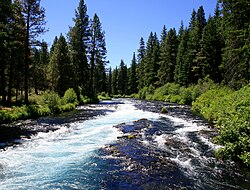
The Metolius River (pronounced muh TOLL ee us) is a tributary of the Deschutes River in Central Oregon, United States. The river flows north from springs near Black Butte, then turns sharply east, descending through a series of gorges before ending in the western end of Lake Billy Chinook. The unincorporated community of Camp Sherman lies astride the southern end of the river. The name of the river comes from the Warm Springs or Sahaptin word mitula, meaning white salmon and referring to a light colored Chinook salmon and not a whitefish.

The river's drainage basin is 315 square miles (820 km2) in area and, according to at least one estimate, contains 110 miles (180 km) of perennial streams, 324 miles (521 km) of intermittent streams, 42 lakes, and 121 ponds.[3]

Headwaters

[edit]
The Metolius River is fed by numerous springs and creeks along its route.

The headwaters of the river are at Metolius Springs, where the river emerges from two clusters of springs at the base of Black Butte. Water flows to these springs from the drainage basin around Black Butte Ranch, several miles to the south. The elevation of the drainage basin is 300 feet (91 m) above that of the springs, forming a natural standpipe that tends to stabilize the river's rate of flow.[4]

As a consequence, the water level in the Metolius River is relatively constant. The rate of flow at the headwaters is approximately 190 cubic metres per minute (6,700 cu ft/min) or 50,000 gallons per minute), although it grows by an additional 2,300 cubic metres per minute (81,000 cu ft/min) or 600,000 gallons per minute) by the time the river reaches Lake Billy Chinook. Similarly, the water temperature is also stable; at the river source, the water temperature is a consistent 48 °F (8.9 °C).[5]

General

[edit]

The Metolius River flows 28.6 miles (46.0 km) from Metolius Springs through the Deschutes National Forest, emptying into Lake Billy Chinook and ultimately the Deschutes River. The upper 11.5 miles (18.5 km) of the river are popular for catch-and-release fishing, whitewater rafting, picnicking, and camping. The lower 17 miles (27 km) are on the boundary of the Warm Springs Indian Reservation, and flow by "a primitive area where motorized vehicles are not allowed."

The Metolius River was officially designated a National Wild and Scenic River in 1988.[6][7]

Many of the summer homes along the Metolius River are constructed on United States Forest Service land, under provisions of a 1915 act of Congress, and are generally required to be set back from the river at least 50 feet (15 m), allowing public access to the river.[citation needed]

In 2009, the Oregon legislature passed the Metolius Protection Act, designating 448 acres of the river basin as an "Area of Critical State Concern (ACSC)", preventing large-scale development on the land and protecting its wildlife.[8][9]

Wildlife

[edit]

The Metolius River supports a broad cross-section of the wildlife present in the Central Oregon region. The river itself is home to several fish species, including rainbow trout, bull trout, kokanee salmon and mountain whitefish. Larger animals including river otters and beaver inhabit the areas in and immediately around the river, and larger land mammals, including mule deer, elk, black bear, and cougar range in the surrounding area.[10] Migratory waterbirds such as the mallard and the Canada goose are common in the spring and summer, as are raptors such as the osprey and the red-tailed hawk. The white-headed woodpecker, generally rare and of interest to many birders, is quite common in several areas along the river.[11]

Recreation

[edit]

Sport fishing for rainbow trout and bull trout is fly-fishing only on the upper Metolius—and catch-and-release, with barbless hooks. A number of small resorts and shops cater to fishermen and other visitors, principally in the community of Camp Sherman.[6][12]

Hiking and horseback riding are popular activities in the area, particularly on the upper, southern portion of the river, with trails extending up and down the river and into the forests on both sides. There are also a number of developed campgrounds on the banks of the river. Fishing, rafting, hunting and cross-country skiing are all popular seasonal activities.[citation needed]

The Wizard Falls Fish Hatchery is about 10.6 miles (17.1 km) north of the headwaters. This hatchery raises rainbow trout, kokanee, and salmon. The hatchery is open to visitors, with various species of trout and other fish on display in ponds.[13]

Coordinates

[edit]

See also

[edit]

References

[edit]
[edit]
Revisions and contributorsEdit on WikipediaRead on Wikipedia
from Grokipedia
The Metolius River is a 29-mile-long spring-dominated tributary of the in , originating from numerous springs at the eastern base of Black Butte and flowing northward through a forested valley to its mouth at . Renowned for its crystalline waters and constant flow of approximately 1,460 cubic feet per second at a temperature of 48°F, the river emerges fully formed from its headwaters, one of the largest spring-fed systems , supporting exceptional and stability unaffected by seasonal . Designated as a National Wild and Scenic River in 1988, with 17.1 miles classified as scenic and 11.5 miles as recreational, it traverses old-growth ponderosa pine forests and provides premier habitats for native fish species including redband trout, , and , alongside restoration efforts for spring and kokanee. The river's ecology and pristine conditions have historically sustained indigenous fisheries for tribes such as the Wasco, Warm Springs, and Northern Paiute, while today it attracts anglers for catch-and-release fly-fishing and offers opportunities for , , and whitewater boating in a largely undeveloped watershed.

Geography and Hydrology

Headwaters and Course

The Metolius River originates from two large springs at the base of Black Butte, an extinct 1.4-million-year-old located in at an elevation of approximately 3,000 feet (914 meters). These headwater springs emerge full-grown, fed by seeping through porous with a hydraulic gradient of about 300 feet (91 meters), making the Metolius one of the largest spring-fed rivers in the United States. From its source, the river flows northward through a forested valley in the Deschutes National Forest, passing the small community of Camp Sherman and notable sites such as the Wizard Falls Fish Hatchery, before curving eastward around Castle Rock—a 9-million-year-old —and then southeastward. The total length of the river is approximately 28.6 miles (46 kilometers), during which it transitions from the moist Cascade Mountains through old-growth ponderosa pine stands into the drier landscape. The river's course is characterized by minimal surface tributaries, instead gaining substantial volume—up to an additional 1,300 cubic feet per second (37 cubic meters per second) beyond its initial 100-110 cfs (2.8-3.1 m³/s) at the springs—from numerous side springs along its path, facilitated by the underlying Green Ridge Fault that creates a structural conducive to discharge. It ultimately empties into , a reservoir impounded by the Round Butte Dam where it joins the Deschutes and Crooked Rivers.

Geological Origins

The Metolius River originates as a spring-fed system emerging from the northern base of Black Butte, a Pleistocene volcano that straddles the ancestral drainage valley. recharged by and in the western High Cascades percolates through highly porous layers of to Pleistocene lava flows—comprising over 150 stacked and units—before encountering the impermeable core of Black Butte's eruptive products, which dammed northward-flowing surface water and forced subsurface discharge at the springs. These springs, including the prominent Headwaters Spring near Wizard Falls, collectively discharge 67 to 130 cubic feet per second, contributing to the river's base flow of approximately 1,460 cubic feet per second under a 300-foot hydraulic . The broader basin's formation traces to in the Cascade arc, where of the Juan de Fuca plate drove recurrent volcanism and faulting since the . Around 5 million years ago, collapse of early High Cascade lava flows along normal faults initiated a structure, with the Green Ridge Fault —exhibiting 2,000 feet of vertical relief—forming the eastern horst boundary and redirecting proto-Deschutes Basin drainage northward into what became the Metolius Valley. Black Butte's eruptions, dated variably from 0.5 to 1.4 million years ago, superimposed on this framework by filling the valley with volcanic debris up to 3,000 feet thick, further modulating pathways and creating sediment-choked lakes that evolved into modern meadows and wetlands. Quaternary glaciation and localized refined the local , with ice advances eroding channels and depositing that enhanced permeability, while andesitic eruptions added heterogeneous layers influencing recharge zones. The resulting karst-like spring system exemplifies interplay between fault-controlled , volcanic , and orographic precipitation, yielding the river's consistent cold, clear output with minimal surface runoff influence.

Flow and Water Quality Characteristics

The Metolius River exhibits highly stable flow due to its exclusive sourcing from springs emerging at the base of Black Butte and along its upper course, including major contributions at Wizard Falls Fish Hatchery. This hydrology results in minimal seasonal or annual discharge variability, with the gauge near Grandview (station 14091500) recording a long-term mean flow of approximately 1,350 cubic feet per second (cfs), ranging historically from lows around 1,080 cfs to highs near 1,610 cfs. Recent measurements as of October 2025 confirm ongoing stability, with instantaneous discharges between 1,280 and 1,320 cfs and gage heights around 1.05 feet. The river's base flow originates from aquifers recharged by precipitation, providing a consistent output that contrasts sharply with surface runoff-dominated streams in the region. Water temperature displays analogous constancy, averaging 48 °F (8.9 °C) throughout the year, with minor elevations to 55 °F possible in lower reaches during summer due to solar heating and limited influence. This thermal regime, measured at 6.3–7.4 °C in recent USGS data, stems from the cool, deep sources and supports cold-water stenotherms like native and introduced . The river's is pristine, characterized by high clarity, low , and minimal dissolved solids, owing to the filtered nature of spring effluents that bypass surface . It ranks second statewide in overall quality, behind only segments of the Grande Ronde River, with parameters meeting or exceeding Oregon's stringent standards for temperature, dissolved oxygen, and nutrients. These attributes, including naturally low phosphorus and nitrogen levels from basaltic , sustain exceptional ecological integrity without significant anthropogenic impairment, though localized headwater flow reductions from have been noted since 2018.

Ecology and Biodiversity

Aquatic Ecosystems

The Metolius River supports robust aquatic ecosystems driven by its spring-fed , which delivers consistently cold, oxygen-rich water with minimal sedimentation and nutrient inputs, maintaining oligotrophic conditions conducive to sensitive . Water quality exceeds drinking standards across its length, with low temperatures—often below 10°C—and high clarity fostering stable habitats for resident and migratory fish while limiting excessive algal proliferation. These characteristics, verified through monitoring by state agencies, underscore the river's role as a refugium for cold-water biota amid regional warming trends. Native fish assemblages dominate, including (Salvelinus confluentus), a federally with a self-sustaining population exceeding 1,000 adults in recent surveys, redband trout ( mykiss gairdneri), and (Oncorhynchus mykiss). Spring-run Chinook salmon (Oncorhynchus tshawytscha) historically spawned in tributaries, while kokanee (Oncorhynchus nerka), a landlocked sockeye form, persist in connected lakes. Introduced , both wild strains and releases, thrive alongside natives, supporting a recreational , though management prioritizes wild stocks to prevent hybridization risks with . Benthic macroinvertebrates, including mayflies, stoneflies, and , exhibit high diversity and abundance, serving as bioindicators of unimpacted conditions and primary prey for . Periodic sampling reveals stable communities with low pollution-tolerant taxa dominance, reflecting nutrient scarcity. Benthic algae, dominated by diatoms and in substrate scrapes from 1967–1968 surveys, provide basal production but remain sparse due to light limitation in the turbid-free flows.

Terrestrial Wildlife

The riparian corridors and adjacent old-growth ponderosa pine and mixed-conifer forests along the Metolius River support a diverse array of terrestrial , sustained by the stable, spring-fed and minimal human disturbance in much of the Deschutes National Forest. These habitats facilitate resident populations of large and small mammals, as well as over 110 bird species, many of which rely on the dense canopy, , and canyon features for , nesting, and migration corridors. Prominent large mammals include (Odocoileus hemionus), (Cervus canadensis), black bears (Ursus americanus), cougars (Puma concolor), and bobcats (Lynx rufus), which roam the basin's canyons, creeks, and forested slopes year-round, drawn to abundant forage like berries, nuts, and browse. Smaller mammals such as northern (Glaucomys sabrinus), voles, , and occasionally badgers (Taxidea taxus) occupy the and riparian edges. Rare or transient predators, including gray wolves (Canis lupus) and wolverines (Gulo gulo), have been documented in the Metolius Basin, reflecting its role as a connectivity zone for wide-ranging carnivores amid recovering populations in the Cascades. Semi-aquatic species like North American beavers (Castor canadensis) and northern river otters (Lontra canadensis) also frequent riverbanks, engineering wetlands that indirectly benefit terrestrial through habitat creation. Avian diversity is notable, with species adapted to mature forests and riparian zones, including the sensitive white-headed woodpecker (Dryobates albolarvatus), (Dryocopus pileatus), (Accipiter gentilis), and (Haliaeetus leucocephalus). The Metolius maintains one of the easternmost strongholds for the (Strix occidentalis caurina) east of the Cascade crest, where old-growth stands provide critical nesting and roosting sites amid ongoing threats from barred owl competition and habitat loss elsewhere. Migratory raptors like ospreys (Pandion haliaetus) and belted kingfishers (Megaceryle alcyon) exploit the clear waters and adjacent uplands seasonally. Reptiles and amphibians are less prominent in the cool, forested environment, with limited records of species like western fence lizards (Sceloporus occidentalis) in sunnier openings, constrained by the river's high-elevation, mesic conditions.

Vegetation and Riparian Zones

The riparian zones of the Metolius River feature specialized vegetation adapted to the moist conditions along its banks, contrasting with the surrounding upland ponderosa pine forests. These zones support dense shrub layers including willows (Salix spp.), thinleaf alder (Alnus incana subsp. tenuifolia), red-osier dogwood (Cornus sericea), and Douglas' spiraea (Spiraea douglasii), which stabilize soils and provide habitat structure. Sedge species and other graminoids further characterize these areas, contributing to nutrient cycling and aquatic-terrestrial linkages. Herbaceous thrive in the riparian understory, particularly during spring blooms along river trails near sites like Riverside Campground, where western buttercup (Ranunculus occidentalis) and various larkspurs ( spp.) emerge starting in May. These nutrient-rich riparian areas, influenced by the river's cold, spring-fed waters, foster a transition in from Cascade foothill to high-desert adapted , enhancing overall diversity. Adjacent to the river, the riparian vegetation interfaces with old-growth mixed conifer stands dominated by ponderosa pine (), interspersed with Douglas-fir (Pseudotsuga menziesii) and grand fir (Abies grandis), forming a mosaic that buffers the river corridor. Restoration efforts have emphasized replanting native riparian species like willows and alders to restore degraded sections, underscoring their ecological role in maintaining and fish habitat. , such as ribbon grass (), pose ongoing threats by displacing natives and encroaching into the channel, first noted in the area around 2011.

Historical Context

Geological Timeline

The geological development of the Metolius River basin reflects the interplay of faulting, volcanism, and glaciation in the eastern High Cascades of . Major block faulting along the Green Ridge Fault, marking the eastern boundary of a regional structure, initiated during the to epochs, creating a structural low that channeled eastward from the western Cascades. This fault system provided permeable pathways through fractured volcanic rocks, setting the stage for later spring emergence. Approximately 500,000 years ago, during the Pleistocene, Black Butte—a now-extinct —erupted on the site of the ancestral Metolius drainage, damming the pre-existing river channel and impounding surface and subsurface waters. This blockage redirected flow, causing to saturate underlying and discharge as the large-volume Metolius Springs at the volcano's eastern base, where the fault intersects impermeable lavas. The springs' consistent output, averaging 183 cubic meters per second, stems directly from this damming effect atop the fault-controlled . Throughout the Period (beginning 2.58 million years ago), the Metolius area underwent three major glaciations originating from ice caps on the High Cascades to the west, with advances grinding down volcanic terrains and depositing moraines, erratics, and outwash in the river valley. volcanism interspersed these events, producing layers and localized lava flows that overlaid glacial deposits and further influenced by sealing fractures or adding to recharge. The most recent glaciation, termed the Cabot Creek phase and correlating to the late Wisconsinan stage (approximately 25,000 to 11,700 years ago), featured the smallest ice extent, with glaciers confined to higher elevations and minimal direct modification to the entrenched Metolius channel post-Black Butte. Post-glacial stabilization has preserved the river's spring-fed morphology, with ongoing minor fault adjustments and shaping the modern riparian corridor.

Pre-Columbian and Indigenous Associations

The Metolius River, located in , was utilized by indigenous peoples including the Wasco, Warm Springs, and Northern Paiute tribes—now confederated as the —for subsistence activities such as fishing, hunting, and gathering prior to European settlement. These groups regarded the river as a sacred site due to its reliable spring-fed waters supporting abundant aquatic life, including spawning grounds and migration corridors, which provided critical protein sources. Archaeological and oral historical evidence indicates seasonal occupation and resource extraction in the Metolius basin extending back thousands of years, with the Northern Paiute specifically naming the river after "white fish" in reference to its value for gathering and fishing. The surrounding Camp Sherman area served as a gathering point for bands from broader regions, including the and , drawn by the river's clear, cold waters and adjacent riparian zones rich in edible plants and game. The 1855 Treaty with the Tribes of Middle Oregon formalized retained rights for these indigenous groups to access unceded lands along the Metolius, Deschutes, and Warm Springs rivers for traditional fishing and hunting, underscoring the river's enduring role in tribal sustenance and cultural continuity despite encroaching settlement.

Modern Settlement and Land Use Changes

European settlement along the Metolius River began in the late , with five homesteads recorded in the upper Metolius Valley by 1881. In 1890, the Allingham family constructed the first permanent house near the river's headwaters, which later served as a Service ranger station starting in 1906. Logging activities emerged around this time, with logs floated down the Metolius and Deschutes rivers to sawmills near present-day Pelton Dam in the late 1800s, marking an initial shift from indigenous resource use to commercial timber extraction. The establishment of the Cascade Forest Reserve in 1893, encompassing much of the watershed, presaged broader federal control, with the area redesignated as part of Deschutes National Forest in 1908; today, approximately 94% of the Metolius basin remains public land under federal and tribal ownership. Small-scale settlement coalesced around Camp Sherman, an unincorporated community founded between 1916 and 1918 when Sherman County families built initial cabins and summer camps along the river, drawn by its and scenic appeal. By 1919, tourist resorts proliferated near key springs and the river, transitioning land use toward recreational lodging amid growing visitor interest promoted in local publications like The Bend Bulletin. Land use intensified in the early with the U.S. Forest Service encouraging leases for summer homes in 1916, leading to recreation residence tracts along the Metolius by the 1920s and 1930s, when the constructed infrastructure such as picnic shelters and fire lookouts at sites like Riverside Campground. Commercial logging accelerated in the 1940s with mechanized equipment targeting large old-growth trees, but proposals in the 1980s to harvest near Camp Sherman triggered opposition from conservation groups, resulting in lawsuits and heightened protections for remaining stands. Post-1988 designation of the Metolius as a National Wild and Scenic River under the Omnibus Wild and Scenic Rivers Act shifted management priorities toward preservation, with the 1990 establishment of the Metolius Conservation Area emphasizing natural appearance and limiting development on federal lands. The Metolius Area of Critical State Concern, governed by Administrative Rules since the 1970s, restricts non-forest uses in unincorporated communities like Camp Sherman and Three Rivers to maintain riparian integrity, allowing limited residential, resort, and campground operations while prohibiting expansive subdivisions. Recent pressures include private land proposals, such as a 2022 plan for 120 homes in the Metolius basin north of U.S. Highway 20, but enhanced environmental regulations have curtailed such expansions, preserving the area's predominantly undeveloped character amid Central 's population growth.

Conservation Efforts and Challenges

Federal and State Protections

The Metolius River was designated a component of the National Wild and Scenic Rivers System on October 28, 1988, under the Omnibus Wild and Scenic Rivers Act, protecting approximately 28.6 miles of the river and an adjacent corridor of 8,560 acres from new federal dam construction, diversions, or other developments that could substantially impair its outstanding remarkable values, including scenic, recreational, fish, and attributes. This federal designation mandates management by the U.S. Forest Service within the Deschutes National Forest to preserve the river's free-flowing condition and ecological integrity, with a comprehensive river management plan finalized in 1995 emphasizing non-degradation of and habitat. At the state level, the Metolius River is classified as an Scenic Waterway, with protections integrated into the federal management framework to safeguard scenic, recreational, and ecological resources while accommodating compatible uses like and trails. In 2009, the Oregon Legislature established the Metolius Area of Critical State Concern under ORS 197.416, encompassing the river basin (excluding certain communities) to regulate , limit development density, and prioritize conservation through coordinated by state agencies like the Department of Land Conservation and Development. Additional state measures include instream water rights reserved for resource protection and ongoing evaluations for enhanced water quality standards, such as a 2022 petition to designate the river as an Outstanding Resource Water under Oregon's antidegradation policy.

Past Development Pressures and Resolutions

In the mid-2000s, the Metolius River basin faced significant development pressures from proposed large-scale destination resorts and subdivisions, which threatened the area's ecological integrity, , and habitats. Two major projects, including The Metolian eco-resort envisioned as a 2,000-unit development with over 4,000 homes in total across proposals, were advanced on rezoned lands within and adjacent to the basin, potentially introducing thousands of new residents, increased septic systems, construction, and withdrawals that could exacerbate low flows and for like and deer winter ranges. These pressures culminated in 2009 amid unprecedented basin-wide proposals, prompting legislative intervention; Oregon Senate Bill 582 designated the Metolius River Basin as the state's sole Area of Critical State Concern (ACSC), prohibiting destination resorts and imposing strict land-use controls to preserve scenic, recreational, and ecological values. The ACSC status, signed into law by Governor on July 15, 2009, also declared the river navigable to enhance state regulatory authority over harmful activities and facilitated transfer of development credits to developers, averting the resorts while compensating proponents. Earlier threats from subdivisions in the and logging proposals, such as old-growth harvesting along access roads in the 1980s, had similarly spurred conservation responses, including the river's federal Wild and Scenic designation in 1988 under the Omnibus Oregon Wild and Scenic Rivers Act, which barred dams and projects impairing outstanding resource values like its pristine springs and native fisheries. These measures, informed by public advocacy from groups like Friends of the Metolius and LandWatch, resolved acute pressures by prioritizing basin-wide planning over fragmented local approvals, though subsequent developer lawsuits in 2022 claimed inadequate credit transfers.

Ongoing Management and Monitoring

The U.S. Forest Service conducts biennial monitoring and evaluation for the Deschutes National Forest, including the Metolius River basin, to assess resource conditions, management impacts, and trends under adaptive management protocols established in forest plans. This includes tracking aquatic habitat integrity, riparian vegetation, and in alignment with the Clean Water Act. The Department of Environmental Quality maintains ongoing data collection at sites like Metolius River at Camp Sherman, contributing to the state's Water Quality Index assessments for water years 2014–2023, which evaluate parameters such as temperature, dissolved oxygen, and nutrients. Fish population monitoring focuses on , with the Forest Service tracking redband trout abundance in the Metolius River since 1995 through surveys to detect changes in adult populations. (Salvelinus confluentus), a federally , receive particular attention; the Metolius population, rated as low-risk, supports annual redd counts and PIT-tagging for movement and survival estimates, with 1,458 spawning adults documented in 2010 and subsequent data informing translocation efforts to other basins. The U.S. Geological Survey operates gauges, such as at USGS site 14091500 near Grandview, to monitor discharge and flow dynamics, revealing persistent low headwater flows in 2023 despite above-average , potentially linked to patterns. Habitat restoration efforts include large wood additions to enhance salmonid rearing; post-project monitoring in 2025 indicated a 300% increase in juvenile densities at treated sites, with nearly all installed logs retained. Invasive plant management targets species like ribbon grass (Phalaris arundinacea), yellow flag iris (), and spotted knapweed (), involving herbicide applications and manual removal coordinated by the Forest Service and partners such as Friends of the Metolius, with re-treatments in 2020 reducing coverage and promoting native riparian recovery. These activities integrate with Wild and Scenic River designations to sustain ecological functions amid recreational pressures and climate variability.

Human Utilization and Impacts

Recreational Activities

The Metolius River supports a range of recreational activities centered on its clear, spring-fed waters and surrounding Deschutes National Forest terrain, with fishing as the predominant pursuit. Fly fishing targets native rainbow trout, introduced brown trout, and bull trout, though all trout must be released unharmed under Oregon Department of Fish and Wildlife regulations, which mandate catch-and-release throughout the river and restrict the upper reaches above Bridge 99 to artificial flies with barbless hooks. The river's challenging conditions and trophy-sized fish draw anglers year-round, though peak activity occurs from spring through fall, with closures to angling during winter spawning periods for bull trout. Hiking trails parallel the river, offering accessible paths for viewing its headwater springs and forested riparian zones. The West Metolius River Trail spans approximately 7.3 miles with minimal elevation gain of 252 feet, suitable for easy day hikes that pass by the Wizard Falls Fish Hatchery and dramatic blue-water features. Other routes, such as loops to Carl Lake or along the lower river, provide 5-6.5 mile outings emphasizing scenic overlooks and . and are permitted in designated forest areas adjacent to the river, while boating activities like are absent due to the river's rocky substrate, swift currents, and protected status prohibiting motorized or non-motorized to preserve water clarity and fish habitat. Camping facilities enhance extended stays for these pursuits, with sites like Camp Sherman and Riverside Campgrounds accommodating tents and RVs near fishing access points. These developed areas, managed by the U.S. Forest Service, feature amenities supporting and , though capacity limits and seasonal closures apply to mitigate overuse in this Wild and Scenic River corridor. Sightseeing and viewing at natural springs complement low-impact activities, underscoring the river's appeal for non-consumptive amid its pristine ecosystem.

Economic Contributions

The Metolius River contributes economically primarily through recreation and tourism, particularly high-quality that draws anglers to its pristine waters and native populations. Designated a National Wild and Scenic River, it supports guiding services, lodging, and outfitters in communities like Camp Sherman, where visitor spending sustains local businesses without reliance on extractive industries or significant water diversions for . Maintaining the river's exceptional is vital for these benefits, as degradation could diminish its appeal as a "crown jewel" fishery. Angling generates direct expenditures, with freshwater anglers in Jefferson County—encompassing key Metolius reaches—spending over $5 million annually on trips as of 2008, much of it tied to overnight pursuits. Over 66% of resident anglers and 46% of non-residents reported such trips in the county that year, highlighting the river's draw for specialized, high-value . The cessation of stockings in the early 2000s temporarily challenged local quality and related revenues, but wild fish recovery enhanced long-term sustainability, avoiding dependency on artificial enhancements. The basin attracts several hundred thousand visitors yearly, including 120,000 to 130,000 annual visits to the Head of the Metolius day-use area alone, amplifying indirect economic multipliers through retail, hospitality, and transportation. , including Metolius-driven activities, contributed over $138 million to Jefferson County's economy in 2019, representing a key pillar amid limited alternative revenue sources in the rural area. These impacts underscore the river's role in Central Oregon's tourism economy, where protected status preserves value over development pressures like proposed resorts.

Regulatory Frameworks for Use

The Metolius River is managed under the federal Wild and Scenic Rivers Act through its designation in the Omnibus Wild and Scenic Rivers Act of 1988, classifying the segment from its headwaters at Metolius Springs to the upper end of as recreational from the springs to Bridge 99 and scenic downstream to the lake. This designation prohibits federal dam construction or other water resource projects that would impair the river's free-flowing condition, outstanding remarkable values (including scenic, recreational, fish, and water quality attributes), and requires protection of the river corridor (typically one-quarter mile on each side) from incompatible development. The U.S. Forest Service, as the administering agency within Deschutes National Forest, implements these protections via the 1996 Metolius River Management Plan, which establishes standards for land allocations, recreation site development, and vegetation retention to minimize visual and ecological impacts from uses like trails, campgrounds, and access. At the state level, the river is also designated as an Scenic Waterway under ORS 390.805 et seq., with administrative rules in 736-040-0056 governing adjacent to preserve scenic, recreational, and natural values, including restrictions on commercial timber harvest, subdivision, and structures within the corridor without state permits. The Metolius Area of Critical State Concern, established under ORS 197.416, overlays additional requirements in Areas 1 and 2 (encompassing key springs and river segments), administered by the Oregon Land Conservation and Development Commission to limit development pressures while allowing compatible low-impact recreation. use is regulated by the Oregon Water Resources Department, prioritizing instream flows for fish habitat and prohibiting new diversions that could harm the river's cold, clear quality, which supports indigenous redband trout and ; the Oregon Department of has proposed Tier 1 Outstanding Resource Waters status to enhance antidegradation protections against from upstream activities. Recreational use, particularly , falls under Oregon Department of Fish and Wildlife (ODFW) regulations per OAR 635-500-1820, which mandate fly-fishing only with single barbless hooks and catch-and-release for in the upper river from Wizard Falls Hatchery downstream to the lower boundary of the Rock Creek workday use area, while allowing bait fishing and harvest in the lower reaches from Bridge 99 to the confluence. These rules, updated in response to wild fish conservation needs, also ban lead weights and enforce seasonal closures to protect spawning and . Forest Service rules further restrict motorized access, prohibit use near the river, limit group sizes at dispersed sites, and ban generators in campgrounds from 10:00 PM to 7:00 AM to reduce noise and disturbance. Enforcement involves interagency coordination, with violations subject to fines under 36 CFR 261 for and Oregon Revised Statutes for state waters.

References

Add your contribution
Related Hubs
User Avatar
No comments yet.