


Community hub
Recent from talks
Contribute something
Nothing was collected or created yet.
Miami Rock Ridge
View on Wikipedia
The Miami Rock Ridge is an oolitic, continuous outcrop of limestone, part of the Miami Formation, which formerly covered a large extent of southernmost South Florida; as part of an ecosystem it formed portions of the Everglades. Rising 7 to 8.6 m (23 to 28 ft) above sea level, it ranges from northern Miami-Dade County—the approximate latitude of North Miami Beach—southward to the upper Florida Keys and southwestward into Everglades National Park, creating a karst-dominated landscape.[1] The ridge is of Late Pleistocene origin. A series of tidal channels, dubbed transverse glades, formed within valleys in the ridge and acted as outlets for freshwater from the Everglades, thereby modifying the estuarine environment of Biscayne Bay.[2][a] One of the few areas above pre-drainage sea level, the Miami Rock Ridge was heavily exploited for agriculture and real estate.[5][6]
Ecology
[edit]The coastal ridge was traditionally a component of the endangered pine rocklands, which grew upon its length.[7] Globally imperiled today, the environmental community consisted of a large, unbroken expanse of South Florida slash pines (Pinus elliottii var. densa), interspersed by tropical hardwood hammocks; related to the Bahamian pineyards, it also occupied the Florida Keys.[8][7] The communities of the Miami Rock Ridge are sustained by wildfires, including those caused by lightning strikes, which affect the vegetation and its associates, maintaining biodiversity,[9][10] with a 20% floristic endemism rate.[7] Climate and an often-marly substrate limit the growth of vegetation, such that a mature subtropical hammock on the ridge typically is no taller than 59 feet (18 m).[11][12] Development has largely removed the original communities, which have fragmented into tiny parts of their original range;[7] remnants include Vizcaya Museum and Gardens, Simpson Park Hammock, and Alice Wainwright Park, which form part of Brickell Hammock, underlain by a large oolite outcrop, Silver Bluff.[13][14][b]
Gallery
[edit]-
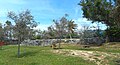 Miami Rock Ridge at Alice Wainwright Park
 -
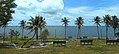 View of Biscayne Bay and Key Biscayne from atop the ridge
 -
 General view of ridge from below


See also
[edit]- Arch Creek, Florida – Site of a natural arch in the Miami Rock Ridge
Notes
[edit]- ^ One of these glades enclosed the Miami River, a section of which sported a 6-foot-2+1⁄2-inch (1.892 m) waterfall and 450-foot-long (140 m) rapids until 1908, when it was progressively bypassed by the Miami Canal and partly dredged.[3][4]
- ^ Noted first by Bernard Romans in 1771, the bluff faced Biscayne Bay as a landmark; a freshwater spring, the Punch Bowl, once gushed nearby.[13][14]
References
[edit]- ^ Multiple sources:
- Meeder 2019
- "Pine Rocklands: A Disappearing Habitat". Miami-Dade Department of Environmental Resources Management. Miami-Dade County. Archived from the original on 15 May 2014. Retrieved 2019-06-11.
- Snyder, Herndon & Robertson Jr. 1990, pp. 234–5
- Trotta, Lauren. "Mountains of Miami". Biodiversity Institute. Gainesville, Florida: University of Florida. Retrieved 10 February 2024.
- Trotta et al. 2018
- ^ Meeder 2019.
- ^ Gaby 1993, p. 8.
- ^ Lodge 2010, pp. 175, 177–9.
- ^ Lodge 2010, pp. 174–80.
- ^ Snyder, Herndon & Robertson Jr. 1990, pp. 271–4.
- ^ a b c d "Pine Rocklands: A Disappearing Habitat". Miami-Dade Department of Environmental Resources Management. Miami-Dade County. Archived from the original on 15 May 2014. Retrieved 2019-06-11.
- ^ Sullivan, Janet (1994). "Kuchler Type: Subtropical Pine Forest". United States Forest Service. Archived from the original on 2010-01-26. Retrieved 2007-06-30.
- ^ U.S. Fish and Wildlife Service. "Florida Brickell-bush (Brickellia mosieri)" (PDF). Southeast Region. Archived from the original (PDF) on October 12, 2006. Retrieved 2007-06-30.
- ^ Miami-Dade County. "Pine Rocklands: Born From Fire" (PDF). Miami-Dade Department of Environmental Resources Management. Retrieved 2019-06-11.
- ^ University of Florida (1999). "Tropical Hardwood Hammock". South Florida Multi-species Recovery Plan (U.S. Fish and Wildlife Service). Retrieved 2007-06-30.
- ^ USFWS 1999, pp. 122, 124–7.
- ^ a b Gann, George; Seasholtz, Alex; Dutra, Elizabeth (2024). Ecological Restoration Plan for Historical Brickell Hammock Alice C. Wainwright Park, City of Miami, Florida (PDF). Institute for Regional Conservation (Report). Delray Beach, Florida. Retrieved 22 July 2025.
- ^ a b Parks 1980, pp. 41, 44.
Sources
[edit]- Gaby, Donald C. (1993). The Miami River and its Tributaries. Miami: The Historical Association of Southern Florida. ISBN 0-935761-04-7.
- Lodge, Thomas E. (2010). "Chapter 12: Peripheral Ecosystems of the Everglades". The Everglades Handbook: Understanding the Ecosystem (3rd ed.). Boca Raton, Florida: CRC Press. pp. 155–80. ISBN 978-1-4398-0262-5 – via Internet Archive.
- Meeder, John F. (24 July 2019). "Origin and development of true karst valleys in response to late Holocene sea-level change, the Transverse Glades of southeast Florida, USA". The Depositional Record. 5 (3). International Association of Sedimentologists: 558–577. doi:10.1002/dep2.84 – via Wiley.
- Parks, Arva Moore (1980) [1977]. The Forgotten Frontier: Florida Through the Lens of Ralph Middleton Munroe. Miami: Banyan Books. ISBN 0-916224-14-7.
- Snyder, James R.; Herndon, Alan; Robertson Jr., William B. (1990). "Chapter 8: South Florida Rockland". In Myers, Ronald L.; Ewel, John J. (eds.). Ecosystems of Florida. Orlando: University Press of Central Florida. pp. 230–77. ISBN 0-8130-1022-5 – via Internet Archive.
- "The Ecological Communities" (PDF). South Florida Multi-Species Recovery Plan (PDF) (Report). Atlanta: United States Fish and Wildlife Service Southeast Region. May 18, 1999. pp. 121–89.
- Trotta, Lauren B.; Baiser, Benjamin; Possley, Jennifer; Li, Daijang; Lange, James; Martin, Sarah; Sessa, Emily B. (9 October 2018). "Community phylogeny of the globally critically imperiled pine rockland ecosystem". American Journal of Botany. 105 (10). Botanical Society of America: 1735–1747. doi:10.1002/ajb2.1168 – via Wiley.