


Community hub
Recent from talks
Contribute something
Nothing was collected or created yet.
Michael Redd
View on Wikipedia
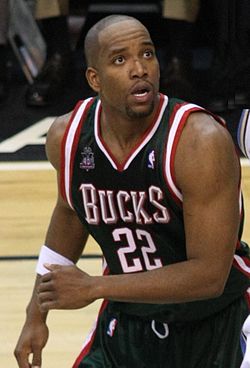
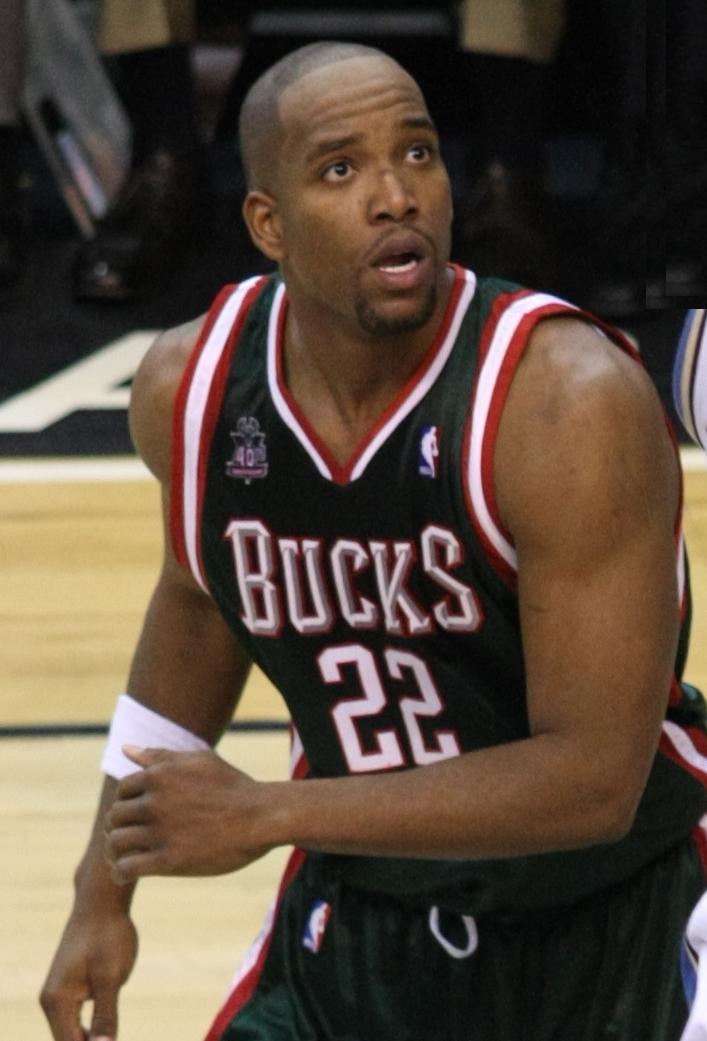
Michael Wesley Redd (born August 24, 1979) is an American former professional basketball player. He was drafted 43rd overall by the Milwaukee Bucks in the 2000 NBA draft and was an All-Star in 2004. He was born in Columbus, Ohio, where he attended West High School. He was also a member of the U.S. national basketball team.
Key Information


Standing 6 feet 6 inches (1.98 m) tall and weighing 215 pounds (98 kg), Redd spent both his collegiate and professional career at the shooting guard and small forward positions.
Early life and education
[edit]Redd was born on August 24, 1979, in Columbus, Ohio. In his college years, Redd spent three years leading the offensive attack of The Ohio State University garnering point averages of 21.9, 19.5, and 17.5, respectively. As a sophomore, Redd and Scoonie Penn led Ohio State to the NCAA Final Four.[1] He was then drafted after his junior year in the 2000 NBA draft as a second round pick (43rd overall) by the Milwaukee Bucks.
Professional career
[edit]Milwaukee Bucks (2000–2011)
[edit]In his rookie year, Redd was not able to contribute immediately as he was behind NBA All-Star guard Ray Allen on the depth chart. Later on, however, it became apparent that he was better than anticipated as proven by accounts that he had played extremely well against Ray Allen, Glenn Robinson, and other teammates in practice. It was then that former Bucks' head coach George Karl rewarded him with additional playing time. He posted averages of 11.4 points per contest as well as 44.4% on three-point shooting during his second NBA season.[2] On February 20, 2002, against the Houston Rockets, Redd made eight three-point field goals in the fourth quarter, a then-NBA record. In October 2002, he signed a four-year, $12 million offer sheet with the Dallas Mavericks,[2][3] but it was matched by the Bucks and he remained in Milwaukee.[2][4][5] During the 2003–04 season, Redd's performance, amongst other reasons (ouster of Ray Allen to Seattle via a trade), was rewarded with full starter's duties and later earning averages of 21.7 points per contest en route to his first and only All-Star Game appearance.
After the 2004–05 season, Redd signed a new contract with the Bucks that lasted six years and was worth $91 million. He chose to stay with the Bucks over leaving for his home state team, the Cleveland Cavaliers, and a chance to play for less money with LeBron James.
In the 2006–07 season, Redd arguably had the best season of his career, averaging a career-high 26.7 points per game. That season, on November 11, 2006, Redd scored a career-high 57 points in a 113–111 loss to the Utah Jazz, breaking the single-game Bucks record for points scored set by Kareem Abdul-Jabbar in 1971.[6] Later that season, on March 4, 2007, Redd scored 52 points in an overtime loss to the Chicago Bulls.[7] Despite his efforts, the Bucks struggled to win games, finishing 28–54 in the season.[8]
The Milwaukee Bucks were dealt a devastating blow January 25, 2009, when they learned Redd would miss the rest of the season with a torn ACL and MCL in his left knee. Redd missed the rest of the 2008–09 season.[9]
Redd returned for the Bucks to start the 2009–10 season, but during a game against the Los Angeles Lakers on January 10, 2010, he re-tore his ACL and MCL in the same knee that he had injured almost a year earlier. It was announced the next day that he would once again be lost for the rest of the season.[10][11]
On March 28, 2011, Redd was able to return to the Bucks after 14 months from the injury and recorded four assists in his return. On March 30, 2011, against the Toronto Raptors, Redd scored his first NBA basket since his return from injury. Redd played 10 games in the 2010–11 season. When he left Milwaukee, he had averaged 20 points per game in his 11 seasons with the team.
Phoenix Suns (2011–2012)
[edit]The Phoenix Suns signed Redd to a one-year contract on December 29, 2011.[12] Redd made his debut for Phoenix on January 12, 2012, scoring 14 points in a loss to the Cavaliers.[13] Redd returned to Milwaukee on February 7, 2012, scoring 14 points in the win over the Bucks. He received a standing ovation from the crowd.[14] On March 18, 2012, Redd scored a season-high 25 points in a victory against the Houston Rockets.[15] In his final NBA game on April 25, 2012, he scored 14 points in a 110–106 loss to the San Antonio Spurs.[16]
Retirement
[edit]On November 6, 2013, Redd announced his retirement from the NBA.[17] In his retirement Redd has become an accomplished entrepreneur and venture capitalist. He also has a popular podcast called Betting On Yourself.[18]
In 2021, Redd was one of only three former Bucks players (Brandon Jennings and Marques Johnson) to appear in Milwaukee's championship parade.[19]
National team career
[edit]
Redd frequently played for Team USA at the junior level and played in the 2007 FIBA Americas tournament, a qualifying tournament for the 2008 Summer Olympics. He averaged over 15 points throughout the competition. During the team's game against Puerto Rico, Redd set the qualifying record for most 3-pointers made in one game. He also set the record of most three-pointers made in the whole tournament (28) surpassing Penny Hardaway who had the previous record of 22. Redd participated in the 2008 Olympics as the team went unbeaten on the way to winning back the gold medal after defeating 2006 FIBA World Championship winners Spain and living up to their "Redeem Team" moniker after missing out on gold in the 2004 Summer Olympics.[20][21]
Personal life
[edit]Redd, a devout Christian, bought a church building for his father's ministry as the first purchase after signing his contract worth $91 million over six years.[22][23] The church was newly named Philadelphia Deliverance Church of Christ built in his hometown of Columbus.[23]
Redd, via NCT Ventures, invested in Azoti, an Ohio startup that connects producers and buyers of food.[24]
Redd lives in New Albany, Ohio.[25]
In pop culture
[edit]Rapper Nelly name-dropped Redd along with fellow NBA players Magic Johnson, Kareem Abdul-Jabbar, Shaquille O'Neal, and Allen Iverson—as well as NFL players Julius Peppers, Ray Lewis, and Peyton Manning—in the song "Heart of a Champion," the first track on 2004 album Sweat. Early in the song's second verse, Nelly says: "... I get Buck like Michael Redd--tell 'em again: I gets Buck like Michael Redd. Heard what I said?"[26]
Accomplishments
[edit]- All-NBA Third Team: 2004
- NBA All-Star: 2004
- Held NBA record for most three-point field goals made in one quarter with 8 in the fourth quarter (February 20, 2002 vs. Houston Rockets); since broken by Klay Thompson on January 23, 2015.
- 5th on Milwaukee Bucks all-time points list, 5th in Milwaukee Bucks all-time scoring avg.
- Won the 1998, 1999, and 2000 Ohio State Most Valuable Player awards.
- Was 1999–00 All-Big Ten First Team in college.
- Scored a playoff career-high of 40 points against the Detroit Pistons on April 29, 2006.[27]
- Named to the USA Olympic basketball team.
- Gold medal with Team USA, 2007 FIBA Americas Championship
- Gold medal with Team USA, 2008 Summer Olympic Games (team-inducted into the Naismith Hall of Fame, class of 2025)
- Scored a career-high and Milwaukee Bucks then-franchise record 57 points against the Utah Jazz on November 11, 2006.[28] The record was later broken by Giannis Antetokounmpo, who scored 64 points against the Indiana Pacers on December 13, 2023.
NBA career statistics
[edit]| GP | Games played | GS | Games started | MPG | Minutes per game |
| FG% | Field goal percentage | 3P% | 3-point field goal percentage | FT% | Free throw percentage |
| RPG | Rebounds per game | APG | Assists per game | SPG | Steals per game |
| BPG | Blocks per game | PPG | Points per game | Bold | Career high |
Regular season
[edit]| Year | Team | GP | GS | MPG | FG% | 3P% | FT% | RPG | APG | SPG | BPG | PPG |
|---|---|---|---|---|---|---|---|---|---|---|---|---|
| 2000–01 | Milwaukee | 6 | 0 | 5.8 | .263 | .000 | .500 | .7 | .2 | .2 | .0 | 2.2 |
| 2001–02 | Milwaukee | 67 | 8 | 21.1 | .483 | .444 | .791 | 3.3 | 1.4 | .6 | .1 | 11.4 |
| 2002–03 | Milwaukee | 82 | 14 | 28.2 | .469 | .438 | .805 | 4.5 | 1.4 | 1.2 | .2 | 15.1 |
| 2003–04 | Milwaukee | 82 | 82 | 36.8 | .440 | .350 | .868 | 5.0 | 2.3 | 1.0 | .1 | 21.7 |
| 2004–05 | Milwaukee | 75 | 75 | 38.0 | .441 | .355 | .854 | 4.2 | 2.3 | .8 | .1 | 23.0 |
| 2005–06 | Milwaukee | 80 | 80 | 39.1 | .450 | .395 | .877 | 4.3 | 2.9 | 1.2 | .1 | 25.4 |
| 2006–07 | Milwaukee | 53 | 53 | 38.4 | .465 | .382 | .829 | 3.7 | 2.3 | 1.2 | .2 | 26.7 |
| 2007–08 | Milwaukee | 72 | 71 | 37.5 | .442 | .362 | .820 | 4.3 | 3.4 | .9 | .2 | 22.7 |
| 2008–09 | Milwaukee | 33 | 32 | 36.5 | .455 | .366 | .814 | 3.2 | 2.7 | 1.1 | .1 | 21.2 |
| 2009–10 | Milwaukee | 18 | 12 | 27.3 | .352 | .300 | .712 | 3.0 | 2.2 | 1.1 | .1 | 11.9 |
| 2010–11 | Milwaukee | 10 | 0 | 13.4 | .400 | .235 | 1.000 | .8 | 1.2 | .2 | .1 | 4.4 |
| 2011–12 | Phoenix | 51 | 2 | 15.1 | .400 | .318 | .793 | 1.5 | .6 | .3 | .0 | 8.2 |
| Career | 629 | 429 | 32.0 | .447 | .380 | .838 | 3.8 | 2.1 | .9 | .1 | 19.0 | |
| All-Star | 1 | 0 | 15.0 | .417 | .500 | .000 | 3.0 | 2.0 | 3.0 | .0 | 13.0 | |
Playoffs
[edit]| Year | Team | GP | GS | MPG | FG% | 3P% | FT% | RPG | APG | SPG | BPG | PPG |
|---|---|---|---|---|---|---|---|---|---|---|---|---|
| 2003 | Milwaukee | 6 | 0 | 21.3 | .404 | .250 | .929 | 3.5 | 1.8 | .3 | .2 | 9.7 |
| 2004 | Milwaukee | 5 | 5 | 38.4 | .410 | .300 | .762 | 5.0 | 2.6 | .0 | .0 | 18.0 |
| 2006 | Milwaukee | 5 | 5 | 37.0 | .524 | .467 | .891 | 5.4 | 1.6 | .8 | .0 | 27.2 |
| Career | 16 | 10 | 31.6 | .452 | .340 | .864 | 4.6 | 2.0 | .4 | .1 | 17.8 | |
References
[edit]- ^ Due to rules violations under Ohio State head coach Jim O'Brien, Ohio State's appearance in this tournament was stricken from NCAA records.
- ^ a b c "Redd Expected to Suit Up for Bucks". The Edwardsville Intelligencer. The Associated Press. October 16, 2002. Retrieved April 9, 2017.
- ^ Stein, Marc (October 14, 2002). "NBA - Mavericks sign Bucks' Redd to $12M offer sheet". ESPN.com. Retrieved April 9, 2017.
- ^ "Bucks keep Redd away from Mavericks". ESPN.com. Associated Press. October 14, 2002. Retrieved April 9, 2017.
- ^ "Disgruntled Bell back as Bucks open training camp". ESPN.com. Associated Press. October 2, 2007. Retrieved April 9, 2017.
- ^ "Redd's record 57 points can't carry Bucks over Jazz". ESPN.com. November 11, 2006. Archived from the original on April 9, 2017. Retrieved March 2, 2022.
- ^ "Bulls get career high from Gordon to beat Bucks in OT". ESPN.com. March 4, 2007. Archived from the original on February 26, 2022. Retrieved March 2, 2022.
- ^ "2006-07 Milwaukee Bucks Roster and Stats". Basketball-Reference.com. Retrieved March 2, 2022.
- ^ "Bucks' Redd done for year with torn ACL/MCL". ESPN.com. Associated Press. January 26, 2009. Retrieved April 9, 2017.
- ^ "Bucks' Redd out for season with injured left knee". NBA.com. Associated Press. January 12, 2010. Archived from the original on June 11, 2015.
- ^ "Redd tears ACL, MCL in left knee". ESPN.com. January 11, 2010. Retrieved April 9, 2019.
- ^ Coro, Paul (December 29, 2011). "Phoenix Suns sign guard Michael Redd". The Arizona Republic. Retrieved December 29, 2011.
- ^ "Cavaliers at Suns". NBA.com. Archived from the original on February 9, 2012. Retrieved April 9, 2017.
- ^ "Happy homecoming: Redd helps Suns down Bucks". Arizona Sports. February 8, 2012. Retrieved April 9, 2019.
- ^ "Postgame Central: Suns Vs. Rockets". NBA.com. March 18, 2012. Retrieved April 9, 2017.
- ^ "Michael Redd 2011-12 Game Log". basketball-reference.com. Retrieved July 7, 2022.
- ^ "Ex-Bucks star Redd to retire in Milwaukee". ESPN.com. Associated Press. November 5, 2013. Retrieved April 9, 2017.
- ^ "Michael Redd". Michael Redd. Retrieved July 24, 2020.
- ^ Hill, Glynn A. (July 22, 2021). "Milwaukee celebrates NBA championship and 'Bucks in Six Day' with a parade". Washington Post. Retrieved March 2, 2022.
- ^ Thamel, Pete (August 24, 2008). "USA Basketball Returns to the Top". The New York Times. Retrieved April 9, 2019.
- ^ "The Redeem Team quieted critics -- and it would beat the Dream Team". SI.com. August 24, 2008. Retrieved April 9, 2019.
- ^ "Redd faces toughest challenge in leadership role". ESPN.com. Associated Press. April 27, 2006. Retrieved April 9, 2017.
- ^ a b Wojciechowski, Gene (November 15, 2005). "Michael Redd's twist of faith". ESPN.com. Retrieved April 9, 2017.
- ^ Mannes, John; Friedman, Rebecca (July 30, 2016). "10 most unlikely startup investments made by NBA legends'". TechCrunch. Retrieved April 8, 2017.
- ^ Michael Redd's House in Powell, OH (Google Maps) (#2) Retrieved May 21, 2018.
- ^ "Heart of a Champion". YouTube.com. July 24, 2018. Retrieved May 20, 2022.
- ^ Redd scores 40, Ford adds 15 assists in Bucks win
- ^ "Jazz vs. Bucks - Game Recap - November 11, 2006". ESPN.com. November 11, 2006. Archived from the original on November 7, 2012. Retrieved April 9, 2017.
External links
[edit]
- Career statistics from NBA.com · Basketball Reference
| |||||||||||||

Michael Redd
View on GrokipediaBackground
Early Life and High School
Michael Redd was born on August 24, 1979, in Columbus, Ohio, to James W. Redd, a pastor, and Haji Redd.[12][13] Growing up on the West Side of Columbus in a working-class neighborhood, Redd was influenced by his father's background as a former college basketball player at Capital University, who instilled in him a passion for the sport from an early age.[14][15] His initial exposure to basketball came through local community programs and playing alongside his father, who had dreamed of pursuing a professional career but instead focused on ministry.[16] Redd attended West High School in Columbus from 1993 to 1997, where he developed into a standout shooting guard.[12] As a late bloomer who grew from 6-foot-1 as a sophomore to 6-foot-5 by his senior year, he transitioned from point guard to a more versatile forward role and averaged over 25 points per game during both his junior and senior seasons.[17] In his senior year, he earned second-team All-Ohio honors, recognizing his scoring prowess and leadership on the team.[17] Despite his strong local performance, Redd was not initially a national recruiting standout, ranking as the fourth-best prospect in Columbus.[17] He drew interest from several colleges, including Ohio State, Iowa, Minnesota, Xavier, and Cincinnati, ultimately committing to Ohio State for its competitive Big Ten environment and proximity to home.[17][16] This recruitment process highlighted his status as a top Ohio talent ready to elevate his game at the collegiate level.College Career
Michael Redd enrolled at Ohio State University in the fall of 1997 after graduating from Columbus West High School.[18] As a guard for the Buckeyes men's basketball team under head coach Jim O'Brien, he quickly emerged as a key contributor, leading the team in scoring throughout his three seasons. Redd decided to forgo his senior year and declare for the 2000 NBA Draft following his junior campaign, where he was selected 43rd overall by the Milwaukee Bucks.[19][20] In his freshman season of 1997–98, Redd averaged 21.9 points and 6.5 rebounds per game while starting all 30 contests, setting Ohio State freshman records for points (658), scoring average, field goals made (241), and free throws made (130).[21][20] He became the first freshman to lead the Big Ten in scoring and earned Big Ten Freshman of the Year honors, in addition to being named the Buckeyes' team MVP.[22][14] During his sophomore year in 1998–99, Redd helped elevate Ohio State to the NCAA Tournament Final Four, the program's first appearance there since 1968, with the Buckeyes finishing 27–9 overall.[23] He averaged 19.5 points and 5.6 rebounds per game across 36 starts, sharing team MVP honors with point guard Scoonie Penn and earning NCAA All-Region recognition for his performance in the tournament.[24][19] As a junior in 1999–2000, Redd averaged 17.3 points and 6.5 rebounds per game in 30 starts, repeating as the Buckeyes' team MVP and securing All-Big Ten First Team honors.[25][18] Ohio State reached the second round of the NCAA Tournament that year, finishing 23–7 and 13–3 in Big Ten play.[25] Over his three-year college career, Redd compiled 1,879 points and 593 rebounds in 96 games, averaging 19.6 points and 6.2 rebounds per game while starting every contest.[19][26] His scoring prowess and leadership significantly boosted the Buckeyes' national profile, particularly through the 1999 Final Four run, where he contributed 15 points in the semifinal loss to UConn.[27]NBA Career
Milwaukee Bucks (2000–2011)
Michael Redd was selected by the Milwaukee Bucks with the 43rd overall pick in the second round of the 2000 NBA Draft out of Ohio State University.[1] As a rookie during the 2000–01 season, he appeared in just six games, primarily serving as a bench player behind established shooting guard Ray Allen, and averaged 2.2 points per game.[1][28] In his second season (2001–02), Redd's role expanded modestly, as he played in 67 games off the bench, averaging 11.4 points per game and helping the team maintain competitiveness in the Eastern Conference.[1] Redd's breakout came during the 2002–03 season, when he became a regular starter following Ray Allen's midseason trade to the Seattle SuperSonics, averaging 15.1 points, 4.5 rebounds, and 1.4 assists per game over 82 appearances.[1] His improved scoring and perimeter shooting were instrumental in the Bucks securing a playoff spot as the seventh seed in the East, though they fell in the first round to the New Jersey Nets in six games.[29] Building on this momentum, the 2003–04 season marked Redd's emergence as a star, as he averaged 21.7 points per game and earned his first NBA All-Star selection, starting for the Eastern Conference team in Los Angeles.[1][30] That year, he also received All-NBA Third Team honors, recognizing his efficiency from beyond the arc (38.1% on three-pointers) and overall offensive impact.[31] In July 2005, following another strong campaign, Redd signed a six-year contract extension with the Bucks worth $90.1 million, solidifying his status as the franchise's cornerstone player.[32] Redd reached the peak of his scoring prowess during his Bucks tenure, highlighted by a career-high 57 points on November 11, 2006, against the Utah Jazz—a franchise record that included 42 points in the second half alone, despite Milwaukee's 113–111 loss.[33] From the 2003–04 through 2007–08 seasons, he consistently averaged over 20 points per game, peaking at 26.7 points in 2006–07 while shooting 44.8% from the field and 38.2% from three-point range.[1] His scoring reliability made him the Bucks' primary offensive option, exemplified by multiple 40-point games and his ability to stretch defenses with long-range shooting.[34] Over nine seasons with Milwaukee from 2000 to 2011, Redd appeared in 578 regular-season games, averaging 20.0 points, 4.0 rebounds, and 2.3 assists per game while shooting 42.7% from the field.[1] The Bucks made playoff appearances in 2001, 2003, 2004, 2006, and 2010 during Redd's tenure, with him playing in the postseasons of 2003, 2004, and 2006—though the team advanced past the first round only once, in 2001.[35][36] Redd's tenure established him as one of the league's premier shooting guards, with his blend of athleticism, shooting touch, and clutch scoring defining the franchise's identity during a transitional era.[28]Phoenix Suns (2011–2012)
After becoming an unrestricted free agent following the expiration of his contract with the Milwaukee Bucks, Michael Redd signed a one-year veteran's minimum contract worth approximately $1.3 million with the Phoenix Suns on December 29, 2011. The move represented an opportunity for the 32-year-old guard to mount a comeback after multiple knee injuries had limited his play in prior seasons, with Suns president Lon Babby highlighting Redd's scoring pedigree and the team's intent to utilize its training staff to help him regain basketball conditioning.[37] Redd debuted for Phoenix on January 12, 2012, against the Cleveland Cavaliers and served primarily as a reserve player for the remainder of the lockout-shortened 66-game season.[38] He appeared in 51 games, starting just two, while averaging 8.2 points, 1.5 rebounds, and 0.6 assists in 15.1 minutes per game.[1] Shooting 40.0% from the field and 31.8% from three-point range, Redd provided occasional scoring bursts off the bench but struggled to replicate his All-Star form from earlier in his career with the Bucks.[1] The Suns' up-tempo system under coach Alvin Gentry emphasized pace and ball movement, which posed challenges for Redd as he worked to rebuild his conditioning and integrate into the rotation amid lingering effects from his injuries.[37] Phoenix finished the season with a 33–33 record, placing 10th in the Western Conference and missing the playoffs.[39] Redd's final NBA game came on April 25, 2012, in a home loss to the San Antonio Spurs, where he played five minutes without scoring.[38] His tenure underscored a diminished role and output compared to his prime, marking the effective end of his on-court contributions in the league.[1]Injuries and Retirement
During the 2008–2009 season, Michael Redd suffered a severe injury to his left knee on January 24, 2009, when he tore both the anterior cruciate ligament (ACL) and medial collateral ligament (MCL) during a game against the Sacramento Kings.[40] The injury forced him to undergo reconstructive surgery on March 3, 2009, to repair the damaged ligaments, resulting in him missing the remainder of the season after appearing in just 33 games.[41] In the following 2009–2010 season, Redd made an attempted comeback but was limited by ongoing knee soreness; he played in 18 games, averaging 11.9 points per game, before reinjuring the same knee on January 10, 2010, against the Los Angeles Lakers, tearing the ACL and MCL once more.[42][1] A second surgery in March 2010 sidelined him for the rest of the year, marking consecutive seasons dominated by the recurring injury.[43] Redd's troubles persisted into the 2010–2011 season, where he returned to the court on March 28, 2011, after over 14 months of rehabilitation, but managed only 10 games of limited action off the bench for the Milwaukee Bucks.[44] After the season ended, he entered unrestricted free agency, but persistent concerns over his knee stability deterred potential suitors, delaying his next contract until a high-risk signing with the Phoenix Suns in December 2011.[45] Knee problems continued to plague Redd during his brief stint with the Suns in 2011–2012, as he sustained another left knee injury on December 30, 2011—shortly after signing but before his debut—which sidelined him briefly; he returned on January 12 and went on to appear in 51 games that season.[46][1] Unable to secure further NBA opportunities following the 2012–2013 lockout-shortened season, which he sat out entirely, Redd formally announced his retirement on November 6, 2013, at age 34 during a Milwaukee Bucks home game, attributing the decision primarily to the cumulative toll of his knee injuries over a 12-year professional career.[47]International Career
2007 FIBA Americas Championship
In 2007, Michael Redd was selected for USA Basketball's "Redeem Team" training camp, an initiative launched to restore the United States' dominance in international basketball following the team's disappointing bronze medal finish at the 2004 Athens Olympics.[9] The camp, held in Las Vegas, Nevada, assembled a talented group of NBA stars under new coach Mike Krzyzewski, with Redd earning a place on the final 12-man roster for the FIBA Americas Championship, the regional qualifying tournament for the 2008 Beijing Olympics. The tournament, hosted entirely at the Thomas & Mack Center in Las Vegas from August 22 to September 2, 2007, featured 10 teams competing in a format that included preliminary and second-round group play followed by medal semifinals and finals. Redd played a supporting role off the bench as a sharpshooting guard, averaging 14.4 points, 1.4 rebounds, and 1.5 assists per game across 10 appearances (including tournament and preparatory contests), while shooting 53.0% from the field and 45.3% from three-point range in 19.9 minutes per game.[48] His efficient perimeter scoring complemented the team's high-powered offense led by emerging stars like Kobe Bryant, LeBron James, and Carmelo Anthony, providing veteran spacing and clutch shooting in a roster designed for unselfish play.[49] Redd's contributions peaked in key moments, such as the September 1 semifinal against Puerto Rico, where he erupted for 23 points—including 15 in the decisive fourth quarter—to help fuel a 135-91 rout that locked in the U.S. team's Olympic berth.[50] Earlier in the second round on August 30, he added timely scoring in a 91-76 group-stage win over Argentina, underscoring his value in maintaining momentum against strong regional rivals.[51] The U.S. team completed an undefeated run through the event—winning all eight official tournament games by an average margin of 39.5 points—to claim the gold medal with a 118-81 final victory over Argentina on September 2. Redd's consistent bench production as a reliable shooter was integral to the Redeem Team's cohesive effort, setting the stage for their continued success in Beijing.[44]2008 Olympic Games
Michael Redd secured a roster spot on the 2008 U.S. men's basketball team, dubbed the Redeem Team, after his standout play in the 2007 FIBA Americas Championship where he helped secure qualification for the Olympics. Coached by Mike Krzyzewski, the squad was assembled to reclaim U.S. dominance following the bronze medal in 2004 and the disappointing third-place finish at the 2006 FIBA World Championship. As a reserve shooting guard, Redd appeared in seven games, averaging 3.6 points and 10.4 minutes per game while shooting 32.3% from the field and 27.8% from three-point range.[48][8][52] The Redeem Team completed an undefeated 8-0 run through the tournament, defeating Spain 118–107 in the gold medal game to cap their redemption arc. Redd provided key contributions off the bench, including 9 points on three three-pointers in 13 minutes during the tournament opener against China, and 4 points in 12 minutes during the group stage victory over Spain. He did not play in the final but tallied 25 points overall across the competition, supporting the team's high-powered offense led by stars like Kobe Bryant and LeBron James.[8][52][53] In training camp and throughout the Olympics, Redd bonded closely with teammates such as LeBron James and Dwyane Wade, fostering a cohesive unit centered on unselfish play and a shared mission to redeem past international shortcomings. The gold medal victory signified the United States' return to unchallenged supremacy in Olympic basketball, with Redd's role underscoring the depth and versatility of the roster.[54][3]Post-Retirement Activities
Entrepreneurship and Investments
In 2019, following his retirement from the NBA, Michael Redd co-founded 22 Ventures, a Columbus-based investment firm focused on early-stage tech and media startups, in partnership with attorney John Weaver.[55] The firm emphasizes long-term support for founders rather than the traditional "fail fast" venture capital model, drawing on Redd's experience as an athlete to prioritize resilience and strategic growth.[55] Through 22 Ventures and his personal angel investing, Redd has backed over 85 companies since 2013, including equity stakes in sports tech and consumer-facing innovations.[56] Redd has also engaged in venture capital through athlete-focused funds, serving as a venture partner for the ADvantage Sports Tech Fund, a collaboration between leAD Sports and OurCrowd that targets global sports technology startups.[57] In this role, he leverages his NBA background to mentor and invest in emerging technologies, such as performance analytics and fan engagement tools.[58] One notable investment came via NCT Ventures, where Redd supported Azoti, an Ohio-based agritech startup connecting food producers and buyers to reduce waste and streamline supply chains.[59] Beyond tech, Redd's portfolio includes real estate and hospitality ventures, such as providing funding through 22 Ventures to Jordan Hospitality Group, which expanded to become the largest Donatos Pizza franchisee with 21 locations in Indianapolis.[60] He has maintained investments in Ohio properties, including a 10,000-square-foot estate in New Albany that he sold in 2022 for a record $4.5 million, the highest home sale price in the area's history at the time.[61] Redd's ties to the Milwaukee Bucks organization have facilitated access to alumni-driven investment opportunities in the Midwest.[62] These endeavors have been bolstered by career endorsements like his long-term Nike partnership and disciplined post-retirement financial planning.Media and Community Involvement
Following his retirement from the NBA in 2013, Michael Redd transitioned into media roles that leveraged his basketball expertise. He has served as an occasional guest analyst, including appearances on Fox Sports to discuss Milwaukee Bucks games and playoff matchups, such as breaking down strategies during the 2021 NBA Finals.[63] Additionally, Redd participated in the Bucks' 2021 NBA championship parade as an alumni ambassador, riding along the route with other former players to celebrate the team's victory and connect with fans.[64] In 2020, Redd launched the "Betting On Yourself" podcast, where he hosts conversations with athletes, entrepreneurs, and business leaders about mindset, personal growth, and career transitions beyond sports.[65] The show emphasizes self-reliance and legacy-building, drawing from Redd's own experiences as an NBA All-Star and investor. Redd has remained active in philanthropy through the Michael Redd Foundation, which he established in 2005 to promote physical, mental, and spiritual development among at-risk youth, with initiatives focused on education and community support in Milwaukee and Columbus, Ohio.[66] The foundation has organized events like holiday food distributions in partnership with local organizations such as the House of Peace in Milwaukee.[67] Post-retirement, he has continued mentoring young players, sharing insights on discipline and perseverance through NBA-affiliated programs.[62] Redd has also sustained support for his father's church initiatives in Columbus, building on his earlier purchase of a new building for Philadelphia Deliverance Church of Christ in 2005 to advance community outreach and spiritual programs.[11]Personal Life
Family and Religious Beliefs
Michael Redd has been married to Achea Redd since 2006.[68] The couple maintains a low public profile regarding their personal life, prioritizing family privacy amid Redd's high-profile basketball career.[69] They have two children: a son, Michael Redd II, and a daughter, Ardyn.[57] Redd's family background is deeply rooted in Christian ministry, with his father, James W. Redd, serving as a pastor for over 45 years at the Philadelphia Deliverance Church of Christ in Columbus, Ohio.[70] In 2005, Redd fulfilled a long-standing promise by purchasing a church building for his father's ministry, marking his first major investment after signing a significant NBA contract.[11] This act underscored the strong influence of his upbringing on his values and decisions. Raised in a Bible-believing household, Redd initially accepted Christ at age 13 during a church altar call, but he developed a deeper personal relationship with Jesus during his early professional years in Milwaukee, around age 22.[70] He has credited his faith with providing resilience throughout his career, particularly in overcoming challenges like injuries, and remains actively involved in Bible studies and youth ministry efforts.[71] This spiritual foundation also subtly shapes his philanthropic initiatives, emphasizing community support aligned with Christian principles.[72] Throughout Redd's NBA tenure, his family offered crucial emotional support, especially during injury recoveries; Achea encouraged him to persist through setbacks, reinforcing his determination to return to the court.[73] The family returned to the Columbus area for full-time residence after his retirement in 2013, building on earlier ties to the region including land purchase shortly after his 2000 NBA draft and the 2005 church donation, allowing closer connections to extended family and community roots.[74]Residences and Lifestyle
Michael Redd maintained his primary residence in New Albany, Ohio, a suburb of Columbus, starting around 2009 after purchasing the land shortly following his 2000 NBA draft selection by the Milwaukee Bucks.[61] The 10,000-square-foot secluded estate on 4.4 acres featured five bedrooms, multiple bathrooms, a swimming pool, and expansive views, designed in a Frank Lloyd Wright-inspired style to provide privacy and comfort for his family.[75] He sold the property in 2022 for $4.5 million, setting a record for the area.[76] In December 2022, Redd purchased a new over 6,000-square-foot home in central Ohio.[77] During his tenure with the Bucks from 2000 to 2011, Redd resided in the Milwaukee area, though specific property details remain private.[62] Post-retirement, Redd has focused on a low-profile lifestyle, emphasizing fitness routines to manage lingering effects from knee injuries sustained during his career. He enjoys golf, a hobby introduced by fellow NBA player Ray Allen, and has played on notable courses worldwide, including Liberty National in New York.[78] Redd balances his days with business engagements and occasional involvement in youth basketball coaching in his local community, while advocating for mental health support during athletes' transitions to life after sports.[62] His interests include collecting art, which adorns his former home's interiors, and fine wines, reflecting a preference for cultured, private pursuits over public attention.[79] Family played a key role in selecting residences that prioritized seclusion and well-being.[61]Legacy
Accomplishments and Awards
During his collegiate career at Ohio State University, Michael Redd earned three-time Most Valuable Player honors for the Buckeyes from 1998 to 2000.[18] He was also selected to the All-Big Ten First Team in 2000, and named Big Ten Freshman of the Year in 1998 after leading the conference in scoring as a rookie with 21.9 points per game.[18] These accolades highlighted his emergence as a premier scorer and leader, culminating in his induction into the Ohio Basketball Hall of Fame in 2009.[80] In the NBA, Redd's breakout came during the 2003-04 season, when he was named to the All-NBA Third Team after averaging 21.7 points per game for the Milwaukee Bucks.[81] That same year, he made his lone All-Star appearance, representing the Eastern Conference in the 2004 NBA All-Star Game in Los Angeles.[82] Redd's scoring prowess also earned him votes for Most Improved Player during the 2001-02 season, where he jumped from 9.8 to 15.3 points per game, finishing as a notable candidate in the voting. Redd established several milestones with the Bucks, including setting the franchise single-game scoring record (later broken) with 57 points against the Utah Jazz on November 11, 2006.[83] Over his 11 seasons primarily with Milwaukee, he amassed 11,972 career points (11,554 with the Bucks), ranking fourth in franchise history at the time of his departure.[1] His sharpshooting from beyond the arc peaked in 2002-03 with 182 three-pointers made, a mark that underscored his role as one of the league's top perimeter threats during his prime.[1] Internationally, Redd contributed to gold medals for Team USA at the 2007 FIBA Americas Championship and the 2008 Olympic Games, adding to his resume of high-level achievements.[8]Cultural Impact and Recognition
Michael Redd's presence in popular culture includes a notable reference in rapper Nelly's 2004 song "Heart of a Champion" from the album Sweat, where Nelly raps about "getting buffer like Michael Redd," highlighting Redd's physical prowess and rising stardom at the time.[84] During the 2000s, Redd appeared as a playable character in NBA video games such as NBA Live 2003 and various NBA 2K titles, often exemplifying the sharpshooter archetype due to his elite three-point shooting ability.[85] Beyond entertainment, Redd's career trajectory has served as an inspirational under-the-radar success story for Midwestern basketball players, rising from a second-round draft pick out of Ohio State to an NBA All-Star and Olympian, motivating aspiring athletes in regions like Ohio and Wisconsin.[86] His tenure with the Milwaukee Bucks defined a pivotal era for the franchise, influencing team identity during a period of competitive resurgence in the early 2000s. In recent years, Redd received significant recognition as a key contributor to the 2008 U.S. Olympic men's basketball team, dubbed the Redeem Team, which was inducted into the Naismith Memorial Basketball Hall of Fame as part of the Class of 2025 for its dominant gold-medal performance in Beijing.[87] Earlier, in February 2012, during a game against the Bucks as a member of the Phoenix Suns, Redd was honored with a video tribute celebrating his 11 seasons and contributions to the organization.[88] Redd's legacy embodies perseverance amid severe injuries, including multiple knee ligament tears in 2009 and 2010 that ultimately curtailed his playing career after a valiant rehabilitation effort.[89] Post-retirement, through his podcast Betting on Yourself, he has elevated conversations around athlete mental health, notably in episodes featuring his wife, advocate Achea Redd, who shares insights on anxiety and resilience.[90] Redd's public persona is further shaped by his devout Christian faith, which he has described as a guiding force in overcoming personal and professional challenges.Career Statistics
Regular Season
Michael Redd played 629 regular-season games over 12 NBA seasons, primarily as a shooting guard for the Milwaukee Bucks and briefly for the Phoenix Suns. His career totals include 11,972 points at an average of 19.0 points per game (PPG), 2,411 rebounds (3.8 rebounds per game, RPG), and 1,338 assists (2.1 assists per game, APG), while shooting 44.7% from the field and 38.0% from three-point range.[91][1] With the Bucks from 2000–01 to 2010–11, Redd appeared in 578 games, averaging 20.0 PPG, which accounted for the bulk of his production during his prime years. In contrast, during his lone season with the Suns in 2011–12, he played 51 games off the bench, averaging just 8.2 PPG as he transitioned to a reduced role late in his career.[91][1] Redd's scoring peaked in the 2006–07 season with the Bucks, when he averaged a career-high 26.7 PPG over 53 games while shooting 38.2% from beyond the arc on high volume. His performance declined sharply after sustaining knee injuries starting in 2008–09, exemplified by the 2010–11 season where he managed only 4.4 PPG in 10 games before being waived.[91][1] Advanced metrics underscore Redd's efficiency as a scorer despite his injury-plagued later years; his career player efficiency rating (PER) stands at 19.5, and his true shooting percentage (TS%) is 55.8%. These figures reflect his ability to generate points effectively through perimeter shooting and drives to the basket during his Bucks tenure.[1][92]| Category | Career Totals |
|---|---|
| Games Played | 629 |
| Points | 11,972 (19.0 PPG) |
| Rebounds | 2,411 (3.8 RPG) |
| Assists | 1,338 (2.1 APG) |
| FG% | 44.7% |
| 3P% | 38.0% |
| PER | 19.5 |
| TS% | 55.8% |
Playoffs
Redd participated in three NBA playoff series during his career, all with the Milwaukee Bucks in the Eastern Conference First Round during the 2002–03, 2003–04, and 2005–06 seasons. In 16 total playoff games, he compiled 284 points (17.8 points per game), 73 rebounds (4.6 rebounds per game), 32 assists (2.0 assists per game), and shot 45.2% from the field overall.[1] In the 2003 playoffs against the New Jersey Nets, Redd appeared in all six games off the bench, averaging 9.7 points, 3.5 rebounds, and 1.8 assists while shooting 40.4% from the field; the Bucks fell in the series 4–2.[35] His scoring increased in the 2004 first-round matchup versus the Detroit Pistons, where he started all five games and averaged 18.0 points, 5.0 rebounds, and 2.6 assists on 41.0% shooting, highlighted by a 26-point performance in Game 2; Milwaukee lost 4–1.[35] Redd's strongest postseason showing occurred in 2006 against the Pistons, his best series statistically, where he started all five games and averaged 27.2 points, 5.4 rebounds, and 1.6 assists while shooting 52.4% from the field.[35] Key moments included a playoff career-high 40 points on 14-of-21 shooting in Game 3 at home, along with 33 points and 12 free throws in Game 4, and 23 points with 9 rebounds in Game 5 on the road; the Bucks were again eliminated 4–1.[35][2] Redd did not appear in any playoff games during his rookie 2000–01 season with the Bucks or in the 2009–10 postseason due to injury, nor during his lone season with the Phoenix Suns in 2011–12, as the team finished 33–33 and missed the playoffs.[1]| Playoff Series | Year | Opponent | Games Played | PPG | RPG | APG | FG% |
|---|---|---|---|---|---|---|---|
| Eastern Conference First Round | 2003 | New Jersey Nets | 6 | 9.7 | 3.5 | 1.8 | .404 |
| Eastern Conference First Round | 2004 | Detroit Pistons | 5 | 18.0 | 5.0 | 2.6 | .410 |
| Eastern Conference First Round | 2006 | Detroit Pistons | 5 | 27.2 | 5.4 | 1.6 | .524 |