Hubbry Logo
ConidiumConidiumMain
Open search
Conidium
Community hub
Conidium
logo
8 pages, 0 posts
0 subscribers
Be the first to start a discussion here.
Conidium
Conidium
from Wikipedia
Conidia on conidiophores
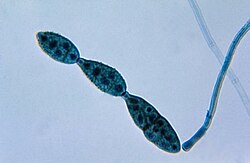
Chain of conidia of Alternaria
Conidiomata of Cypress canker (probably Seiridium cardinale) erupting on a Thuja twig

A conidium (/kəˈnɪdiəm, k-/ kə-NID-ee-əm, koh-; pl.: conidia), sometimes termed an asexual chlamydospore or chlamydoconidium (pl.: chlamydoconidia),[1] is an asexual,[2] non-motile spore of a fungus. The word conidium comes from the Ancient Greek word for dust, κόνις (kónis).[3] They are also called mitospores due to the way they are generated through the cellular process of mitosis.[citation needed] They are produced exogenously. The two new haploid cells are genetically identical to the haploid parent, and can develop into new organisms if conditions are favorable, and serve in biological dispersal.

Asexual reproduction in ascomycetes (the phylum Ascomycota) is by the formation of conidia, which are borne on specialized stalks called conidiophores. The morphology of these specialized conidiophores is often distinctive between species and, before the development of molecular techniques at the end of the 20th century, was widely used for identification of (e.g. Metarhizium) species.

The terms microconidia and macroconidia are sometimes used.[4]

Conidiogenesis

[edit]

There are two main types of conidium development:[5]

  • Blastic conidiogenesis, where the spore is already evident before it separates from the conidiogenic hypha which is giving rise to it, and
  • Thallic conidiogenesis, where first a cross-wall appears and thus the created cell develops into a spore.

Conidia germination

[edit]

A conidium may form germ tubes (germination tubes) and/or conidial anastomosis tubes (CATs) in specific conditions. These two are some of the specialized hyphae that are formed by fungal conidia. The germ tubes will grow to form the hyphae and fungal mycelia. The conidial anastomosis tubes are morphologically and physiologically distinct from germ tubes. After conidia are induced to form conidial anastomosis tubes, they grow homing toward each other, and they fuse. Once fusion happens, the nuclei can pass through fused CATs. These are events of fungal vegetative growth and not sexual reproduction. Fusion between these cells seems to be important for some fungi during early stages of colony establishment. The production of these cells has been suggested to occur in 73 different species of fungi.[6][7]

Germination in Aspergillus

[edit]

As evidenced by recent literature, conidia germination of Aspergillus, a common mold, specifically is of interest. Aspergillus is not only a familiar fungus found across various different settings in the world, but it poses a danger for immunocompromised individuals, as inhaled Aspergillus conidia could germinate inside the respiratory tract and cause aspergillosis, a form of pulmonary infection, and continual developments of aspergillosis such as new risk groups and the resistance against antifungal drugs.

Stages of Germination: Dormancy

[edit]

Germination in Aspergillus follows a sequence of three different stages: dormancy, isotropic growth, and polarized growth. The dormant conidia are able to germinate even after an year of remaining at room temperature, due to their resilient intracellular and extracellular characteristics, which enable them to undergo harsh conditions like dehydration, variation in osmotic pressure, oxidation, and temperature, and change in UV exposure and acidity levels. These abilities of the dormant conidia are dictated by a few central regulatory proteins, which are the main drivers of the conidia and conidiophore formation. One of these proteins, the developmental regulatory protein wetA, has been found to be particularly essential; in wetA-defective mutants have reduced tolerance to external factors mentioned above, and exhibit weak synthesization of the conidial cell wall. In addition to these central regulators, some notable groups of genes/proteins include other regulatory proteins like the velvet regulator proteins, which contribute to fungal growth, and other molecules that target specific unfavorable intra and extracellular conditions, like heat shock proteins.[8][9]

Stages of Germination: Isotropic and Polarized Growth

[edit]

The phases following dormancy include isotropic growth, in which increased intracellular osmotic pressure and water uptake causes swelling of the conidia and increased cellular diameter, and polarized growth, in which the swelling from isotropic growth directs the growth to one side of the cell, and leads to the formation of a germ tube. First, however, the conidia must go through the stage of breaking dormancy. In some species of Aspergillus, dormancy is broken when the dormant conidia is introduced to a carbon source in the presence of water and air, while in other species, the mere presence of glucose is enough to trigger it. The dense outer layer of the dormant conidia is shed and the growth of the hyphae cells begins, which has a significantly different composition compared to the dormant conidia cell. Breaking of dormancy involves transcription, but not translation; protein synthesis inhibitors prevent isotropic growth, while DNA and RNA synthesis inhibitors do not, and the start of breaking of dormancy is accompanied by and increase in transcripts for genes for biosynthesis of proteins, and immediate protein synthesis. Following the expansion of the cell via isotropic growth, studies have observed many new proteins emerging from the processes in the breaking of dormancy and transcripts associated with remodeling of the cell wall, suggesting that remodeling of the cell wall is a central process during isotropic growth. In the polarized growth stage, upregulated and overexpressed proteins and transcripts included ones involved in synthesis of chitin (a major component of the fungal cell wall), mitosis and DNA processing, remodeling of cell morphology, and ones in germ tube formation pertaining to infection and virulence factors.[8][9]

Structures for release of conidia

[edit]

Conidiogenesis is an important mechanism of spread of plant pathogens. In some cases, specialized macroscopic fruiting structures perhaps 1 mm or so in diameter containing masses of conidia are formed under the skin of the host plant and then erupt through the surface, allowing the spores to be distributed by wind and rain. One of these structures is called a conidioma (plural: conidiomata).[10][11]

Two important types of conidiomata, distinguished by their form, are:

  • pycnidia (singular: pycnidium), which are flask-shaped, and
  • acervuli (singular: acervulus), which have a simpler cushion-like form.

Pycnidial conidiomata or pycnidia form in the fungal tissue itself, and are shaped like a bulging vase. The conidia are released through a small opening at the apex, the ostiole.

Acervular conidiomata, or acervuli, are cushion-like structures that form within the tissues of a host organism:

  • subcuticular, lying under the outer layer of the plant (the cuticle),
  • intraepidermal, inside the outer cell layer (the epidermis),
  • subepidermal, under the epidermis, or deeper inside the host.

Mostly they develop a flat layer of relatively short conidiophores which then produce masses of spores. The increasing pressure leads to the splitting of the epidermis and cuticle and allows release of the conidia from the tissue.

Health issues

[edit]

Conidia are always present in the air, but levels fluctuate from day to day and with the seasons. An average person inhales at least 40 conidia per hour.[12] Exposure to conidia from certain species, such as those of Cryptostroma corticale, is known to cause hypersensitivity pneumonitis, an occupational hazard for forest workers and paper mill employees.[13][14]

Conidia are often the method by which some normally harmless but heat-tolerating (thermotolerant), common fungi establish infection in certain types of severely immunocompromised patients (usually acute leukemia patients on induction chemotherapy, AIDS patients with superimposed B-cell lymphoma, bone marrow transplantation patients (taking immunosuppressants), or major organ transplant patients with graft versus host disease). Their immune system is not strong enough to fight off the fungus, and it may, for example, colonise the lung, resulting in a pulmonary infection.[15] Especially with species of the Aspergillus genus, germination in the respiratory tract can lead to aspergillosis, which is quite common, can vary in severity, and has shown signs of developing new risk groups and antifungal drug resistance.[8]

See also

[edit]

References

[edit]
[edit]
Revisions and contributorsEdit on WikipediaRead on Wikipedia
from Grokipedia
A conidium (plural: conidia) is an asexual, nonmotile fungal that develops externally on specialized hyphal structures known as conidiophores or is liberated from the cell that produces it. These s are characteristic of many molds and fungi, enabling rapid through mitotic division without the need for or sexual stages. Conidia typically form via conidiogenesis, a process where conidiogenous cells—such as phialides or hyphal tips—undergo blastic development, hyphal fragmentation, or conversion of existing hyphal elements to produce propagules that are genetically similar to the parent but allow for parasexual . In fungal biology, conidia play a critical role as dispersal agents, often becoming airborne to facilitate colonization of new substrates and survival in diverse environments. Their formation occurs on conidiophores, which can be simple or branched hyphae dedicated to production, and the spores themselves vary in size, shape, color, and septation depending on the fungal species. For instance, some conidia contain , classifying the producing fungi as dematiaceous, while others are (transparent). Morphological features of conidia, including their ontogeny (developmental process), arrangement on conidiophores, pigmentation, and presence of (cross-walls), are essential for taxonomic identification and differentiation of mold genera in . These traits help distinguish between genera such as (with phialidic conidiogenesis producing chains of conidia) and (similar but with distinct brush-like conidiophores), aiding in clinical, agricultural, and ecological studies of fungi. While conidia are primarily associated with , some fungi exhibit dimorphism, switching between mold (conidia-producing) and forms under varying conditions.

Definition and Morphology

Definition

A conidium is an asexual, non-motile produced exogenously on specialized hyphal structures known as conidiophores in various fungi, primarily those belonging to the phylum and to a lesser extent . These spores serve as propagules for dispersal and colonization, forming through mitotic division without or cytoplasmic cleavage, distinguishing their development from that of sexual spores. Unlike sexual spores such as ascospores in or basidiospores in , which arise from meiotic processes within or structures, conidia are purely asexual in origin. They also differ from other asexual fungal structures, including , which develop endogenously as thick-walled resting cells within hyphae, and sporangiospores, which form internally within sac-like sporangia typically in . The term "conidium" derives from the word "konis," meaning dust, alluding to the powdery, lightweight appearance of these spores that facilitates aerial dispersal; it was first described in 19th-century mycological studies as advanced the understanding of fungal . Conidia are particularly prominent in imperfect fungi, formerly classified as Deuteromycota or anamorphic fungi, where sexual reproductive stages remain unknown or undescribed, making conidial production the primary mode of propagation.

Structural Features

Conidia exhibit a diverse range of morphologies, typically appearing as unicellular or multicellular structures that are either (transparent) or pigmented, with sizes generally spanning 2-50 μm in length. Unicellular conidia lack internal septa and resemble yeast-like forms, while multicellular variants are divided by septa, enabling compartmentalization. Pigmentation arises from deposition in the , conferring a dark appearance in species such as . Septation in conidia varies from aseptate forms, which are undivided and common in simpler structures like those of species, to uni- or multi-septate types observed in more complex fungi. For instance, conidia in species are often 1- to 5-septate, with macroconidia displaying multiple transverse septa that contribute to their elongated, sickle-shaped profile measuring up to 65 μm in length. The cell wall of conidia is multi-layered, primarily composed of and β-1,3-glucan forming a rigid inner scaffold, overlaid by an outer matrix that may include α-1,3-glucan and proteins. In certain species, integrates into this structure, enhancing UV resistance by absorbing harmful radiation and stabilizing the wall against environmental stress. Specialized structural adaptations occur in aquatic fungi, where conidia may feature appendages or sigmoid, coiled shapes for . For example, conidia of Helicomyces are multicellular with a curved main axis bending through at least 180°, often including branched laterals. These forms are produced on conidiophores adapted to submerged environments.

Production and Formation

Conidiogenesis Processes

Conidiogenesis refers to the developmental processes by which asexual spores, known as conidia, are produced from specialized fungal hyphae called conidiophores. This process is central to the of many filamentous fungi, particularly in the and their anamorphic states. Two primary modes of conidiogenesis exist: blastic, in which the conidium arises as a budding outgrowth from a conidiogenous cell without the entire cell converting into a spore, and thallic, in which conidia form through the modification and segmentation of preexisting hyphal elements. These modes differ fundamentally in how the conidial wall develops relative to the conidiogenous cell's wall layers. In blastic conidiogenesis, the conidial initial emerges as a small protuberance that enlarges, typically from the apex or side of the conidiogenous cell, before a delimits the mature conidium. This mode is subdivided into holoblastic and enteroblastic types based on wall involvement. Holoblastic conidiogenesis occurs when both the inner and outer walls of the conidiogenous cell contribute to the conidial wall, resulting in no rupture of the outer wall. In contrast, enteroblastic conidiogenesis involves only the inner wall layer in conidial development, with the outer wall rupturing to release the conidium, often through a pore or channel. A prominent example is the phialidic enteroblastic process in species, where flask-shaped phialides produce successive chains of conidia from a fixed collarette at the apex, with each conidium forming internally before . Thallic conidiogenesis, by comparison, involves the conversion of whole hyphal segments into conidia through septation, without budding or significant enlargement of a new structure. This mode is characterized by the formation of cross-walls () prior to conidial differentiation, leading to the transformation of hyphal cells into spores. Subtypes include arthric development, where mature conidia result from the jointed fragmentation of a septate , with disarticulation occurring at weakened septal regions to release individual or chained arthroconidia. Additionally, thallic processes can produce conidial chains through basipetal or acropetal succession: basipetal chains form with the youngest conidium at the base (pushed downward by new formations), while acropetal chains develop with the youngest at the apex, often seen in hyphal branching and segmentation. The initiation and progression of conidiogenesis are tightly regulated at the genetic level, particularly in model fungi like . A key regulator is the brlA gene, which encodes a that activates the central conidiation pathway, including downstream genes such as abaA and wetA, to coordinate hyphal differentiation into conidiophores and conidia. Mutations in brlA result in aconidial phenotypes, underscoring its essential role in triggering asexual sporulation. Upstream factors, including fluffy genes (e.g., fluG) and velvet complex proteins (e.g., VeA), further modulate brlA expression to ensure spatiotemporal control. Environmental cues play a critical role in inducing conidiogenesis by promoting hyphal differentiation under stress conditions. Nutrient limitation, especially carbon starvation, triggers conidiation in many fungi, as seen in Aspergillus niger, where aerial exposure combined with nutrient scarcity shifts metabolism toward asexual reproduction. Light acts as a positive regulator in species like Aspergillus flavus, with blue light perceived via the velvet complex stimulating brlA activation and conidiophore formation, while darkness can suppress it in some contexts. Temperature also influences the process, with optimal conidiation often occurring between 25–30°C in entomopathogenic and saprotrophic fungi, where deviations (e.g., heat stress above 37°C) can either promote or inhibit sporulation depending on the species.

Types of Conidiophores and Conidia

Conidiophores, the specialized hyphal structures bearing conidia, exhibit diverse morphologies adapted to fungal lifestyles and environments. They are broadly classified into mononematous, synnematous, and sporodochial types based on their organization and development. Mononematous conidiophores are single, erect, and unbranched or sparingly branched stalks, often hyaline and septate, as seen in Aspergillus species where they form uniseriate or biseriate heads for conidial production. Synnematous conidiophores consist of bundled hyphae fused into compact, erect synnemata, which may be darkly pigmented and terminate in slimy heads of conidia, exemplified by Graphium species. Sporodochial conidiophores aggregate into cushion-like, pad-shaped structures called sporodochia, typically producing conidia in dense clusters; Fusarium species illustrate this type, with conidiophores emerging from a basal stroma to form multicellular macroconidia. Conidia, the asexual spores produced on conidiophores, vary in arrangement depending on the developmental sequence. In chain-forming arrangements, conidia develop acropetally—youngest at the apex—in unbranched or branched sequences, as observed in Cladosporium where pale olivaceous, smooth-walled conidia form extended chains on branched conidiophores. Brush-like heads arise from phialides on metulae or directly on conidiophores, creating compact, spherical clusters of conidia; Penicillium species display this penicillus structure, with phialides producing chains of conidia in a broom-like array. Solitary conidia occur individually without chaining, often as terminal structures on conidiophores, common in various hyphomycetes where they detach via schizolytic or rhexolytic mechanisms. Conidial classifications further distinguish based on size, septation, and formation mode. Macroconidia are larger, multicellular spores, typically or clavate with multiple , such as the spindle-shaped, multi-septate forms in Fusarium complex. In contrast, microconidia are smaller, unicellular, and often ovoid or pyriform, like the , single-celled spores in Trichoderma species. Aleurioconidia develop terminally on conidiophores with a distinct basal scar, detaching individually, as in Cladosporium where they are globose to pyriform and aleuric. Blastoconidia form by budding from conidiogenous cells or other conidia, yielding ovoid or spherical spores, exemplified by the ellipsoidal blastoconidia in Candida . Specific conidial ontogenies highlight further diversity. Annellidic conidia arise from annellides—conidiogenous cells with percurrent proliferations leaving ring scars—producing cylindrical or ellipsoidal spores, as in Phialophora verrucosa where they form slimy aggregates. Poroconidia are extruded through apical pores in the conidiogenous , often in dictyoconidial forms; Stemphylium species produce such muriform conidia from percurrent conidiophores. These variations in structure and arrangement underpin taxonomic distinctions among conidial fungi.

Dispersal Mechanisms

Release Structures

Conidia are detached from conidiophores through specialized anatomical adaptations that facilitate precise and efficient release, ensuring effective initial dispersal. One primary mechanism is schizolytic secession, where the basal septum of the conidium splits centripetally due to the enzymatic dissolution of the , allowing clean separation without significant damage to adjacent structures. This is common in many ascomycetous fungi, such as Aspergillus clavatus, where conidia form in chains that fracture readily at weakened septa. In contrast, rhexolytic secession involves the rupture of the outer wall layer of the conidiogenous cell immediately below the conidial base, often leaving behind denticle-like projections or teeth on the conidiophore, as observed in species like . These denticles serve as residual scars from previous detachments, highlighting the structural specialization for repeated conidial production. Phialides and annellides represent key conidiogenous cell types adapted for successive conidial release without substantial cellular growth. Phialides are flask-shaped structures with a collarette or collar-like neck at the apex, through which conidia are extruded enteroblastically in basipetal succession; the fixed aperture prevents elongation of the phialide itself, enabling the production of long chains of conidia, as seen in and species. Annellides, on the other hand, elongate percurrently after each conidial formation, pushing through the previous and leaving a series of ring-like annellations along the , which mark sites of prior detachments; this is evident in fungi like Scopulariopsis brevicaulis. Both structures optimize release by maintaining a stable point of , minimizing energy expenditure on new cell formation. Abscission of conidia often relies on a combination of enzymatic and mechanical processes to weaken attachment points. Enzymatic mechanisms involve the localized action of lytic enzymes, such as chitinases or glucanases, that degrade septal components, facilitating schizolytic separation as demonstrated in mutants deficient in such enzymes, which fail to release conidia properly. Mechanical tension arises from continued growth or within developing conidial chains, causing physical rupture at predetermined weak zones, particularly in rhexolytic modes where wall stress leads to circumscissile fractures. These processes ensure timely detachment, often triggered by maturation signals. Illustrative examples underscore these adaptations' diversity. In , vesiculate heads—swollen apical vesicles bearing numerous phialides—produce dense chains of conidia that release en masse upon mechanical disturbance, leveraging fragile connections for airborne dispersal. Similarly, coremia within synnemata, as in Podosporium elongatum, form elongated, erect bundles of conidiophores that elevate conidia above the substrate, with apical regions often coated in mucilaginous slime to aid detachment and initial adhesion to vectors, enhancing dispersal efficiency.

Environmental Dispersal

Conidia are primarily dispersed through environmental vectors that facilitate their transport from the source fungus to new colonization sites. Wind, or anemochory, serves as a dominant mechanism for many terrestrial fungi, particularly in powdery mildews such as those caused by Erysiphe species, where lightweight conidia are carried over short to moderate distances by air currents. Water-mediated dispersal, known as hydrochory, is crucial for aquatic and semi-aquatic fungi, including aero-aquatic species like Varicosporium and Heliscus, whose tetraradiate conidia are released into streams and dispersed by water flow to adhere to submerged substrates. For terrestrial fungi, rain splash dispersal propels conidia short distances (up to several meters) from infected plant surfaces, as seen in pathogens like Phyllosticta citricarpa on citrus, facilitating local epidemics. Animal-assisted dispersal, or zoochory, occurs via adhesion to insects or other invertebrates; for instance, conidia of entomopathogenic fungi like Beauveria bassiana and Metarhizium anisopliae attach to collembolans, enabling transport across soil surfaces and vegetation. To endure environmental stresses during transit, conidia possess adaptations that enhance survival. Thick cell walls provide mechanical protection against and physical damage, as observed in species like Stemphylium ilicis, where multicellular conidia with robust walls exhibit prolonged viability under irradiation compared to thinner-walled variants. Pigments such as further bolster resistance to (UV) radiation, heat, and ; in , melanin-deficient mutants show reduced tolerance to UV exposure and , underscoring its role in maintaining conidial integrity. Additionally, conidia enter states that allow long-term persistence, with some fungal species retaining viability for up to 17 years in dry or adverse conditions before reactivation. Long-distance dispersal is achieved primarily through passive environmental processes. More commonly, conidia engage in passive drift within atmospheric aerosols, enabling intercontinental transport; studies of fungal air spora demonstrate that windborne conidia from pathogens like Alternaria can travel thousands of kilometers, contributing to widespread epidemics. Viability during dispersal is modulated by abiotic factors that can either preserve or diminish conidial populations. High relative humidity (above 80%) and moderate temperatures (15–25°C) promote prolonged survival by minimizing desiccation, whereas low humidity and extreme temperatures accelerate germination failure or death in species like Monilinia fructigena. Pollutants, including ozone and particulate matter, further impair dispersal efficiency; exposure to 1 ppm ozone for 30 minutes induces premature germination and reduces viability in Alternaria solani conidia, while urban air pollutants decrease overall survivability of airborne fungal propagules by up to 50% in contaminated environments.

Germination and Development

Stages of Germination

Conidial germination in fungi proceeds through three distinct sequential stages: , isotropic growth, and polarized growth, representing a transition from metabolic quiescence to active hyphal development. These phases involve coordinated morphological changes and physiological activations, enabling the conidium to sense suitable conditions and initiate outgrowth. In the dormancy stage, conidia exhibit metabolic quiescence characterized by low and minimal cellular activity, which confers resistance to environmental stresses. This state is maintained by the accumulation of protectants such as , a that stabilizes cellular structures and prevents damage during storage. levels are high in dormant conidia, supporting long-term viability even after extended periods without cues. The isotropic growth stage, also known as the swelling phase, begins upon exposure to favorable conditions, primarily through rapid water uptake that leads to uniform expansion of the conidium. This phase activates key metabolic processes, including enhanced respiration to generate energy and the initiation of protein synthesis to remodel cellular components. In species like Aspergillus niger, isotropic growth commences approximately 2 hours after inoculation and involves a decrease in cytoplasmic viscosity, preparing the conidium for further development; nuclear division often occurs during this period, typically one round of mitosis. Transitioning to the polarized growth stage, the conidium establishes a single axis of outgrowth, resulting in the emergence of a germ tube from one pole. This apical extension is directed by the Spitzenkörper, a dynamic cluster of vesicles and cytoskeletal elements at the tip that organizes the delivery of wall-building materials for directed hyphal elongation. Polarity is established through the activation of regulatory genes, such as stuA, which contributes to axis formation and the switch from isotropic to directed growth during early vegetative phases. The germ tube develops into a mature , marking the completion of . The entire process typically spans 1 to 24 hours, varying by fungal species; for instance, in Aspergillus species, swelling occurs within 2 to 6 hours, followed by germ tube emergence by 6 to 8 hours. In Fusarium graminearum, a model organism, initial swelling is observed at 2 hours, germ tube elongation at 8 hours, and hyphal branching by 24 hours.

Factors Influencing Germination

Abiotic factors play a critical role in regulating conidial , with moisture availability being paramount; (a_w) levels above 0.9 are typically required to initiate swelling and subsequent isotropic growth in many fungal species, as lower levels inhibit and metabolic activation. optima for germination generally fall between 20°C and 30°C across diverse fungi, where rates are maximized, while extremes below 10°C or above 35°C delay or prevent outgrowth by disrupting enzymatic processes. environments ranging from neutral (around 7) to acidic (5-6) favor germination for most species, with alkaline conditions often reducing viability through impaired function and uptake. Nutrient availability serves as key cues for transitioning from to active growth; carbon sources such as glucose trigger initial isotropic swelling by activating breakdown and metabolic pathways, enabling energy mobilization without supporting full hyphal extension. Micronutrients like are essential for germ tube elongation, acting as cofactors in enzymatic reactions that stabilize cell walls during polarized growth. Biotic interactions can either promote or inhibit depending on the context; host surfaces may provide attachment cues that accelerate outgrowth via surface hydrophobins, but competitors such as often release antifungals that block metabolic activation and delay . In dense conidial populations, mechanisms involving autoinducers regulate density-dependent inhibition, preventing premature to optimize resource use. Species-specific variations highlight adaptive differences; in Aspergillus species, elevated CO2 levels (around 0.1%) enhance by stimulating respiratory shifts and for remodeling. Conversely, Fusarium conidia experience delayed under drought stress, with reduced water availability prolonging and lowering potential on hosts.

Biological Significance

Role in Fungal Reproduction

Conidia primarily function as asexual propagules in fungal reproduction, enabling rapid clonal propagation through without the need for or . This process allows fungi, especially in the , to produce genetically identical offspring efficiently, facilitating quick colonization of substrates. In species like , conidia are formed on specialized conidiophores, with each structure capable of yielding up to 10,000 spores, contributing to extraordinarily high production rates—up to 10^9 conidia per cm² in mature colonies. This abundance ensures a high probability of successful dispersal and establishment, while the genetic stability of mitotic division maintains uniform traits advantageous for adaptation in consistent environments. In the fungal life cycle, conidia serve as critical links between the vegetative mycelial phase and the initiation of new growth, germinating under favorable conditions to form hyphae that expand the . They represent the dispersive stage in anamorphic (asexual) fungi, where the absence of a sexual phase does not preclude integration with facultative sexual cycles; for instance, in some , conidia can act as male gametes (spermatia) in teleomorph stages, bridging asexual and when environmental cues trigger . This versatility allows fungi to alternate reproductive strategies based on conditions, with conidia providing a resilient, dormant reservoir for reactivation. Evolutionarily, conidia have become predominant in anamorphic fungi due to their role in enhancing survival in unstable or nutrient-poor habitats, where rapid, energy-efficient outperforms slower sexual cycles requiring compatible mates. The prolific output and stress tolerance of conidia, regulated by conserved genetic pathways like the central regulatory pathway in , underscore their adaptive value, enabling efficient population maintenance and dispersal in diverse ecological niches without reliance on sexual recombination.

Ecological Importance

Conidia are essential propagules for saprotrophic fungi, enabling the initial colonization of dead and facilitating recycling through . These asexual spores germinate upon contact with substrates like decaying material, allowing mycelial networks to penetrate and break down lignocellulosic compounds into simpler forms that support microbial and growth. For instance, species, common and aerial dispersers, produce abundant conidia that initiate rot on decaying fruits, accelerating the release of carbon, , and other nutrients into ecosystems. This process is critical for maintaining and carbon cycling in terrestrial habitats. In symbiotic contexts, conidia contribute to the establishment and maintenance of mutualistic associations between fungi and . Certain ectomycorrhizal fungi, particularly in the , release conidia that aid in colonization by germinating near host and forming extraradical hyphae that extend nutrient acquisition, particularly and , in exchange for -derived carbohydrates. Endophytic fungi also rely on conidial dispersal to enter tissues asymptomatically, where they enhance host resilience to environmental stresses and herbivores, thereby supporting stability. These interactions underscore conidia's role in fostering and productivity. As primary inoculum in pathogenic fungi, conidia drive disease dynamics that shape and . In rust fungi (Pucciniales), urediniospores—specialized conidia—facilitate repeated infection cycles, leading to widespread epidemics that reduce host fitness and alter competitive balances among plant species. This selective pressure promotes in host populations and influences , as seen in natural grasslands where rust outbreaks regulate dominant grasses, enhancing overall floral diversity. Such interactions highlight conidia's indirect role in evolutionary processes and heterogeneity. Conidial spores serve as effective bioindicators for assessing environmental conditions, particularly air quality and impacts on fungal distributions. Airborne concentrations and seasonal patterns of conidia reflect levels, with elevated spore loads often correlating to urban stressors that favor resilient species. Moreover, warming trends have advanced fungal spore seasons across regions like the , signaling shifts in fungal driven by and potential disruptions to services such as and . Monitoring these spores thus provides insights into broader ecological responses to anthropogenic pressures.

Human Relevance

Health Impacts

Inhalation of conidia from certain fungal species, such as Alternaria alternata and Cladosporium herbarum, serves as a major aeroallergen that triggers respiratory allergies, including allergic rhinitis and asthma exacerbations in sensitized individuals. These conidia provoke type I hypersensitivity reactions upon deposition in the airways, leading to symptoms like wheezing, coughing, and bronchial hyperresponsiveness, particularly in children and those with pre-existing atopic conditions. Meta-analyses indicate that exposure to Cladosporium and Alternaria conidia increases the risk of current asthma symptom exacerbation by 36% to 48% compared to non-exposed environments. A 2024 study found fungal sensitization, often linked to these conidia, affects approximately 27% of asthma patients in a Taiwanese cohort. Pathogenic conidia from species pose significant infectious risks, particularly in immunocompromised hosts, where they can cause upon inhalation. In individuals with weakened immune systems, such as those undergoing or , inhaled conidia evade clearance by alveolar macrophages and germinate into invasive hyphae, leading to pulmonary with high mortality rates exceeding 50% in invasive cases. This process within tissue results in tissue destruction, , and systemic dissemination if untreated, making it a leading mold in critical care settings. In 2025, the published its first reports on diagnostics and treatments for invasive fungal infections, highlighting critical gaps in tools to detect and manage conidia-mediated diseases like . The 95-95 by 2025 initiative aims to diagnose and treat 95% of individuals with serious fungal infections by the end of the year, addressing rising antifungal resistance in pathogens spread via airborne conidia. Conidia produced by species contribute to health risks through of food supplies, notably fumonisins, which are potent toxins associated with and neural tube defects in humans. These conidia facilitate the spread of Fusarium verticillioides and related species during , leading to fumonisin accumulation in and other grains consumed by humans and animals, with global affecting millions annually. Chronic exposure via diet causes , renal damage, and immunotoxicity, underscoring the role of conidia in indirect but widespread toxicological impacts. Occupational exposure to high concentrations of fungal conidia in agricultural settings, such as handling moldy hay, can induce , commonly known as , characterized by acute flu-like symptoms and progressive if repeated. This condition arises from massive inhalation of conidia from molds like and thriving in damp stored crops, triggering an exaggerated with fever, dyspnea, and reduced function. Farmers and agricultural workers face elevated risks, with studies reporting that fungal-linked accounts for a notable portion of occupational respiratory diseases in rural populations.

Applications and Control

Conidia play a pivotal role in biotechnological applications, particularly as biocontrol agents in agriculture. Species of Trichoderma, such as T. harzianum and T. viride, produce conidia that are formulated into commercial biopesticides to antagonize plant pathogens through mechanisms like mycoparasitism, antibiosis, and competition for nutrients. These conidia effectively suppress soil-borne fungal diseases in crops like tomato and cucumber. Additionally, conidia from Aspergillus species, such as A. terreus, serve as inocula for solid-state fermentation processes to produce industrial enzymes such as α-amylases, which hydrolyze starch in food and biofuel industries. Yields of up to 19.19 U/g substrate have been achieved using pearl millet as a carbon source. In , conidia from (now P. rubens) initiate the like penicillin. The process begins with spore inoculation into nutrient media, followed by submerged fermentation in large-scale bioreactors, yielding titers exceeding 50 g/L under optimized conditions. This method revolutionized antibiotic manufacturing during and remains a cornerstone of pharmaceutical production. Control strategies target conidiogenesis to disrupt fungal proliferation. fungicides, such as and , inhibit biosynthesis in the fungal membrane, compromising conidiation in pathogens like and . Physical methods, including UV-C , provide non-chemical alternatives; doses of 1.57 kJ/m² completely inhibit conidial in Fusarium species for at least 24 hours, as demonstrated in 2025 greenhouse trials on . Agricultural management integrates cultural practices to minimize conidial inoculum. Crop rotation with non-host plants, such as alternating cereals with , reduces survival and buildup in , effectively controlling diseases like Fusarium head blight. Biofumigation using cover crops releases isothiocyanates that suppress antagonistic conidia from pathogens, while incorporating Trichoderma conidia enhances this effect against Fusarium circinatum in pine seedlings, achieving up to 75% disease reduction.

References

Add your contribution
Related Hubs
User Avatar
No comments yet.