
Recent from talks
Microwave radiometer
Knowledge base stats:
Talk channels stats:
Members stats:
Microwave radiometer
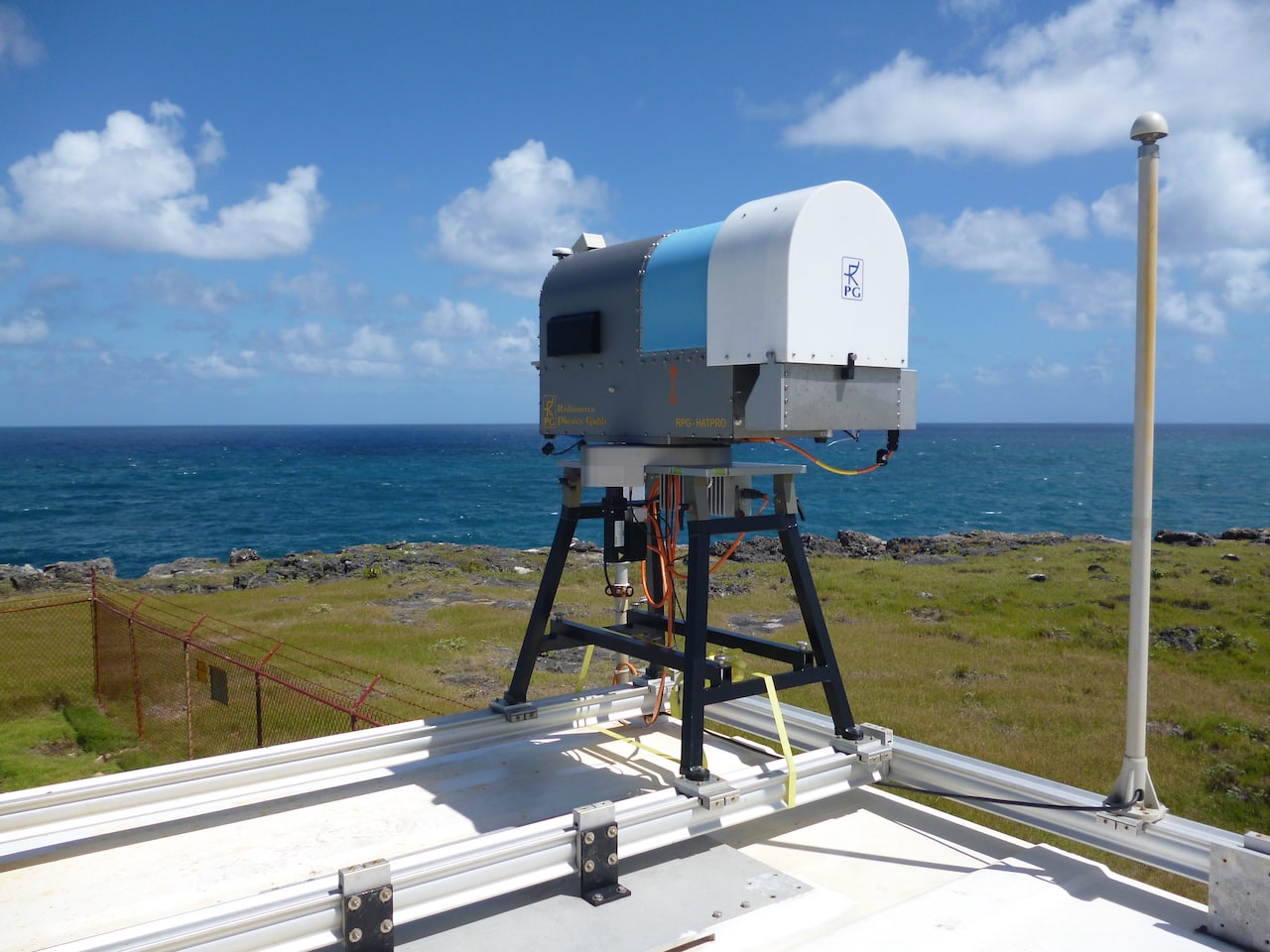
A microwave radiometer (MWR) is a radiometer that measures energy emitted at one millimeter-to-metre wavelengths (frequencies of 0.3–300 GHz) known as microwaves. Microwave radiometers are very sensitive receivers designed to measure thermally-emitted electromagnetic radiation. They are usually equipped with multiple receiving channels to derive the characteristic emission spectrum of planetary atmospheres, surfaces or extraterrestrial objects. Microwave radiometers are utilized in a variety of environmental and engineering applications, including remote sensing, weather forecasting, climate monitoring, radio astronomy and radio propagation studies.
Using the microwave spectral range between 1 and 300 GHz provides complementary information to the visible and infrared spectral range. Most importantly, the atmosphere and also vegetation is semi-transparent in the microwave spectral range. This means components like dry gases, water vapor, or hydrometeors interact with microwave radiation but overall even the cloudy atmosphere is not completely opaque in this frequency range.
For weather and climate monitoring, microwave radiometers are operated from space as well as from the ground. As remote sensing instruments, they are designed to operate continuously and autonomously often in combination with other atmospheric remote sensors like for example cloud radars and lidars. They allow the derivation of important meteorological quantities such as vertical temperature and humidity profiles, columnar water vapor quantity, and columnar liquid water path with a high temporal resolution on the order of minutes to seconds under nearly all weather conditions. Microwave radiometers are also used for remote sensing of Earth's ocean and land surfaces, to derive ocean temperature and wind speed, ice characteristics, and soil and vegetation properties.
First developments of microwave radiometer were dedicated to the measurement of radiation of extraterrestrial origin in the 1930s and 1940s. The most common form of microwave radiometer was introduced by Robert Dicke in 1946 in the Radiation Laboratory of Massachusetts Institute of Technology to better determine the temperature of the microwave background radiation. This first radiometer worked at a wavelength 1.25 cm and was operated at the Massachusetts Institute of Technology. Dicke also first discovered weak atmospheric microwave absorption using three different radiometers (at wavelengths of 1.0, 1.25 and 1.5 cm).
Soon after satellites were first used for observing the atmosphere, microwave radiometers became part of their instrumentation. In 1962 the Mariner-2 mission was launched by NASA to investigate the surface of Venus including a radiometer for water vapor and temperature observations. In following years a wide variety of microwave radiometers were tested on satellites. The launch of the Scanning Multichannel Microwave Radiometer in 1978 became an important milestone in the history of radiometry. It was the first time a conically scanning radiometer was used in space; it was launched into space on board the NASA Nimbus satellite. The launch of this mission gave the opportunity to image the Earth at a constant angle of incidence that is important as surface emissivity is angle dependent. In the beginning of 1980, new multi-frequency, dual-polarization radiometric instruments were developed. Two spacecraft were launched which carried instruments of this type: Nimbus-7 and Seasat. The Nimbus-7 mission results allowed to globally monitor the state of ocean surface as well as surface covered by snow and glaciers. Today, microwave instruments like the Advanced Microwave Sounding Unit (AMSU) and the Special Sensor Microwave Imager / Sounder (SSMIS) are widely used on different satellites.
Ground-based radiometers for the determination of temperature profiles were first explored in the 1960s and have since improved in terms of reduced noise and the ability to run unattended 24/7 within worldwide observational networks. Review articles, and a detailed online handbook are available.
Solids, liquids (e.g. the Earth's surface, ocean, sea ice, snow, vegetation) but also gases emit and absorb microwave radiation. Traditionally, the amount of radiation a microwave radiometer receives is expressed as the equivalent blackbody temperature also called brightness temperature. In the microwave range several atmospheric gases exhibit rotational lines. They provide specific absorption features shown at a figure on the right which allow to derive information about their abundance and vertical structure. Examples for such absorption features are the oxygen absorption complex (caused by magnetic dipole transitions) around 60 GHz which is used to derive temperature profiles or the water vapor absorption line around 22.235 GHz (dipole rotational transition) which is used to observe the vertical profile of humidity. Other significant absorption lines are found at 118.75 GHz (oxygen absorption) and at 183.31 GHz (water vapor absorption, used for water vapor profiling under dry conditions or from satellites). Weak absorption features due to ozone are also used for stratospheric ozone density and temperature profiling.
Besides the distinct absorption features of molecular transition lines, there are also non-resonant contributions by hydrometeors (liquid drops and frozen particles). Liquid water emission increases with frequency, hence, measuring at two frequencies, typically one close to the water absorption line (22.235 GHz) and one in the nearby window region (typically 31 GHz) dominated by liquid absorption provides information on both the columnar amount of water vapor and the columnar amount of liquid water separately (two-channel radiometer). The so-called „water vapor continuum" arises from the contribution of far away water vapor lines.
Hub AI
Microwave radiometer AI simulator
(@Microwave radiometer_simulator)
Microwave radiometer
A microwave radiometer (MWR) is a radiometer that measures energy emitted at one millimeter-to-metre wavelengths (frequencies of 0.3–300 GHz) known as microwaves. Microwave radiometers are very sensitive receivers designed to measure thermally-emitted electromagnetic radiation. They are usually equipped with multiple receiving channels to derive the characteristic emission spectrum of planetary atmospheres, surfaces or extraterrestrial objects. Microwave radiometers are utilized in a variety of environmental and engineering applications, including remote sensing, weather forecasting, climate monitoring, radio astronomy and radio propagation studies.
Using the microwave spectral range between 1 and 300 GHz provides complementary information to the visible and infrared spectral range. Most importantly, the atmosphere and also vegetation is semi-transparent in the microwave spectral range. This means components like dry gases, water vapor, or hydrometeors interact with microwave radiation but overall even the cloudy atmosphere is not completely opaque in this frequency range.
For weather and climate monitoring, microwave radiometers are operated from space as well as from the ground. As remote sensing instruments, they are designed to operate continuously and autonomously often in combination with other atmospheric remote sensors like for example cloud radars and lidars. They allow the derivation of important meteorological quantities such as vertical temperature and humidity profiles, columnar water vapor quantity, and columnar liquid water path with a high temporal resolution on the order of minutes to seconds under nearly all weather conditions. Microwave radiometers are also used for remote sensing of Earth's ocean and land surfaces, to derive ocean temperature and wind speed, ice characteristics, and soil and vegetation properties.
First developments of microwave radiometer were dedicated to the measurement of radiation of extraterrestrial origin in the 1930s and 1940s. The most common form of microwave radiometer was introduced by Robert Dicke in 1946 in the Radiation Laboratory of Massachusetts Institute of Technology to better determine the temperature of the microwave background radiation. This first radiometer worked at a wavelength 1.25 cm and was operated at the Massachusetts Institute of Technology. Dicke also first discovered weak atmospheric microwave absorption using three different radiometers (at wavelengths of 1.0, 1.25 and 1.5 cm).
Soon after satellites were first used for observing the atmosphere, microwave radiometers became part of their instrumentation. In 1962 the Mariner-2 mission was launched by NASA to investigate the surface of Venus including a radiometer for water vapor and temperature observations. In following years a wide variety of microwave radiometers were tested on satellites. The launch of the Scanning Multichannel Microwave Radiometer in 1978 became an important milestone in the history of radiometry. It was the first time a conically scanning radiometer was used in space; it was launched into space on board the NASA Nimbus satellite. The launch of this mission gave the opportunity to image the Earth at a constant angle of incidence that is important as surface emissivity is angle dependent. In the beginning of 1980, new multi-frequency, dual-polarization radiometric instruments were developed. Two spacecraft were launched which carried instruments of this type: Nimbus-7 and Seasat. The Nimbus-7 mission results allowed to globally monitor the state of ocean surface as well as surface covered by snow and glaciers. Today, microwave instruments like the Advanced Microwave Sounding Unit (AMSU) and the Special Sensor Microwave Imager / Sounder (SSMIS) are widely used on different satellites.
Ground-based radiometers for the determination of temperature profiles were first explored in the 1960s and have since improved in terms of reduced noise and the ability to run unattended 24/7 within worldwide observational networks. Review articles, and a detailed online handbook are available.
Solids, liquids (e.g. the Earth's surface, ocean, sea ice, snow, vegetation) but also gases emit and absorb microwave radiation. Traditionally, the amount of radiation a microwave radiometer receives is expressed as the equivalent blackbody temperature also called brightness temperature. In the microwave range several atmospheric gases exhibit rotational lines. They provide specific absorption features shown at a figure on the right which allow to derive information about their abundance and vertical structure. Examples for such absorption features are the oxygen absorption complex (caused by magnetic dipole transitions) around 60 GHz which is used to derive temperature profiles or the water vapor absorption line around 22.235 GHz (dipole rotational transition) which is used to observe the vertical profile of humidity. Other significant absorption lines are found at 118.75 GHz (oxygen absorption) and at 183.31 GHz (water vapor absorption, used for water vapor profiling under dry conditions or from satellites). Weak absorption features due to ozone are also used for stratospheric ozone density and temperature profiling.
Besides the distinct absorption features of molecular transition lines, there are also non-resonant contributions by hydrometeors (liquid drops and frozen particles). Liquid water emission increases with frequency, hence, measuring at two frequencies, typically one close to the water absorption line (22.235 GHz) and one in the nearby window region (typically 31 GHz) dominated by liquid absorption provides information on both the columnar amount of water vapor and the columnar amount of liquid water separately (two-channel radiometer). The so-called „water vapor continuum" arises from the contribution of far away water vapor lines.
Recent media