
Recent from talks
Mid-Pleistocene Transition
Knowledge base stats:
Talk channels stats:
Members stats:
Mid-Pleistocene Transition
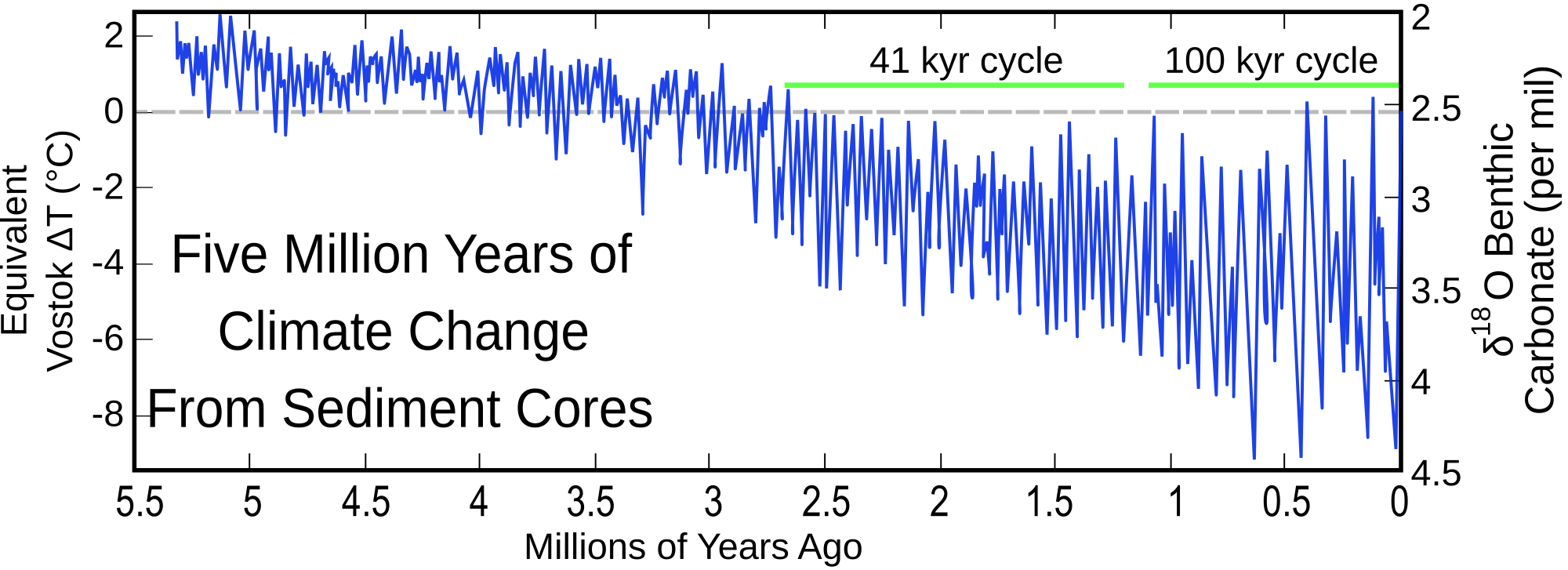
The Mid-Pleistocene Transition (MPT), also known as the Mid-Pleistocene Revolution (MPR), is a fundamental change in the behaviour of glacial cycles during the Quaternary glaciations. The transition lasted around 550,000 years, from 1.25 million years ago until 0.7 million years ago approximately, in the Pleistocene epoch.
Before the MPT, the glacial cycles were dominated by a 41,000-year periodicity with low-amplitude, thin ice sheets, and a linear relationship to the Milankovitch forcing from axial tilt. Because of this, sheets were more dynamic during the Early Pleistocene. After the MPT there have been strongly asymmetric cycles with long-duration cooling of the climate and build-up of thick ice sheets, followed by a fast change from extreme glacial conditions to a warm interglacial. This led to less dynamic ice sheets. Interglacials before the MPT had lower levels of atmospheric carbon dioxide compared to interglacials after the MPT. One of the MPT's effects was causing ice sheets to become higher in altitude and less slippery compared to before. The MPT greatly increased the reservoirs of hydrocarbons locked up as permafrost methane or methane clathrate during glacial intervals. This led to larger methane releases during deglaciations. The cycle lengths have varied, with an average length of approximately 100,000 years.
In Alaska, the MPT caused a net mass loss in the Saint Elias Mountains because the plate tectonic input of mass into this mountain range became exceeded by mass loss from glacial erosion. The Loop Current decreased in strength, contributing to the cooling of the Northern Hemisphere.
In Europe, the MPT was associated with the Epivillafranchian-Galerian transition and may have led to the local extinction of, among other taxa, Puma pardoides, Megantereon whitei, and Xenocyon lycaonoides. The prevalence of ungulates adapted for grazing increased in the Mediterranean region after the "0.9 Ma event". The northern North Sea Basin was first glaciated during the MPT. The increased intensity of transgressive-regressive cycles is recorded in northern Italy.
The cooling brought about by the MPT increased westerly aridity in the western Tarim Basin. East Asian Summer Monsoon (EASM) precipitation declined. Grasslands expanded across the North China Plain as forests contracted.
During the MPT, the Indian Summer Monsoon (ISM) decreased in strength. In the middle of the MPT, there was a sudden decrease in denitrification, likely due to increased solubility of oxygen during lengthened glacial periods. After the MPT, the Bay of Bengal experienced increased stratification as a result of the strengthening of the ISM, which resulted in increased riverine flux, inhibiting mixing and creating a shallow thermocline, with stratification being stronger during interstadials than stadials. Paradoxically, variability in Δδ18O in the Bay of Bengal between glacials and interglacials decreased following the MPT.
In Central Africa, detectable floral changes corresponding to glacial cycles were absent prior to the MPT. Following the MPT, a clear cyclicity became evident, with interglacials being characterised by warm and dry conditions while glacials were cool and humid.
In Australia, the MPT resulted in the formation of the dunes of Fraser Island and the Cooloola Sand Mass. The increasing amplitude of sea level variations led to increased redistribution of sediments stored on the seafloor across the continental shelf. The development of Fraser Island indirectly led to the formation of the Great Barrier Reef by drastically decreasing the flow of sediment to the area of continental shelf north of Fraser Island, a necessary precondition for the growth of coral reefs on such an enormous scale as found in the Great Barrier Reef.
Hub AI
Mid-Pleistocene Transition AI simulator
(@Mid-Pleistocene Transition_simulator)
Mid-Pleistocene Transition
The Mid-Pleistocene Transition (MPT), also known as the Mid-Pleistocene Revolution (MPR), is a fundamental change in the behaviour of glacial cycles during the Quaternary glaciations. The transition lasted around 550,000 years, from 1.25 million years ago until 0.7 million years ago approximately, in the Pleistocene epoch.
Before the MPT, the glacial cycles were dominated by a 41,000-year periodicity with low-amplitude, thin ice sheets, and a linear relationship to the Milankovitch forcing from axial tilt. Because of this, sheets were more dynamic during the Early Pleistocene. After the MPT there have been strongly asymmetric cycles with long-duration cooling of the climate and build-up of thick ice sheets, followed by a fast change from extreme glacial conditions to a warm interglacial. This led to less dynamic ice sheets. Interglacials before the MPT had lower levels of atmospheric carbon dioxide compared to interglacials after the MPT. One of the MPT's effects was causing ice sheets to become higher in altitude and less slippery compared to before. The MPT greatly increased the reservoirs of hydrocarbons locked up as permafrost methane or methane clathrate during glacial intervals. This led to larger methane releases during deglaciations. The cycle lengths have varied, with an average length of approximately 100,000 years.
In Alaska, the MPT caused a net mass loss in the Saint Elias Mountains because the plate tectonic input of mass into this mountain range became exceeded by mass loss from glacial erosion. The Loop Current decreased in strength, contributing to the cooling of the Northern Hemisphere.
In Europe, the MPT was associated with the Epivillafranchian-Galerian transition and may have led to the local extinction of, among other taxa, Puma pardoides, Megantereon whitei, and Xenocyon lycaonoides. The prevalence of ungulates adapted for grazing increased in the Mediterranean region after the "0.9 Ma event". The northern North Sea Basin was first glaciated during the MPT. The increased intensity of transgressive-regressive cycles is recorded in northern Italy.
The cooling brought about by the MPT increased westerly aridity in the western Tarim Basin. East Asian Summer Monsoon (EASM) precipitation declined. Grasslands expanded across the North China Plain as forests contracted.
During the MPT, the Indian Summer Monsoon (ISM) decreased in strength. In the middle of the MPT, there was a sudden decrease in denitrification, likely due to increased solubility of oxygen during lengthened glacial periods. After the MPT, the Bay of Bengal experienced increased stratification as a result of the strengthening of the ISM, which resulted in increased riverine flux, inhibiting mixing and creating a shallow thermocline, with stratification being stronger during interstadials than stadials. Paradoxically, variability in Δδ18O in the Bay of Bengal between glacials and interglacials decreased following the MPT.
In Central Africa, detectable floral changes corresponding to glacial cycles were absent prior to the MPT. Following the MPT, a clear cyclicity became evident, with interglacials being characterised by warm and dry conditions while glacials were cool and humid.
In Australia, the MPT resulted in the formation of the dunes of Fraser Island and the Cooloola Sand Mass. The increasing amplitude of sea level variations led to increased redistribution of sediments stored on the seafloor across the continental shelf. The development of Fraser Island indirectly led to the formation of the Great Barrier Reef by drastically decreasing the flow of sediment to the area of continental shelf north of Fraser Island, a necessary precondition for the growth of coral reefs on such an enormous scale as found in the Great Barrier Reef.
Recent media