


Community hub
Recent from talks
Contribute something
Nothing was collected or created yet.
Four tones (Middle Chinese)
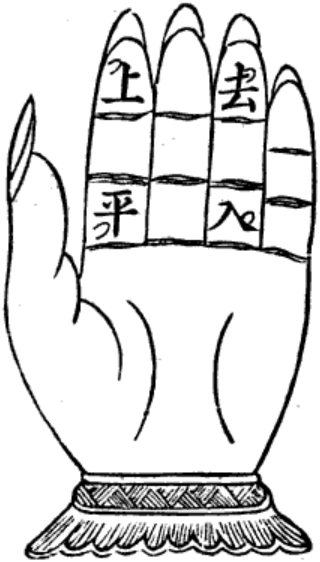
View on Wikipedia| ꜂上 shǎng | 去꜄ qù |
| ꜀平 píng | 入꜆ ru(ʔ) |


The four tones of Chinese poetry and dialectology (simplified Chinese: 四声; traditional Chinese: 四聲; pinyin: sìshēng) are four traditional tone classes[1] of Chinese words. They play an important role in Chinese poetry and in comparative studies of tonal development in the modern varieties of Chinese, both in traditional Chinese and in Western linguistics. They correspond to the phonology of Middle Chinese, and are named even or level (平 píng), rising (上 shǎng), departing or going (去 qù), and entering or checked (入 rù).[2] (The last three are collectively referred to as oblique 仄 (zè), an important concept in poetic tone patterns.) They are reconstructed as mid (˧ or 33), mid rising (˧˥ or 35), high falling (˥˩ or 51), and mid (˧ or 33) with a final stop consonant respectively.[3] Due to historic splits and mergers, none of the modern varieties of Chinese have the exact four tones of Middle Chinese, but they are noted in rhyming dictionaries.
Background
[edit]According to the usual modern analysis, Early Middle Chinese had three phonemic tones in most syllables, but no tonal distinctions in checked syllables ending in the stop consonants /p/, /t/, /k/. In most circumstances, every syllable had its own tone; hence a multisyllabic word typically had a tone assigned to each syllable. (In modern varieties, the situation is sometimes more complicated. Although each syllable typically still has its own underlying tone in most dialects, some syllables in the speech of some varieties may have their tone modified into other tones or neutralized entirely, by a process known as tone sandhi. Furthermore, many varieties of Chinese deleted Middle Chinese final consonants, but these contrasts may have been preserved, helping lead to tonogenesis of contemporary multitonal systems.)
Traditional Chinese dialectology reckons syllables ending in a stop consonant as possessing a fourth tone, known technically as a checked tone. This tone is known in traditional Chinese linguistics as the entering (入 rù) tone, a term commonly used in English as well. The other three tones were termed the level (or even) tone (平 píng), the rising (上 shǎng) tone, and the departing (or going) tone (去 qù).[2] The practice of setting up the entering tone as a separate class reflects the fact that the actual pitch contour of checked syllables was quite distinct from the pitch contour of any of the sonorant-final syllables. Indeed, implicit in the organisation of the classical rime tables is a different, but structurally equally valid, phonemic analysis, which takes all four tones as phonemic and demotes the difference between stop finals [p t k] and nasal finals [m n ŋ] to allophonic, with stops occurring in entering syllables and nasals elsewhere.[4]
From the perspective of modern historical linguistics, there is often value in treating the entering tone as a tone regardless of its phonemic status, because syllables possessing this tone typically develop differently from syllables possessing any of the other three tones. For clarity, these four tones are often referred to as tone classes, with each word belonging to one of the four tone classes. This reflects the fact that the lexical division of words into tone classes is based on tone, but not all tone classes necessarily have a distinct phonemic tone associated with them. Some contemporary fāngyán such as Taiwanese Hokkien, Jin and Penang are said to preserve the entering tone, which is used as a marker to differentiate them from other varieties and also genetically classify them via the comparative method.
The four Early Middle Chinese (EMC) tones are nearly always presented in the order level (平 píng), rising (上 shǎng), departing (去 qù), entering (入 rù), and correspondingly numbered 1 2 3 4 in modern discussions. In Late Middle Chinese (LMC), each of the EMC tone classes split in two, depending on the nature of the initial consonant of the syllable in question. Discussions of LMC and the various modern varieties will often number these split tone classes from 1 through 8, keeping the same ordering as before. For example, LMC/modern tone classes 1 and 2 derive from EMC tone class 1; LMC/modern tone classes 3 and 4 derive from EMC tone class 2; etc. The odd-numbered tone classes 1 3 5 7 are termed dark (陰 yīn), whereas the even-numbered tone classes 2 4 6 8 are termed light (陽 yáng). Hence, for example, LMC/modern tone class 5 is known in Chinese as the yīn qù (dark departing) tone, indicating that it is the yīn variant of the EMC qù tone (EMC tone 3). In order to clarify the relationship between the EMC and LMC tone classes, some authors notate the LMC tone classes as 1a 1b 2a 2b 3a 3b 4a 4b in place of 1 2 3 4 5 6 7 8, where a and b correspond directly to Chinese yīn and yáng, respectively.
Baxter's transcription, an alphabetic notation for representing Middle Chinese, represents the rising (上 shǎng) tone with a trailing X, the departing (去 qù) tone with a trailing H, and it leaves the level and entering tones unmarked.
Names
[edit]In Middle Chinese, each of the tone names carries the tone it identifies: 平 level ꜁biajŋ, 上 rising ꜃dʑɨaŋ, 去 departing kʰɨə꜄, and 入 entering ȵip꜇.[5] However, in some modern Chinese varieties, this is no longer true. This loss of correspondence is most notable in the case of the entering tone, syllables checked in a stop consonant [p̚], [t̚], or [k̚] in Middle Chinese, which has been lost from most dialects of Mandarin and redistributed among the other tones.
In modern Chinese varieties, tones that derive from the four Middle Chinese tone classes may be split into two registers, dark (陰 yīn) and light (陽 yáng) depending on whether the Middle Chinese onset was voiceless or voiced, respectively. When all four tone classes split, eight tones result: dark level (陰平), light level (陽平), dark rising (陰上), light rising (陽上), dark departing (陰去), light departing (陽去), dark entering (陰入), and light entering (陽入). Sometimes these have been termed upper and lower registers respectively, but that may be a misnomer, as in some dialects the dark registers may have the lower tone, and the light register the higher tone.
Chinese dictionaries mark the tones with diacritical marks at the four corners of a character:[6] ꜀平 level, ꜂上 rising, 去꜄ departing, and 入꜆ entering. When yin and yang tones are distinguished, these are the diacritics for the yin (dark) tones; the yang (light) tones are indicated by underscoring the diacritic: ꜁平 light level, ꜃上 light rising, 去꜅ light departing, 入꜇ light entering. These diacritics are also sometimes used when the phonetic realization is unknown, as in the reconstructions of Middle Chinese at the beginning of this section. However, in this article, the circled numbers ①②③④⑤⑥⑦⑧ will be used, as in the table below, with the odd numbers ①③⑤⑦ indicating either 'dark' tones or tones that have not split, and even numbers ②④⑥⑧ indicating 'light' tones. Thus, level tones are numbered ①②, the rising tones ③④, the departing tones ⑤⑥, and the entering (checked) tones ⑦⑧.
In Yue (incl. Cantonese) the dark entering tone further splits into high (高陰入) and low (低陰入) registers, depending on the length of the nucleus, for a total of nine tone classes. Some dialects have a complex tone splittings, and the terms dark and light are insufficient to cover the possibilities.
The number of tone classes is based on Chinese tradition, and is as much register as it is actual tone. The entering 'tones', for example, are distinct only because they are checked by a final stop consonant, not because they have a tone contour that contrasts with non-entering tones. In dialects such as Shanghainese, tone classes are numbered even if they are not phonemically distinct.
Origin
[edit]The tonal aspect of Chinese dialects that is so important today is believed by some linguists to have been absent from Old Chinese, but rather came about in Early Middle Chinese after the loss of various finals. According to Sagart (1999:11),[7]
"Old Chinese was a toneless language. Tones arose between Old Chinese and Early Middle Chinese (that is between 500 BCE and 500 CE) as a result of the loss of final laryngeals."
The four tones of Middle Chinese, 平 píng level, 上 shǎng rising, 去 qù departing, and 入 rù entering, all evolved from different final losses from Old Chinese. The 上, or rising tone, arose from the loss of glottal stops at the end of words. Support for this can be seen in Buddhist transcriptions of the Han period, where the rising tone was often used to note Sanskrit short vowels, and also in loans of words with final [q] in the source language, which were borrowed into Chinese as shǎng tone. The glottal stop even survives in some Min and Hakka dialects, either as a phonetic glottal stop, a short creaky vowel, or denasalization, which for example the final -ng of Old Chinese has changed to modern [ɡ] in shang-tone words.[8] This evolution of final glottal stop into a rising tone is similar to what happened in Vietnamese, another tonal language.[9] The 去, or departing tone, arose from the loss of [-s] at the end of words. Support for this theory is found when examining Chinese loans into neighbouring East Asian languages. For example, in Korean, the word for comb, pis, is a loan of the Chinese word bì 篦, which means that when the word comb was borrowed into Korean, there was still an [-s] sound at the end of the word that later disappeared from Chinese and gave rise to a departing 去 tone. The 入, or entering tone consisted of words ending in voiceless stops, [-p], [-t], and [-k]. Finally, the 平, or level tone, arose from the lack of sound at the ends of words, where there was neither [-s], a glottal stop, nor [-p], [-t], or [-k].[7]
Distribution in modern Chinese and Sino-Vietnamese
[edit]Sample dialects and their realization of tone are given below.
Different authors typically have different opinions as to the shapes of Chinese tones. Tones typically have a slight purely phonetic drop at the end in citation form. It is therefore likely that a tone with a drop of one unit (54, say, or 21) is not distinct from a level tone (a 55 or 22); on the other hand, what one author hears as a significant drop (53 or 31) may be perceived by another as a smaller drop so it is often ambiguous whether a transcription like 54 or 21 is a level or contour tone. Similarly, a slight drop before a rise, such as a 214, may be from the speaker approaching the target tone and so may also not be distinctive (from 14).[10]
| major group | subgroup | local variety | Early Middle Chinese tone class | number of tone classes (number of phonemic tones) | |||||||||||||
|---|---|---|---|---|---|---|---|---|---|---|---|---|---|---|---|---|---|
| ꜀平 Level ꜀①꜁② | ꜂上 Rising ꜂③꜃④ | 去꜄ Departing ⑤꜄⑥꜅ | 入꜆ Entering ⑦꜆⑧꜇ | ||||||||||||||
| Syllable onset | |||||||||||||||||
| voiceless | voiced | voiceless | voiced | voiceless | voiced | voiceless | voiced | ||||||||||
| son | obs | son | obs | tenuis | asp | son | obs | (short) | (long) | son | obs | ||||||
| Sample characters: | 加坡 | 人 | 平 | 岛考 | 马 | 棒 | 布 | 怕 | 外 | 大 | 北七 | 八 | 入 | 白 | |||
| Mandarin | Beijing | Beijing | ① ˥ 55 | ②[a] ˧˥ 35 | ③ ˨˩˦ 21(4)[b] | ⑤ ˥˩ 51[c] | (any)[d] | ⑤ | ② | 4 | |||||||
| Taipei[12] | ① ˦ 44 | ②[a] ˧˨˧ 323 | ③ ˧˩˨ 31(2)[b] | ⑤ ˥˨ 52 | (any)[d] | ⑤ | ② | 4 | |||||||||
| Northeastern | Harbin | ① ˦ 44 | ②[a] ˨˧ 23 | ③ ˨˩˧ 213 | ⑤ ˥˧ 53 | (any) | 4 | ||||||||||
| Shenyang | ① ˧ 33 | ②[a] ˧˥ 35 | ③ ˨˩˧ 213 | ⑤ ˥˧ 53 | (any) | 4 | |||||||||||
| Jiao–Liao | Dalian | ① ˦˨ 42 | ① or ② | ②[a] ˧˥ 35 | ③ ˨˩˧ 213 | ⑤ ˥˧ 53 | ③ | ⑤ | ② | 4 | |||||||
| Ji–Lu | Tianjin | ① ˨˩ 21 | ②[a] ˧˥ 35 | ③ ˩˩˧ 113 | ⑤ ˥˧ 53 | ① | ⑤ | ② | 4 | ||||||||
| Jinan | ① ˨˩˧ 213 | ②[a] ˦˨ 42 | ③ ˥ 55 | ⑤ ˨˩ 21 | ① | ⑤ | ② | 4 | |||||||||
| Zhongyuan (Central Plain) |
Xi'an | ① ˧˩ 31 | ②[a] ˨˦ 24 | ③ ˦˨ 42 | ⑤ ˥ 55 | ① | ② | 4 | |||||||||
| Dungan | ① ˨˦ 24 | ③ ˥˩ 51 | ⑤ ˦ 44 | ① | ③ | 3 | |||||||||||
| Lan–Yin |
Lanzhou | ① ˧˩ 31 | ②[a] ˥˧ 53 | ③ ˦˦˨ 442 | ⑤ ˩˧ 13 | ② | 4 | ||||||||||
| Yinchuan | ① | ③ | ⑤ | 3 | |||||||||||||
| Southwestern | Wuhan | ① ˥ 5 | ②[a] ˨˩˧ 213 | ③ ˦˨ 42 | ⑤ ˧˥ 35 | ② | 4 | ||||||||||
| Chengdu | ① ˥ 5 | ②[a] ˨˩ 21 | ③ ˦˨ 42 | ⑤ ˨˩˧ 213 | ② | 4 | |||||||||||
| Luzhou | ① ˥ 5 | ②[a] ˨˩ 21 | ③ ˦˨ 42 | ⑤ ˩˧ 13 | ⑦[e] ˧ 3 | 5 | |||||||||||
| Kunming | ① ˦ 4 | ②[a] ˧˩ 31 | ③ ˥˧ 53 | ⑤ ˨˩˨ 212 | ② | 4 | |||||||||||
| Jiang–Huai | Nanjing | ① ˧˩ 31 | ②[a] ˩˧ 13 | ③ ˨˩˨ 212 | ⑤ ˦ 44 | ⑦[e] ˥ 5 | 5 (4) | ||||||||||
| Nantong | ① 35 | ②[a] 21 | ③ 55 | ⑥ | ⑤ 213 | ⑥ 42 | ⑦[e] 55ʔ | ⑧[e] 42ʔ | 7 (5) | ||||||||
| Jin | Bingzhou | Taiyuan | ① ˩ 11 | ③ ˥˧ 53 | ⑤ ˦˥ 45 | ⑦[e] ˨ 2 | ⑧[e] ˥˦ 54 | 5 (3) | |||||||||
| Wu | Taihu | Shanghainese | ① ˥˨ 52 | ⑥[f] | ⑤ | ⑥[f] | ⑤ ˧˧˦ 334 | ⑥[f] ˩˩˧ 113 | ⑦[e] ˥ 5 | ⑧[e][f] ˨˧ 23 | 5 (2)[f] | ||||||
| Suzhou | ① ˦ 44 | ②[f] ˨˦ 24 | ③ ˥˨ 52 | ⑥[f] | ⑤ ˦˩˨ 412 | ⑥[f] ˧˩ 31 | ⑦[e] ˦ 4 | ⑧[e][f] ˨˧ 23 | 7 (3)[f] | ||||||||
| Yixing[13] | ① ˥ 55 | ②[f] ˩˥ 15 | ③ ˥˩ 51 | ④[f] ˧˥ 35 | ④/⑥ | ⑤ ˥˩˧ 513 | ⑥[f] ˨˩ 21 | ⑦[e] ˥ 5/⑧ | ⑧[e][f] ˩˧ 13 | 8 (3)[f] | |||||||
| Oujiang | Wenzhounese | ① ˦ 44 | ②[f] ˧˩ 31 | ③ʔ/④ʔ[f] ˧˥ 35 | ⑤ ˥˨ 52 | ⑥[f] ˨ 22 | ⑦/⑧[f] ˧˨˧ 323 | 8 (4–6)[f] | |||||||||
| Huizhou | Ji-She | Jixi | ① ˧˩ 31 | ② ˦ 44 | ③ ˨˩˧ 213 | ⑤ ˧˥ 35 | ⑥ ˨ 22 | ⑦[e] ˧˨ 32 | 6 (5) | ||||||||
| Xiang | New | Changsha | ① ˧ 33 | ② ˩˧ 13 | ③ ˦˩ 41 | ⑥ | ⑤ ˥ 55 | ⑥ ˨˩ 21 | ⑦[e] ˨˦ 24 | 6 (5) | |||||||
| Gan | Changjing | Nanchang | ① ˦˨ 42 | ⑤ | ② ˨˦ 24 | ③ ˨˩˧ 213 | ⑥ | ⑤ ˥ 55 | ③ | ⑥ ˨˩ 21 | ⑦[e] ˥ 5 | ⑧[e] ˨˩ 21 | 7 (5) | ||||
| Hakka | Meizhou | Meixian | ① ˦ 44 | ② ˩ 11 | ③ ˧˩ 31 | ⑤ ˥˨ 52 | ⑦[e] ˨˩ 21 | ⑧[e] ˦ 4 | 6 (4) | ||||||||
| Yue | Yuehai | Guangzhou, Hong Kong |
①a ˥ 55 ~ ①b ˥˧ 53 [g] | ②[a] ˨˩ 21~11 | ③[h] ˨˥ 25 | ④[h] ˨˧ 23 | ④/⑥[i] | ⑤ ˧ 33 | ⑥ ˨ 22 | ⑦a[e] ˥ 5 | ⑦b[e] ˧ 3 | ⑧[e] ˨ 2 | 9~10 (6~7) | ||||
| Shiqi | ① ˥ 55 | ② ˥˩ 51 | ③ ˩˧ 13 | ⑤ ˨ 22 | ⑦a[e] ˥ 5 | ⑧[e] ˨ 2 | 6 (4) | ||||||||||
| Siyi | Taishanese | ① ˧ 33 | ②[a]? ˩ 11 | ③ ˥ 55 | ④[a]? ˨˩ 21 | ① | ⑥ ˧˨ 32 | ⑦a[e] ˥ 5 | ⑦b[e] ˧ 3 | ⑧[e] ˨˩ 21 | 8 (5) | ||||||
| Gou-Lou | Bobai | ① ˦ 44 | ②[a]? ˨˧ 23 | ③ ˧ 33 | ④[a]? ˦˥ 45 | ⑤ ˧˨ 32 | ⑥ ˨˩ 21 | ⑦a[e] ˥˦ 54 | ⑦b[e] ˩ 1 | ⑧a[e] ˦ 4 (long) |
⑧b[e] ˧˨ 32 (short) |
10 (6) | |||||
| Pinghua | Southern | Nanning | ① ˥˨ 52 | ②[a]? ˨˩ 21 | ③ ˦ 44 | ④[a]? ˨˦ 24 | ⑤ ˥ 55 | ⑥ ˨ 22 | ⑦[e] ˦ 4 | ⑧a[e] ˨˦ 24 | ⑧b[e] ˨ 2 | 9 (6) | |||||
| Min | Northern | Jian'ou | ① ˥˦ 54 | ⑤ | ③ ˨˩ 21 | ⑤ ˨ 22 | ⑥ ˦ 44 | ⑦[e] ˨˦ 24 | ⑧[e] ˦˨ 42 | 6 (4) | |||||||
| Eastern | Fuzhou | ① ˥ 55 | ② ˥˧ 53 | ③ ˧ 33 | ③/⑥[j] | ⑥ | ⑤ ˨˩˧ 213 | ⑥ ˨˦˨ 242 | ⑦[e] ˨˦ 24 | ⑧[e] ˥ 5 | 7 (5) | ||||||
| Central | Yong'an | ① ˦˨ 42 | ② ˧ 33 | ③ ˨˩ 21 | ④ ˥˦ 54 | ⑤ ˨˦ 24 | ⑦[e] ˩˨ 12 | 6 | |||||||||
| Southern | Amoy | ① ˥ 55 | ② ˧˥ 35 | ③ ˥˧ 53 | ③/⑥[k] | ⑤ ˨˩ 21 | ⑥ ˧ 33 | ⑦[e] ˩ 1 | ⑧[e] ˥ 5 | 7 (5) | |||||||
| Quanzhou | ① ˧ 33 | ② ˨˦ 24 | ③ ˥ 55 | ③/④ [l] | ④ ˨ 22 | ⑤[m] ˦˩ 41 | ⑥[m] ˦˩ 41 | ⑦[e] ˥ 5 | ⑧[e] ˨˦ 24 | 8 (6) | |||||||
| Teochew | ① ˧ 33 | ② ˥ 55 | ③ ˥˨ 52 | ④ ˧˥ 35 | ⑤ ˨˩˧ 213 | ⑥ ˩ 11 | ④/⑥[n] | ⑦[e] ˨ 2 | ⑧[e] ˦ 4 | 8 (6) | |||||||
| Sino-Vietnamese[20][21] | Northern | Hanoi[22] | ① ˦ 44 | ② ˧˨ 32 | ③ ˧˩˨ 312 | ④ ˧˨˥ 325 | ④/⑥ | ⑤ ˧˦ 34 | ⑥ ˨ 22 | ⑦ ˦˥ 45 | ⑧ ˨˩ 21 | 8 (6) | |||||
| Central | Hue[23] | ① ˥˦˥ 545 | ② ˦˩ 41 | ③ ˧˨ 32 | ③/⑥ | ⑤ ˨˩˦ 214 | ⑥ ˧˩ 31 | ⑦ ˦˧˥ 435 | ⑧ ˧˩ 31 | 7 (5) | |||||||
| Southern | Saigon[24] | ① ˦ 44 | ② ˧˩ 31 | ③ ˨˩˦ 214 | ③/⑥ | ⑤ ˧˥ 35 | ⑥ ˨˩˨ 212 | ⑦ ˦˥ 45 | ⑧ ˨˩ 21 | 7 (5) | |||||||
| major group | subgroup | local variety | voiceless | son | obs | voiceless | son | obs | tenuis | asp | son | obs | (short) | (long) | son | obs | number of tone classes (number of phonemic tones) |
| voiced | voiced | voiceless | voiced | voiceless | voiced | ||||||||||||
| Syllable onset | |||||||||||||||||
| ꜀平 Level ꜀①꜁② | ꜂上 Rising ꜂③꜃④ | 去꜄ Departing ⑤꜄⑥꜅ | 入꜆ Entering ⑦꜆⑧꜇ | ||||||||||||||
| Early Middle Chinese tone class | |||||||||||||||||
- ^ a b c d e f g h i j k l m n o p q r s t u v A muddy consonant becomes aspirated here rather than tenuis. (Note a historical entering tone will not be aspirated.)
- ^ a b In the citation form, Beijing tone ③ may end with a rising segment.
- ^ Mandarin 4th tone.
- ^ a b Irregular development, due to dialect mixing in the capital. However, colloquial readings tend to display tones ① and ③, whereas literary readings tend to display ② and ⑤. The preservation of the literary readings is chiefly due to 協韻 xiéyùn, artificial preservation of rhyming pronunciations for words that rhyme in classical poetry.[11]
- ^ a b c d e f g h i j k l m n o p q r s t u v w x y z aa ab ac ad ae af ag ah ai aj ak al am an ao ap aq ar The entering tone(s) are distinct because they are checked by a final stop. (Wenzhounese is an exception: Entering tone is distinct without a final stop.)
- ^ a b c d e f g h i j k l m n o p q r s t In Wu and Old Xiang, the 'light' tones are always dependent on voiced initials, and so are not phonemically distinct. In Wenzhounese, rising tone is likewise marked with a final glottal stop.
- ^ A lexical tone change for some speakers in Guangzhou, mostly obsolete in Hong Kong. High Level becomes High Falling when the character isn't used as a concrete noun. For other speakers, both realizations are interchangeable, and High Level seems to be dominant.
- ^ a b Some studies show that in Hong Kong Cantonese the two rising tones are used interchangeably by some younger speakers indicating an ongoing merger,[14][15] but this is in fact extremely uncommon[citation needed].
- ^ A muddy consonant becomes aspirated here and the syllable acquires tone ④ in colloquial readings, but in literary pronunciations it is tenuis and the syllable becomes tone ⑥.
- ^ In the Fuzhou dialect and the Fuqing dialect, the traditional rising tone with voiced sonorant onsets have undergone a split, where in literary readings they are in tone ③ with their unvoiced counterparts, but in colloquial readings they are merged into ⑥.[16]
- ^ In Zhangzhou and Amoy Hokkien variants of Southern Min, the traditional rising tone with former voiced obstruent onset has become tone ③ in literary reading pronunciations but tone ⑥ in colloquial pronunciations.[17] In the Quanzhou variant of Southern Min, it is the sonorants that were voiced and in the rising tone in Middle Chinese that have split. In literary pronunciations they have merged into tone ③, but they have become tone ④ in colloquial pronunciations.[17]
- ^ In the Quanzhou variant of Southern Min, it is the Middle Chinese sonorants that have split in the historic rising tone. In literary pronunciations they have merged into tone ③, but they have become tone ④ in colloquial pronunciations.[18]
- ^ a b In the Quanzhou Hokkien variety of Southern Min, the traditional 'light' and 'dark' departing tone categories are only differentiated by their behavior under tone sandhi; they are pronounced the same in isolation.
- ^ In Teochew, some Middle Chinese departing tone syllables with voiced obstruent initials develop tone ④ instead of the expected tone ⑥.[19]
See also
[edit]- Four tones (Mandarin Chinese), the modern outcome of the development of these tones in Standard Mandarin
- Proto-Tai language#Tones, a similar set of tones in a non-Chinese language
References
[edit]- ^ A "tone class" is a lexical division of words based on tone. The four tones may not directly correspond with phonemic tone. The three tones of open syllables in Middle Chinese contrast with undifferentiated tone in checked syllables, and words are classified according to these four possibilities.
- ^ a b Baxter, William H. (1992). A Handbook of Old Chinese Phonology. Berlin, New York: Mouton de Gruyter. p. 33. ISBN 3-11-012324-X.
- ^ Wang, William S.-Y.; Sun, Chaofen (2015-02-26). The Oxford Handbook of Chinese Linguistics. Oxford University Press. p. 84. ISBN 978-0-19-026684-4.
It is commonly accepted that the pingsheng is with a level contour, the shangsheng a high rising tone, the qusheng a falling tone, and the rusheng a checked tone. Thus their tonal values may be reconstructed as ˧33, ˧˥35, ˥˩51, and ˧3ʔ, respectively.
- ^ Chao Yuen-Ren (1934). "The non-uniqueness of phonemic solutions of phonetic systems". Bulletin of the Institute for History and Philology (Academia Sinica). 4: 363–397.
- ^ Pulleyblank's reconstructions
- ^ Karlgren, Bernhard (1974) [1923]. "Introduction I. Transcription system of the dictionary, Tones". Analytic Dictionary of Chinese and Sino-Japanese (1st ed.). New York: Dover Publications, Inc. pp. 7/8. ISBN 0-486-21887-2.
The p'ing (even), ṣang (rising) and k'ü (falling) inflexions are marked by hooks in the usual Chinese style. The ẓu ṣəng is characterized by the abrupt cutting off of the voice and recognized by final -p, -t or -k; there is no need of adding a hook (tat,).
- ^ a b Sagart, Laurent. "The origin of Chinese tones" (PDF). Proceedings of the Symposium/Cross-Linguistic Studies of Tonal Phenomena/Tonogenesis, Typology and Related Topics. Institute for the Study of Languages and Cultures of Asia and Africa, Tokyo University of Foreign Studies. Retrieved 1 December 2014.
- ^ Branner, David (1999). Problems in Comparative Chinese Dialectology: The Classification of Miin and Hakka. De Gruyter Mouton
- ^ Mei, Tsu-Lin (1970). "Tones and Prosody in Middle Chinese and The Origin of The Rising Tone". Harvard Journal of Asiatic Studies. 30: 86–110. doi:10.2307/2718766. JSTOR 2718766.
- ^ Matthew Chen, 2000. Tone Sandhi: Patterns across Chinese Dialects. CUP.
- ^ David Branner, A Neutral Transcription System for Teaching Medieval Chinese, T ̔ang Studies 17 (1999), pp. 36, 45.
- ^ Multiple sources:
- Fon, Yee-Jean (1999). "What Does Chao Have to Say about Tones? A Case Study of Taiwan Mandarin". AH.
- 石, 鋒; 鄧, 丹 (2006). "普通話與台灣國語的語音對比" (PDF). 山高水長:丁邦新先生七秩壽慶論文集: 371–393. Archived from the original (PDF) on 2021-09-19. Retrieved 2021-12-10.
- Sanders, Robert (2008). "Tonetic Sound Change in Taiwan Mandarin: The Case of Tone 2 and Tone 3 Citation Contours" (PDF). Proceedings of the 20th North American Conference on Chinese Linguistics (NACCL-20). 1: 87–107.
- ^ Xuhui Hu and J. Joseph Perry, 2018. The syntax and phonology of non-compositional compounds in Yixing Chinese. Natural Language and Linguistic Theory 36:701-42.
- ^ Mok, Peggy Pik-Ki; Wong, Peggy Wai-Yi (May 2010). Perception of the merging tones in Hong Kong Cantonese: preliminary data on monosyllables. Speech Prosody 2010. Chicago, IL, USA. S2CID 5953337.
- ^ Bauer, Robert S.; Kwan-hin, Cheung; Pak-man, Cheung (2003-07-01). "Variation and merger of the rising tones in Hong Kong Cantonese". Language Variation and Change. 15 (2): 211–225. doi:10.1017/S0954394503152039. hdl:10397/7632. ISSN 1469-8021. S2CID 145563867.
- ^ 冯爱珍 Feng, Aizhen (1993). 福清方言研究 Fuqing fangyan yanjiu (1st ed.). Beijing: 社会科学文献出版社 Shehui kexue wenxian chubanshe. p. 125. ISBN 978-7-80050-390-0.
- ^ a b 闽南语的声调系统, The Tonal System of Min Nan; accessed 24 January 2012.
- ^ Lee Hae-woo 이해우 (December 2001). "천주 민남방언의 음운 특징 The phonological characteristics of the Quanzhou Min Nan dialect". 중국언어연구. 13. Retrieved 27 June 2022.
- ^ "声调:入声和塞尾韵 | 潮语拼音教程". kahaani.github.io. Retrieved 2019-06-02.
- ^ Nguyễn Tài, Cẩn (2000). Nguồn gốc và quá trình hình thành cách đọc Hán Việt [The origin and formation of Sino-Vietnamese pronunciation]. Hà Nội: Đại học Quốc gia Hà Nội. pp. 305–314.
- ^ Nguyễn Tài, Cẩn (25 March 2007). "Từ tứ thanh tiếng Hán đến tám thanh Hán–Việt [From the four Middle Chinese tones to the eight Sino-Vietnamese tones]". Ngôn ngữ học và Tiếng Việt. Retrieved April 21, 2020.
- ^ Kirby, James P. (2011). "Vietnamese (Hanoi Vietnamese)". Journal of the International Phonetic Association. 41/3.
- ^ Nguyễn, Văn Lợi (2013). "Hệ thống thanh điệu Huế [Tone system in Hue dialect]". Phonetics lab (Faculty of Vietnamese Studies). Archived from the original on December 10, 2021. Retrieved April 21, 2020.
- ^ Huỳnh Công, Tín (2013). Tiếng Sài Gòn [The Saigon dialect]. Cần Thơ: Chính Trị Quốc Gia - Sự Thật. pp. 70–77.
Further reading
[edit]- Branner, David Prager, ed. (2006). The Chinese Rime Tables: Linguistic Philosophy and Historical-Comparative Phonology. Studies in the Theory and History of Linguistic Science, Series IV: Current Issues in Linguistic Theory; 271. Amsterdam: John Benjamins. ISBN 90-272-4785-4.
Four tones (Middle Chinese)
View on GrokipediaHistorical Context
Early Middle Chinese Tones
Early Middle Chinese (EMC), dating to approximately the 6th century and primarily documented in the Qieyun rime dictionary compiled in 601 CE under Lu Fayan, represents a pivotal stage in the evolution of Chinese phonology, distinct from Late Middle Chinese (LMC) of the Tang dynasty period (post-7th century). The Qieyun standardized a literary pronunciation blending northern and southern dialects, serving as a reference for poetry and orthography, but EMC's system predates the more elaborated analyses of LMC rhyme tables, which introduced divisions based on vowel quality and initial voicing.[4][1] The core tonal framework of EMC comprises four tone categories—level (píngshēng), rising (shǎngshēng), departing (qùshēng), and entering (rùshēng)—with the first three applied to open syllables ending in vowels, semivowels, or nasals, and the entering defined by syllable-final stops (-p, -t, -k), functioning as a prosodically short, checked category without independent pitch contrast. The Qieyun organizes entries into these four categories for rhyming purposes, using the fǎnqiè method to spell pronunciations via initial and final components. For instance, syllables like nga (level), ngaX (rising), ngaH (departing), and ngak (entering) illustrate the tonal markers, with stop-final forms inherently belonging to entering.[4][1] Phonetic reconstructions of EMC tones, informed by comparative evidence from modern dialects and rhyme patterns, assign approximate pitch contours to these categories: the level tone as mid-level [˧], the rising tone as mid-rising [˧˥], the departing tone as high-falling [˥˩], and the entering tone as a mid short [˧] abruptly terminated by the stop coda. These values capture the relative pitches inferred from dialect reflexes, such as Vietnamese and Korean loanwords, where level often appears steady, rising contours ascend moderately, and departing falls from a higher register, while entering's brevity emphasizes its checked role.[1][4] The EMC tonal system played a foundational role in early phonological analysis, as seen in the Qieyun's rhyme groupings that preserved distinctions crucial for versification and later scholarship. These categories informed the development of rime tables like the Yùnjìng (c. 1150 CE), which expanded EMC's framework by incorporating articulatory features, thus bridging to LMC's more complex tone splits influenced by initial consonant voicing. This four-tone structure, including the checked entering category, set the groundwork for the register distinctions in subsequent stages.[1]Development to Four Tones
The transition from Early Middle Chinese (approximately 5th–7th centuries CE) to Late Middle Chinese (7th–10th centuries CE) marked the refinement and standardization of the tonal system, with the four tone categories—level (píngshēng), rising (shǎngshēng), departing (qùshēng), and entering (rùshēng)—already established in the Qieyun but further developed through emerging yin (high register, associated with voiceless initials) and yang (low register, associated with voiced initials) distinctions within the level, rising, and departing tones. These registers expanded the system to eight tones, reflecting pitch and voicing variations while maintaining the four primary categories for phonological and poetic purposes.[1][4] The rime dictionary Qieyun, compiled in 601 CE by Lu Fayan and his colleagues, played a pivotal role in this development by systematically documenting the four tones based on the prestige dialects of the northern capital Luoyang and southern Nanjing, incorporating the yin-yang registers as subcategories within each tone except the entering tone, which was primarily defined by its short duration and stop codas (-p, -t, -k). This work captured the tone splits that had occurred between approximately 500 and 700 CE, driven by phonological shifts such as the loss of certain final laryngeals and the influence of initial consonant voicing on pitch contours. Later expansions, such as the Guangyun (1008 CE), further refined these categories by integrating additional dialectal data from the Tang-Song transition (roughly 700–900 CE), solidifying the four-tone system with its eight-register framework amid ongoing regional variations.[1][4] The entering tone solidified as the fourth distinct category during this era, distinguished by its exclusive association with stop-final syllables and functioning as a prosodically short tone class. Dialectal variations across northern and southern regions contributed to these splits, with northern dialects showing more merger tendencies and southern ones preserving sharper contrasts, ultimately influencing the consolidation observed in Guangyun. These changes, occurring amid broader phonological evolutions like medial developments and rhyme reorganizations, established the four-tone framework that persisted into Early Modern Chinese.[1][4]Terminology and Notation
Traditional Names
The traditional names for the four tones of Middle Chinese, as systematically articulated in early medieval phonological treatises, are píngshēng (平聲, level tone), shǎngshēng (上聲, rising tone), qùshēng (去聲, departing tone), and rùshēng (入聲, entering tone). These designations were first prominently outlined by the scholar Shěn Yuē (沈約, 441–513 CE) and his contemporaries, such as Zhōu Yóng (周顥), in discussions of prosodic theory around 500 CE, emphasizing their role in distinguishing syllables for literary and rhetorical purposes.[4][5] The etymological roots of these names derive from the perceived pitch characteristics of each tone category: píngshēng evokes an even, level pitch without significant rise or fall; shǎngshēng suggests an upward or rising movement in intonation; qùshēng implies a departing or fading contour, often interpreted as falling away; and rùshēng denotes an abrupt entry or checked termination, typically associated with a glottal stop or short duration. These terms reflect the intuitive descriptions of tonal contours in classical phonological analysis, as preserved in texts like the Qieyun rime dictionary compiled in 601 CE.[4][6] In historical texts and traditional phonology, these tone names were essential for composing regulated verse (jintishi, 近體詩), a formal poetic genre that emerged in the Tang dynasty and required strict alternation between píng (level) tones and zé (oblique) tones—encompassing shǎngshēng, qùshēng, and rùshēng—to create rhythmic balance and auditory harmony. For instance, lüshi (律詩, regulated poems) followed specific alternating patterns of píng and zé tones for line endings (e.g., ping-ze in adjacent couplets), enforcing tonal contrast and parallelism across couplets. This usage underscored the tones' structural importance in classical literature, influencing recitation practices and aesthetic judgments.[7][8] Although the four primary tones formed the foundational categories, later refinements in Middle Chinese phonology, particularly in the Qieyun system, introduced subdivisions based on the yin (陰, voiceless initial) and yang (陽, voiced initial) registers of consonants, yielding eight subcategories: yīnpíng (陰平), yángpíng (陽平), yīnshǎng (陰上), yángshǎng (陽上), yīnqù (陰去), yángqù (陽去), yīnrù (陰入), and yángrù (陽入). These yin-yang distinctions served as precursors to the expanded eight-tone framework in subsequent rime dictionaries, while maintaining the core four-tone classification for broader phonological and poetic applications.[9][10]Modern Scholarly Notation
In modern linguistic scholarship, the four tones of Middle Chinese are represented using standardized notations that facilitate phonological analysis and comparison with contemporary dialects and Sino-Xenic pronunciations. These systems prioritize clarity in distinguishing the level (píngshēng), rising (shǎngshēng), departing (qùshēng), and entering (rùshēng) categories, often drawing on the Qieyun rhyme dictionary's framework while incorporating refinements from rhyme tables and loanword evidence.[11] In Baxter's transcription, the level tone is unmarked (e.g., kae), the rising tone is marked with -X (e.g., kaeX), the departing tone with -H (e.g., kaeH), and the entering tone by a final stop without additional marking (e.g., kaet). This system, refined in Baxter and Sagart's collaborative work, uses letters A, B, C, D to categorize tones—A for level, B for rising, C for departing, and D for entering—in tabular representations, allowing for precise mapping to Old Chinese origins.[12][11] Another variant employs Chao tone letters to represent contours, such as ꜀ for level (high-level), ꜂ for rising (mid-rising), ꜄ for departing (high-falling), and checked syllables indicated by stops under a short level tone ꜀ for entering. In International Phonetic Alphabet (IPA) reconstructions, the tones are typically rendered with contour values derived from dialect correspondences and historical phonetics: the level tone as mid [˧] (or 33 in numerical notation), the rising tone as mid-rising [˧˥] (35), the departing tone as high-falling [˥˩] (51), and the entering tone as mid [˧] (33) accompanied by a glottal or stop coda (-p, -t, -k). These values reflect a consensus from comparative studies, though slight variations occur; for instance, Edwin Pulleyblank proposed a level tone at in late Middle Chinese contexts to account for higher pitch in open syllables.[13] Notations vary across scholars to balance historical fidelity and analytical utility. Bernhard Karlgren's early 20th-century system relied on broad phonetic approximations influenced by modern northern dialects, assigning level as even-pitched, rising as circumflex, departing as falling, and entering as clipped, but this has been critiqued for overemphasizing Beijing Mandarin. In contrast, modern refinements by Pan Wuyun integrate rhyme table data and uvular distinctions, maintaining the four-tone core while subdividing into eight registers (yin and yang splits based on initial voicing: e.g., yin-level vs. yang-level), emphasizing the four categories as primary for Qieyun-based analysis. Baxter and Sagart further adapt this by prioritizing Sino-Vietnamese and Sino-Korean evidence, avoiding speculative contours in favor of categorical markers to highlight tonogenesis links. These evolutions ensure notations support rigorous reconstruction without assuming exact pitch realizations lost to time.[1][4][12]Phonological Characteristics
Description of Each Tone
The pitch contours of Middle Chinese tones are not known with certainty and are reconstructed approximately based on comparative evidence and modern reflexes. The level tone, known as píngshēng (平聲), is characterized by a steady mid-level pitch, conventionally reconstructed as [˧] or 33 on the five-point Chao tone scale. It possesses the longest duration among the tones on open syllables, contributing to a sense of stability in prosody, and is subdivided into yīnpíng (陰平) for syllables with voiceless onsets and yángpíng (陽平) for those with voiced onsets, the former typically realized in a higher register and the latter in a lower register. The rising tone, or shǎngshēng (上聲), exhibits an approximate mid-rising pitch contour [˧˥ or 35], with moderate duration that allows for a perceptible upward movement in pitch, distinguishing it phonologically from level tones. This tone is associated with original glottal stop codas (-ʔ) in certain reconstructions of preceding stages, and like the level tone, it features a yin/yang split based on onset voicing, resulting in higher-register realizations for voiceless initials and lower-register for voiced. The departing tone, qùshēng (去聲), displays an approximate high-falling contour [˥˩ or 51], often with variable but generally shorter duration than the level tone, creating a sense of resolution or departure in syllable prosody. It is linked to original -s codas in some historical reconstructions and includes the standard yin/yang subdivision, where voiceless onsets yield higher-register variants and voiced onsets lower-register ones. Within Middle Chinese syllable structure, these tones—level, rising, and departing—form the core prosodic framework, with their contour shapes and register distinctions (higher for yin, lower for yang) interacting with onsets and finals to define lexical contrasts and rhythmic patterns across open syllables.The Entering Tone
The entering tone in Middle Chinese was defined by short syllables terminating in stop codas, namely -p, -t, or -k, distinguishing it from the open syllables of the other tones.[4][1] Unlike the level, rising, and departing tones, which featured distinct pitch contours, the entering tone lacked a full melodic shape and was typically realized with a mid-level pitch, often notated as [˧] or [˧ʔ] to indicate its abrupt closure.[14][1] This tone category was subdivided into yin entering (for syllables with voiceless onsets, associated with a higher register) and yang entering (for those with voiced onsets, linked to a lower register), reflecting the broader yin-yang tonal split in the system.[15][14] Although primarily a coda-based category rather than a pitch-defined one, the entering tone played a crucial prosodic role equivalent to the other tones in classical poetry and regulated verse, where it contributed to rhythmic patterns and rhyme schemes.[4][15] Its syllables were notably shorter in duration than those of the non-entering tones, due to the glottal or oral stop closure that truncated the vowel.[14][15] Reconstructing the entering tone presents challenges, particularly in determining whether it functioned as a genuine tone or as a prosodic feature tied to syllable structure and closure.[4][14] Scholars such as Edwin G. Pulleyblank have analyzed its evolution, arguing that its "tonal" status may have been secondary to its checked quality before the loss of stop codas in later varieties.[14] In early rime dictionaries like the Qieyun (601 CE), entering tone syllables were segregated into dedicated sections, separate from the level, rising, and departing categories, to facilitate phonological organization and rhyming.[1][4] A representative example is the word for "seven" (七), reconstructed as Middle Chinese */t͡ɕip/ in the entering tone, belonging to the -ip rime group.[1]Origins and Evolution
From Old Chinese
Old Chinese, the language of the period roughly before 200 BCE, lacked lexical tones, with syllables typically concluding in stop consonants such as -p, -t, -k, fricative or laryngeal finals like -s or -h, or glottal stops -ʔ.[4][16] This atonal nature is inferred from the absence of tonal distinctions in early written records and comparative linguistics. Evidence from oracle bone inscriptions (jiǎgǔwén, dating to the late 2nd millennium BCE) and bronze inscriptions (jīnwén, from the 1st millennium BCE) shows no phonetic components or graphic variants indicating tone contrasts, as the script primarily captured segmental features like initials and finals.[4] Similarly, rhymes in the Shī Jīng (Book of Odes, compiled ca. 1000–600 BCE) group words by final consonants and vowels without tonal categorization, further supporting an atonal system.[4] Comparative reconstruction within Sino-Tibetan languages also points to a non-tonal Proto-Sino-Tibetan ancestor, as tones are absent or independently developed in non-Sinitic branches like Tibeto-Burman, with phylogenetic analyses confirming tones emerged later in the Sinitic lineage.[17] The transition to the four tones of Middle Chinese occurred through tonogenesis, a process of sound change spanning approximately 500 BCE to 500 CE, driven by the loss of these final consonants, which left behind prosodic contours that became phonemic.[18] Specifically, syllables ending in stops -p, -t, -k evolved into the entering tone (rùshēng), characterized by an abrupt termination; those with glottal stops -ʔ developed into the rising tone (shǎngshēng); finals in -s (often a suffix) led to the departing tone (qùshēng), with a lengthening or falling effect; and open syllables (without obstruent codas, often ending in sonorants like -m, -n, -ŋ) resulted in the level tone (píngshēng).[19][16] This mapping is evidenced by correspondences between reconstructed Old Chinese forms and Middle Chinese rhyme dictionary categories in the Qièyùn (601 CE), where finals align systematically with tone classes.[19] The foundational hypotheses for this tonogenesis were advanced by André-Georges Haudricourt in 1954, who proposed that Middle Chinese tones arose from the loss of final consonants in an originally atonal Old Chinese. These ideas were later refined by Zhengzhang Shangfang, who emphasized the role of post-codas (e.g., distinguishing pre-final laryngeals) in conditioning the tone splits, drawing on detailed phonological modeling of pre-Qin texts and Sino-Tibetan cognates to clarify the pathways from atonal finals to tonal contrasts.[18][20]Factors in Tonogenesis
The development of tones in Middle Chinese involved phonetic conditioning by initial consonants, particularly through differences in voice onset time (VOT), which refers to the duration between the release of a stop consonant and the onset of voicing in the following vowel. Voiceless initial consonants, characterized by longer positive VOT, conditioned higher pitch contours, leading to the yin register (higher register tones), while voiced initials, with shorter or negative VOT, resulted in lower, often creaky voice qualities associated with the yang register (lower register tones). This register split applied to the four tones, resulting in an eight-tone system that expanded possibilities for rhyme and prosody in poetry, a process widely recognized in reconstructions of Middle Chinese phonology.[21] Dialectal variations played a key role in tonogenesis, with evidence suggesting that the process may have originated in northern varieties of Old Chinese before spreading southward. Northern dialects, as reflected in early rime dictionaries like the Qieyun (compiled in 601 CE based on the Chang'an dialect), exhibit the canonical four-tone system with clear register distinctions, indicating an earlier completion of tonogenesis in the north. In contrast, southern dialects show greater tonal complexity, with additional splits and mergers likely arising from regional phonological innovations and substrate influences, resulting in modern varieties that often have five to nine tones. These north-south differences highlight how tonogenesis was not uniform but conditioned by geographic and sociolinguistic factors across Old Chinese speech communities.[15] Contact with non-Sinitic languages, particularly Tibeto-Burman varieties in southern regions, may have accelerated tone emergence by reinforcing pitch-based distinctions in bilingual settings. Tibeto-Burman languages, many of which developed tones independently through similar mechanisms like consonant loss, likely exerted areal influence on southern Chinese dialects during periods of migration and interaction from the late Old Chinese era onward. This contact is posited to have promoted the exaggeration of f0 (fundamental frequency) differences into phonemic tones, especially in areas of overlap such as the Yangtze basin, though the exact directionality remains debated.[22] Recent computational research post-2020 has modeled tonogenesis in the Sino-Tibetan family, focusing on VOT-tone correlations to simulate the gradual shift from consonantal contrasts to lexical tones. For instance, studies using information-theoretic measures on Tibetan dialects quantify how pitch cues progressively assume functional load during register splits, providing quantitative support for the phonetic pathways observed in Chinese. These models address gaps in traditional reconstructions by integrating acoustic data from modern dialects to infer diachronic stages, confirming that VOT differences reliably predict early tone differentiation across related languages.[23][17]Representation in Reconstructions
Systems of Notation
The transcription of Middle Chinese tones has evolved from traditional methods embedded in early phonological texts to contemporary scholarly systems designed for precision and digital compatibility. In the Qieyun rime dictionary compiled in 601 CE, tones were not explicitly marked but indicated through fanqie, a spelling technique that combined the initial consonant from one character with the rime (vowel and coda) and tone category from a second character, with the tone inferred from the rhyme group's classification into level (ping), rising (shang), departing (qu), or entering (ru).[1] This approach relied on the reader's familiarity with the tonal affiliations of rhyme sections, allowing indirect notation without dedicated symbols.[24] Subsequent historical systems, such as the rime tables in the 12th-century Yunjing, organized syllables into grids categorizing tones alongside initials and finals, explicitly labeling sections for each of the four tones to facilitate analysis of phonological contrasts.[24] These tables treated tones as primary divisions, with entering tones distinguished by their association with stop codas (-p, -t, -k), providing a visual framework for reconstruction that influenced later dialectology.[1] Modern notations adapt romanization systems like Pinyin, employing diacritics or numbers to denote the four tones—such as ā or superscript 1 for level (ping), á or 2 for rising (shang), ǎ or 3 for departing (qu), and short vowels with stops or 4 for entering (ru)—to approximate Middle Chinese distinctions in linear text.[11] In the Baxter-Sagart reconstruction, tones are appended as letters to syllable transcriptions: A for level, B for rising, C for departing (often with -H for historical -s), and D for entering (marked by stop codas), as in forms like *phjeŋA for a level-tone syllable.[25] This ASCII-compatible method facilitates computational analysis while linking to Old Chinese etymologies.[26] Specialized digital notations include Unicode modifier tone letters (U+A700–U+A707), which represent the four tones with yin (high register) and yang (low register) splits: ꜀ (yin ping), ꜁ (yang ping), ꜂ (yin shang), ꜃ (yang shang), ꜄ (yin qu), ꜅ (yang qu), ꜆ (yin ru), and ꜇ (yang ru), enabling precise markup in philological databases.[27] These symbols address the yin-yang register split, where voiceless initials yield higher-pitched yin tones and voiced initials lower-pitched yang tones, expanding the four basic categories into eight for accurate representation.[27] Notating these features in linear systems poses challenges, particularly in distinguishing yin-yang splits without additional markers, as the registers emerged from initial voicing contrasts and require subscripts or dual symbols to avoid ambiguity in compact transcriptions.[4] The entering tone further complicates linear notation, as its short duration and stop coda integration can merge with other categories in tone-less modern varieties, necessitating explicit coda indicators or separate labels to preserve its distinct phonological role.[1]Examples and Illustrations
To illustrate the four tones of Middle Chinese, consider representative lexical examples drawn from reconstructed forms based on the Qieyun rhyme dictionary and subsequent scholarly analyses. The level tone (píngshēng) is exemplified by the word 平 "flat" or "even," reconstructed as *phjeŋ, where the tone is realized as a relatively even pitch without a marked contour.[25] Similarly, the rising tone (shǎngshēng) appears in 解 "untie," reconstructed as *kjeX, featuring an initial low pitch that rises toward the end of the syllable.[25] The departing tone (qùshēng) is demonstrated by 去 "depart," reconstructed as *kʰjoH, with a falling or lengthening contour that departs from the main pitch.[25] Finally, the entering tone (rùshēng) occurs in 葉 "leaf," reconstructed as *ʔip, characterized by a short, checked syllable ending in a stop consonant, often with a mid or high pitch.[25] These examples highlight the yin-yang distinctions within the tones, where "yin" categories (open syllables with clear initials) contrast with "yang" (obstructed by cloudy initials or other features). A comparative table of selected characters across tones, using Baxter's notation for Middle Chinese, underscores these contrasts:| Character | Meaning | Reconstruction | Tone Category | Yin/Yang Distinction |
|---|---|---|---|---|
| 平 | flat | phjeŋ | Level (píng) | Yin (open, clear initial) |
| 解 | untie | kjeX | Rising (shǎng) | Yin (rising contour, open) |
| 去 | depart | kʰjoH | Departing (qù) | Yin (long vowel, falling) |
| 葉 | leaf | ʔip | Entering (rù) | Yang (checked with glottal stop) |
| 知 | know | trje | Level (píng) | Yang (voiced initial) |
| 出 | exit | tsyhwit | Entering (rù) | Yang (checked, stop coda) |