


Community hub
Recent from talks
Contribute something
Nothing was collected or created yet.
Mike Grier
View on Wikipedia
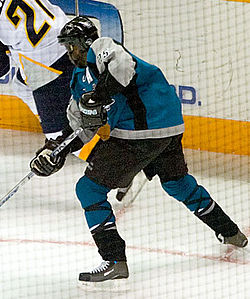
Michael James Grier (born January 5, 1975) is an American former professional ice hockey winger and current general manager of the San Jose Sharks in the National Hockey League (NHL). He played for the Edmonton Oilers, Washington Capitals, Buffalo Sabres, and San Jose Sharks. Primarily a checking forward, he played 1,060 games over 14 seasons. He was the first African-American NHL player to train exclusively in the United States, and the league's first black general manager.[1][2][3]
Key Information


Early years
[edit]Grier's father Bobby was the associate director of Pro Scouting for the Houston Texans of the National Football League (NFL). Prior to that, Bobby Grier was a running backs coach, director of pro scouting, and vice-president of player personnel for the New England Patriots of the NFL. (The elder Grier (born 1942) should not be confused with the Bobby Grier (born 1933) who broke the color barrier in the 1956 Sugar Bowl.) Grier's brother Chris served as the general manager for the Miami Dolphins, a position he held starting in 2016.[1] Another notable athlete in the family is Pro Bowl NFL defensive lineman Roosevelt "Rosey" Grier.[4]
Grier was raised in Holliston, Massachusetts, where he attended and played hockey at St. Sebastian's School. He is of Bajan descent.[5]
Playing career
[edit]Grier was originally drafted by the St. Louis Blues in the ninth round (219th overall) of the 1993 NHL entry draft, and was considered a long-shot[citation needed] to make an NHL team. He spent his early playing days with Saint Sebastian's School and later with Boston University, culminating in his best amateur season in 1994–95, where he was named a first team all-star. During his time at BU, Grier's NHL rights were dealt to the Edmonton Oilers along with star goaltender Curtis Joseph in exchange for a pair of first round picks.
After leaving college, Grier immediately cracked the Oilers lineup as a checking-line right-winger, scoring 32 points and bearing a respectable +7 plus-minus rating. During his time in Edmonton, Grier was best known for provoking Chris Simon of the Washington Capitals in 1997. Grier allegedly made derogatory comments about Simon's Ojibwa heritage, and Simon allegedly responded with a racial slur directed at Grier. Although the spoken words were never confirmed, Simon was suspended for three games as a result of the incident.[6][7] Grier played six seasons with the Oilers organization, including two in which he scored twenty goals.
On October 2, 2002, in order to free up roster space, Grier was traded to the Washington Capitals for a pair of draft choices. Incidentally, this put Grier and Simon on the same team for a short time. Simon was traded to Chicago after playing 10 games in the 2002–03 season. The Capitals attempted to put a Stanley Cup-caliber team together, primarily built around star forward Jaromír Jágr and goaltender Olaf Kölzig. The team disappointed on the ice, although Grier remained a reliable checking player.
This did not last long, as Washington traded Grier on March 4, 2004, to the Buffalo Sabres for Czech prospect Jakub Klepiš. Grier finished the season with Buffalo, scoring nine points, but the Sabres failed to make the playoffs. During the 2005–06 NHL season, Grier set a personal record, scoring four game-winning goals for the Sabres and contributing to their run to the 2006 Eastern Conference Finals. Grier was then signed to a free agent deal by the San Jose Sharks, where he recorded 16 goals, including three shorthanded, in his first season with San Jose. He scored nine and 10 goals in his next two seasons with the Sharks, respectively.
On August 10, 2009, Grier returned to the Buffalo Sabres as a free agent.[citation needed]
Grier's biggest contribution to the Sharks and Sabres was his penalty-killing ability. San Jose ranked 14th, 1st, and 4th in penalty killing in the three years he played there. In the 2009–10 season, Buffalo was second overall in the NHL in penalty killing. He was in the top penalty-killing units of both teams.
Grier played his 1,000th NHL game on November 3, 2010, against the Boston Bruins, becoming the 254th player in NHL history to reach the milestone.[8] After not being re-signed by Buffalo for the 2011–12 season, Grier announced his retirement from the NHL on December 1, 2011.[9]
Post-playing career
[edit]Early roles
[edit]After retiring, Grier served as a scout with the Chicago Blackhawks and an assistant coach with the New Jersey Devils before he was hired by the New York Rangers as hockey operations advisor on May 19, 2021.[10]
Grier also coached at Saint Sebastian's School, where he played his high school hockey. He also coached his son's Boston Jr. Terriers 03 AAA team.
San Jose Sharks general manager (2022–present)
[edit]On July 5, 2022, Grier became the general manager of the San Jose Sharks.[11] This move made him the first black general manager in NHL history.[1]
Awards and honors
[edit]| Medal record | ||
|---|---|---|
Representing  United States United States
| ||
| Ice hockey | ||
| World Championships | ||
 |
2004 Prague | |
| Award | Year |
|---|---|
| All-Hockey East All-Star | 1994–95 |
| AHCA East First-Team All-American | 1994–95 |
Career statistics
[edit]Regular season and playoffs
[edit]| Regular season | Playoffs | |||||||||||||
|---|---|---|---|---|---|---|---|---|---|---|---|---|---|---|
| Season | Team | League | GP | G | A | Pts | PIM | GP | G | A | Pts | PIM | ||
| 1992–93 | St. Sebastian's School | ISL | 22 | 16 | 27 | 43 | 32 | — | — | — | — | — | ||
| 1993–94 | Boston University | HE | 39 | 9 | 9 | 18 | 58 | — | — | — | — | — | ||
| 1994–95 | Boston University | HE | 37 | 19 | 26 | 45 | 85 | — | — | — | — | — | ||
| 1995–96 | Boston University | HE | 38 | 21 | 26 | 47 | 82 | — | — | — | — | — | ||
| 1996–97 | Edmonton Oilers | NHL | 79 | 15 | 17 | 32 | 45 | 12 | 3 | 1 | 4 | 4 | ||
| 1997–98 | Edmonton Oilers | NHL | 66 | 9 | 6 | 15 | 73 | 12 | 2 | 2 | 4 | 13 | ||
| 1998–99 | Edmonton Oilers | NHL | 82 | 20 | 24 | 44 | 54 | 4 | 1 | 1 | 2 | 6 | ||
| 1999–2000 | Edmonton Oilers | NHL | 65 | 9 | 22 | 31 | 68 | — | — | — | — | — | ||
| 2000–01 | Edmonton Oilers | NHL | 74 | 20 | 16 | 36 | 20 | 6 | 0 | 0 | 0 | 8 | ||
| 2001–02 | Edmonton Oilers | NHL | 82 | 8 | 17 | 25 | 32 | — | — | — | — | — | ||
| 2002–03 | Washington Capitals | NHL | 82 | 15 | 17 | 32 | 36 | 6 | 1 | 1 | 2 | 2 | ||
| 2003–04 | Washington Capitals | NHL | 68 | 8 | 12 | 20 | 32 | — | — | — | — | — | ||
| 2003–04 | Buffalo Sabres | NHL | 14 | 1 | 8 | 9 | 4 | — | — | — | — | — | ||
| 2005–06 | Buffalo Sabres | NHL | 81 | 7 | 16 | 23 | 28 | 18 | 3 | 5 | 8 | 2 | ||
| 2006–07 | San Jose Sharks | NHL | 81 | 16 | 17 | 33 | 43 | 11 | 2 | 2 | 4 | 27 | ||
| 2007–08 | San Jose Sharks | NHL | 78 | 9 | 13 | 22 | 24 | 13 | 0 | 1 | 1 | 2 | ||
| 2008–09 | San Jose Sharks | NHL | 62 | 10 | 13 | 23 | 25 | 6 | 0 | 0 | 0 | 6 | ||
| 2009–10 | Buffalo Sabres | NHL | 73 | 10 | 12 | 22 | 14 | 6 | 2 | 0 | 2 | 2 | ||
| 2010–11 | Buffalo Sabres | NHL | 73 | 5 | 11 | 16 | 12 | 7 | 0 | 1 | 1 | 0 | ||
| NHL totals | 1,060 | 162 | 221 | 383 | 510 | 101 | 14 | 14 | 28 | 72 | ||||
International
[edit]| Year | Team | Event | GP | G | A | Pts | PIM | |
|---|---|---|---|---|---|---|---|---|
| 1995 | United States | WJC | 7 | 0 | 2 | 2 | 12 | |
| 2004 | United States | WC | 9 | 1 | 2 | 3 | 8 | |
| Junior totals | 7 | 0 | 2 | 2 | 12 | |||
| Senior totals | 9 | 1 | 2 | 3 | 8 | |||
See also
[edit]References
[edit]- ^ a b c Dubow, Josh. "Sharks make NHL history with Mike Grier becoming 1st Black general manager". CBC Sports. The Associated Press. Retrieved July 6, 2022.
- ^ Allen, Kevin (January 14, 2008). "Willie O'Ree still blazing way in NHL 50 years later". USA Today. Retrieved January 26, 2012.
- ^ The first African American in the NHL, Val James, played two years of junior hockey in Quebec.
- ^ Nowels, Michael; Simon, Alex (July 5, 2022). "5 things to know about new Sharks GM Mike Grier". The Mercury News. Retrieved July 6, 2022.
- ^ "Mike Grier". www.hockeyarchives.info.
- ^ "Simon suspended for hitting player with stick". ESPN. March 10, 2007. Retrieved October 18, 2016.
- ^ "Mike Grier, First American Born Black NHL Player". Regalmag.com. July 2, 2009. Archived from the original on December 12, 2013. Retrieved October 18, 2016.
- ^ "Notebook: Sabres Prep For Boston | Nhl.Com". Sabres.nhl.com. Retrieved October 18, 2016.
- ^ "Mike Grier retires after 14 seasons". ESPN.com. December 1, 2011. Retrieved May 20, 2021.
- ^ "Mike Grier Named Hockey Operations Advisor". NHL.com. May 19, 2021. Retrieved May 20, 2021.
- ^ "Mike Grier Named to become first Black GM of the NHL". sportsnet.com. July 4, 2022. Retrieved July 4, 2022.
External links
[edit]
- Biographical information and career statistics from NHL.com, or Eliteprospects.com, or Hockey-Reference.com, or The Internet Hockey Database
| |
| Franchise | |
| History | |
| Personnel |
|
| Arenas | |
| Rivalries | |
| Affiliates | |
| Media |
|
| Culture/Lore | |

Mike Grier
View on GrokipediaMichael James Grier (born January 5, 1975) is an American ice hockey executive and former professional player, serving as the general manager of the San Jose Sharks of the National Hockey League (NHL) since July 2022, becoming the first Black individual to hold the position in league history.[1][2] Drafted 219th overall in the ninth round of the 1993 NHL Entry Draft by the St. Louis Blues, Grier played 14 seasons as a right winger and checking forward across four teams, logging 1,060 regular-season games with 162 goals and 221 assists for 383 points.[3][4] Prior to his executive role, he contributed to the Sharks as an assistant general manager and in player development, building on a collegiate career at Boston University where he helped secure an NCAA championship in 1995 and earned recognition as a Hobey Baker Award finalist.[5] Grier's tenure as GM has focused on rebuilding the franchise through draft selections and roster management amid competitive challenges.[1]
Early life and education
Family background and influences
Mike Grier was born on January 5, 1975, in Detroit, Michigan, to Bobby Grier, a former college running back at Penn State who transitioned into coaching and NFL front-office roles, including scouting and player personnel positions with the New England Patriots and Houston Texans.[6][7] His family relocated to the Boston area before he turned three, following Bobby's appointment as an assistant football coach at Boston University, where the younger Grier would later play hockey.[6][8] This move immersed Grier in a competitive sports environment in Holliston, Massachusetts, despite his father's primary involvement in football.[9] Bobby Grier's career, marked by a 28-year tenure in NFL operations beginning as an intern and contributing to key decisions like the 2000 draft selection of Tom Brady, emphasized analytical evaluation and resilience in professional sports.[7][10] Grier's younger brother, Chris, pursued a parallel path in football administration, rising to general manager of the Miami Dolphins, reflecting a familial orientation toward executive roles in athletics.[11] Mike diverged toward hockey, beginning play at age four and amassing notable youth achievements, such as 227 goals over two seasons by age nine, which earned him recognition in Sports Illustrated's "Faces in the Crowd" feature.[12] Key influences from his upbringing included his father's modeling of perseverance, integrity, and understated leadership, values articulated in family reflections following Bobby's death on September 22, 2025, at age 82.[13][7] These principles, drawn from Bobby's experiences navigating racial barriers in mid-20th-century college football—including as the first Black starter for Penn State—fostered Grier's disciplined approach to hockey, where he prioritized toughness and character over his family's football legacy.[9][8]Youth development in hockey
Grier began playing organized hockey at age five in Holliston, Massachusetts, following his family's relocation there after his father, Bobby Grier, accepted the head coaching position for Boston University's hockey team in 1982.[14] This early immersion in a hockey-centric environment, influenced by his father's profession, fostered Grier's development amid the competitive youth leagues of the region.[9] In local youth programs, including the Holliston Mites, Grier exhibited prodigious talent, scoring 227 goals across two seasons and gaining early recognition for his offensive prowess and physicality.[15] By age nine, his achievements warranted inclusion in Sports Illustrated's "Faces in the Crowd" feature, highlighting his rapid ascent in Massachusetts minor hockey.[9] These foundational experiences emphasized skill development through structured play, aligning with the era's focus on high-volume games and individual milestones in New England youth hockey circuits. Grier advanced to St. Sebastian's School in Needham, Massachusetts, for high school, where he starred on the varsity team, honing his game in the demanding Independent School League.[14] His performance there, characterized by strong skating, physical checking, and leadership, prepared him for collegiate-level competition, underscoring the pathway from regional youth systems to elite prep programs that propelled many New England talents toward NCAA and professional ranks.[9]Collegiate and amateur career
Boston University tenure
Mike Grier played three seasons for the Boston University Terriers men's ice hockey team from 1993 to 1996, transitioning from a reserve player in his freshman year to a key contributor on a national championship squad.[6] Standing at 6 feet 1 inch and weighing 225 pounds, Grier brought physicality as a right winger, accumulating significant penalty minutes while developing offensively.[14] His freshman season (1993–94) saw modest production with 9 goals and 9 assists in 39 games, reflecting his initial role on the depth chart.[16] Grier broke out in 1994–95, leading the team with 29 goals and 55 points in 37 games, earning first-team All-American (East) honors, All-Hockey East First Team selection, and the Walter Brown Award as the top American-born college player in New England.[14] [5] That year, he was a finalist for the Hobey Baker Award, college hockey's top individual honor.[5] In his junior season (1995–96), Grier maintained strong output with 21 goals and 47 points in 38 games.[16]| Season | GP | G | A | Pts | PIM |
|---|---|---|---|---|---|
| 1993–94 | 39 | 9 | 9 | 18 | 58 |
| 1994–95 | 37 | 29 | 26 | 55 | 85 |
| 1995–96 | 38 | 21 | 26 | 47 | 82 |
| Total | 114 | 59 | 61 | 120 | 225 |
International junior representation
Grier represented the United States at the 1995 IIHF World Under-20 Championship, held from December 26, 1994, to January 5, 1995, in Red Deer, Alberta, Canada.[20] As a forward on the roster captained by Adam Deadmarsh, he contributed to Team USA's efforts in the tournament, which featured top under-20 national teams competing for the gold medal ultimately won by Canada.[21] [1] In seven games played, Grier recorded no goals and two assists for two points, along with 12 penalty minutes.[22] [5] Team USA finished fifth in the standings, advancing from the preliminary round but eliminated in the relegation round.[22] This appearance marked his primary international junior representation, occurring during his sophomore season at Boston University.[23]Professional playing career
Entry into the NHL and early teams
Grier was selected by the St. Louis Blues in the ninth round, 219th overall, of the 1993 NHL Entry Draft, a position that positioned him as a long-shot prospect given the depth of the draft and his status as an undrafted college-bound player. His rights were traded to the Edmonton Oilers on August 31, 1995, in exchange for future considerations, allowing Edmonton to secure him after he completed his collegiate eligibility at Boston University. Following his graduation in 1996, Grier signed a professional contract with the Oilers and made his NHL debut on October 4, 1996, against the Vancouver Canucks, becoming the first African American player born and trained exclusively in the United States to appear in an NHL game.[19][1] In his rookie 1996–97 season with Edmonton, Grier appeared in 79 games, recording 15 goals and 17 assists for 32 points, along with a +7 plus-minus rating and 45 penalty minutes, establishing himself as a physical right winger capable of contributing offensively while providing checking-line energy. The following year, 1997–98, he played 66 games, tallying 9 goals and 6 assists for 15 points amid a -3 plus-minus and increased physicality with 73 penalty minutes, reflecting his adaptation to a more defensive role amid the Oilers' rebuilding phase. Over the next four seasons (1998–2002), Grier solidified his presence in Edmonton's lineup, peaking with 20 goals in 1998–99 and accumulating 143 points in 313 games during that span, often deployed on penalty-killing units and third-line shifts valued for his size (6'1", 220 lbs) and forechecking ability.[3][16] On October 7, 2002, Edmonton traded Grier to the Washington Capitals in exchange for Washington's second- and third-round picks in the 2003 NHL Entry Draft, a move that allowed the Oilers to acquire draft capital amid roster constraints. With Washington, Grier played the 2002–03 and 2003–04 seasons, registering 13 goals and 17 assists in 153 games, including a career-high 88 penalty minutes in 2003–04, where he continued as a reliable penalty killer and bottom-six forward on a Capitals team struggling with injuries and defensive inconsistencies. His tenure in Washington ended on March 9, 2004, when he was traded to the Buffalo Sabres for prospect Jakub Klepis, marking the conclusion of his early NHL teams phase focused on establishing durability and utility in competitive Western and Eastern Conference environments.[24][19]Mid-career with Buffalo and San Jose
On March 9, 2004, Grier was traded from the Washington Capitals to the Buffalo Sabres in exchange for the rights to forward Jakub Klepis.[25] In his partial 2003–04 season with Buffalo, he appeared in 14 games, recording 1 goal and 8 assists for 9 points, along with a +10 plus-minus rating and 4 penalty minutes.[19] Following the 2004–05 NHL lockout, Grier re-signed with Buffalo on August 8, 2005, accepting a one-year qualifying offer worth $1.4 million.[5] During the 2005–06 season, he played all 81 games, tallying 7 goals and 16 assists for 23 points, with a -7 plus-minus and 28 penalty minutes.[19] That year, Grier set a career high with four game-winning goals and served as a key checking forward, contributing to Buffalo's run to the Eastern Conference Finals.[3] As an unrestricted free agent after the 2005–06 season, Grier signed a three-year contract with the San Jose Sharks on July 3, 2006.[5] In his first season with San Jose (2006–07), he skated in 81 games, scoring 16 goals—including three shorthanded—and adding 17 assists for 33 points, with a -5 plus-minus and 43 penalty minutes, while receiving 25th-place votes in Frank J. Selke Trophy balloting for best defensive forward.[19] The following year (2007–08), Grier posted 9 goals and 13 assists for 22 points in 78 games, earning 14th-place Selke votes amid his role as a reliable third- or fourth-line checking winger.[19] Grier's tenure with San Jose emphasized his physical, penalty-killing presence, as he continued logging significant defensive-zone starts and shorthanded time on ice, though his offensive output declined slightly in subsequent seasons.[3] In 2008–09, he recorded 10 goals and 13 assists for 23 points in 62 games before departing the team.[19]Playing style, roles, and retirement
Grier played primarily as a right winger throughout his NHL career, serving in a checking-line role focused on defensive responsibilities and physical forechecking.[19] His style emphasized physicality, leveraging his 6-foot-1, 225-pound frame to deliver hits and disrupt opponents, often as a depth grinder who prioritized team defense over offensive production.[15] Described as a hard-working, high-character player, he contributed through penalty killing and faceoff duties, though critics noted occasional limitations in puck-handling finesse, such as fumbled opportunities on breakaways.[26] Over 14 seasons, he accumulated 383 points (162 goals, 221 assists) in 1,060 games, reflecting consistent but not star-level output suited to bottom-six minutes.[19][4] In various team contexts, Grier adapted to roles as a veteran leader and enforcer-type forward, including stints on the penalty kill for teams like the Edmonton Oilers and Buffalo Sabres.[27] His physical presence made him valuable in playoff matchups, where he logged shifts against top lines, though he never exceeded 20 goals in a season.[16] Grier's approach aligned with a gritty, blue-collar archetype, earning praise for work ethic but underscoring his niche as a complementary piece rather than a primary scorer.[26] Grier retired from the NHL on December 1, 2011, at age 36, after the Buffalo Sabres declined to re-sign him following the 2010-11 season.[27] His departure capped a career spanning four franchises—Edmonton, Washington, Buffalo (twice), and San Jose—without a Stanley Cup but with over 1,000 games played, a milestone reached in 2010 with the Sabres.[19][28] Post-retirement, he transitioned directly into scouting and development roles, forgoing minor league play entirely after debuting in the NHL in 1996.[3]Executive career
Scouting and development positions
Following his retirement from professional play in 2011, Grier transitioned into scouting with the Chicago Blackhawks, serving as a professional scout from 2014 to 2018.[29] In this capacity, he evaluated professional players for potential acquisitions and contributed to the team's personnel decisions during a period that included their 2015 Stanley Cup victory, for which he received a championship ring.[30] His scouting work focused on pro-level talent assessment, aiding the Blackhawks' front office in roster management and trade evaluations.[11] After departing Chicago, Grier took on a role as hockey operations advisor with the New York Rangers starting May 19, 2021.[31] This position encompassed scouting responsibilities for amateur and professional players, including oversight of the Rangers' prospects at NHL and international levels, as well as contributions to off-ice player and prospect development strategies.[32] He collaborated with general manager Chris Drury on hockey operations decisions, emphasizing development pathways for young talent within the organization.[1] Grier's advisory work provided him with executive-level exposure to talent evaluation and organizational planning ahead of his appointment with the San Jose Sharks.[2]Appointment as San Jose Sharks GM
The San Jose Sharks named Mike Grier as their general manager on July 5, 2022, succeeding Doug Wilson who had resigned on April 26, 2022, after 19 seasons in the role.[1] The appointment followed a three-month search process to identify Wilson's replacement, during which the Sharks evaluated candidates with executive experience in player development and scouting.[33] Grier, who had served as director of pro player development for the New York Rangers since 2018, was selected for his familiarity with the organization, having played as a right winger for the Sharks from 2006 to 2009, accumulating 221 NHL games and 31 points.[1][2] Grier's hiring marked a milestone as the first Black general manager in NHL history, a league established in 1917 with no prior African-American executives at that level despite increasing diversity efforts in recent decades.[29][2] Sharks owner Hasso Plattner and team president Jonathan Becher emphasized Grier's proven track record in talent evaluation and player relations over diversity quotas, citing his prior roles including assistant director of scouting for the Rangers and scouting positions with the Toronto Maple Leafs.[33] Grier was introduced at SAP Center in San Jose on the same day, expressing commitment to rebuilding the franchise amid recent playoff absences.[1] The decision drew praise from NHL figures for Grier's hockey acumen rather than symbolic value, with former players and executives noting his analytical approach honed through 15 years in scouting and development.[29] Grier signed a multi-year contract, though specific terms were not publicly disclosed, positioning him to oversee draft, trades, and free agency starting with the 2022 offseason.[2]Rebuilding strategy and draft decisions
Upon assuming the role of general manager on July 5, 2022, Mike Grier initially assessed that the San Jose Sharks did not necessitate a full-scale teardown, prioritizing incremental improvements amid ongoing roster evaluation.[34] However, persistent poor performance, including a league-worst 19-54-9 record in the 2023-24 season, prompted a pivot toward a deliberate rebuild focused on draft capital accumulation, prospect development, and cap flexibility through veteran departures.[35] This strategy emphasized trading aging assets for picks and prospects while fostering internal culture and defensive depth, as articulated by Grier's pre-trade deadline comments in March 2023.[35] Sharks owner Hasso Plattner later endorsed this systematic approach in October 2025, contrasting it favorably with prior regimes' draft shortcomings.[36] Central to the rebuild is a best-player-available draft philosophy, prioritizing elite talent, size, and skill over immediate positional needs, with openness to trades for optimal value.[37][38] Grier has leveraged high lottery positions—secured via tanking-like results—to select franchise cornerstones, amassing a prospect pool rich in centers and defensemen for long-term balance.[39] This has included nine first-round selections across four drafts, yielding high-upside forwards and blueliners projected to anchor future rosters.| Year | Round 1 Picks | Positions and Notes |
|---|---|---|
| 2022 | Filip Bystedt (#27 overall, C) | Traded down from #11 to acquire additional mid-round assets (#34, #45); focused on value maximization in inaugural draft.[40][41] |
| 2023 | Will Smith (#4 overall, F); Quentin Musty (#26 overall, LW) | Emphasized offensive skill; Smith, a U.S. NTDP standout, emerged as a top-line prospect.[42] |
| 2024 | Macklin Celebrini (#1 overall, C); Sam Dickinson (#11 overall, D) | Celebrini, a Hobey Baker winner, selected as generational talent; Dickinson added size to defensive pipeline.[43] |
| 2025 | Michael Misa (#2 overall, C) | BPA selection despite trade discussions; prioritized scoring prowess over need.[44][37] |
Key transactions and roster management
Upon assuming the role of general manager on July 5, 2022, Mike Grier initiated a roster teardown to accumulate draft capital and prospects, trading high-salary veterans while retaining portions of their contracts to facilitate deals. A pivotal move was the February 26, 2023, trade of forward Timo Meier to the New Jersey Devils, in which the Sharks received forwards Fabian Zetterlund and Andreas Johnsson, defenseman Santeri Hatakka, prospect Ethan Cardwell, a 2023 first-round pick (used to select Ty Nelson), a conditional 2024 first-round pick, and a 2024 seventh-round pick, while retaining 50% of Meier's salary.[46] [47] This transaction netted the Sharks multiple assets contributing to their prospect pool, though initial fan and media reactions questioned the return's immediate value.[48] Grier continued shedding cap commitments with the August 6, 2023, three-team trade sending defenseman Erik Karlsson and a 2024 third-round pick to the Pittsburgh Penguins; in return, the Sharks acquired forward Mikael Granlund from Pittsburgh and a conditional 2025 third-round pick, while Pittsburgh sent prospect Jeff Marcoux's rights to the Montreal Canadiens (who received a 2025 fourth-round pick from Pittsburgh).[49] [50] The deal retained 25% of Karlsson's salary for San Jose, freeing approximately $11.25 million in cap space annually and accelerating the rebuild by prioritizing future assets over contention.[51] Other notable 2023-2024 trades included moving forward Tomas Hertl to the Vegas Golden Knights on March 8, 2024, for prospects and picks that later facilitated acquiring goaltender Yaroslav Askarov, enhancing long-term goaltending depth.[52] By the 2024-2025 season, with a young core including draft picks like Macklin Celebrini emerging, Grier shifted toward bolstering depth via trades and free agency, acquiring veteran forward Ryan Reaves from the Minnesota Wild on July 10, 2025, to add physicality and leadership.[53] Free-agent signings emphasized short- to medium-term contracts for skill and experience, such as winger Jeff Skinner (multi-year deal), defenseman Dmitry Orlov (adding backend stability), and forwards Philipp Kurashev, Adam Gaudette, and others for forward depth.[54] [55] [56] At the 2025 trade deadline, Grier moved forward Fabian Zetterlund to the Ottawa Senators, prioritizing draft capital accumulation amid another non-playoff season.[57] Roster management under Grier has emphasized cap flexibility, with 70% of contracts carrying AAVs under $2 million and a focus on entry-level deals for prospects, enabling aggressive asset acquisition without long-term overcommitment.[58] This approach, supported by owner Hasso Plattner, transitioned the Sharks from a veteran-heavy payroll post-contention era to a prospect-driven rebuild, adding eight veterans in the 2025 offseason to mentor youth while preserving cap space for contention.[54]Performance evaluations and criticisms
Under Grier's leadership since July 5, 2022, the San Jose Sharks have compiled league-worst or near-worst records, finishing the 2022–23 season at 22–44–16 (82 points), the 2023–24 season at 19–54–9 (47 points), and the 2024–25 season at 20–50–12 (52 points), failing to qualify for the playoffs in each campaign.[59][60] These outcomes reflect an intentional rebuild strategy emphasizing asset accumulation over short-term competitiveness, as Grier inherited a cap-strapped roster with limited prospects and declining performance from prior management.[61] Positive evaluations highlight Grier's trade decisions, which prioritized future returns over retaining aging core players. The February 2023 trade of Timo Meier to New Jersey yielded forward Fabian Zetterlund—who posted 24 goals and 38 points in 2023–24, emerging as a top-line contributor—and prospect Quentin Musty, who recorded 102 points in 53 OHL games during 2023–24.[61] Similarly, the August 2023 deal sending Erik Karlsson to Pittsburgh netted Mikael Granlund (48 assists in 2023–24 before being traded), Mike Hoffman, Jan Rutta, and a 2024 first-round pick used to select defenseman Sam Dickinson (ranked highly for size and skating).[61] Other moves, like trading Brent Burns to Carolina for Steven Lorentz (10 goals and strong physical play in 82 games) and Tomas Hertl to Vegas for prospect David Edstrom and a 2025 first-rounder, have been credited with shedding burdensome contracts while stocking the pipeline.[61] Analysts from outlets like Pro Hockey Rumors praise Grier's drafting as a cornerstone of long-term success, citing the 2024 lottery win for Macklin Celebrini (No. 1 overall, projected franchise center) and 2023's Will Smith (No. 4 overall, elite scorer at Boston College).[39] Criticisms center on the absence of tangible on-ice progress despite asset gains, with the Sharks allowing the most goals in the NHL across Grier's first three seasons and ranking last in key metrics like goals against per game.[59] Grier fired head coach David Quinn in May 2024 after back-to-back bottom finishes, signaling internal accountability but also exposing potential misalignments in roster construction or development systems.[62] Some evaluators question the overemphasis on high-volume drafting without aggressive free-agent additions to stabilize the bottom six or goaltending, leading to prolonged tanking that risks fan disengagement and prospect burnout.[63] Grier has countered pessimism by asserting the team has "played a little better than our record" in 2024–25, emphasizing process over results in a youth-driven rebuild.[64] While early returns from trades and drafts show promise, skeptics argue that Grier's tenure will be judged by whether these pieces coalesce into contention within 3–5 years, given the NHL's parity demands rapid translation of prospects to wins.[61]Personal life
Family and sports legacy
Mike Grier was born on January 5, 1975, in Detroit, Michigan, to Bobby Grier, a longtime National Football League executive who held roles including director of player personnel for the New England Patriots from 1993 to 2000, associate director of pro scouting for the Houston Texans, and various scouting and advisory positions across multiple teams.[1][65] Bobby Grier, who passed away on September 22, 2025, instilled values of perseverance, integrity, and quiet leadership in his sons, drawing from his own career trajectory that spanned playing, coaching, scouting, and front-office work in professional football.[13] Grier's older brother, Chris Grier, serves as the general manager of the NFL's Miami Dolphins, a position he has held since 2016, making the siblings prominent figures in sports management across major North American leagues.[11] The Grier family's athletic involvement reflects a multigenerational commitment to professional sports, with Mike and Chris crediting their father's guidance for shaping their approaches to personnel evaluation and team-building.[11] Grier is married and has children, including son Jayden Grier, who plays forward for the Colby College men's hockey team, extending the family's hockey lineage into the collegiate level as of 2024.[66] The Griers represent a rare instance of a Black family producing lead executives in both the NHL and NFL, with Mike's 2022 appointment as San Jose Sharks general manager marking him as the first Black GM in league history and the third family member to achieve such a front-office pinnacle.[1][11] This legacy underscores a pattern of advancement through scouting, development, and executive roles, grounded in direct observation of professional operations from youth.[65]Challenges faced, including racism and recent tragedies
Throughout his youth hockey career, Grier faced racial slurs and derogatory comments from parents and opposing players, experiences that his mother, Wendy, helped him navigate by emphasizing resilience and focus on the game.[6] These incidents were part of broader racial barriers in a predominantly white sport, where Black players like Grier, one of the few in the NHL during his era, encountered implicit and explicit discrimination that tested their perseverance.[6] Despite such obstacles, Grier advanced to become a professional enforcer and later the NHL's first Black general manager in July 2022, a milestone delayed by the league's historical issues with racism and limited diversity in executive roles.[67] As San Jose Sharks GM, Grier has acknowledged the heightened scrutiny and representational burden of his position, noting the weight of advancing opportunities for Black individuals in hockey amid ongoing diversity challenges in the NHL.[68] In September 2025, Grier and his family endured a profound personal loss with the death of his father, Bobby Grier, at age 82; Bobby was a trailblazing NFL executive who served as vice president of player personnel for the New England Patriots and contributed to scouting Tom Brady in 2000.[69] The announcement came on September 22, 2025, affecting Mike and his brother Chris Grier, the Miami Dolphins' GM, during a period of professional demands for both.[70] This tragedy compounded the familial pressures in a lineage marked by breaking barriers in professional sports, where Bobby himself overcame racial hurdles as one of the first Black pro scouts and executives.[69]Awards, honors, and legacy
Individual accolades
Grier earned recognition for his performance during his collegiate tenure at Boston University. In the 1994–95 season, he was selected to the NCAA East First All-American Team after recording 27 goals and 57 points in 42 games.[5] He also received First Team All-Star honors in Hockey East, contributing to the conference championship.[5] That year, Grier won the Walter Brown Award, awarded annually to the top American-born player in New England Division I college hockey.[71] Additionally, his standout play made him a finalist for the Hobey Baker Memorial Award, presented to the most outstanding player in NCAA men's ice hockey.[72] On the international stage, Grier represented the United States at the 2004 IIHF Men's World Championship in Austria, where the team secured a bronze medal after defeating Slovakia 3–1 in the third-place game; Grier contributed two assists in seven games.[5] In May 2025, Grier was inducted into the Massachusetts Hockey Hall of Fame as part of the class recognizing outstanding contributions to the sport in the state.[73]Historical significance and debates on merit
Mike Grier's appointment as general manager of the San Jose Sharks on July 5, 2022, marked him as the first Black executive to hold the position in the NHL's 105-year history, a milestone reflecting the league's historically low representation of minorities in front-office roles.[29][2] This breakthrough occurred amid broader NHL efforts to enhance diversity following racial justice initiatives in 2020, though Grier's prior path as a player—debuting in 1996 as the first U.S.-trained Black NHLer to play exclusively in American youth systems—and subsequent roles in scouting and development underscored his internal ascent rather than external mandates.[14][74] Grier's significance extends to exemplifying persistence in a sport where Black players have comprised less than 1% of rosters historically; he logged 1,060 regular-season games across 14 seasons before transitioning to executive positions with the New York Rangers (assistant director of player development, 2014–2018) and New Jersey Devils (assistant GM, 2018–2022).[75][1] Sharks owner Hasso Plattner emphasized Grier's "breadth of experience" in the hire, including his collaborative style and listening skills, as affirmed by peers like Devils GM Tom Fitzgerald.[30][74] Debates on Grier's merit have centered less on overt challenges to his qualifications and more on whether his historic role amplifies symbolic progress over substantive evaluation of rebuilding outcomes in a cap-constrained franchise inheriting poor contracts.[1] Critics within hockey analytics circles have questioned early draft choices and asset management amid the Sharks' deliberate tanking strategy—yielding high picks like third overall in 2023 (Will Smith) and fourth in 2024 (Macklin Celebrini)—but these reflect intentional youth infusion rather than incompetence, with no peer-reviewed or league-wide consensus deeming the hire tokenistic.[6] Grier's pre-GM tenure in player evaluation roles provided empirical grounding, though long-term success metrics, such as prospect development yields, remain pending as of 2025, prioritizing causal links between decisions and on-ice results over representational optics.[30]Career statistics
NHL regular season and playoffs
Grier appeared in 1,060 NHL regular season games over 14 seasons from 1996–97 to 2010–11, scoring 162 goals and 221 assists for 383 points, along with 510 penalty minutes and a career plus-minus of -9.[19] He primarily played as a checking right winger for the Edmonton Oilers, Washington Capitals, Buffalo Sabres, and San Jose Sharks.[19]| Season | Team | GP | G | A | Pts | PIM | +/- |
|---|---|---|---|---|---|---|---|
| 1996–97 | Edmonton Oilers | 79 | 15 | 17 | 32 | 45 | +7 |
| 1997–98 | Edmonton Oilers | 66 | 9 | 6 | 15 | 73 | -3 |
| 1998–99 | Edmonton Oilers | 82 | 20 | 24 | 44 | 54 | +5 |
| 1999–00 | Edmonton Oilers | 65 | 9 | 22 | 31 | 68 | +9 |
| 2000–01 | Edmonton Oilers | 74 | 20 | 16 | 36 | 20 | +11 |
| 2001–02 | Edmonton Oilers | 82 | 8 | 17 | 25 | 32 | +1 |
| 2002–03 | Washington Capitals | 82 | 15 | 17 | 32 | 36 | -14 |
| 2003–04 | 2TM* | 82 | 9 | 20 | 29 | 36 | -9 |
| 2005–06 | Buffalo Sabres | 81 | 7 | 16 | 23 | 28 | -7 |
| 2006–07 | San Jose Sharks | 81 | 16 | 17 | 33 | 43 | -5 |
| 2007–08 | San Jose Sharks | 78 | 9 | 13 | 22 | 24 | -8 |
| 2008–09 | San Jose Sharks | 62 | 10 | 13 | 23 | 25 | +8 |
| 2009–10 | Buffalo Sabres | 73 | 10 | 12 | 22 | 14 | -4 |
| 2010–11 | Buffalo Sabres | 73 | 5 | 11 | 16 | 12 | 0 |
| Career | 1,060 | 162 | 221 | 383 | 510 | -9 |
| Postseason | Team | GP | G | A | Pts | PIM | +/- |
|---|---|---|---|---|---|---|---|
| 1997 | Edmonton Oilers | 12 | 3 | 1 | 4 | 4 | -2 |
| 1998 | Edmonton Oilers | 12 | 2 | 2 | 4 | 13 | +4 |
| 1999 | Edmonton Oilers | 4 | 1 | 1 | 2 | 6 | +3 |
| 2001 | Edmonton Oilers | 6 | 0 | 0 | 0 | 8 | -2 |
| 2003 | Washington Capitals | 6 | 1 | 1 | 2 | 2 | 0 |
| 2006 | Buffalo Sabres | 18 | 3 | 5 | 8 | 2 | +3 |
| 2007 | San Jose Sharks | 11 | 2 | 2 | 4 | 27 | +1 |
| 2008 | San Jose Sharks | 13 | 0 | 1 | 1 | 2 | -2 |
| 2009 | San Jose Sharks | 6 | 0 | 0 | 0 | 6 | -2 |
| 2010 | Buffalo Sabres | 6 | 2 | 0 | 2 | 2 | 0 |
| 2011 | Buffalo Sabres | 7 | 0 | 1 | 1 | 0 | -3 |
| Career | 101 | 14 | 14 | 28 | 72 | 0 |