Hubbry Logo
Hasso PlattnerHasso PlattnerMain
Open search
Hasso Plattner
Community hub
Hasso Plattner
logo
8 pages, 0 posts
0 subscribers
Be the first to start a discussion here.
Hasso Plattner
Hasso Plattner
from Wikipedia

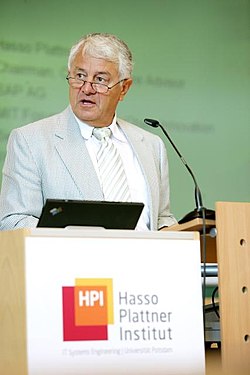
Hasso Plattner (born 21 January 1944)[1] is a German businessman who is the co-founder of SAP SE software company. From 2003 to 2024, he served as the chairman of the company's supervisory board.[2] As of August 2020, Forbes reported that he possessed a net worth of US$17.9 billion.[3]

Key Information

Early life

[edit]

Plattner was born to German ophthalmologist Horst Plattner (1918–2001) and his wife shortly before the end of the Second World War, in Berlin.[citation needed] He grew up in Bavaria and completed his masters degree in communications engineering from the University of Karlsruhe in 1968.[1]

Career

[edit]

In 1972, Plattner and four colleagues left IBM to launch SAP,[1][3] where he eventually served as co-chief executive (together with Henning Kagermann) from 1998.[4] He stepped down in 2003 at age 60.[5]

From 2003 to 2024, Plattner chaired the company's supervisory board[6] and played an influential role in the company's governance, orchestrating the hiring of co-CEOs Jennifer Morgan and Christian Klein in 2019.[7] He has reduced his stake in SAP several times;[8] as of 2020, he owned a 5.89% stake, making him the company's largest individual shareholder.[9]

In 1998, Plattner founded the non-profit Hasso Plattner Institute (HPI). He is Chair of Enterprise Platform and Integration Concepts and Professor of Enterprise Systems at HPI.

In 2005, Plattner set up his own venture capital fund, Hasso Plattner Ventures, with more than 25 million euros. By December 2009, HPV managed €150 million and had 17 companies in its portfolio, including online cruise portals Dreamlines.[10] An affiliate fund, HPV Africa in Cape Town, was founded in 2008, with €29 million, and soon invested in five companies.[11] Plattner provides the lion's share of this investment capital.[12] In September 2010, HPV invested $6 million in Israeli software company Panaya in exchange for the company's stakes.

Sporting interests

[edit]

In 2005, Plattner's maxZ86 maxi yacht set a record at the Transpacific Yacht Race and was the scratch boat when it led a five-boat assault on the record for monohulls. She finished the race in 6 days, 16 hours, 4 minutes, and 11 seconds to win "the Barn Door" trophy, a slab of carved koa wood traditionally awarded to the monohull with the fastest elapsed time. In 2013, he won the German Dragon Championship as part of a three-man crew that included Hamish Pepper.[13]

Plattner is a keen golfer. In 1994, he acquired the Fancourt Hotel and Country Club, which has three Gary Player-designed championship courses, in addition to the CordeValle Golf Club in San Martin, California.[14] The Links of Fancourt staged the 2003 Presidents Cup matches between the US and an international team, captained by Gary Player.

Plattner is also an investor in San Jose Sports & Entertainment Enterprises, which owns the San Jose Sharks, and other related properties as well as managing the city owned SAP Center at San Jose. In 2013, he bought out two of the partners in SJS&E, and began serving as the Sharks' representative on the National Hockey League's board of governors.[15][16] However, general manager Mike Grier and his staff run the hockey operations.[17]

Philanthropy

[edit]

Plattner signed The Giving Pledge in February 2013.[18][19] In 2015, he set up the Hasso Plattner Foundation and the charity's activities span education, art and culture, and conservation.[20] Since 2017, the foundation has been headquartered at Villa Wunderkind in Potsdam, the former home of German fashion designer Wolfgang Joop.[21]

HIV/AIDS

[edit]

Plattner has had strong connections with South Africa over the years and spends some of his time living there, while participating in charitable work. In the fight against AIDS, he supports the universities of KwaZulu Natal and Cape Town.

Plattner's donation of €6 million for the Isombululo programme for the prevention and treatment of HIV/AIDS was announced at the Presidents Cup, one of the world's leading international golf tournaments in 2003 and it is suggested that this amount will have helped 360,000 people. In the spring of 2005, Plattner personally covered the costs of the 46664 benefit concert, which took place at his Gary Player-designed golf course, The Links of Fancourt in George which is near Cape Town and which was broadcast globally on television. Proceeds went towards the Global Fund to Fight AIDS, Tuberculosis and Malaria, an organisation co-founded by former South African president Nelson Mandela.[22][23]

Architecture and visual arts

[edit]

Plattner contributed more than €20 million which enabled reconstruction of the historic exterior of the Stadtschloss in Potsdam, which had damaged during World War II and demolished in 1959. At the time, it was the largest donation ever gifted in Germany by a single individual.[24]

In 2016, Plattner joined forces with art dealer Guy Wildenstein to form the Wildenstein Plattner Institute, a foundation dedicated to advancing art historical scholarship by fostering the accessibility, cataloguing, and digitisation of primary sources.[25]

Plattner also helped in the establishment of the Museum Barberini, devoted to his holdings of modern and Impressionist art, as well as artists active in the former German Democratic Republic (GDR).[26] For the museum, he purchased one of Monet’s 1890 Meules paintings for $110.7 million at a 2019 Sotheby's auction, making it the most high-priced Impressionist work ever sold at auction.[27][28] In 2022, he opened Das Minsk [de], another private museum in Potsdam, which focuses on East German artists who were active after the fall of the Berlin wall.[29]

Research

[edit]

Since his retirement from SAP, Plattner has been particularly active as a benefactor in the field of technological research. Media reports have named him one of Germany's most important private sponsors of scientific research. In 1998, Plattner founded the Hasso Plattner Institute for software systems engineering based at the University of Potsdam, and in Palo Alto, California, its sole source of funding being the non-profit Hasso Plattner Foundation for Software Systems Engineering. Plattner has pledged €50 million of his personal fortune over a period of 20 years. Since its foundation, Plattner's commitment to the HPI has quadrupled to over €200 million. He not only fully finances the HPI, but is also actively involved as a director and lecturer in Enterprise Platforms and Integration Concepts.[30]

In October 2005, with a donation of US$35 million, Plattner founded the Hasso Plattner Institute of Design at Stanford University.[31] Students of varying disciplines have been charged with the development of user-friendly innovations. Another of Plattner's pledges to promote science was of €10 million to redevelop the library at the University of Mannheim, Germany, given in 2003.

Recognition

[edit]

On 21 January 2004, at a ceremony at the Hasso Plattner Institute celebrating the 60th birthday of its founder, German Chancellor Gerhard Schröder made the following comments on Plattner's achievements: "We need more Hasso Plattners and more SAPs in order to get Germany moving again economically."[32] According to the Chancellor, Plattner created an international corporation proving "that German companies can be at the top of the technological hierarchy worldwide". In an interview in August 2004, management consultant Roland Berger named Hasso Plattner as one of the five Germans who have made the greatest impression on him. In the Welt am Sonntag article Berger pointed out how Plattner founded, built up and adapted SAP to a changing market was a "master achievement".

Honorary degrees

[edit]

Plattner received his honorary doctorate in 2002, and his honorary professorship in 2004 from the University of Potsdam. He had also received an honorary doctorate (1990) and an honorary professorship in Information Systems (1994) from the Saarland University, Saarbrücken. The same university named him an honorary senator in 1998.[33]

Awards

[edit]

Personal life

[edit]

Plattner is married to Sabine Plattner, a former teacher.[37] The couple has two daughters,[38][39] who grew up in Heidelberg, Germany.[23]

Plattner lives in San Jose, California, which he considers his 'adopted home'. Since his retirement from SAP he hasn't visited Germany.[40] The family also maintains residences in Potsdam's Babelsberg district,[41] Sylt and Yzerfontein.[42]

See also

[edit]

References

[edit]
[edit]
Revisions and contributorsEdit on WikipediaRead on Wikipedia
from Grokipedia
Hasso Plattner (born January 21, 1944) is a German software engineer, entrepreneur, and philanthropist renowned as the co-founder of SE, the world's leading provider of enterprise application software, which he helped transform into a global powerhouse with over €34 billion in annual revenue as of 2024. Born in during , Plattner earned a in communications engineering from the University of in 1968, after which he began his career as a systems engineer at , where he worked until 1972. In that year, he co-founded alongside four former colleagues—, , , and Hans-Werner Hector—initially as a consultancy focused on standardizing for businesses. Under Plattner's leadership as co-CEO from 1997 to 2003, SAP pioneered real-time business software with products like R/1 (1973) and R/3 (1992), which globalized the company's reach and established it as the market leader in enterprise resource planning (ERP) systems. He continued influencing SAP's direction as chairman of the supervisory board from 2003 until his retirement in May 2024, notably driving the development of the in-memory computing platform SAP HANA in 2006, which revolutionized data processing and generated €1.2 billion in revenue by 2013. As of 2025, Plattner's stake in SAP contributes to his estimated net worth of approximately $28 billion (per Bloomberg) to $15 billion (per Forbes), making him one of Germany's wealthiest individuals. Beyond business, Plattner has committed to education and innovation through philanthropy, founding the Hasso Plattner Institute (HPI) in , , in 1998 with a pledge exceeding €200 million to train IT systems engineers, where he holds a chair in Enterprise Platform and Integration Concepts and has co-authored over 50 publications on in-memory data management. He established the Hasso Plattner Foundation in 2015 to support , science, and culture, and in 2005 donated $35 million to create the at , emphasizing in engineering. Plattner, who is divorced with two children and resides in , also owns the NHL's hockey team.

Early Life and Education

Birth and Family Background

Hasso Plattner was born on January 21, 1944, in , , during . He was the son of Horst Plattner, a German ophthalmologist (1918–2001), and his wife Inge, growing up in a family facing the economic hardships of post-war recovery in a divided city. Plattner's early childhood in war-torn was marked by scarcity, including limited resources for activities like sports, as his family could not afford proper equipment such as skates for hockey. His parents introduced him to sailing on small boats on lakes near the city, fostering an early connection to the outdoors amid the rebuilding efforts of 1950s . At age 15, following his parents' divorce, Plattner was sent to a strict, military-style in , an experience that demanded physical toughness and built his resilience in the face of adversity. After the boarding school, the family moved to , where Plattner completed his in 1963 at the Humboldt-Gymnasium. These formative years in post-war , characterized by displacement and economic challenges, shaped his determination and sparked an early interest in science and as avenues for progress and escape from hardship. This background influenced his later pursuit of higher education in communications engineering.

Academic Training

Hasso Plattner pursued his higher education in communications engineering at the Technical University of Karlsruhe (now ), commencing his studies shortly after completing his in 1963. His program focused on the principles of and , reflecting the era's growing interest in automated data handling and early computing systems. This technical curriculum equipped him with foundational knowledge in system design and information processing, areas that would later prove instrumental in his professional pursuits. In 1968, Plattner completed his studies, earning a Diplom-Ingenieur degree, the standard German qualification equivalent to a master's in at the time. The rigorous five-year program integrated theoretical coursework with practical applications in communications technologies, fostering his analytical approach to complex technical problems. Plattner's academic experience at highlighted his discipline in mastering , bridging theoretical concepts with real-world challenges.

Business Career

Early Employment at IBM

Hasso Plattner joined Germany in 1968 as a and systems based in . From 1968 to 1972, Plattner worked on computers, focusing on development. His contributions included key projects in early database management and real-time processing, such as developing a real-time online for the multinational chemical company ICI, which he built in nine months alongside colleague . This work shifted operations from to instant data access, honing Plattner's expertise in business applications for large-scale enterprises. During his tenure, Plattner advanced to junior management roles, including a promotion that positioned him as a prospective sales executive for major clients like . He collaborated closely with future SAP co-founders, including , on these integrated system initiatives, building foundational skills in and customer-driven development. Plattner's experiences at , though formative, also revealed frustrations with the company's rigid structure and field-only policies, which limited internal product innovation and ultimately influenced his decision to leave in 1972.

Founding and Expansion of SAP

In 1972, Hasso Plattner co-founded —originally named Systemanalyse und Programmentwicklung—with four former colleagues: , , , and Hans-Werner Hector. The company was established on April 1 in , , initially operating from nearby and , with the goal of developing standardized to enable real-time data processing for business operations. This vision stemmed from their experiences at , where they had worked on customized software solutions, and aimed to create modular, integrated systems that could replace fragmented, client-specific applications. By the end of its first year, had completed its initial project, the MIAS system for the German subsidiary of , marking an early success in standard . SAP's early development centered on real-time processing capabilities, launching its first commercial product, the RF financial accounting system (part of SAP R/1), in 1973. The "R" in R/1 stood for "real-time," emphasizing the system's ability to handle ongoing business transactions without batch processing delays, a innovation that addressed inefficiencies in traditional accounting software. This modular approach allowed for integration with other functions, such as the materials management system (RM) introduced in 1975, and quickly gained traction in Germany, securing 40 reference customers by 1974. Revenue grew steadily, reaching DM 3.81 million by 1976 with a workforce of 25 employees, reflecting the demand for standardized solutions in industries like chemicals and manufacturing. By 1979, SAP shifted focus to mainframe systems, developing R/2 to expand beyond R/1's limitations and target broader international markets. R/2 introduced enhanced modules for , , and , running on mainframes and supporting multi-language capabilities, which facilitated early exports—such as installations in in 1975 and in 1977. The company's international push accelerated in the , with its first U.S. subsidiary established in 1988, alongside entries into , , , and other regions. That same year, SAP went public on the and stock exchanges, raising its capital from DM 5 million to DM 60 million and enabling further growth; revenues surpassed DM 500 million by 1990 and reached DM 6.02 billion by 1999, with over 80% generated outside , underscoring the global scale achieved during this foundational period.

Executive Leadership and Innovations at SAP

Hasso Plattner co-founded SAP in 1972 and served on its Executive Board from inception, with Dietmar Hopp as CEO until 1998, after which Plattner served as co-CEO with Henning Kagermann until stepping down in 2003 to chair the Supervisory Board. During his executive tenure, Plattner played a pivotal role in steering SAP toward innovative architectural shifts, notably overseeing the development and 1992 launch of SAP R/3, which introduced a client-server model for real-time enterprise resource planning (ERP) and revolutionized business software by enabling integrated, scalable operations across global organizations. This product propelled SAP to ERP market leadership, with revenues surpassing DM 1.8 billion (approximately €920 million) by 1996 and reaching €4.3 billion by 2000, reflecting explosive growth driven by R/3's adoption in over 10,000 installations worldwide. Under Plattner's leadership, SAP expanded aggressively into international markets, establishing subsidiaries in , , and beyond during the , which accounted for over 60% of revenues by the early and solidified its position as the world's largest provider. He championed forward-thinking technologies, particularly advocating for in-memory to address limitations in traditional databases; this vision led to the initiation of SAP HANA's development at the end of 2006 at the Hasso Plattner Institute, culminating in its 2010 commercial release as an in-memory, column-oriented database that accelerated by orders of magnitude for real-time analytics and transactions. HANA's integration into SAP's portfolio marked a strategic pivot toward , enabling innovations like and within ERP systems. Even after transitioning to the Supervisory Board chairmanship in 2003, Plattner's influence shaped SAP's adaptation to emerging paradigms, including key acquisitions such as SuccessFactors in 2012 for $3.4 billion, which bolstered cloud-based human capital management capabilities and accelerated SAP's shift to software-as-a-service (SaaS) models. This move, along with subsequent cloud investments, helped SAP achieve over €1 billion in cloud revenue by 2015 and positioned the company to capture the growing demand for hybrid cloud-ERP solutions amid digital transformation trends. Plattner's emphasis on innovation ensured SAP's evolution from on-premise dominance to a cloud-centric leader, with HANA serving as the foundational technology for these advancements.

Post-Retirement Involvement with SAP

After stepping down as co-CEO of in 2003, Hasso Plattner assumed the role of Chairman of the , a position he held until May 2024, during which he provided strategic oversight that propelled the company's evolution in a rapidly changing technology landscape. Under his leadership, navigated key transitions, including the shift from on-premise systems to cloud-based solutions through initiatives like the development of S/4HANA and acquisitions such as SuccessFactors and Concur, enabling greater scalability and real-time data processing for enterprise customers. Plattner played a pivotal role in integrating artificial intelligence into SAP's offerings, overseeing the rollout of AI capabilities such as the Joule AI copilot in 2023, which embeds generative AI directly into business processes to enhance and . He also championed efforts ahead of industry peers, advocating for SAP's focus on environmental responsibility through software solutions that support and models, aligning with broader goals. As Chairman, Plattner endorsed SAP's strategic growth initiatives, including the expansion of and AI-driven innovations targeted for 2023-2025, which aimed to double the company's cloud backlog and position it as a leader in intelligent enterprises. On May 15, 2024, Plattner stepped down from the after 52 years of involvement with since its founding in 1972, marking the end of the company's founding era but affirming his ongoing commitment as a major shareholder holding approximately 6.2% of the company's shares (personal and via foundation) as of 2023, with no significant changes reported as of 2025. In reflections tied to his retirement, Plattner emphasized 's enduring innovation legacy, crediting its success to a customer-centric approach and relentless pursuit of technological advancement, themes he reiterated in discussions around the company's AI trajectory into 2025.

Philanthropic Endeavors

Education and Research Support

Hasso Plattner founded the Hasso Plattner Institute (HPI) in , , in 1998 as a leading center for software and digital technologies, in partnership with the . The institute, fully privately funded, focuses on research and education in IT , , and cybersecurity, offering bachelor's and master's programs to foster innovation in digital engineering. Plattner committed over €200 million to support HPI's operations and growth since its inception, enabling it to become one of Europe's premier institutions for digital technology research. In 2015, Plattner established the Hasso Plattner Foundation to consolidate and expand his philanthropic efforts in and , with a strong emphasis on funding digital engineering programs and scientific . The foundation supports initiatives that promote , , and interdisciplinary , including collaborations with universities worldwide to advance technology-driven solutions. Through the foundation, Plattner has enabled the development of research schools and labs, prioritizing scalable educational models in . Plattner's support for higher education extends to , where he has provided substantial funding to the since 2003, including contributions to programs in and the establishment of the Hasso Plattner d-school Afrika for education. These efforts aim to build research capacity in digital and mathematical fields, fostering talent development on the continent. In June 2025, Plattner announced a major expansion of the HPI campus as part of a strategic partnership with the , transforming the historic Brauhausberg site into a new hub for research and teaching in digital engineering over the next decade. This initiative, funded through the Hasso Plattner Foundation, seeks to position as a global center for AI, , and education. Additionally, in September 2025, Plattner backed the MIT Morningside Academy for project through ongoing collaboration with HPI, funding joint programs in and to address global challenges like . The partnership emphasizes interdisciplinary approaches to , integrating digital technologies with creative problem-solving.

Health and Social Initiatives

Hasso Plattner has demonstrated a longstanding commitment to combating through the Hasso Plattner Foundation, which he established in 2015 but whose philanthropic efforts in this area date back to 2000. The foundation has invested significantly in research, treatment, and prevention programs, including over R58 million in early initiatives since 2006, focusing on high-prevalence regions to address the epidemic's impact on communities. These initiatives include funding for antiretroviral therapy rollout, education, and infrastructure development at key institutions, emphasizing sustainable, locally driven solutions to reduce transmission and improve patient outcomes. Overall, the foundation has disbursed approximately €1 billion for philanthropic initiatives as of 2025. A cornerstone of Plattner's health philanthropy is his support for the Desmond Tutu HIV Centre at the , which has received funding from Hasso Plattner since 2005, including support through the Hasso Plattner Foundation since its establishment. The centre's programs, bolstered by multi-year grants, have enabled studies on prevention strategies, such as trials and adolescent-focused interventions, contributing to evidence-based policies in . This ongoing partnership has also facilitated training for healthcare professionals, enhancing capacity in infectious disease management amid the country's high burden. In November 2025, Plattner expanded his focus on innovative healthcare solutions with a $15 million donation from the Hasso Plattner Foundation to the , further developing and expanding the Hasso Plattner Institute for Digital Health. This institute leverages for diagnostics and , particularly in areas like for chronic conditions and early disease detection, aiming to integrate digital tools into clinical practice for broader . The funding supports collaborative research between and the Hasso Plattner Institute in , prioritizing ethical AI applications to improve equity. Plattner's support extends to the Data4Life initiative, founded in 2017 and funded by the Hasso Plattner Foundation, with significant expansions and partnerships in 2025, which develops secure platforms for sharing anonymized patient data to accelerate research on chronic diseases. By enabling and privacy-preserving data exchange, Data4Life facilitates studies on conditions like and cancer, partnering with healthcare providers to generate without compromising patient confidentiality. This effort underscores Plattner's emphasis on technology-driven social initiatives to enhance treatment efficacy and outcomes worldwide.

Arts, Architecture, and Cultural Contributions

Hasso Plattner has made significant contributions to the and through philanthropic initiatives that emphasize preservation, , and . In 2013, he initiated the reconstruction of the historic Barberini Palace in , , which had been destroyed during , transforming it into the Museum Barberini. This project, completed and opened in 2017, serves as a venue for his extensive collection of Impressionist and post-war East German artworks, including over 100 paintings by artists such as , , and , fostering public engagement with . Plattner's support extends to advancing art historical scholarship via the Wildenstein Plattner Institute, co-founded in 2017 with art dealer . The institute focuses on digitizing and cataloging archival materials to enhance research in , producing digital catalogues raisonnés for artists like , , and , thereby making vast collections more accessible to scholars and the public. In architecture, Plattner has funded innovative campus developments at the Hasso Plattner Institute (HPI) in , including modern facilities designed to integrate sustainable practices such as energy-efficient structures and green spaces, aligning with broader goals of environmental responsibility in educational environments. Additionally, through the Hasso Plattner Foundation, he supported the restoration of architectural elements like the sculptures on the roof of Potsdam's City Palace, in collaboration with the Prussian Palaces and Gardens Foundation, preserving sites. The Hasso Plattner Foundation, established in 2015, channels grants toward programs and cultural events in , supporting initiatives like the DAS MINSK Kunsthaus in for contemporary exhibitions and the ANOHA children's world at the to promote cultural education through experiences. These efforts highlight Plattner's commitment to bridging historical preservation with contemporary cultural dialogue.

Sports Interests and Investments

Ownership of the San Jose Sharks

In 2002, Hasso Plattner joined the ownership group of the through Sharks Sports & Entertainment (SSE), the team's parent company. He acquired a majority stake in January 2013 by purchasing shares from Kevin Compton and Stratton Sclavos, becoming its principal owner, at a time when valued the franchise at approximately $405 million. He later completed his purchase of full ownership. Under Plattner's leadership, SSE secured naming rights for the team's home arena, renaming it the in 2013 in a multiyear deal valued at $1.675 million annually to SSE, reflecting his ties to the he founded. He has overseen significant team rebuilds, including investments in scouting and youth development to cultivate a of talent, such as prioritizing high draft selections to reverse years of playoff shortcomings. These efforts emphasize long-term competitiveness over short-term spending, aligning with Plattner's in fostering sustainable growth. In October 2025, ahead of the 2025-26 season, Plattner broke his decade-long media silence in rare interviews, expressing regrets over past management decisions under former general manager Doug Wilson, including the 2024 trade of forward Tomas Hertl—who had personally requested a move for contention after multiple injuries—and suboptimal draft choices that prolonged the rebuild. He highlighted excitement for emerging stars like , the first overall pick in the 2024 NHL Draft, as a cornerstone of the team's revitalization. Plattner reaffirmed his commitment to competitiveness, stating the rebuild phase had ended and pledging to pursue wins aggressively. Navigating financial pressures, Plattner has guided SSE through compliance with the NHL's floor of $70.6 million for the 2025-26 season, a threshold the team approached cautiously amid cap constraints from prior contracts. He emphasized openness to increased spending as the league's cap rises toward $113.5 million by 2027-28, prioritizing roster enhancements to support the young core without compromising fiscal discipline. Plattner's personal passion for sports underscores his hands-on approach to elevating the franchise's profile in the Bay Area.

Other Athletic Pursuits

Plattner has long been an avid sailor, engaging in competitive as a personal passion that dates back to the early years of his professional . In the late 1970s, while was still a nascent German start-up, he raced a in his spare time, balancing the demands of with his enthusiasm for the . More recently, Plattner and his daughter have actively competed aboard their Phoenix in prestigious international regattas, including the 52 Super Series. The team, featuring a South African crew, achieved notable success, such as securing victory at the 2025 event off and assuming the overall lead in the season standings at that point. Plattner has also supported yachting events in , notably by providing software for live tracking and broadcasting at competitions like the J/70 , enhancing the visibility and organization of these gatherings. Beyond sailing, Plattner maintains involvement in and as key components of his recreational pursuits and commitment to . He regularly plays , alongside other activities like and , reflecting a broad interest in athletic endeavors that complement his high-energy lifestyle. In , his personal engagement extends to promoting the sport through initiatives at his Fancourt estate in , where he has overseen developments that broaden access to world-class facilities in the region; however, in 2024, he faced controversy when a ordered the reinstatement of terminated memberships for three residents. This passion for underscores his broader investments, such as ownership of the , as an extension of his lifelong dedication to athletic excellence.

Recognition and Honors

Honorary Degrees

Hasso Plattner has received multiple honorary degrees from distinguished universities, reflecting his profound impact on , innovation, philanthropy, and . In 2002, the University of Potsdam conferred an honorary doctorate upon him for his significant advancements in and his role as a key benefactor to academic initiatives in the field. In 1990, awarded him an honorary doctorate. The awarded him an honorary in 2010, recognizing his extensive philanthropic efforts, particularly in supporting , , and innovation programs in . He has also received honorary doctorates from the in 2020 for his lifetime achievements, and from the .

Awards and Accolades

Hasso Plattner has been recognized annually on the World's Billionaires List since 2006, reflecting his substantial wealth derived primarily from his stake in SAP SE. In the 2025 edition, he and his family were ranked #141 with an estimated of $15.2 billion. Plattner also appears regularly on the Bloomberg Billionaires Index, which tracks the fortunes of the world's wealthiest individuals based on real-time market data and shareholdings. As of November 2025, his net worth was estimated at $28.9 billion, underscoring his enduring status as a leading technology billionaire. In acknowledgment of his contributions to the German economy and innovation, Plattner received the Bundesverdienstkreuz (Order of Merit of the Federal Republic of Germany) for his pioneering role in enterprise software. For his broader impact on engineering and technology, Plattner was awarded the Werner von Siemens Ring in 2018, one of Germany's highest honors for technical sciences, honoring his visionary work as SAP's co-founder and his advancements in . Additionally, in 2014, Plattner earned the Leonardo European Corporate Learning Award in the "Thought Leadership" category for his innovative approaches to and in the technology sector.

Personal Life

Family and Relationships

Hasso Plattner is married to Sabine Plattner, with whom he shares a long-standing partnership focused on family and shared philanthropic endeavors. The couple has two daughters, Steffi and , who have been actively involved in extending the family's commitments to conservation and business interests. Plattner's daughters contribute to the family's legacy in distinct ways: Plattner participates in family-owned ventures such as the Fancourt resort in and engages in competitive alongside her father, while Steffi supports conservation initiatives aligned with the family's broader goals. The family maintains close ties despite geographic spread, with the daughters residing in and , , fostering ongoing collaboration in personal and charitable activities. In 2013, Plattner signed , committing to donate the majority of his wealth to philanthropic causes during his lifetime or in his will, emphasizing a family-oriented legacy in , , and . This pledge underscores the Plattners' dedication to intergenerational impact, with family members participating in foundation efforts that promote global well-being.

Residences and Lifestyle

Hasso Plattner's primary residence is a historic villa in , , known as the Churchill-Villa, located near the Hasso Plattner Institute (HPI), the university he founded in 1998. He maintains additional properties in , including a home in Portola Valley close to SAP's former headquarters in Palo Alto. In , Plattner owns the Fancourt Hotel and Golf Estate in George, which he and his wife acquired in 1994 and has since expanded into a premier resort spanning over 600 hectares. Plattner leads a low-profile lifestyle, largely avoiding public attention despite his prominence in technology and sports ownership. His interests include , which he pursues at his Fancourt estate, , and following hockey through his ownership of the . Post-retirement from SAP's board in May 2024, he has emphasized a balanced routine that incorporates occasional attendance at Sharks games at the in San Jose, where serves as his adopted home base. As of 2025, Plattner's net worth is estimated at $15.2 billion, derived primarily from his longstanding stake in SAP SE, the enterprise software company he co-founded in 1972. Through 2023, he had sold SAP shares totaling more than $5 billion, including a significant transaction of approximately 818,000 shares in December 2023. This wealth supports his global properties and philanthropic endeavors, reflecting a post-executive phase focused on selective engagements in education, arts, and sports.

References

Add your contribution
Related Hubs
User Avatar
No comments yet.