Hubbry Logo
Mike RozierMike RozierMain
Open search
Mike Rozier
Community hub
Mike Rozier
logo
8 pages, 0 posts
0 subscribers
Be the first to start a discussion here.
Contribute something
Mike Rozier
Mike Rozier
from Wikipedia

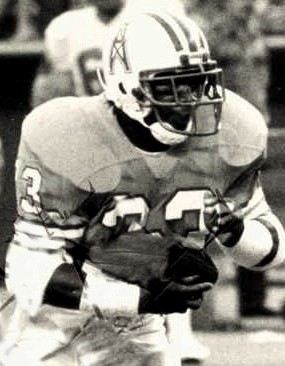
Michael M. Rozier (born March 1, 1961) is an American former professional football player who was a running back in the United States Football League (USFL) for two seasons and the National Football League (NFL) for seven seasons from 1985 to 1991. He played college football for the Nebraska Cornhuskers, winning the Heisman Trophy in 1983. Afterward, he played for the Pittsburgh Maulers and the Jacksonville Bulls of the USFL, then played for the Houston Oilers and the Atlanta Falcons of the NFL. He was inducted into the College Football Hall of Fame in 2006.

Key Information

Early life

[edit]

Rozier was born in Camden, New Jersey. He attended Woodrow Wilson High School in Camden, where he was a standout high school football player. Today, the football field bears his name.

College career

[edit]

Rozier went largely unnoticed by most of the major college programs. His recruitment to Nebraska was a complete accident. Former Nebraska head coach Frank Solich, at the time an assistant to head coach Tom Osborne, had been a keen observer of high school game films. While watching film of Pennsauken's game against nearby Woodrow Wilson High School, one player on the opposing team (Rozier) continually caught Solich's eye.

Rozier spent his freshman season at Coffeyville Junior College in Kansas, in order to get his grades up. In his one season with the Coffeyville Ravens, he led them to a 9–0 season in 1980, gaining 1157 yards with a gaudy 7.4 yards-per-carry average, and scored ten touchdowns.

As a sophomore in 1981, Rozier first dazzled Husker fans with a 93-yard touchdown run against Kansas State. As the season progressed, Rozier began challenging Roger Craig for the starting position, a job he would eventually win in the fall of 1982 prior to his junior year. Rozier's progress was so pronounced that the talented and established Craig moved to fullback.

During his junior season, Rozier broke Bobby Reynolds's long-standing school record for rushing yards in a single season, with 1,689 yards, and led Nebraska to a second consecutive outright Big 8 title and a 12–1 record, losing only in controversial fashion to eventual national champion Penn State. In a performance against Missouri, Rozier came off the bench in the second half to rush for 139 yards on 17 carries to lead Nebraska to a comeback victory despite suffering from a painful hip-pointer injury. Rozier finished the 1982 season a consensus All-American and finished 10th in the Heisman voting.

As a senior, Nebraska's high-octane offense was often unstoppable, averaging 52 points and 401 rushing yards per game. Rozier had a nation's best 2,486 total yards with 2,148 of those coming on the ground and twenty-nine touchdowns scored. His 7.8 yards-per-carry mark on the season stands as the third-highest mark for players with more than 214 carries in a season. Against Kansas, Rozier rushed for 230 yards in the first half and finished with 285 rushing yards total, at that time a school record. Rozier went over 200 yards in each of his last four regular-season games of the 1983 season. His senior season was capped when he was awarded the Heisman Trophy, given to the best individual player in college football and was again an All-American.

His college career would end in disappointment, losing the 1984 Orange Bowl in which Miami defeated Nebraska 31-30 for the national championship. Rozier had 138 yards on 21 carries at halftime against a Miami Hurricanes team with the second-ranked defense in football, but he had to leave in the third quarter following an ankle injury. Rozier finished the game with 147 yards on 26 carries.

College statistics

[edit]
Season Team Rushing Receiving
Att Yds Avg Lng TD Att Yds Avg Lng TD
1980 Attended Coffeyville Junior College
1981 Nebraska 166 1,018 6.1 93 5 4 64 16.0 32 0
1982 Nebraska 268 1,807 6.7 62 15 6 46 7.7 14 2
1983 Nebraska 300 2,295 7.7 71 29 10 106 10.6 26 0
Career 734 5,120 6.9 93 49 20 216 10.8 32 2

Professional career

[edit]

Rozier was selected by the Pittsburgh Maulers first overall in the 1984 USFL draft. He played his first two professional seasons in the United States Football League, in 1984, with the Pittsburgh Maulers, and 1985, with the Jacksonville Bulls. In 1985 Rozier played for the Jacksonville Bulls in the spring and the Houston Oilers in the fall.

He was drafted by the Houston Oilers in the 1st round (2nd pick overall) of the 1984 NFL Supplemental Draft of USFL and CFL Players, joining them in the fall of 1985.[1] Rozier played six seasons for the Oilers, amassing a total of 900 carries for 3171 yards, including a 1,002-yard rushing season in 1988. While playing for the Oilers, Rozier was elected to the AFC Pro Bowl squad in both 1987 and 1988.

In 1990, Rozier only played three games for the Oilers, rushing 10 times for a total of 42 yards, before being released after they found no suitable trade partners.[2] He was quickly picked up by the NFC's Atlanta Falcons, where he finished the year with 153 carries for 675 yards. His final season in the NFL came the next year with the Falcons. He completed the 1991 season with 361 yards on 96 carries, announcing his retirement during the off-season.

Rozier finished his career with a total of 1159 carries for 4462 yards, having averaged 3.8 yards per carry, and scoring 30 touchdowns.

As of the end of the 2020 season, Rozier is ranked 172nd on the NFL All-Time Rushing Yards list.

Career statistics

[edit]

USFL career

[edit]
Year Team GP Rushing Receiving
Att Yds Avg TD Rec Yds Avg TD
1984 Pittsburgh Maulers 14 223 792 3.6 3 32 259 8.1 0
1985 Jacksonville Bulls 18 320 1,361 4.3 12 50 366 7.3 3
Total 32 543 2,153 4.0 15 82 625 7.6 3

NFL career

[edit]
Year Team GP Rushing Receiving
Att Yds Avg Lng TD Rec Yds Avg Lng TD
1985 HOU 14 133 462 3.5 30 8 9 96 10.7 52 0
1986 HOU 13 199 662 3.3 19 4 24 180 7.5 23 0
1987 HOU 11 229 957 4.2 41 3 27 192 7.1 27 0
1988 HOU 15 251 1,002 4.0 28 10 11 99 9.0 18 1
1989 HOU 12 88 301 3.4 17 2 4 28 7.0 8 0
1990 HOU 3 10 42 4.2 11 0 5 46 9.2 24 0
ATL 13 153 675 4.4 67 3 8 59 7.4 24 0
1991 ATL 11 96 361 3.8 19 0 2 15 7.5 20 0
Total 92 1,159 4,462 3.8 67 30 90 715 7.5 52 1

Personal life

[edit]

Mike has been married to his wife Rochelle, an attorney, since 2005. They reside in the Sicklerville section of Winslow Township, New Jersey and together they have one son, Michael Guy Pacheco Rozier.[3] He has two other children, Amber and JaMichael Rozier, who reside in Houston, Texas.

In 1996, he was shot in his hometown of Camden, New Jersey.[4][5]

Rozier, along with his wife and three other family members, appeared on the October 22, 2013 episode of Family Feud as the anchor to his team.[6]

Rozier was called one of the most stylish dressers in the history of the Heisman Trophy by SBNation.[7]

On April 9, 2024, Rozier was honored in his hometown of Camden, New Jersey, with a street dedication. Additionally, a sign was erected in the city proclaiming it the home of the renowned former Nebraska, USFL, and NFL running back.[8]

See also

[edit]

References

[edit]
[edit]
Revisions and contributorsEdit on WikipediaRead on Wikipedia
from Grokipedia
Mike Rozier (born March 1, 1961) is a former American football running back who achieved national prominence as a college player at the University of Nebraska, where he won the Heisman Trophy in 1983 after rushing for 2,148 yards and 29 touchdowns in his senior season. He later played professionally in the USFL and NFL, amassing 6,615 rushing yards in his pro career while earning accolades as one of the most dynamic runners of his era. Born in , Rozier attended High School before spending his freshman year at in , where he rushed for 1,157 yards on 157 carries, helping lead the team to a 9-0 record. Transferring to for his through senior seasons (1981–1983), he transformed into a star, totaling 4,780 rushing yards and 49 touchdowns over his college career, with a career average of 7.2 yards per carry. In 1983, Rozier became the second player in NCAA history to rush for 2,000 yards in a single season, leading the nation with 179.0 yards per game and powering to a 12-1 record. His exceptional senior year earned him not only the Heisman but also the as the nation's top player and the Player of the Year honor. Rozier's professional career began in the USFL, where he was drafted by the in 1984 and played the following spring season with the Jacksonville Bulls in 1985. He then joined the with the in 1985 (after being selected in the supplemental draft), spending six seasons there from 1985 to 1990 (partial) and rushing for 3,462 yards and 27 touchdowns with the Oilers. Rozier finished his NFL tenure with the from late 1990 to 1991, retiring after nine professional seasons with career totals of 6,615 rushing yards, 45 touchdowns, and a 3.9 yards-per-carry average. For his contributions to the sport, Rozier was inducted into the in 2006, as well as the Camden County Sports Hall of Fame and in 2005, and the in 2025.

Early Life and Education

Childhood in Camden

Mike Rozier was born on March 1, 1961, in Camden, New Jersey. He grew up in a working-class family in one of Camden's tough urban neighborhoods, which he later described as a "ghetto" environment that shaped his resilience. As the second youngest of six brothers, Rozier was raised on South 27th Street, where he and his siblings spent much of their time playing games outdoors in the street. From an early age, Rozier showed a natural affinity for athletics, participating in little league football and other programs in Camden. Known for his small but speedy and sturdy build, he honed his skills as a sprinter and in these local activities. This early involvement laid the groundwork for his athletic development, leading him to enroll at High School in Camden for his secondary education.

High School Football Career

Mike Rozier played football as a wishbone fullback for the Woodrow Wilson High School Mighty Tigers in , during the late . Standing at 5 feet 10 inches and known for his speed and sturdiness despite his size, he emerged as a standout , drawing attention for his explosive plays in a challenging urban environment that fueled his determination. Rozier shattered numerous school records during his tenure, establishing himself as one of South Jersey's premier prospects with a career total of 4,167 rushing yards. One of his most memorable performances came in the Day rivalry game against crosstown rival Camden High School, where he helped keep competitive until the contest was infamously suspended in the third quarter due to a gang-related , with Camden leading 14-6. His efforts contributed to the team's competitive seasons, showcasing the raw talent that would later propel him to national acclaim. Despite his on-field dominance, Rozier faced limited recruitment interest upon graduating in 1980, largely due to subpar academic grades that deterred major programs. The University of extended his best offer after an assistant coach spotted him during a game against Pennsauken High School, but Rozier opted instead to enroll at in to bolster his academics and eligibility. In recognition of his high school legacy, High School renamed its football stadium Mike Rozier Field, honoring the Camden native's foundational impact on the program.

College Career

Junior College at Coffeyville

Following his standout high school career in , where his speed and elusiveness as a drew interest from programs, Mike Rozier enrolled at in for the 1980 season. As a freshman for the Coffeyville Red Ravens, Rozier adapted swiftly to the physical and fast-paced competition, emerging as a central figure in the team's revitalized ground game under coach Dick Foster. His explosive style complemented a balanced offense, allowing him to exploit defenses effectively in the Jayhawk Conference. Rozier's on-field impact was immediate and dominant; he rushed for 1,157 yards over nine games, powering the Red Ravens to an undefeated 9-0 regular season record and a No. 2 national ranking in the NJCAA poll. Notable performances included 176 yards on 28 carries against and a career-high 295 yards on 32 carries in a 63-21 rout of Dodge City Community College, which clinched the conference title. The season culminated in a hard-fought 7-6 victory over in the Beef Empire Bowl, where Rozier played a key role in the game-winning drive despite the low-scoring affair. His contributions earned him First Team All-American recognition from both J.C. Gridwire and the NJCAA. Buoyed by his academic progress—maintaining a 2.5 GPA—and on-field success, Rozier decided to transfer to the University of Nebraska after the season to pursue Division I football.

University of Nebraska Seasons

Rozier transferred to the University of Nebraska in 1981 following a standout performance at Coffeyville Junior College, which prepared him for the physical demands of competition. Head coach recruited him specifically for the Huskers' wishbone offense, a run-oriented scheme emphasizing option plays and multiple backs, where Rozier slotted in as the I-back alongside incumbent Roger Craig. In his sophomore season of 1981, Rozier shared the backfield workload but quickly demonstrated his potential, rushing for 943 yards while adapting to the nuances of Osborne's system. He burst onto the national scene with explosive runs, including a 93-yard against Kansas State that highlighted his speed and vision. Rozier's junior year in marked his emergence as the primary tailback, as he rushed for a then-school-record 1,689 yards and earned consensus All-American honors for his contributions to 's 12-1 campaign. Taking full command of the I-back role, he showcased improved burst and power, helping the Huskers maintain their offensive dominance through the wishbone's triple-option framework. During his senior season in 1983, Rozier elevated his game to historic levels, rushing for 2,148 yards—the second-highest single-season total in NCAA history at the time and only the second instance of a player surpassing 2,000 yards. His performance powered Nebraska's high-octane wishbone attack under , fueling a 12-1 record and the team's contention for the as the top-ranked squad entering the . Rozier capped the year as a unanimous All-American, solidifying his growth into one of college football's premier rushers.

College Statistics and Awards

Mike Rozier's college rushing statistics highlight his explosive productivity, particularly during his three seasons at the University of Nebraska from 1981 to 1983, where he totaled 4,780 yards on 668 carries for an average of 7.2 yards per carry and 49 rushing touchdowns. Including his performance at in 1980, Rozier gained 1,157 rushing yards and 10 touchdowns on approximately 156 carries averaging 7.4 yards per carry over nine games. He also contributed modestly as a receiver at , catching 20 passes for 216 yards and 2 touchdowns across his career there. The table below provides a year-by-year breakdown of Rozier's primary rushing statistics, with receiving and total touchdowns noted where applicable:
YearSchoolGamesRush AttRush YdsYPCRush TDRecRec YdsRec TDTotal TD
1980Coffeyville91561,1577.41010
1981111519436.2546405
1982122421,6897.015646217
1983122752,1487.82910106029
Career356684,7807.24920216251
Notes: Rushing attempts for 1980 derived from yards and average; games played reflect individual participation. Receiving stats confirmed from season reports. Total touchdowns include rushing and receiving only. Sources: Nebraska Athletics, Sports-Reference, CFB Hall of Fame. Rozier's season, in which he set a then-school record with 2,148 rushing yards, provided crucial context for his national recognition as the NCAA leader in rushing yards per game at 179.0. Rozier garnered significant awards for his collegiate excellence, most notably the 1983 Heisman Trophy, making him Nebraska's second winner of college football's most prestigious individual honor. That year, he also claimed the as the outstanding player in , the as the top player, and was selected as a unanimous All-American. In 1982, Rozier earned consensus All-American honors following his breakout junior campaign.

Professional Career

USFL Playing Years

Mike Rozier entered professional football by signing a three-year, $3.1 million contract with the Pittsburgh Maulers of the United States Football League (USFL) on January 9, 1984, shortly after winning the Heisman Trophy, which served as leverage for the lucrative deal that allowed him to bypass the NFL draft. The Maulers selected Rozier first overall in the 1984 USFL draft, positioning him as the cornerstone of their expansion franchise owned by Edward DeBartolo Sr. In his season with the Maulers, Rozier faced challenges adjusting to the professional level amid a turbulent team environment marked by coaching instability and financial strains. The Maulers struggled throughout the year, finishing with a 3-15 record under head coach Joe Pendry, as defensive woes and offensive line issues hampered the team's overall performance. Rozier's integration was further complicated by early disputes, leading to a settlement that resolved payment issues but highlighted the league's precarious financial landscape. Rozier joined the Jacksonville Bulls for the 1985 USFL season, where he assumed a prominent role as the team's leading rusher in a more stable and competitive setup compared to . Under coach , the Bulls provided Rozier with better support, allowing him to showcase his skills more effectively over the spring campaign and contribute to a playoff-contending effort. The USFL's operations concluded after the 1985 season when the league folded in 1986 following a failed antitrust against the , prompting the dispersal of its players through the 's supplemental draft.

NFL Tenure

Mike Rozier was selected by the Houston Oilers in the first round, second overall, of the 1984 NFL Supplemental Draft of USFL players, allowing him to join the team in the fall of 1985 after completing his USFL season. His prior professional experience in the USFL provided valuable seasoning as he transitioned to the . With the Oilers from 1985 to 1990, Rozier quickly established himself as the starting , sharing carries early but becoming the primary option by 1987. That year, he rushed for 957 yards and earned his first selection, highlighting his burst and vision in a run-heavy offense. In 1988, Rozier surpassed 1,000 rushing yards again with 1,002, securing a second consecutive nod and solidifying his role despite the team's middling records. His tenure with spanned six seasons, during which he adapted to the NFL's physical demands, though injuries began to impact his durability. In October 1990, after appearing in just three games for the Oilers amid a crowded backfield, Rozier was waived and immediately claimed off waivers by the Atlanta Falcons, effectively ending his time in Houston. With Atlanta, he revitalized his career in 1990, rushing for 675 yards in 13 games as a complementary back, but persistent challenges mounted. Injuries limited him to 11 games in 1991 with 361 rushing yards, leading to his retirement at age 30 following the season. These ailments, alongside the stylistic shift from the USFL's open-field schemes to the NFL's grind, tested Rozier's resilience throughout his seven NFL seasons.

Personal Life

Family and Residence

Mike Rozier married Rochelle, an attorney, in 2005. The couple has one son together, Michael Guy Pacheco Rozier. Rozier also has two children from a previous relationship, daughter and son JaMichael, who reside in , ; he makes efforts to spend time with them when possible. Since retiring from professional football, Rozier has lived in Sicklerville, a section of Winslow Township in . His choice of residence reflects his deep ties to the region, having grown up in nearby Camden. In post-retirement life, Rozier has focused on family stability and community contributions. In April 2024, a street in East Camden was renamed Mike Rozier Way in recognition of his contributions to the community.

Health Incidents and Challenges

In November 1996, Mike Rozier survived a near-fatal shooting in his hometown of Camden, New Jersey, when he was wounded three times—twice in the abdomen and once in the hand—during an altercation at a local housing project. The incident occurred while Rozier, then 35, was drinking with friends, including Bart Merriel, who was also shot multiple times in the back and chest. Authorities identified Louis Pierce as the assailant, who was later convicted of attempted murder in 2000 and sentenced to 20 years in prison. Rozier was rushed to Cooper Hospital-University Medical Center, where he was listed in satisfactory condition despite the severity of his injuries; medical reports indicated the bullets narrowly missed vital organs, including an artery near his kidney. Rozier's recovery from the shooting was physically demanding but ultimately successful, involving weeks of hospitalization followed by outpatient rehabilitation to regain mobility and strength. By early 1997, he had returned to his routine in the area, though the trauma prompted reflections on the dangers of his environment and how close he came to death. The event exacerbated existing physical strains from his football career, where a chronic foot injury had already forced his retirement in 1991 after nine professional seasons. These football-related ailments contributed to ongoing mobility issues in his personal life, limiting his daily activities and requiring periodic medical management post-retirement. Despite these adversities, Rozier demonstrated notable resilience, choosing to remain in the area near Camden and focusing on family and community involvement rather than relocating. His family provided crucial emotional support during the shooting recovery, helping him navigate the psychological aftermath of the . Over the years, he channeled his experiences into positive outlets, such as founding the Michael T. Rozier Cancer Foundation to assist those facing health crises, underscoring his determination to overcome personal hardships.

Legacy and Honors

Hall of Fame Inductions

Mike Rozier was inducted into the inaugural class of the Camden County Sports Hall of Fame in 2005, recognizing his contributions as a native of Camden, New Jersey, and his achievements in football from high school through the professional ranks. The ceremony, held in October 2005, honored a group of local sports figures including Russ Spicer, Skeets Irvine, and Wilbur Wilson, with Rozier celebrated for his Heisman Trophy-winning career at the University of Nebraska. This induction highlighted his roots in the community, where he had starred at Woodrow Wilson High School before pursuing college football. That same year, Rozier was inducted into the New Jersey Sports Hall of Fame as part of the 2005 class, honoring his accomplishments as a standout athlete from the state. In 2006, Rozier was selected for induction into the College Football Hall of Fame by the National Football Foundation, based on criteria including at least 10 years since college graduation, All-America recognition, and exceptional on-field performance that advanced the sport. His eligibility was bolstered by his 1983 Heisman Trophy win, which underscored his record-setting 2,148 rushing yards that season. The official induction occurred on December 5, 2006, at the 49th Annual Awards Dinner at the Waldorf-Astoria Hotel in New York City, where Rozier joined other honorees in a ceremony broadcast on the NFL Network. Earlier that year, on October 21, he was honored at halftime of a Nebraska-Texas football game in Lincoln, with notable attendees including former coach Chuck Neinas. Tying into his early legacy, the football field at Woodrow Wilson High School in Camden was named "Mike Rozier Field" in recognition of his high school exploits and subsequent success, a tribute established by the mid-1990s that symbolized his enduring impact on local sports.

Post-Retirement Recognitions

On April 9, 2024, officials in Camden, New Jersey, dedicated a reconstructed section of 27th Street as "Mike Rozier Way" to honor the former Heisman Trophy winner's roots in the city, marking the completion of a $10 million roadway improvement project in East Camden. The event celebrated Rozier's legacy as a Woodrow Wilson High School standout and highlighted his enduring ties to his hometown. In July 2025, Fox Sports recognized Rozier as the greatest college football player to wear jersey number 30, praising his dominant performance as a Nebraska running back and his status as one of the program's all-time greats. This accolade, part of a series ranking top players by jersey number, underscored his 1983 Heisman-winning season and career rushing totals that remain among NCAA benchmarks. Rozier's post-retirement celebrity, bolstered by his induction, continued to draw public engagement, including a meet-and-greet event on August 22, 2025, at the Husker Hounds store in , where he signed autographs on memorabilia and interacted with fans. The appearance reflected his ongoing involvement in Nebraska alumni activities, fostering connections with the Cornhusker community. Media features have also highlighted Rozier's personality beyond the field, such as clips from his 2013 appearance on , which resurfaced in fan discussions and in recent years, showcasing his humorous side during the game show.

References

Add your contribution
Related Hubs
Contribute something
User Avatar
No comments yet.