


Community hub
Recent from talks
Contribute something
Nothing was collected or created yet.
Joe Greene
View on Wikipedia
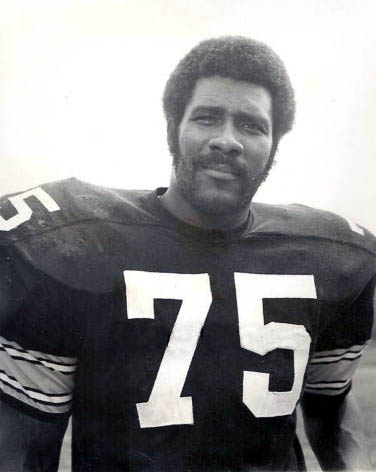
Charles Edward Greene (born September 24, 1946), better known as "Mean" Joe Greene, is an American former professional football defensive tackle who played for the Pittsburgh Steelers of the National Football League (NFL) from 1969 to 1981. A recipient of two NFL Defensive Player of the Year awards, five first-team All-Pro selections, and ten Pro Bowl appearances, Greene is widely considered to be one of the greatest defensive linemen to play in the NFL. He was noted for his leadership, fierce competitiveness, and intimidating style of play for which he earned his nickname.
Key Information


Born and raised in Temple, Texas, Greene attended North Texas State University—now University of North Texas—where he earned consensus All-America honors as a senior playing for the North Texas State Eagles. He was selected by the Steelers fourth overall in the 1969 NFL draft and made an immediate impact with the team, as he was named the NFL's Defensive Rookie of the Year. Greene is credited with providing the foundation upon which Steelers coach Chuck Noll turned the dismal franchise into a sports dynasty. He was the centerpiece of the "Steel Curtain" defense that led Pittsburgh to four Super Bowl championships in a six-year span.
Throughout his career, Greene was one of the most dominant defensive players in the NFL, able to overpower opposing offensive linemen with ease and disrupt blocking. Former teammate Andy Russell called Greene "unquestionably the NFL's best player in the seventies". He is a member of the Pro Football Hall of Fame and the College Football Hall of Fame, and his number 75 jersey is one of only three retired by the Steelers. Greene is also well known for his appearance in the "Hey Kid, Catch!" Coca-Cola commercial, which aired during Super Bowl XIV and solidified his reputation as a "tough football player who's a nice guy".[1]
Early life and college
[edit]Charles Edward Greene was born September 24, 1946, in Temple, Texas. He played high school football at Dunbar High School in Temple. Despite Greene's talents, the Dunbar Panthers had a mediocre record, and he was not heavily recruited by colleges. His options were limited further due to segregation of the Southwest Conference.[citation needed] He was eventually offered a scholarship to play college football at North Texas State University (now University of North Texas), where he played for Odus Mitchell on the varsity team from 1966 to 1968. In the three seasons he played on the squad, they had a 23–15–1 record. With a per-carry average of less than two yards in his 39 games at defensive tackle, North Texas State limited the opposition to 2,507 yards on 1,276 rushes. Greene was a three-time All-Missouri Valley Conference selection.[2]
In his junior season Greene married Agnes Craft, also a student at North Texas State and the daughter of a Dallas businessman.[citation needed] Tight on money, they were wed at Craft's sister's house in Dallas. Chuck Beatty, Greene's teammate at North Texas and later again in the NFL with the Steelers, served as best man.[3]
As a senior, Greene was a consensus pick as a defensive tackle for the 1968 All-America team, earning first-team honors from United Press International (UPI), the Newspaper Enterprise Association, and The Sporting News, among others.[4] His college coach, Rod Rust, said of Greene: "There are two factors behind Joe's success. First, he has the ability to make the big defensive play and turn the tempo of a game around. Second, he has the speed to be an excellent pursuit player." A pro scout said, "He's tough and mean and comes to hit people. He has good killer instincts. He's mobile and hostile."[5]
Nickname
[edit]While sources agree the name is a reference to North Texas' athletics teams, the Mean Green,[6][7][8] there are conflicting accounts as to how, when, and why Greene received his "Mean Greene" nickname. When he first arrived at North Texas, the university's moniker was the Eagles. In 1966, Greene's first year on the varsity team, the team adopted the "Mean Green" moniker. Two possible origins of the nickname are two separate cheers that supposedly developed independently during North Texas' 1966 game against UTEP. One cheer was by Sidney Sue Graham, wife of the North Texas sports information director. In response to a tackle by Greene, she blurted out, "That's the way, Mean Greene!"[9] Bill Mercer, former North Texas play-by-play announcer, states Graham's thought behind the nickname was the Mean Green defense.[10] Meanwhile, in the student section, North Texas basketball players Willie Davis and Ira Daniels, unsatisfied with the unenthusiastic crowd, began to sing, "Mean Green, you look so good to me". The rest of the crowd soon followed. "After that we did it every game," Davis said. "A lot of people later on started associating it with Joe because his last name was Greene, but it actually started with that simple chant that Saturday night at Fouts Field. And that's the truth."[9]
Although it stuck with him throughout his professional career due to his playing style, Greene himself was not fond of the nickname, insisting it did not reflect his true character.[7] "I just want people to remember me as being a good player and not really mean," he said. "I want to be remembered for playing 13 years and contributing to four championship teams. I would like to be remembered for maybe setting a standard for others to achieve."[11]
As for the “Joe” part of his nickname (since his given name was Charles, not Joseph), that came from one of his aunts.[12] During a 2014 interview with NFL Films, Greene said that his aunt nicknamed him Joe due to his resemblance to boxing legend Joe Louis, who at the time of Greene's birth was in the middle of his 12-year reign as heavyweight champion. "She thought I was hefty and bulky enough to be called Joe Louis," Greene said. "She started calling me Joe, and it kind of stuck."[12]
Professional football career
[edit]The Pittsburgh Steelers franchise was one of the most downtrodden in the NFL, having experienced many losing seasons before the hiring of Chuck Noll as head coach in 1969.[13] Noll and the Rooney family, which had owned the franchise since its formation, agreed that building the defensive line was crucial to rebuilding the team.[14] Thus, they decided on Greene with the fourth pick of the 1969 NFL draft. The selection proved unpopular with fans and media, who were hoping for a player that would generate excitement; the relatively unknown Greene did not appear to meet their expectations.[15] Meanwhile, Greene, who was highly competitive, was disappointed he was picked by a team that had such a reputation for losing.[16] "I did not, did not want to be a Steeler," he admitted in a 2013 interview.[17] Noll saw immense potential in Greene and insisted on drafting him.[18] Ken Kortas, who had played in all 42 games as defensive tackle over the previous three seasons, was soon traded away to the Chicago Bears to accommodate him on the roster.[19] In a matter of months, Greene established himself as one of the most dominant players in the league at his position. Despite his team finishing 1969 with a 1–13 record, the Associated Press (AP) named Greene the NFL Defensive Rookie of the Year,[20][21] and he was invited to his first Pro Bowl.[22]
Former teammate Andy Russell called Greene "unquestionably the NFL's best player in the seventies," saying "No player had a greater impact or did more for his team."[23] Greene and coach Noll are widely credited with turning the Steelers franchise around.[24][25] The Steelers finished 1970 with a 5–9 record and went 6–8 in 1971. Greene was invited to the Pro Bowl in both seasons.[26] In 1972, Pittsburgh finished 11–3 and won its first division title and its first playoff game—the "Immaculate Reception" game against the Oakland Raiders. During the season, Greene tallied 11 quarterback sacks and 42 solo tackles, and he was recognized as the AP NFL Defensive Player of the Year. Miami Dolphins head coach Don Shula lauded Greene, saying, "He's just a super super star. It's hard to believe he isn't offside on every play. He makes the other team adjust to him."[27] By this time, Noll had built a formidable defense. "We have maybe 10 guys now capable of making All-Pro," said Greene in 1972. "I'm just like all the other guys, doing my best in a team effort."[27] With the drafting of defensive tackle Ernie Holmes in 1972, the Steelers assembled what became known as the "Steel Curtain" defensive line of Greene, Holmes, L. C. Greenwood, and Dwight White.[28] Greene was invited to the Pro Bowl for 1973, joining White and Greenwood on the American Football Conference (AFC) roster.[29]
Greene won his second AP NFL Defensive Player of the Year Award after the 1974 season, becoming the first player to receive the award multiple times.[30] That year, he developed a new tactic of lining up at a sharp angle between the guard and center to disrupt the opposition's blocking assignments which he called the "stunt 4-3".[11] His coaches were at first skeptical of the tactic and did not allow him to try it during the regular season. He first implemented the "stunt 4-3" against the Buffalo Bills in the division championship game. It proved to be highly effective, as it impeded Buffalo's blocking, and running back O. J. Simpson managed only 48 yards rushing.[23] The following week, the Steelers faced the Oakland Raiders in the AFC championship game, with the defining match-up being Greene against All-Pro center Jim Otto. At one point Greene, consumed by emotions, kicked Otto in the groin. Later, on a third-down play, Greene threw Otto to the ground with one arm before leaping to sack quarterback Ken Stabler.[31] Oakland was held to 29 rushing yards in the Steelers' 24–13 victory. On January 12, 1975, the Steelers won their first of four Super Bowl championships in a six-year span by defeating the Minnesota Vikings 16–6 in Super Bowl IX. In that game, lined up against center Mick Tingelhoff, Greene recorded an interception, forced fumble, and fumble recovery in what is considered one of the greatest individual defensive Super Bowl performances.[32][33] Pittsburgh limited the Vikings to only 119 total yards of offense, 17 of which were gained on the ground.[34] After the season, Greene was honored by the Pittsburgh Post-Gazette at its 39th Dapper Dan dinner as Pittsburgh's outstanding sports figure of the year.[35]

Greene missed four games in 1975 due to a pinched nerve, snapping a streak of 91 straight games started since he entered the league.[11] In December 1975, he and the other members of the Steel Curtain appeared on the cover of Time magazine.[16] After leading the Steelers to another Super Bowl win after the 1975 season over the Dallas Cowboys in Super Bowl X, Greene missed the first several games of the 1976 season with a back injury. The Steelers started off the season 1–4 and looked like they would not make the playoffs. Quarterback Terry Bradshaw was also injured and was replaced by rookie Mike Kruczek. Greene returned and the Steelers defense carried the team to nine-straight wins and the playoffs. With a defense considered one of the best in NFL history,[36][37] the 1976 Steelers held opponents to an average of less than 10 points per game (138 points over 14 games). During their nine-game winning streak, the Steelers defense recorded five shutouts, including three straight, and surrendered a total of 28 points (roughly 3 points per game).[38] The defense allowed only two touchdowns over those nine games. The Steelers were defeated by the Raiders in that year's AFC championship game.[39]
By 1977, Greene was the captain of the Steelers defense, although his reduced effectiveness over the previous two seasons due to injuries led to rumors that he was washed up.[40][41] He was never again able to attain the same success as a pass rusher after his pinched nerve in 1975.[42] Spurred by the rumors, he returned in 1978 to lead all Pittsburgh linemen in tackles, and he had four sacks and a career-high five fumble recoveries. The Steelers defense allowed a league-low 195 points during the season, en route to a 35–31 victory over the Cowboys in Super Bowl XIII.[43] In that contest, Greene had one of Pittsburgh's five sacks of Dallas quarterback Roger Staubach.[44]
Pittsburgh finished the 1979 season with a 12–4 record, and ranked second in total defense and fifth in scoring defense. Greene was named a first-team All-Pro by the Pro Football Writers Association and Pro Football Weekly and was invited to his final Pro Bowl.[26] He was also deemed the NFL's Man of the Year in recognition of his off-field contributions. In the AFC championship game against the Houston Oilers, the Steelers held NFL MVP Earl Campbell to just 15 rushing yards on 17 carries.[45] Pittsburgh then defeated the Los Angeles Rams in Super Bowl XIV for an unprecedented fourth Super Bowl title.[46] With the fourth title came Greene's fourth Super Bowl ring, inspiring his famous phrase, "one for the thumb", an allusion to winning a fifth championship.[47][48] His wish went unfulfilled, however, as the Steelers failed to reach the playoffs in each of his final two seasons.[49]
Greene retired as a player following the 1981 season.[50] He finished his career having played in 181 out of a possible 190 games, and recorded 77.5 sacks[41] (unofficially, as sacks were not an official statistic until 1982) and 16 fumble recoveries. His spot in the lineup was technically not replaced; the Steelers switched to a 3–4 defensive alignment for the 1982 season, which has only one nose tackle as opposed to two defensive tackles. The team has used the 3–4 as its base alignment continuously in the years since Greene's retirement, and more recently have used alignments that deploy only two true linemen.[51]
NFL career statistics
[edit]| Legend | |
|---|---|
| NFL Defensive Player of the Year | |
| Won the Super Bowl | |
| Bold | Career high |
Regular season
[edit]| Year | Team | Games | Sacks | Fumbles | Interceptions | |||
|---|---|---|---|---|---|---|---|---|
| GP | GS | FR | Yds | Int | Yds | |||
| 1969 | PIT | 14 | 14 | 9.5 | 0 | 0 | 0 | 0 |
| 1970 | PIT | 14 | 14 | 8.0 | 0 | 0 | 0 | 0 |
| 1971 | PIT | 14 | 14 | 5.5 | 3 | 7 | 0 | 0 |
| 1972 | PIT | 14 | 14 | 11.0 | 1 | 0 | 0 | 0 |
| 1973 | PIT | 14 | 13 | 4.0 | 2 | 0 | 0 | 0 |
| 1974 | PIT | 14 | 14 | 9.0 | 4 | 3 | 1 | 26 |
| 1975 | PIT | 10 | 9 | 3.0 | 0 | 0 | 0 | 0 |
| 1976 | PIT | 14 | 14 | 6.0 | 0 | 0 | 0 | 0 |
| 1977 | PIT | 13 | 13 | 4.0 | 1 | 0 | 0 | 0 |
| 1978 | PIT | 16 | 16 | 4.5 | 5 | 0 | 0 | 0 |
| 1979 | PIT | 15 | 15 | 5.0 | 0 | 0 | 0 | 0 |
| 1980 | PIT | 15 | 15 | 3.5 | 0 | 0 | 0 | 0 |
| 1981 | PIT | 14 | 7 | 4.5 | 0 | 0 | 0 | 0 |
| Career | 181 | 172 | 77.5 | 16 | 10 | 1 | 26 | |
Postseason
[edit]| Year | Team | Games | Sacks | Fumbles | Interceptions | ||
|---|---|---|---|---|---|---|---|
| GP | GS | FR | Int | Yds | |||
| 1972 | PIT | 2 | 2 | 0.0 | 0 | 0 | 0 |
| 1973 | PIT | 1 | 1 | 0.0 | 0 | 0 | 0 |
| 1974 | PIT | 3 | 3 | 1.0 | 1 | 1 | 10 |
| 1975 | PIT | 2 | 2 | 0.0 | 0 | 0 | 0 |
| 1976 | PIT | 2 | 2 | 1.0 | 0 | 0 | 0 |
| 1977 | PIT | 1 | 1 | 0.0 | 1 | 0 | 0 |
| 1978 | PIT | 3 | 3 | 4.0 | 0 | 0 | 0 |
| 1979 | PIT | 3 | 3 | 0.0 | 0 | 0 | 0 |
| Career | 17 | 17 | 7.0 | 2 | 1 | 10 | |
Attitude and playing style
[edit]He's tough and mean and comes to hit people. He has good killer instincts. He's mobile and hostile.[5]
Greene's nickname remained popular due to his exploits on the playing field, where he was described as ferocious and intimidating.[18][52] He instilled fear in opponents with the intensity of his play. In a 1979 game against the Houston Oilers, with only seconds remaining and Houston leading 20–17, the Oilers lined up near the Pittsburgh goal line to run their final play. With victory already assured for the Oilers, Greene pointed angrily across the line of scrimmage at Houston quarterback Dan Pastorini, warning, "If you come into the end zone, I'll beat the crap out of you! I'm gonna kill you!" Pastorini responded by taking a knee, ending the game. Afterward, Greene laughed and said, "I knew you weren't going to do it."[47]
In his early years with the Steelers, Greene was at times uncontrollable, and often let his temper get the best of him. On one occasion during a 1975 game against the rival Cleveland Browns at Cleveland Municipal Stadium, Greene repeatedly kicked Browns lineman Bob McKay in the groin while McKay was lying on the ground.[47][53] He also punched Denver Broncos guard Paul Howard and spat at quarterback Fran Tarkenton,[42] and he frequently clashed with officials.[23][47]
Greene and middle linebacker Jack Lambert became the emotional leaders of Pittsburgh's defensive squad. Greene was described as a huge presence both on and off the field.[16] Joe Gordon of the Steelers front office recalled an instance in which a teammate was loudly voicing his discontent over the long and cold practice they had just gone through as he yanked off his equipment. At a nearby locker, Greene lifted his head and silently glared at him. "Believe me, that's all Joe did, he never even said anything," said Gordon. "I don't think the other players saw Joe glare at him. I think the other player just felt it, and then he sat down and never said another word."[42] A natural leader, Greene was named the captain of the defense in 1977.[11][54] His leadership was also channeled to the offense; Lynn Swann, a wide receiver, considered Greene a mentor. "If you were giving less than 100 percent, he let you know one way or the other," said Swann.[42]
Acting career
[edit]Coca-Cola commercial
[edit]Greene appeared in a famous commercial for Coca-Cola that debuted on October 1, 1979, and was aired during Super Bowl XIV on January 20, 1980. The ad won a Clio Award in 1980 for being one of the best commercials of 1979.[55] It is widely considered to be one of the best television commercials of all time.[56][57] The commercial helped shift the public's perception of Greene as hostile and unapproachable, to a soft-hearted "nice guy".[1][54]
Other roles
[edit]While most well known for the Coca-Cola commercial, Greene has acted in other roles. One of his first acting roles was in The Black Six, a blaxploitation film starring other NFL players including fellow Hall of Famers Lem Barney, Willie Lanier, and Carl Eller.[58] Greene also played himself in the movie ...All The Marbles, a TV movie on teammate Rocky Bleier, titled Fighting Back: The Rocky Bleier Story, and in Smokey and the Bandit II, in which he was ordered to "tackle that car" by Terry Bradshaw when Sheriff Buford T. Justice, played by Jackie Gleason, was in pursuit of Burt Reynolds' "Bandit". Greene then went and "tackled" Justice's patrol car, turning it completely over.
Coaching career and later life
[edit]After retiring from the NFL, Greene spent one year, 1982, as a color analyst for NFL on CBS before becoming an assistant coach under Steelers' head coach Chuck Noll in 1987. He spent the next 16 years as an assistant coach with the Pittsburgh Steelers (1987–1991), Miami Dolphins (1991–1995), and Arizona Cardinals (1996–2003).[59] In 2004, he retired from coaching and was named the special assistant for player personnel for the Steelers. In this position, he earned his fifth Super Bowl ring after the Steelers won Super Bowl XL. When asked how it felt to finally win "one for the thumb", he replied, "That's all utter nonsense. It's one for the right hand. It's one for this group, for this team."[49] He earned a sixth ring from Super Bowl XLIII. Greene is one of four people outside the Rooney family to have Super Bowl rings from the first six championship seasons. He retired from his position in the Steelers front office in 2013.[60]
In 2014, Greene was the subject of an episode of the NFL Network documentary series A Football Life, which chronicled his life and career.[61] As of 2024, he resides in Flower Mound, Texas. His wife of 47 years, Agnes, with whom he had three children, died in 2015.[62] He has since remarried to Charlotte Greene. Greene is known as "Papa Joe" to his seven grandchildren.[61][63] In 2017, Greene released an autobiography entitled Mean Joe Greene: Built by Football.[64]
In 2018, Greene set up the Agnes Lucille Craft Greene Memorial Scholarship in honor of his late wife. The scholarships are presented annually to students from Texas, whose parents have battled cancer.[65]
Legacy
[edit]I just want people to remember me as being
a good player and not really mean. I want to be
remembered for playing 13 years and contributing to
four championship teams. I would like to be remembered for maybe setting a standard for others to achieve.[66]
Greene is recognized as one of the most dominant players to ever play in the NFL.[67] He is widely considered one of the greatest defensive linemen in league history.[68] His durability allowed him to play in 181 of a possible 190 games, including a streak of 91 straight to begin his career.[11] The Steel Curtain defense is consistently ranked among the top defensive groups of all time. As of the death of L. C. Greenwood in September 2013, Greene is the last surviving member of the Steel Curtain.[17]
Post-career honors
[edit]- In 1984, Greene was enshrined in the College Football Hall of Fame.[69] He is the only former UNT player so honored.
- His number 75 jersey is retired by the North Texas football team, and he was inducted into the UNT Hall of Fame in 1981.[2]
- He was inducted into the Pro Football Hall of Fame in 1987, a class which also included Larry Csonka, Len Dawson, Jim Langer, Don Maynard, Gene Upshaw, and John Henry Johnson.[70]
- The Hall of Fame Selection Committee named Greene to the NFL 1970s All-Decade Team, honoring the best players of the decade. In 1994, he was selected by a 15-person panel of NFL and Pro Football Hall of Fame officials, former players, and media representatives to the NFL 75th Anniversary All-Time Team as one of the greatest players of the NFL's first 75 years.[71]
- In 1999, Greene was deemed the 14th greatest player of all time by The Sporting News.[72] He was ranked 13th on The Top 100: NFL's Greatest Players by the NFL Network in 2010.[73]
- Greene is regarded among the greatest players in Steelers franchise history.[74] His number 75 jersey was officially retired at halftime during the Steelers' game against the rival Baltimore Ravens on November 2, 2014. Greene also briefly wore number 72 during his rookie season before switching to his more familiar 75 mid-season. He is only the third Steeler to have his jersey formally retired, the first being Ernie Stautner[63] and the other being Franco Harris.[75] However, the Steelers had not reissued No. 75 since Greene's retirement, and it had been understood long before 2014 that no Steeler would ever wear it again.[59]
- The University of North Texas, Greene's alma mater, unveiled a statue of him outside of Apogee Stadium in 2018. Greene is regarded as the most famous alum of UNT.[76]
- In 2015, the Mean Joe Greene Community Football Field was dedicated in Greene's honor in his hometown of Temple, Texas.[77]
- In 2019, Greene was named to the NFL 100th Anniversary All-Time Team as one of the greatest players of the NFL's first 100 years.[78]
Notes and references
[edit]- ^ a b Emery, Mark (January 28, 2016). "NFL legend 'Mean Joe' Greene reunited with co-star from classic 1979 Coke commercial". New York Daily News. Archived from the original on November 12, 2016. Retrieved November 11, 2016.
- ^ a b "Legends of the Mean Green: Joe Greene No. 75". University of North Texas Libraries. Archived from the original on November 11, 2016. Retrieved November 11, 2016.
- ^ Pomerantz 2014, pp. 68–69
- ^ "Joe Greene Is Named All-American". Denton Record-Chronicle. November 26, 1968. p. 8. Archived from the original on August 27, 2017. Retrieved May 28, 2017 – via Newspapers.com.
- ^ a b "Joe Greene College Football Hall of Fame bio". National Football Foundation. Retrieved December 30, 2016.
- ^ Myerberg, Paul (August 15, 2015). "Which nickname came first at North Texas? 'Mean Joe' Greene or Mean Green?". USA Today. Archived from the original on October 28, 2016. Retrieved October 27, 2016.
But we can put one misguided theory to rest right here: The North Texas Mean Green are not, in fact, named in honor of 'Mean Joe' Greene
. - ^ a b "'Mean Joe' Doesn't Like His Nickname". Sarasota Herald-Tribune. Associated Press. January 8, 1975. p. 3-C. Archived from the original on April 23, 2021. Retrieved October 27, 2016.
- ^ Pomerantz 2014, p. 66.
- ^ a b Coleman, Rufus. "How Our Green Got Mean". The North Texan. Archived from the original on October 28, 2016. Retrieved October 27, 2016.
- ^ Ehsan, Azad (September 5, 2013). "Looking back at a century of Mean Green". North Texas Daily. Archived from the original on October 28, 2016. Retrieved October 27, 2016.
- ^ a b c d e "Joe Greene Bio". Pro Football Hall of Fame. Archived from the original on October 22, 2016. Retrieved October 21, 2016.
- ^ a b "Joe Greene turns 75: Six amazing facts about the Steelers' greatest player of all-time". CBSSports.com. Retrieved November 9, 2021.
- ^ Freedman & Hoak 2009, p. 72.
- ^ Millman & Coyne 2010, p. 45
- ^ Smith, Don (1993). "Chuck Noll" (PDF). The Coffin Corner. 15 (2). Archived (PDF) from the original on September 7, 2015. Retrieved October 19, 2016.
- ^ a b c Freedman & Hoak 2009, p. 83.
- ^ a b Pompeani, Bob (November 25, 2013). "Joe Greene Opens Up About Time With Steelers, Teammates' Passing". CBS Pittsburgh. Archived from the original on May 7, 2016. Retrieved October 18, 2016.
- ^ a b Wexell, Mendelson, & Aretha 2014, p. 82.
- ^ Rutter, Joe (June 17, 2020). "'Burgh's Best to Wear It, No. 75: Joe Greene nearly wore another number to fame with Steelers". Pittsburgh Tribune-Review. Retrieved October 20, 2022.
- ^ "Greene Top Defensive Rookie". The Odessa American. Associated Press. December 20, 1969. p. 15. Archived from the original on April 25, 2017. Retrieved April 25, 2017 – via Newspapers.com.
- ^ Harrison, Elliot (April 9, 2015). "Top rookie seasons of the Super Bowl era: Defensive linemen". NFL.com. Archived from the original on October 19, 2016. Retrieved October 19, 2016.
- ^ "Sports Briefs". The Tuscaloosa News. December 23, 1969. p. 6. Archived from the original on April 23, 2021. Retrieved October 19, 2016.
- ^ a b c Russell, Andy; Bleier, Rocky (2012). "Joe Greene". Andy Russell: A Steeler Odyssey. Skyhorse Publishing, Inc. ISBN 978-1613211595. Archived from the original on April 23, 2021. Retrieved October 18, 2016.
- ^ Pomerantz 2014, p. 58.
- ^ Brown, Scott (June 14, 2014). "Hall of Famer Chuck Noll dies at 82". ESPN. Archived from the original on October 20, 2016. Retrieved October 19, 2016.
- ^ a b "Joe Greene Stats". Pro-Football-Reference.com. Sports Reference. Archived from the original on March 21, 2021. Retrieved October 19, 2016.
- ^ a b Mihoces, Gary (January 5, 1973). "Joe Greene Defensive Player of the Year". The Evening News. Associated Press. p. 6B. Archived from the original on April 23, 2021. Retrieved October 19, 2016.
- ^ Battista, Judy (January 31, 2009). "Steelers' Defense Recalls Steel Curtain Memories". The New York Times. Archived from the original on October 29, 2017. Retrieved May 28, 2017.
- ^ "NFL Ready For Final 'Joke' Game". The Daily Courier. United Press International. January 18, 1974. p. 7. Archived from the original on November 13, 2018. Retrieved May 28, 2017 – via Newspapers.com.
- ^ "Defensive Honor Goes To 'Mean' Joe Greene". Sarasota Herald-Tribune. Associated Press. January 8, 1975. p. 1C. Archived from the original on April 23, 2021. Retrieved October 21, 2016.
- ^ Pomerantz, Gary M. (November 1, 2013). "Mean Joe vs. Double O". Sports Illustrated. Archived from the original on November 14, 2016. Retrieved November 13, 2016.
- ^ Ruiz, Steven (February 2, 2016). "The best Super Bowl performances at every position". USA Today. Archived from the original on October 15, 2016. Retrieved October 21, 2016.
- ^ Silverman, Steve (2014). Who's Better, Who's Best in Football?: Setting the Record Straight on the Top 65 NFL Players of the Past 65 Years. Skyhorse Publishing. p. 71. ISBN 978-1613217535. Archived from the original on April 23, 2021. Retrieved October 21, 2016.
- ^ "Super Bowl IX Game Recap". NFL.com. NFL Enterprises LLC. Archived from the original on October 29, 2018. Retrieved October 21, 2016.
- ^ "Mean Joe Star of Dapper Dan Weekend". Pittsburgh Post-Gazette. February 8, 1975. p. 10. Archived from the original on April 23, 2021. Retrieved November 8, 2016.
- ^ Ruiz, Steven (February 8, 2016). "Stats show the 2015 Broncos defense is top-10 all time, but just barely". USA Today. Archived from the original on November 3, 2016. Retrieved November 1, 2016.
- ^ Tallent, Aaron (February 15, 2016). "10 Greatest Defenses in NFL History". Athlon Sports. Archived from the original on November 16, 2016. Retrieved November 1, 2016.
- ^ Pomerantz 2014, p. 7.
- ^ "Steelers' Dan Rooney through the years". Pittsburgh Tribune-Review. April 13, 2017. Archived from the original on May 22, 2017. Retrieved May 28, 2017.
- ^ Marshall, Joe (January 15, 1979). "Pouncing on a Championship". Sports Illustrated. Vol. 50, no. 2. Archived from the original on April 8, 2016. Retrieved October 29, 2016.
- ^ a b Wexell, Mendelson, & Aretha 2014, p. 83.
- ^ a b c d Anderson, Dave (February 16, 1982). "More Than Just Mean". The New York Times. Archived from the original on November 4, 2016. Retrieved November 3, 2016.
- ^ Fox, Larry (January 22, 1979). "Super Bowl XIII: Steelers first 3-time winner in Super thriller, 35-31". New York Daily News. p. 3. Archived from the original on October 29, 2016. Retrieved October 28, 2016.
- ^ "Super Bowl XIII - Pittsburgh Steelers vs. Dallas Cowboys - January 21st, 1979". Pro-Football-Reference.com. Sports Reference. Archived from the original on November 2, 2016. Retrieved October 28, 2016.
- ^ Zimmerman, Paul (January 14, 1980). "Hitting a Wall of Steel". Sports Illustrated. Vol. 52, no. 2. Archived from the original on November 8, 2016. Retrieved November 7, 2016.
- ^ Attner, Paul (January 21, 1980). "Super Bowl XIV: Steelers Rally for Fourth Title". The Washington Post. Archived from the original on November 8, 2016. Retrieved November 7, 2016.
- ^ a b c d Pomerantz 2014, p. 239.
- ^ Bouchette, Ed (June 5, 2006). "The one for the thumb: Steelers collect their Super Bowl rings". Pittsburgh Post-Gazette. Archived from the original on April 15, 2016. Retrieved November 8, 2016.
- ^ a b Wexell 2006, p. 79.
- ^ "Joe Greene Retires". The New York Times. February 11, 1982. Archived from the original on June 12, 2018. Retrieved June 11, 2018.
- ^ Bouchette, Ed (October 6, 2016). "On the Steelers: Signature 3–4 defense is a thing of the past". Pittsburgh Post-Gazette. Archived from the original on October 12, 2016. Retrieved December 30, 2016.
- ^ "75. DT Joe Greene (Steelers, IX, X, XIII, XIV)". Sun-Sentinel. Associated Press. Archived from the original on November 4, 2016. Retrieved November 3, 2016.
- ^ Schudel, Jeff (September 14, 2008). Rivalry makes turn to primetime. The Morning Journal. Retrieved November 3, 2016.
- ^ a b "Steelers' Joe Greene retires after 13 years". The Afro-American. United Press International. February 20, 1982. p. 9. Archived from the original on April 23, 2021. Retrieved November 2, 2016.
- ^ Shontell, Alyson (January 18, 2011) "The 10 Best Award-Winning TV Ads Everyone Must See" Archived April 4, 2011, at the Wayback Machine. Business Insider
- ^ Fowler, Scott (February 23, 1992). "Take it from Mean Joe: Famous ad wasn't easy". The Philadelphia Inquirer.
- ^ Mooney, Philip; Ryan, Ted; Nash, Helen (November 29, 2000). "Highlights in the History of Coca-Cola Television Advertising". Library of Congress. Archived from the original on March 8, 2010. Retrieved November 10, 2016.
{{cite web}}: CS1 maint: bot: original URL status unknown (link) - ^ Butters, Gerald R. (2016). From Sweetback to Super Fly: Race and Film Audiences in Chicago's Loop. University of Missouri Press. p. 104. ISBN 978-0826273291. Archived from the original on April 23, 2021. Retrieved August 25, 2018.
- ^ a b "Pittsburgh Steelers to retire Joe Greene's No. 75 jersey". Sports Illustrated. July 30, 2014. Archived from the original on November 11, 2016. Retrieved November 11, 2016.
- ^ Bouchette, Ed (May 7, 2013). "Steelers legend Joe Greene retires from front office job". Pittsburgh Post-Gazette. Archived from the original on May 7, 2013. Retrieved May 6, 2013.
- ^ a b Waits, Tim (September 28, 2014). "Film returns 'Mean' Joe Greene to spotlight". Temple Daily Telegram. Archived from the original on January 26, 2020. Retrieved December 30, 2016.
- ^ Starkey, Joe (November 11, 2016). "Joe Starkey: Joe Greene reflects on life, loss and the Cowboys". Pittsburgh Post-Gazette. Archived from the original on December 31, 2016. Retrieved December 30, 2016.
- ^ a b Fittipaldo, Ray (November 2, 2014). "'Completely overwhelming': Steelers raise curtain on Joe Greene's No. 75". Pittsburgh Post-Gazette. Archived from the original on August 5, 2016. Retrieved October 29, 2016.
- ^ Kapp, Joe (March 22, 2017). "Steelers Hall Of Famer Joe Greene Would Have Said Goodbye To Antonio Brown". CBS Pittsburgh. Archived from the original on November 13, 2018. Retrieved July 25, 2017.
- ^ Weller, Patrick (May 24, 2018). The Prime Ministers' Craft. Vol. 1. doi:10.1093/oso/9780199646203.001.0001. ISBN 9780199646203.
{{cite book}}:|journal=ignored (help) - ^ Joe Greene
- ^ Best run stuffer? Finding the best defensive tackle in the NFL Archived January 7, 2012, at the Wayback Machine. USA Today. July 5, 2008. Retrieved November 10, 2016.
- ^ Augustyn, Adam. "Joe Greene". Encyclopædia Britannica. Archived from the original on November 16, 2016. Retrieved November 15, 2016.
- ^ "Eleven join Hall of Fame". Ellensburg Daily Record. United Press International. February 13, 1984. p. 10. Archived from the original on April 23, 2021. Retrieved November 10, 2016.
- ^ "1987 Pro Football Hall of Fame Ballot". Pro-Football-Reference.com. Sports Reference. Archived from the original on September 28, 2016. Retrieved November 10, 2016.
- ^ "The Very Best of the NFL". Detroit Free Press. August 24, 1994. p. 1D. Archived from the original on October 2, 2016. Retrieved November 10, 2016 – via Newspapers.com.
- ^ "Sporting News Top 100 Football Players". Democrat and Chronicle. August 15, 1999. p. 3D. Archived from the original on November 16, 2018. Retrieved November 10, 2016 – via Newspapers.com.
- ^ "The Top 100: NFL's Greatest Players". NFL.com. Archived from the original on December 7, 2010. Retrieved December 9, 2017.
- ^ Brown, Scott (November 3, 2014). "Steelers retire Joe Greene's No. 75". ESPN.com. Archived from the original on October 29, 2016. Retrieved October 29, 2016.
- ^ DeArdo, Bryan (December 21, 2022). "Steelers to retire Franco Harris' No. 32 jersey during halftime of Week 16 matchup vs. Raiders". CBSSports.com. Retrieved June 7, 2025.
- ^ "Statue Unveiled for UNT Legend Mean Joe Greene". CBS News. September 29, 2018. Archived from the original on October 18, 2018. Retrieved October 17, 2018.
- ^ "Mean Joe Green Community Football Field". Archived from the original on September 2, 2019. Retrieved September 2, 2019.
- ^ "Steelers legend Joe Greene is first defensive player named to NFL's 100th Anniversary All-Time Team". CBS Sports. November 29, 2019. Archived from the original on April 10, 2020. Retrieved June 1, 2020.
Bibliography
[edit]- Freedman, Lew; Hoak, Dick (2009). Pittsburgh Steelers: The Complete Illustrated History (illustrated ed.). MBI Publishing Company LLC. ISBN 978-0760336458.
- Millman, Chad; Coyne, Shawn (2010). The Ones Who Hit the Hardest: The Steelers, the Cowboys, the '70s, and the Fight for America's Soul. Penguin. ISBN 978-1101459935.
- Pomerantz, Gary M. (2014). Their Life's Work: The Brotherhood of the 1970s Pittsburgh Steelers (illustrated, reprint ed.). Simon and Schuster. ISBN 978-1451691634.
- Wexell, Jim (2006). Pittsburgh Steelers: Men of Steel (illustrated ed.). Sports Publishing LLC. ISBN 978-1582619965.
- Wexell, Jim; Mendelson, Abby; Aretha, David (2014). The Steelers Experience: A Year-by-Year Chronicle of the Pittsburgh Steelers (illustrated ed.). MVP Books. ISBN 978-0760345764.
External links
[edit]
- Career statistics from Pro Football Reference
- Official website
- Pro Football Hall of Fame profile
- College Football Hall of Fame profile
Joe Greene
View on GrokipediaEarly Life
Childhood and Family
Charles Edward Greene was born on September 24, 1946, in Temple, Texas.[1] He was raised by his single mother, Cleo Thomas, after his father abandoned the family when he was ten years old.[5][6][7] As the oldest of three children, Greene grew up in a modest socioeconomic household marked by poverty and hardship in Temple.[7][8] After his father's departure, he helped support his younger siblings, including by picking cotton, which instilled in him strong values of hard work and resilience amid these challenges.[9][8] During the 1950s, Greene navigated a segregated environment in Temple, where racial separation was enforced in schools, public facilities, and daily life until desegregation efforts began in the mid-1960s.[10][11] An aunt nicknamed him "Joe" in his youth, inspired by boxer Joe Louis and envisioning his potential for physical prowess, which reflected early family encouragement toward athletic pursuits.[12] Greene's initial exposure to sports came through informal community activities and family support in Temple, fostering his interest before organized play.[8]High School Career
Charles Edward "Joe" Greene attended Dunbar High School in Temple, Texas, graduating in 1965 after starting his education in local elementary schools including Wheatley and Crestview.[13] As a student in the segregated Prairie View Interscholastic League (PVIL), he emerged as a standout athlete despite the school's limited resources and competition against other all-Black teams.[14] In football, Greene played primarily as a linebacker and fullback for the Dunbar Panthers, standing at 6 feet 3 inches and weighing around 225 pounds during his high school years.[15] Known for his aggressive style and desire to win, he contributed to a team that maintained a mediocre overall record, often facing regional opponents from cities like Austin, San Antonio, and Houston but barred from competing against nearby integrated schools such as Temple High or Belton High due to segregation.[16] His performance helped establish him as a dominant force on both sides of the ball, though specific statistics from the era are scarce; Greene later reflected that the lack of elite competition limited their potential success.[16] Beyond football, Greene excelled in track and field, further building his reputation as an all-around athlete at Dunbar.[13] He maintained strong academic performance, describing himself as a good student while prioritizing athletics.[16] Despite his talents, Greene faced limited initial college recruitment, attributed partly to racial barriers and the obscurity of his segregated school.[17] He received invitations to visit programs including Texas A&I (now Texas A&M-Kingsville), Prairie View A&M, and New Mexico State, which sparked his interest in higher-level play.[3] This modest attention from scouts underscored the challenges of his background, yet it laid the foundation for his eventual scholarship to North Texas State University.[17]College Career
University of North Texas
After graduating from Dunbar High School in Temple, Texas, in 1965, Joe Greene was initially overlooked by major college football programs due to his status as a late bloomer, receiving limited recruitment interest primarily from smaller institutions such as Texas A&I (now Texas A&M-Kingsville), Prairie View A&M, and New Mexico State University.[3] Upon receiving an invitation to visit North Texas State University (now the University of North Texas), Greene was impressed by the welcoming atmosphere created by assistant coach Fred McCain and head coach Odus Mitchell, who emphasized personal and athletic development; he signed with the Eagles that year, viewing it as the ideal environment to grow as both a player and individual.[3] Greene enrolled at North Texas State in 1965 and played on the freshman team before transitioning to the varsity squad as a defensive tackle from 1966 to 1968.[7] During this period, the program competed in the Missouri Valley Conference within the NCAA's University Division (equivalent to modern Division I), having elevated from NAIA status in the late 1950s to establish itself as a competitive entity in major college football throughout the 1960s.[18] Under head coach Odus Mitchell, who led the team from 1946 to 1966, Greene benefited from coaching that refined his aggressive playing style and technique, with Mitchell and assistants like McCain fostering a disciplined defensive approach that highlighted Greene's quickness and power off the line.[19] Mitchell's emphasis on fundamentals helped Greene adapt to the higher level of competition, transforming him into a dominant interior lineman during his first two varsity seasons; he played his final season in 1968 under head coach Rod Rust.[20] On campus, Greene experienced the vibrant student life of the mid-1960s at North Texas State, a time marked by strong community spirit around the football program and broader social changes amid the civil rights movement.[3] As one of the prominent Black athletes on an integrated team—following the university's desegregation of athletics in 1956—Greene contributed to the growing presence of Black players, helping to advance racial inclusion in the sport during an era of national tension.[21] While balancing rigorous training, he pursued studies toward a degree, immersing himself in the academic and extracurricular environment that supported his holistic development.[3]College Achievements
During his tenure at North Texas State University, Joe Greene emerged as a dominant force on the defensive line, earning widespread recognition for his disruptive play and earning three first-team All-Missouri Valley Conference selections from 1966 to 1968.[22][3] His senior year in 1968 marked the pinnacle of his college career, as he was named a consensus All-American defensive tackle, receiving first-team honors from major outlets including the Associated Press and United Press International.[1][23] Greene's statistical impact was profound, particularly in anchoring a stout run defense; over his three starting seasons from 1966 to 1968, North Texas opponents managed just 2,507 rushing yards on 1,276 carries, averaging under two yards per attempt.[20] In his dominant senior campaign, Greene's efforts helped propel the Eagles to an 8-2 overall record and a 4-1 mark in Missouri Valley Conference play, highlighted by key victories that showcased the unit's resilience despite no postseason appearance.[22] The team fell 17-15 to No. 16 Arkansas in a close contest.[24] Greene's achievements extended beyond individual honors, significantly elevating the North Texas football program; his selection as the fourth overall pick in the 1969 NFL Draft made him the first Mean Green player ever chosen in the first round, setting a benchmark for future recruits and underscoring the talent development potential at the school.[25] Over his three collegiate varsity seasons, Greene's consistent excellence contributed to a 23-5-1 team record, fostering a legacy of defensive prowess for the Eagles.[20]Professional Football Career
NFL Draft and Steelers Tenure
In the 1969 NFL Draft, the Pittsburgh Steelers selected defensive tackle Joe Greene fourth overall in the first round out of North Texas State University, viewing him as a foundational piece for their defense under new head coach Chuck Noll. As a consensus All-America selection in his senior college season, Greene brought elite talent to a franchise coming off a 2-12 record.[1][26] Greene signed a five-year contract after a brief holdout during training camp negotiations, avoiding any trade discussions and committing to the team despite initial reservations about joining a struggling organization. In his rookie year of 1969, he started all 14 games at left defensive tackle, anchoring a defense that allowed 404 points in a 1-13 season. His dominant play earned him the Associated Press NFL Defensive Rookie of the Year honors and a Pro Bowl invitation, marking an immediate adjustment to the professional level as Noll began instilling discipline and rebuilding the roster.[27][4][1] Over his 13-season tenure from 1969 to 1981, Greene remained exclusively with the Steelers, emerging as the cornerstone of the "Steel Curtain" defense alongside linemates such as L.C. Greenwood, Ernie Holmes, and Dwight White. He played in 181 games, starting 172, and his consistent leadership transformed Pittsburgh's defensive identity from porous to formidable, contributing to the team's shift toward sustained contention. No trades were ever pursued for Greene, reflecting his deep loyalty to the organization and the city, where he became a symbol of resilience amid the steel industry's challenges.[4][1][27]Super Bowl Successes and Key Seasons
Joe Greene played a pivotal role in the Pittsburgh Steelers' dynasty during the 1970s, anchoring the "Steel Curtain" defense that secured four Super Bowl championships in six seasons. In Super Bowl IX following the 1974 season, Greene's dominant performance helped limit the Minnesota Vikings to just 17 rushing yards and 119 total yards in a 16-6 victory, setting the tone for Pittsburgh's first NFL title. The Steelers' defense, coordinated by Bud Carson's innovative Cover 2 scheme, overwhelmed opponents with a blend of power and speed, where Greene's interior disruption forced quarterbacks like Fran Tarkenton into predictable passing lanes.[1][28][29] Building on that momentum, Greene contributed to back-to-back triumphs in Super Bowl X after the 1975 campaign, where the Steelers defense recorded seven sacks on Dallas Cowboys quarterback Roger Staubach in a 21-17 win, stifling a potent offense led by Tony Dorsett. In Super Bowl XIII (1979), Greene sacked Staubach on a crucial third down, jarring the ball loose deep in Dallas territory during a thrilling 35-31 victory that showcased the unit's resilience. The following year in Super Bowl XIV, Greene's veteran leadership helped the defense hold the Los Angeles Rams to 111 rushing yards in a 31-19 rout, capping Pittsburgh's era of dominance with his relentless run-stopping ability protecting quarterback Terry Bradshaw and the offense from prolonged exposure. Greene's synergies with linemates L.C. Greenwood and Dwight White on the ends, along with linebackers Jack Lambert and Jack Ham, created a symbiotic front that clogged lanes and generated pressure without frequent blitzes.[30][31][1] Greene's individual excellence peaked during several standout seasons that fueled these championship runs. In 1972, he earned NFL Defensive Player of the Year honors with a career-high 11 sacks, leading the Steelers to an 11-3 record and their first playoff appearance since 1947. He repeated as Defensive Player of the Year in 1974, recording nine sacks en route to the team's inaugural Super Bowl victory, becoming the first player to win the award multiple times. Over his career, Greene garnered five first-team All-Pro selections and 10 Pro Bowl invitations, primarily from 1969 to 1976, reflecting his consistent disruption of opposing offenses.[1][32][4] Despite these heights, Greene faced challenges from injuries in the late 1970s that tempered his dominance. A pinched nerve in 1975 hampered his pass-rushing effectiveness, and subsequent ailments, including age-related wear, limited his explosiveness during the 1978 and 1979 seasons despite earning another Pro Bowl nod in 1979. These setbacks came amid Carson's schemes emphasizing zone coverage and disciplined gap control, where Greene's leadership remained vital even as younger players like Lambert took on more prominent roles in the Steel Curtain.[1][33]Playing Style and Persona
On-Field Approach
Joe Greene's on-field approach as a defensive tackle was defined by an aggressive yet technically precise style that revolutionized the position. He pioneered the tilted nose tackle alignment, positioning himself at a slight angle over the center to create leverage and enable a explosive first step off the snap, allowing him to penetrate gaps and disrupt plays before they developed.[34][35] This technique, influenced by his college coaching at North Texas State under Rod Rust, emphasized proper stance and body care to maximize quickness and power.[36] Greene's aggressive hand usage—employing swim moves and clubbing techniques to shed blocks—complemented his run-stopping prowess, making him a formidable anchor against rushing attacks as the cornerstone of the Pittsburgh Steelers' "Steel Curtain" defense.[37][38] Mentally, Greene approached the game with intense preparation and a competitive edge that set him apart. Scouts praised his extensive film study habits, which enabled him to anticipate offensive tendencies and execute with precision.[38] His leadership extended to the huddle, where he motivated teammates with fiery intensity and strategic insight, serving as the emotional and tactical leader of the defensive line.[39][40] Over his 13-year career, Greene evolved from a power-based rookie who relied on raw athleticism—evidenced by his 9.5 sacks in 1969—to a veteran who incorporated finesse elements like nuanced hand fighting and route recognition to counter increasingly sophisticated offenses.[38] This adaptation allowed him to maintain dominance into his later seasons, earning Defensive Player of the Year honors in 1972 and 1974.[38] His style drew comparisons to contemporary Merlin Olsen, another elite defensive tackle noted for bull-rush power, though Greene distinguished himself with superior quickness and a broader array of pass-rush moves.[37][41]"Mean Joe" Nickname
The nickname "Mean Joe" was first applied to Charles Edward Greene by Pittsburgh sportswriters upon his selection as the fourth overall pick in the 1969 NFL Draft by the Steelers, drawing from a misinterpretation of his University of North Texas team's "Mean Green" moniker as a personal descriptor of his intense demeanor.[42] The label gained traction that season after a notorious on-field confrontation during a November 9, 1969, loss to the Chicago Bears, where Greene grabbed Bears linebacker Dick Butkus by the facemask and spat in his face in retaliation for Butkus blindsiding and knocking out Steelers defensive end L.C. Greenwood.[43] Greene eventually embraced the "Mean Joe" persona in media interactions and team contexts, though it sharply contrasted with his affable, gentle nature off the field, where he was known among teammates and in the community as soft-spoken and kind-hearted.[1] This duality became a recurring theme in coverage of his career, highlighting how his on-field ferocity fueled the Steelers' defensive identity while his personal warmth humanized the image. The nickname evolved into a cultural symbol of the 1970s Pittsburgh Steelers' gritty toughness, embodying the "Steel Curtain" defense's unrelenting style and frequently invoked in broadcasts, fan chants, and Steelers lore as shorthand for the era's intimidating physicality.[44] In later interviews, Greene reflected on the moniker with mixed feelings, expressing a desire to be defined by his achievements rather than the "mean" label: "I just want people to remember me as being a good player and not really mean. I want to be remembered for playing 13 years and contributing to four Super Bowl championships."[1]Career Statistics
Regular Season Stats
Joe Greene played 13 regular seasons in the NFL, all with the Pittsburgh Steelers from 1969 to 1981, appearing in 181 games and starting 172 of them. His career defensive statistics include 77.5 sacks—unofficial for games prior to the 1982 season when the NFL began officially tracking them—1 interception, and 16 fumble recoveries. These totals underscore his dominance as a defensive tackle, particularly in disrupting passing and running plays during an era defined by run-heavy offenses.[27] Greene's individual excellence was recognized with 10 Pro Bowl selections spanning 1969 through 1976, 1978, and 1979, reflecting consistent elite performance across nearly a decade. He earned five first-team All-Pro honors in 1972, 1973, 1974, 1977, and 1979, along with three second-team selections, highlighting his status as one of the league's top defenders. His peak production occurred in the 1970s, exemplified by a career-high 11 sacks in 1972, when he also won his first NFL Defensive Player of the Year award.[4][1] Advanced metrics from era-specific analyses further illustrate Greene's impact; his NFL Approximate Value of 143 ranks among the highest for defensive tackles in history, emphasizing his value in pass rushing and run defense. Production trended downward after a 1975 pinky injury that caused him to miss six games and lingered into subsequent seasons, leading to fewer sacks in his final years (e.g., 4.5 in 1981).[45] The following table summarizes key regular season stats by year, focusing on games played, estimated sacks (where documented), interceptions, and fumble recoveries:| Season | Team | Games | Starts | Sacks | INT | FR |
|---|---|---|---|---|---|---|
| 1969 | PIT | 14 | 14 | 9.5 | 0 | 0 |
| 1970 | PIT | 14 | 14 | 8.0 | 0 | 0 |
| 1971 | PIT | 14 | 14 | 5.5 | 0 | 3 |
| 1972 | PIT | 14 | 14 | 11.0 | 0 | 1 |
| 1973 | PIT | 14 | 13 | 4.0 | 0 | 2 |
| 1974 | PIT | 14 | 14 | 9.0 | 1 | 4 |
| 1975 | PIT | 10 | 9 | 3.0 | 0 | 0 |
| 1976 | PIT | 14 | 14 | 6.0 | 0 | 0 |
| 1977 | PIT | 13 | 13 | 4.0 | 0 | 1 |
| 1978 | PIT | 16 | 16 | 4.5 | 0 | 5 |
| 1979 | PIT | 15 | 15 | 5.0 | 0 | 0 |
| 1980 | PIT | 15 | 15 | 3.5 | 0 | 0 |
| 1981 | PIT | 14 | 7 | 4.5 | 0 | 0 |
| Career | PIT | 181 | 172 | 77.5 | 1 | 16 |
Postseason Stats
Greene appeared in 17 postseason games over his career with the Pittsburgh Steelers, contributing to the team's 11-6 playoff record during that span.[27] His postseason totals include 7.0 sacks, 1 interception, and 2 fumble recoveries, highlighting his disruptive presence in critical matchups.[46] These efforts underscored his big-game reliability, particularly as the anchor of the "Steel Curtain" defense that limited opponents' scoring in key elimination games. Greene's impact was especially evident in the 1974 and 1975 playoffs, where the Steelers achieved a perfect 6-0 record en route to back-to-back Super Bowl victories. In the 1974 AFC Championship Game against the Oakland Raiders, he registered 1.0 sack for an 11-yard loss, helping stifle a potent Raiders offense. The following year, in the 1975 AFC Championship rematch with the Raiders, Greene generated multiple quarterback pressures, contributing to a defense that held Oakland to just 14 points in a 16-10 win.[1] In the Super Bowls, Greene's statistics from the four Steelers victories reflect his consistent excellence, though detailed individual defensive metrics were not always comprehensively tracked in that era. The following table summarizes his recorded contributions:| Super Bowl | Date | Opponent | Result | Tackles (Solo/Assist) | Sacks | Interceptions | Fumble Recoveries | Other |
|---|---|---|---|---|---|---|---|---|
| IX | Jan 12, 1975 | Minnesota Vikings | W 16-6 | 1/0 | 0.0 | 1 (10 yds) | 1 | - |
| X | Jan 18, 1976 | Dallas Cowboys | W 21-17 | 2/0 | 0.0 | 0 | 0 | - |
| XIII | Jan 21, 1979 | Dallas Cowboys | W 35-31 | 0/2 | 1.0 | 0 | 0 | 1 forced fumble |
| XIV | Jan 20, 1980 | Los Angeles Rams | W 31-19 | 1/0 | 1.0 | 0 | 0 | 1 pass defensed, 1 forced fumble |